A great little film thanks to Justin–
Vodpod videos no longer available.
A great little film thanks to Justin–
Vodpod videos no longer available.
20 years ago I became a social worker.
It seemed like the thing to do.
I was driven by a desire to do a job that had at its very centre the desire to help other people. I think this was driven by a number of things- my own troubled childhood, a social conscience that was stoked by a progressive education and perhaps above all, my faith.
It was a mix of motivations that I have never quite escaped- despite the frequent screaming frustrations of working within a bureaucracy, and the early disillusionment with the idealism of being a genuine change agent- working both within and against the state.
It survived the huge pressure of work in inner city Greater Manchester with people in mental health crisis- in what could be a very scary, violent place. It survived because I met some wonderful people, and there was value in kindness and caring, even if I often felt impotent and ineffectual when faced with such overwhelming need.
It survived work as a therapist in GP surgeries- seeing 6-7 people a day with a wide variety of brokenness. Along the way I became more aware of my own brokenness- and aspired to become a wounded healer.
It survived a move to Scotland, and an encounter with a different kind of stress- where the busyness was driven by isolation and lack of resources over a wide rural area.
It has even survived a move into management, with all the power mongering and encounters with the sociopaths.
But under the recent onslaught, the flame flickers dimly. I am tired. My blood pressure is high. I suffer from cluster headaches. Sleep fluctuates. All the classic signs of approaching burnout.
But then- it has been a bad day. And there are still better days- perhaps tomorrow…
And I am trying to do the right things to try to keep the balance towards the centre.
In the hope that the motivations that took me into social work survive, well- survive social work.
Audrey steered me towards Louis MacNeice, as I am always on the look out for great poetry.
MacNeice was born in Belfast, but spent much of his life working for the BBC in London. He was part of a group known as the ‘thirties poets’, including Auden, Spender and Day Lewis. They were united by their left-leanings.
He said this- which I very much agree with-
Poetry in my opinion must be honest before anything else and I refuse to be ‘objective’ or clear-cut at the cost of honesty.
Here is one of his poems which I love, entitled ‘Prayer before birth’-
I am not yet born; O hear me.
Let not the bloodsucking bat or the rat or the stoat or the club-footed ghoul come near me.I am not yet born, console me.
I fear that the human race may with tall walls wall me, with strong drugs dope me, with wise lies lure me, on black racks rack me, in blood-baths roll me.I am not yet born; provide me
With water to dandle me, grass to grow for me, trees to talk to me, sky to sing to me, birds and a white light in the back of my mind to guide me.I am not yet born; forgive me
For the sins that in me the world shall commit, my words when they speak me, my thoughts when they think me, my treason engendered by traitors beyond me, my life when they murder by means of my hands, my death when they live me.I am not yet born; rehearse me
In the parts I must play and the cues I must take when old men lecture me, bureaucrats hector me, mountains frown at me, lovers laugh at me, the white waves call me to folly and the desert calls me to doom and the beggar refuses my gift and my children curse me.I am not yet born; O hear me,
Let not the man who is beast or who thinks he is God come near me.I am not yet born; O fill me
With strength against those who would freeze my humanity, would dragoon me into a lethal automaton, would make me a cog in a machine, a thing with one face, a thing, and against all those who would dissipate my entirety, would blow me like thistledown hither and thither or hither and thither like water held in the hands would spill me.Let them not make me a stone and let them not spill me.
Otherwise kill me.
In a previous post, I asked if anyone had heard of poets from the 2nd world war, and confessed that I could not remember one.
But thanks to the BBC, this evening, on remembrance day, I heard about the life of another poet- Keith Douglas.
A man whose difficult childhood turned him into himself- into his own imagination. A difficult, mercurial man, born into extraordinary times. An intelligent man, with a precious gift.
A man who was to die three days after the D day landings, but whose poetry remains as a means of communicating the nature and horror of war.
Here is one of his poems, entitled ‘How to Kill’
Under the parabola of a ball,
a child turning into a man,
I looked into the air too long.
The ball fell in my hand, it sang
in the closed fist: Open Open
Behold a gift designed to kill.Now in my dial of glass appears
the soldier who is going to die.
He smiles, and moves about in ways
his mother knows, habits of his.
The wires touch his face: I cry
NOW. Death, like a familiar, hearsAnd look, has made a man of dust
of a man of flesh. This sorcery
I do. Being damned, I am amused
to see the centre of love diffused
and the wave of love travel into vacancy.
How easy it is to make a ghost.The weightless mosquito touches
her tiny shadow on the stone,
and with how like, how infinite
a lightness, man and shadow meet.
They fuse. A shadow is a man
when the mosquito death approaches
Vodpod videos no longer available.
1st collector for Keith Douglas- WW2 poet…
Follow my videos on vodpod
Aoradh are planning a massed sky lantern launch on the banks of the river Clyde as a way of celebrating the season of Advent.
In doing this, we pray that we can learn how to wait in hope for the coming of light into darkness.
This is a repeat of an event we did last year- some photos of which are here.
We will be using lanterns made from 100% biodegradable materials- with no wire that can be of potential risk to any animals.
We will be selling the lanterns at a local shop, and making others available free for schools and community groups. And profit will go to a Christmas charity.
Here is the poster-
If you are fairly local it is well worth coming to join us- the spectacle is wonderful.
And the process of making prayers that float upwards is very moving.
This is the blurb that we include with the lanterns-
The light keeps shining in the darkness, and the darkness can never put it out…
As part of our Advent festivities, Aoradh invite you to be part of a celebration of light.
Each year, we are plunged into a whirl of busyness around Christmas- all the presents we buy, the cards we send, the pressure of making ready for a feast. All these things are good, but it is so easy to lose sight of the Christ-child. We wanted to encourage one another to step aside, and reflect…
Our intention is to use these paper sky lantern as carriers of our hopes, expectations and prayers in this season of waiting, and so make our deliberate preparation for the coming Christmas.
You are invited to write prayers and thoughts on the lantern, and to be part of a MASS SKY LANTERN LAUNCH from the West Bay Dunoon, on Sunday the 12th of December, from 5.00 pm– weather permitting.
(NB We will need fairly calm, dry conditions for the mass launch to take place. If we are not able to launch on the Sunday, then we will go for 5.00 on Monday- then Tuesday and so on.)
The spectacle of a large number of sky lanterns rising over the Clyde together is something that we hope will live in our memories, as a visual reminder of the rising possibility of hope.
And of light flickering in the darkness…
Be careful as you write on the lanterns- they are fragile!
There was an interesting discussion on the radio a few days ago about war poetry, during which the question was asked again about why the voices of the Sasoon, Brooke and Owen are so powerful and evocative even so many years (and so many wars) later.
They capture for us the humanity and inhumanity of war in language so vivid and immediate that it resonates still.
But what of the war poets since? Can you name one? What poems told the story of the second world war, or the countless ones since? How many names can you bring to mind?
I read some poetry, but I can name none.
Perhaps this is because the voices of the world war poets bring something to us of a different time, when gentlemen went to war and discovered that there was nothing gentlemanly about industrial slaughter. A time when poetry was at the centre of literature and the arts, and when other forms of media were limited and closely managed.
Wars since then have increasingly been media events. Propaganda became as important as bullets, and image is all.
I wonder, in our mad information overloaded world, if the modern day equivalent of the poetry of Owen and Sasoon is the website Wikileaks.
But I am a poet (if that does not sound too pompous!)
So as we approach another remembrance day, here is a poem about war, and a poem hoping for peace-
A time for war
There is a time for all things under heaven
.
A time to dig trenches and put up barbed wire
Then run to our deaths into withering fire
A time for mass graves, for mums to wear black
Time to kill and to maim- a time to attack
.
A time to dehumanise, a time to breed hate
A time to decide the whole nations fate
A time when all truth is wrapped up in lies
For secret policemen and neighbourhood spies
.
A time to manipulate the news and the media
A time of unassailable powerful leaders
A time of expedient centralised power
Cometh the man in this our dark hour
.
A time for Guantanamo, a time for Auschwitz
A time of gas chambers and motherless kids
A time to throw rocks and let loose the rockets
A time for dead eyes fixed in dead sockets
.
A time for insurgents, a time to suppress
To disappear dissidents, and people oppress
Of brave freedom fighters and terrorist cells
A time for Robin Hoods and William Tells
.
In some foreign field or in our back yard
In red sucking mud or ground frozen hard
Lie the bones of our children who answered the call
Now glorious dead with their names on a wall
.
A time to break up and time to destroy
A time to make men of every small boy
Over by Christmas or just a bit more
Now is the time for us to make war
A time for peace
There is a time for all things under heaven.
.
There must come a time when canons will fall silent
And men start again to look beyond the battlements
Into the scarred and empty fields
Seeded still with land mines
.
There is a time to strike the white flags of surrender
And put away the banners of victory
A time when triumphalism
No longer seems to honour
The broken bodies
And the freshly dug graves
.
There must also come a time when displaced people
Dare to step beyond the bounds of the refugee camp
And walk the long road home
.
Surely too the day will come when guns will be melted into garden forks
And tanks will pull the plough
A time for doves instead of hawks
And lions to learn care for the cows
.
A time will come too when borders are open
And bitterness and hate are eroded by the resilience of a new generation
Who begin to replace fear with hope
And the need for revenge recedes
.
But for now the shadows cast will lie long
Across these broken houses
And the empty streets
In this brand new time of fragile peace.
Both poems from ‘Listing’, available from http://www.proost.com.)
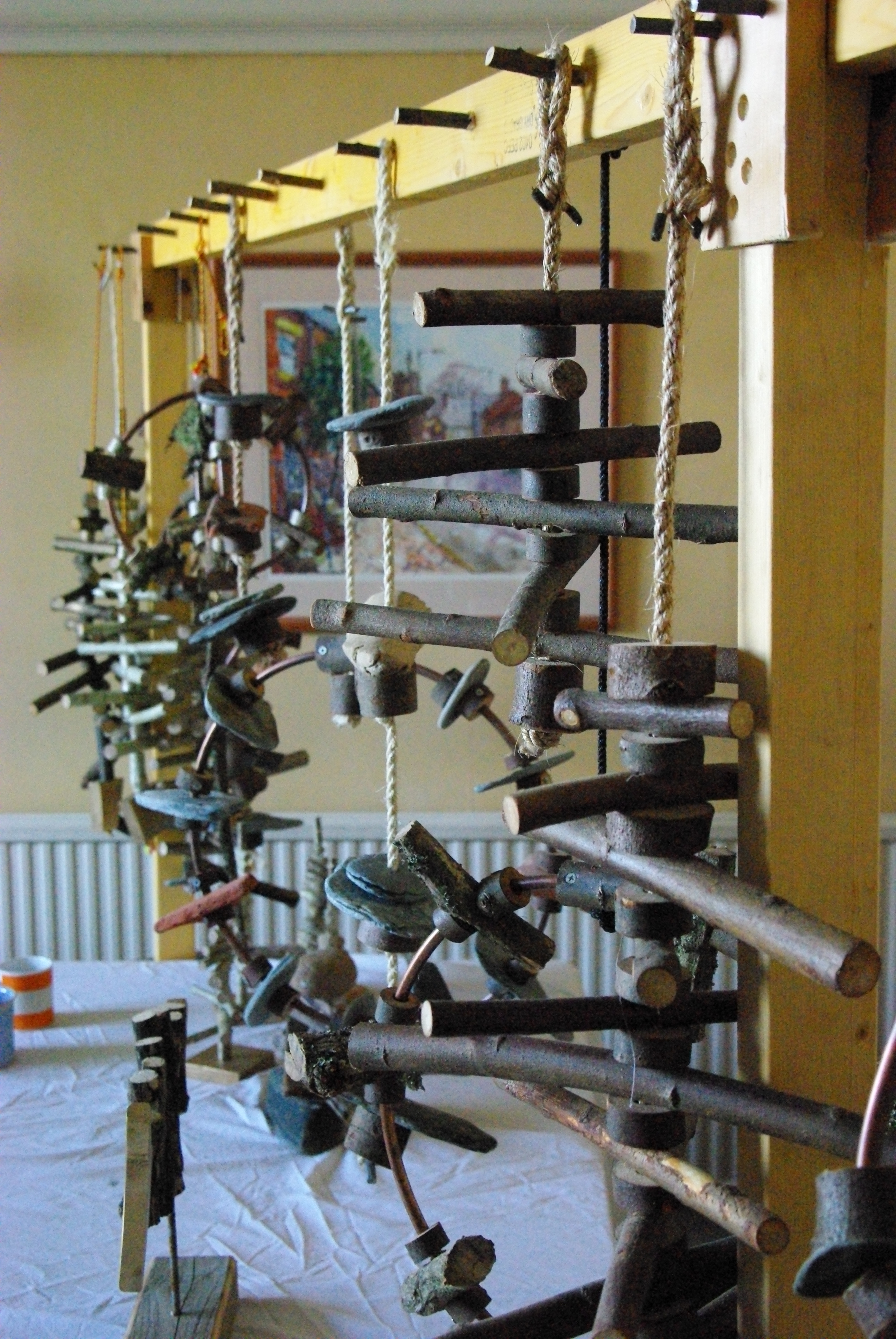
My hands are sore this week- lots of shaping and cutting and shaving- and I am more used to soft office work. Repetitive strain injury has nothing on vibration white finger.
I came across these words today, from the book Ecclesiasticus (or Sirach) chapter 38
The writer appreciated people who make things with their hands, even if they are not very bright.
So- for craftspeople everywhere-
With what wisdom shall he be furnished that holdeth the plough, and that glorieth in the goad, that driveth the oxen therewith, and is occupied in their labours, and his whole talk is about the offspring of bulls?
He shall give his mind to turn up furrows, and his care is to give the kine fodder.
So every craftsman and workmaster that laboureth night and day, he who maketh graven seals, and by his continual diligence varieth the figure: he shall give his mind to the resemblance of the picture, and by his watching shall finish the work.
So doth the smith sitting by the anvil and considering the iron work. The vapour of the fire wasteth his flesh, and he fighteth with the heat of the furnace.
The noise of the hammer is always in his ears, and his eye is upon the pattern of the vessel he maketh.
He setteth his mind to finish his work, and his watching to polish them to perfection.
So doth the potter sitting at his work, turning the wheel about with his feet, who is always carefully set to his work, and maketh all his work by number:
He fashioneth the clay with his arm, and boweth down his strength before his feet:
He shall give his mind to finish the glazing, and his watching to make clean the furnace.
All these trust to their hands, and every one is wise in his own art.
Without these a city is not built.
And they shall not dwell, nor walk about therein, and they shall not go up into the assembly.
Upon the judges’ seat they shall not sit, and the ordinance of judgment they shall not understand, neither shall they declare discipline and judgment, and they shall not be found where parables are spoken:
But they shall strengthen the state of the world, and their prayer shall be in the work of their craft, applying their soul, and searching in the law of the most High.
This is lovely.
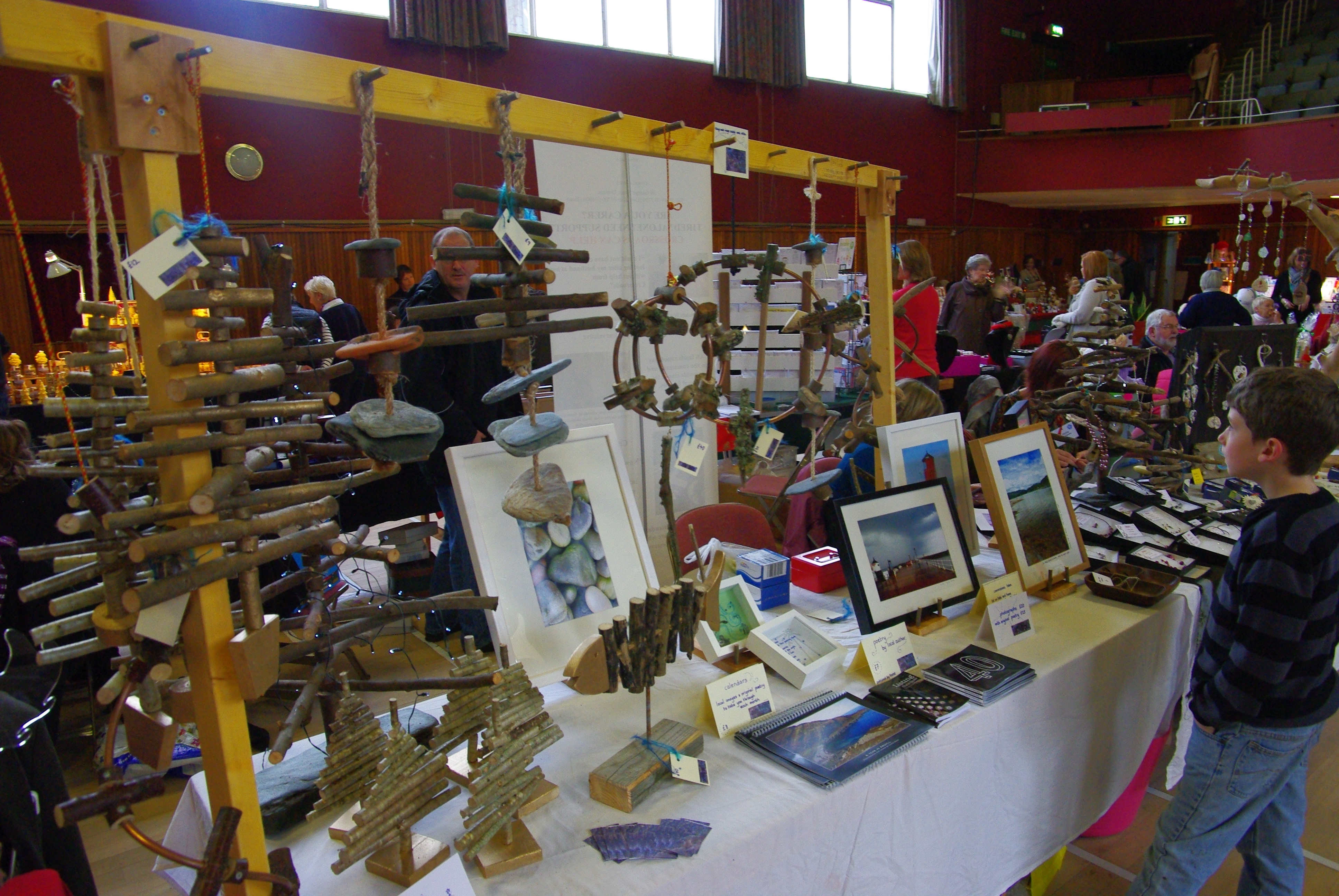
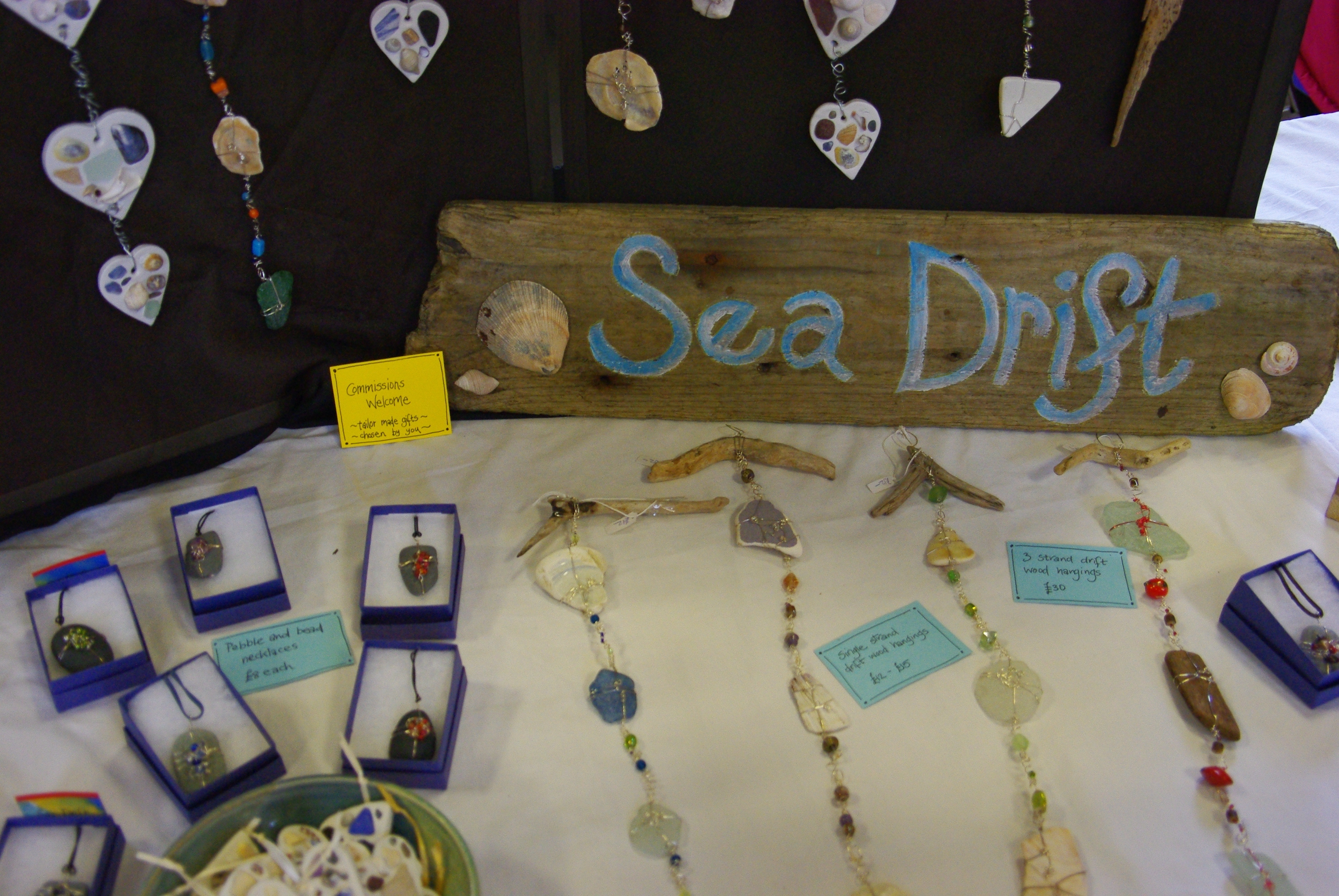
Michaela, Pauline and Helen spent a day behind a stall today, selling crafts. Pauline is an old hand, but for the rest, it was a new thing.
We made all together around 250 quid, which ain’t half bad, considering two of the three crafty contributors where experimenting with prices and ideas.
I chickened out- reserving my energies for being the removal man.
It is hard work this commerce- up at 7, and I sat down again 12 hours later.
A good start though…
A deliberately provocative title, which I hope you will forgive me for.
I have been thinking about sin. This was brought home to me recently when watching the BBC programme ‘The Big Silence’, in which this statement was made-
If you have not got a pure heart, you can not see/hear God.
There is a debate as to whether this is true, and whether any of us can ever lay claim to purity of heart- but the issue has nagged at me a little, and I have learnt to listen to this kind of nagging.
Because in all the discussions, books and blogs about emerging church (in the broader sense of the term,) you do not see the word ‘sin’ used very much. Sure, it is there or there abouts in the debates about atonement and the nature of sexuality in particular, but the concept of holiness and purity as goals for life have largely been left behind. They belong to a different church movement, and between ‘them’ and ‘us’ is a respectful distance at best.
Perhaps this is because the emerging church discussion has largely started out as a reaction to the excesses of a certain kind of spirituality- it is in part revisionist and reformist, despite having sweeping influence in so many areas of church. So in rejecting fixed inflexible positions and seeking to open up possibilities for new encounters with God, and new connections with culture, the debates often assumed that participants had a common starting position- Evangelical, orthodox Christianity- with all it’s assumptions and fixed world view.
So, most of us were probably well versed in an awareness of our sinfulness, and the price paid, in terms of substitutionary atonement of Jesus. And also of how the process of maturity was one of becoming more holy- measured in terms of personal, private behaviour.
Evangelical Christianity regarded ‘the problem of sin’ as the centre of everything- and the mission of Church was to save people from the consequences of this sin. To be honest, in my experience, what happened when you had been ‘saved’ was a little more mixed. We assumed that we Christians will then be on a journey towards purity and holiness, where sins are ‘dealt with’ and we become more like Jesus.
Between you and me, this was not my experience- neither subjective nor observational. Church often became a place where external measures of maturity- such as length of time ‘on the road’ and ‘gifting’- was at odds with our real, private selves.
There was also the fact that we overemphasised the private, personal aspects of sin as opposed to other vital parts of the life of faith- serving others, working for peace and justice, living in community.
And finally there was the problem of sin-definition. Sex was right up there- particularly homosexual sex (incidentally, did anyone see this Jewish take on the issue that is causing such controversy? HT Graham Peacock) This kind of sin, along with others, depended on a particular view of Biblical authority, which has come under considerable challenge.
My contention is that as a result of these issues, the debates around what is emerging have tended to leave the issue of ‘sin’ to one side.
Anyway- back to the point of this piece. Any reading of the words of Jesus will have to acknowledge the centrality of the call to holiness- by which I mean an honest process of coming to terms with all the things within out motivations, our behaviour and our lifestyles that are not compatible with the life of Jesus within us.
And, in the old language, this sin becomes a wall separating us from God- in terms of our ability to hear from God, and to live in the flow of the Spirit in our lives. Sin does spiritual damage.
Given too that sin is a source of actual damage in our lives- to our external relationships with people and the world as well as to our inner development, then I wonder if we have let slip some important principles for life.
Our call it to be a holy nation (not a Holy Nation- if you get my drift.) In order to do this, we Christians walk a path with and towards and encounter with the Living God. And there is accountability for the way that we do this.
And if (like mine) your lives are cluttered with all sorts of things that you know they should not be- then this ought to be an issue for us all. It ought to be an issue for church- even Emerging church.
I have been thinking about how we might bring the issue of sin into the new context, and made a list of principles that made sense to me-
Focus on yourself– not other people.
Categorising other groups as sinful is a bad idea- for what ever reason.
Let those who are without sin throw stones- the rest is up to the voice of God in the life of individuals. Concentrate on listening to God, and for the rhythms of grace. Some people may need direction, but let them seek that for themselves when prompted by the Spirit.
Excluding people from your group because of sin is dangerous, and should only be an absolute last resort- where the alternative is damage to other individuals in the group, or to the group itself.
People are more important than policies.
Collective sin is possible- but again, apply this to your own group in humility.
I do not think God requires purity before he engages with us- rather he requires a contrite heart, and a desire to turn away from the stuff that we know it wrong.
Process is important- and ritual. The old practices of confession and deliberate corporate repentance.
Watch for the things that you hold secret. There may come a time to bring them into the open- in a trusted quiet place. But this requires great trust and security- and this is special, rather than ordinary.
Watch for the things that are tolerated in your community- the lessons of history teach us that in our collectives we easily accommodate to things that individually we might despise.