“In the name of Christ, I quit being a Christian…”

Not my words, but the words of novelist Anne Rice– see this recent article in the Guardian.

I confess not to have read anything that she has written- I am not into Vampire related literature, but others who are tell me that she is very good.

This is what she said on her facebook page

For those who care, and I understand if you don’t: Today I quit being a Christian. I’m out. I remain committed to Christ as always but not to being “Christian” or to being part of Christianity. It’s simply impossible for me to “belong” to this quarrelsome, hostile, disputatious, and deservedly infamous group. For tenyears, I’ve tried. I’ve failed. I’m an outsider. My conscience will allow nothing else.

And later-

As I said below, I quit being a Christian. I’m out. In the name of Christ, I refuse to be anti-gay. I refuse to be anti-feminist. I refuse to be anti-artificial birth control. I refuse to be anti-Democrat. I refuse to be anti-secular humanism. I refuse to be anti-science. I refuse to be anti-life. In the name of Christ, I quit Christianity and being Christian. Amen.

Check out her facebook page– it has literally thousands of responses- mostly supportive, but some predictably angry-

I read Rice’s comments, and find myself in full agreement. In the circles I move in, these are not controversial. There seems to be an increasing number of Christians who can no longer cope with Christianity- or rather what we have made of it.

The challenge for organised religious Christianity is to find a way to engage with us again. Some will return later- we will have our times of rebellion, but then come home. Others will never come back- it is too hard to return to an environment that may have been perceived as abusive and manipulative.

Many more are looking for a way to re-engage and network with a different kind of Christianity- even though we are not quite sure what this looks like. We know what it is NOT, but lack certainty as to what it could be.

But it is certainly about a return to Jesus- to a radical, counter cultural faith that turns over the tables in the temple- that takes another look at all this baggage we have accumulated.

And it will happen. It is happening.

Here is another status update from Anne Rice-

My faith in Christ is central to my life. My conversion from a pessimistic atheist lost in a world I didn’t understand, to an optimistic believer in a universe created and sustained by a loving God is crucial to me. But following Christ does not mean following His followers. Christ is infinitely more important than Christianity and always will be, no matter what Christianity is, has been, or might become.

Amen.

Jesus the magician…

Bad day today- so needed cheering up. Time for some t’internet comedy.

I came across this clip- and watched in trepidation, as I do not really like people laughing a Jesus. It is like someone mocking your wife or child- if only they could see what you see…

On second watching- there seemed to be a deeper meaning here.

Something to do with the Jesus we make use of.

The Jesus who shifts product.

The Jesus who gets us what we want.

The Jesus that we can wear like a lucky charm to ward of all unpleasantness…

The Jesus who is made after our image.

Hmmmmm….

Downshifting…

So friends- you may have noticed a wee sub plot on this blog over the past few years- all the veg growing and the chickens pecking and the desire to live more simply…

Downshifting.

There is a lot around on the old t’internet about downshifting. Everyone is doing it, it seems- or rather everyone is talking about doing it.

And to be fair- not everyone is able to downshift really- because even being able to consider the possibility of downshifting rather depends on a degree of consumption and employment that is already a position of privilege- another of those middle class fantasies ever since the glorious Felicity Kendal in The Good Life-

Downshifting is an idea that has perhaps never been so relevant in the shadow of the Credit Crunch, and in an increasing awareness that our way of life in the rich west is not sustainable, equitable or morally justifiable. It is dependent on greed for ever more pointless gadgets.

Talking of gadgets, William is sat next to me watching ‘The Gadget Show‘ and it is making me feel slightly ill. A review of the latest i-phone- which is a bit like gadget porn. A totally pointless test to see whether the i-phone could post something on twitter faster than some less sexy piece of plastic.

To be honest, even though we do not live a profligate lifestyle, I too like stuff. I notice that Oliver James is speaking at Greenbelt this year- author of the book Affluenza, defined like this-

affluenza, n. a painful, contagious, socially transmitted condition of overload, debtanxiety and waste resulting from the dogged pursuit of more. (de Graaf [1])
affluenza, n. 1. The bloated, sluggish and unfulfilled feeling that results from efforts to keep up with the Joneses. 2. An epidemic ofstressoverwork, waste and indebtedness caused by the pursuit of the American Dream. 3. An unsustainable addiction to economic growth. (PBS [1])

But for all my talk- I have been a wage slave for all my adult life. 20 years working for local governments as a social worker- climbing up the slimy pole into management- which comes with scant extra financial reward as the difference between a main grade social worker and my current post as area manager.

Making a decision to move away and do something different has been a subject of conversation in our house for years. But then there is a mortgage, growing children, security, role and purpose… all sorts of reasons for inertia.

However- it could well be that the decision will be made for me- or at very least an opportunity will be given to me for me to make some radical decisions… because of the regular scourge of all people who work for local authorities- euphemistically called ‘reorganisation’- or this time round, I heard a new phrase which still makes my eyebrows go sky wards- delayering.

(I kid you not- delayering. Who makes this stuff up?)

I had an exchange of e-mails with an old friend yesterday. He has made some brave decisions over recent years- moving from a high flying career in business through to working as a dog trainer, and now a bicycle engineer. He and his wife have now bought some land with a view to growing their own food and keeping- you’ve guessed it- chickens!

He sent me a great list of things that he thought were important for any of us aiming to live a simpler, more sustainable life-

“I think there are practical steps to take in ‘disconnecting from the matrix’.

First I would get rid of all debt if at all possible. Could you carry on work, reduce your spending and overpay your mortgage and clear it or reduce it drastically? This might take 5 years or so?

Second, make your house as energy efficient as possible. No draughts and insulate, insulate, insulate – heating bills WILL go up and STAY up!

Third, grow more of your own food. Food prices will go up as the cost of oil rises. The added benefit is you will eat healthier.

Fourth, only buy things you really need or will give you great LASTING pleasure. No point wasting money on things that won’t get used.

Fifth, be part of a vibrant LOCAL community that can care for each other, barter and trade goods and services with each other. I’ll give you 5 eggs for 2 lettuce for example.

Also, stay fit and healthy as the NHS won’t be around in its present form!

Here endeth the lesson for today!”

Not sure I fully agree with him in relation to the NHS, but the rest makes good sense.

Watch this space friends- I have decided to let go, and let things unfold- being prepared to make some risky leaps as and when it feels right.

It is time to follow the Spirit into some more adventures…

In which I take for myself a patron saint…

Mark Berry recently told me that his community (Safespace, Telford) had a patron saint- St Brendan.

It had never previously occurred to me that a patron saint would be useful,  sensible or even possible- but in the moment I idly confessed to slightly feeling the lack of a personal saint…

I am not quite sure what they are for however. Some people believe that saints intercede for them in heaven- a kind of word in God’s ear from someone on the inside. I do not mean to be dismissive of other people’s faith, but this makes little sense to me.

However, I began a little journey of discovery on my holiday recently, enquiring into some of those old Anglo Saxon saints. In a trip round Whitby Abbey, you trip over them after all.

Whitby Abbey was founded (or perhaps organised by) Hilda in 657. All I knew about her and her times, I learned fromthis book

It is a good book- history made real, with some good earthy bodice ripping (if the Anglo Saxon’s wore bodices.) Certainly worth a place in the suitcase if you are away on holiday. But it is Melvin Bragg’s take on the times- information is pretty sketchy after all.

Melvin Bragg did a programme on Hilda’s influence on his wonderful ‘In our time’ programme- well worth a listen here.

What is clear is that Hilda was a pagan who converted to Christianity aged 13 along with a whole Kingdom. There is a fantastic story about how this came about- her own father had been on the wrong side of some dynastic troubles and ended up poisoned, and so Hilda, a princess of royal blood sought refuge at the court of King Edwin in Northumbria. Edwin came under the influence of Christian missionaries, and asked his whole court to come to a consensus as to whether they should convert to Christianity. One of his courtiers is recorded as asking the court to imagine a sparrow flying into the great hall and finding itself surrounded by the glories of court. The suggestion was that we too are sparrows, living a short life amid much uncertainty- and here was a faith that promised an eternal relationship with the divine…

They converted, along with Hilda.

The venerable Bede, author of  The Ecclesiastical History of the English People around 731 is our main source of information about Hilda. Bede probably met people who knew her.

Bede describes Hilda as a woman of great energy, who was a skilled administrator and teacher. She gained such a reputation for wisdom that kings and princes sought her advice. Considering all the fuss at the moment in the Church of England over women Bishops (and the Pope preposterous pronunciations about women priests being a sin along side child abuse) it is interesting to note that Hilda presided over two houses- one male and one female. She was part of a tradition of royal princesses who became leaders of holy houses all along the north east coast of England- wherever a river met the sea.

Hilda’s kindness and leadership seemed to allow others to flourish in learning and leadership- 5 of her monks went on to be bishops in the Anglo Saxon church. She was also well enough thought of that her house became the site of the famous Synod of Whitby, where the date of Easter was debated, and many believe the power of Rome finally overcame the Celtic churches.

She also had a concern for ordinary folk such as Cædmon, however. He was a herder at the monastery, who was inspired in a dream to sing verses in praise of God. Hilda recognized his gift and encouraged him to develop it.

Although Hilda must have had a strong character she inspired affection. As Bede writes, “All who knew her called her mother because of her outstanding devotion and grace”.

The stories of lives of faith lived out in these ancient times are fascinating. The accounts are not history as we understand it- rather they are seeking to inspire and encourage devotion.

Hilda, because of her support of Caedmon , Hilda is regarded as the patron saint of Poets everywhere.

Everywhere- and here…

The hens arrive (along with one egg)

I know, I know, it is sooo middle class.

Kind of like the new stone cladding.

Or the new companion to every IKEA kitchen.

If you do not believe me, check out the Eglu. The coop for people with far more money than sense…

But today we collected three chickens. They were from the British Hen Welfare Trust, and are all ex battery hens, so have had a pretty crap life up till now. Battery hens are all disposed of (in the sense of ‘killed’) after one year of production, as egg productivity drops. In the first year, each hen will lay around 300 eggs, but these 18 month old hens will probably manage around 4 a week now.

Two dozen eggs a week- more than enough for us, although William will eat as many eggs as you will put in front of him.

If it is not obvious why we wanted to keep hens (apart from just being pretentious!) then perhaps you can call round and have breakfast with us some time- fresh egg with chunky toast anyone?

They are all a bit scraggly and the expectation is that they will take a few weeks to settle in to their new coop before we will see any eggs, but when we opened up the box that the chickens had travelled home in, one of them had rewarded us already with a nice brown egg!

Back from hols…

We are back in Scotland after a lovely break on the Yorkshire coast after what we can only call a traditional English holiday…

We stayed in Michaela’s uncle Barry and Aunt Sue’s caravan up on the cliffs next to Whitby abbey, and hardly used the car at all for the first week- cycling and walking everywhere. The distances were increased as the swing bridge over the harbour broke down, meaning a long detour from one side of Whitby to the other.

The sun shone, and when it rained, it was dramatic and beautiful…

I confess that I always find blog posts on other people’s holidays a bit naff, so this time we decided that each of us would just list our highlights- so here we go…

Michaela

Listening to Norma Waterson along with some of her singing family in an old church. Singing as easily as breathing.

Going first class on the North Yorkshire Railway- the first time ever (and perhaps the last!)

Relaxing, reading writing letters, lying in bed in the morning…

William

Watching England under 19 cricket team play Sri Lanka at Scarborough Cricket Ground. Catching a ball on the boundary, and getting autographs of both teams. Chatting to the Sri Lankan team in their room, and being on first name terms with their coach!

Riding a real steam train.

Cycling into town.

Emily

Relaxing. Somewhere were we had never been before- doing touristy things, and seeing old Whitby.

Eating very good chips!

Horse riding.

As for me…

All of the above (minus the horses!)

I really needed a break- and it was certainly that- spending time with those I love the most, walking and riding and building sand castles, it was simply lovely.

I loved visiting Whitby Abbey, and walking on the moors.

And the cricket match- watching William lit up by a game that I love- that was special too…

It was also really great to meet up with Graham Peacock, whose blog I follow (Digging a lot.) Graham is a Methodist minister who lives near to Whitby, so we hitched a plan to meet up and share a pint. We share a lot of interests- faith, cricket, music, so we had lots to talk about.  And yes- he blogged about it first!

However what was amazing was that we discovered that I used to work with his wife Victoria when I was a social worker in Bolton!

Small small world…

Anyone got a spare bucket and spade?

The Goans are off on a traditional British summer holiday.

Cue for a song- take it away Cliff…

(Nice little misogynist twist at the end there!)

This year we are heading to Whitby, on the Yorkshire coast- a familiar old place for us, as we had our Honeymoon at Robin Hood’s Bay almost 20 years ago. We have fond memories of parking our Citroen 2cv with it’s bumper against a lamp post as neither the hand brake nor leaving it in gear would hold it on the steep cobbled street.

The blog will be quiet for a couple of weeks

For those of you who are staying at home, or travelling- may you find rest. May there be some mid summer Jubilee.

May the noise of children mingle with the sound of sea gulls to conjure up best memories of your own childhood.

May the days rest soft and the nights be kind.

And may God hold you in the palm of his hand…

There is a time for all things under heaven

A time for marram grass to move
In gentle air
And for the dying sun
To turn all green things gold
To alchemise the evening
Into a luminal place
On the twilit edge
Between here
And there

A time when the last call of the curlew
Will echo away over the dimming mountains
And the stillness is itself

Whispering

A time for this day

To silence

The soul

From ‘Listing‘.

Jim Crow repainted- again…

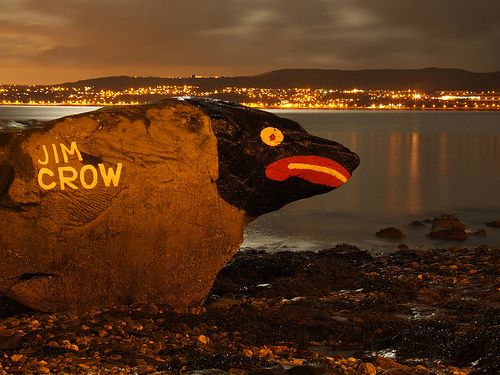
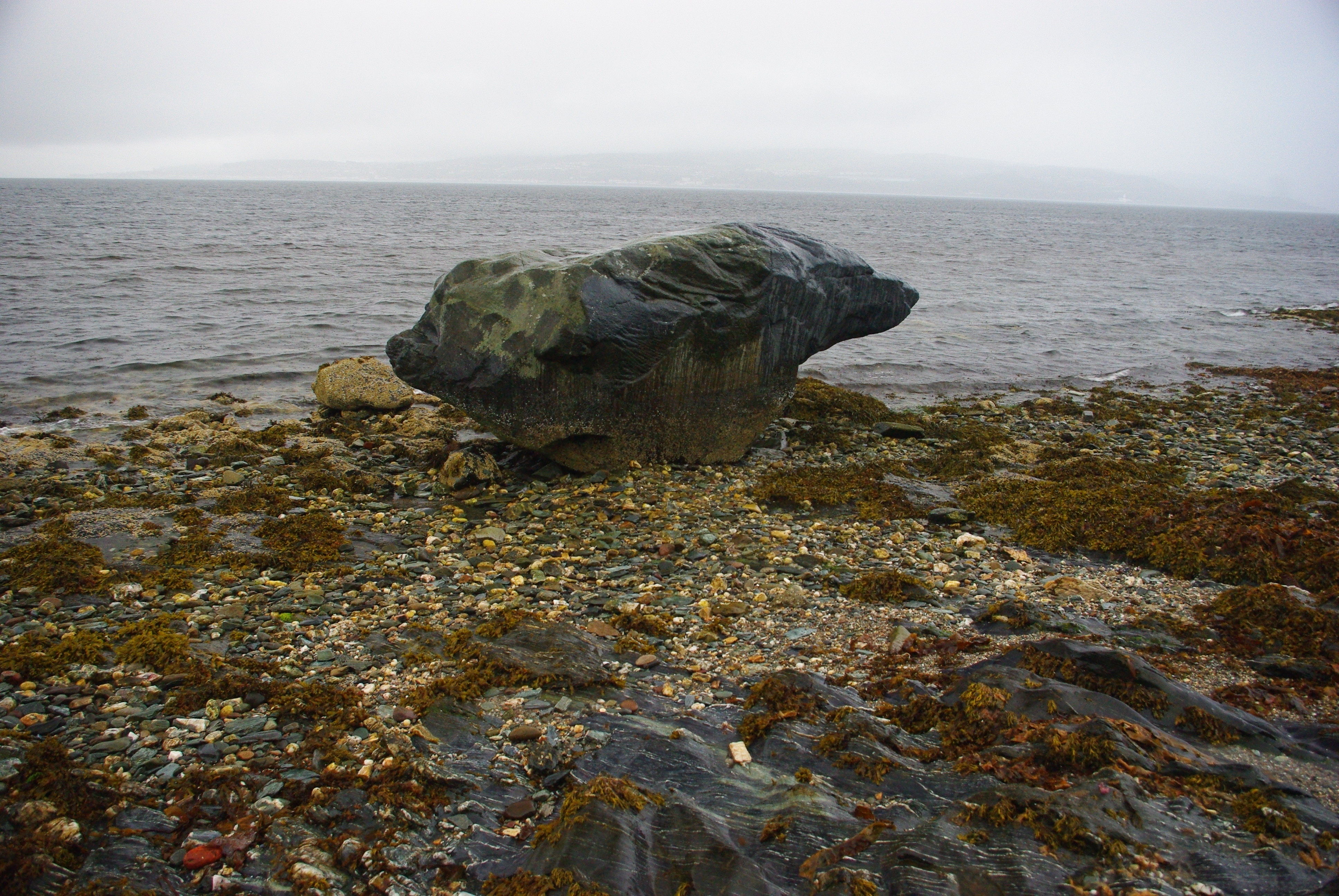
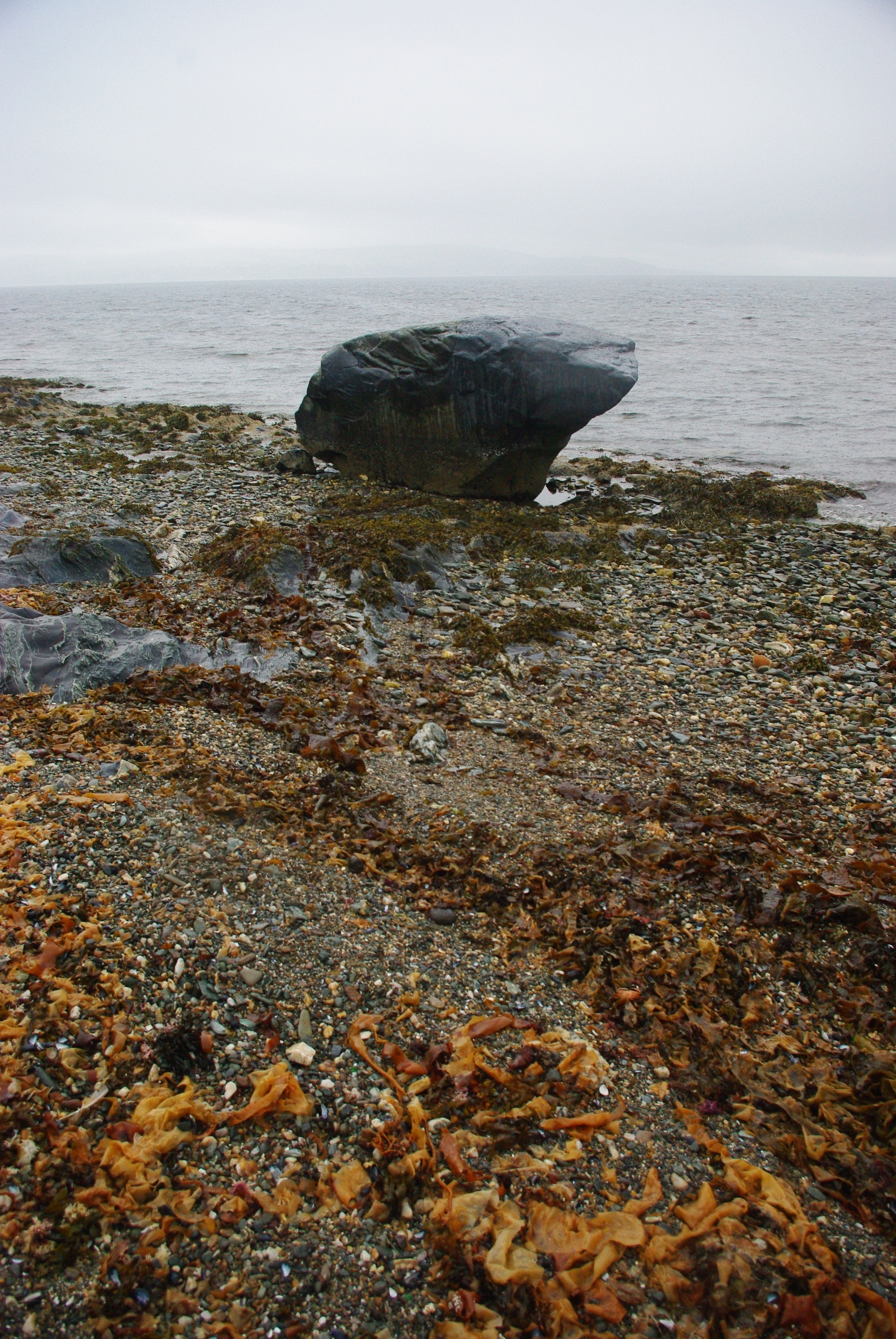
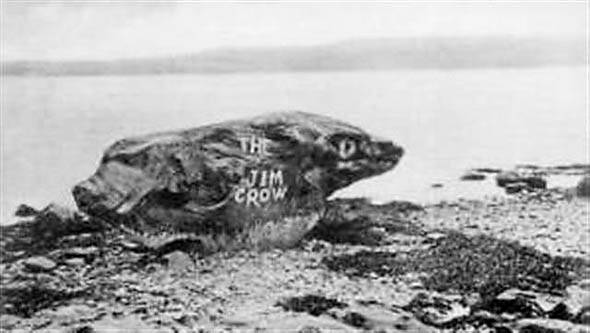
So- another twist in the local debate about a painted rock on the Dunoon shoreline.
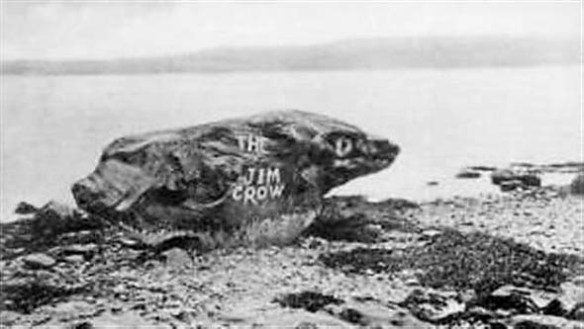
Photo c.1900

The rock has now been defaced twice by someone who decided that direct action was required to highlight the murky history that may be behind this local land mark. Local politicians have expressed their outrage-

Councillor Bruce Marshall, chair of the Bute and Cowal Area Committee, told the Standard on Tuesday: “I was unaware that Jim Crow had again been defaced and find it hard to believe that anyone can be so petty.
“Jim Crow has been a landmark on the foreshore at Hunter’s Quay all of my life and I would not like to see it permanently lost.”

From Dunoon Observer.

Two people were seen yesterday redecorating the rock with its golliwog face.

The local paper has dealt with the issue in a rather lazy and partisan fashion. It reads like the reporter was looking for a way to dismiss any concerns about the rock, and seeking to interpret history in this light. A quote from the article

In an age where international news was not widely spread, it is unlikely that Dunoon people knew about these laws when the rock was originally painted, possibly around 1900.

It seems more likely that the rock was originally named after a Thomas Ingoldsby rhyming story The Jackdaw of Rheims. which was popular in Victorian times, The poem, about a particularly pious jackdaw made ito a saint, ends with the stanza:

And on newly-made Saints and Popes, as you know,

It’s the custom, at Rome, new names to bestow,

So they canonized him by the name of Jim Crow!

The research the local reporter has done seems to ignore the pervasive influence of ‘coon songs‘ and ‘black face songs’ in the Victorian and Edwardian music halls (right through to the dreadful black and white minstrel shows that were on TV in the 1970’s.)

People in Dunoon, and holiday makers from the big city who flocked here around the turn of the 20th Century, probably did not know much about the Jim Crow laws, but they would have known that ‘Jim Crow’ was a derogatory caricature of a black man.

As for the Jackdaw of Rheims– written by Rev Richard H Barham (under the pen name Thomas Ingoldsby,) it makes one reference to Jim Crow- as part of a long poem about a Jackdaw. Here is the question- why did Barham use this name? The song ‘Jump Jim Crow‘ was a huge international hit, with sheet music sold over all the world- carrying the caricature everywhere it went. The song was written about 5-10 years before the Jackdaw of Rheims was published.

The Observer reporter appears to assume that before the internet, before radio and TV, communication of ideas like this between continents was unlikely- that there could be no real exchange of ideas between sleepy Dunoon and America. This is to totally misunderstand our history-

Looking back from a totally different culture and time, there is no blame that can be attached to whoever first crudely decorated this rock and wrote ‘Jim Crow’ on its side. It was probably a bit of holiday fun. Using terms and prejudices that were so pervasive that they were hardly noticed.

The issue remains how we come to understand the symbolism contained within this image now– how we engage honestly with our past.

And this rock gives us an opportunity to do just that.

I notice that the local paper did not quote this-

“… there can be no doubt that the painting of the ‘face’, with its exaggerated red mouth, is a typically caricatured image of a black person, as popularised by the American entertainer T.D. Rice in the nineteenth century. […] I feel certain that black visitorsfrom outside would see this as somewhat insulting […] as a derogatory reference to their skin colour and origins.”

Institute of Race Relations.

So –  are we sure that this is just a little bit of harmless local colour? And even if it is just that- are we really comfortable with the associations that are being made, and the offence that this might carry to the descendants of slaves who had to fight on for generations against the oppression of the Jim Crow laws?

If the rock is to stay, then we need to tell these stories.

If we are to keep the face on the rock- then let us also put a big sign on the foreshore dealing with the darker side of our past…

Social work and stress…

Social work is a job for young people. Mostly.

A few survive into their 40’s- possibly by specialising, or (oh dear- like me) becoming a manager, but on the whole, the nature of the job, and the political/economic/social environment we work in simply burns people out.

It is a slow process- and is poorly recognised even within the profession- as it is usually manifested in a loss of effectiveness and responsiveness- and in these days where performance targets dominate every area of practice, this kind of thing wins you no friends in busy teams.

It is a process that must be difficult to understand when you have never been involved in this kind of work. Some of my friends have a go at me as being in an easy lazy public sector job, often in comparison to their ‘real’ jobs. I smile, but inside I want to have a bit of a go back- and ask them to try doing what I do for a while…

I want to ask them who they think will do the jobs we do if we do not?

Who will visit a family living in squalor because of an alcoholic parent?

Who will look after an old cantankerous man who has become to infirm and confused to get out of the house, and has been unable to manage to get himself to the toilet for the last few weeks?

Who will try to build relationships of trust with the people on the margins of society who have lost all social connections?

…etc etc.

Because in devaluing the people that do these things, we potentially devalue the people who need the help.

I read this today-

“Modern social work is in a state of crisis. It has always been a profession towards which society has displayed ambivalence and it is now grossly underfunded and understaffed. Tragedies and subsequent vilification of social workers and their managers are reported with increasing frequency. The profession attempts to function in an environment of obstructive administrative ‘systems’, … severe financial restrictions and conflicting demands …” –Davies, p. 9, Stress in Social Work (1998, Jessica Kingsley Publishers).

“Because they deal in actual and emotional injustice, and actual and psychic injury, the reality for social workers much of the time is that while they may bring about some relief or improvement, the most that they may hope for is some damage limitation, particularly in areas such as child abuse and criminality.” —Davies, p. 19, Stress in Social Work (1998, Jessica Kingsley Publishers).

This is a familiar picture to me. Add to this the fact that the cut backs in public spending are making things worse. I am about to lose my job for the second time in 2 years through ‘reorganisation’. Quite what I will be doing in 2 years I have no clue.

My colleague recently had a health check and was told her blood pressure was very high. A retest suggested that this might just have been temporary as a result of a particularly bad day.

‘I think I am going to take the blood pressure test with a pinch of salt’ she suggested, and then realised what she had said.

We laughed.

Thank the Lord for companionship and good colleagues. As long as we can hold on…

Eliza Cathy and her mum (Norma Waterson and her lass.)

I am off work today, and supposed to be cutting the grass, but this has been rather defeated by the fact that the mower is broken, and there is a storm raging outside.

But today a new album arrived through the post- this one

First listening- love it. Sumptuous folk vocals relax into one another, whilst the backing (Dad Martin Simpson, Danny Thompson on double bass, Oliver Knight on cello- what could go wrong there?) is lovely.

It is English folk at it’s best- traditional, unpretentious, emotional and beautiful.

This kind of music is sometimes difficult to hear for those of us who have been schooled on soft pop and American ubiquitous R and B. It certainly divides my friends.

But it plugs me into something deep and important.

Here is a flavour (not of the album but of some of the family)-