The new book is out!

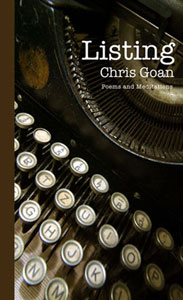
Forgive the conceit, because here is a plug for my new book!

listingcover

‘Listing’ is a collection of poetry and meditations mostly inspired by some of those great lists in the Bible- the fruit of the Spirit, the Beatitudes, the ‘love’ passage in Corinthians and the ‘seasons’ passage in Ecclesiastes 3.

It is published by Proost- and available by clicking here.

Here is the Proost blurb from Jonny Baker;

Listing is a little gem, a surprise that came Proost’s way over the horizon from Chris Goan. He loves crafting words, playing with words, chewing over words, creating and re-creating worlds with words. His poems and meditations are a delight, spinning off from and opening up new takes on familiar verses of ancient wisdom from the scriptures. It’s the second book from Chris on proost. The first is the wonderful meditation he wrote to go along with Si Smith’s images of Christ’s journey into the wilderness ‘40’. The books is available as both hard copy or to download as pdf.

Thanks Jonny!

Go on- Buy two and give one away…

Dunoon, twinned with Eyam?

The swine flu outbreak in Dunoon continues- more cases confirmed today. The Dunoon rumour mill has had a field day. I have really enjoyed hearing all the different versions of the same stories- you hear them in the queues at supermarkets, in the street, and in offices.

It is difficult to know whether we are over reacting, or under reacting. The school kids who have been told to go home, and not to associate with others are clearly ignoring this advice en masse- apart from my daughter, much to her disgust! I even heard about one girl in her year working as a waitress! I kid you not! Although, this being Dunoon, this story may well not be true.

The jokes have started too- the obvious ones are football related- the judgement of God on all Rangers fans, or the fact that God is a Celtic supporter, and has contaminated Ibrox to ensure that they win something next year. ( The link here, in case you missed it, is the fact that the outbreak here is linked to a bus full of Rangers supporters who travelled together from Dunoon.)

Then there have been the rather more pompous jokes about links to other plagues through history-

It did remind me of the story of the village of Eyam in Derbyshire close to where Michaela and I grew up. The story of the sacrifice made by the villagers there had entered into folklore to such an extent that it was the destination of many a school trip.
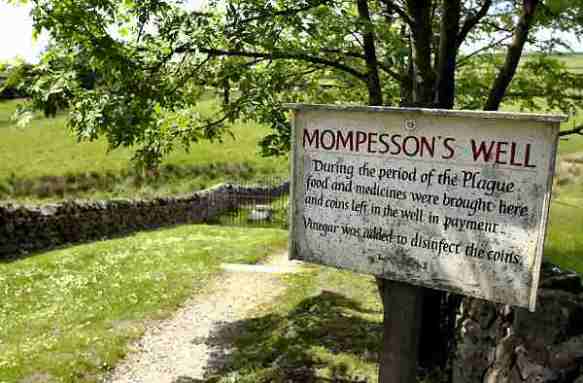
Eyam 5W

Here is the story as told here.

Eyam, a village in Derbyshire, was also badly affected by the great plauge of 1665 even though the disease is most associated with its impact on London. The sacrifices made by the villages of Eyam may well have saved cities in northern England from the worst of the plague.

At the time of the plague, the village had a population of about 350. The most important person in the village was the church leader – William Mompesson.

In the summer of 1665, the village tailor received a parcel of material from his supplier in London. This parcel contained the fleas that caused the plague. The tailor was dead from the plague within one week of receiving his parcel. By the end of September, five more villagers had died. Twenty three died in October.

Some of the villagers suggested that they should flee the village for the nearby city of Sheffield. Mompesson persuaded them not to do this as he feared that they would spread the plague into the north of England that had more or less escaped the worst of it. In fact, the village decided to cut itself off from the outside would. They effectively agreed to quarantine themselves even though it would mean death for many of them.

The village was supplied with food by those who lived outside of the village. People brought supplies and left them at the parish stones that marked the start of Eyam. The villages left money in a water trough filled with vinegar to steralise the coins left in them. In this way, Eyam was not left to starve to death. Those who supplied the food did not come into contact with the villagers.

Eyam continued to be hit by the plague in 1666. The rector, Mompesson, had to bury his own family in the churchyard of Eyam. His wife died in August 1666. He decided to hold his services outside to reduce the chances of people catching the disease.

Eyam Church where plague victims are buried

By November 1666, the plague was considered at an end. 260 out of 350 had died in the village but their sacrifice may well have saved many thousands of lives in the north of England. Mompesson did survive. He wrote towards the end of the village’s ordeal:

Now, blessed be God, all our fears are over for none have died of the plague since the eleventh of October and the pest-houses have long been empty.

How would Mompesson fare if he tried to persuade we Dunoon folk to close up the borders and sit out the infection, burying our dead as we went?

Not very well I suspect. But then again- who knows, we Brits tend to be at out best at times of adversity, or so we like to think.

In celebration of the poetry of Edwin Morgan…

I may be wrong, but it seems to me that poetry is making a comeback!

I heard recently that the scary concept of the poetry slam is taking a hold in trendy urban settings of the UK.

So I thought it worth spending some time celebrating someone else’s poetry.

I was just watching another one of the BBC’s poetry films on BBC 4- this time on Lynnette Roberts– the fabulously talented Welsh poet whose creativity was cut short by her experience of mental illness. You can watch it again here.

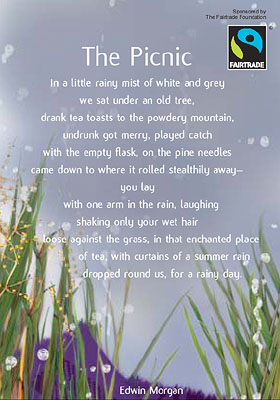
Something of her style reminded me of a card I have on my wall at work- the one below- by another wonderful poet, this time a Scot, Edwin Morgan.

in a little rainy mist

The picnic

In a little rainy mist of white and grey
we sat under an old tree,
drank tea toasts to the powdery mountain,
undrunk got merry, played catch
with the empty flask, on the pine needles
came down to where it rolled stealthily away –
you lay
with one arm in the rain, laughing
shaking only your wet hair
loose against the grass, in that enchanted place
of tea, with curtains of a summer rain
dropped round us, for a rainy day.

Edwin Morgan

I love this poem.

It takes me to a happy place. Scotland. Michaela and me finding space to fill with each other. The sense of place strong on us, and the changing weather welcome and wonderful.

So here are more of his poems- read by some good folk of Glasgow, filmed by the Late Show. They made me cry good tears- so have a hanky to hand…

Swine flu hits Dunoon…

swine flu

So, Dunoon is famous. Infectious even.

As of today, there are 18 suspected cases of swine flu in our little town. Emily’s year have been sent home from school and told not to associate with people for a week. Two of my workers are off because one of their families is suspected of having the virus too.

The hospital is just about at meltdown, testing and chasing down folk who have had sustained contact with those infected. The good news is that those who are suffering seem to be OK, and the Tamiflu vaccine is said to be effective.

Of course, Emily is very pleased to be off school however!

There is some footage from the news here.

On growing things…

We have been doing a lot of work in the garden in the last few months. We had two rough aims- one was to create an outside social space- we were inspired by the Quiet Garden trust, and hope still to offer the garden as a space for others.

The other aim was to start using the green space we have to produce our own food.

And things are growing! We have already been harvesting our own salad- lovely green leaves, radishes and spring onions. And all sorts of other things are shooting upwards…

DSCF3896

We are very fortunate to have the space to think about these things, but the thing about gardening, is that it is very hard work! We have had a gloriously sunny weekend up here- and although I spent a few hours cutting the grass, to be honest- the dilemma I have is rather summed up in this picture below-

DSCF3897

I came across this clip on you tube the other day-

Our friend Ali is doing battle with Argyll and Bute council to try to get them to fulfill obligations to provide an allotment site in Dunoon. How do you fancy a plot like this one Ali?

Grace, ungrace and brokenness…

homeless3

For a day job, I manage social work services for people with severe and enduring mental health problems. For the last twenty years I have been a mental health worker and therapist, working in hospitals, GP surgeries, prisons, day centres and clinics.

Even as I have become very frustrated with the nature of organised social work- the inevitable beauocracy, the compartmentalisation of humanity, the feeling that we police people, but do not really help- I have continued to be driven by the hope that broken people can mend.

And the conviction that comes from my faith that people forced to the edges of society by their experience of life can teach us much about our own experience, and in meeting this, we meet Jesus.

I found Philip Yancey’s wonderful book ‘What’s so amazing about grace‘ really helpful at a time in my life when I was struggling. One of the concepts he introduced was the concept of ‘Ungrace’.

Grace is not easy to define but we usually recognize it when we see it. Yancey describes it as `the last best word’ of the English language because in every usage it retains some of the glory of the original. His story-telling style takes `grace’ from a religious context and puts it in the market place, moving it from theological discussion to practical application.

What is obvious to me, is that as we develop as humans, the soil we grow in can be full of the nutrients of grace, or poisoned by a kind of toxicity that can put a stain down generations… you could say that people are grace-impoverished, living in the shadow of ungrace.

That is not to say that this is the only formative or defining force that is acting on us. Illness sometimes just IS- with no clear causal factors, and equally, some grow strong out of dreadfully difficult situations. Grace is built into all of us somewhere deep down.

Today was a fairly typical day, this morning in an Adult Protection meeting, discussing a man who has mental health problems, but is killing himself with drugs and living in squalor. And when you look at his earlier experience, it was easy to see why. In the afternoon, I chaired another conference on a woman who had been admitted to hospital after a fall, but seems to have rapidly deteriorating dementia. A life unraveling after broken relationships, isolation and depression.

Ungrace.

Yancey describes our world as being `choked with the fumes of ungrace’. But, he adds, `occasionally a grace note sounds, high, lilting, ethereal, to interrupt the monotonous background growl of ungrace’.

Grace comes from the outside as a gift.

Grace billows up.

Grace happens.

As for me- I listen for those grace notes.

And hope that I might learn to echo them…

Melvin does St. Paul…

rembrandt-saint-paul-in-prison

Ah the joys of Radio 4.

If any experience refines and celebrates my sense of connectedness with the place of my birth, it is listening to Radio 4. And because I am often on the road driving around Argyll, the station has become my faithful traveling companion.

This morning is a case in point- Melvin Bragg speaking to theologians  about the impact of St Paul on western civilisation. You can listen again, or down load the podcast here.

Enjoy!

Baby Peter- the debate continues. Who could/should have saved him?

A little lad for whom it is all too late...

A little lad for whom it is all too late...

So, yet more discussions in the media over the last few days about the terrible death of little Peter, earlier known as ‘Baby P’.

Like many others, I have been following this story closely- and have posted thoughts on the issue several times. Earlier posts are here, here and here. This will be my last reflection…

So what has been going on?

It was the turn of the health authority to answer hard questions about its contacts with Peter and his mother. This from here.

Health workers missed dozens of opportunities to identify abuse being suffered by Baby P before his death because of “systemic failings” in the care given to the child, an official report has found.

The inquiry into NHS failings, conducted by the Care Quality Commission and published today, concludes that doctors and other health professionals had contact with the little boy 35 times but every chance to raise the alarm was missed.

Any one of these professionals could have picked up that he was suffering abuse if they had been “particularly vigilant” and gone “beyond what was required” by the system, the health regulator said.

The report talked about staff shortages, inadequate training, delays and poor communication. The General Medical Council has suspended from practice Dr al-Zayyat and Baby P’s family GP, Jerome Ikwueke, over their involvement in the case, but the Care Quality Commission was clear that no individual health workers should be singled out, as the problems were systematic. 5 Social work staff members have been sacked.

There are no surprises here. After every tragedy, and sadly Children die every week at the hands of their parents in this country, inquiries usually make similar points- communication, errors of judgment, poor training, staff shortages. These are not excuses- they are present realities of any beaurocratic response to complex human dysfunction.

Last week, Peter’s mother, her boyfriend were all sentenced. Entirely predictably, the Sun newspaper started a campaign to increase the sentences awarded. (The Sun had earlier campaigned for the sacking of social workers involved in the case, and claimed responsibility for their dismissal.)

And finally, Graham Badman, chair of Haringey local safeguarding children board (Sharon Shoesmith’s replacement) released details of a serious case review. This is the second such review, the first one concluding that there had been procedural failings and errors of judgment, but none on their own “were likely to have enabled further responses that might have prevented the outcome.”

Here is the Guardian’s take on the new report (from here)

The Badman review is clear that this was too generous a reading: Peter’s death “could and should have been prevented”. He could reasonably have been taken into care after the first serious incident, in December 2006, and on several occasions afterwards had professionals been more diligent.

The original report explains – but does not excuse – the failures to take Peter from his family in the context of the behaviour of his mother: she was frequently co-operative, with an open manner, and keen to please, so agencies built up a trust in her.

They saw Peter’s injuries as resulting from lack of parental supervision coupled with his observed tendency to “throw his body around and headbutt family members and physical objects.”

This perspective framed the way professionals viewed Peter’s subsequent injuries, the original report concluded. Wrong-footed by the mother, and seemingly never quite getting enough solid evidence to warrant a criminal charge or issue care proceedings, they effectively gave her the benefit of the doubt. The overwhelming sense of the first review is of well-meaning professionals struggling to bring a clear focus to an infernally complex, chaotic and constantly shifting situation.

Badman is scathing of this. He argues that social workers in particular were too timid. Professionals “over-identified with the parent”, and were even bullied by her.

While the original report gives no clear picture of the mother, Badman portrays her as an arch-manipulator, subverting the professionals, “a dominating and forceful personality”, eminently capable of intimidation.

In the report, there is a devastating sting in the tail. It remains to be seen whether there will yet have to be a public back lash against this- the usual corrective pendulum swing in the opposite direction…

Badman’s interpretation, fashioned with access to more information, is at times clear-sighted in spotting of unforgiveable errors, at others unforgiving of understandable human failings.

Professionals should be more interventionist: if they suspect abuse, they should act on it, even if they are proved to be mistaken. “Better that than the harm the child will experience.”

The removal of children from home, and reception into care has already increased in real terms by around one third. Each one of these actions is a human tragedy- characterised by damaged and broken people, holding opposing and contradictory views, and professionals acting in a context where information is incomplete, and finances are under great pressure.

So for those of you who will never have to encounter such incredibly difficult situations- know this. There will be more scandals. More children will die. There will be more outcry as children are removed on evidence that later turns out to be wrong.

And in the middle of all this will be a set of people who will be held accountable. They will almost certainly be social workers.

Who else?

A bit of Scottish-German culture…

CIMG1477

We had a great night at our friends Juergen and Michaela’s party. Juergen is hitting the big 40. They had a Ceilidh, with  the wonderful local band Canned Haggis, and we danced all night. Emily played some fiddle in the interval too…

Juergen has a love affair going with all things Scottish. Germans seem to be able to wear the Kilt much more easily than the English ever can, and he knows more about whiskey than anyone else I know.

So happy birthday Juergen.

Achtung the noo…

Emily and Will dancing

Emily and Will dancing

Picture preach 7- falling like rain…

CIMG1457

Deuteronomy 32

1 Listen, O heavens, and I will speak;
hear, O earth, the words of my mouth.

2 Let my teaching fall like rain
and my words descend like dew,
like showers on new grass,
like abundant rain on tender plants.

3 I will proclaim the name of the LORD.
Oh, praise the greatness of our God!

4 He is the Rock, his works are perfect,
and all his ways are just.
A faithful God who does no wrong,
upright and just is he.

(NIV)