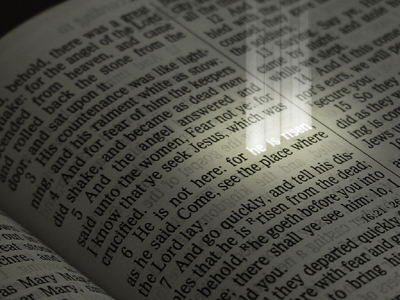
Is it possible that we overemphasised the Bible?

perspective

Emphasis is all.

I had a conversation tonight with my friend Nick. We were talking about some planning he was getting into for a programme of Bible study for young people. He was talking about the need to get into the basics of Christianity, and how many of the young people (and some of the older ones) had very little basic knowledge of the tenets of our faith.

I thought about this for a while, and genuinely wondered about what these tenets were- and what I would teach young people if I was in Nicks shoes.

The ’emerging’ conversation has shaken loose a lot of fixed positions for me. It has helped me see that a lot of the things I held to be basic building blocks for faith were perhaps not always so solid- but rather required robust examination. It made me wonder again about an approach to faith that started with one small group of people telling another larger one what it needed to know- facts and figures of faith that they needed to internalise in order to be a proper Christian.

In my discussion with Nick, I found myself making the following statement-

“I think we modern Christians made two particular mistakes in our attempts to engage with God.

  1. We overvalued the Bible- wanting it to provide for us a textbook that creates a Christian, in the same way that a blueprint could make a balsa wood model plane.
  2. We overvalued the need to get our doctrine sorted- the finding and adopting of correct positions in relation to all aspects of faith.

That is not to say that these things are not both wonderful and important- but simply that we over-emphasised them- making them perhaps the only way that Christians could discover God. In order to make this stick, we had to pretend that there was only one way to read and understand the words, and to suppress all less tangible and less ‘objective’ spirituality- rendering it untrustworthy and dangerous.

Sure, the Charismatic movement came along and added a whole new experiential encounter with the power and wonder of God, but ultimately, I would argue that the modern Protestant faith was grounded on the two points above.”

This statement is shot through with faultlines, but I think, on the whole, I stand by what I said.

bible-page

If I am right (and many would strongly disagree!) does it matter?

Does it matter as we seek to engage with young people? Do they not just need to be given some basic truth before we get all post modern and mystical? Perhaps they do. Perhaps the trampoline bouncing that Rob Bell talks about as an image of theology can only really begin once we have set up the trampoline.

But alongside the importance of the written words of the Bible, and the need to establish doctrinal beginnings- I think I would gently suggest that the emergent conversation might challenge us to add in other emphases too. Because people of faith have always encountered God through many other means.

So I am convinced that rightness of doctrine is not the precursor to being acceptable to God. It may be a consequence of this, but as far as I can see, God seems to tolerate a fairly wide spectrum.

And the Bible is wonderful- but many have lived lives in the name of Christ but have never seen one- either because they could not read, or because the canon of scripture as we know it today simply did not exist, or because the Bible was not available to them.

So what other ways to encounter God should be emphasised?

Perhaps we can only start by looking back to the spirituality of pre-moderns, and use this as a set of goggles to consider our own culture. There is much there that we would reject, and count our blessings that we are this side of the reformation- but still…

We see people seeking to engage with God through living encounters– through hardship, pilgrimage and through community. We see lives of service and humility. We see the importance of shared ritual and engagement with God in the passing of seasons and in connection to every day experience.

So might we learn from this as we seek to encounter God in our new changing context? Might we learn again the vitality and meaningfulness of the mundane, and the wonder of small adventures in which the wind of the Spirit blows us into the path of all sorts of opportunities to be shaped and changed?

The Bible will continue to be a gift to our new generations. There will be others too.

Listing- book project…

I have finally finished my collection of poetry and prose which forms a new book called ‘Listing’. I have very much enjoyed the creation of this thing, but there is so much other stuff I need to be getting on with, so it is great to have it completed.

Next- the wilderness book with Nick, and this novel that may yet find some kind of shape.

This (might) be the cover photo, taken in Benmore Gardens by yours truly-

image031

This book, which will be published through Proost and will hopefully be available in June/July. It is a collection of words-poems prose and meditation- based on some Biblical lists-

Ecclesiastes 3

Galatians 5

Matthew 5

1 Corinthians 13

Some of the poetry I have tried out first on this blog. Here is one more- if you like it, then please get hold of the book!

Now is the time to keep

There is a time for all things under heaven…

This Kingdom is always here
Always now
Held here in the hands of we
His failing followers

Standing on the shoulders
Of countless men and women of faith

Diggers of catacombs
Carvers of secret Kingdom symbols
Men making missionary journeys in hide skinned boats
And setting up carved crosses
Monks and nuns holding the world in prayer
Parchment gilders
Cathedral builders
Protestors
Reformers
Transformers
Renewers

So I take from you my fathers of faith
Grateful for the gifts you gave to me

For the canon of Scripture gathered and held precious
For those adventuring out with good news
For purifying zeal
For generous, graceful orthodoxy
For those planting a cross in the gutter
And those who consort with kings
For Bible teachers and interpreters
For a hundred synods
And a thousand million books
For people lit up in the fire of the Spirit
And others who seek the Lord in silence.

For Methodists and Catholics
Wesleyans and Quakers
House and Mega churchers
Baptists and Greek Orthodox
Each facet of a this precious thing
Called Church

And perhaps most of all
I stand in the sheltering shadow
Of people who stood between me
And a harsh prevailing wind
Who saw through the mess of me
Or chose to ignore it for a while
And shared with me the love that draws us
And meant it

All of these treasures
Handed down
To keep

Ritual and meaning in post Christian society…

dscf3752

Religion, according to sociologists like Durkheim, plays a vital role in society.

It unites and solidifies our morality, our world view and facilitates social cohesion. According to Durkheim, religion is very real; it is an expression of society itself, and indeed, there is no society that does not have religion.

Since Durkheim, there have been many discussions about the value of religion to society. Some have been critical, and seen organised religion as a form of social control and a supporter of oppression and a reactionary force in favour of the status quo. It seems clear that it has indeed been used for this purpose.

The interesting question for those of us living in a post Christian world in Western Europe, is if organised religion has lost a central place at the heart of society, then are there measurable sociological effects of this on our societies?

As we lose the unifying and cohesive affect of shared faith, might we expect to see an erosion of some of the key aspects of our society? Our social and class structures, our sense of community and belonging etc?

I have been enough of a social science student to avoid making broad unsupported generalisations, and I am yet to find some recent research about this (If you come across any, I would love to hear from you.)However, it is clear that some of the cohesion seen in modern society has now gone. What we appear to unite behind these days is very different from what motivated our collectivisation 50 years ago.

So if Durkheim is right, and all societies have a shared religion, then how might we understand this in our post-Christian western societies? Particularly when the drive appears to be towards increasingly individualistic activities based on ‘choice’.

What brings meaning to life?

What allows us to express our collective consciousness?

Some have suggested that football fills this slot in many people’s lives.

We are just back from a journey down south to visit family in the Midlands. I took the photograph above at the site of the death of a young man killed on a road crossing. Family and friends had left flowers and cans of beer hanging on the railings, as well as football scarves. It occurred to me that what we regard as central to life will shape the rituals and ceremony we use to mark the stuff of humanity.

I also had a conversation with my brother in law- a great bloke. He jokingly described how his i-pod, when set to random, seemed to constantly pick appropriate songs from the thousands stored on it, to fit in with the activity or mood he was experiencing.

Is this evidence of our human need for ritual and meaning beyond the temporal and mundane? For a collectivisation of our consciousness and the need to mythologise this in the form of things sacred beyond the profane?

Or is this a fluid society in the middle of huge social change, struggling to fill what we used to call ‘the God shaped hole’ in the middle of all of us?

However we understand it, the need for meaning and ritual seems pretty universal, even for we post-moderns. And I think that God is not done with us, nor we with him.

The dangers of cross-carrying- a lesson for us all…

US-FILM-PREMIERE-THE CROSS

The above image is of Arthur Blessitt followed by supporters, walking on Hollywood Blvd in Los Angeles on March 24, 2009 on his way to the premiere of “The Cross,” a film about his life on a 40-year voyage carrying the cross for Jesus around the world. Blessitt began his pilgrimage in 1969 and has carried the 12-foot (four meter) cross over 38,102 miles (61,319 kms) to 315 countries, island groups and territories, according to his website. Blessitt is listed in the Guinness World Records for the ‘world’s longest walk’.

A friend told me a story about cross carrying today.

There was a recent Easter march in town. Good folk from different churches gathered at one end of town and processed through to the other end. Someone was carrying a large wooden cross, others were waving banners, and the procession was flanked by tract sprinklers. At the end of it all folk gathered on the seafront and sank choruses through a PA never intended for outdoor use, and the seagulls got some crackly competition.

Apparently there was an incident at the beginning of the march, while people were gathering, during which someone decided to try out cross carrying. The person concerned misjudged the weight and balance of the thing, and over it went, cracking someone else on the head on the way down.

Now I know the person who recieved the full weight of the blow, and she is a lovely. I understand she is OK, but will have a nasty bruise.

There is some obvious comedic value in this story- the conviction of sin brought down on the head of one poor soul.

There is also the lesson for all of us in using the Cross as a battering ram or a weapon for our particular cause.

And perhaps most of all we should remember that a cross can be a dangerous weapon in the hands of the poorly balanced!!!

Baby P- the Police investigation is examined…

p2_baby-p_top1

Followers of this blog may remember earlier posts about the tragic case of Baby P, the Haringey toddler who was murdered despite the continuing involvement of Social Workers, Health Workers and Police.

Earlier posts are here, here and here.

As a social worker, I was concerned with the media feeding frenzy that surrounded this tragic case, and with the certainty that this would obscure the real issues.

Today, after what can only be described as a Witch Hunt against the leader of Children’s Services in Haringey, Sharon Shoesmith, the media gaze finally turned to the Police investigation.

Earlier, the police claimed to have warned social services of the danger, and said these were rejected by the social worker concerned. Story here.

Now a report lists systemic failure on the part of the Metropolitan Police in it’s investigation of the injuries sustained by Baby P 9 months prior to his eventual death. These failures are familiar to anyone working in complex organisations-

  • Time ‘drift’ and deadlines being missed
  • Staff moving on and not handing information over properly
  • A failure to chase up requested medical reports (Presumably the focus will switch to Health now.)
  • A specialist was appointed to review the evidence- but seemed to be forgotten about

Here’s the Guardian newspapers take on the story.

And from the BBC.

Perhaps the truth of the terrible loss of this child will start to emerge. Everyone failed.

Systems always will fail.

Good Friday rituals…

So, on this Good Friday, how are you going to remember the death of Jesus?

In the Philippines, there is an extreme ritual that has to be seen to be believed. For those with weak stomachs, I suggest you do not watch the following clip-

There are more photos of these bizarre rituals here.

Inflicting pain on yourself as a spiritual discipline seems to have a long Christian tradition. Often called mortification of the flesh, it has remained a strong Catholic practice. Taking this to the extreme, the Flagellants of the 13th Century became a popular movement- peaking around the time of the Black Death.

What motivates people to do damage to themselves in the name of God? Fervency? Desperation? Group psychosis? I suppose this is one of those things that can only really be commented on from the inside. I notice that the story of an Australian comedian’s participation in one such ceremony this year has made a splash- here.

What of us? Michaela is making hot cross buns. Not mortification, but fortification of the flesh you could say!

You might also like to try Jon Birch’s 12 Stations

Jon is one of the creative forces behind Proost. You can see more of his fantastic stuff on asbojesus

3days-jon-birch

Emily sails away to Norfolk…

dscf36011

My girl Emily is off sailing in Norfolk with Bitternes afloat. Our friends Nick and Lindsay are skippers on the cruise, which is a yearly event. Em had a great time last year.

In the words of Arthur Ransome;

If NOT DUFFER WILL NOT DROWN, IF DUFFER, BETTER DROWNED…

Watching her disappear for the ferry and airport, I do not concur. She may or not be a duffer, but come home safe Emily…

On marriage…

dscf3695

On the drive round to Inveraray yesterday, I stopped the car and climbed a gate to go and check out the Gypsy ring overlooking a rain and windswept Loch Fyne. I have mentioned this place before- a mythical, and slightly neglected place which is half covered by tarmac from the old road, and is protected by a flimsy wire fence from the substantial herd of Highland Cattle that roam the fields thereabouts.

What this place is all about is lost in folklore. But one person told me that this was the site of Gypsy wedding ceremonies. The place where the Romany people who used to live in some numbers hereabouts would make a commitment to one another.

I have tried to find out more about these traditions, but so far have failed to find much from a Scottish context- and certainly nothing about this Gypsy ring. however, there is a very interesting account of Romany wedding rituals here. Romany culture has been persecuted and battered into the margins of society, perhaps now more than ever in these so called enlightened times. It has flourished still however, and I hope it may long continue to do so. There is room for all in this wonderful humanity of ours…

I have often wondered about the use of this dramatic site- high over the Loch, with panoramic views over towards Kintyre. Exposed as it is to the constantly changing weather. There is a whiff of magic about the place.

It clearly still has meaning to some folk. There are always a few coins scattered onto the circle, seeking some kind of luck or superstitious blessing.

One of the more adventurous young calves is often to be seen inside the fence. I hope he or she has been careful about what intonations they mooed out, lest they found themselves accidentally married…

dscf3696

I am a person who would describe himself as happily blessed through marriage.

For those who are on the outside of such a union, this is definitely not the same thing as living in blissful joyful togetherness all the time- although we have had our moments. But after almost 19 years together, I feel I have given it enough of a road test to be able to make a firm recommendation of the concept.

Marriage has been in the news lately. Check out this report from the BBC last month.

Or this one from last year.

To summarise- the statistics seem to show a decline in numbers of folk marrying, an increase in civil ceremonies as opposed to religious ones (up from 47% in 1990 to 67% in 1997), and people are getting married later in life for the first time.

Paradoxically, and perhaps related to economic concerns, the divorce rate is thought to be at it’s lowest for 26 years (See here.)

Does all this matter? To some, particularly Christian family groups, it is vital. These groups tend to see nuclear families as God-given building blocks, and to seek to defend this idealised way of living at all costs- campaigning against any aspect of government policy, or ‘alternative lifestyle’ that seems to challenge the centrality of marriage. I will not mention any names, but some of these groups scare me, and I feel I have more in common with the Romanies than them at times!

Is the nuclear family a Judeo-Christian thing that can be distilled from the Bible as the way to be? It has always puzzled me to hear people claim this. It seems clear that family structures were very different in the different cultures and contexts that can be inferred from Biblical stories.

Some random thoughts about marriage-

  • Marriage is a partnership of two people who bring all sorts of baggage with them. Some relationships are toxic and damaging to all that come into contact with them.
  • Many do not survive. My pull is towards the broken people- not because of their failure, but rather because that is where Jesus would be.
  • Social Policy based on idealistic moral stances is dangerous.
  • We live in a post-Christian country. Things are changing.
  • All the central institutions of society are under challenge and review.
  • Marriage may well mean different things to different people within this new context.

But despite this, I believe in marriage. But then, this is easy for me to say, because I am married to Michaela- so I had an advantage.

The fact remains that study after study shows that kids born into stable loving family environments with strong parental role models have won the whole life lottery, in terms of psychology, emotionality, education, health- just about about every other measure. You can strip these statistics back and dig into what exactly was helpful about these situations, and whether they might be available through other social constructs, but the value of traditional family structures at their best are simply undeniable.

As can be shown from the Romany marriage circle- this model is not restricted to Christian tradition. The nuclear family remains the main social unit in Communist China also.

Perhaps we are going through change. But I have a feeling that marriage is here to stay…

marriage1

Happy birthday Michaela!

Today is my lovely wife’s birthday. She is 41 years young.

And I love her.

dscf2359

This is one of the few photos of the two of us together- taken in France last year.

Today we took a trip out for lunch in Strachur, then out to Inveraray, where we decided to be tourists for the day, and look around the Duke of Argyll’s Castle.

It was one of those horizontal rain kind of days, but in order to complete the tourist thing, Michaela decided to have an ice cream.

I am sure the hypothermia will pass…

dscf3698