War- those who objected…

shotatdawn

One more post about the Great War…

I have often wondered what would have been my fate if I had been born about 60 years earlier. The Sherwood Foresters Regiment, raised around where I grew up, were decimated in several of the huge battles of the First World War- including the Battle of the Somme, where they were almost wiped out.

Eight of these men and boys were court marshaled and executed for cowardice and desertion (check out this record here, which seems even sadder than the names on war memorials that I grew up with.)

What drove men to walk towards destruction? It is a strange testament to the fragility and contradictory nature of humanity that we regard such a thing as noble, admirable whilst still valuing life (at least our own) above all things.

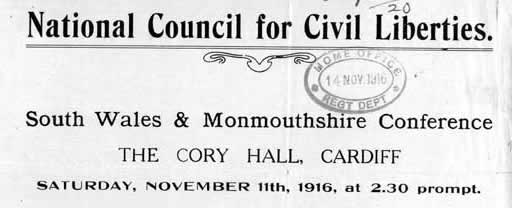
It is interesting to note that even in war-drunk imperial Britain in the middle of the war, there were those who were able to show a different courage, and protest.

civil-liberties-poster

This protest, attended by a future Labour Prime Minister, Ramsey MacDonald, caused a near riot.

Then there were the conscientious objectors- according to the National Archive, about 16,000 of them, who refused to fight. Many spent time in prison- particularly the 1500 ‘absolutists’, who refused to participate in any activities that gave any support whatsoever to the war. Prominent in this group were the Quakers, and other Christian groups who saw the taking of human life as wrong (more info here.)

These people were loathed by the society that they were part of. They were branded as cowards and traitors. Could I have been strong enough to stand with them?

Or would I have joined up in 1915 along with my pals, answering Kitchener’s call to arms? And would my name then have been entered on a monument after the pointless slaughters of 1916?

Historical hindsight is a rather indulgent pastime, but I hope I would have been able to protest.

And I hope too that in this new and very different age, I will also be able to find inspiration in the story of 16,000 people, whose names are on no monument. What would they have made of the current conflicts in Afghanistan and Iraq?

These are not simple issues. I am not sure that there is nothing worth fighting for, but I am sure that there is no such thing as a just war…

In the words of Derek Webb, from the song ‘A man like me’ from the Hummingbird album.

I have come to give you life
And to show you how to live it
I have come to make things right
To heal their ears and show you how to forgive them

’cause i would rather die
I would rather die
I would rather die
Than to take your life
’cause how can I kill the ones I’m supposed to love
My enemies are men like me

So I will protest the sword if it’s not wielded well
’cause my enemies are men like me
Peace by way of war
Is like purity by way of fornication
It’s like telling someone murder is wrong
And then showing them by way of execution

Because my enemy is a man like me

The Sentry- Wilfred Owen

Following on from my last post, here’s a bit more of Owen’s poetry.

I have just watched a programme on Channel 4 about the excavation of a dug out near Ypres in Belgium dug in 1917. It has been clogged with the mud and bones of some of the hundreds of thousands who died there for 90 years, but was found in remarkably good order (check out here for more details.)

It made me think of this poem.

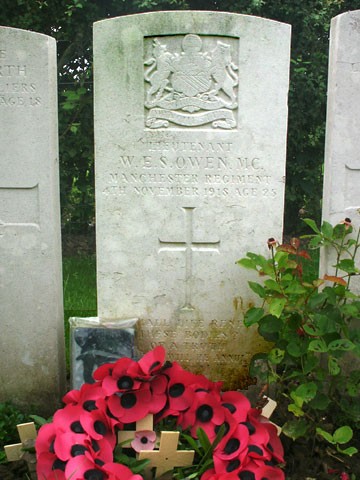
Preserved like the shadow of Owen, who died aged 25, fighting a war that he did not believe in.

For people like me, Owen speaks clearly and immediately of things unimaginable to us- but where to him everyday normality.

Our fascination for stories of war is not healthy, or at least I do not think so. For every John Wayne or Bruce Willis, or docudrama about the Third Reich- there should be 100 Wilfred Owen’s.


Blogged with the Flock Browser

Remembrance day and war poetry

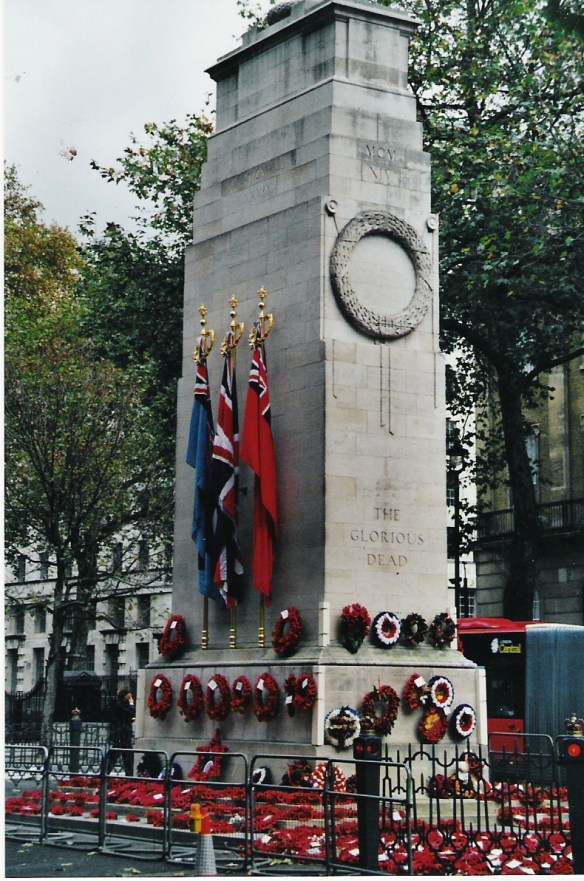
cenotaph_london

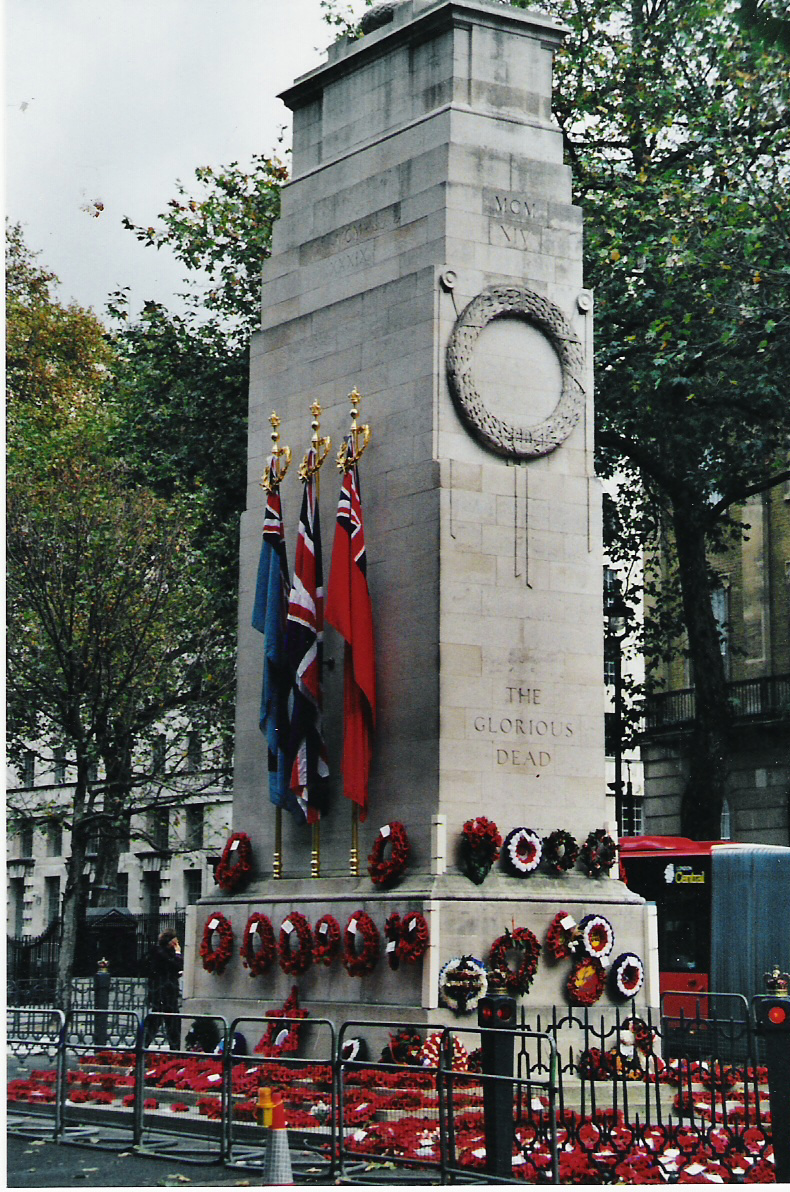
Michaela and I have just sat and listened to the Remembrance day ceremony from the Cenotaph in London. This ceremony is held every year, on the 11th hour of the 11th day of the 11th month, to honour first the dead of the ‘great war to end all wars’ (1914-1918) and then the subsequent second world war, along with all the post-empire skirmishes and border confrontations that our soldiers have died in ever since.

We were silent first through the emotional beauty of laments played by brass bands, then for the official minutes silence

I have had a mixed relationship with the ceremony. At worst, it seems to glorify and exalt the business of war. For a while, I refused to wear a red poppy, finding instead the white ones with an overtly pacifist stance to be more appropriate. It seemed to me the only response that followers of Jesus could take.

I spent some time working as a therapist in GP surgeries, and met several ex-soldiers struggling with post traumatic symptoms years after conflicts in Cypress, the Falklands or the wars in the Gulf. I heard their matter-of-fact stories of broken bodies and a culture of brotherhood, booze and easy violence that was both intensely supportive and ultimately destructive to the rest of their lives. I now wear red poppies with respect and humility.

But still, this balance between remembering those who suffered and died, whilst wanting to de-glamourise war and pursue peace- this is a hard thing to find at times.

This was highlighted too by my reaction to the front page of our local paper- the Dunoon Observer. In a creative response to Remembrance day, they printed a famous poem from the Great war on the front page. It is this one;

greatwar

In Flanders fields the poppies blow
Between the crosses, row on row,
That mark our place; and in the sky
The larks, still bravely singing, fly
Scarce heard amid the guns below.

We are the dead. Short days ago
We lived, felt dawn, saw sunset glow,
Loved, and were loved, and now we lie
In Flanders fields.

Take up our quarrel with the foe:
To you from failing hands we throw
The torch; be yours to hold it high.
If ye break faith with us who die
We shall not sleep, though poppies grow
In Flanders fields.

Lt Col John McRae


This poem was written in 1915, after a terrible battle, but still in an early part of the war, when glory still beckoned, at least for some. McRae was a staff officer, and the second verse always seemed to me to fit uneasily alongside the first. Some have called it ‘recruiting office rhetoric’- handing on the torch to others to have revenge…

But I applaud the Observer for printing poetry. I just would have preferred them to print another famous war poem- the one below.

I remember reading the first world war poets at school- Seigfreid Sassoon, and most of all, Wilfred Owen,
Wilfred Owen

Wilfred Owen

who was killed by a snipers bullet at just about the very end of the war. It was these men who first showed me that poetry can be something powerful. It can be healing, challenging, therapeutic, revolutionary, beautiful and harrowing- all at the same time.

This poem captures the whole thing of war for me. Here it is (with some notes pinched from here.)

DULCE ET DECORUM EST1

Bent double, like old beggars under sacks,
Knock-kneed, coughing like hags, we cursed through sludge,
Till on the haunting flares
2 we turned our backs
And towards our distant rest
3 began to trudge.
Men marched asleep. Many had lost their boots
But limped on, blood-shod. All went lame; all blind;
Drunk with fatigue; deaf even to the hoots
4
Of tired, outstripped
5 Five-Nines6 that dropped behind.

Gas!7 Gas! Quick, boys! – An ecstasy of fumbling,
Fitting the clumsy helmets
8 just in time;
But someone still was yelling out and stumbling,
And flound’ring like a man in fire or lime
9 . . .
Dim, through the misty panes
10 and thick green light,
As under a green sea, I saw him drowning.
In all my dreams, before my helpless sight,
He plunges at me, guttering,
11 choking, drowning.

If in some smothering dreams you too could pace
Behind the wagon that we flung him in,
And watch the white eyes writhing in his face,
His hanging face, like a devil’s sick of sin;
If you could hear, at every jolt, the blood
Come gargling from the froth-corrupted lungs,
Obscene as cancer, bitter as the cud
12
Of vile, incurable sores on innocent tongues,
My friend, you would not tell with such high zest
13
To children ardent
14 for some desperate glory,
The old Lie; Dulce et Decorum est
Pro patria mori.
15

8 October 1917 – March, 1918

1 DULCE ET DECORUM EST – the first words of a Latin saying (taken from an ode by Horace). The words were widely understood and often quoted at the start of the First World War. They mean “It is sweet and right.” The full saying ends the poem: Dulce et decorum est pro patria mori – it is sweet and right to die for your country. In other words, it is a wonderful and great honour to fight and die for your country

2 rockets which were sent up to burn with a brilliant glare to light up men and other targets in the area between the front lines (See illustration, page 118 of Out in the Dark.)

3 a camp away from the front line where exhausted soldiers might rest for a few days, or longer
4 the noise made by the shells rushing through the air
5 outpaced, the soldiers have struggled beyond the reach of these shells which are now falling behind them as they struggle away from the scene of battle

6 Five-Nines – 5.9 calibre explosive shells
7 poison gas. From the symptoms it would appear to be chlorine or phosgene gas. The filling of the lungs with fluid had the same effects as when a person drowned
8 the early name for gas masks
9 a white chalky substance which can burn live tissue
10 the glass in the eyepieces of the gas masks
11 Owen probably meant flickering out like a candle or gurgling like water draining down a gutter, referring to the sounds in the throat of the choking man, or it might be a sound partly like stuttering and partly like gurgling
12 normally the regurgitated grass that cows chew; here a similar looking material was issuing from the soldier’s mouth
13 high zest – idealistic enthusiasm, keenly believing in the rightness of the idea
14 keen
15 see note 1

owens-grave

The fruit of the Spirit is kindness

kindness

I was sore
Abraded by the road gravel
And you wrapped me
In a soft bed
Of kindness

I was weary from the world
And like a soothing embrocation
You took these road weary feet
And slippered them
In front of a warm fire

I failed
Again
And stared down low
Until the soft music in your voice
Brought to me possibility
That I too
Could be loved

That I too could love
In return

So may you be showered with blessings
Like blossom petals
Butterflying about you
In this beautiful breeze

kind

Sex and the internet…

freeimages.co.uk techonology images

About 10 years ago, a some friends of mine were exchanging a computer system.

The receiver of the computer had never had one before, and knew next to nothing about the internet, which, it is interesting to note, was not uncommon 10 years ago. He asked what the internet was all about.

I suggested that it was mainly about 3 things- making money, mad religion and perhaps most of all, sex.

He was most taken with the later of the three, and asked what I meant by sex.

I replied that every sexual perversion known (and a few that are not) was available at the click of a button.

Unable to resist, he asked “Like what?”

Not wanting to reveal any expertise whatsoever, I asked him for suggestions. He (rather quickly I felt) came up with sex with donkeys.

Quick as a flash, my other friend typed into the address bar http://www.donk…….. (best not complete the link just in case I lead you into temptation!)

And there is was.

Which kind of made the point. And then some.

A few months ago, in response to the hysteria around the Olympics, I posted a poem called ‘Cheerleading’ (here).

This item is the most popular one I ever wrote in terms of the ‘hits’ it receives. It has a picture of some Cheerleaders, but I can not imagine that most of the people who visit this post linger there for very long. Poetry probably amounts to a big disappointment.

Which brings me, in a round about way, to the point of this post. A question-

There is one other thing that occurs to me- the viewing of pornography is clearly something that is common to many men (and some women.) It seems at least possible that this secretive and shameful activity is as common amongst Christians as without. It is just that we are even less likely to be open and honest about it. Which will almost certainly make the activity even more secretive and compulsive.

If this is an issue with you, or you just want to protect your computer from uses that you are unhappy with- then you might like to check out X3 watch.

God the symmetrical…

symmetry

The other day we Michaela and William were having a discussion about people’s faces- I think they had been drawing faces at school. William was rather astonished that his friend had eyes that were not level- one was higher than the other. His face was not symmetrical.

Michaela suggested to him that everyone’s face was different, and no-one was perfectly symmetrical, and so Will chewed on this for a while and said

“…apart from God’s face. His must be symmetrical.”

Michaela did not know how to respond, and so made a few comments about us being made in the image of God. She later recounted the story to me with a bemused expression on her face.

This kind of left me thinking.

There is something appealing about being able to sketch a predictable, perfect shape out of our knowledge and understandings of God.

For generations people of faith have been trying to do just this. We look at our scriptures and listen to our prophets and from these glimpses of the divine, we fill out a version of God that we cast in concrete and endlessly reproduce.

The image that came into mind when thinking about the concept of a symmetrical God was one of those paper chains that you make by folding paper and cutting it to make a connected chain.

paper-chain

Is it possible that this metaphor works as a way of understanding the process of theological explorations for who God is?

We take the source material- fold it according to our particular perspective, and then make careful symmetrical cuts according to our own understanding- ensuring the inclusion of acceptable texts and that when displayed, all is orderly and connected.

The great age of modernity, with its enlightened gifts of rational systematic analysis, needed a symmetrical God more than most. We needed solid propositional concepts, measured, tested and cross referenced against scripture, which is given unassailable status as Holy, inerrant, the very Words of God.

Increasingly, the modern theological edifices, in all their apparent certainty, are being re-examined by this new generation- in many ways that is what the ’emerging church conversation’ has been all about.

And many of us are no longer interested in Symmetry- at least not as a first priority.

Who says that symmetry is perfect anyway?

The compensations of landscape…

dscf3179

I had a tough meeting yesterday- one of those where you suddenly find yourself isolated and scapegoated by people who appear to be out for blood.

But the drive to Lochgilphead was stunning.

I spent some time thinking and chewing and grinding my teeth on the drive home, forgetting again the peace of the Spirit, losing my anchor for a while. Forgetting to bring these things to God.

Not that I believe that God waves a wand to make all the tough stuff go away. But I think that the possibility of a deeper and more loving life is present within all our encounters- and the seeing of these is the work of the Spirit, should we allow this.

As for me, i am blessed by landscape- by the stunning perfection of the Highlands in late autumn.

It is no small compentation

dscf3162

dscf3151

The fruit of the Spirit is joy…

image from flickr

Something down deep
Wants out
Spleen and liver shiver
Pressure mounts
Rise up this heavy heart to heaven
And shout

This precious life and loving
In these veins now flowing
Will burst the banks old rivers
had formed
And pour out
On thirsty ground

So you and me-
Let’s find our feet
In freedom
And dance
Let’s live out lives
All open
To circumstance

For joy is a bubble building
In me
And Lord-
How beautiful
Is this world
I see

Freshwater Bouzouki- a review…

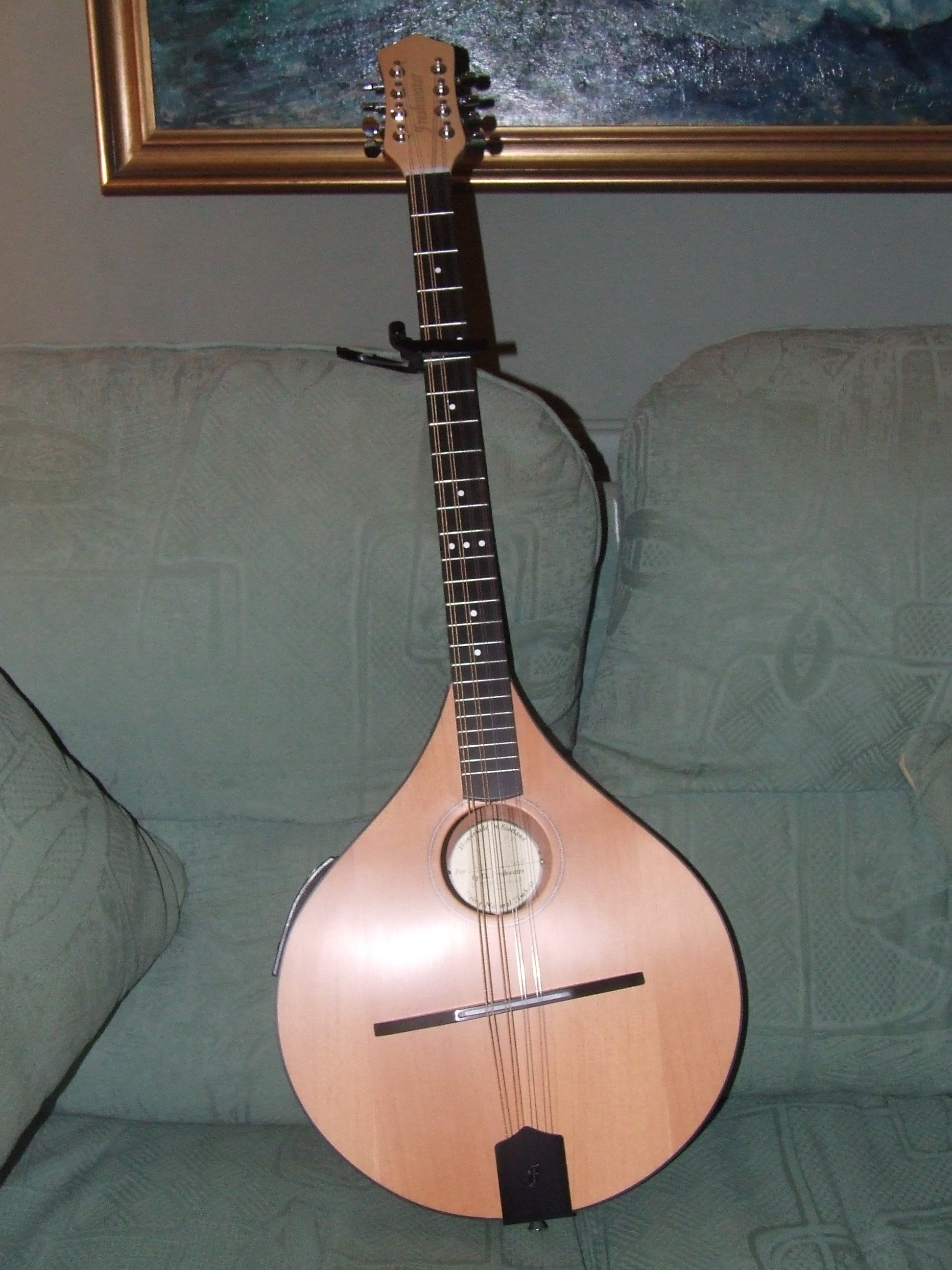
I ordered a Bouzouki from Dave Freshwater- one of the accord range, with pick-up. You can read Dave’s info on this instrument here. I have now had the instrument a few months, and thought it was time to commit myself to a review.

I have a Freshwater mandolin- a beautiful thing, and loved the idea that I would be ordering something handmade in Scotland.

I had also considered Moon, Buchanan and Fylde. However, all of these wonderful luthiers turn out instruments that command prices of double the cost that Dave charges for his accord range.

What you are buying is a handmade instrument at roughly the same cost of many factory produced Korean bouzoukis. This is remarkable.

So- how was it?

Quality and workmanship… 7/10

Well, both are good. The instrument looks great, is well finished, and made from fine tone woods. The pick up is of low quality, but works well- there is some ‘live’ noise from the body of the instrument as you play, but I quite like the percussive effect that this gives to what is after all a rhythm instrument.

The floating bridge is set up at an acute angle (when aligned with the marks placed by Dave on the soundboard) and I questioned this at first, but Dave assures me that this is correct.

The sound board marks very easily. Already it has scratches from my plectrum.

The stick-on freshwater logo’s are a bit low rent, but look better on this than on my mandolin. Machine heads smooth and decent, tailpiece will work with ball and loop strings. Frets dressed OK.

Playability… 5/10

Dave telephoned to ask what kind of set up I required- based on whether it would be played hard or more sensitively. I can be hard on my guitar at times so opted for the same. He gave instructions as to how to change the set up if required.

However, when the instrument arrived, it was unplayable for any length of time because the action was very high. The intonation was also affected, and I spent some time trying to compensate for this with different bridge settings.

A phone call to Dave was not very helpful- he told me that the instrument had been checked by a musician prior to being sent, and was fine. I am not sure what kind of musician. I also wonder whether Dave has a good understanding of how best to set up his instruments.

I have now lowered the bridge significantly. THERE IS NO TRUSS ROD, so this is the only way you can change the action of the instrument. (I knew this before ordering- so no complaints there…) The instrument now plays much better- although I will still lower it further I think.

The other thing that takes some getting used to is the neck- it is very thick and round. Perhaps it needs this bulk to remain stable without a truss rod? I am used to playing a Taylor profiled guitar, and this is very different. However- it is something I find myself warming to, as it shapes the hands for slide chords nicely.

I use doubled strings, tuned to DADG. I have not tried octaves yet.

Sound 7/10

This is a small bodied instrument, and so played acoustically, it projects thinly- but it has warmth and sustain.

Plugged in it has some power. If you are used to guitar playing, this will make a sound that you will easily appreciate as providing something different and useable.

Experience of buying from Freshwater 3/10

I am afraid things did not go very well here. I ordered the instrument online around my birthday in February. The estimate of delivery time was 6 weeks. It took much longer- about 6 months. I made several calls to chase it up, and even considered canceling my order. Dave described waiting for machine heads- this for a number of weeks.

The original payment (made by card) did not go through. I checked if all was in order, but although Dave had the order, it later transpired he had no money- all a bit confusing, and I wonder if he thought I was trying to rip him off.

When the instrument was delivered, it was entrusted to a courier who could not find our address. Dave made several calls about this, appearing to be very irritated with us for living in such a difficult place to find.

I ordered a case for the instrument- paying quite a lot extra. When it came it was a cheap guitar case that did not fit at all. I sent it back- again this involved some terse e-mails. There then followed a few phone calls to make sure that the money was returned- including some rather bad tempered answering machine messages.

To do Dave credit- he did try to ring me persistently to resolve any issues. However, this amounted to several calls a day at one point- and it felt quite intimidating.

I have no clear idea of the size of Dave’s operation, but suspect that it could do with some fine tuning- both in terms of logistics and customer relations!

Overall conclusion

This instrument is a significant improvement on the mass produced Korean imports. It has character and if you get the set up right, is fun to play.

If you are a guitar player looking to diversify, or want to move up from some of those awful Ozarks, it is well worth a try. You may need some patience, but hopefully it will be rewarded!

The fruit of the Spirit is peace…

After the rain squalling
And the bombs falling
After the back stabbing
And the tongue lashing
After love is betrayed
And dreams disarrayed
When the knife cuts and slashes
After sackcloth and ashes
Comes the peace

After the tumours
And cruel vicious rumours
After bodies broken
And evil words spoken
After guns cease their shooting
Troops no longer jack-booting
With the grave trodden down
And the trees now turned brown
Comes peace

Even after the failure
Of life-long labour
And after deadlines missed
After the getting pissed
When the pressure’s done mounting
And it’s all over-even the shouting
When the race has been run
In the setting of sun
Comes the peace

When anger burns out
After faith turns to doubt
When we give up on walking
And wolf packs are stalking
When the money is spent
Safety curtains are rent
At the end of all coping
Even Polyanna’s done hoping

Even then
Will fall
My peace

Blogged with the Flock Browser