Let’s talk about inequality; blog action day 2014…

Facebookinstagramsocialtile2

We used to talk about equality a lot in the UK. After the war there was a political consensus around the need to flatten inherited hierarchies of opportunity, health and living standards. I was a social studies student in the 1980s, when even at the height of the Thatcherite government we still were interested above all in how we understood the causes of poverty and the perpetuation of wealth and privilege. We cared that women were disadvantaged in work, or that young black men packed our prisons and our secure psychiatric hospitals. It bothered us that poor people died younger and that if you had a particular accent you were not welcome on the BBC.

On a previous Blog Action Day post I mentioned the infamous Black report, that encapsulated much of the research around this time in these areas.

Something has happened since then however. The Blair government stopped talking about poverty, changing the language to ‘inclusion’. The focus went from the role of government to deliberately intervene in order to equalise, towards ‘Education, education, education’- as if we had to give up on the current generation and blame the next for their failure if they do not take the chances offered to them (we have learned nothing from the failure of every previous attempt to engineer through education; poor kids always do less well, despite individual successes.) The agenda changed- market and consumer forces now set the agenda. Economic forces became our master, not our servant.

The Market decides, so we are told. Equilibrium will always be found by The Market, unless we meddle with in in which case things will go badly wrong. So we watch a narrow selection of indicators of The Market’s healthiness (inflation/economic growth/unemployment/public borrowing) in order to gauge how happy The Market is. If it is not happy we feed it human sacrifices in the form of austerity packages, slashing at those unproductive leaches on the underbelly of the proud beast that is….The Market.

Although no-one quite knows for sure what keeps The Market happy (S/he being a capricious God) we suspect that The Market likes inequality. It keeps people hungry for more, and so The Market remains exalted. Without personal individual aspiration (sometimes understood as greed) how will we feed the voracious appetite of The Market? Casualties may fall by the wayside but The Market rises still…

Some ideas become so ingrained in our cultural consciousness that any challenge seems impossible; countering them seems foolish, dangerous even. So it is with those who want to de-throne The Market; those who see it as a kind of conspiracy against the common good in which profits are ruthlessly privatised whilst losses are socialised. We have accepted a myth as truth- the myth of the wealth-creators, whose aspirations to accumulate are the engine of our national success.

The work of French Economist Thomas Piketty, whose book Capital in the Twenty-First Century has taken the issue of inequality on directly- so much so that the book has become something of a sensation- entering the best selling list alongside the latest blockbusting novels.

He has carefully analysed data from about 200 years of capitalist expansion, and came to this rather startling conclusion;

Capital, he argues, is blind. Once its returns – investing in anything from buy-to-let property to a new car factory – exceed the real growth of wages and output, as historically they always have done (excepting a few periods such as 1910 to 1950), then inevitably the stock of capital will rise disproportionately faster within the overall pattern of output. Wealth inequality rises exponentially.

Piketty tells us that in a society where The Market is god, rich people get richer, and the poor get poorer. This was a short period after the last world war when this seemed to have been moderated in the UK- there was a convergence of wealth as progressive taxation and a rise in living standards of the lower classes overturned the power of The Market. However, this has now been totally forgotten. Now the gap between the rich and the poor is increasing and those who benefit from austerity are clearly the top 1% whose share of national wealth has greatly increased.

Oxfam, The Trussel Trust and the Church Action on Poverty recently released a report entitled Below the Breadline, the relentless rise of food poverty in Britain. It makes for sobering reading;

Although the UK is the seventh richest country in the world, it is also deeply unequal, and millions of families across the UK are living below the breadline.

Oxfam and Church Action on Poverty have calculated that 20,247,042 meals were given to people in food poverty in 2013/14 by the three main food aid providers. This is a 54 percent increase on 2012/13.
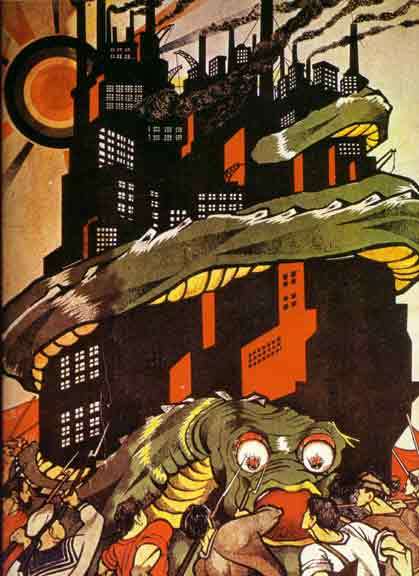
 

capitalism3

George Monbiot wrote this recently;

One of the remarkable characteristics of recent growth in the rich world is how few people benefit. Almost all the gains go to a tiny number of people: one study suggests that the richest 1% in the United States capture 93% of the increase in incomes that growth delivers. Even with growth rates of 2 or 3% or more, working conditions for most people continue to deteriorate, as we find ourselves on short contracts, without full employment rights, without the security or the choice or the pensions our parents enjoyed.

Working hours rise, wages stagnate or fall, tasks become duller, more stressful and harder to fulfill, emails and texts and endless demands clatter inside our heads, shutting down the ability to think, corners are cut, conditions deteriorate, housing becomes almost impossible to afford, there’s ever less money for essential public services. What and whom is this growth for?

It’s for the people who run or own the banks, the hedge funds, the mining companies, the advertising firms, the lobbying companies, the weapons manufacturers, the buy-to-let portfolios, the office blocks, the country estates, the offshore accounts. The rest of us are induced to regard it as necessary and desirable through a system of marketing and framing so intensive and all-pervasive that it amounts to brainwashing.

A system that makes us less happy, less secure, that narrows and impoverishes our lives, is presented as the only possible answer to our problems. There is no alternative – we must keep marching over the cliff. Anyone who challenges it is either ignored or excoriated.

So, is the battle for greater equality worth fighting? Has it not already been lost?

Research would suggest that there is little doubt that the more equal a society is, the healthier it tends to be for its citizens, whilst the more unequal a nation is, the more prevalent these things tend to be mental illnesses, obesity, ill health, crime, infant mortality etc. By enthoning The Market, we make ourselves sick it seems…

So, how do we achieve it?

My suggestion is that we need to look back, and look forward.

We need to look back to a time when people tried hard to achieve some kind of convergence within a liberal democratic tradition- using a consensus around progressive taxation, Market regulation and state sponsored health and welfare. We need to treasure this as part of our UK heritage- to be proud that our people achieved this, whilst learning from the mistakes we made too, in anchoring ourselves to an economic model based around unsustainable ‘growthism‘.

In looking forward however, we also have to remember that issues of inequality are not restricted to our own national borders. The single greatest threat to the stability of our planet is the destructive and exploitative effects of The Market on a global scale. Wars fought around oil deposits, mineral rights. Poor southern countries providing natural resources and a labour force in order to sustain the avarice of the rich north. Starting to tackle this kind of equality requires a much greater leap, towards living more simply, more sustainably, more collectively…

The first step however is to do one simply thing- dethrone The Market.

Start to imagine what we might exalt instead of The Market. What values do we want to live by- do we want our children to live by? What currency might we measure success with other than these inhumane  ones concerned only with finance/growth/consumption?

In this, my friends, there is a kind of grace that goes deeper into who we are as humans.

Monbiot again;

Thus the Great Global Polishing proceeds, wearing down the knap of the Earth, rubbing out all that is distinctive and peculiar, in human culture as well as nature, reducing us to replaceable automata within a homogenous global workforce, inexorably transforming the riches of the natural world into a featureless monoculture.

Is this not the point at which we shout stop? At which we use the extraordinary learning and expertise we have developed to change the way we organise ourselves, to contest and reverse the trends that have governed our relationship with the living planet for the past two million years, and that are now destroying its remaining features at astonishing speed? Is this not the point at which we challenge the inevitability of endless growth on a finite planet? If not now, when?

We made The Market. It should not make us.

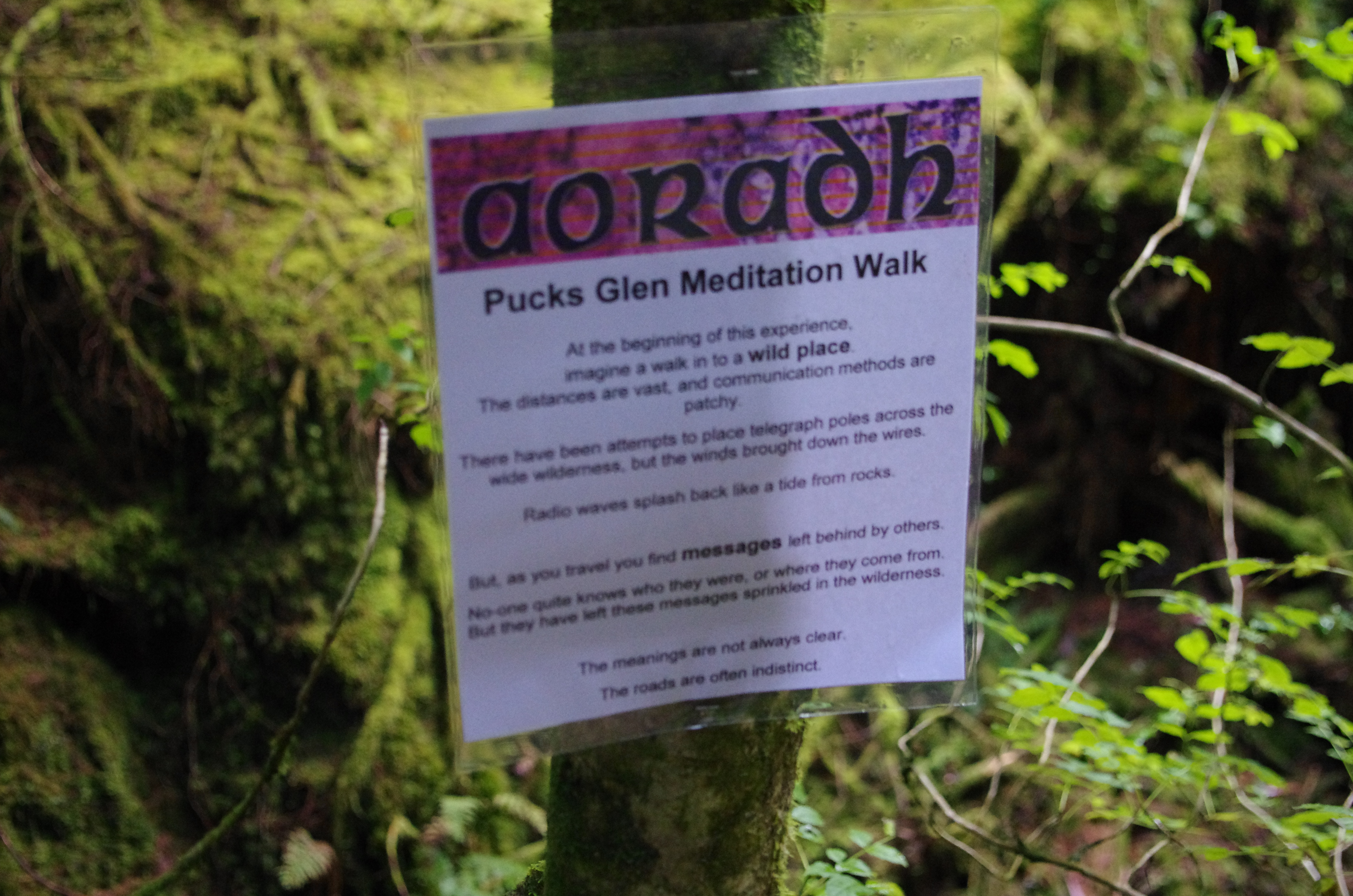
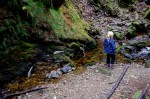
Aoradh meditation trail, Pucks Glen…


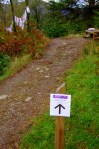
Aoradh meditation walk, start

We are just back after deconstructing the installations and stations in the lovely Puck Glen, which formed Aoradh’s contribution to Cowalfest. It felt like a real shame to take them down, as even today the Glen was full of people who were visibly affected by what they were encountering.

This is the second time we have used Pucks Glen in this way, and I have ideas about other things I would love to use this magical place for- watch this space to see if they ever come in to being.

As ever, if anyone wants to know more about what we did, or wants a copy of some of the resources feel free to get in touch.This time our contributions went something like this;

A water wheel spinning from a bridge in the darkest part of the Glen, asking people to think about the fact that it was energised by silver streams that had come from above.

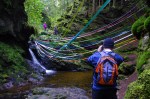
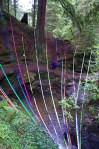
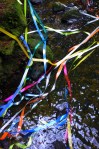
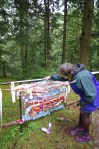
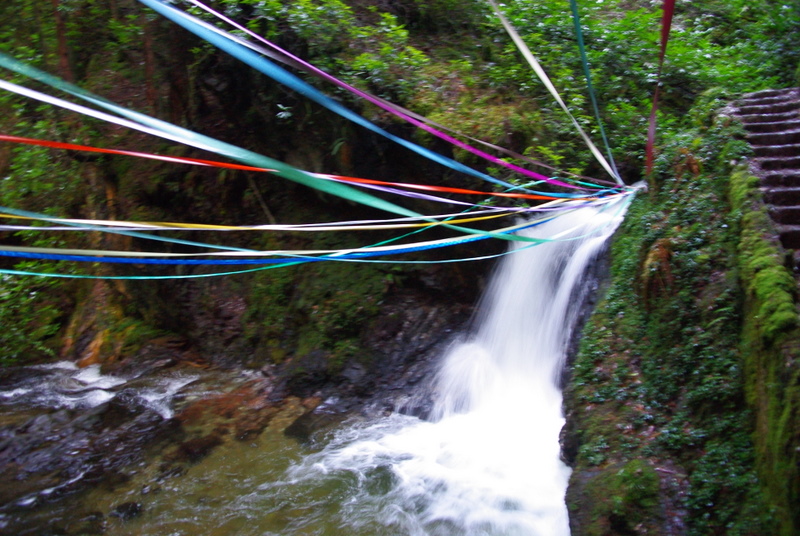
Ribbons of all sorts of colours anchored to the top of a waterfull then fanning out over a pool. The path goes under the ribbons, in a way to make people part of the waterfall- with some suggestions to think about Streams of Living Water.

A way side shrine, with candles and a wooden carved cross.

‘Leaping’ silver fish on flexible stainless steel rods, anchored to the bottom of the stream, moving as the water rushes past. An image of freedom- where the spirit of the Lord is…

Large dry leaves (from Benmore Gardens) and pens at the top of the Glen, with an invitation to write on the leaves and drop them into the water- letting go, repentance etc.

Prayer flags, asking people to raise their own ensign- things that they want to be animated by the wind of the Spirit.

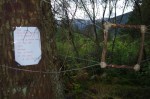
A wooden frame to look out over open country through.

A Loom, with an invitation to write names of special people who make up their community- the gifts of the Spirit being so much to do with getting on with each other.

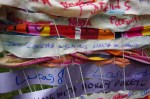
Poetry on large PVC banners in and amongst the trees from another previous Aoradh event on a theme of ‘A time to…’

Speaking/listening tube- a long plastic drainpipe up into the tree canopy with a horn on one end and a speaking cup on the other- with an invitation to listen and speak prayers.

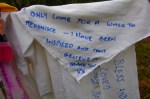
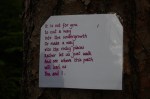
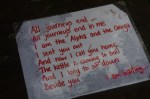
Also all the way through the Glen were small bits of poetry- what we called ‘messages’.

At some point over the weekend someone vandalised the installations- always a surprise given it’s location. Much of the poetry was ripped off or had disappeared altogether, as had the carved wooden cross. I can only assume that someone had a problem with the Christian starting point of what we were offering. This was balanced however by so many people who seemed to have found it so lovely, and had engaged with it using the materials provided. It really was a lovely thing to be part of…

Here are a few photos;

Time to look to the left…

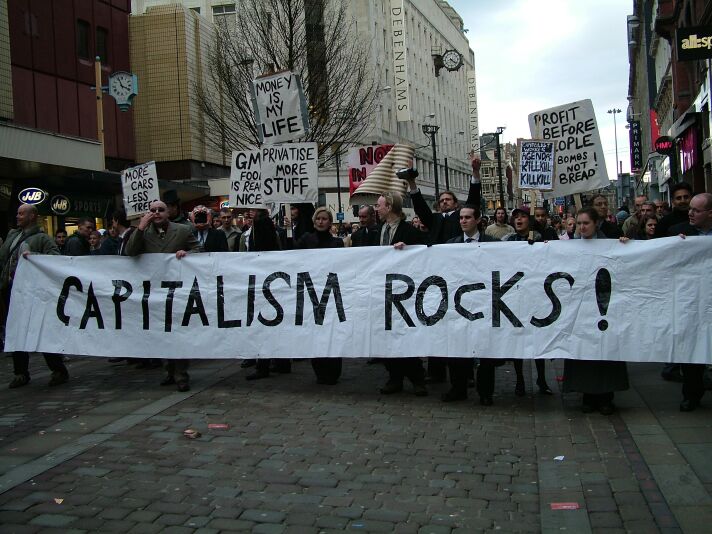
capitalismrocks

In the wake of the Referendum debate up here, we are all wondering if the remarkable upsurge of political engagement can actually lead to real change, and what new/old political or social movements might be the vehicle that will allow this change to take place.

My feeling is that despite all the noise and smoke, real change is not inevitable.  This is partly because maintaining momentum is a challenge, (particularly in the wake of the NO vote) and perhaps even more because there is no real clarity over WHAT people want to change. There has been a clear expression of dissatisfaction- both with the current socio-political status quo, and with Westminster (which was usually seen to be English) in particular, but the Yes campaign up here seemed to me a combing together of very great complexity under the deceptively simple duality of yes/no. People were able to invest hopes and dreams along with a way to vent their spleen, but consensus over the sort of society/economy/community that should replace the one we are part of now? This is a wholly different issue.

Regular readers of this blog will know that I was not convinced by the nationalist argument, but that I am desperate for change. The process of engaging with the referendum has therefore been a painful one for me- one that I feel to have driven wedges between myself and things I hold dear- as well as people I hold dear. Aside from the personal aspects of this however, to a certain extent, what has happened is what always seems to happens in the UK- it has become another means by which the political left splits itself apart.

The challenge then for radicals on both sides of the referendum campaign is to find a way to come together again. If the real issue was not nationalism, but a desire to be in charge of shaping things towards our own destiny, then what happens now that these things need to be filtered again through the current political machinery? For the NO voters like me, now that we have rejected one possible change process, what are we going to put in its place?

I have spent hours and hours since the referendum reading stuff about alternatives, and how policy might be different. If you are interested, here are a few links;

The New Economics Foundation. A collection of ideas on how to achieve greater environmental, social and economic justice.

Countless articles in Newspapers (mostly The Guardian, which is the only one to give voice to persistent thoughtful radicals.) Including this one

The big idea of the three main parties is the same: not capitalism, or neo-liberalism, or social democracy – but growthism. This term was coined by the author Umair Haque to describe the pursuit, above all other things, of economic growth. Never mind who it benefits, who gets left behind or what it destroys; never mind if its practices are unfair or unsustainable: if the numbers go up, everyone is happy, and if they’re not happy, give them a tax break.

Common Weal. “…a vision of what Scotland can be if it rejects the failed Me-First politics that left us all in second place and instead builds a politics that puts All Of Us First.”  A collection of reports on a range of political and economic solutions.

The Green Party. The only UK political party that has a comprehensive set of radical policies on everything from social welfare and defence- not just the environment! I confess that as a lifelong (albeit latterly reluctant) Labour supporter, I am on the cusp of making the leap towards the Greens. I am gathering a clarity over the changes I long for and the Greens seem to have most of these things as policy objectives. A change from Growthism to sustainability, and emphasis on social justice and progressive fair taxation, and a defence policy that is as radical as almost anything I have ever seen- a real movement away from the military industrial machine.

I had a long discussion with a friend recently- someone still heartbroken and raw from the referendum. One of the things we talked about was whether change had to be local or more global. My feeling is that it has to be both. Activism has to be rooted in real community, local connection, but it needs to be connected to something bigger- to leadership, creativity and passion that has a wider expression. This is what the Left has failed to achieve for some time- possibly because Labour (ostensibly a Leftist party, but actually as rooted in the accommodation of growthism as any party) was seen as offering all that the Left could offer. However, also this might have something to do with it too;

“The smart way to keep people passive and obedient is to strictly limit the spectrum of acceptable opinion, but allow very lively debate within that spectrum….”
― Noam Chomsky, The Common Good

We need to forge local connections, but we also need to look beyond them. Part of this might well require healing some of those divisions with our political allies. When we look to the left, let us see people of hope, not people of division.

Cowalfest meditation walk…

pucks glen poster 2014

Aoradh are setting up another meditation walk around the beautiful Pucks Glen, to be part of Cowalfest, which starts on Saturday. We are meeting this evening to sort out who is doing what, but I am really looking forward to it.

This will be a series of stations, art and poetry up through the glen and back down to the car park.

We set up some similar installations there once before, around Christmas a couple of years ago- but unfortunately this coincided with massive storm that brought trees down and washed away a lot of the paths in the gorge. The installations were remarkably untouched, but getting to them involved some challenges and a bit of scrambling. Hopefully we will be a bit better served by the weather this time!

This is what it looked like last time;

water wheel 2

ribbons in situ

Some local creativity…

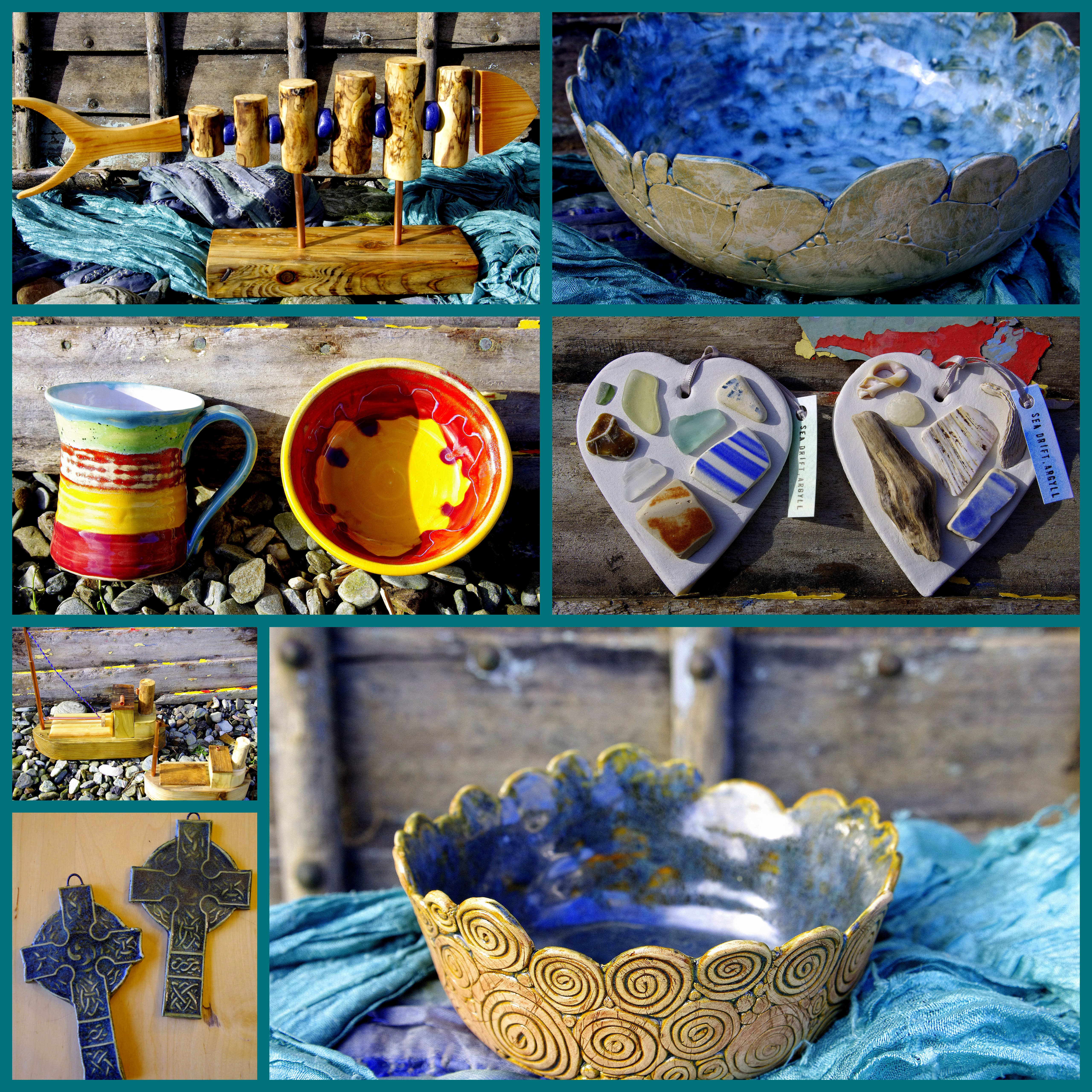
crafts

This weekend we are participating in Cowal Open Studios (along with Pauline Beautyman and her lovely pottery.) Come along and have a look if you are local…

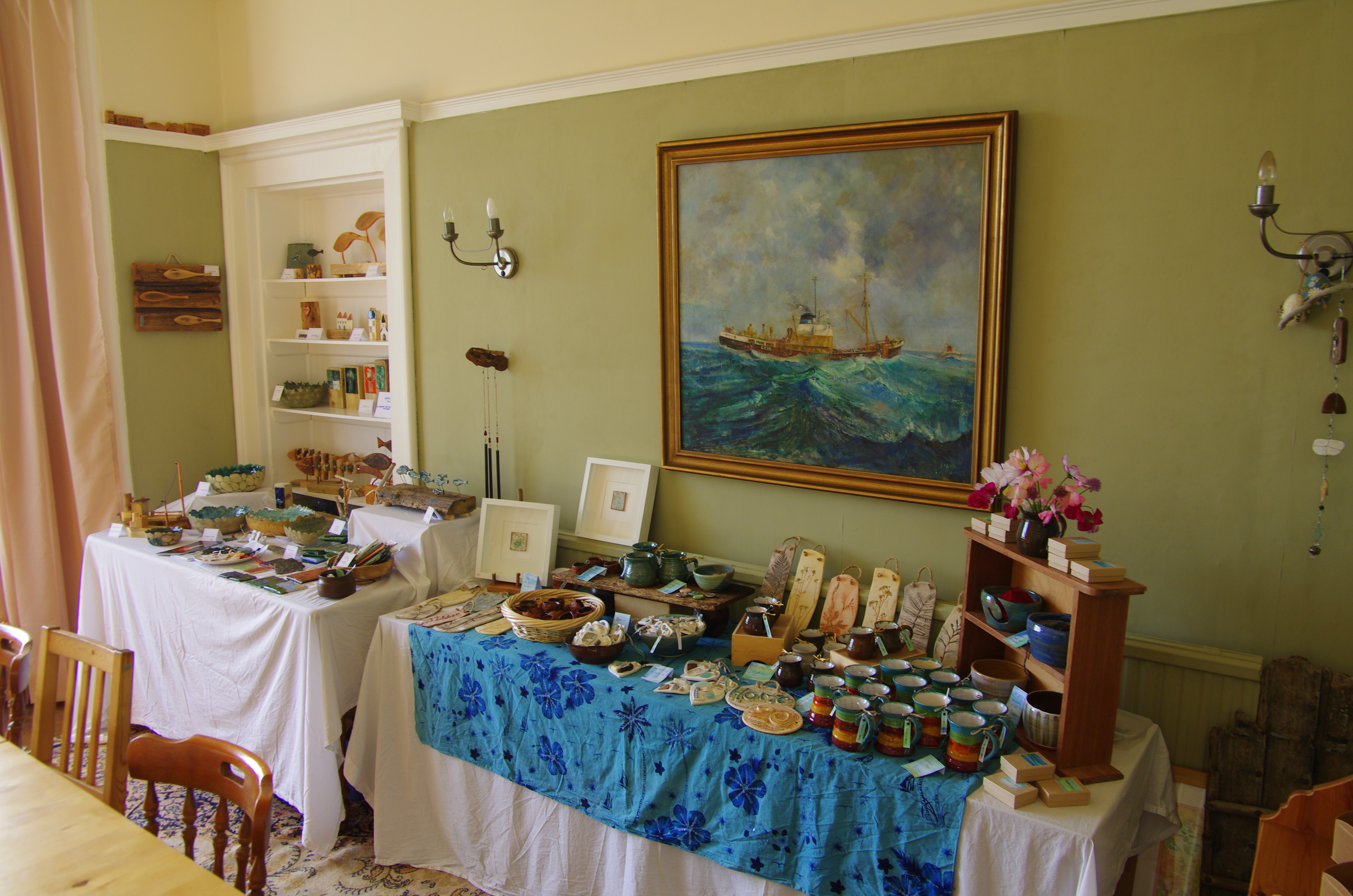
COS is a collection of artists/crafty people on the Cowal peninsular who have ‘open house’ this weekend, allowing people to come visit, talk about techniques, methods and even have a go (in the pottery in our case.)  Here is our dining room at the moment;

IMGP7069

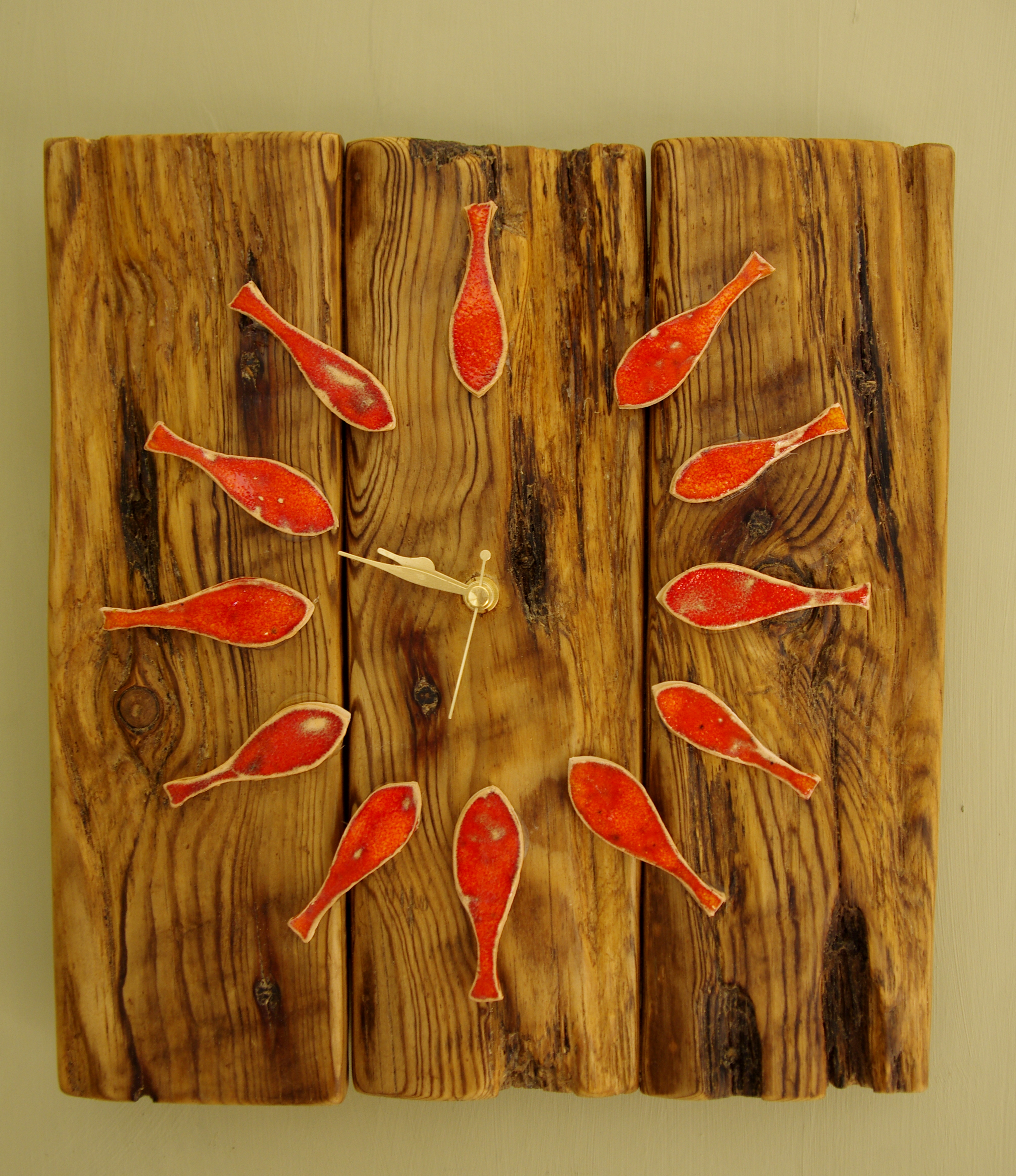
It is also a chance to sell some things. I could have sold this several times over it seems- messing about with some little ceramic fish and some battered old driftwood. Still, if you want one, I can always make more!driftwood clockIn terms of local arty stuff, I should also mention that next Thursday at 7.00 I am doing a poetry reading at our local bookshop, Bookpoint. Be lovely to see you there! I should post a poem in celebration really…

I do not really do celebratory poems but here is an old one anyway;


Life still flickers


I have heard it said that

Dead men walking

We are

Corporeal

Tenderised

Like veal

Blown by flies


But life still flickers

Faint but strong

Vibrating these hollow veins

And the voltage you make

Is a current

Wired to the nape

Of my neck


Because this thing we are

Is more than just

A bottle

For blood

So much more than just

Shapes

Mixed from mud


Beautiful creature

Sing, spirit-

Sing


The creation of fundamentalist religion…

ARABIA_SAUDITA_-_terrorismo_islamico

I was reading today how the Iranian President, Hassan Rouhani, has accused the west of creating the conditions which allowed the development of the extreme militant fundamentalist group that is the current enemy number one of the US and her allies- ISIS. It is a sign of how much things have changed in international relations that an Iranian president could say things like this and anyone would be listening. Even more than most of us would listen and think that he is absolutely right.

Anyone ever heard someone say this?-

“More wars are created by religion than just about any other cause.”

It is one of those truisms that, even though very easily challenged by a cursory look at history (witness both world wars in the last C) is remarkably persistent in our culture. Religion creates fervently held divergent ideas and fanatics who would defend these ideas at any cost.

Karen Armstrong (she of the Charter for Compassion initiative) has written a new book entitled Religion and the history of violence. She deals with this subject in a remarkable article in The Guardian today, which is really worth reading in full. In the article, she deals with the co-existence of violence and religion throughout history, arguing that in most cases, religious violence is intermingled with political expediency in such a way that it is almost impossible to describe the cause of the violence as being the religion itself.

She next deals with the rise of this thing called ‘secularism’, which was the West’s answer to perceptions of the danger of allowing religion to mix with politics.

When dealing with more recent religious conflicts, she had this to say;

When secularisation was implemented in the developing world, it was experienced as a profound disruption – just as it had originally been in Europe. Because it usually came with colonial rule, it was seen as a foreign import and rejected as profoundly unnatural. In almost every region of the world where secular governments have been established with a goal of separating religion and politics, a counter-cultural movement has developed in response, determined to bring religion back into public life. What we call “fundamentalism” has always existed in a symbiotic relationship with a secularisation that is experienced as cruel, violent and invasive. All too often an aggressive secularism has pushed religion into a violent riposte.


Every fundamentalist movement that I have studied in Judaism, Christianity and Islam is rooted in a profound fear of annihilation, convinced that the liberal or secular establishment is determined to destroy their way of life. This has been tragically apparent in the Middle East.

Fundamentalism as reaction, not as consequence of faith itself. Pretty much what the Iranian President is saying. Armstrong goes on to say this;

Many secular thinkers now regard “religion” as inherently belligerent and intolerant, and an irrational, backward and violent “other” to the peaceable and humane liberal state – an attitude with an unfortunate echo of the colonialist view of indigenous peoples as hopelessly “primitive”, mired in their benighted religious beliefs. There are consequences to our failure to understand that our secularism, and its understanding of the role of religion, is exceptional.


When secularisation has been applied by force, it has provoked a fundamentalist reaction – and history shows that fundamentalist movements which come under attack invariably grow even more extreme.


The fruits of this error are on display across the Middle East: when we look with horror upon the travesty of Isis, we would be wise to acknowledge that its barbaric violence may be, at least in part, the offspring of policies guided by our disdain.

It feels to me there is great wisdom in these words. Contrast them with the rising cry of violence that our government is rushing to join. The answer to violent groups like ISIS appears to be, more violence- as if this will ever put out the flames. As if this will remove the circumstances that led to the violence in the first place.

The counter cry will arise- evil can not be allowed to stand. Men of violence must be opposed. Justice should flow like a river.

But we have been here before have we not?


September, Castle Lachlan…

Written from word-sketches done during a recent poetry workshop I led out at Castle Lachlan.

Autumn trees

September, Castle Lachlan

.

The surface of the water holds a muted print

Inked by all these early autumn colours

Leached from trees, from sky

Until a fish leaps

Rips a dripping hole in this perfect picture

Then plops back on a belly laugh


Something buzzes by

Lacquered like a Chinese cabinet

The air still warm enough for the burn of tiny insect engine

Converting speed to sound in this

The last gasp of a summer almost

Gone


Meanwhile in the ragged edge of the old wood

Small things claw and clatter by

Moving in sudden squirts to trick the hungry eye

Clinging leaves filter and flick at the low sunlight

They have not quite

Fallen


The ragged old castle leans on its ivy Zimmer

Watching it all go by through watered eyes

Wondering where it all went

Leaking dark memories through those broken curtain walls

The canons roars

No more

And now what?


Military flags, Lichfield Cathedral

The referendum in Scotland is over. The narrowness of the result has left half of Scotland relieved, whilst many are sore, even heart-broken. This is democracy by referendum I suppose – a black and white duality that gives a one-size-fits-all answer.

My FB feed is full of people suggesting that the vote was rigged or finding other reasons to blame. It seems to reflect peoples anger and hurt as well as the refusal to let go of something that felt vitalising and alive. The referendum was a blank canvas onto which all sorts of hopes and dreams were projected onto, but it lit us up like politics has failed to do for a generation. Can it really be all over?

My own feelings are very confused, for all sorts of reasons. The referendum somehow never asked questions that I could get excited about. I tried to express some of this in a previous post, but do not feel that I said it well, and in the end I was left rather sore and deflated. For all of us now however the question surely has to be, what next?

For some, the issue remains sovereignty; authorship over national fate, and so the matter of devolved powers is top of the agenda. The constitutional changes needed to achieve this, not just in Scotland, but in the whole of the UK, are likely to have far reaching consequences. It will also be a protracted process involving lots of twists and turns, dodgy deals and uncomfortable compromises. This is democracy too. We make deals with the devil and rubber stamp them with 4 yearly elections in which people vote blindfolded.

What about followers of Jesus in these interesting times? Where do we look for leadership, for inspiration, for challenge to our inertia and complicity with empire? How do we continue to seek to be agents of the New Kingdom (rather than a particular earthly one?)

I started to make a list of things that I think might be important. None of them are new, but for my own benefit, I thought it was time to restate them;

  1. Our primary allegiance is not to a flag or a country, rather it is to Jesus and the New Kingdom. This is not to say that we should not seek to be enthusiastic engaged critical lovers of the place where we live however, rather it is an encouragement to see ourselves as agents of something deeper, something purer and more loving. Something bigger than now, so that the now might be carried forwards into something better.
  2. The rules of engagement with the place we live are given to us in clues by the life of Jesus, his sermons, the stories he told, and the stories of his failing followers ever since. Our job, which sometimes seems almost impossible, is to apply these rules anew in this context, this time. We have to start with the Shalom of God, made real in the person of Jesus.  We are to people a people who first of all are learning to love. A people who seek to make peace. Too often we have been easily sucked into to making war.
  3. Jesus had a skew towards the poor, the weak, the broken. It almost seemed as though he deliberately eschewed power in all of its earthly forms- particularly political power. That is not to say that he despised people in power- witness the ‘rich young ruler’, or the Roman Centurion – rather that he preferred the company of the small people.
  4. Justice. This word clearly means different things to different people, then and now. from one perspective, Jesus’ teachings seemed to focus more on our inner lives, to the exclusion of protesting injustice, but on the other hand, you might see his whole life as being a lesson in HOW to protest injustice. How to look in the face of power and take the radical alternative path of love. How to turn the other cheek. How to scandalize by simple acts of mercy.
  5. Community. Jesus seemed to place deep value in friendship, in shared life, in teaching and learning through close community. In a shattered society, where communality has been devalued and we worship instead the gods of individuality, personal growth, me, myself and mine. The way of Jesus might be described as deliberately putting the self (my ‘rightness’, my stuff, my needs, my art, my dreams, my own fulfillment) behind the rule of love.
  6. Healing, restoration, stewardship. Again, the life of Jesus that we know about tended to be transitory, always on the move; he had 4 years on the road then they crucified him. But in all those years he sought to mend what was broken- as if to return the world to the way it was made. In our time, the whole of creation might just be broken. We are all vulnerable, particularly the poor and the weak. How might we become agents of healing?
  7. Agents of peace and love might get angry- Jesus did after all. Because being engaged hopeful critics of culture and place might often lead to outrage. It is all too easy to forget the way of love, to turn from being people of the open hand, to people of the clenched fist.
  8. Agents of the Kingdom are not bound by narrow sectarian divisions. Hard boundaries and walls were never the Jesus way. Rather he looked beyond the labels, the religious and political differences and saw real people. He even formed friendships and allegiances across the boundaries- to the frequent anger and disgust of those around him. Tax collectors, Romans, Samaritans. This was not political expediency, it was love.

How do I apply this to now – to the UK, 2014, to post referendum Scotland, to Argyll, to Dunoon, to my house, to my self? One small decisions at a time I suppose. Most of the time I feel like I get it all wrong, that my hands have formed themselves, almost unbidden, into fists.

I think that whatever happens next is not my really my concern. Rather it is to seek always to form in myself the way of love. The Spirit within me will do the rest. One shuffling step at a time.

The referendum was seen by some followers of Jesus as a means by which justice might be increased, by which love could have more elbow room, by which old wounds could be exposed to the therapy of new sunlight. Hopes and dreams became wrapped up in an ideal of renewed nationhood. Amidst the disappointment perhaps all we can do is return together to the way of Jesus. The point was never nationhood, it was love.

May we followers of Jesus be part of the healing of our nation. May we try always to see through the eyes of the poor, the weak and the broken. And when others around us seek to build walls of division, let us smile and step back, hoping for the best, whilst looking for cracks, through which the light can get through.

paved with light

The Crown of London…

I have been listening to some music by Lau’s Kris Drever of late.

One song has stuck with me- writen by Kris’s brother, all about the fate of the 17th C Covenanters after the Battle of Bothwell Bridge in 1679.

It seems all the more poignant a song in the wake of the recent Independence referendum, reminding us of the mess of politics and religion that gave birth to the Union of the United Kingdom. Some people remember the Covenanters as Godly heroes who stood up for truth against oppression. At the time they were seem more in the way we would see the Taliban fighting Jihad. Disenfranchised people in the grip of religion that proclaims truth whilst entirely missing the point.

The so called ‘English’ Civil war involved many thousands of Scottish soldiers fighting on both sides, but most tellingly on the side of the Parliament. Many of these were lowland Scots who saw themselves as fighting a Holy war to free Presbytarian Scotland of all Popery and Catholicism. There was some skulduggery along the way though- the Covenanters switched sides for a while and eventually invaded the North of England but were defeated at the Battle of Preston. After the Civil war, they were eventually defeated in Scotland by a Parlimentary army under Cromwell. The trouble did not end there though, as after the Resoration of the Crown, Charles II did not remember the deal he had made with the Covenanters.

Following the restoration of Episcopacy rebel ministers began to preach at secret open-air meetings in the countryside known as ‘conventicles’ A period of sustained persecution began. Oppressive measures against these illegal field assemblies where attendance was made a capital offence[1] led to an outbreak of armed rebellion in 1666, originating in Galloway. Advancing from the west towards Edinburgh, a small force of badly armed Covenanters was defeated at theBattle of Rullion Green in the Pentland Hills, a location which caused the whole tragic episode to be misleadingly named the Pentland Rising. To quell unrest in south-west Scotland, the government brought in 6,000 Highland soldiers, described by its enemies as an “inhumane and barbarous Highland host” which was quartered on suspected Covenanters and was accused of committing many atrocities.[1]

A further rebellion broke out in 1679, after the unexpected success of a group of covenanters, armed with pitch forks and the like, against government forces led by John Graham of Claverhouse at the Battle of Drumclog. For a time the authorities looked in danger of losing control of the south west of Scotland, as more and more people joined the rebel camp at Bothwell near Glasgow; but only a few weeks after Drumclog the rebels were defeated at the Battle of Bothwell Brig. In the weeks before the battle the Covenanters spent more time arguing among themselves than preparing for the inevitable counterstroke, which did much to contribute towards their downfall. Of 1,200 captured rebels taken to Edinburgh, some 400 were imprisoned in an area of Greyfriars Kirkyard over the winter months.[2]

It was the survivors of the Greyfriar Kirkyard that found themselves shipped off as slaves in the fateful ship ‘The Crown of London’. There is more of the story here.

This from here;

So, in November 1679, these unfortunates were lead on to a ship, the Crown of London, in Leith, where they were to be transported to English plantations in America to become slaves.

Under the command of one Captain Patterson, the Crown of London set sail in December 1679.

The captain’s planned course is unknown, but the ship’s first port of call was Orkney where, on December 10, 1679, she sheltered from a storm off Scarvataing, a headland in the parish of Deerness, a mile or two from the sheltered bay of Deer Sound.

In gales typical of the season, the ship was driven on to rocks after her anchor chain snapped. The captain and crew escaped the doomed vessel by hacking down the ship’s mast and clambering across it to reach land.

The prisoners, however, were not so fortunate.

They had been confined to the hold and the hatches battened down under the captain’s orders. The reasoning behind this act was simple – the captain would be paid for the number of slaves on board the vessel and recompensed for those who died on the voyage. He would receive nothing for an escaped prisoner.

So, when the ship left port, Patterson took steps to make sure none did.

One member of crew did attempt a rescue by breaking through the deck with an axe. His valiant efforts meant that around 50 prisoners escaped and made it to the Deerness shore.

The remainder perished as the ship broke up and sank. It is said that over the following days, bodies washed up over three miles of the Deerness coastline.

Why do these things matter?

They are part of what made our nation. Upheavals that led to the death of thousands. Power ebbing and flowing, rebellious ideas flaring and then being snuffed out. Religion being employed as a cutting edge. And in the middle of it all cruel powerful forces use small people to achieve their own ends…

The peaceful democratic process of the recent referendum seems such a blessed contrast.

We would do well to honour this process- no matter whether we are saddened or relieved by the outcome. Let the killing times be at the back of our minds- after all, not so far away, just across the Irish sea, they never quite stopped…

Here is the song;

That’s what set’s the poet free…

I am sort of in between jobs at the moment- one of the joys of doing agency work. There is a song that keeps coming in to my mind;

Having said that- on Sunday, I got paid for talking about poetry all day! It was such a lovely day that I kind of feel bad for even taking the money. The soup was good too- not a cold dog in sight.

I am referring to the poetry workshop that I ran for the Castle Lachlan Trust out at Inver Cottage Restaurant. I had three punters- and it was such a privilege to share a day full of words with them. Each person used poetry in different ways, but it felt like something was being set free in each of us…