Seatree artist retreat- help needed…

For years now, we have been trying to get a project over the line. It has often seemed like it was never going to happen, but now we are finally on the cusp of making it reality.

When we moved to our house, we were not looking for lots of land. Our brief was simple – a smaller house, with room for a pottery studio in which we could work and run workshops, and a small vegetable patch to grow as much food as we could. The aim was for a simple lifestyle, as environmentally sustainable and low impact as possible. Things did not quite work out in the way we planned…

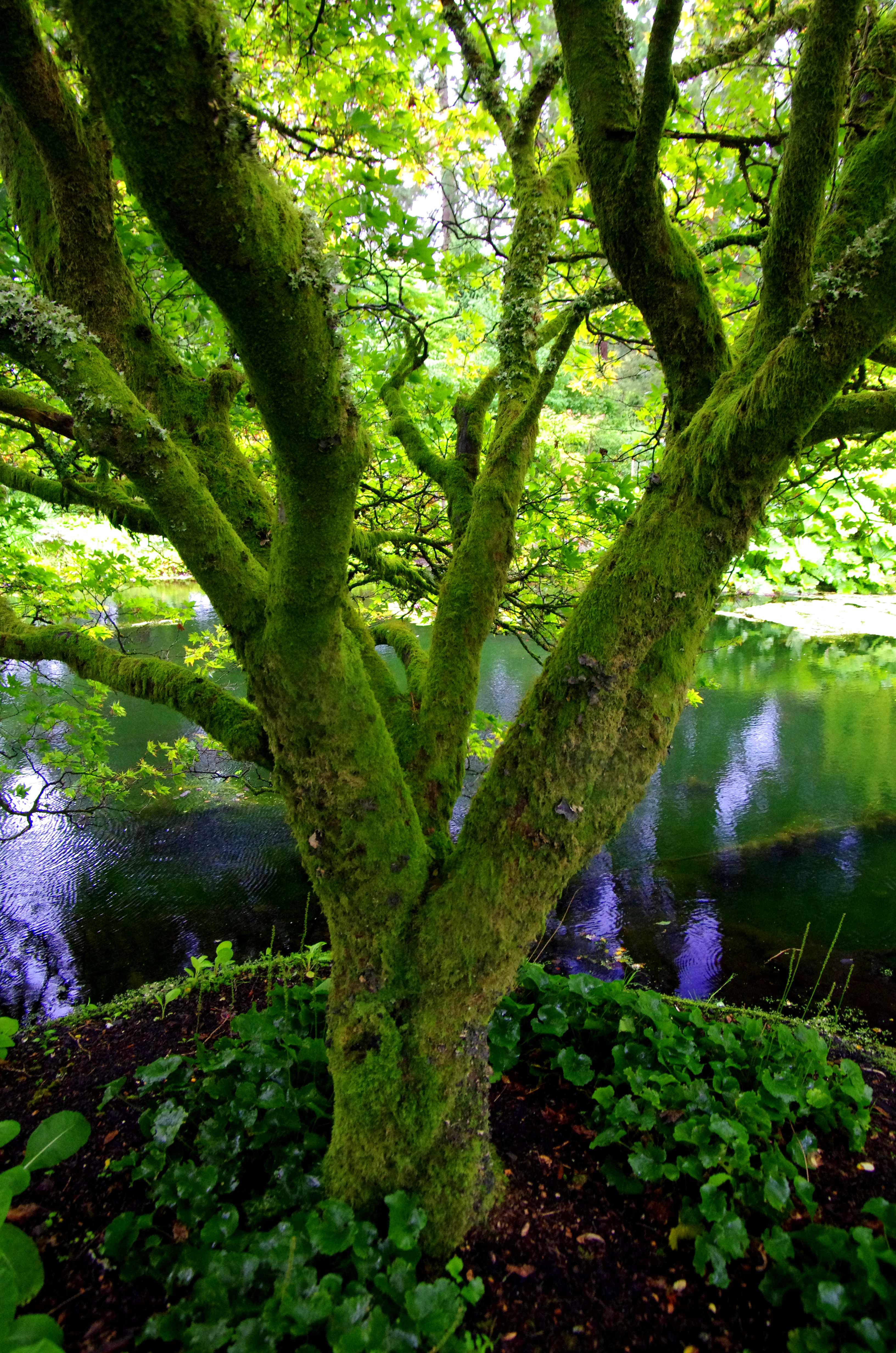
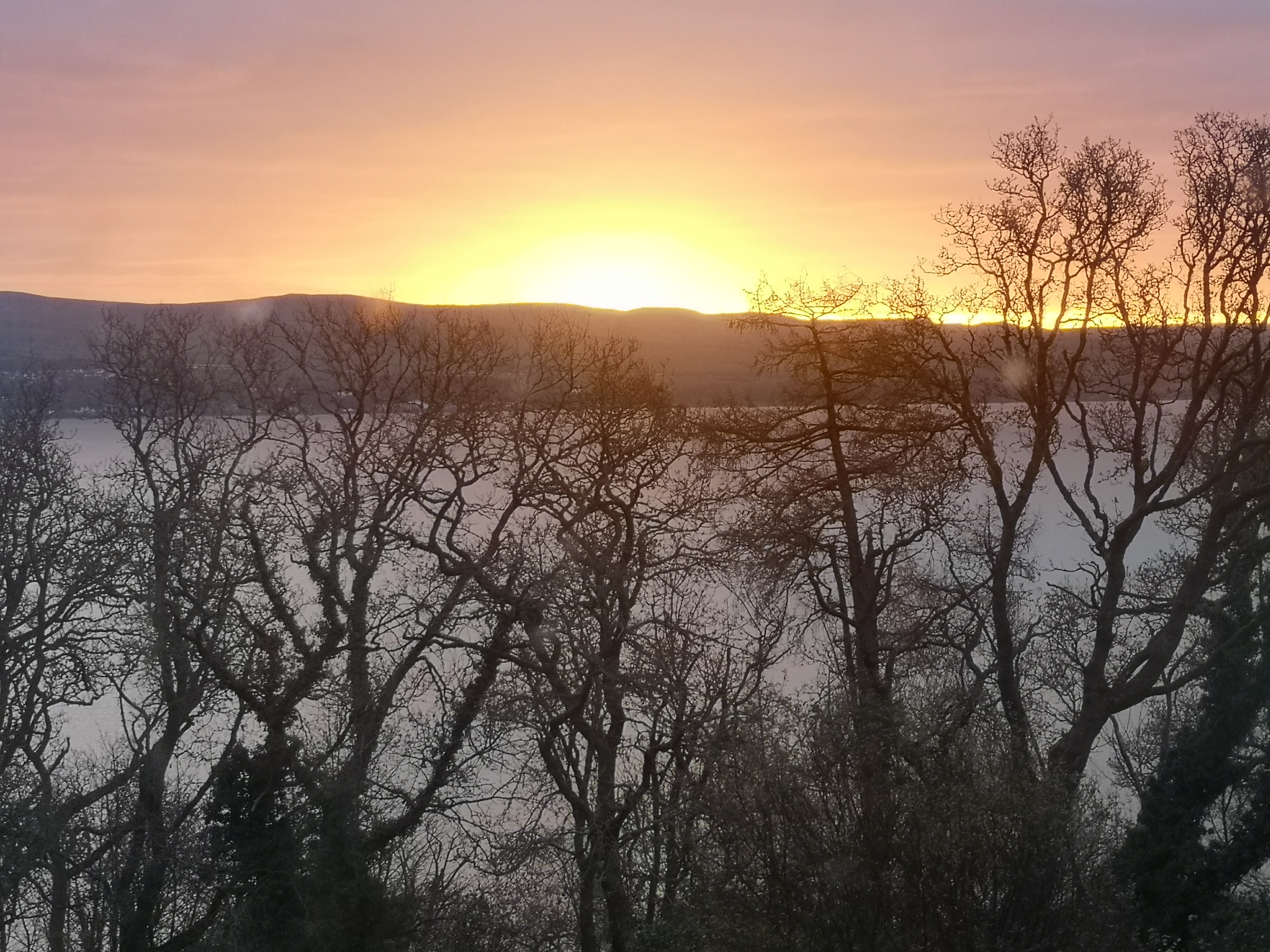
Firstly, we ended up buying a house that came with a large area of overgrown woodland. When we moved, it was impossible to explore most of it, choked as it was by invasive rhodedendron and buddleia. I felt the responsibiity to care for this land keenly – to take out the invasive species and let the old oak trees breathe. I have since spent a long time and lots of hard work trying to do just that – and slowly it has started to transform the woodland back to what it always should have been- a pocket of beautiful oak rainforest, perched above the Clyde estuary…
The other thing that did not go to plan was that we had an unfortunate brush with officialdom. When we moved to our new house, we asked a series of questions of Argyll and Bute planning department about what permissions we needed to obtain to work from home and run pottery workshops for members of the public. We were told (by e-mail) that we required none. Accordingly, we built workshops and pretty soon a third of our income was made up of people paying for pottery workshops.

Unfortunately, following a complaint from a neighbour about us running a business from home, the planning department conducted an investigation, and decided that although our activities were not in breach of planning, the building we had erected as our workshop was not deemed to pass building regulations for recieving members of the public. We appealed, on the basis that we had previously been informed by e-mail that building regulations were not required, but to no avail. Conspiracy theorists might well enjoy the fact that our beloved council deleted all documents and e-mails relating to our enquiries, meaning that the ombudsman was not able to rule in our favour. Such is life. We adapted and moved on…
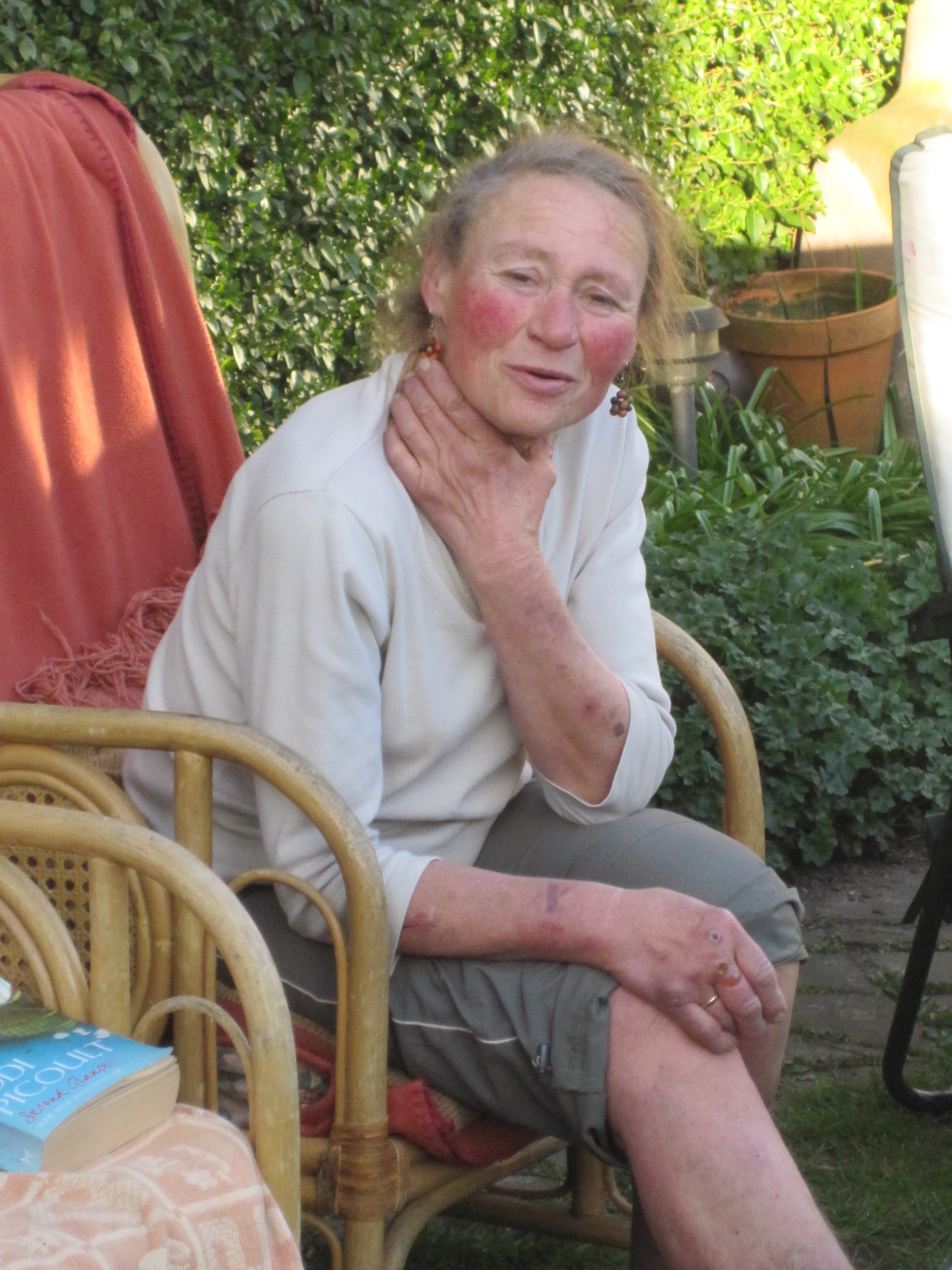
My mum died. Here she is, sitting in a garden, her favourite place in the world. She never got to see our new garden, here in the Clyde, being too ill to travel north. When it came to a share of the small amount of inheritance from the sale of her house that was coming to us, I wanted to make something that might form a lasting memorial.

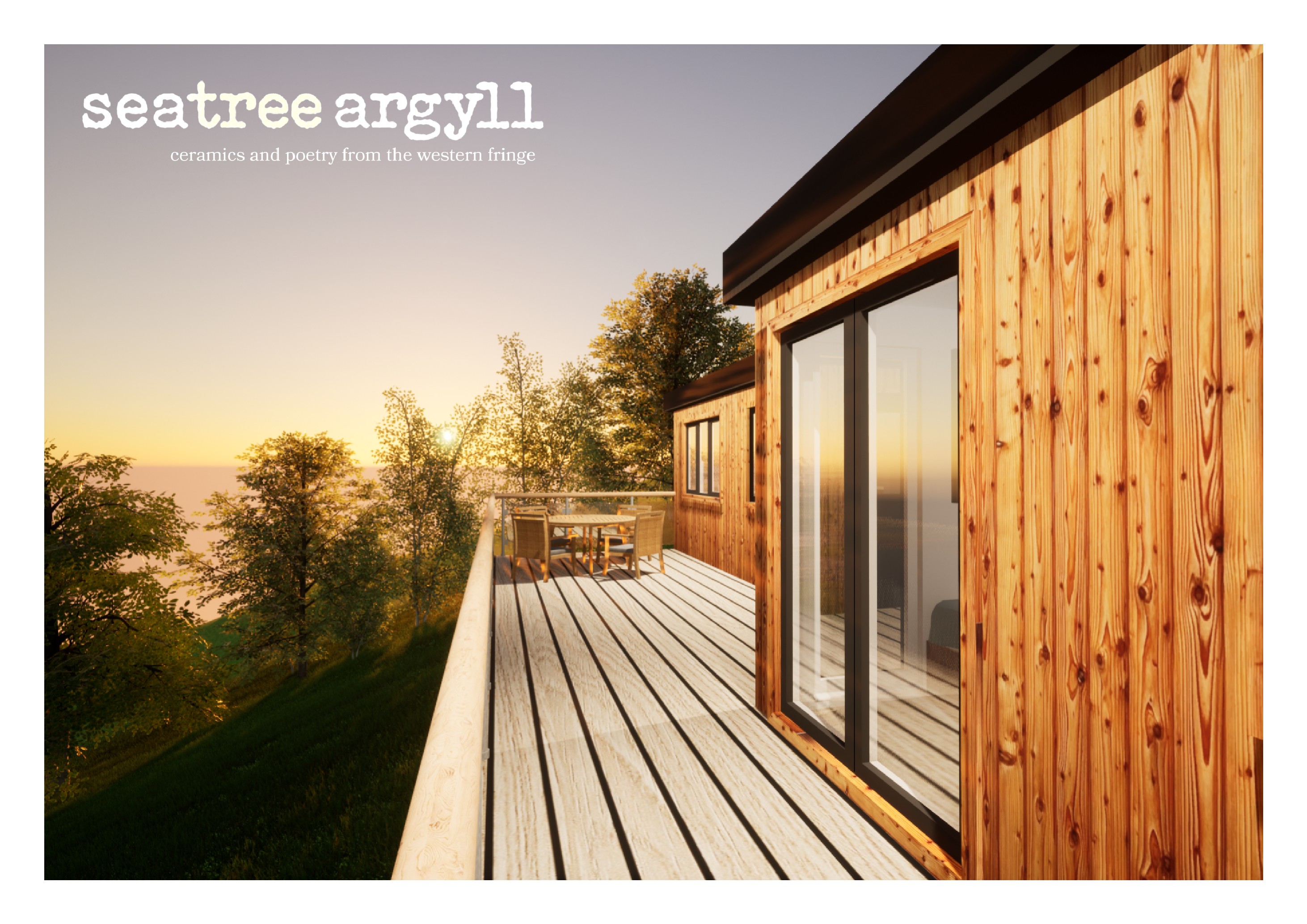
Could we use it to build a new workshop? Something that enhanced the woodland, built from sustainable materials and using low impact construction methods?

Even better, could we make a space in the woodland that might become a haven for people – for artists and makers to spent time creating and recharging their passion?

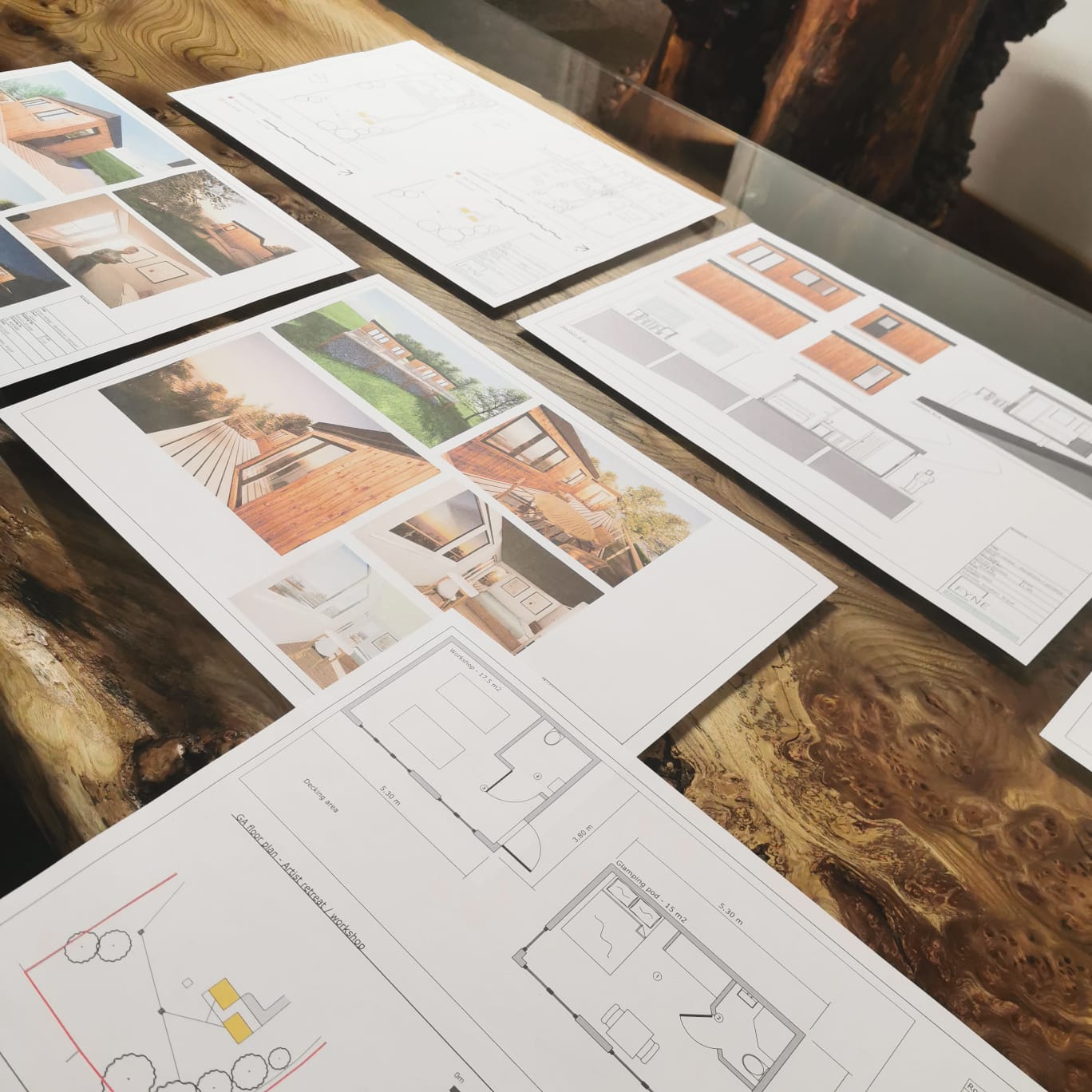
Fortunately, we have a friend who runs a company who have the skills to make something like this happen. Without Stuart and his company Fynewood, we would have given up long ago as we have tried to navigate the labyrinth of planning. Along with Ronan (who handles design and planning) we came up with something…
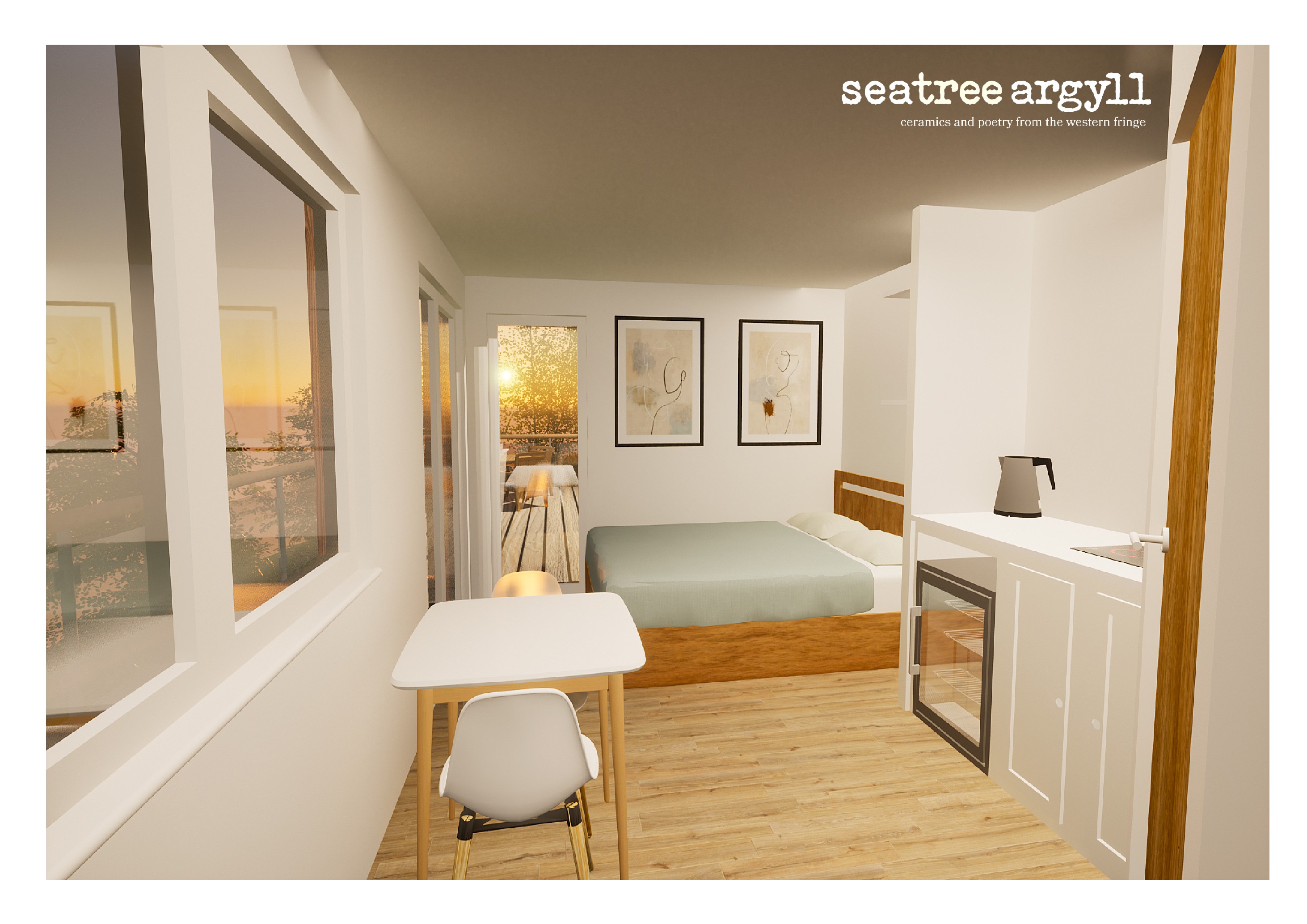
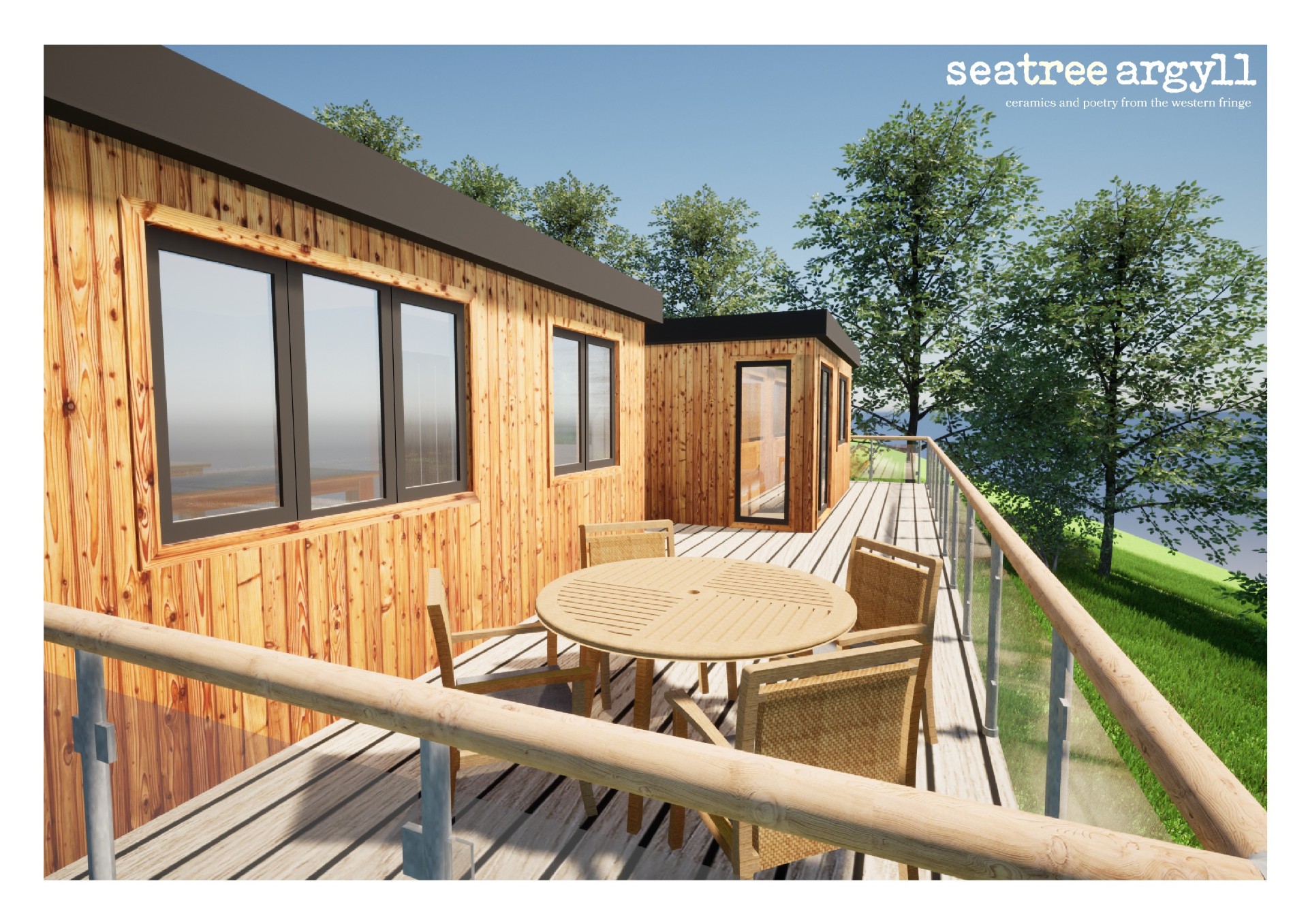
We now have planning consent to put up two small buildings – one a micro-lodge with shower and amenities, the other a workshop with disabled access loo. We intend to make the whole site fully accessible to people in wheelchairs by putting in a graded pathway and decking.

We will then use the premises in a number of different ways;

  • A place for people to make artist retreats. People will be able to book both the accommodation and the workshop for either four, seven or eleven nights.
  • We intend to make some slots available at low/no cost to artists who would otherwise not be able to participate.
  • Our own workshops. Pottery, retreat days, poetry and writing days.
  • Guest workshops. Working with our network of artists and creatives, to host a wide range of arts, crafts and writing.
  • Bookings by other artists to run their own events.
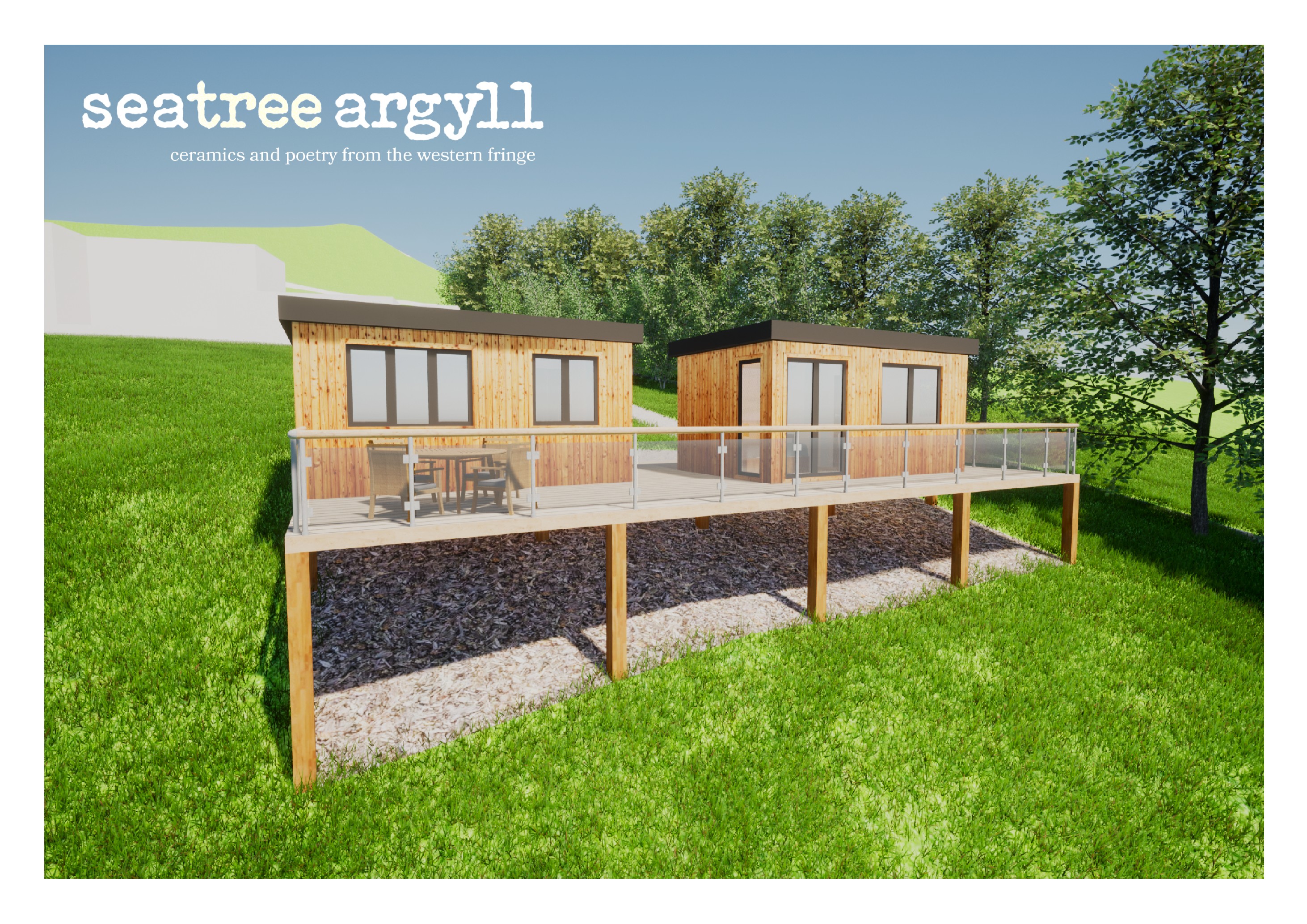
As you can imagine, the costs of making this happen is a real challenge – particularly as these costs have been rising constantly, making everything much more expensive than when we started this process. Conditions imposed by the planning department have raised these costs further – we are still negotiating some of these conditions.

Despite this, we are pressing forward, determined and very grateful for the support of Fynewood.

But now we need your help.

Firstly, there is this survey.

If you are an artist, and you have ever taken, or would like to take, an artists retreat, then we would love to hear from you.

If you have undertaken workshops, would like to start or attend more, we would love to hear from you.

If you have run workshops yourself, we would love to hear from you.
Crowdfunding

The next way you might be able to help is to support this project more directly – specifically with the accessibility side of the project. Feel no pressure, but if this project connects with things that you find important and you have some spare cash to put towards it, then we would be most grateful.

Back in 2020, we were amazed when our crowdfunded ‘shop shed’ was so well supported. We decided to reach out once more to our wonderful supporters.

We have set up a new crowd funding portal, with a set of rewards as before – both physical things, but also the opportunity to book in advance as a way of investing in the future.

You can take a look here.

Creative Scotland have a system of match funding crowdfunded donations (up to a combined total of £10K) so your contributions might count for double!

Help us make this plan a reality. Help us create a space for hospitality and creativity, Let us bring good things out of this good ground, together.
Art as agitator/discomforter/confronter…

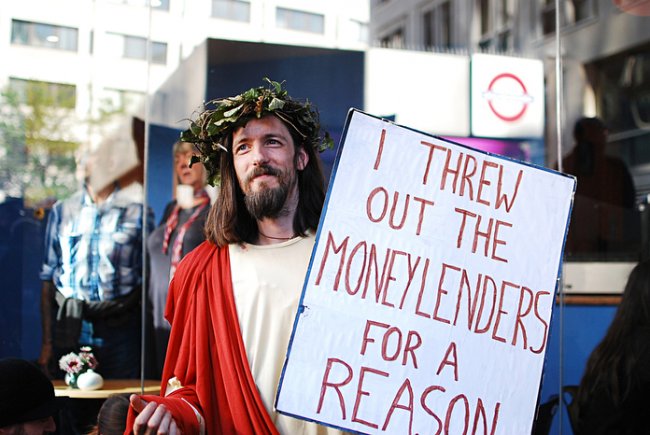
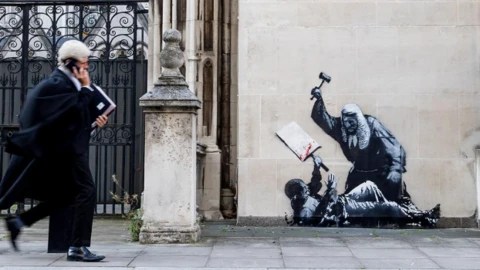
This image is everywhere.

Why? is it because it is ‘good’ art? I am not sure how to judge such a thing. Is it because it is brave and fearless in the face of unyielding bureacracy? Perhaps there is some of this here. Is it because it captures a mood- a national feeling against an unjust law? I hope so. God knows, we need our post-modern Prophets even more than the ancient Israelites did.

There remains something else too that makes me slightly uncomfortable- the celebrity mystique of protest art that is allowable somehow because it has been owned by the establishment – permissable as a democratic safety valve that pretends towards non-conformity whilst at the same time playing the art game as well as everyone. The Banksy machine is very well oiled after all…

He even made a self-aware film in which he describes the rules of the machine…

Michaela tells me that the inverse snobbery in me never allows me to fully enjoy anything that is popular, and this skews me towards art that is made on the edge, the fringes rather than the centre. The irony here is that I love art that challenges our culturual assumptions injustices but in order to do this, it has to break through the algorythms somehow to reach large numbers of people… just as Banksy has managed. For art to engage, it has to find vehicles that will allow it to travel.

Here is a case in point. I was recently asked to supply some poetry for an art exhibition entitled ‘A colourful world’. The idea was to place some poems on coloured cloth and drape them in the entrance. I suggested this poem from 2014 as it seemed to fit the theme rather well. Each three-line verse taking a different colour as inspiration. It was my attempt to consider the beauty and brokenness of this wonderful life that we have, in all its different colours…

Blue hangs like a limp flag above him

Stirred only by half-a-breeze

Always waiting for tomorrow

.

Light falling through these trees

As if through ten green bottles

Hanging on for the fall

.

In a crush of commuting greys she wore bright orange

Less to draw attention to herself, more in blazing protest

Against complicity, against the curse of ordinary compliance

.

Yellow says hello

As the summer strips the grass to straw

And flowers forget their gazing upwards

.

Red bowl of the sun in a darkening sky

Curtaining so fast that I reach out

Grasping as to cup it, to keep it close

.

Pink flesh unfolds like a flower

This fragile child, as if fearing the late frost

Now wrapped up safe in mother

.

The night is purple, not-quite-dark

Wide open like the mouth of a whale

Or the space between stars

.

Black like before-life, like un-pregnancy

Like before the big bang roared outwards into us

Before love made anything possible

.

Grey like the day she came to say “The time has come for leaving”

The sun itself was choked by cloud

The very sea was weeping

.

Water falling down on these old rocks

Gilding them with liquid silver

This normal place, anointed

.

Age has turned your hair pure white

Like the soul that dances in you

You are cathedral and I, your evensong

.

Sunlight makes alchemy from mountains

Now gold in the evening mist

Far beyond the wealth of kings

.

Brown like the ground where we lay down

The earth is pillow-soft

And waiting

After accepting this suggestion , the curator later gave me a print-out of the poem with crosses next to the verses he wanted. Black, pink and brown where all out, as was white. He only wanted ‘positive’ verses, or ones he could understand. He wanted a kind of ‘Hallmark’ poetry that was pretty, ornamental, but unchallenging. When I suggested this was not the way that most of us experienced this colourful world, or wanted to engage with it through art, he told me that I would have to deal with the ‘complaints’. In the end, we did use most of the poem, but it left me thinking again about art gatekeeping.

Photo by Tracy Le Blanc on Pexels.com

What does this look like at my end of the market? Where are the organisations that would foster/network/encourage/publish this kind of art?

Of course, in this internet age, we are all our own agents, our own publicists… each one of us has the same chance, right? The same access to the communal megaphone? Except it does not seem to work like that. In a world in which we all have access to mass connection, it has remains as true as ever that the media IS the message.

Art that challenges can not play by the same rules. It must find other ways to support and sustain itself.

It is for this reason that I am involved in the Proost project, which is an attempt to network and bring together a community of artists around the intersection between faith and social justice. This is not about selling product (although this has to be part of it) rather it is about finding a collective voice.

This meet up is a chance to be part of what Proost might become. We would love you to be part of it.

Saturday will be a day for networking, sharing ideas and making art together.

There will be a ceilidh in the evening!

Sunday will be outward facing, inviting the wider community of Castlemilk into spaces we have created. There will be live Raku firings and other installations.

We are very grateful to St Oswalds, Kings Park Parish Church and to the wider diocese for hosting and trusting us.

For more information, check this out

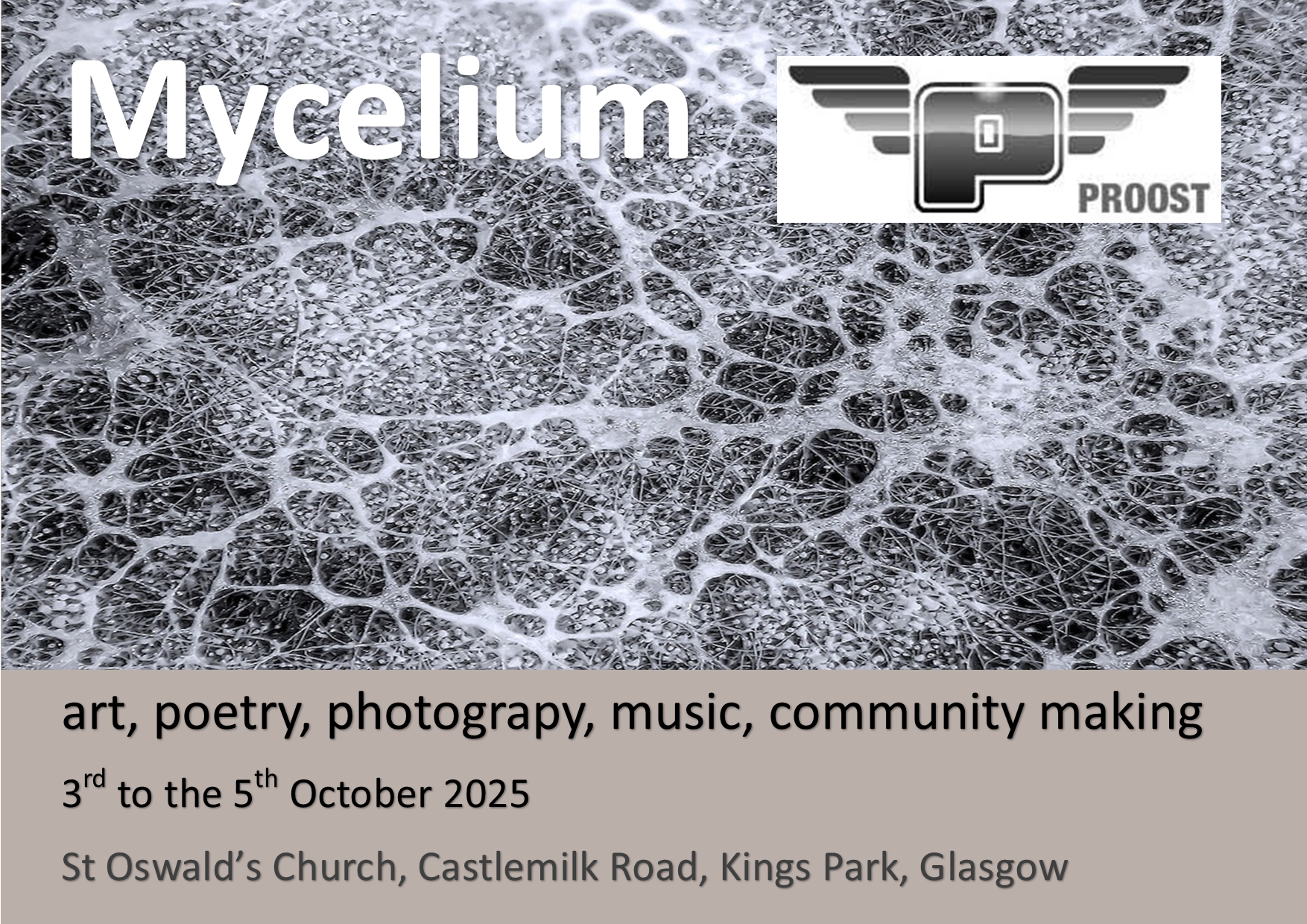
ARTISTS CALL – weekend exploring the theme of Mycellium, with Proost.

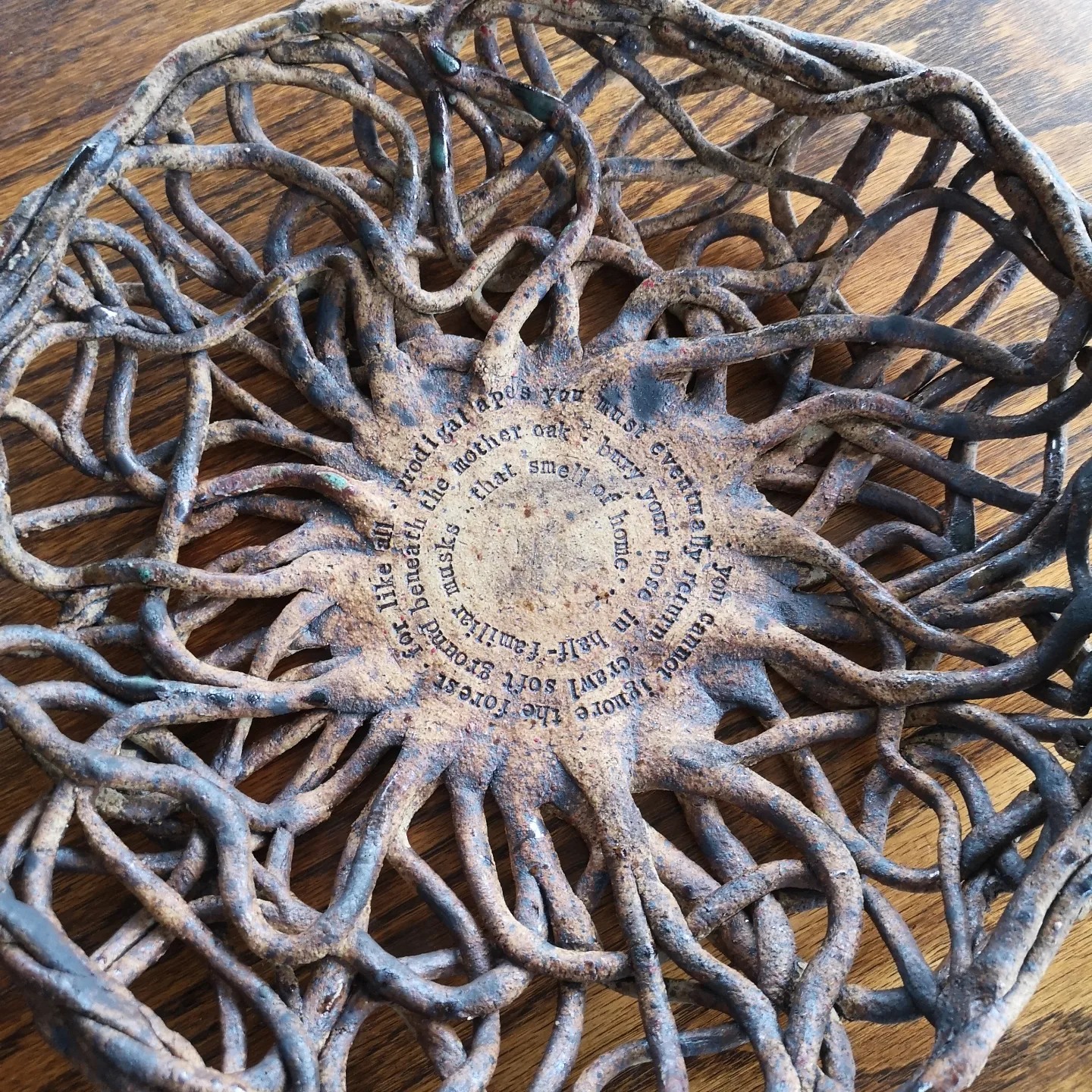
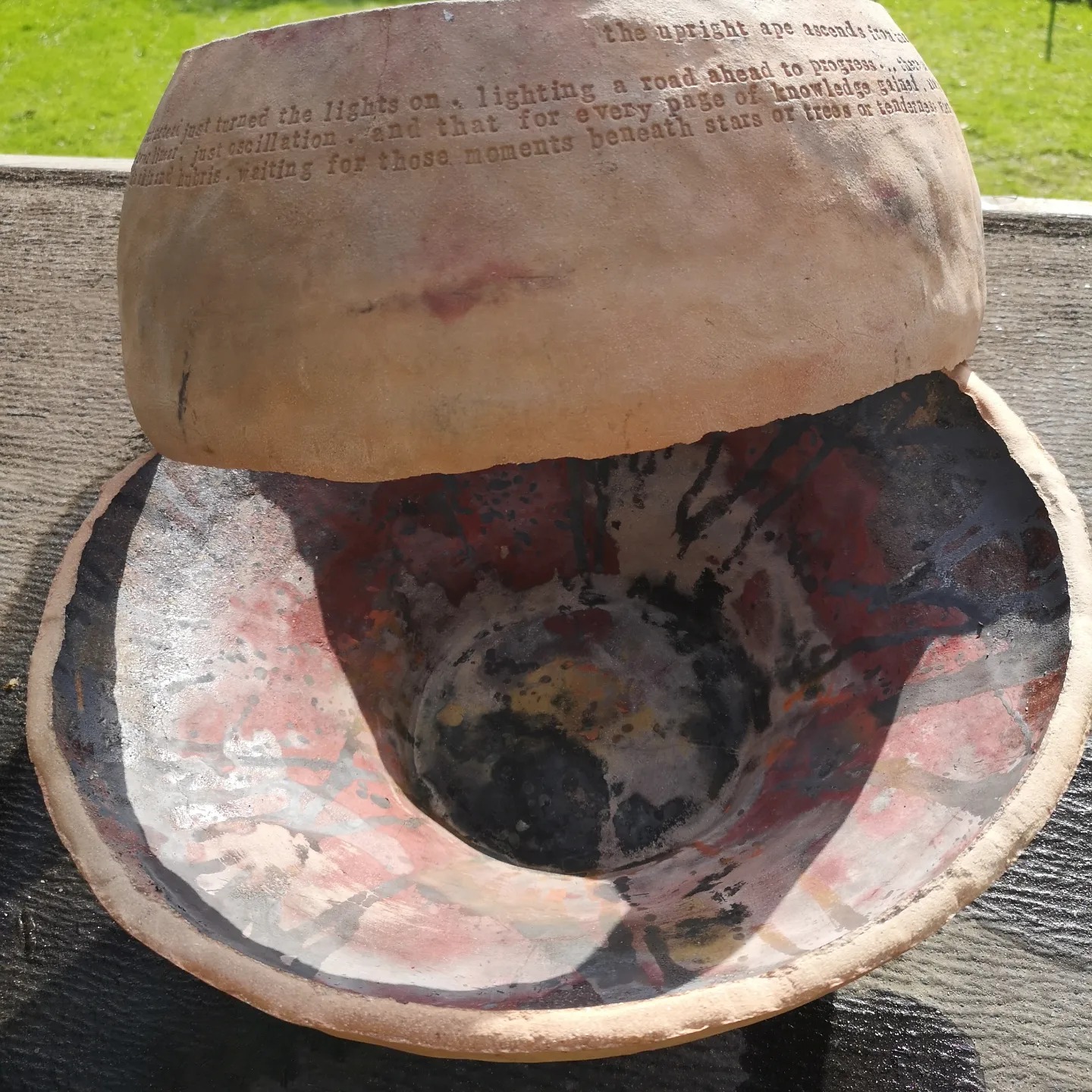
fungus bowl, seatreeargyll.com

Here is a quick update on the Proost meet up for artists in Glasgow. First, the key details;

PROOST MEET UP, 2025

Date: 3rd October 2025 (6:00 PM) to 5th October 2025 (4:00 PM)
Location: St Oswald’s Episcopal Church, King’s Park, 260 Castlemilk Rd, Glasgow G44 4LB

Hosted by: Proost, in partnership with local Episcopal and Church of Scotland Churches
Cost: The gathering is free, with the aim of making this gathering as accessible as possible for all.
Accommodation: Informal hosting options are available for those who need them, and we’re happy to provide guidance on nearby accommodation options to help you make your stay as comfortable as possible. Let us know how we can assist you!

WHAT IS IT ALL ABOUT?

Many of you will remember Proost as it used to be- a publishing platform established on the edge of what we used to call ’emerging church’ or ‘missional groups’ or ‘alt worship’. It gathered a community of creatives who made poetry, art, video, music, liturgy and much more. For many of us, it gave a sense of belonging and connection – and ways to collaborate with other artists in both gathered and dispersed events. We live in different times now, but if anything, creatives need these connections more than ever.

We need art that engages, that challenges, that allows us to go deeper.

We need to hear from people who are otherwise marginalised.

We need to speak of justice and peace, so challenge where appropriate.

We need to take allow our art to connect with the deep spirituality of the earth.

The landscape of faith and culture has changed a lot in the decades since Proost first came on to the scene. Communication technology has made publishing easier, yet at the same time so much harder because of the sheer volume of content being produced. Funding streams and generating income is a massive challenge. Against all this, we have a powerful tool called community.

This is our dream for a new Proost- the means by which we combine our voices, our creativity and our resources to transcend the limitiations imposed by our context in service of justice. We think this is a holy pursuit, made ever more urgent by the crises gathering around us- wars, climate breakdown, inequality and political/economic impotence.

Much of this discussion has been taking place via two podcasts…

The main feed

The poetry feed

… and we have made a start with some collaborations around Advent and Lent.

But we feel that community also needs to make physical connections. We need to come together in one place, to share stories, to make plans and art together.
WHAT WILL WE DO?

The idea is simple- choose a theme and then invite people to respond to it using their art – music, poetry, painting, dance, pottery, photography, animation, video – or anything else.

We will make space for as many contributions and expressions of creativity as we can comb together in the form of installation or performance. The only limitation is that you need to bring those contributions in person!

We are so grateful to St Oswald’s Episcopal Church (King’s Park, 260 Castlemilk Rd, Glasgow G44 4LB) in partnership with local Episcopal and Church of Scotland Churches for generously hosting this weekend.

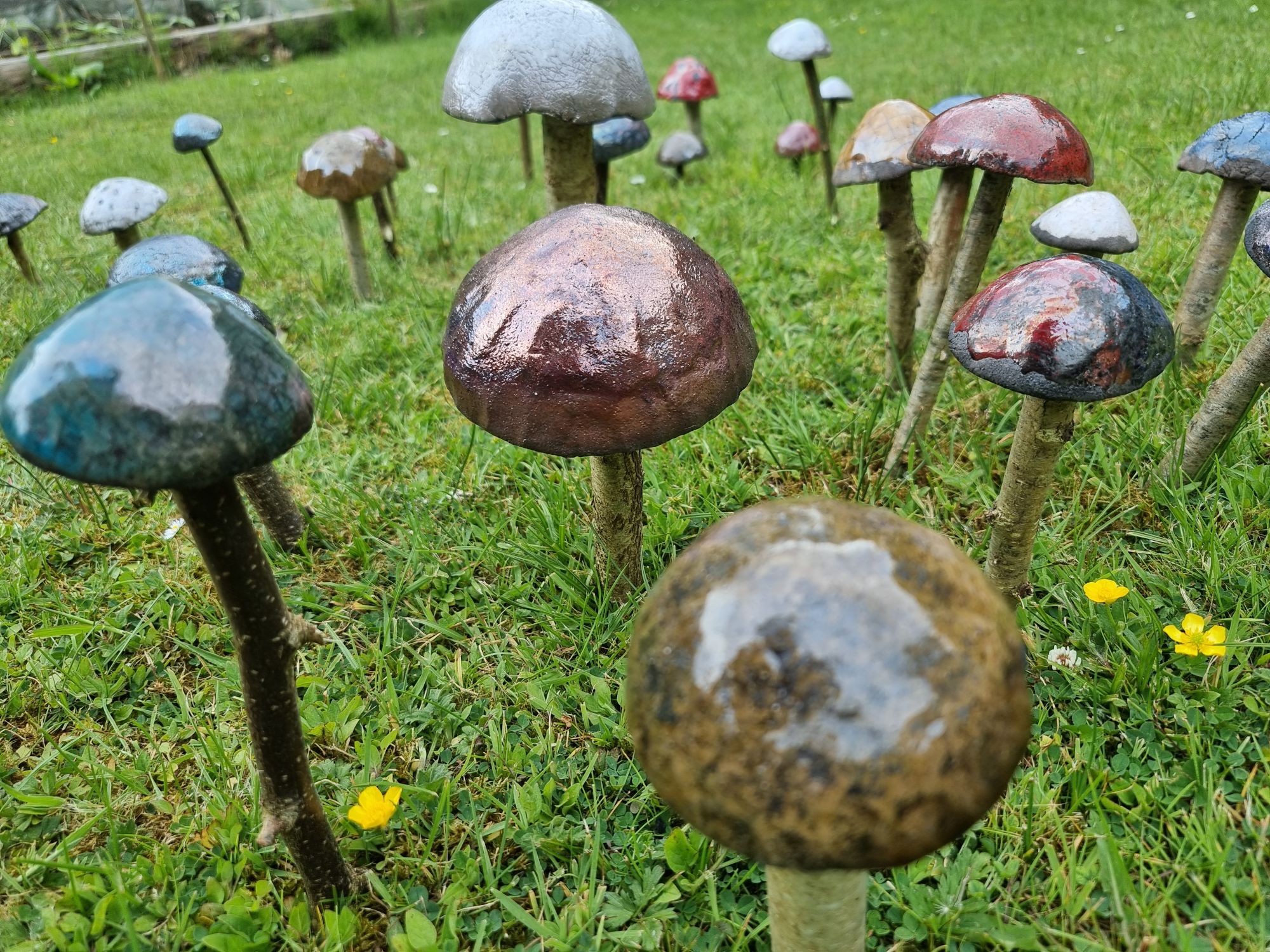
Installation space will be in and around the St Oswalds. (This will include a large mushroom-related ceramic offering!)

Performance opportunities will be via 1. A great big Ceilidh on Saturday night – dancing, hopefully interspersed with all sorts of other poems, songs and stories. 2. Sunday afternoon event. Both will be open to local people.

We want to keep Saturday day-time for discussion and chat amongst Proostians – working out together what seems important, and how this project might progress. There will be themed discussions led by different members of the team.

20250519_1500171594497244553114269

WHY MYCELLIUM?

This is the theme we have chosen for our meet up. Some of the reasons for this will already be in your heads, but here are some ponderings that might help unleash your own creative responses.

Soil science is advancing rapidly – we now need to stop thinking of soil as just inert dirt. It might be more accurate to regard it as a living entity all on its own – but if that is a little fanciful surely we need to understand that it is a complex ecosystem- one which almost all other land based life on the planet depends upon. Without soil, we die. Crucially, the role of mycelial networks in connecting, communicating and making communalities is increasingly being understood to be so much more important than previously thought.

Mycelium is the way that trees ‘talk’ to one another. Think about that- one life form relies upon another lifeform in order to share nutrients, warn of disease and so much more.

We modern humans tend to think about the natural world as being characterised by competition, the elimination of weakness and ‘survival of the fittest’. We have taken Darwinian ideas, misunderstood them and used them to justify our economics, our politics – even our spiritualities. The more we understand about mycelium, the more we need to think again.

Perhaps the ‘survival of the fittest’ might better be understood to mean that we survive best when we seek to fit with our context – when we seek connection and community.

What are we connecting with? Does mycelium only represent a way to understand human interrelatedness – with both each other and with the wider natural world? I would argue however that we might consider this connection to be much deeper than that.

These ideas have always been at the heart of the Christian story, not least the mystical traditions and the Celtic wisdom traditions, both of which have long emphasised that it is through God that all things live and have their being. In the Celtic understanding, God is to be found at the centre of everything, even us. We encounter him by going deeper.

Richard Rohr, in his magnificent book ‘The Universal Christ’ show us a different window into this way of understanding, in which the Christ is ‘another name for everything’ – the cosmic consciousness through which the universe expanded and came into being. We are all held in this commonality and invited to participate according to the deep truth of love.

As followers of Jesus, there seem to me to be so many other resonances here.

  • Unity and Oneness:

Jesus called for a unified community, where individuals, despite their differences, are “perfectly joined together” in their minds and judgments. 

  • Body Analogy:

He used the image of a body with many parts, each playing a vital role, to illustrate the interconnectedness and interdependence of his followers. 

  • Love for Neighbour:

Jesus emphasized the importance of loving one’s neighbour as oneself, which encourages cooperation and mutual support within a community. Compassion and love are a natural law that we need to be drawn towards.

  • Serving Others:

He demonstrated the importance of serving others, highlighting the value of helping those in need and working together for a common good. 

  • Collaboration and Partnership:

Jesus encouraged his followers to work together, emphasizing the importance of partnership in living as agents of the Kingdom of God.

HOW TO GET INVOLVED?

We need ideas, songs, poems, film, images, dance, liturgies. We will ‘curate’ these in advance and include as many as we can. HOWEVER- this is about community, so we need you to bring your ideas, not just to send them. We will make the event together.

We have some very limited funding, and the offer of some accommodation. We don’t want money to be an obstacle for anyone.

This is the start of a new thing. Come and help shape it. On saturday we want to explore ideas together- to talk of Poesis and dream of how art and spirituality move togther and miight lead us forward.

If this is interesting to you, what you can do is

SIGN UP VIA THE PROOST WEBSITE

This will not commit you to anything- we will keep you informed, that is all.

If you have ideas you want to talk through,or want to know more, or have questions, we would love to hear from you- you can get in touch via the website, or drop me a message via the comments below, or send me an e-mail at thisfragiletent@com

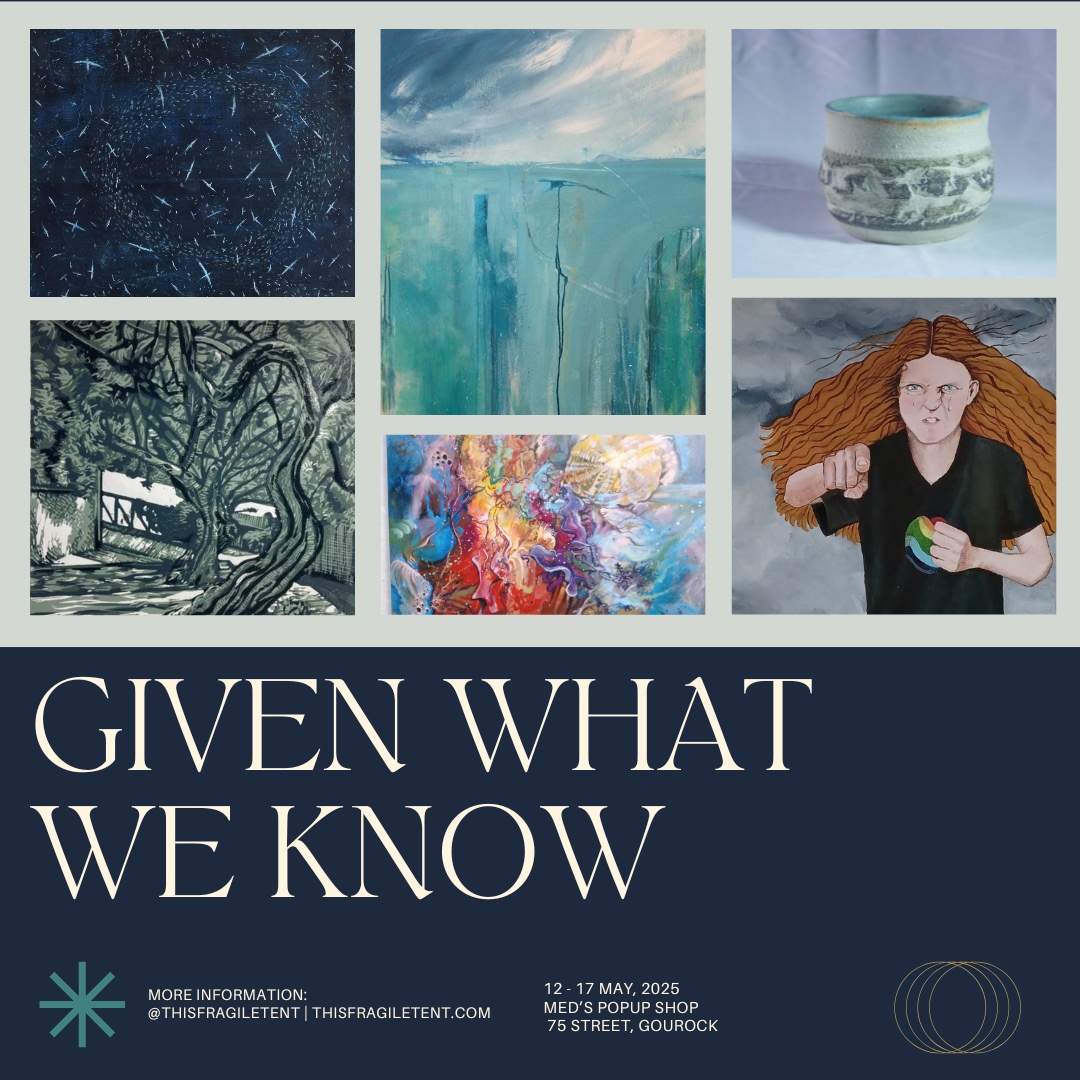
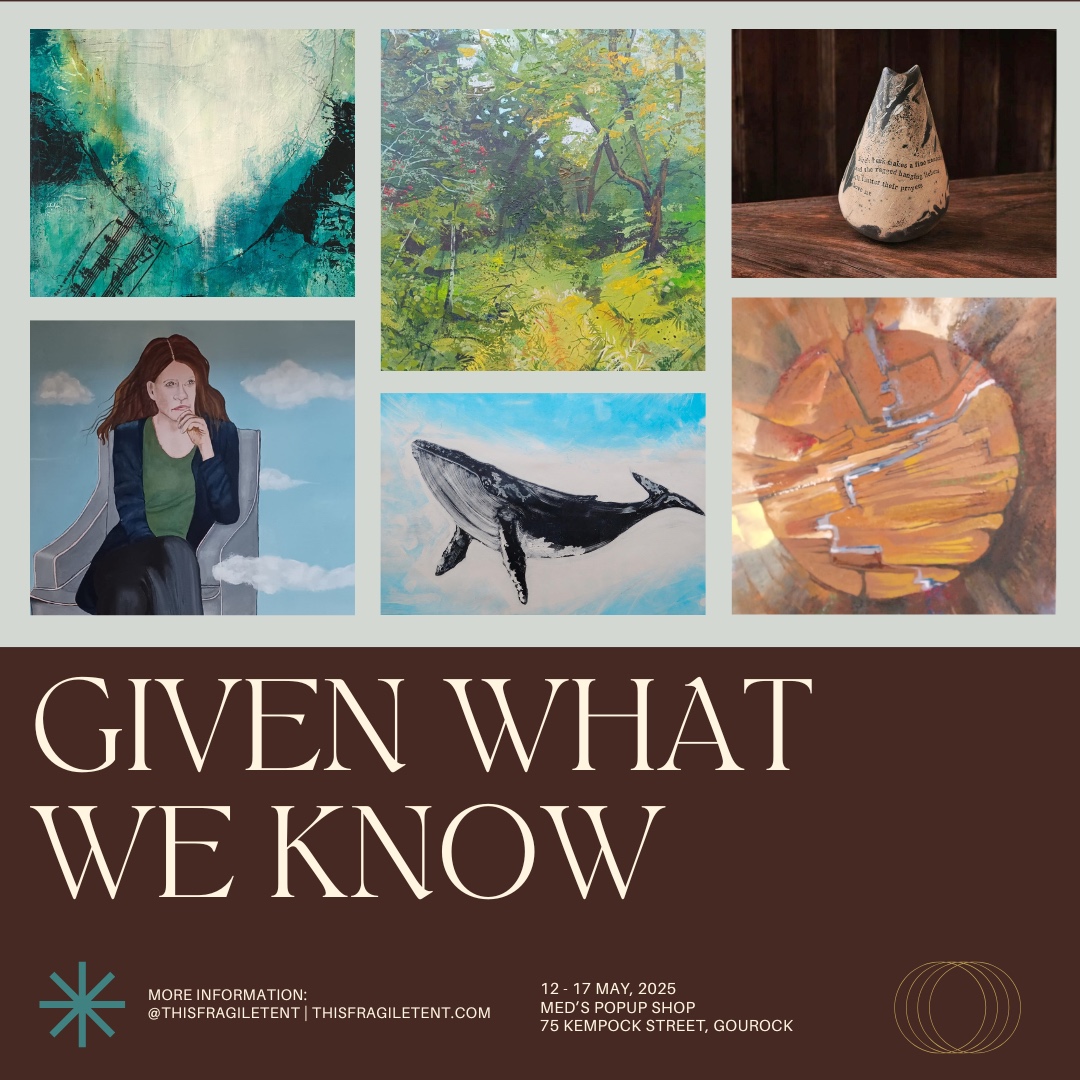
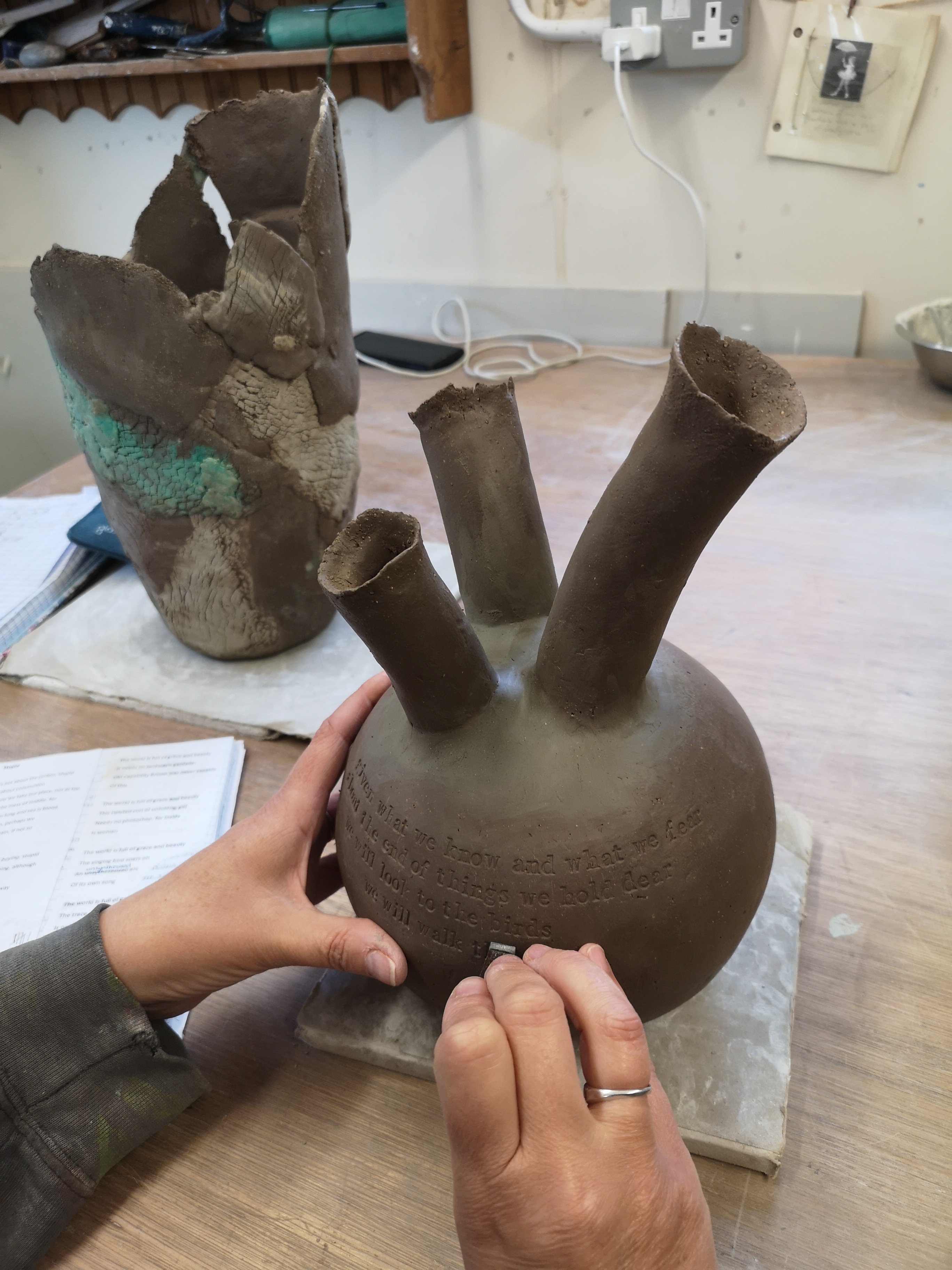
“Given what we know” pop up art exhibition…

The art world here in the UK has a bit of a new trend, in the form of pop up art exhibition spaces, typically in old shops. Accross the Clyde from where we live there are two such spaces. They tend to get booked very quickly, so we booked some slots. Then we began to wonder…

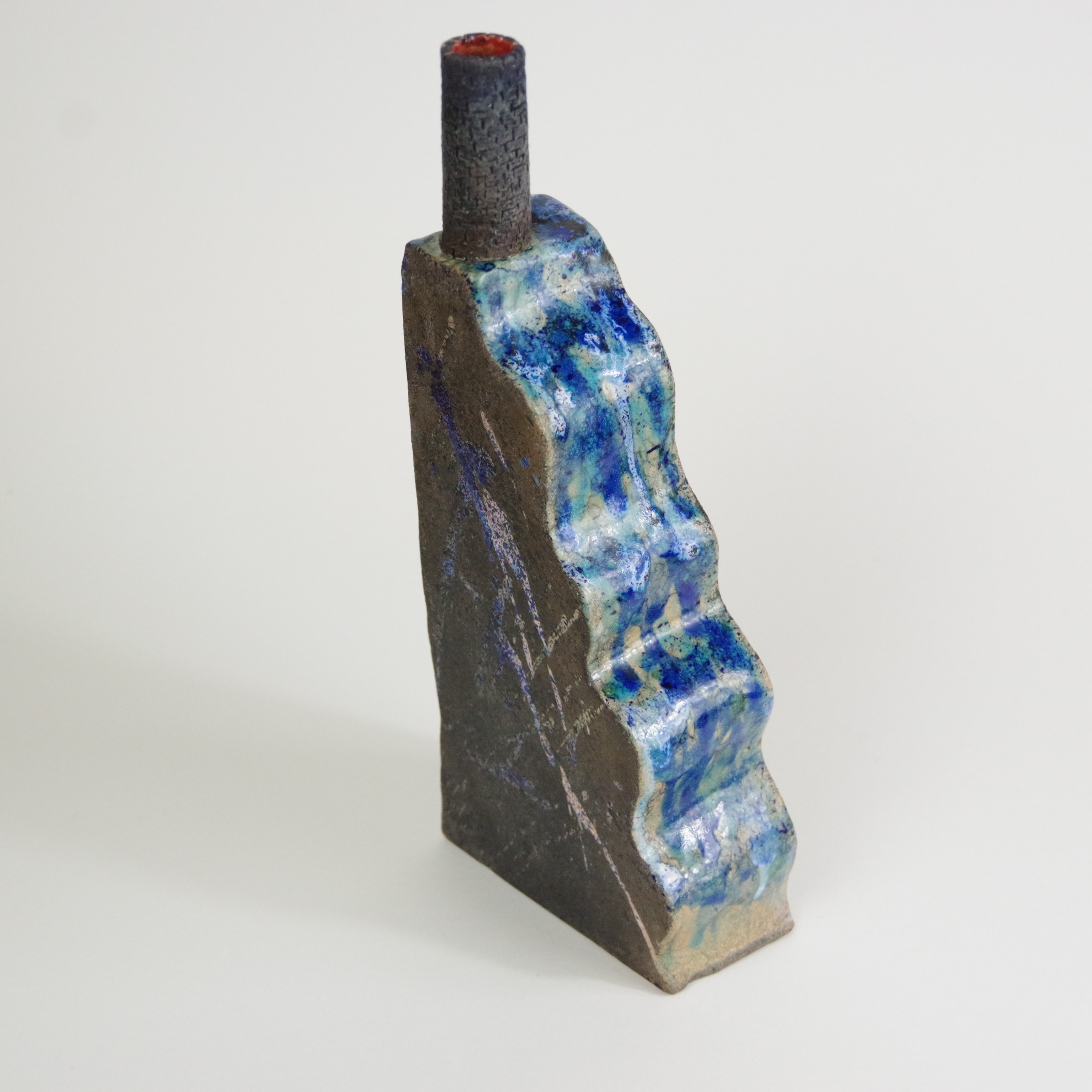
Our son-in-law James makes ceramics ‘inspired’ by trauma following spending years as an oceanographer, watching the arctic icesheets melt. Meanwhile, our art and my poetry was constantly trying to explore themes of brokenness and earth connectedness. We started to wonder about a joint exhibition…

…but then we started to think bigger and invited some others to join us.

Jules Cadie with his landscape inspired paintings

Jenny Philips with her stunning playful portraits

Karen Komurcu with her beautiful linocuts

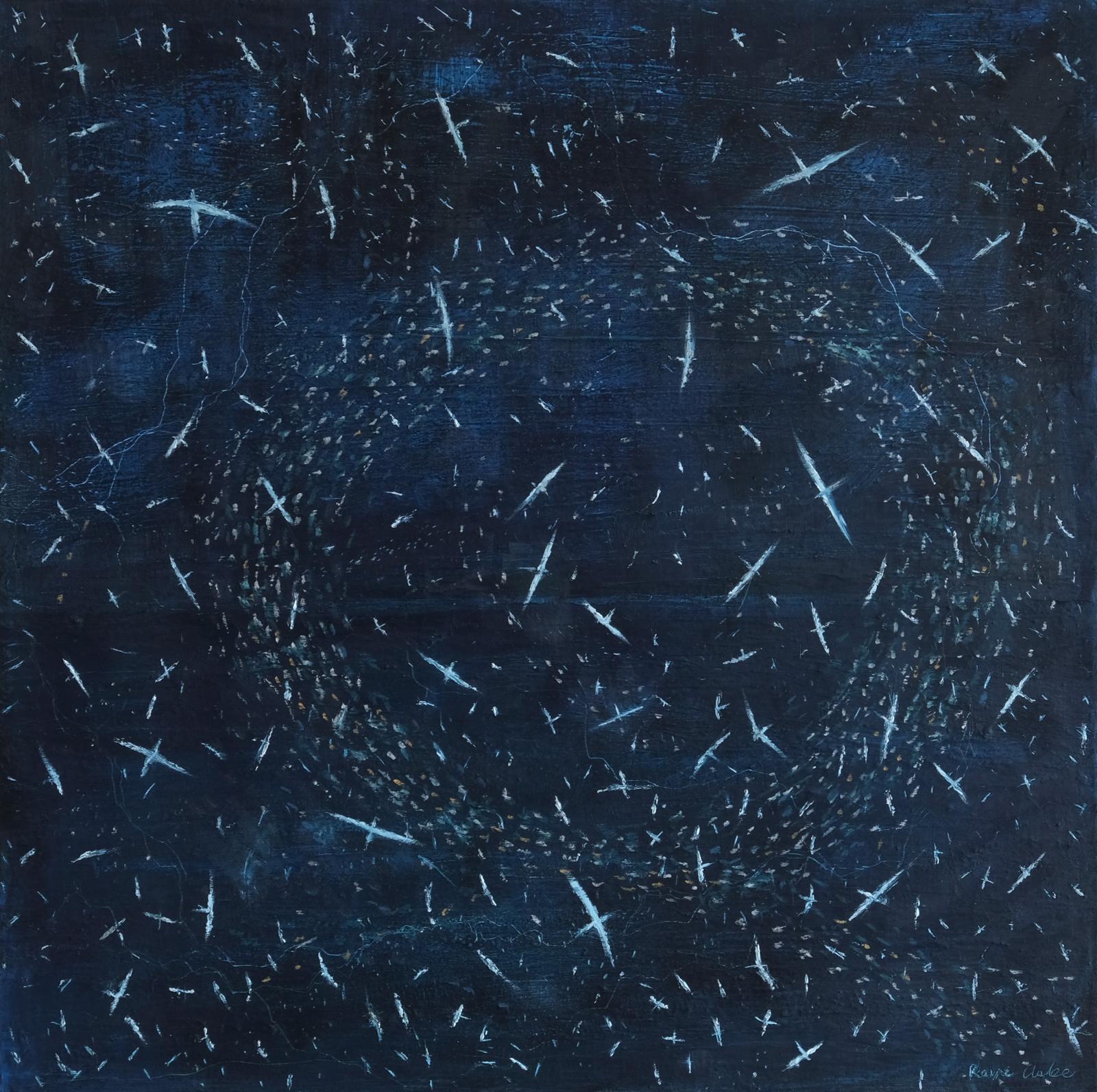
Raine Clarke with her printmaking and general creative magnificence.

Paul Knight with his creative explosion of ceramics, sculpture and ink drawings

Yvonne Lyon who is not content with being a singer-songwriter, so also makes stunning abstract art.

Here is the brief for the exhibition, based around a poem that some might recognise.

“Given what we know and what we fear about the end of things we hold dear, we will look to the birds. We will walk the woods that remain, and we will sing”

How do we respond to a world in omni-crisis in which our politics, our economics, our spirituality – even our protest movements  – all seem broken?

In a world polarised and splintered by algorithms, what does goodness look like? We know there are no easy answers to these questions.

Perhaps, like us, you are experiencing hope as a rare and hard to reach commodity.

In this context, we need our artists and our poets more than ever…

Raine Clarke

Launch evening

On Monday the 12th of May, we will be having a launch evening in the exhibition space. There will be live music and Poetry, not to mention the odd tipple. Watch social media for more details!

If you can join us, please do!

Art as evolution…

Over the past few years I have been grappling with a new craft. Even though we have run a business making pottery for about a decade, Michaela was the potter really whilst just worked around the edges, helping out with some of the donkey work. My areas of creativity were outside the use of actual clay. Then it all changed.

First, I began working with a different clay body- with much more ‘grog’ mixed in (ground down fired clay.) This was much more forgiving than the white stoneware clay that Michaela loves so much, more plastic and willing to hold shape – or at least I think so. Michaela might protest. These qualities of the grogged clay mean that building bigger vessels is that bit easier, but also this kind of clay also has the capacity to cope with so much more thermal shock, meaning that alternative firing methods are possible… so I started making big old pots and trying to fire them in pits dug in the garden, with mixed success!

Then I discovered raku.

Time for a short introduction to clay firing.

Most pottery is fired in kilns, either electic, gas or more rarely, wood fired. All three methods introduce variations to the process and to how the glazes in particular react, due to the conditions created, for example the degree of oxygen present during the firing.

Using a purpose build kilns allows careful control of the temperature, which in the case of our electric kiln will step up around 100 degrees per hour, then cool down over a long period of time. This means that failures in the form of cracking (or even exploding) pots are minimised and colours from glazes are reliable and predictable.

There are other methods however, most of which require specialist clays. These include pit firing/barrel firing, saggar firing and most drramatic of all, raku firing.

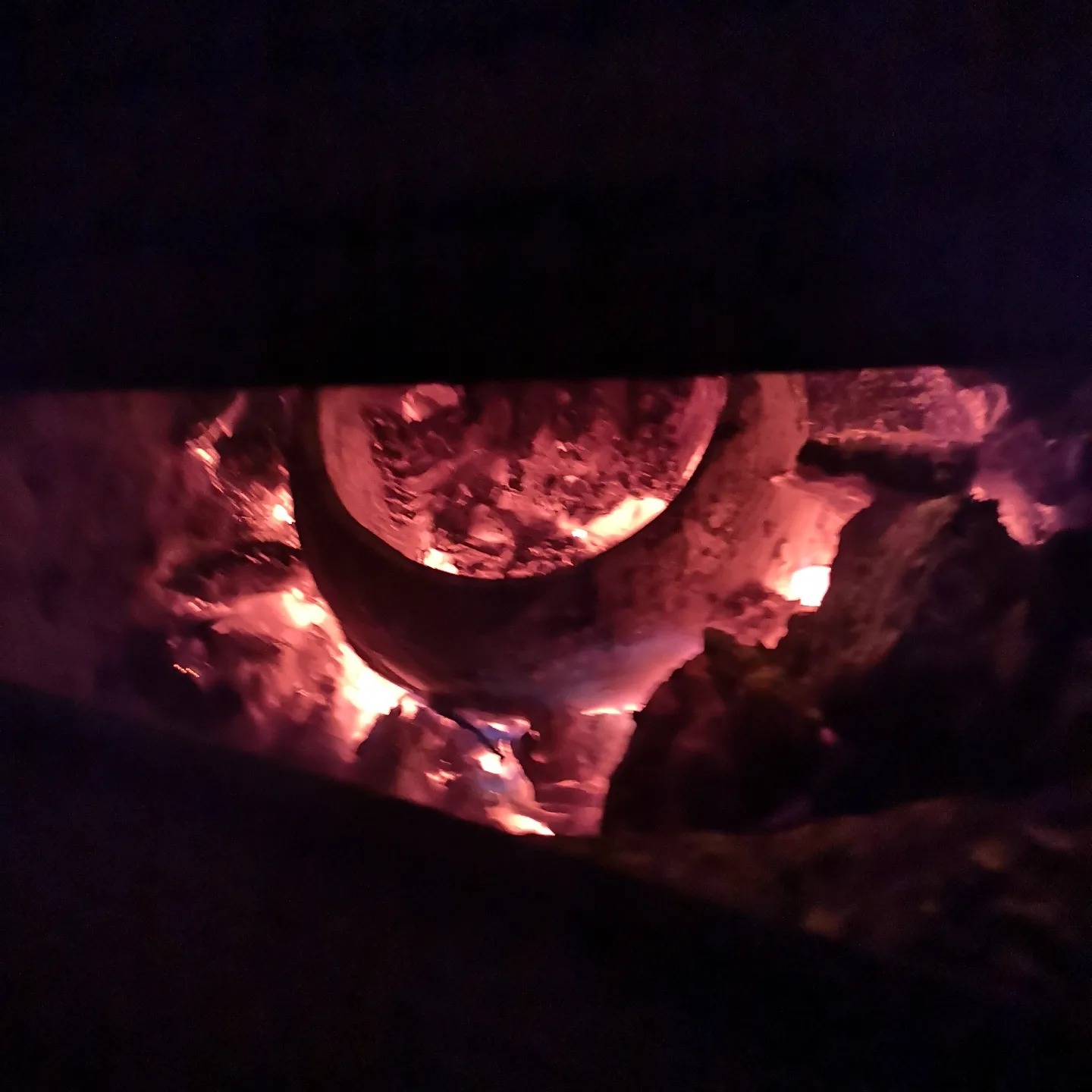
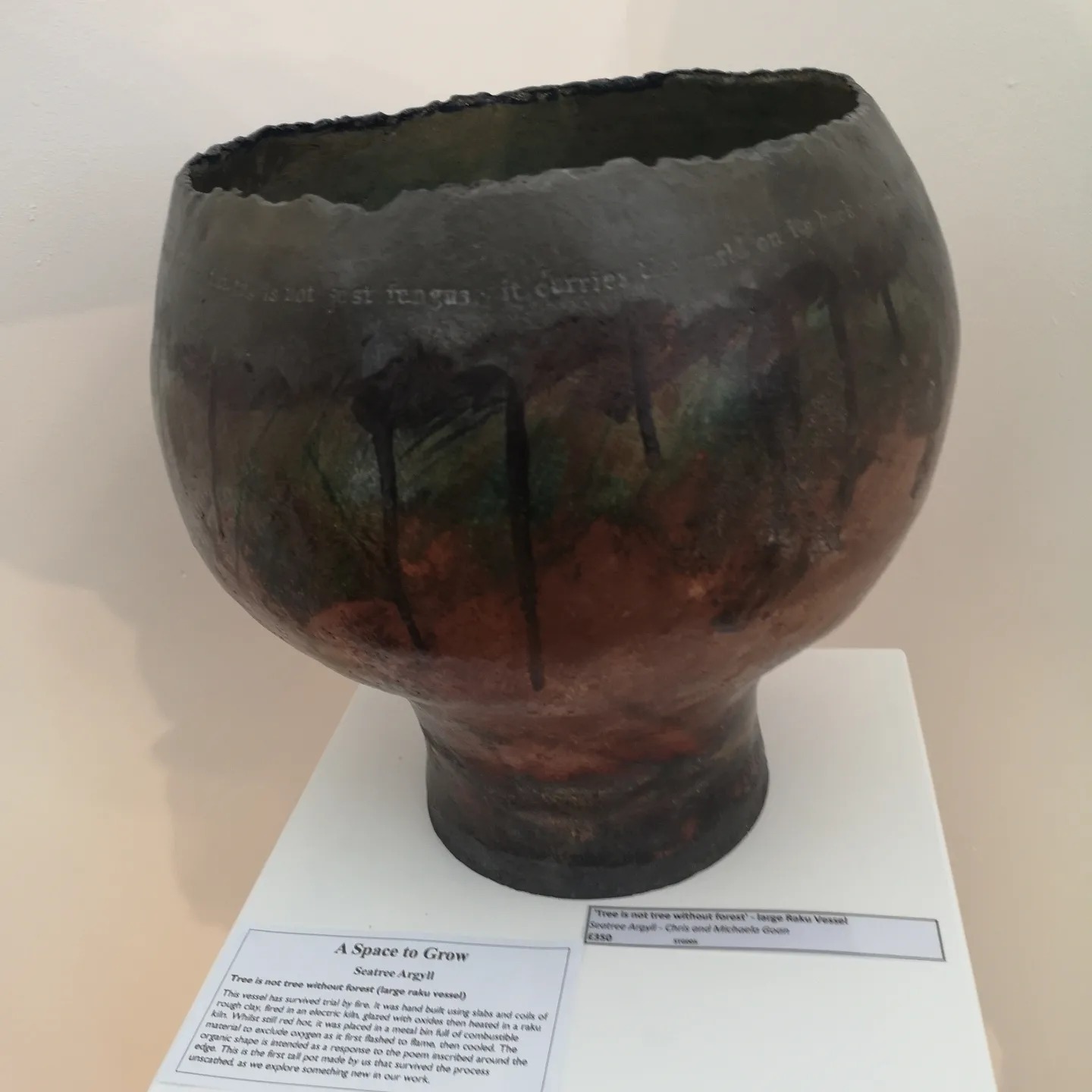
Raku, meaning ‘easy” in Japanese, involves heating up a previously fired pot to 1000 degrees in an insulated container- typically a barrel or a dustbin – using a gas burner. The pot is then removed and placed in a sealed contained along with combustable materials. The oxides and glazes applied to the pot will then react in the oxygen depleted conditions to form bright colours, crackles and textures.

The thing is about this kind of pottery, it is always shifting, changing – it never quite arrives at a destination. It is art by experiementation and evolution. Perhaps all art is like this, but let me explain what I mean.

Functional pottery might be understood as the means to perfect a process in order to create a usable shape. As such, potters are developing their shapes and glazes to make their versions of archetypal forms. There is art and beauty in this that is beyond my skills. I look in wonder at many of the things that people are able to make. I hold their mugs in my hands as if they were grails. This is not what I am trying to do.

The pottery I am making is not really in puruit of shape or colour (even though both are essential elements) rather they are chasing after meaning. So when I make a pot, I am not asking if it is a ‘good’ pot, I am asking if it carrys any meaning for me. Has it told a story? Has it opened up a space or framed something that asks questions that I find important?

Let me tell you, this kind of art can drive you mad.

It is rarely sarisfied and never completed. There are no real reference points for comparison, other than whether someone is prepared to pay money for it.

The evolution thing I mentioned before suggests an ascendancy, in which we get ‘better’ and certainly I have learned through lots of mistakes and failures, so that I at least make different mistakes now rather than the same ones. I am also slightly more able to steer the chaos, but as I look back on some of the things I made previously, I wonder if I have gone in the wrong direction since. Perhaps I should have made more of the same?

But who am I kidding… this is not an option. The quest I am on is always after meaning, and so I have to search for these in new shapes, new ideas.

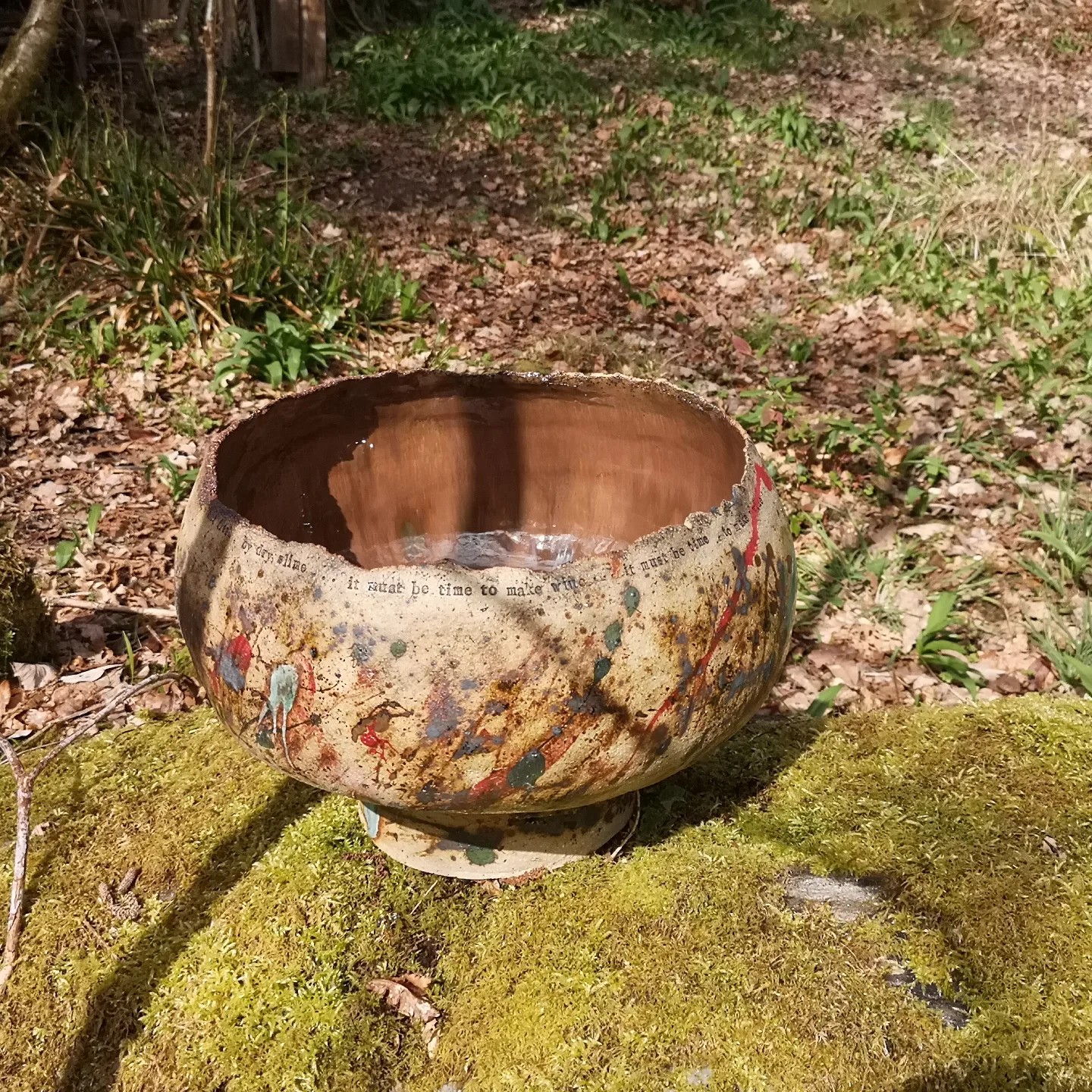
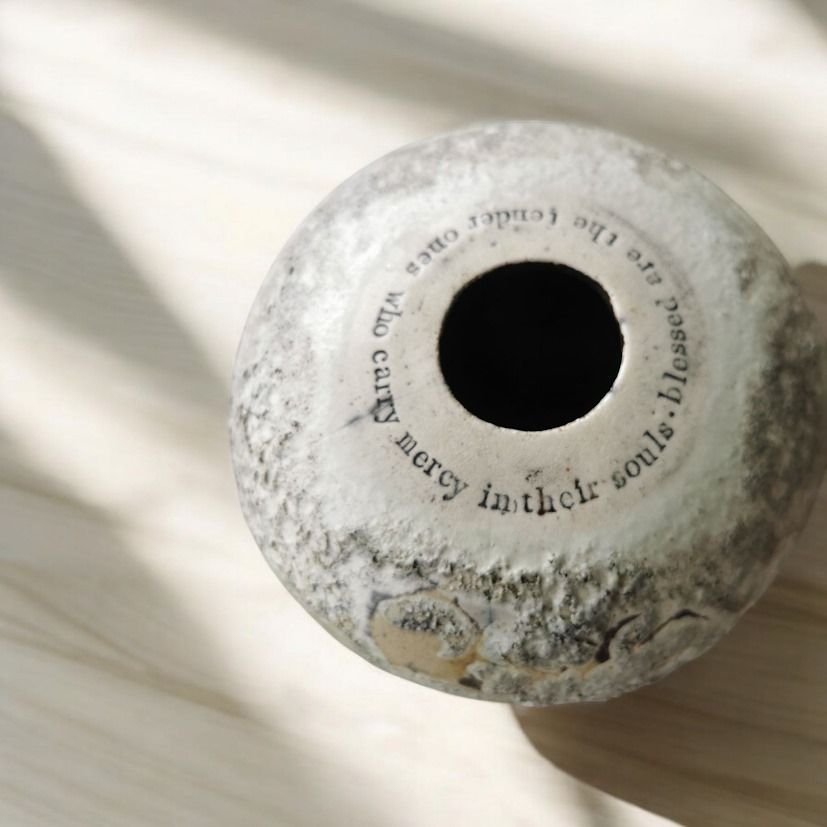
I have a secret weapon however, in that our pots use poetry. This alows me to set up an interplay between words, form and colour in such a way as to gather meaning more directly. In other words, I can cheat.

One last thing about this evolutionary quest- it is entirely addictive.

There may come a time when I am done with it – music was like this for me once – but for now, if a couple of days goes by without me spending significant amounts of time in pursuit of my clay meanings, I am anxious for a fix.

In the spirit of charity, it is possible you may be interested in helping out this addict in his continuing quest.

Some of our work is available in the website shop, here.

Much of our larger work is simply too big for us to make available through an on-line shop – It is not really ‘postable’ after all – these are more likely to be things we take to ceramics shows or place in galleries (and we work with some fantastic galleries!)

Perhaps the best way though might be to come and visit us. Drop us a line first and see what we have in our storage shed. There may well be a bargain or two to be had!

img-20241120-wa00062668580301732975181

Remaking religion pod 6: pod chat…

You may be aware that Rob and I have been podcasting as a means of making connections relevant to the revival of an old publishing platform called Proost. What this might look like is starting to take place- we are determined that whatever Proost is will depend on the community that comes together to make it happen. Our committment is to provide spaces for this community to happen. If you are interested in knowing more about this, feel free to drop me a message, or join our facebook group– it is a closed group, but this is simply to keep it a safe supportive place for those who need it.

This advent, we will be inviting artists to contribute to a collaborative daily offering

Some of these will be live poetry readings.

We would genuinely love to connect as many of you who want ot be part of this embryonic movement. There is a possibility here of the development of a very different kind of space for spirituality and creativity. It may be chaotic, but Rob and I are determined to make sure that it will be kind, supportive and fun.

Photo by Pixabay on Pexels.com

(We don’t have posh mikes on our pod by the way)

Rob is a lovely man. He is so encouraging and enthusiastic about other people’s work – mine included. He had been following the long form ponderings on this blog about the renewal of religion (spool back through the feed – we are up to 7 posts in the series now) so he asked if we could chat through some of this on the Proost podcast.

Iniitialy I was reluctant, for these reasons;

  1. I was not sure I could articulate my thinking in a chat. I tend to think by writing. In the end though, I decided I did not need to post it if it did not go well!
  2. Was the Proost format an appropriate place for this discussion? As I thought about this though, it seemed to me that the Proost project is driven by the same thoughts and feelings
  3. Finally, I am conscious that so many friends – including some who areninvolved in Proost – are still very much involved in organised religion. But then again, most of these have similar frustrations with elements of the old religion.

So we had the chat. In the end I enjoyed it – perhaps too much, as Rob had to slow me down! Being interviewed rather than being the interviewer is an interesting experience, and I was surprised how far the themes and issues unfolded. We will probably do one more as well. I will leave it to you to decide whether the podcast format helps to explore these complex issues more helpfully than written words…

Here it is.

Music and spirituality…

Photo by Vishnu R Nair on Pexels.com

This week and next week there will be two Proost podcast episodes released, featuring interviews with musicians. The first one (out already) is with the rather wonderful Ant Clifford, of the band Lofter. Next week we will hear from our lovely friend Yvonne Lyon.

These chats are part of our on-going pondering as to the shape and purpose of a revival of Proost, an old publishing organisation. It might be interesting to note that before the old Proost took on the role of publishing loads of written material, video and animation etc. it was first concieved of as a record label.

Photo by Eric Esma on Pexels.com

The questions we are trying to explore are some of these;

What role does music take in our spiritual lives? More than just soundtrack, might it actually shape us in real and meaningful ways? If so, how?

What kinds of music might we want to showcase? Who might help us navigate a world we know little about, particularly the music being made by non-white,non-male, non-middle-class people like us?

What is the difference between worship music and ‘music of the spirit’ of the kind we are most interested in?

Who is making this kind of music? Are there people out there who should be heard, but are struggling with an indifferent music money machine?

Is there a need for a simple network to support grass-roots music that seeks to make a difference?

Photo by Clem Onojeghuo on Pexels.com

We have an inkling (particularly following these two conversations) that musicians need connection, just like all artists do. In fact, there may be particular reasons why musicians need this more than most. The music business has taken such a pounding in the last few years. The rise of streaming services has placed all the earning power out of reach of all but the biggest stars, and the pandemic left many performing artists in a hole. Meanwhile rising energy costs are forcing many vanues that previously supported live music to close.

As Yvonne points out, music is also relational at heart. The image of the tortured bedroom genius, making tracks on a laptop, might have some basis in reality, but actually, music flies when it is made in community, when it sparks between different creative inputs on different instruments. It comes alive when people listen. It creates a space in which people can transcend, almost uniquely.

But it can also be a hard road, and musicians need one another.

Photo by Edward Eyer on Pexels.com

Creating open spaces for encounter…

Photo by Zachary DeBottis on Pexels.com

I have this grandiose, unreasonable, impractical and unlikely-to-ever-happen-in-the-way-I-want-it-to idea.

(Full confession, I have a lot of these, but this one feels more urgent – it beats in my chest.)

I want to create events in which we use art (music, poetry, photography, dance, film, painting, etc etc) to make open, inclusive spaces for encounter…

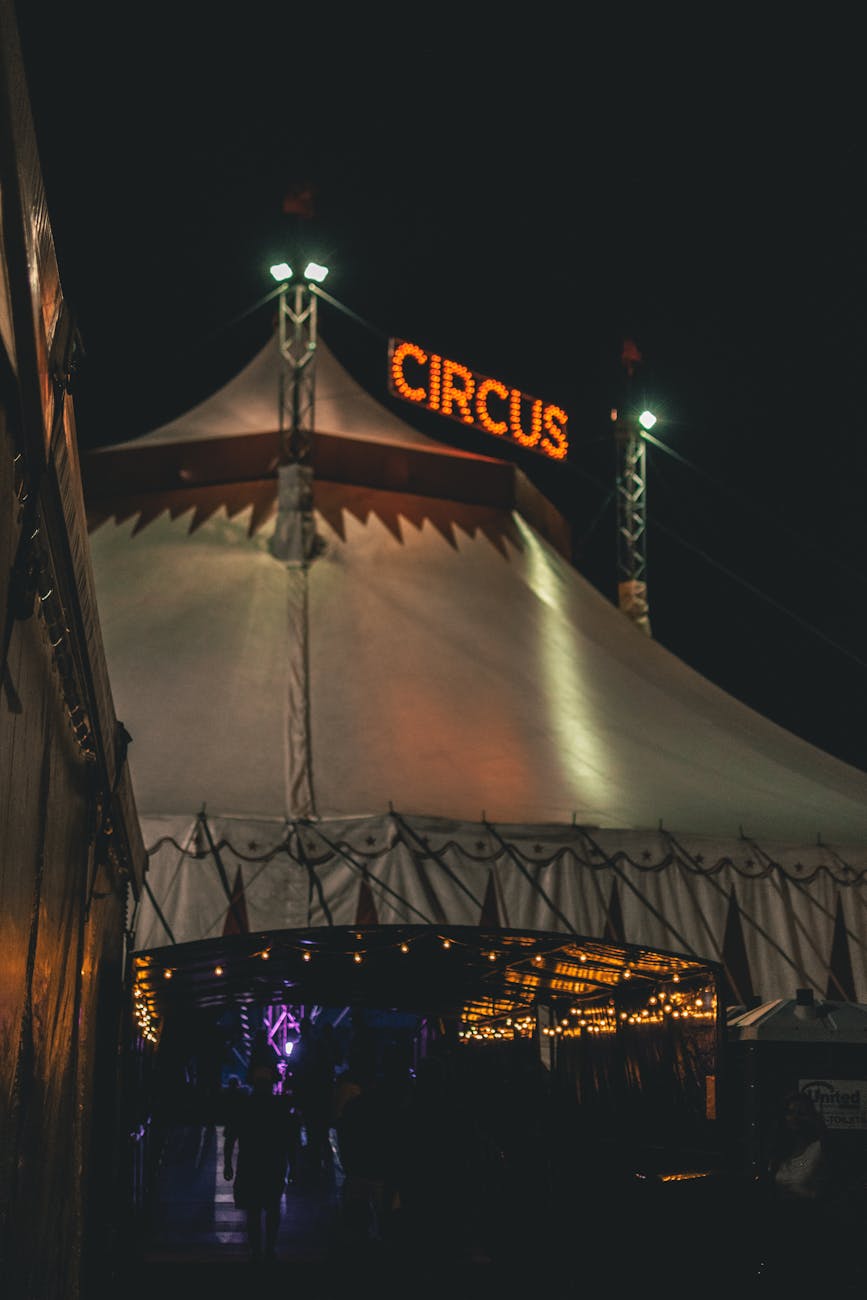
A kind of circus for the spirit.

What do I mean by ‘encounter’? I made this list for us to pick from. You can have all of them, just one, or any combination inbetween;

  • thinking deeper
  • connecting
  • laughing together
  • collectively hoping for better
  • Lamenting all that we have lost
  • making spiritual connection
  • protesting where it is overdue
  • lyrical, poetic, sensonry immersion
  • imagining a healing for our broken world
  • including those who have be excluded
  • chaotic collaborations between artists and disciplines
  • weeping together

I am sure this list will get longer, but questions may occur to those of you who are (justifiably) suspicious of my religious intent. Am I just trying to reclaim my long rejected evangelicalism? What am I selling? What version of god am I re-hashing? My only answers are that we all approach these things through our own experiences and limited perspectives, but what I am dreaming about is a space in which, broadly, we accept difference.

I could spout truisms about being ‘intolerent of intolerance’, but if I’m honest, some of my prejudices are precious to me, so I may have to work hard to stay open. (I suspect most of us are the same, to variable degrees.)

There is a tension here too in that art of the middle ground – inoffensive and safe – is very much not what is in my mind. Art has to challenge, divide and even outrage, not because that is an end in itself, but because it seems to be an emergent quality of good art, as well as an emergent quality of any attempt to engage with our culture in a prophetic (as in failthfully critical) way.

As for the god I reach towards, what I said above applies too. I long for a movement towards good, and feel sure that art and activism are vital components of the pre-political, spiritual journey that we make individualy and (perhaps more importantly) collectively.

Whether the idea of god (or God) is helpful to us as we make this movement is ambigious to me – I think this position is consistent with my (current) understanding of the teachings of Jesus, but I am interested too in how other faith traditions – or none – might illuminate our open spaces.

What might this circus look like? How might it happen? Where would it happen?

Don’t spoil my dream with practicalities! Dreams don’t have to be tested by reality. Except I really hope this one is, so here goes…

Think of a theme… something fairly broad and abstract but likely to provide a window into which we project and see. Perhaps it could be a subversion of an old religious idea like ‘redemption’, or a more opaque concept like ‘obscure’, or a politically charged idea like ‘equality’.

Invite artists and co-conspirators to consider the theme… this is where we need to be well networked, to invite a wide range of creatives into our ‘big top’. The community that develops must seek to include, to treasure, to encourage, to mutually inspire. They will bring their egos too, so each event will need a curator – someone who can see the whole picture and put together a story…

Find a space and time… we need venues prepared to host us and take risks. Perhaps these might be underused church spaces? I love the idea of doing things in forests too. Each artist ‘owns’ this space and time, so they use their own networks/social media to create anticipation.

Collaborate… on day one, the artists bring their work together. Poems and songs are woven with pictures and film clips. People dance and bang drums. There may even be juggling. An order is agreed. Technology is made ready.

Perform… on day two, the big top doors are thrown wide and members of the public are invited inside. The event unfolds. People laugh and cry. They catch glimpses beyond and long for better.

Photo by Timur Weber on Pexels.com

How do we pay for all of this? (There you go again, with your dream-bubble popping.)

Is art of this kind every capable of funding itself? I don’t know. It depends on what artists need to get out of it, I suppose. Ticket sales might cover some if not all costs, and artists may have their wares to sell… artists have to live after all, we can’t exist on ideas alone.

There are other values- the community, the friendship, the tribal nature of the happening. Then there is the wider exposure, the potential spin-off colaborations, the love of the art and the ‘experience’, but I am painfully aware that many artists get frustrated with these kind of discussions. Artists have to eat and pay the rent too, so my dream also contains the hope that we can pay a fair wage.

I suppose I would be upfront here and say that I don’t think the circus of the spirit will make any of us rich- otherwise it will cease to be of the spirit and be increasingly of the wallet.

I would love to know what my artist (and non-artist) friends think of my unreasonable idea…

Proost podcast with Jonny Baker…

The third Proost podcast is out, here.

This one features an interview with Jonny Baker, who probably needs no introduction to readers of this blog, but here goes anyway.

I first met Jonny back in the early 2000’s, during a very different time of my life, and perhaps a very different context for Christianity/faith/spiritual exploration in the UK. Back then, Jonny’s blog was one of the go-to places for connecting to all sorts of new things that were happening, under labels such as ‘alternative worship’, ’emerging church’, ‘small missional communities’ and eventually, the more anchored, institutional ‘contextual expressions’ of church that came under the title of ‘fresh expressions’.

He is a long time member of one of the first of these ‘small missional groups’ Grace, which is still going strong. I remember a rather sniffy review of one of their services in The Guardian in which Jonny was described as ‘an aging youth’, which I think is Guardianese for youthful looking and all round cool dude.

As an interesting aside, back then, blogs were a thing. Even this one! (As a rough measure, during the early days articles on this blog would recieve hundreds, sometimes thousands of hits, whereas now, dozens. But who is counting?) They were the primary way that we discovered new things, had debates and conversations, heard about new books etc. Jonny’s blog, along with a bunch of others were very important to us. The emergence of so many other communication platforms are one sign of just how much things have changed over the past decades. Our interior and external worlds now have to contend with a part of our persona’s that are neither one nor the other, but also both – fused and formed in the digital, online world. Hmmmmm.

Jonny was doing lots of other things too – he worked/s for the Church Mission Society, in the vanguard of considering how faith engages with culture. Later this morphed into a whole new way of seeing the ministry and the development of pioneer minister training within the CofE. All this makes him an excellent candidate for a podcast trying to reflect on how the context for faith may have shifted and changed, and what art and resources might be relevant to our shifting context…

He is also a father and grandfather these days – one of his sons is rather famous too, the wonderful Harry Baker, poet extrordinaire.

But there was another key reason to inerview Jonny, and that was because he was one of the people (Along with Jon and Ad) to found Proost.

So, if any of this interests you, the third Proost Podcast first takes us through some of the fascinating history, but then moves on to consider our new context…

We would love to know your thoughts. If this is of interest to you, please share the pod because we are trying hard to develop a communal conversation about what a new proost might look like.

We also have a closed facebook group here, which we would love to welcome people to- it is closed so we can keep our conversation generous and generative, not because we want to keep anyone out!

Seatree patreon…

Photo by Monstera on Pexels.com

A few months ago, Michaela listened to one of those business webinar things aimed at small creative businesses, where they were talking about different ways for artists like us to make a living from what we create. The idea was that we could use Patreon as an exchange, in which people give monthly support in return for a sliding scale of content and ‘rewards’.

I confess, I was skeptical, but the reason we are still able to make a living through what we create is because Michaela works so hard to make it work so we gave it a whirl. To our (or mostly my) amazement, a number of people signed up.

This seems to me to be a miraculous and wonderful thing – that some people who I have never met would see something of value and beauty in what we make, so that they feel prepared to support us financially. Our lifestyle is nor lavish and so these small acts of support make a big difference.

How does it work? Well, check it out for yourself, here.The seatree patreon has four tiers, unlocked by different subscriptions, which include things like

  1. access to a private video of yours truly reading a poem
  2. a handwritten anotated poem
  3. a monthly gift
  4. a piece of seatree pottery each month.

The other thing I have discovered is how much I have enjoyed making these short videos. I hope our patreons will understand if I share one of these here as a sneak preview;