Economic lie number 4; inequality is good for the system…

The whole Capitalist system is dependent on aspiration, or so we are told. Our Chancellor of the Exchequer has just heralded his 2013 budget as something for an ‘aspiration nation’- seeking to help those who want to help themselves- those who want to own their own houses.

Without the wealth creators (business entrepreneurs) there can be no long term prosperity. All that you will have is stagnation- look what happened in the old soviet bloc countries.

Without greed we have bad cars, cabbage soup and bureaucrats in stone washed denim.

Except that the rich are getting richer, even WITHIN our western economies. This from The Telegraph;

The world’s rich are getting richer. The Forbes billionaire list was published this morning (there are now 1,426 of them globally in dollar terms, with 210 new entrants in the last year), and collectively they are $800bn richer than they were a year ago. Each billionaire is, on average, $100m richer than in 2011, with an average wealth of $3.7bn.

And the poor poorer; The Institute of Fiscal Studies forecasts that, as a result of UK tax and benefit policies, there will be significant increases in child poverty in the coming years. In Scotland alone forecast trends would suggest between 50,000 and 100,000 more children being pushed into poverty by 2020. (See here.)

And what is more, the argument can be questioned even by people on the inside;

There is the opposite argument too- that the more equal societies are in terms of income, the better its citizens seem to do. This from here;

In The Spirit Level Wilkinson and Pickett base their analysis on data from 23 rich countries as well as data from the 50 American states. They say that in the main this shows that the following problems are much more pronounced in countries with higher levels of income inequality.

Health inequalities: At the end of the 1990s there was an average gap of 7.3 years in mortality between rich and poor people in unequal societies. This can rise to as much as 28 years in some American states. They argue that research shows these differences cannot simply be explained by differences in health behaviours.
Mental illness: They argue that ‘inequality is  causally related to mental illness’; that rates of mental illness are five times higher in the most unequal societies compared to the least unequal.  Illegal drug taking is also higher.
Obesity: Unequal societies are more likely to have higher levels of obesity, with poor people most at risk, partly because of the attractions of ‘comfort eating’.  Indeed the rate of obesity is six times higher in the most unequal, compared to the least unequal, societies.
Divorce rates: There have been larger rises in more unequal societies. This then creates more stress for children.
Teenage pregnancy: This is more prevalent in unequal societies. Indeed in the USA the rate of teenage pregnancy is four times the EU average.
Violence: Wilkinson and Pickett argue that the strongest evidence or the negative effects of inequality is violence figures. The reasons for this are explored below.
Imprisonment: Unequal societies are more punitive. People are five times more likely to be imprisoned in the most unequal societies than the least unequal.
Social mobility: Inequality leads to less social mobility. Inequality ‘solidifies the social structure’ and also depresses educational attainment for the poor.
Women’s position: In general women are less likely to be in higher status jobs in unequal societies and they also have worse health than women in more equal societies.

Wilkinson and Pickett argue that the problem of inequality is not just for poor people: everyone suffers. The life expectancy figures even for rich people is lower in unequal societies than more equal ones. The reason they advance for this is that unequal societies have lower levels of trust than more equal societies. This lack of trust leads to more hostility, fear and lower levels of community participation. In this way everyone suffers.

In the data they present the societies which are most unequal, and have the biggest health inequalities and social problems, are the USA, the UK, Portugal, Australia and New Zealand. The least unequal are the Scandinavian countries and Japan.
 

Christianity and Capitalism- to resist or to accommodate?

I have been dwelling on economics over the past few weeks. One of the things that has often troubled me has been the role that Christianity has had to play in developing a culture of enforced inequality, both locally and globally. At best we have become guilty by association, at worst we provided the moral justification for the whole shebang and then enshrined it in liturgy.

I have written about this before- if you are interested you might like to check out these posts;

Capitalism; a conspiracy against the common good?

Capitalism and Durkheim

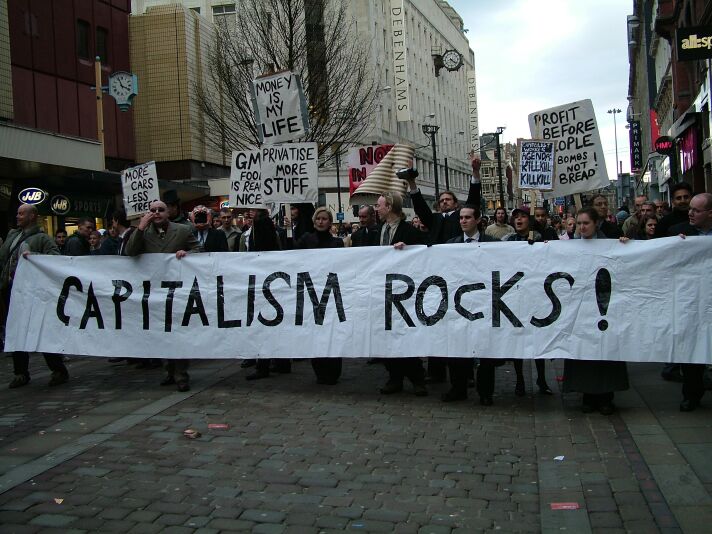
capitalismrocks

Jason Clark has an interesting piece on his blog about the relationship between Evangelicalism and Capitalism, particularly in the US. It is a tough read, but basically, he contrasts two potential kinds of analysis which he characterises as ‘Cultural dispisers’ and ‘Cultural accomodators’.

Firstly the dispisers;

William Connolly, in his 2008 work Capitalism and Christianity, American Style, sets out firstly to diagnose how the ‘capitalist project’ has been perverted and warped by its resonant relationship with conservative right-wing Christian religious beliefs.[1]

Connolly describes how this relationship between an Evangelical right-wing ethos and capitalism is best understood through ‘assemblages’ of media, churches, cultural consciousness, and a ‘spiral of resonances’ that produce the Evangelical capitalist resonance machine.[4]

Connolly’s response to this contention and diagnosis is to suggest that it is within an alternative and ‘counter political movement’,[6] a democratic and left-wing visualisation of a new ethos, that capitalism might be redeemed.[7]

Now for the accommodators;

Pete Ward, in his 2002 work Liquid Church, offers an account of the relationship with Evangelicalism to capitalism that contrasts starkly with those of Milbank and Connolly.

Where Milbank would warn us of the complicity of the Evangelical Church in conforming to the practices of capitalism, and Connolly of the pathologies of the Christian ethos that shapes those practices, Ward critiques the Church for failing to embrace commodification as a spiritual practice and suggests that the Church should be engaged with it even more. For ‘rather than condemn the shopper as materialist Liquid Church would take shopping seriously as a spiritual exercise.’[17] Where the underwriting of commodification by ecclesial practice is inherently evil for Milbank, according to Ward it is a vital and theologically necessary ecclesial practice to the Church.

I have not read Connolly’s book, but I have read Pete Ward’s Liquid Church- which is a great book, although I do not think the points made by Jason do it full justice. What Ward was seeking to do was to get the church to engage fully with the culture we are part of- to flow in its veins. He reckons that it is only by doing this that we understand, that we become relevant, that we can become part of the mission of God for our times. I am not sure that this is the same thing as ‘accommodation’.

Ward uses the example of advertising as a case in point- he suggested that rather than dismissing all such commercialism as ‘of the world’ and therefore having no spiritual significance for the followers of Jesus, rather we can learn so much about the collective spiritual yearnings of our age from advertising. Is this accommodation, or is it being engaged as thoughtful critics?

I am much more convinced by Mike Frost’s book Exiles, in which he compares Christians living in our post-modern, post-Chistendom world to the Jews exiled in Babylon. It is simply not possible to live lives of isolation- neither is it our calling. Rather we have to learn to live as engaged, loving, active agents of the Kingdom of God. This might involve the celebration of aspects of culture, or it might also require us to resist other elements- injustice, prejudice, the power of the strong over the weak. This also brings us into contact with the language of sin and evil- the ways of living that tear into each other and destroy us.

The other polarity that Jason proposes in his piece is that of the dispisers. This is not a word I would have chosen to apply to myself in relation to Capitalism- more because I do not think it would be honest. At the same time as asking my intellectual and theological questions about Capitalism I am very conscious that my whole lifestyle is wrapped up in it.

Back to the direct relationship between Christianity (particularly Evangelical Christianity) and Capitalism. How might we characterise the ways that faith has accommodated? I started making a list;

  1. By emphasising personal, individual salvation above all else. The only useful purpose of mission is to save people from hell after they die.
  2. By embracing success culture. We use the same corporate structures, we reward our religious successes as we would our CEO’s, we value hard measurable outcomes, we construct programmes.
  3. We make mission a kind of hostile take over. Business success involves out performing the opposition, and rejoicing in their bankruptcy. So it is that we see any form of religion not our own as our economic enemies.
  4. Christianity is a lifestyle choice that requires no change to the way we live our economic lives. Yes, I know there is the old ‘tithing’ argument around Evangelical churches, but we drive the same cars, live in the same houses, take the same holidays, fill our lives with the same gadgets- or (and here is the sting) even if we do not have these things, we aspire to them.
  5. We bought into lives characterised by individualism over the collective. The model given to us by the life of Jesus and the early church was all about the collective- how we live for one another, how we hold things in common, how we find ways of including the poor, the weak. Yet these things are not really part of our DNA.
  6. We failed to demonstrate any kind of radical alternative. The best that we have been able to offer is how to live as better Capitalists- more sensible, more responsible, with greater probity.
  7. We did not see injustice, inequality, poverty, unfair taxation, usury, over consumption, environmental destruction, as any of our business. Which relates to point 1.
  8. And where there was visible discomfort with Capitalism, we lacked any coherance, we lacked leadership, we did not become a critical movement. Rather we splintered and focused on totemic side shows live homosexuality and women bishops- all of which is destroying our credibility anyway.
  9. Our mission to the poor was conditional on redeeming them to become like us. Difficult one this, but stay with me. There is lots of wonderful Christian history of engagement with the poor from the Salvation Army right through to local soup kitchens. These activities clean up the edges of Capitalism- but also justify the dominant ethos. It encourages us to lift people back into becoming productive consumers. Like us. It does not suggest that the problem might be in any way systemic.
  10. We forgot that the Church exists not to give us a better life, but to serve the lost and the least. If we are serving the lost and the least, how can we have convinced ourselves that our unsustainable greedy lifestyles are God-given rewards for our moral superiority- which we Brits built an Empire on, and then passed the baton to the USA?

So, the question at the head of this piece- to resist, or to accommodate?

I think we need to resist what should be resisted, and to where there are seeds of justice, of beauty, of grace- there we should plant ourselves alongside and accommodate for all we are worth.

And what would church look like if we took each of these 10 points above and reversed them?


RSA animation’s take on the failure of Capitalism…

I may have posted this before, but given my recent posts thought it worth posting again. It crams so many ideas and concepts into such a short video. The bottom line however is that something ain’t working!

It was done in the early days of the ‘credit crunch’ in an attempt to grapple with what went wrong- what caused this current economic crisis.

Trickle down economics; economic lie number one…

The first of a little mini series about Capitalism that has been nagging at me for a while…

trickle down economics

There was an article in out local paper last week- Argyll and Bute council, like most of our councils, has to make significant cuts to the budget. Despite our large geographical area, Argyll has a low density of population and services are already stretched tight. The article listed the sordid detail of the cuts- older peoples care, youth rehab, road schemes, outsourcing services to the private sector who will do the support of our most vulnerable more cheaply etc etc.

And what is all this about? Why is money suddenly so tight? Why do we all buy into the collective idea that ‘times are hard’ and so ‘we all have to tighten our belts?’

The fact is that not all of us do tighten our belts. Many people are doing very well out of the crisis. This from the Guardian;

The super-rich – the top 1% of earners – now pocket 10p in every pound of income paid in Britain, while the poorest half of the population take home only 18p of every pound between them, according to a report published this week by the Resolution Foundation thinktank, which reveals the widening gap between those at the very top and the rest of society.

Inequality has grown sharply over the past 15 years, according to Resolution’s analysis: the top 1% of earners have seen their slice of the pie increase from 7% in the mid-1990s to 10% today, while the bottom half have seen their share drop from 19% to 18%.

And then there are those right at the bottom- the Strivers who are forced to become Scyvers, or the Skyvers who have lost hope, or those who never had a fair crack of the whip in the first place. Have you noticed that when the economy takes a dip, they always take a hit? They become the problem– the scapegoats.

So we see all these regressive punative policy decisions being pursued by our current government- lower benefits to fewer people, changes to housing benefit to force people to leave their homes if they have an extra bedroom. All this in the context of reductions in care provision, and less funding for voluntary bodies and charities. Our current government is doing things that even Thatcher at her most strident would have baulked at.

But again- why? Where does all this come from?

What the neo-liberal economists will tell us is that the problem is caused by natural adjustments made by a self regulating economic system. That the job of us all is to get out of the way and let it all sort itself out like some kind of higher intelligent life form. The problem, they would say, is an over inflated public sector, whose interference in the natural order of things by public spending, taxation and welfare provision means that the economy fails to self regulate.

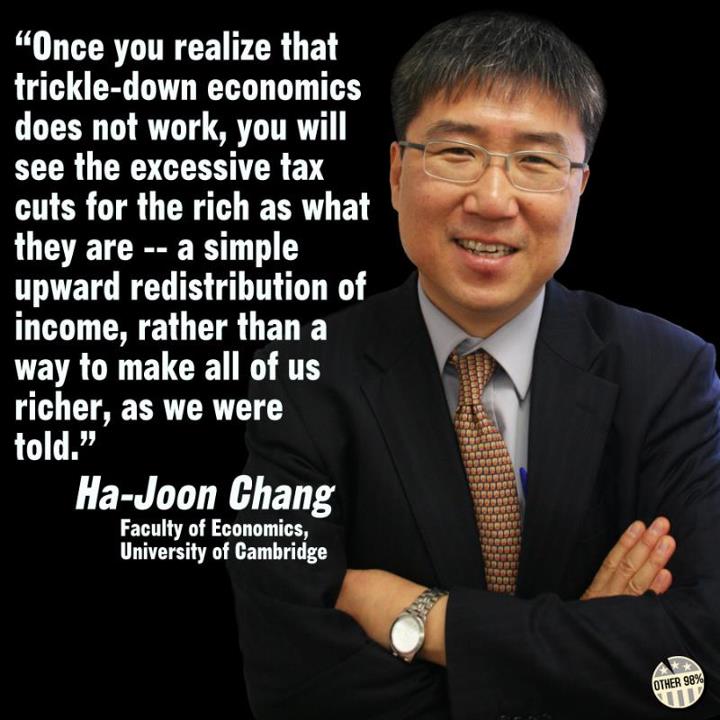
This kind of economic thinking has become so pervasive, so wrapped up in the political system, so much in service of powerful self interests, that we all wriggle on its hook. We are compliant because we have bought in to some of the lies that the system has sold to us- perhaps the biggest one is this one- Trickle down theory.

In a nu­tshell, trickle-down theory is based on the premise that within an economy, giving tax cutsto the top earners makes them more likely to earn more. Top earners invest that extra money in productive economic activities or spend more of their time at the high-paying trade they do best (whether that be creating inventions or performing heart surgeries). Either way, these activities will be productive, reinvigorate economic growth and, in the end, generate more tax revenue from these earners and the people they’ve helped. According to the theory, this boost in growth will ultimately help those in lower income brackets as well.

So, the argument is, if we have lots of rich people, and they are encouraged to become super rich, then our country, and our economy, will benefit- right down to the roots.

This analysis does not regard the wealth of the few as contingent upon the poverty of many- in this country and even more crucially in the poor countries around the world whose raw materials and cheap labour we are entirely dependent upon.

It also does not conform with the facts, as the rich get richer, and the poor get poorer.

As the worlds resources are over consumed by the few and our environment continues to be damaged, perhaps beyond repair.

As austerity plans are still touted as ‘good housekeeping’, as if the UK economy could be compared to a household budget.

So, what is the alternative? Fairer, more progressive tax systems? This might be a start- but I think the problem is the system- and we are all part of the system aren’t we? It is really hard to get out of it- the mortgages, the gadgets, the foreign holidays and the dependency on technology to deliver distraction, entertainment and connection.

Where is the Kingdom of God in all of this? What are we, the agents of this Kingdom , to put our energy towards? I am convinced that we need to be engaged critics of injustice wherever we see it- particularly towards the poor and the marginalised.

And the beginning of how we can do this is to take a look at the system through a different set of lenses…

A window into the underbelly of a nation…

I have a confession to make- I watch too much TV.

We have a Sky TV package at the moment which we bought because Test Match Cricket is only shown live on Sky Sports these days. At the time we started the package you got to chose three categories- and we chose the sport, kids entertainment and more as penance, the documentary channels- well they will be educational won’t they (we thought.)

So we have a hundred channels. Mostly American. Mostly all different shades of crap.

Religious crap (possibly the most pungent of all.)

Consumer crap- all those shopping channels.

Lifestyle crap- ways of sexing up your house, your body, your holidays, your sex.

Endless rolling repeats of CSI and all of its spin-offs.

Do you remember the old conversations about what might happen if aliens tuned in to our TV in order to try to understand human kind. What might they learn about us. What sense would they be able to make of Jersey Shore or Big Brother?

Perhaps they might learn quite a lot about us from the documentary channels I referred to above however. By the way- most of these programmes do not show documentaries of the kind we would have grown up with. There is very little in the way of education- no David Attenborough or ‘The World About Us’- rather the channels are full of angry tattooed men and women shouting at each other whilst making motorbikes, digging for gold, attending auctions, or repossessing possessions and pets from the undeserving feckless poor.

Here is what I think they are telling us about ourselves;

The world is a scary dangerous place- but thankfully we can protect ourselves. Or at least you can if you are an American, because there they have GUNS.

There are several programmes worshipping the icon of the gun. A couple are gun manufacturers – God fearing families who just happen to love blowing things up. There is very little mention of shooting people, just the fun fun fun of bang bang bang.

There are others that endless spiral around catching terrorists, shooting insurgents, glorifying the work of our military hero’s. There is no questioning of purpose, intent or context. Facts are served up behind an unspoken set of assumptions about the way the world is, and the inherent rightness of our side. It is like warfare waged by Disney.

There is one that scares me more though which I flicked past tonight. It is called Doomsday Preppers, and is on the National Geographic channel. This programme visits individuals and groups of Americans who have taken the decision to live their lives in preparation for what they see as an inevitable disaster- either a natural disaster like an earthquake, or a breakdown in law and order after an economic crisis or a terrorist attack. ‘Experts’ then evaluate the plans and preparations, suggesting better ways of for people to arm themselves, to store more food and water, and how to prepare better ‘bug out’ escape plans. Again, there is no questioning of the assumptions behind the prepping or the sanity of lifestyles dedicated to dealing with insecurity and fear by military stockpiling.

It reminded me of this;

Such fear-mongering, reinforced by security entrepreneurs, the mass media and the entertainment industry, generates its own momentum.The terror entrepreneurs, usually described as experts on terrorism, are necessarily engaged in competition to justify their existence. Hence their task is to convince the public that it faces new threats.

The next group of programmes celebrate above all, individuality;

In our wonderful capitalist democratic free market utopias, everyone can succeed- so long has they work hard, and play by the rules of the game.

There are several motorcycle programmes- fat men swearing at each other and hammering on metal. I quite like the fact that they are making things with their hands. Then there are those people who buy up storage units that appear to have been forgotten by their owners. This seems to me to be bottom feeding of the worst kind- we have no idea what happened to the original owners of all the stuff. All we know is that there is money to be made.

Again the assumptions of all this gold digging and empire building are never questioned. Life is good, and life is massive.

I hope those Aliens also watch Eastenders- it would be a shame if they thought that we were all happy and fulfilled in our collective dysfunction.

Capitalism; a conspiracy against the common good?

Interesting interview with the current Bish of Durham in the Guardian.

Justin Welby, who is apparently one of the favourites to become the next Archbishop, has an interesting background at the centre of UK establishment- Eton school, Cambridge University, The City of London as an oil executive, along with stints working in the oil fields of Nigeria.

All of which would suggest that his perspective on economic ethics would be rather right of centre. Not so however- this on the Occupy Movement;

“Occupy reflects a deep-seated sense that there is something wrong, and we need to think very hard about what’s wrong.” I press him on this, just to make sure I am hearing him right: “Were Occupy right that something is wrong?” He doesn’t hesitate in any careful, diplomatic Anglican way. “Of course they were right. Absolutely. And everything we are hearing now says that.”

His time as an oil executive in the centre of the City must give him a particular perspective on Capitalism, red in tooth and claw. The interviewer asked him if it all was not just one great, big conspiracy against the common good; profits privatised, losses socialised, to which he had this to say;

“When one group corners a source of human flourishing, it is deeply wicked. It applies to the City, to commodities traders, and to churches who say only this way is right.” This is pretty strong stuff. He continues: “The City is unspeakably powerful. The longer I go on, the more I am aware of the power of finance.”

Talk of the common good is exactly where Bishop Welby is at, ethically. He cites Pope Leo XIII’s 1891 letter Rerum Novarum as the greatest influence over his moral thinking. In this letter, a response to the exploitation of workers in industrial societies, the Pope sets out that the job of the state is to provide for the benefit of all, not least the most dispossessed. Though it rejects socialism, the theology it advocates lays out what later came to be called a preferential option for the poor: “The interests of all, whether high or low, are equal. The members of the working classes are citizens by nature and by the same right as the rich; they are real parts, living the life which makes up, through the family, the body of the commonwealth … therefore the public administration must duly and solicitously provide for the welfare and the comfort of the working classes; otherwise, that law of justice will be violated which ordains that each man shall have his due.”

There is also an interesting discussion about how Christianity is intertwined with capitalism- how the cultural inheritance of Christianity made us who we are, including our greed and excess;

(He quotes a) letter from the economist John Maynard Keynes to Virginia Woolf. The Bishop tries to recite the quote from memory: “We are the lucky generation, we have inherited the benefits of our father’s faith but don’t have the moral obligations. The next generation will be lost in their lust like dogs. We have destroyed Christianity, they will reap the cost of that.” In other words, Welby suggests we are living off and running down the cultural capital of Christianity. I point out to him that Stephen Green (Rev’d Stephen Green, now Lord Green, trade minister and author of Good Value, a book about ethics and finance) ran HSBC when it was laundering Mexican drug money, and Roman Catholic John Varley was CEO of Barclays. Christianity may offer little mitigation against City wrongdoing or morally significant mistakes.

Can Christianity, through the voice of people like Justin Welby, really start to become the faithful, engaged critics of our generation? Can we propose or model a real live alternative? This is my hope, although what this alternative may be is still so hard to visualise, so entwined are we with the culture we have both spawned and feed from.

The wisdom about Solomon…


Old Melvin Bragg did it again this morning- great discussion on what we know (and don’t know) about King Solomon. You can listen again to this programme (and all sorts of others spanning years and years) here.

Solomon- the archetypal enlightened Oriental monarch, the nearest thing we have in our adoptive western tradition of a Sun King. He is said to have lived in relative peace, accumulated great wealth, a vast harem of wives and concubines, built temples and palaces and a network of ‘chariot towns’ in an expanding Kingdom. He was said to have been visited by great Queens, and to have ‘satisfied’ them. Along the way, he asked God to grant him wisdom, and is accredited with authorship of several books in the Bible- Ecclesiastes, Proverbs, Song of Songs. He is revered in Hebrew tradition as presiding over a golden age, and in the Islamic tradition as a prophet.

The truth of all this is in the dust. No certain evidence of his existence, or that of his great building projects, has been found. Authorship of his books in the Bible are almost certainly more complex. Having said that the written record of the minutiae of his life in the Bible are beyond almost any other comparable ancient figure. There is no doubt that Solomon is a dominant Icon in the history of us.

He is also a flawed figure. The Bible story talks about his enslaving of the people, and his descent into the paganism of his many wives. He accumulated vast wealth and thousands of horses- all on the back of slavery. According to scripture, God was not pleased, but rather than destroy his Kingdom in Solomon’s lifetime, God decided that the Kingdom would not stand. Solomon’s sons fought, argued and it all fell apart.

The interesting thing is that despite the obvious flaws that the Hebrew tradition records in this great leader, we remember mostly the wisdom and the glory. We somehow root for Solomon- we envy him his achievements- his wealth, his women, his worldly wisdom.

This led me to wonder what wisdom might these stories communicate to us, here, now? Why are these stories so central to the Bible story? Whatever the historical truth of these stories, what truth do they have to our spirits?

It is all there I think- the pursuit of a nationhood of conquest and empire. The accumulation of wealth and fame. The exploitation of women and sexuality. The enslavement of the powerless individual towards the wealth of the few. The demonisation of those outside the boundaries as less-than-human.

Then there is the rise and inevitable fall. Like boom and bust economics. And at the core of it all, the loss of the core of things- the turning from what is good and pure towards idolatry.

I look at this story through what we know of the journey that was to come, and perhaps most of all through the person of Jesus; who had no stately majesty, no wealth, no interest in power, other than power-to-save. Jesus who came to proclaim that other word that we have heard too much of over the last few days in the UK- Jubilee.

Jubilee not in the sense of a celebration of wealth and pompous privilege. Jubilee that had nothing to do with looking backwards towards an empire now gone, and had nothing to do with jingoism or nationhood. Rather it was about this;

The Spirit of the Lord is on me,
because he has anointed me
to proclaim good news to the poor.
He has sent me to proclaim freedom for the prisoners
and recovery of sight for the blind,
to set the oppressed free,
to proclaim the year of the Lord’s favour.

(See Luke 4 and Isaiah 61)

The focus shifts to the little people like you and me.

Solomon has had his day. May all Kings and Queens take note.

Where is the new ideology?

It is an old academic political discussion- the end of Ideology– by which I mean the end of the time of battling grand political/economic theories that inspired and fuelled our attempts to understand and shape our society. Thatcher put an end to all that in the UK- not because she had no ideology, but because she cleared the field of all opposition. Capitalism and ‘The Market’ triumphed and gifted us with the so called free movement of capital, trickle down, neoliberalism and globalisation.

Over the next 20 years, nation after nation fell in line, cajoled by the promise of great wealth or manipulated by powerful organisations who needed scarce resources or a new market.

None of this is a surprise, but what is more noticeable is the lack of viable alternative. Sure there are voices of protest- not least the Occupy Movement- but to demand change is not necessarily the same thing as proposing an alternative (I know that the OM are in discussion about all sorts of issues, but I would suggest that no real coherent alternative ideology has yet emerged.)

There was an interesting article in the Guardian today by Aditya Chakrabortty. Here are a couple of quotes;

When the history of how a good crisis went to waste gets written up, it will surely contain a big chapter on the failure of our academic elites. Because just like the politicians, the taxpayer-funded intellectuals at our universities have missed the historic opportunities gifted to them by the financial collapse. And it will be the rest of us who pay the price…

…So have the non-economists grasped their moment? Have they hell. Look at the academic conferences held over the past few weeks, at which the latest and most promising research in each discipline is presented, and it’s as if Lehman Brothers never fell over…

Chakrabortty did a search of recent sociological and social science conferences and academic papers and concluded that pretty much the disciplines were not interested in challenging the core assumptions of the dominant ideology.

So where is the challenge to come from, if not from the academic elite? And more importantly, where are the alternative ideologies going to emerge from?

I watched the two Che Guevara films recently- a time when ideology believed that revolution was possible and even worth killing for. Revolution meant overcoming the ruling elite, empowering the poor and dispossessed and bringing egalitarian justice to society. Whilst I abhor the violence, most of us will instinctively feel the pull of these ideas.

Most of us too will have heard the spoilers- the voices that suggest that such ideas are unrealistic, unobtainable, work against human instincts and have been proved to serially fail because of the repeated failures of communist regimes throughout the world. Therefore the only option left is to continue as we are- with a few tweaks to satisfy the left field.

I want to raise my own voice in protest at this hopelessness. I want to invite my friends into a journey to find a new kind of ideology. We are not there yet, but I think we have some clues;

Start small. Start local.

Buy less, want less, make more.

Reduce waste, increase sharing and holding things in common.

Increase joint social enterprise.

In all things be aware of the impact on those who have little.

In all things be aware of the impact on the environment.

For me, the other academic/social/political group that has been near silent in the offering of a viable alternative is this one- the Church. Because as I look at the economic list above, it seems to me to be also a SPIRITUAL list. Without the life of the Spirit within us, we are mere animals, scratching and scraping at one another for the meatiest parts of the carcass.

So perhaps it all comes down to the word Love. If Economics are subordinate to love, then what might the theories look like? If political science was shaped by love, how might we organise ourselves differently? Even as I write this I feel the rise of cynicism, but- love remains.

I think this is the ideology of the Kingdom of God, and the viral vitality that we can and should bring to all these debates. And we do not have to wait until the universities write papers and hold conferences- because we can make our own small economy now- here.

Kaynes and Hayek, why their ideas still matter…

In order to look for new ideas of how to organise our economy, we have to understand the old ones. Never was this more important.

In the 1920’s and 30’s, two protagonists argued polarised opposite views in the midst of their own economic crisis. One (Friedrich Hayek) insisted that the free market would right itself, and that the job of government was to get out of the way, to reduce its spending and the proportion of the public purse that interfered with the self correcting forces of free market economics.

John Maynard Keynes fundamentally disagreed. He said it was the job of government to govern, and the primary way that they should do this was by managing the economy. He was concerned with the human consequences of boom and bust economics – mass unemployment, poverty.

These two polar opposite positions have been fought over ever since. One libertarian, one interventionist. One arguing for centralised control, the other wanting no control at all. Evidence for the failure of both positions exists.

The free market brought us vulture capitalism, Thatcherism and the current crisis. It became the mantra of the International Monetary Fund, and the basis on which it manipulated whole nations. Centalised managed economies did not do well in the former communist countries. And we in the UK remember the strikes and power cuts of the 1970’s.

However it is also possible to point to the stable, eventually prosperous and well managed period after the second world war when Keynes ruled the world, or the eventual triumph of the Free Market, until this current crisis of course.

The question remains as to how this argument will play out in our current context. It seems that the current political instinct is towards Hayek, whilst having to acknowledge that when the free market is really free, then the unbridled greed it releases is potentially destructive to us all.

There is a really good clip on the Guardian website, here.

Pawned in the USA- Springsteen gets angry…

Bruce Springsteen’s new album Wrecking Ball is out soon, and it looks set to do some damage. In a good way. Too late for my birthday, but

I am not a die hard Springsteen fan- his music always seems a bit too industrial for my taste, although I love one of his old albums- Nebraska. However, industrial is what this new album needed to be, as Springsteen seems to have given voice to the disenfranchised working American man.

What he seems to have produced is a protest album- with the finger pointed at the very heart of the Capitalist machine, which Springsteen calls with such irony, unamerican.

This from a Guardian article;

“A big promise has been broken. You can’t have a United States if you are telling some folks that they can’t get on the train. There is a cracking point where a society collapses. You can’t have a civilisation where something is factionalised like this.”

“Previous to Occupy Wall Street, there was no push back at all saying this was outrageous – a basic theft that struck at the heart of what America was about, a complete disregard for the American sense of history and community … In Easy Money the guy is going out to kill and rob, just like the robbery spree that has occurred at the top of the pyramid – he’s imitating the guys on Wall Street. An enormous fault line cracked the American system right open whose repercussion we are only starting to be feel.

“Nobody had talked about income inequality in America for decades – apart from John Edwards – but no one was listening. But now you have Newt Gingrich talking about ‘vulture capitalism’ – Newt Gingrich! – that would not have happened without Occupy Wall Street.”