The myth of equality…

Just had an interesting discussion with my daughter. Emily is 16, lovely, intelligent, part of a middle class nuclear family, surrounded by good friends and enjoys a situation of safety and security. She lives in a quiet, relatively crime free part of the UK, one of the richest countries in the world.

In many ways, you could say that she has won the life lottery.

This would be unfair of course-life has this way of challenging all of us in some ways- she is having to learn to cope with dyslexia, and to develop her own individual self confidence, which is difficult enough for any of us.

But what this highlights to me is the issue of equality. Equality of opportunity is the watch word for our current political elite. Borrowed perhaps from the American dream, we cling to the idea that in a vibrant market driven capitalist economy, our measure of success is determined by our ability, more or less.

I suppose in many ways I stand as some kind of evidence of this- the child of a single parent, brought up by the welfare state, educated to degree level, now more or less middle class. However…

There is a devastating critique of this idea by Deborah Orr in today’s Guardian. Here are a few extracts-

The idea is that as long as there is “equality of opportunity”, then a highly competitive economic system that naturally sorts people into “winners and losers” – let’s call it a meritocracy – is perfectly reasonable. But the rhetoric is laughably fallacious. In a system that divides people into winners and losers, you can’t have “equality of opportunity”. The children of the winners will, broadly, always have the advantage. The children of the losers will, broadly, always have the disadvantage, theinability, if you will.

Welfare dependency is not a cause of society’s problems, but a consequence of them. Sadly, it is in the febrile interest of all mainstream politicians to continue pretending that it’s the other way round. The belief that you can transform society by prodding at welfare is similar to the belief that you can untangle knots by pushing at the ends of string.

What might this mean for those of us who are about to hand over our responsibilities to Emily’s generation? Will we saddle them with the same addictions to capitalist excesses? Or will we (and in turn they) find a different way untie the knots?

It is difficult to know where to begin on the macro scale- back to earlier discussions about the Grand Correction. But it is perfectly possible (if extremely challenging) to begin on the individual scale…

Some of this might be about an attitudinal shift, away from blaming the victims of our system-

Humans are not born equal, and individual vulnerabilities are not always easy to identify or to repair. Those who are stronger need to look after those who are weaker. It is precisely because humans are not good at doing this – it’s not in our aggressive, predatory natures – that so many people shrug at their inability to clothe, feed and house themselves. At the very least, this failure of the able should be recognised, rather than dressed up as a failure of the unable. Until it is, it’s hard to see how a better future can be imagined, let alone planned for.

But my greater hope is in Emily, and the desire for us to yet live together in a way that is less concerned with protecting what we have as we seek to gain more, and more concerned with sharing and supporting others, and living our lives in connection.

If anyone can do it, she can.
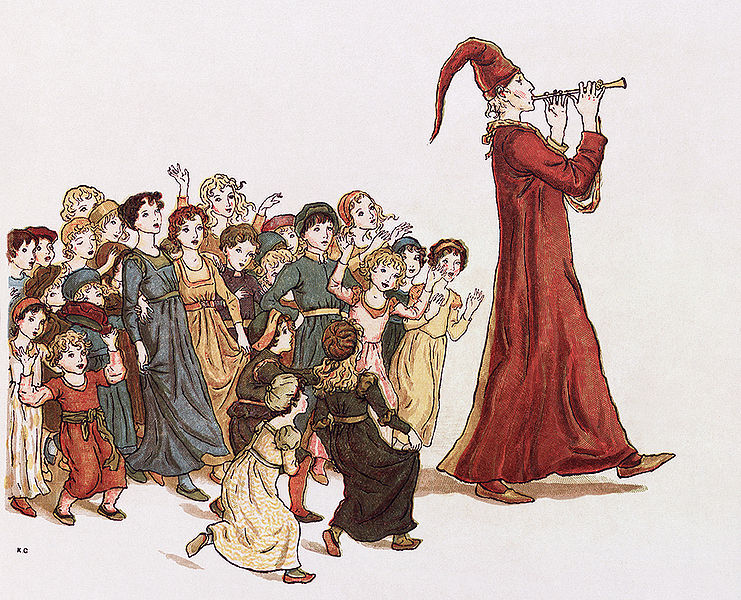
The Pied Piper revisited (part 1)…

I enjoyed listening to this on boxing day.

It was a retelling of the weird old story of the Pied Piper of Hamelin. As legends go, it is one of the strangest- you can feel in it the depths of some kind of tragedy that was the origin of the myth.

The story originates sometime in the 1300’s in Lower Saxony, Germany. This from the Wikipedia entry-

The earliest mention of the story seems to have been on a stained glass window placed in the Church of Hamelin c. 1300. The window was described in several accounts between the 14th century and the 17th century. It was destroyed in 1660. Based on the surviving descriptions, a modern reconstruction of the window has been created by Hans Dobbertin (historian). It features the colorful figure of the Pied Piper and several figures of children dressed in white.

This window is generally considered to have been created in memory of a tragic historical event for the town. Also, Hamelin town records start with this event. The earliest written record is from the town chronicles in an entry from 1384 which states:

It is 100 years since our children left.

What dreadful events were being described no-one knows. A mass drowning in a river? Plague? Mass emigration to avoid famine? Lured away be a pagan sect into the dark forest?

Whatever the origin, at some point, the legend began to be told in the form we receive today- a magical figure on which we can project all sorts of fears- the Pied Piper who leads children on some terrible dance of death. All except one, who lives a life of regret that he could not have disappeared with his friends to the whatever land they travelled to.

Anyway- as I listened to this, it appeared to me to carry a current resonance, and I started to write.

Here is the first part of my re-telling of the legend of the Pied Piper. A bit of fun for the new year…

The was a time when the city prospered.

Ships flooded the dockyards with spice and sandalwood from the far reach of the arm of Empire.

Old men were cushioned by safe investments and young men were well oiled cogs in an industrial machine whose engines never stopped. After lives spent accumulating, some sought to leave a legacy in stone- museums, galleries and monuments to their own magnificence.

And on the fat of it all we feasted. Even as others far away slaved in chains and died young in the service of our comfort.

We had so much that what we had started to mean nothing. We filled our dustbins and our landfill sites with food we could not eat and clothes of last years colour. Meanwhile we wanted more more more. More gadgets. More cars. Bigger houses. Faster food.

Soon not even the rubbish dumps could contain all that we threw away.

Then there came a time when it all started to go wrong.

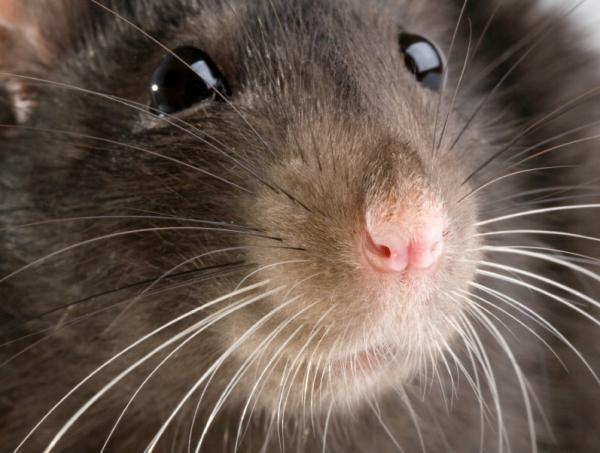
Rats.

Everywhere, rats.

They were in the warehouses, in the store rooms and scurrying under the tables of all the restaurants.

They were under the floorboards and in the kitchen cupboards. They stripped bare the sofas then started on the insulated cables.

In the attempt to get rid of all these rats, no effort was spared. Men in clean overalls poisoned, trapped, shot and burned them in their thousands. But it seemed to make no difference- if anything their numbers increased.

In desperation, the mayor of the city offered a prize. “Let it be known across the world” he said “that anyone who can rid us of this vermin that has invaded our city will be handsomely rewarded. They shall receive a prize of £10 million pounds.”

So from all over the country they came. Then from all over the world.

Scientists with genetic theories and chemical potions and tiny cameras on the end of flexible rods.

Commercial pest control companies with an army of men and women prepared to go further than ever before- into the slimiest sewer and the darkest cellar. They dug and shot and stabbed and burned in every corner of the city.

Religious nuts who cried to us all to ‘Repent’ so that God would have mercy on the sinners of the City and take back the plague from the unrighteous. So that he would let his people go.

Mad inventors employed light beams and sound waves and all sorts of machines that whirred and clicked and rattled.

All failed to make any appreciable difference on the number of rats. At night, the noise they made kept us all awake- the scurrying and the scratching. The passage of a million claws in and round and over.

As their numbers grew they were bolder in their hunger. They no longer stayed hidden in the dark places- they were in the corners of rooms, watching, waiting for an opportunity to pounce.

There were stories of faces bitten whist people lay abed, and children running screaming for protection.

Everything was affected- schools closed, hospitals were under siege. Factories were clogged with fur and the flesh of the rats and places of business were eaten full of holes. The dockyard cranes rusted on their rails from under use- no captain wanted to take on this kind of cargo.

The stories spread like wildfire- they were twittered and blogged and gossiped in the bars and pubs. Anger grew- something must be done. The fat cats in the town hall did not have to live like this- they had protection. Rather than spending money on fancy cars and big salaries- they ought to be looking after the citizens.

Some fed these stories into megaphones of their own particular cause and began to stir up violence. Windows in the town hall were smashed and slogans written on walls.

The rioting began.

The response from the authorities was predictable- first police in riot gear, later the army. Finally, when the numbers on the streets seemed almost as numerous as the rats, the tanks were called in to stem this new vermin from smashing and looting and burning.

It was all falling apart.

Eaten from within.

To be continued…

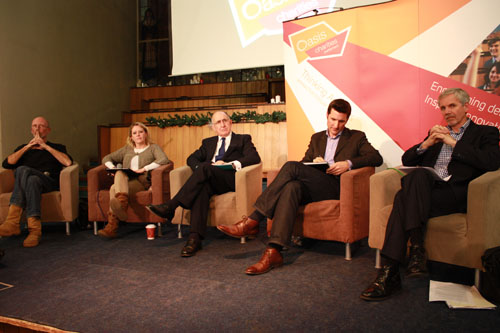
Ethical capitalism debate podcast…

If you are interested in the reformation (or destruction) of our capital driven economic system, then check out this podcast from a recent debate held by the Oasis’s Charities Parliament-

Does capitalism need reforming, replacing or is it fine just as it is?

Listen to the lively debate around the question of our generation with representatives of Occupy London Stock Exchange, former investment banker Ken Costa and Dr Luke Bretheton.

You might also be interested in checking out some of the stuff on the Occupy Movement’s ‘Occupy Cafe’ website. It full of activism, protest and even poetry! Any activist website with poetry will get my vote…

I really liked this for example-

America

Then one of the students with blue hair and a tongue stud

Says that America is for him a maximum-security prison

~

Whose walls are made of Radio Shacks and Burger Kings, and MTV episodes

Where you can’t tell the show from the commercials,

~

And as I consider how to express how full of shit I think he is,

He says that even when he’s driving to the mall in his Isuzu

~

Trooper with a gang of his friends, letting rap music pour over them

Like a boiling Jacuzzi full of ballpeen hammers, even then he feels

~

Buried alive, captured and suffocated in the folds

Of the thick satin quilt of America

~

And I wonder if this is a legitimate category of pain,

or whether he is just spin doctoring a better grade,

~

And then I remember that when I stabbed my father in the dream last night,

It was not blood but money

~

That gushed out of him, bright green hundred-dollar bills

Spilling from his wounds, and—this is the weird part—,

~

He gasped, “Thank god—those Ben Franklins were

Clogging up my heart—

~

And so I perish happily,

Freed from that which kept me from my liberty”—

~

Which was when I knew it was a dream, since my dad

Would never speak in rhymed couplets,

~

And I look at the student with his acne and cell phone and phony ghetto clothes

And I think, “I am asleep in America too,

~

And I don’t know how to wake myself either,”

And I remember what Marx said near the end of his life:

~

“I was listening to the cries of the past,

When I should have been listening to the cries of the future.”

~

But how could he have imagined 100 channels of 24-hour cable

Or what kind of nightmare it might be

~

When each day you watch rivers of bright merchandise run past you

And you are floating in your pleasure boat upon this river

~

Even while others are drowning underneath you

And you see their faces twisting in the surface of the waters

~

And yet it seems to be your own hand

Which turns the volume higher?

Tony Hoagland

There is also quite a lot on the site about faith- and how this might stimulate or oppose activism for change. Check out this or this for instance.

Let’s join in the conversation at least friends…

Biutiful film…

I have just watched this film…

It  is the story of Uxbal – a single father who struggles to reconcile fatherhood, love, spirituality, crime, guilt and mortality amid the dangerous underworld of modern Barcelona — all before his life is over. He must deal with his loving but unreliable, reckless, and bipolar wife (from whom he is separated and who poses a threat to the safety of their children), and a large group of illegal immigrants for whom he obtains material so that they may not be deported. In the middle of all of this, he is diagnosed with terminal cancer, which he tries to hide from his two children.

It is a gut wrenching masterpiece of cinematography, and is soaked with a wonderful kind of broken loving humanity.

It also tells the story of globalisation, and the poverty on the frontiers of capitalism.

Watch it- but be warned. It will open something up inside…

The Zeitgeist Movement…

A little while ago, in response to my blog piece on the camp at St Paul’s, an old school friend sent me a link to something by The Zeitgeist Movement.

Specifically, Carol suggested I watch the clip below. It is quite long, but makes for rather interesting watching.

I had not heard of this movement before, so spent some time researching what I could about what they are about, their core beliefs and campaigning aims. At first I was pretty suspicious to be honest- there is something about their website that made me instantly uncomfortable- it is a little too slick, too shiny.

TZM is another one of these internet generation organisations that grows not along the lines of corporations that are led and controlled from the centre, but rather grows virally by a network of connections, and a set of common evolving principles. It has vague, fuzzy edges, and slightly non specific goals. Rather than ‘leaders’ who are appointed and recognised, there appear to be some key voices, but the structure is deliberately local.

This is a familiar organisational structure to me- as it reminds me very much of the ‘Emerging church’ movement. Such organisations are always difficult to get your head around from the outside- as they appear to lack structure and substance. There is more about these kinds of organisations here.

But back to the specifics of what BenMcLeish had to say above-

I liked much of what he had to say- particularly his analysis/critique of the state of our current economic/political/environmental situation, which I find myself largely in agreement with. I might also echo some of his concerns about religion- although unlike him,  I remain a believer.

I think the importance of a strong critical voice against the excess and over consumption of our wider culture is vital. I have been wondering for a while where this will come from, and where we might see examples of people living lives that are different- people that break from the flock and show a better way to live. I have been excited by these possibilities all my life, and so wherever I see these things being talked about, I am interested.

Unlike what Ben had to say above however, I have seen most of this kind of thing within faith based organisations. Sure, there are a lot of people within our churches and mosques and synagogues who are as sheep like as the rest of society, but there are also many whose beliefs lead them to aspire to something more. Within my own faith, I would point to the  New Monastic movement, towards which my own little community makes a slight nod.

CS Lewis used to talk about Communism being a ‘Christian heresy’- in the sense that the impulse towards good things was in many ways Jesus-like. I think you could perhaps say the same about TZM. I have described previously my belief that the job of Christians is to watch out for wherever there is truth and beauty, then to seek to shine light on it, and to salt it to bring out the flavours. On this basis alone, I intend to keep an eye on TZM.

Which makes what is happening in front of St Paul’s Cathedral all the more interesting. The grand old Church of England have got themselves in a bit of a cafuddle- they want to be ‘nice’ to the young activists, but can’t quite deal with the mess of it all.

Having said all that- TZM seems to espouse some macro economic and political solutions to our current woes- these I find myself less inspired or convinced by. A futurist perspective like this, with grand predictions of the fragmentation of the current mechanisms of state and society, seems to me to be highly speculative. The grand idea of a money-less society, with resources allocated according to need (and administrated by think tank and committee) just seems to be rather fanciful on a national scale.

But not necessarily so on a local small community scale. This is where my interests lie. Ben speaks at the end about what individuals and families might do to look at their own patterns of consumption and life choices- a list of things that are very familiar to the aspirations of my faith community.

Does this organisation offer a real alternatives to our Capitalist consumer economy? Not yet. What it does do however, is to push back– to offer a visible critical analysis of what we are.

Alleluia.

Church closes it’s doors to radicals shock!

So, in the light of my recent ponderings about capitalist excess and consumerism- this story caught my attention…

The protest – modelled on earlier such events in Spain and, more famously, New York – descended on London’s financial district last Saturday with the intention of setting up a permanent camp in Paternoster Square, the private commercial and retail plaza housing the Stock Exchange headquarters.

However, the square’s owners won a court order preventing this, and police blocked access. Several thousand activists, who eventually coalesced into an encampment of around 200 tents, instead based themselves on the western edge of St Paul’s. There, they set up an increasingly entrenched camp, featuring a food marquee, a media tent and a “university”.

Relations with the church began well, especially when its canon chancellor, the Rev Dr Giles Fraser, delighted protesters on Saturday by saying he supported the right of the “good-natured” crowd to remain.

Since then, however, cathedral officials have repeatedly raised concerns about the size and scope of the camp, warning that it was impeding access for both worshippers and tourists, especially ahead of next week’s busy half term. This is a particular issue for a cathedral that relies heavily on entrance fees for its income.

Hmmm- I wonder if they Dean is concerned that some radical might start turning over the money collecting tables?

To be fair, the closing of the doors of the Cathedral does seem to be at odds with his earlier statements-

He said: “We are delighted that the London protests have been peaceful, and indeed there has been a good atmosphere generally between cathedral staff and those dwelling in the tents around St Paul’s.

“There is something profound about protest being made and heard in front of this most holy place – a gathering together of those concerned about poverty and inequality facing the great dome of this cathedral church.”

I wonder though- is this perhaps the beginning of a real movement for change in our rather sclerotic socio-economic system? Might these few hundred tents be far more in touch with the zeitgeist than the health and safety constrained Cathedral managers?

Over in America, a recent survey suggested that only a slight majority of American adults believe capitalism is better than socialism, according to the latest Rasmussen Reports national telephone survey. Asked whether capitalism or socialism is a better system, 53% of American adults cited capitalism, 20% said socialism and 27% said they weren’t sure.

The question remains- what next?


Let the grand correction commence…

Today we heard from the Labour leader.

I find so little to celebrate in what he said, or the way he said it (so said the Guardian– “Miliband’s pedestrian, drooping delivery did no justice to the ambition of his argument.”)

In saying this, I feel sad. Sad that once again I am writing out of negativity not from a position of hope. Sad too that the party I have roughly aligned myself with all my life appears so bereft of ideas.

A swipe at the Tories, the bankers and Southern Cross care homes- then a strange promise that people who work hard or volunteer will get preferential allocation of social housing. (Sounds a bit like ‘the deserving poor’ to me.) But at least ‘I am not Tony Blair (awkward pause…..)

I have been asking myself what is missing- and I think it is this- a visible value base that comes from a passion that is not merely manufactured, or self consciously media friendly.

I have also been thinking a lot about just how bankrupt our political/economic system seems to have become. When did commerce become capitalism, and when did capitalism become turbo-capitalism? How did the survival of our affluent way of life come to require the addiction of a whole nation to the accumulation of ever more stuff that we do not need?

And perhaps the most important question; what might be an alternative way of ordering our collective economy?

Ed Milliband’s father, the late great Ralph Miliband, was a Marxist Sociologist whose writing was an essential part of my student days. For a while, my hope was for an egalitarian socialism to take gentle hold in our country- mixed in the very British way of changing slowly whilst still holding on to idiosyncratic anachronisms- because it is better to accommodate and compromise rather than to revolt and overthrow…

But it seems that at least for now, ‘Free Market’ Capitalism has cleared the playing field of all opposition. The Berlin wall has been reduced to the dust of folk memory.

And in the middle of all this economic mess, Capitalism (despite being the cause of so much difficulty) continues to present itself as the solution.

I am no longer a political ideologue. All of that was killed by Blair and middle age. But still, where are the critical voices? Where are those who bring hope for change- for better ways of living that are not geared towards entrenching the global inequalities that condemn the poor south to be one large sweatshop for our supermarkets and high streets?

Do we need more riots? More kids in hoodies running away with box-fresh trainers and security tagged x-boxes?

As someone who tries to follow Jesus, I am ever more conscious of the way he had of standing as a faithful, hopeful, critic of the way we live. This is not the same thing as condemning and rejecting- rather it might mean that we should seek to participate, whilst at the same time hoping for better.

Hoping for voices to be raised that offer an alternative- that start not from a position of protecting the status quo, but instead long for justice for the global poor, and a sustainable, honest and healthy way of life for the rest of us. Looking for love, Grace and beauty, then seeking to nurture it.

Little of which did I hear today in Milibands speech. But perhaps there is time yet…

Time for a song I think…

Some words from the Archbishop…

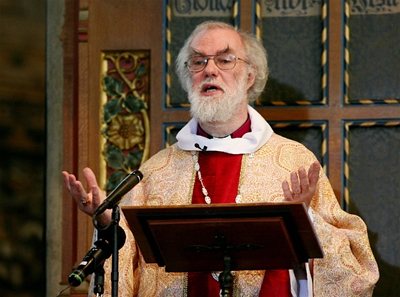
There was a lovely interview by David Hare in the Guardian yesterday with Rowan Williams- here.

It reminded me again why this man is something of a hero of mine- his deep, thoughtful, compassionate stance on so many of the issues facing us, and his fierce intelligence. I thought it worth extracting a few quotes from the article…

When he observes that economic relations as they are currently played out threaten people’s sense of what life is and what reality means, surely what he’s really saying is that capitalism damages people. To my surprise, he agrees. Does he therefore think economic relations should be ordered in a different way? “Yes.” So is it fair to say, then, that he’s anti-free market capitalism? “Yes,” he says and roars with laughter. “Don’t you feel better for my having said it?”

He goes on to rehearse what he insists he’s said before (“I don’t mind saying it again”) about how no one can any longer regard the free market as a naturally beneficent mechanism, and how more sophisticated financial instruments have made it even harder to spot when the market’s causing real hurt.


Is he paying too high a price for keeping together people who believe different things about gender, priesthood and sexuality? “I’ve no sympathy for that view. I don’t want to see the church so balkanised that we talk only to people we like and agree with. Thirty years ago, little knowing what fate had in store, I wrote an article about the role of a bishop, saying a bishop is a person who has to make each side of a debate audible to the other. The words ‘irony’ and ‘prescience’ come to mind. And of course you attract the reproach that you lack the courage of leadership and so on. But to me it’s a question of what only the archbishop of Canterbury can do.”


“We must get to grips with the idea that we don’t contribute anything to God, that God would be the same God if we had never been created. God is simply and eternally happy to be God.” How on Earth can he possibly know such a thing? “My reason for saying that is to push back on what I see as a kind of sentimentality in theology. Our relationship with God is in many ways like an intimate human relationship, but it’s also deeply unlike. In no sense do I exist to solve God’s problems or to make God feel better.” In other words, I say, you hate the psychiatrist/patient therapy model that so many people adopt when thinking of God? “Exactly. I know it’s counterintuitive, but it’s what the classical understanding of God is about. God’s act in creating the world is gratuitous, so everything comes to me as a gift. God simply wills that there shall be joy for something other than himself. That is the lifeblood of what I believe.”


I ask him if he’s happy to be thought of in a tradition of Welsh poet-priests – George HerbertGerard Manley HopkinsRS Thomas? “I always get annoyed when people call RS Thomas a poet-priest. He’s a poet, dammit. And a very good one. The implication is that somehow a poet-priest can get away with things a real poet can’t, or a real priest can’t. I’m very huffy about that. But I do accept there’s something in the pastoral office that does express itself appropriately in poetry. And the curious kind of invitation to the most vulnerable places in people that is part of priesthood does come up somewhere in poetic terms.

“Herbert’s very important to me. Herbert’s the man. Partly because of the absolute candour when he says, I’m going to let rip, I’m feeling I can’t stand God, I’ve had more than enough of Him. OK, let it run, get it out there. And then, just as the vehicle is careering towards the cliff edge, there’s a squeal of brakes. ‘Methought I heard one calling Child!/And I replied My Lord.’ I love that ending, because it means, ‘Sorry, yes, OK, I’m not feeling any happier, but there’s nowhere else to go.’ Herbert is not sweet.”

“And you like that?”

“Non-sweetness? I do.”


Poverty and debt in the UK…

I have just been reading some research by the Institute for Public Policy Research (IPPR) on UK poverty.

Poverty? In the UK? This from an article in the Church Times- here

What does it mean to be poor in the UK today? For many of us, the Victorian notion of poverty may still persist in our minds: ragged, barefoot chil dren, malnourished, overworked par ents, and slum housing. Yet in 21st-century Britain it is possible to be in poverty and own a mobile phone.

Poverty is a relative concept, explains Chris Goulden of the Joseph Rowntree Foundation. Where once it was measured on the basic principle of the “basket of goods”, the official poverty line is now set at 60 per cent of the national median income (currently £377 a week), i.e. £226.

For children who are classed as disadvantaged, it is as much about their participation in society as about their diet and clothes. While it may be possible to buy cheap tech nology such as mobile phones, these children may still not be able to af ford to go on the school trips, which can be relatively expensive, Mr Goulden says.

The number of people officially in poverty is increasing in the UK; and they are most likely to be children, pensioners, the disabled, or single-parent families. While New Labour made inroads into cutting poverty when it first came to office, this has now gone into reverse. According to the latest figures, after housing costs are taken into account, there are 13.2 million people in poverty today — about one in five of the population.

Of these, two to three million are thought to be in extreme poverty, living on just 40 per cent of the average income.

We live in a time when our obsession with ownership- of houses, of shiny electronic devices, of constructed and packaged experience- is at an all time high. This addiction to consumption has received some closer examination in the wake of recent economic upheavals, but the trend remains.

The IPRR research followed 58 low-income families in London, Newcastle, Nottingham and Glasgow aimed to understand what the expansion of household debt has meant for them. The research found that many low income families have become increasingly vulnerable and exposed because of debt, which has increased substantially in the last decade- from 93 to 161 per cent of disposable income over the last decade.

The study found that the main reason that families got into trouble was because of a reduction in income- the loss of a job to one of the working members, or the reduction of a benefit. The effects of this were often catastrophic.

Poverty, once some basic human needs are satisfied, is always relative.

Our sense of security, of personal value and of mental wellbeing is fuelled by lots of things, but in this world of shiny consumption, it is certainly influenced by our ability to make the same consumer choices that those around us are making.

It is very hard to resist the truth of this. Particularly for those whose finances are marginal. Choices that we make to stand aside from the consumer madness- to make decisions to live a simpler life- these may feel like middle class indulgences to many people when faced with kids who are fed a relentless stream of advertisements for gaming consoles, mobile telephones and expensive clothing.

This kind of poverty is no less brutalising.

Poverty is still the main predictor of lower life expectancy, poor educational outcomes, health problems, mental illness, family dysfunction, poor housing etc etc.

What is the answer?

I suspect that this relates to the need for much wider societal change- the need to find a different way of experiencing human society that breaks with the economic enslavement that our capitalistic system demands of us. To find meaning and relationships in other things.

Is this possible?

I think that it ought to be possible for the people of Jesus, if for any of us- despite our tendency to forget our call to be in this world, but not of it.

And I still hope that there will be enough of us prepared to live extraordinary lives, so that the huge loaf that is society will have a different leaven.

Or to put it a different way, we would learn to live up to the business of being salt to bring out the flavour in our communities, or light to illuminate the beautiful and small.

But- for me, there is the seduction of middle class security, and the accumulation of more stuff. It may yet be the end of us- and what a sad way to go…

Fair trade and recession…

fairtrade

Michaela and I have been interested in fair and ethical trade practices for some time. As a student, my final year thesis dug into this area. For some time we were Traidcraft representatives also.

In earlier times, fairtrade production was low scale and marginal. Who can remember the early instant coffees that tasted slightly like a mixture of sludge and gravy?

Fairtrade produce has become much more mainstream in the last few years. The supermarkets use Fairtrade as a niche selling strategy, and large companies like Cadbury’s, later followed by Galaxy have bowed to pressure and started to use fairtrade materials in their produce. Whilst the edges of what constitute ‘fair trade’ seems to be as fuzzy as ever, these larger scale moves towards breaking down the power of the multi-nationals and giving producers in the South a fair wage are great.

And then came recession.

Logic would suggest that during periods of recession people look to make savings on household bills. They are less willing to pay premiums for quality, and more likely to buy budget products. We might expect too that people will give less to charity, and buy less fair trade produce.

It is encouraging then to read this report from the Ethical Corporation Institute, which suggests that interest in ethical and fairtrade products is soaring.

I wonder why?

Is it possible that the aftermath of the consumer driven credit crisis has led to people examining again the lack of sustainability of our lifestyle? And the inequalities we depend on to maintain it?