Are people with high moral beliefs more likely to act them out?

sin

It has always been a bit of a strange thing to me how followers of Jesus came to be seen as collectively ‘holier than thou’. How over the millennia we serially get caught up in elaborate morality systems, measuring others by how much they share the same code and punishing those who do not.

It is not as though this was the model for life that Jesus gave us. As far as we are able to understand his way of teaching, way of living, he seemed to react against those in his time who lived this kind of religious life. Remember all those exchanges with the Pharisees, who had a rigid rule to measure everything against. By total contrast, Jesus seemed much keener for his disciples to live deeply and fully, opening themselves up to the wild ways of the Spirit and subjugating all sorts of rules to the overarching principle called love.

Having said that, let us not pretend that morality has no place within the life of faith. It is not as if anything goes. Choices we make in life have consequences – even passive choices. But those outside the holy huddles will often accuse those inside of rank hypocrisy, suggesting that we do not live according to our principles, let alone live up to the life of Jesus. Remember these words attributed to Ghandi?

I like your Christ. I do not like your Christians. Your Christians are so unlike your Christ. The materialism of affluent Christian countries appears to contradict the claims of Jesus Christ that says it’s not possible to worship both Mammon and God at the same time.

Or these, which he wrote in his autobiography;

 I heard of a well known Hindu having been converted to Christianity. It was the talk of the town that, when he was baptized, he had to eat beef and drink liquor, that he also had to change his clothes, and that thenceforth he began to go about in European costume including a hat. These things got on my nerves. Surely, thought I, a religion that compelled one to eat beef, drink liquor, and change one’s own clothes did not deserve the name. I also heard that the new convert had already begun abusing the religion of his ancestors, their customs and their country. All these things created in me a dislike for Christianity.

All of this starts for me to highlight the fact that although shaping our souls towards love may involve a constant processions of moral choices, morality itself should not be the starting point.

There was a story in The Guardian yesterday that made a rather different point about morality- suggesting that there might be an inverse relationship between highly developed ethical/moral belief and ethical/moral action. In other words, perhaps those who have rigid moral belief might be LESS likely to act on these beliefs.

Ethical philosophy isn’t the most scintillating of subjects, but it has its moments. Take, for example, the work of the US philosopher Eric Schwitzgebel, who’s spent a large chunk of his career confirming the entertaining finding that ethicists aren’t very ethical. Ethics books, it turns out, are more likely to be stolen from libraries than other philosophy books. Ethics professors are more likely to believe that eating animals is wrong, but no less likely to eat meat. They’re also more likely to say giving to charity is a moral obligation, but they were less likely than other philosophers to return a questionnaire when researchers promised to donate to charity if they did. Back when the American Philosophical Association charged for some meetings using an honesty system, ethicists were no less likely to freeload.

One take on this is that ethicists are terrible hypocrites. As Schwitzgebel points out, that’s not necessarily as bad as it sounds: if philosophers were obliged to live by their findings, that might exert a “distortive pressure” on their work, tempting them to reach more self-indulgent conclusions about the moral life. (And there’s a case to be made, after all, that it’s better for people to preach the right thing but not practise it than to do neither.) But another possibility bears thinking about. It’s plausible to suggest that ethicists have an unusually strong sense of what’s right and wrong; that’s what they spend their days pondering, after all. What if their overdeveloped sense of morality – their confidence that they know what’s what, ethically speaking – makes them less likely to act ethically in real life?

Hmmm, what if our churches carry a similar kind of ethical corruption? Later the article describes something called  “moral licensing”, the deep-seated human tendency that leaves us feeling entitled to do something bad because we’ve already done something good. It explains why people give up plastic bags, then feel justified in taking a long-haul flight, obliterating the carbon savings. It’s also why, if you give people a chance to condemn sexist statements, they’ll subsequently be more likely to favour hiring a man in a male-dominated profession.

How might this play out in our religion? A focus on those parts of us that are good so we can blind ourselves to those parts of us that are not? A compartmentalism that means we can live externally moral religious lives whilst compromising on some of the most basic ways of loving our neighbours.

One reaction to this (a very common one in our churches) is the call from the pulpit to be MORE moral. The call to purify, to get our moral codes sorted and organised. The degree to which this ever works is rather doubtful, to my mind at least. We are all of us a complex mess of aspiration and failure at the surface and subliminal levels; old sinful habits die hard in me.

What we need to do then, we followers of Jesus, is to return to trying to understand his relationship with morality. We have to remember that the moral leaders of his day clearly regarded him as immoral. He drank, he mixed with the unclean and ungodly, he broke religious rules, he disrupted churchyness, smashed up tables, upset good people and seemed to prefer low-lifes.

Morality was something to be challenged, to be tested, to be subjugated towards love. Morality was not to be seen as the goal, or the most valid measure, not even of righteousness.

Just as well, otherwise we are all screwed.

Tony Campolo on homosexuality…

Over the last few years, a number of people who would previously have been regarded as Evangelical Christian heavyweights appear to have changed their stance on homosexuality significantly. There seems to be a whole wing of Evangelicalism that is ‘coming out’- or do I generalise from the particular?

Is this accommodation with the changing views of culture- albeit lagging behind because of a dragging-anchor theological hermeneutic?  Or is it the fact that Christians are finally catching the scent of freedom and justice on the breeze? Whatever, I celebrate the change.

I will not list the names I am thinking of, as this plays into the hand of the totemic brigade- you know the way it works, the degree to which a person is ‘OK’, ‘Biblical’, ‘Theologically sound’, depends on whether they agree with us on certain totemic issues. I try, but if I am honest I am guilty of a bit of this too…

I was first inspired by listening to Tony Campolo speak back in the early-mid 1980’s. He upset a lot of people at Spring Harvest festival some time around then (I think I was there, but the story might have become more important than fact on this one!) by telling a story something like this;

You know folks, X (can’t remember the exact figure) number of people have starved to death since I started to speak to you tonight.

And you know what is worse? Most of you people here do not give a shit.

And even worse that that, most of you are far more concerned that I just used the word ‘shit’ than the fact that those people have starved to death.

It is hard to convey how genuinely shocking hearing these words from a preacher at Spring Harvest was back then. Campolo has always been rather left field.

However, his stance on homosexuality in books of his I have read went something like this;

It is not the fault of gay people that they were born different, but the Bible is clear that the homosexual act is sin. It is however NOT a sin to be homosexual, as people have no control over their sexual orientation. Therefore to be gay and Christian is to be celibate.

I think he may even have used the old ‘love the sinner, hate the sin’ argument. If he did not, others certainly did in his wake.

Contrast this with the clip below. He does not need to talk about the theology- rather he tells a story, which is a very Jesus kind of way of doing theology of course.

The emotional musical soundtrack is a bit naff, but Campolo is always (ahem) Campelling.


Doing church the new/old way…

a church under reconstruction?

Michaela and I have just had a really lovely trip up north to spend some time with friends who are part of Garioch Church. We had been asked to be part of something called a ‘sounding board’- a group of people from outside the church who meet a couple of times a year to reflect on where the church is heading, and what challenges it is facing. We were looked after by Andrew and Jane magnificently and it was a privilege to hear something of their story, not least because it enabled us to reflect anew on our own.

Garioch is an area on the outskirts of the city of Aberdeen- a string of villages over a 10-15 mile area. It is a largely affluent place, with pockets of deprivation, fueled by prosperity from the oil industry. We had never spent any time in that part of Scotland before, and in many ways it felt like a different Scotland to the one we knew. It was busy, bustling, full of industry and people had a pace of life very different to our small west coast town.

The church has been trying to find a way of being authentically present in this new context. What they have done is really interesting and genuinely innovative. Rather than seeking to follow a familiar model of church planting, which goes something like- small group of people with lots of energy start a gathering, invite friends, it grows and so house becomes too small so they rent a hall, it grows so they need to buy own hall, appoint staff, etc, they did this;

Gairioch church wanted to remain based around homes, families, small community. They wanted to be a local, connected expression of faith- engaged in their small context. What they now have are three thriving home groups which are the focus of ‘church’. Once a month they meet in a school hall where they can make a bit more noise and feel a wider sense of connection.

Simple huh? Sounds very like that elusive but often used idea of trying to connect with a New Testament idea of what church looked like?

Alongside this deliberate emphasis on the small, they have found themselves having to grapple with some familiar themes- what does leadership look like in this context? How do you survive community? How do you continue reaching out when there is so much to do within the social context of community itself? What does teaching look like when traditional ‘preaching’ no longer fits? What about all the children? How do we manage all these competing demands with such limited time?

It was rather special to see them feeling for answers to all these questions- to appreciate the freedom that allows them to try, and the long tradition of Christian collectives who have done the same.

My own small community feels special too. We are different, in that we are one (rather isolated) community, and in many ways the pressure to lead, to organise, to manage is very different. As a result of this we are less hierarchical, more driven by the need to be joint travelers, not leaders and followers. This made for some interesting parts of our discussion at the sounding board day. How much do we as leaders, in taking responsibility, remove this in both obvious and more subtle ways from the people we lead?

I came home inspired, humbled and also grateful for the fact that people remain inspired by Jesus towards the new. That Christians in these times are still looking for new ways to love better, to live better, to serve better.

Yesterdays post was a rather cynical one about church names- I removed it as although a whiff of controversy in blogging is usually a good thing, I never like giving offence, and it turned out that some friends of mine have a church whose name I accidentally lambasted. As part of yesterdays post however, I said this, and I will repost it as a prayer for our churches everywhere!

I think the words of Jesus lead us on a path emphasising a whole different set of principles. Rather than our success he promised that the last shall be first. Rather than our satisfaction, he promised a hard road. Rather than storing up comfort and riches he pointed us towards the lost and the least.

When Church is defined as being the provider of success and abundance I also cringe for those whose experience has NOT fitted into this shiny stereotype. People who even whilst in this kind of environment feel unable to share pain and brokenness. People whose lives fall apart for no apparent reason.

I pray that the people in the shiny Churches grow in to abundant life, so that they can become a well of blessing for the rest of us whose lives are full of beautiful aching brokenness…

I think we can take heart and courage, because good things are growing in the cracks of Old Church.

Off to Greenbelt…

Mud greenbelt 2012

(Hope we do not get a repeat of last years conditions!)

Will and I are going down to Greenbelt Festival on our own this year- Michaela and Emily are simply too busy with other things. In fact, it was a late call to decide to go down, partly because Will was desperate to go, and also because I get the chance to meet up with some old friends. Oh- and my mate Andy had some spare tickets!

This year we are going as punters- no responsibilities, no installations to set up/services to lead. I have strangely mixed feelings about this however. Greenbelt has provided for me a sense of loose ‘belonging’ to a wider ‘church’, and I am not sure that it will be quite the same experience without actually contributing something to the festival. It will certainly be a lot less stressful however!

I watched a DVD last night called Greenbelt/40, the journey so far. It was full of the music of my youth- trips to the festival in the early 80s. It was a slightly surreal experience- like watching your life pass away into the distance. It did leave me wanting to look forward, not backwards however….

May there be sunshine, good conversation, great music and new ideas…

Rowan Williams on spirituality and whinging Christians…

rowan_1724695c

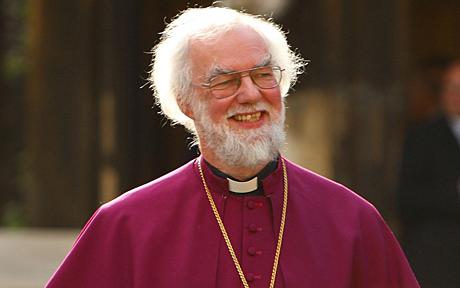
He always was worth listening to carefully. Sure he never got used to packaging up media friendly sound bites, and even though many counted this in a list of his faults whilst in office, I always loved the fact that there was depth and intellect in everything he said. I have wondered how his voice might develop after being released from all the pressure of his post.

Early signs seem to be business as usual. Here are a couple of extracts, courtesy of The Guardian;

Firstly on whinging Christians, by which I mean those who see Christians in this country as under some kind of attack from the forces of evil. Check out the pages of Christian Voice and you will see what I mean;

Christians in Britain and the US who claim that they are persecuted should “grow up” and not exaggerate what amounts to feeling “mildly uncomfortable”, according to Rowan Williams, who last year stepped down as archbishop of Canterbury after an often turbulent decade.

“When you’ve had any contact with real persecuted minorities you learn to use the word very chastely,” he said. “Persecution is not being made to feel mildly uncomfortable. ‘For goodness sake, grow up,’ I want to say.”

True persecution was “systematic brutality and often murderous hostility that means that every morning you wonder if you and your children are going to live through the day”. He cited the experience of a woman he met in India “who had seen her husband butchered by a mob”.

Nothing confirms some Christians in their sense of persecution more than issues around homosexuality- it is almost as if every legal/social step forward offered to gay people is seen as some kind of prod of the devil-horns into the side of the church. Considering the fact that gay people have suffered (and still suffer) actual persecution this always seems to me to be a terrible miss-representation of the Gospel.

Rowan Williams then started out on a wider theme- that of ‘Spirituality’;

Sharing a platform at the Edinburgh international book festival with Julia Neuberger, president of the Liberal Judaism movement, Williams launched a withering critique of popular ideas about spirituality. “The last thing it is about is the placid hum of a well-conducted meditation,” he said.

He said the word “spiritual” in today’s society was frequently misused in two ways: either to mean “unworldly and useless, which is probably the sense in which it has been used about me”, or “meaning ‘I’m serious about my inner life, I want to cultivate my sensibility'”.

He added: “Speaking from the Christian tradition, the idea that being spiritual is just about having nice experiences is rather laughable. Most people who have written seriously about the life of the spirit in Christianity and Judaism spend a lot of their time telling you how absolutely bloody awful it is.” Neuberger said she found some uses of the word self-indulgent and offensive. Williams argued that true spirituality was not simply about fostering the inner life but was about the individual’s interaction with others.

I am still working on a collection of ‘Spiritual’ poetry. I think I just found a quote for the introduction!


Leadership, networking and the trajectory of pioneering groups…

network


I am part of a small ‘missional’ group. We had ‘emerging church‘ conversations, flirted with ‘new monasticism‘. We found the old ‘paradigms’ restrictive and so wanted to do a new thing, using new ‘alternative worship‘ styles.

There you go; I have established my credentials- the badges and trendy buzz words that have allowed me to find a groove to travel in, no matter how shallow and indistinct.

The reality is that this language has often felt contrived and pompous, and the journey of our group has been one of ordinary people trying to get along, whilst searching for a way to live out faith that has some integrity and authenticity. Groups like ours are not unusual, even if they are ephemeral, fragile.

Many small groups like ours set out with pioneering passion- they have this idea of the purity of community releasing a power in them to achieve something special. Often they are right- but very soon it will get messy. The enforced intimacy of small community will crack things open quickly- there is no place to hide at times.

Then there is the inevitable reduction in passion that comes over time; things that were exciting always feel stale with repetition. How do you refresh, revitalise and renew. How do you avoid creating a new narrow liturgy that ensnares every bit as much as the ones we gratefully left behind?

This is the trajectory of most small groups- excited start, success, stagnation, crisis, reinvention (or destruction.)

If we are to be sustainable, if we are to make the longer journeys together, then we will probably need some help in the form of some external connections- we will need to speak to people who understand, who have made some of the same mistakes and dreamed the same dreams. Sometimes we may need others to listen to our pain or laugh with our small absurdity.

Groups like ours are inoculated against organised booted-and-suited religion for the most part. However I remember some interesting research from my old group work days within social work.  I nforget the references (I will try to add them later) but it goes something like this;

The success of a group depends to a large extent on the external context it is embedded within. An example of this might be an encounter group within a hospital or a prison. If the group lacks the support of the establishment this might be a plus at first- people feel embattled and react against their context – but it is simply less likely to be successful in the longer term. However, a little external validation seems to go a long way. So if the staff in the wider hospital speak positively of the group, see it as valuable and helpful, the group absorbs it all, and thrives.

Of course, the links to groups like ours is rather tenuous, but it is no surprise to me that many of the pioneers of missional groups that I know arrived at their adventure after many years of established churching. Despite their maturity, experience and a degree of reaction-formation against the context they escaped from, many of them still look back. Some return.

And this is no bad thing.

In Englandshire, there are good supportive links now for ephemeral groups- there is a wider recognition of the value of micro church through movements like CMS and Fresh Expressions. This is much less the case north of the Border in Scotland.

Last night (and this morning) I had a long discussion with David from Garioch Church, around this kind of stuff. We talked about the possibility of a new kind of network- an old theme for me. 5 years ago we tried to start such a network (see here and here for example) but things did not work out for various reasons.

So here is a question to people north of the border who find themselves on the ragged edge of organised church- where do you find your connections, and is it time to try this networking thing again?

Ways to pray in public places…

pints of beer

It has been a long day. I was off early to Lochgilphead as I was a trainer on a course for social workers who are about to participate in our emergency out of hours duty rotas across Argyll. Part of todays task was to look at some child protection issues- including the inevitable photographs of injuries that been inflicted on kids- little boys with cigarette burns on their feet and tiny girls with finger bruises wrapped around their faces. I am always broken a little bit when I see these photographs.

So I should be- but this relates also to my own childhood memories, fractured as they are.

However, in the midst of all this, I had a transcendent moment. Don’t get me wrong- no angels sang, there was no whiff of incense or pure white lights. What I was captured by was the sudden depth of the Kingdom of God- woven through everything, and this thing called the shalom of God. What might it mean to hope for a future in which the lion will lie down with the lamb, and in which all things are made new?

A world in which parents do not damage children, and damaged children do not do damage in turn? A world where love sets the agenda in more things than not?

Come the evening I was sat in a pub with some friends. We have been meeting to discuss a book by Brian McLaren called A New Kind of Christianity. Tonight however we did discuss the book, but I suggested we try to find a way, in the busyness of the public bar, to pray.

I started with something that we had used on an island recently, in the middle of a wilderness with eagles riding the late spring storms over our heads. I thought that if God was there, then he was here too.

  • I asked people to find a place of quietness inside themselves- to find a neutral spot on wall or table to look at, and to focus on their breathing
  • Next I asked them to listen to the sounds all around them in the pub. The hubbub of conversation, the chink of glasses, the scrape of knives of plates, phones ringing jokes raising burst of laughter. I asked them to notice as many different sounds as possible and acknowledge each one
  • Then I asked them to listen again to deeper sounds- the sounds behind the sounds. As we do this, a remarkable thing happens. The hubbub kind of fades and blurs together- it ebbs and flows like the sea, and behind it all are other noises- the hum of all creation. Some people still noticed things like the ringing of a bell on the till, or the footsteps of a lovely friendly waitress
  • I then asked people to imagine that the sound behind the sounds was the music of God. God in and through it all, rejoicing in the beauty of us all. Rejoicing in the drinks, the food and the lives being shared. It was not hard to do so.

Next I passed round a pen and paper, and asked people imagine what God might want for all these people in the bar. What might he hope for them. I asked people to write something down, and to fold the paper over so the next person could not see it, then pass it on.

This is what people wrote, in no particular order;

Eternal life

Freedom!

I see your heart and know your sadness and want to bring you my peace.

Peace, hope, love and understanding

Shalom

Peace

And there, with a pint in my hand, it was holy.

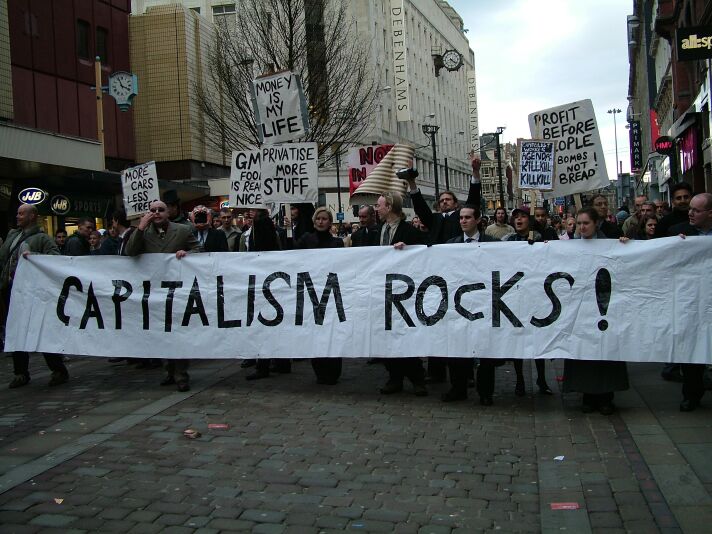
Christianity and Capitalism- to resist or to accommodate?

I have been dwelling on economics over the past few weeks. One of the things that has often troubled me has been the role that Christianity has had to play in developing a culture of enforced inequality, both locally and globally. At best we have become guilty by association, at worst we provided the moral justification for the whole shebang and then enshrined it in liturgy.

I have written about this before- if you are interested you might like to check out these posts;

Capitalism; a conspiracy against the common good?

Capitalism and Durkheim

capitalismrocks

Jason Clark has an interesting piece on his blog about the relationship between Evangelicalism and Capitalism, particularly in the US. It is a tough read, but basically, he contrasts two potential kinds of analysis which he characterises as ‘Cultural dispisers’ and ‘Cultural accomodators’.

Firstly the dispisers;

William Connolly, in his 2008 work Capitalism and Christianity, American Style, sets out firstly to diagnose how the ‘capitalist project’ has been perverted and warped by its resonant relationship with conservative right-wing Christian religious beliefs.[1]

Connolly describes how this relationship between an Evangelical right-wing ethos and capitalism is best understood through ‘assemblages’ of media, churches, cultural consciousness, and a ‘spiral of resonances’ that produce the Evangelical capitalist resonance machine.[4]

Connolly’s response to this contention and diagnosis is to suggest that it is within an alternative and ‘counter political movement’,[6] a democratic and left-wing visualisation of a new ethos, that capitalism might be redeemed.[7]

Now for the accommodators;

Pete Ward, in his 2002 work Liquid Church, offers an account of the relationship with Evangelicalism to capitalism that contrasts starkly with those of Milbank and Connolly.

Where Milbank would warn us of the complicity of the Evangelical Church in conforming to the practices of capitalism, and Connolly of the pathologies of the Christian ethos that shapes those practices, Ward critiques the Church for failing to embrace commodification as a spiritual practice and suggests that the Church should be engaged with it even more. For ‘rather than condemn the shopper as materialist Liquid Church would take shopping seriously as a spiritual exercise.’[17] Where the underwriting of commodification by ecclesial practice is inherently evil for Milbank, according to Ward it is a vital and theologically necessary ecclesial practice to the Church.

I have not read Connolly’s book, but I have read Pete Ward’s Liquid Church- which is a great book, although I do not think the points made by Jason do it full justice. What Ward was seeking to do was to get the church to engage fully with the culture we are part of- to flow in its veins. He reckons that it is only by doing this that we understand, that we become relevant, that we can become part of the mission of God for our times. I am not sure that this is the same thing as ‘accommodation’.

Ward uses the example of advertising as a case in point- he suggested that rather than dismissing all such commercialism as ‘of the world’ and therefore having no spiritual significance for the followers of Jesus, rather we can learn so much about the collective spiritual yearnings of our age from advertising. Is this accommodation, or is it being engaged as thoughtful critics?

I am much more convinced by Mike Frost’s book Exiles, in which he compares Christians living in our post-modern, post-Chistendom world to the Jews exiled in Babylon. It is simply not possible to live lives of isolation- neither is it our calling. Rather we have to learn to live as engaged, loving, active agents of the Kingdom of God. This might involve the celebration of aspects of culture, or it might also require us to resist other elements- injustice, prejudice, the power of the strong over the weak. This also brings us into contact with the language of sin and evil- the ways of living that tear into each other and destroy us.

The other polarity that Jason proposes in his piece is that of the dispisers. This is not a word I would have chosen to apply to myself in relation to Capitalism- more because I do not think it would be honest. At the same time as asking my intellectual and theological questions about Capitalism I am very conscious that my whole lifestyle is wrapped up in it.

Back to the direct relationship between Christianity (particularly Evangelical Christianity) and Capitalism. How might we characterise the ways that faith has accommodated? I started making a list;

  1. By emphasising personal, individual salvation above all else. The only useful purpose of mission is to save people from hell after they die.
  2. By embracing success culture. We use the same corporate structures, we reward our religious successes as we would our CEO’s, we value hard measurable outcomes, we construct programmes.
  3. We make mission a kind of hostile take over. Business success involves out performing the opposition, and rejoicing in their bankruptcy. So it is that we see any form of religion not our own as our economic enemies.
  4. Christianity is a lifestyle choice that requires no change to the way we live our economic lives. Yes, I know there is the old ‘tithing’ argument around Evangelical churches, but we drive the same cars, live in the same houses, take the same holidays, fill our lives with the same gadgets- or (and here is the sting) even if we do not have these things, we aspire to them.
  5. We bought into lives characterised by individualism over the collective. The model given to us by the life of Jesus and the early church was all about the collective- how we live for one another, how we hold things in common, how we find ways of including the poor, the weak. Yet these things are not really part of our DNA.
  6. We failed to demonstrate any kind of radical alternative. The best that we have been able to offer is how to live as better Capitalists- more sensible, more responsible, with greater probity.
  7. We did not see injustice, inequality, poverty, unfair taxation, usury, over consumption, environmental destruction, as any of our business. Which relates to point 1.
  8. And where there was visible discomfort with Capitalism, we lacked any coherance, we lacked leadership, we did not become a critical movement. Rather we splintered and focused on totemic side shows live homosexuality and women bishops- all of which is destroying our credibility anyway.
  9. Our mission to the poor was conditional on redeeming them to become like us. Difficult one this, but stay with me. There is lots of wonderful Christian history of engagement with the poor from the Salvation Army right through to local soup kitchens. These activities clean up the edges of Capitalism- but also justify the dominant ethos. It encourages us to lift people back into becoming productive consumers. Like us. It does not suggest that the problem might be in any way systemic.
  10. We forgot that the Church exists not to give us a better life, but to serve the lost and the least. If we are serving the lost and the least, how can we have convinced ourselves that our unsustainable greedy lifestyles are God-given rewards for our moral superiority- which we Brits built an Empire on, and then passed the baton to the USA?

So, the question at the head of this piece- to resist, or to accommodate?

I think we need to resist what should be resisted, and to where there are seeds of justice, of beauty, of grace- there we should plant ourselves alongside and accommodate for all we are worth.

And what would church look like if we took each of these 10 points above and reversed them?


The silliness of religion…

2007_01162007ireland0179

Christianity is a lifestyle – a way of being in the world that is simple, non-violent, shared, and loving. However, we made it into an established “religion” (and all that goes with that) and avoided the lifestyle change itself. One could be warlike, greedy, racist, selfish, and vain in most of Christian history, and still believe that Jesus is one’s “personal Lord and Savior” . . . The world has no time for such silliness anymore. The suffering on Earth is too great.


Richard Rohr

(Courtesy of yesterdays minimergent.)