Teaching, preaching- in small missional groups…

In the middle of all the laughter around the campfire on my recent wilderness trip, conversation took a much more serious turn. I found myself in the middle of a rather intense and difficult discussion with one of my friends and Aoradh chums. Some of this was about leadership in Aoradh- which I will return to when I have had a chance to process and discuss it again, but another issue flickered briefly in a way that surprised me- ‘Teaching’.

‘Teaching’ that is, in the traditional Christian/Evangelical sense of the word. Apologies to those not from a background like this, but those that are will know exactly what I mean. All our services revolved around one thing- the climactic 45 minute to an hour long sermon. Through this a skilled preacher would expound on a passage from ‘The Word’, inspiring us, shaping us, challenging us and bring us to repentant response.

This kind of spirituality grew out of Victorian spirituality- a combination of the elevation of the written words of the Bible  as the primary (even the only) revelation of God, and the syncretism of faith with modern rationalistic culture. So it was natural to engage with spirituality in the same way that we would engage with the study of medicine or chemistry- in a lecture hall, with the celebrity scientist at the centre, sharing his accumulation of knowledge- even his life long labour- with those eager for understanding.

Along with this of course, scientific rigour was required, along with reliable, testable source material. So faith became something it was possible to organise, define and defend. And we did this above all things by knowledge of the Bible- carefully cross referenced verses, once produced, ended all argument.

Perceptive readers may sense a certain scepticism in the tone of this piece. It is easy to have a go at all this from a post modern cynical perspective.  We can point to all sorts of problems that we inherited with this kind of spirituality-

  • The top down nature of it, casting us in the role of passive receivers, not active questioners
  • The potential it gives for the misuse of power and control
  • The one dimensional quality of a lot of preaching- the giving of one man’s (and it usually is a man’s) perspective on ‘truth’
  • The elevation of the words of the Bible to what I would describe as idolatry- a tendency to treat the words as some kind of unassailable blue print that arrived down on earth on the wings of an angel as the transcription of the very word of God (in case you are wincing at my heresy, there is a fuller discussion of this issue here.)
  • The changing communication style of the age- the shortening of attention spans, the endless competition of other media has now entered into the human condition.

There is also this question in me about my own experience of listening to preaching. I have had the privilege of hearing some really great preachers- people who hold the attention by their great oration and carefully constructed sentences. Preaching like this is an art form, all the more to be celebrated in this age of the 30 second sound bite. Some of my friends still are responsible for delivering sermons each weekend- and I celebrate their honest creativity- their genuine efforts in the long direction, to bring light into the lives of a congregation through words.

I also love to go and listen to speakers at festivals like Greenbelt- people who bring a totally new and sometimes controversial perspective.

But having said all this, when I consider the shape of my own journey, and try to remember how this was affected by teaching or preaching I have heard, I struggle to remember more than one or two actual sermons/teaching sessions (and even those, not necessarily for the right reasons.) Perhaps I was shaped by the experience more than I can remember the actual events, but considering the countless hours of preaching I have sat through, we might expect there to be much more connection between hearing a message, responding to the challenge, and life changes that flow from this.

I think that we have been caught up in the idea that refining our knowledge of a certain kind of moral interpretation of the Bible equates to something we called ‘spiritual maturity’. It was like a uniform we put on- a way of identifying with the church culture we belong to. But as I look back now, this is not the kind of spirituality that has deep value to me.

It is not that knowledge is unimportant, or that we do not need someone to give us some basic knowledge for the road, but despite all this, spirituality (in my experience) is only discovered in real places, encountering real people and asking questions of the experiences along the way.

I also think that the reductionism of faith down to basic facts is dangerous. It suggests that there is ONE understanding that we should all be conforming to- and increasingly I have found faith to be a glorious question mark, within which there are routes for many lines of enquiry.

Those of you that preach will right now want to tell me that there are other ways to skin the cat- and I would agree with you. Preaching can open up issues, not close them down. Preaching can soar like poetry in the ears of the listener. This kind of preaching I want to hear.

Perhaps preaching is reshaping too- think of all those wonderful TED talks that go viral on t’internet. Like this one;

So, what of our short discussion about teaching in small missional groups? How do we ‘teach’ one another in this kind of context?

The very idea initially took me by surprise. Why would I want to ‘teach’ my fellow community members anything? Does this not assume that I am some kind of God-expert who needs to sprinkle my knowledge on my disciples? Are we not learning together constantly just by living deliberately shared lives of faith? Ideas enter constantly into conversation through books we have read, things we have encountered through the internet etc.

Then I thought of our young people- who perhaps do need to learn some things in order to go through their own process of deconstruction/construction. Is it enough for them to learn in this kind of community chaotic way? Perhaps it is time to think again, if not about teaching, then certainly how we facilitate discussions around particular questions.

It is a work in progress- like most of my theological positions, but some principles seem important to me;

  • Open spaces. Learning requires safe spaces in which to adventure. We have to be free to get it wrong.
  • The honest question is worth a million cheap answers.
  • Community is teaching. Teaching is community.
  • We learn in different ways- listening, watching, reading, experiencing, discussing.
  • Everyone has something to teach.

hmmmm….

Vocation…

Yesterday I received my redundancy letter. It was not a surprise- it has been two years plus in the writing. Neither was it entirely without choice, I have decided not to accept offers of alternative employment within the social work department.

Which brings me to this word-vocation, defined in the dictionary as

vo·ca·tion

[voh-key-shuhn]  Show IPA

noun

1.

a particular occupation, business, or profession; calling.
2.

a strong impulse or inclination to follow a particular activityor career.
3.

a divine call to God’s service or to the Christian life.
4.

a function or station in life to which one is called by God: thereligious vocation; the vocation of marriage.

But also defined here like this;

The idea of vocation is central to the Christian belief that God has created each person with gifts and talents oriented toward specific purposes and a way of life. In the broadest sense, as stated in the Catechism of the Catholic Church, “Love is the fundamental and innate vocation of every human being” (CCC 2392). More specifically, in the Orthodox and Catholic Churches, this idea of vocation is especially associated with a divine call to service to the Church and humanity through particular vocational life commitments such as marriage to a particular person, consecration as a religious, ordination to priestly ministry in the Church and even a holy life as a single person. In the broader sense, Christian vocation includes the use of one’s gifts in their profession, family life, church and civic commitments for the sake of the greater common good.

I entered social work as a vocation. It was almost a priestly thing for me. This might be difficult for others to understand-it is not as though social work has a status that might be seen to deserve respect. But there are lots of parallels- both are concerned with pastoral care, both are (or were) driven by higher ideas and ideology, both are embedded in institutions in the main.

To leave a vocation is no easy matter.

Reading through the second definition of the word (above) I wonder about this suggestion that God has created each person with gifts and talents oriented toward specific purposes and a way of life. This reminds me too much of old conversations about some kind of plan that God has written for each of us in some kind of massive ledger, and woe betide us if, like Christian in Pilgrims progress, we step off the golden path into some kind of career apostasy.

Such determinism has little place in my understanding of our pilgrim journeys, but we all make choices, even if the choice is to not change a thing. I do not know clearly what my vocation is at the moment. I have some clues of course- if I was to get to the very heart of things, it would be to create– to write words that inspire and shape the thinking of others. Whether this is a realistic vocation now has to be tested!

But this bit of the definition above I can stand on firmly;

“Love is the fundamental and innate vocation of every human being”

And the application of this in the ways that we come to live, this is the long road that we Christian pilgrims have to travel.

Travel well…

New belief…

Over the past few years, often charted on this blog, the defining codes of faith on which I have sought to live my life has changed considerably.

At first it fragmented. I was no longer sure if I believed at all, let alone had confidence in the traditions I was part of. This was sometimes traumatic. Later however faith began to emerge again less as a set of resounding assertions about the nature of the divine but more as a process of faithful questioning.

In other words, it could be regarded as faith not as the opposite of doubt but rather doubt as an integral part of a living faith journey. I wrote about this before, here.

Along the way, the emphases I place have shifted considerably. I do not think that the correct goal for the life of faith is perfecting our theology- either from the point of view of knowledge, or narrowing down our understanding of ancient text until we have nailed down every errant verse to fit an integrated whole. Rather I think that attempts to do this will always be futile, and distractions from the real business of faith, which is all about how it releases us to live.

This has led me to worry far less about all those ‘questions-in-a-bubble’ theological arguments- the sort that no one really cares about apart from theologians. Such intellectual sparring can be entertaining, but when it is mixed with angry defensiveness or attack in the name of truth I walk away.

But to suggest that what we believe does not matter is foolish.

Our actions are driven in both subtle and obvious ways by the core ideas that we build our lives on. Here is an example from a psychological point of view.

>Core belief;  People are inherently evil and untrustworthy, particularly those who are ‘different’.

>Leading to guiding assumptions; I am at risk, my family needs to be defended, you are a threat, I need to prepare for hostilities.

>Leading to instinctive interactions; Distrust, hostility, defensiveness, aggression, tendency to isolation  and separation.

Everything that Jesus taught us about love is based on the idea that if this becomes the core of everything we believe then our core assumptions about the world and our instinctive reactions to it are all affected. In this way, love is not weak, nebulous and irrational, rather it can change the whole world.

But (unfortunately perhaps) life involves a whole lot of other questions to which we have to at least form working theories, if not absolute conclusions.

So back to the point of this post- the forming of new tenants of faith out of all of the questioning. It is another regular theme on this blog- what to construct after all the deconstruction. There comes a point (or at least there has for me) when I start to feel more comfortable with making tentative statements about what you believe again.

Although as I think about it, as a young man raised in Evangelical/charismatic settings, saying what you believed was not  often necessary- it was obvious as we all kind of knew what was held in common to be ‘true’. The point at which belief was really defined was in the negative- that is when someone (usually outside out immediate group) got it wrong. We could then dissect their incorrect doctrine and discount it and in doing so we could also discount them.

I confess that there is this tendency in me still- I continue to strive towards grace in this as in many things.

What I am starting to construct however, I do not construct alone- everywhere I see a convergence of a new kind of consensus around some basic ways of approaching faith. It seems to me to be cross denominational, but typical of those of us who may have come through all of those ‘posts’ discussions (post modernity, post evangelical, post charismatic, post Christendom.)

So, here are a few of the things that I have come to believe, structured around the ancient Apostles Creed. I expect things to change- I will be carving nothing in stone, nor nailing anything to church doors- these theories are not external, they are made of flesh, some sinew, and even a little muscle.

1. I believe in God, the Father almighty, creator of heaven and earth.

I do. I believe that this unfolding universe began in the mind of God, and he let it all out in a burst of creativity. I also believe that we embody this god-quality of creativity as we are made out of the dust of the heavens, in the image of the Creator- and that this imposes deep responsibilities on us in relation to the heaven and the earth.

2. I believe in Jesus Christ, His only Son, our Lord.

If there is one thing of faith that lives in me, it is the idea, the hope, the person of Jesus. Immanuel, God-with-us, walking in our filth and turning every thing upside down. I believe in the New Kingdom he proclaimed as being here, and near.

And if I believe in Jesus, then what we know of his ways has to be the place that I start from in relation to all other belief. I have to start with the stories and parables he told, and the way he lived his life in relation to everyone around him.

And I have to concede that love is the most important thing- far more important than judgement, or doctrine, so if I am going to make any error, I am going to strive to make it on the side of love and grace. This will inform my relationships to everyone, particularly those who are marginalised or oppressed.

3. He was conceived by the power of the Holy Spirit and born of the Virgin Mary.

To be honest, this is not something I think about often- but I rest on the stories I have inherited.

4. He suffered under Pontius Pilate, was crucified, died, and was buried.

5. He descended to the dead. On the third day he rose again.

6. He ascended into heaven and is seated at the right hand of the Father.

These stories too live in me and inspire me.

7. He will come again to judge the living and the dead.

Perhaps Jesus will come again- but I am not going to spend too much time thinking about this as we were not put on this earth just to hope for some kind of swift exit or heavenly Dunkirk. We are here to learn how to love, and how to put this into action.

I believe that we should not fear judgement from a loving God, and that all of us need grace.

8. I believe in the Holy Spirit,

I do- despite all the charlatans and the hype. I believe in the Spirit of God within us.

9. the holy catholic Church, the communion of saints,

I want to believe that the collectives of the followers of Jesus might be the conscience, the peace makers, the justice dealers, the healers, the party makers and the gardeners of this world. I hope for communities of people who support one another in this direction, whilst learning to love.

I believe that God is present in these gatherings, but also elsewhere. I believe that he reveals himself to people of other faiths, and none.

10. the forgiveness of sins,

Oh yes.

11. the resurrection of the body,

I was never quite sure what this meant- something to do with a day to come when all our bodies will be raised incorruptible. To be honest, I think this is another one of those that I will just shelve with a bit of a shrug.

12. and life everlasting.

Yes, I have this hope that we might be more than flesh but also Spirit, and that those Spirits that leave before us might yet be waiting for us elsewhere.

Is this ancient creed enough to define the central things of our faith now?

As I read it over, I do not think it is. Firstly, I continue to think that we have over emphasised right belief- even to the point of burning dissenters at the stake. The creed is all about belief, and very little to do with our response to it.

What I am hungry for is to see right ways of living and ideas of how love can be put into action.

So I would add to the list above a few of my own;

13. I believe in love

For those reasons above.

14. I believe that we are called to be active subjects of the Kingdom of God, and to participate with him in acts of creativity, healing, peace making, protesting, lamenting, redeeming and the formation of community.

15. I believe in the mission/adventure/pilgrimage that God releases us on.

16. I believe that my ideas of God are incomplete and imperfect, and that not every question can be answered. And that that is OK.

Conversations on being a heretic…

There is a great video of a discussion between Brian McLaren and Scot McKnight here;

Conversations of being a heretic

McLaren is always worth listening to even if (like McKnight) you find him to have gone too far down the path of heresy. His intelligence and humanity mingled with a deep faith have been for many of us the means by which faith might live on beyond the religious straight jackets that we have gratefully shed. He has been a pioneer into new and deeper understandings, and these people are always seen by the establishment as heretics. Just read the comments under the video clip.

‘Making missional communities’ podcasts…

Graham sent us a copy of the recording of our talk about making small missional communities at Calvary Christian Fellowship near Preston.

We were invited to take a road trip to describe something of our experiences with Aoradh, and we structured the discussion into three main sections ‘in’, ‘out’, ‘up’ with me talking about some of the background and theory (such as it is!) behind what we do, and Michaela describing our activities in a bit more detail. We tried to be really honest about the difficult bits as well as all the great stuff.

I have uploaded it as a series of podcasts, partly because other folk in Aoradh might be interested to know what we said about them, and also because the issue of how we make and sustain community in these fluid postmodern times seems to be pretty important, so others might like to hear something of our story.

You should be able to download the different sections on these links, but I am told that ‘ourmedia’ sometimes takes a little while to make uploads ‘live’, so you may need to come back a little later…

Making missional communities 1

Making missional communities 2

Making missional communities 3

Making missional communities 4

Making missional communities 5

Making missional communities 6

Making missional communities 7

Making missional communities 8

Aoradh Easter service…

We are just back from a lovely Easter service.

Thanks to the kindness of Aileen, one of our local ministers, we were given permission to use the beautiful Inverchaolain Chapel– out along Loch Striven. It is a small simple stone building, cupped in the bowl of the hills next to the Loch.

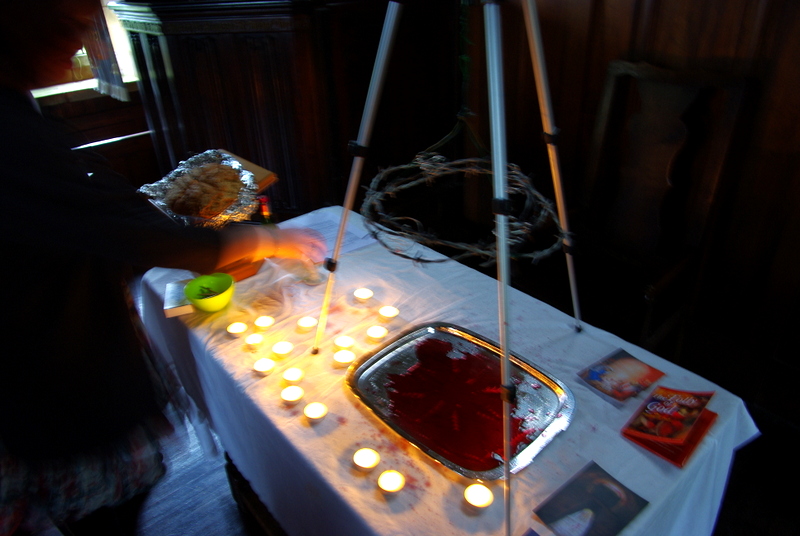
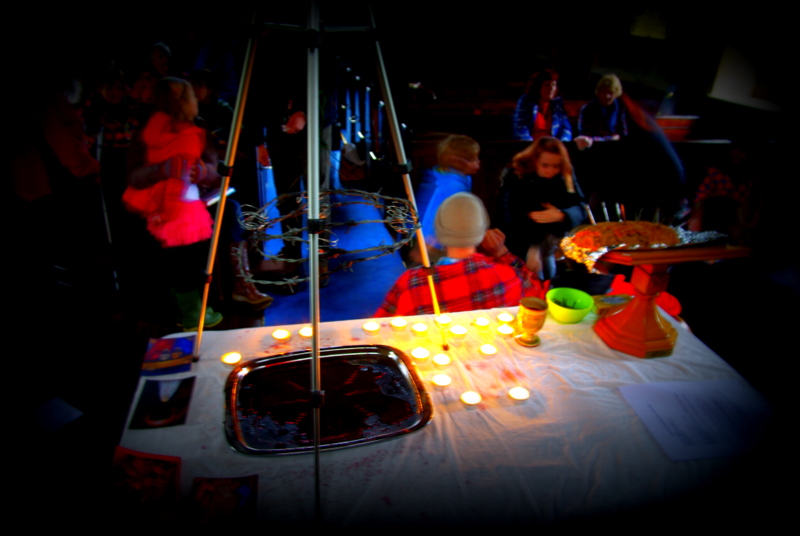
Audrey led us through a liturgy, using some ideas borrowed from Tabled– which is a fantastic collection of creative ideas for communion. We used two objects- one was a crown of thorns suspended with little baskets containing frozen cubes of wine, which dripped down onto a silver tray and a white cloth. The other was a loaf of bread into which we asked people to push nails. The images were powerful and Audrey’s words complimented them wonderfully.

(By the way- if you try the frozen wine thing, bear in mind that wine does not freeze very well- better to use water with some food colouring.)

Afterwards we went back to Andy and Angela’s as the planned picnic was rather rained off. No matter though, we took with us something precious that brought a deeper sense of the death of Jesus, and his resurrection then, and through us, now.

‘The wrath of God was satisfied’

Within churches across the western world, many of us will be singing this line today- from the modern hymn by Stuart Townend, ‘In Christ alone’. The whole verse goes something like this;

In Christ alone! who took on flesh
Fulness of God in helpless babe!
This gift of love and righteousness
Scorned by the ones he came to save:
Till on that cross as Jesus died,
The wrath of God was satisfied –
For every sin on Him was laid;
Here in the death of Christ I live.

It is a great hymn, deeply emotional and soaring in its melody. However I increasingly find the one dimensional nature of it’s theology really difficult. It is this one line about the wrath of God. It conjures up the idea of some kind of unstoppable force of holy hate and destruction in the universe that was narrowly averted only by the torture and death of Jesus.

This is another one of those underpinning assumptions of Evangelicalism that most of us accepted as unassailable truth- Jesus died the horrible death on the cross that was rightfully ours and because of this, God was able to undertake some kind of divine conjuring trick for some of us. This was the only way to overcome the natural forces of justice in the universe. It was the only way to deal with the wrath of God.

For non theologians like me, the fact that this kind of understanding of the atonement of the cross is not the ONLY way of understanding the central drama of the Christian faith might come as a surprise. Recently of course, a number of hugely controversial books have emerged taking a new look at the issue. The authors of these books (Rob Bell, Steve Chalke, Brian McLaren) have often been subjected to the outrage of the faithful.

So, on this Good Friday, I thought that it might be worth examining some of the other understandings of atonement- the other ways that followers of Jesus have attempted to come to terms with the enormity of a God who would come to earth to die such a death.

The name given to the theory of atonement outlined above is ‘Substitutionary atonement’ or sometimes ‘Penal Substitution’. However rather than talk more about I think it would be useful to take a journey through atonement in church history.

Firstly, there is a summary of some of the ideas in this clip by Tony Jones, along with some of his own hard hitting alternatives;

There are other theories of atonement, but here is a quick summary of the dominant ones again;

Moral influence

In this view the core of Christianity is positive moral change, and the purpose of everything Jesus did was to lead humans toward that moral change. He is understood to have accomplished this variously through his teachings, example, founding of the Church, and the inspiring power of his death and resurrection.

This was the atonement theory dominant in the early church in the second and third centuries and was taught by the Church Fathers. It was also popular into the middle ages and beyond.

Ransom theory

Jesus liberates mankind from slavery to Satan and thus death by giving his own life as a ransom. Victory over Satan consists of swapping the life of the perfect (Jesus), for the lives of the imperfect (mankind).

Christus victor

Here Jesus is not used as a ransom but rather defeated Satan in a spiritual battle and thus frees enslaved mankind by defeating the captor. This theory continued to influence Christian theology for a thousand years.

Satisfaction

This theory grew from the work of the 11th century theologian Anselm.  Mankind owes a debt not to Satan, but to sovereign God himself. A sovereign may well be able to forgive an insult or an injury in his private capacity, but because he is a sovereign he cannot if the state has been dishonoured. Anselm argued that the insult given to God is so great that only a perfect sacrifice could satisfy and Jesus, being both God and man, was this perfect sacrifice. Here we see the influence of earthly politics projected onto the heavens.

Penal substitution

The Protestant reformers developed Anselm’s theory.  Instead of considering sin as an affront to God’s honour,  rather sin is regarded as the breaking of God’s moral law. Placing a particular emphasis on Romans 6:23 (the wages of sin is death), penal substitution sees sinful man as being rightfully deserving God’s wrath with the essence of Jesus’ saving work being his substitution in the sinner’s place, bearing the curse in the place of man (Galatians 3:13).

A variation that also falls within this metaphor is Hugo Grotius’ “governmental theory“, which sees Jesus receiving a punishment as a public example of the lengths to which God will go to uphold the moral order.

Some would argue that all these theories contain part of the truth, and (in the absence of certainty) I think I would agree with this.

Apart from this thing that we call ‘the wrath of God’.

I would contend that our theological projections of God are always partial, always incomplete and always emerging from our cultural perspective. So it was natural for the children of the modern enlightenment to see God as embodying a force of logical, highly technical justice. It seemed like the elevation of mankind towards democratic freedom mediated by the purity of the law was a process ordained by God, and so this must also be the character of God himself.

God the judge- stern, inflexible, bound by the fine detail of the law, but able to save a narrow few through a technicality.

But today we remember the death of a man Jesus.

The scandal of the cross.

The unreasonableness of the cross.

The injustice of the the cross.

The laying down of all power and majesty, the ultimate vulnerability of the cross.

The end of all our hopes on the cross.

The defeat of the cross.

The humanity of the cross.

And the mystery unfolds within us.

Spiritual maturity and the pursuit of significance…

We humans are so contradictory. Sometimes we are driven to destroy anyone or anything in our pursuit of personal gain. At other times we are capable of such incredible self sacrifice in pure service of the other. Always we hope that life is more than mere bio mechanics- it has to mean something.

For men in particular, this contradiction often creates some kind of deep void that we spend a lifetime’s journey trying to fill. We believe that the only good life is a life a success. And ultimately success has to be measurable against the failure of others- against the poverty of others, the lack of creativity in others, the lack of godliness in others, even the lack of love in others.

The problem is that success is so fickle- life moves the goalposts constantly and so we feel constantly diminished.

The void remains.

I read this today;

It’s a gift to joyfully recognize and accept our own smallness and ordinariness. Then you are free with nothing to live up to, nothing to prove, and nothing to protect. Such freedom is my best description of Christian maturity, because once you know that your ‘I’ is great and one with God, you can ironically be quite content with a small and ordinary ‘I.’ No grandstanding is necessary. Any question of your own importance or dignity has already been resolved once and for all and forever.

Richard Rohr

It seemed to me that there was a deep spiritual significance in this. What is this thing that we are becoming as we seek to live deeper, more meaningful, more loving lives? Is it really to be bigger, or is it more about recognising that we are small?

Small that is, like a beloved child, whose achievements might be indeed be celebrated, but in no way make us any more (or any less) beloved.

If only it was so simple.

But then again, I am still immature. I have a lot of growing to do yet.

Thy will be gun…

Thanks to Graham for this- it hits at the heart of the ‘Christian Nation’ nonsense, at a time when the worlds only superpower is starting to decline…

America stands in a long line of previous Empires who employ Jesus as a military-industrial figurehead to justify all sorts of things that are simply incompatible with any understanding of what Jesus died for. From Constantine to Queen Victoria.

Some music on Monday 2- Insane Clown Posse…

(In total contrast to my previous post!)

Did any of you read this story in the weekend Guardian a couple of weeks ago? Bizarre was the first word to come to mind…

It concerns the recent decision by the Insane Clown Posse to come out as ‘Christians’-

Foul mouthed, misogynist, violent and aggressive Christians perhaps- but apparently this image was really all an act to get on the wavelength of their audience, so they can hit them with the ‘message’.

If you are not familiar with ICP (and I confess they are not on my MP3 player) here is a sample of their new Christian output-

(Warning! Sweary words abound…)

The Guardian article reveals the two members of ICP as somewhat troubled and confused, so I am not going to have a go. I hope they find something of meaning in spite of all the baggage they seem to be carrying with them.

What is interesting is the clash of cultural world views.

On the one hand, you have gangsta rap, celebrating the stabbing of whores, violent threats and the carrying of weapons.

On the other hand you have conservative Christianity, with it’s distrust of science, and it’s desire to find evidence for God in nature.

All wrapped up in a shallow manipulative image- behind which real people have lost themselves.