Scotland, Prophecy and Jean Darnell…

Jean DarnallIn 1967, American evangelist Jean Darnell, whilst passing through the UK had a ‘prophetic vision’ about the future of faith in these Islands- particularly regarding Scotland. It was such a powerful image that she and her husband stayed in this country for the next 25 years.
I was born in 1967, but had heard of Jean Darnell as I grew up- she had connections to an Anglican community of people in the South of England who were greatly influential as to development of charismatic revival throughout the Anglican church. I always thought of her as a kind and wise person, steeped in the Holy Spirit.

I had not heard about the prophecy however until I moved to Scotland. Here, it is still talked about in hushed and awed tones. She has repeated and clarified her account on several occasions, and various versions can be found using a quick google search- for example this one which is on the Cross rhythms website. However, this is a summary of what she said-

Vision Of Revival In Great Britain

The British Isles were covered in mist (a green haze), and Jean Darnell saw lots of pinpoints of light piercing through. As she looked, they turned out to be fires breaking out all over the nation, from Scotland in the North, to Lands End in the South.

As these God-lit fires were joined together they burned brighter. As she continued to pray, she saw lightning and explosions of fire and then rivers of fire flowing from North to South; from Scotland, Ireland, and Wales into England and some of the streams of fires crossed the channel into Europe, whilst others stopped.

These fires were pockets of people who had been made intensely hungry for the word of God and for New Testament Christianity, those who read the book of Acts and wondered ‘where is this church?’

These people would come together to pray and extra meetings would have to be laid on to accommodate all the people. Groups would be formed, prayer groups, Bible study groups – some would meet in churches, others would be in homes: some converted, others unconverted who were searching and seeking.

Two Moves Of God

Jean Darnall asked the Lord about the vision and had the distinct impression that there would be two moves of God.

1. Renewal In The Church.

The first would be the renewal of Christian faith and fullness of the Holy Spirit within the church.

2. National Awakening And World Vision.

This renewal of life in the church would spread outside resulting in a public awakening. The second part of the vision was the lightning striking around the nation. This move of God would be a national spiritual awakening, which would move into every level of the nation’s life; on the campuses, universities, colleges, schools etc., into the media and in the government.

There would be so many conversions that it would actually change the character of the nation of Britain and determine the future move of God in Europe. Jean continued that there would not be a part of the nation’s life that will not feel the impact of the spiritual awakening when God releases it to the country.

Great Preachers

The Lord told Jean Darnall that He would also raise up highly anointed preachers who would move in signs and wonders. These people would be a gift to Britain.

Communicators Reaching Britain And Europe

The word ‘communicators’ was strongly laid upon Jean’s heart and was a word that was not trendy in those days. [The internet was not be birthed until nearly three decades later in 1994 and Christian television first came to Britain via satellite in October 1995].

Jean explained that as the rivers of fire moved, it would produce powerfully gifted communicators who would address the nation through the media, (Through the arts, journalism, the radio and television). Actors, singers, teachers and powerful communicators (who have an anointing to work through the media) will be the new warriors that the Lord is raising up for His army [the younger generation] to reach the heart of the people on the European Continent. People with a special anointing will be sent out from these islands (of Britain) to other nations.

These communicators will be excellent in all that they do and will go into Europe and meet those of like quality (in training and abilities) and together they will work to release God’s word speedily into Europe. This will result in another wave of a spiritual awakening into Europe. Also, there would be communicators in government and within the educational system and wherever people are speaking [up] for others.

Jean Darnell visited the UK again this year- here is her speaking about Scotland again-

So what are we to make of this? Some of you will not even be interested in asking the question. If you do not have a Christian faith, you may think that all this stuff is just a little mad. Many Christians will agree with you. Many others (like me) have a more complicated relationship with the ideas and hopes contained in this prophecy.

As I mentioned above, I grew up in a church greatly affected by the wonders and wackyness of the Anglican Charismatic revival. I have since spent a lot of time around charismatic churches. I have blogged before about this experience- here for example. As a result of my experiences, I remain (in the words of Pete Rollins) a devout, faithful skeptic. I have seen much that repels me, but also much that was beautiful.

So here are a few thoughts/possibilities that occur to me as I look again at this prophecy…

  1. Jean Darnell was just wrong. Nothing of what she suggests would happen has happened. They used to stone false prophets in the OT days. Far from being a conduit of a massive move of God, the church in the UK is in terminal decline…
  2. Jean Darnell was speaking encouragement into an embryonic move of God. The late 60’s and 70’s did indeed see a charismatic revival- fires did spread through the church, and the ripples go on today. There are communicators, and preachers who still connect with wider Europe…
  3. Jean Darnell was speaking out of a particular context and understanding of evangelism- which longed and hoped for REVIVAL- transformative, all encompassing Holy Spirit saturated revival. No other move of God makes sense, and as such, the prophecy comes from a wish-fulfilling impulse. Revivals like this have happened here before (Wales, Outer Hebrides for example) and continue to happen in other parts of the world (Korea, parts of Africa.) However the outcome and aftermath of these outpourings is often very mixed. I no longer think that attempting to conjour and cajole God into reviving us should be our prime focus. But then again…
  4. Scotland. The central role played by Scotland in Jean’s prophecy seems to imply that what ever is to happen, begins here. I have looked in hope, but see no sign of fires in the North. There are enclaves of fervency and fundamentalism, but there is so much sectarian division and hard heartedness too… I do not see the fires starting inside the churches at the moment, let alone outside.
  5. Because of the decline in church, certain embattled remnants hold on to this prophecy with both hands. We NEED it to be true- because the alternative is an end to all that is held dear. However there is such danger in this- we become people desperate for heavenly Holy Spirit intervention, and forget the call to be Agents of the Kingdom here and now, rather than in the future. The shift in thinking that this requires for the people of faith in Scotland might itself bring about the fires in the north envisioned!
  6. How we understand prophecy seems to be crucial. We tend to think of prophecy as a prediction for the future that will be tested by time. In this instance, the jury is out, and perhaps about to rule against Jean’s prophecy. However, there is another way to understand prophetic utterances- as something that speaks truth into NOW- so many of the OT prophets were encouraging and warning their peers and rulers. Perhaps in this context, Jean was inspiring a generation, and we should not worry about carrying forward this vision like some kind of vision for the future.
  7. Let us just leave it to God.

Islam and the voice of the Spirit…

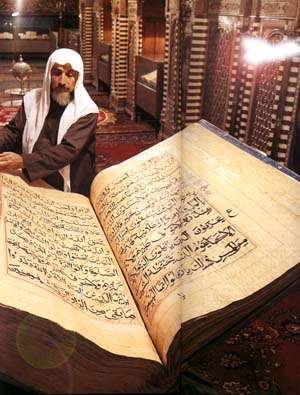
quran

If you follow particular streams in the blogosphere, then you will notice how themes emerge- particular issues that crop up here and there. Not surprising really, as we are attracted to those with like interests, and new ideas are viral. At worst this can feel like self congratulatory hot air.

But sometimes there is a feeling that issues arise that are beyond merely like minded people feeding off one another. Some things just feel important, and right- I suppose you could say that there is something of the Spirit mixed in there- speaking into this time and place.

I have this feeling about all the discussion about how we as Christians should engage with Muslim brothers and sisters.

So we see Brian McLaren joining in with the festival of Ramadan, and blogging his experience, along with the chorus of vitriol being aimed at him from fellow Christians.

Check out this excellent and provocative podcast by Samir Salmanovic, called ‘finding our God in the other.

TallSkinnyKiwi reported some thoughts about this issue by John Azumah. This is what Azumah has to say

One of the crucial issues facing Christians around the world today is finding the right balance in our response to the various challenges posed by Islam and engagement with Muslims. The quest for an appropriate Christian response to Islam and engagement with Muslims has sadly polarized Christians along evangelical vs. liberal, truth vs. grace, or confrontational vs. conciliatory lines.

As an African, my own struggle is the way these positions are presented as absolutes in either/or categories. In the wake of the 11 September 2001 attacks on the World Trade Center in New York City (9/11), the Iraq war, the Madrid bombings, etc., the division among Christians has deepened. Reflecting on the situation, Joseph Cummings talks of a titanic struggle going on in the heavenly realms—a struggle not between Muslims and Christians or between Islam and the West, but “a struggle within Christianity itself, a struggle for the soul of the Christian faith.”1

What Cummings is suggesting, and I couldn’t agree more, is that Islam per se is not necessarily the greatest challenge facing Christians today, but rather how Christians choose to respond to Islam. There seems to be a general consensus that we should be talking about Christian responses rather than “response” to Islam.

I tend to agree- for the following reasons-

There is a perception (which I think is far more imaged than real) of a western democratic capitalism under direct attack from Islamic extremism. Terrorist attacks in New York and London, despotic regimes in Iran and Afghanistan, Israel surrounded by Islamic cultures that breed terror and appear to place no value on the life of innocents.

There is truth here. Islamic terrorists have killed and maimed. Islamic governments seeking to reinstate a primitive version of Sharia law have indeed behaved in despicable ways. Israel has been under attack from neighbouring states since 1948.

But- anyone who seeks to look behind the tabloid headlines will be forced to acknowledge the possibility of contradictory evidence and perspectives. Of thousands killed by western soldiers fighting what has all the appearance of a Crusade against the heathen hordes. Raining down techno-terror on villages and refugee camps. Manipulating and propping up despotic regimes in order to keep the oil taps wide open and flowing westwards. You may look at the sheer numbers of dead Muslims killed by both fellow Muslims and the armies of the West, and compare this to our own losses, terrible as each loss is.

We may also be forced to remember a historical perspective that takes and honest look back at the development of our own modern Christian states- of politics of hate fueled by extremist Christians- hate against heretics, or people with black skins. Civil wars, inquisitions and Pogroms. Of how Sharia compares to Puritanical fervours of our own, and how distorted versions of Jihad can be compared to concepts of a Just War.

Some would also point us to the vacant role left in the international power play by the collapse of Communism- and the need to replace the reds under the bed with… something other, external, alien and less than human, wearing a semtex vest and carrying a copy of the Qu’ran. Something to distract and unify us behind our Governments- according to the conspiracy theorists at least.

But despite this, a rather warped but pervasive view of all things Muslim, and all things Islamic, persists. Perhaps this is because of our ignorance. Ignorance of Islamic faith, and Muslim culture. Ignorance of the rich and wonderful cultural heritage. Ignorance of the serial injustice that some Muslim people have experienced for generations, and of how this has been the fertile subsoil for extremism.

And where ignorance and distorted views of reality interact with a Christian faith that demonises rather than seeks to understand, I start to feel that we Christians are losing the way of Jesus, and joining our lot with a different and more earthly Kingdom.

I grew up in a fairly moderate Evangelical Anglican church, and later attended a left of centre kind of charismatic free church. The general view of the Islamic faith was that it was dangerous, despicable, and a deception of the Devil from which people needed to be rescued. We needed to know nothing else- lest we somehow become infected.

Well I no longer fear infection. I rather fear distortion, and accommodation with (oh the irony) our very own Babylon.

Because we Christians are called to live with our faces towards a different way of being- to seek peace where there is war, understanding where there is ignorance, and to look for love where there is hate- to be a source of hope in times of hopelessness, and healing where there is brokenness.

Even (and perhaps in these times especially) for Muslims.

Some Grey Bloke- you tube prophet for our times!

Came across Some Grey Bloke today and have been laughing and wincing along with him for a little while.

(WARNING- some sweary words, and perhaps just may offend the sensitive…)

So here is Some Grey Bloke on Christianity-

And just for contrast- and given our recent preoccupations in Dunoon, here is Some Grey Bloke on Swine Flu-

That familiar question- what is emerging?

building_church1

Like many others, I have been participating in the emerging church ‘conversation’ for a few years now.

It has been wonderful.

It has transformed the way I think about and understand faith, and brought me again to a deep love of Jesus and all he calls us to.

It has brought me into contact with wonderful people who are traveling in the same direction.

It has given me a genuine hope that things are changing- that something NEW is happening.

The Lion of Judah is circling again…

But it has also brought me into conflict with others- whose core beliefs lead them to adopting different positions in relation to some of the building blocks of faith. And within me, after these years of discussing and blogging and reading- I also wonder where we are up to with this thing.

I particularly wonder where we are up to in Scotland, 2009.

So- some questions!

Where are new forms of church emerging and in what ways are they different?

Where are the agitators, the innovators, the people who pioneer new (emerging) forms of church?

The term seems to be used too as a way for traditional churches to seek renewal. Is this genuine change, or is it merely an attempt to do the same things, but be a bit more trendy?

Where is leadership coming from? Do we need it, or is there still a reaction against centralisation and control?

How do we find mentoring and companionship? Do we still need sympathetic and skillful people who will hold us accountable? Where are these people?

These seems to me to be a difficult, but very important questions. Our reaction to them will no doubt very much depend on where we start from.

I am part of a small group of people outside established church. We meet in houses and celebrate in non-religious environments. We form partnerships where we can, and have many friends, and some folk who view us with at best considerable suspicion! Groups like ours have many advantages- freedom, mobility, passion and excitement. But they are also fragile and ephemeral. They tend to depend on a small group of innovators, and are held together by friendship. When the storms begin (as the surely will) many things can simply destroy such gatherings.

This may be the natural order of things. Perhaps what survives is what is of worth. But perhaps too, like me, you are hungry for connection and for ways to seek and to provide support. Perhaps you are facing a difficult situation, and just need to speak to someone who has been there before.

Perhaps too you are, or have been, part of church situations where you no longer feel at home, New ideas and ways of doing things are in your mind, but the leadership of the place where you are is not open to such things. Perhaps what you need is to find others who have adventured still within such a situation.

There is a discussion thread that digs into some of these things on the Emerging Scotland site.

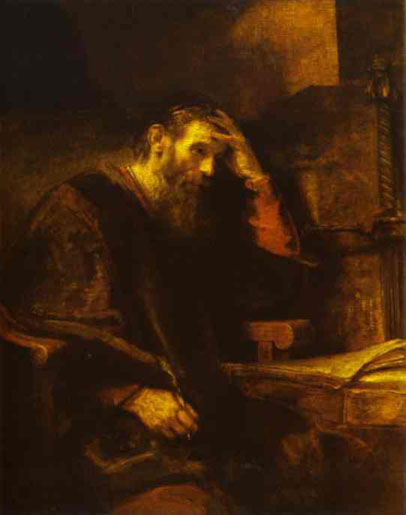
Saul of Tarsus- he was only human… wasn’t he?

Interesting discussion in housegroup the other night.

We are continuing with a study on Acts of the Apostles as part of the Exilio study, and we are up to chapters 25 and 26. It is in this passage that Paul manages to offend the Jews (again) and they get the Roman Governor to throw him into prison.

rembrandt-saint-paul-in-prison

This is not a new thing, Paul has been on the end of imprisonments and beatings in just about every town across the region. Each time, it works out for the best in the end.

But this time, when he is offered a trial, he does something he has not done before- he appeals to Caesar.

Paul was a Roman Citizen. We do not know how he acquired this status, but according to Wikipedia (so it must be true) citizenship was granted for one of the following reasons

  • Roman citizenship was granted automatically to every male child born in a legal marriage of a Roman citizen.
  • Freed slaves were given a limited form of Roman citizenship; they were still obliged in some aspects to their former owner who automatically became their patron.
  • The sons of freed slaves became full citizens.
  • Auxilia were rewarded with Roman citizenship after their term of service. Their children also became citizens.
  • Only Roman citizens could enlist in the Roman Legion. However an enlisted Roman legionary was deprived of many of his rights. He could not legally marry, and therefore all his children born during his military service were denied citizenship, unless and until he married their mother after his discharge.
  • Some individuals received Roman citizenship as a reward for outstanding service to Rome.
  • One could also buy citizenship, but at a very high price.
  • People who were from the Latin states were gradually granted citizenship.
  • Rome gradually granted citizenship to whole provinces; the third-century Constitutio Antoniniana granted it to all free male inhabitants of the Empire.

It iseems clear that in acquiring and then using  his rights as a full Roman Citizen, Paul was pulling rank. I wonder if in some way he was taking a step back- no longer being Paul, but rather reverting to Saul…

Citizenship seemed to involve swimming in some murky waters;

Roman citizenship was also used as a tool of foreign policy and control. Colonies and political allies would be granted a “minor” form of Roman citizenship, there being several graduated levels of citizenship and legal rights (the Latin Right was one of them). The promise of improved standing within the Roman “sphere of influence”, and the rivalry for standing with one’s neighbours, kept the focus of many of Rome’s neighbours and allies centered on the status quo of Roman culture, rather than trying to subvert or overthrow Rome’s influence.

The granting of citizenship to allies and the conquered was a vital step in the process of Romanization. This step was one of the most effective political tools and (at that point in history) original political ideas (perhaps one of the most important reasons for the success of Rome).

As a precursor to this, Alexander the Great had tried to “mingle” his Macedonians and other Greeks with the Persians, Egyptians, Syrians, etc in order to assimilate the people of the conquered Persian Empire, but after his death this policy was largely ignored by his successors. The idea was to assimilate, to turn a defeated and potentially rebellious enemy (or his sons) into a Roman citizen. Instead of having to wait for the unavoidable revolt of a conquered people (a tribe or a city-state) like Sparta and the conquered Helots, Rome made the “known” (conquered) world Roman.

There is the rather telling line in Acts 26 in which Festus suggests that Paul had done nothing wrong, and so would have been free to go, had he not have appealed to Caesar.

Paul was never free again after this point.

So- the question that hit me was whether in playing this political game, Paul got it wrong somehow. Perhaps he stopped relying on God, and the rollercoaster ride of following the Spirit into the missional life he was called to.

Because he was human. We easily forget this, I think as we read the accounts of his life in Acts, and as we live out doctrine based on his inspired writings. But there are enough hints of his human frailty despite the esteem in which he is described. The falling out with other people, the ‘thorn in his flesh’.

But if we can read the Roman Citizenship thing in this way- it seems harsh. Almost as if God is vengeful, merciless towards the mistakes of Paul, his faithful but imperfect servant. Is this a God you recognise?

It kind of reminds me of Pilgrims Progress, by Bunyan- a work that I have always disliked. Pilgrim has a road laid out before him, and should he step off this road- should he make the wrong turn, then he is in for trouble…

The fact is, this way of understanding the life of faith is just too deterministic. Almost as if Paul lived out a life of micro cause and effect, making choices like moving chess pieces, leading to sacred or profane consequences.

Almost as if God has mapped out a plan- a pre-determined track for each of our lives, and our task in life is to find it, and stumble along taking the utmost care to stay on this path at all costs…

footrpints

If this is not true, then how does God interact or respond to our choices? Is he just a (mostly) benign presence watching from afar as we, the ephemera, live out our little lives?

I think that this view of God neither matches the account from the Bible, nor my own experience.

I have come to believe that life is indeed about choice- decisions made in the presence of the Spirit of God, as we move through the difficult terrain of life. Some things go bad. But the Spirit is still there, still prompting and calling us on to a higher deeper way of loving others and serving the Kingdom.

And some decisions have consequences that go beyond the immediate situation. Does that mean that we can count on miraculous intervention by Angels to rescue us? I do not think so. But then again…

But if not, it is perhaps good to remember that the mission of Paul began anew- on a journey to Rome, and through the wonderful letters written to early outposts of the Kingdom that survive today.

Kindness- as a measure of spiritual maturity

Another great collection on Radio 4’s start the week programme. Listen again to it here.

There was this fascinating discussion about KINDNESS, relating to this new book, co written by a psycho analyst Adam Philips  and Historian Barbara Taylor.

on-kindness

They appear to take the view that our society has retreated from kindness as a way of interacting and engaging with the people around us. We assume that we are no longer inter-dependent and needful of others, and so kindness becomes identified with a kind of weakness and vulnerability.

They go as far as to suggest that we tend naturally towards kindness, but learn to suppress this as we grow into our culture. All Kindness, suggests Philips, is a RISK- but a risk that is transformative in the taking.

There is a review of this book in Guardian by Mary Warnock where she says this

Kindness to others arises out of sympathy. As the authors note, there is much evidence that other animals besides human beings (or “men” as they properly designate them) can enter into the sufferings and fears of others of their kind. But it is human animals alone who, because of their imaginative powers, can enter into the feelings of other people far removed from them, whom they cannot see or touch, but whose plight as fellow-humans they can share

In the Gospel of St Luke, a lawyer is told by Jesus that to live well he must love his neighbour as himself and, when he further asks who is to count as his neighbour, Jesus answers with the story of the good Samaritan, for many the very essence of Christianity. Kindness here arose spontaneously, not in obedience to any rule, in fact in defiance of convention. But as Christianity became increasingly ecclesiastical and hierarchical, with the consequent corruption of the priesthood, the good Samaritan was forgotten.

The new Protestantism declared man to be fundamentally sinful, such good actions as he could do dependent on the grace of God; and so the possibility of natural kindness disappeared.

So we come back to Jesus, and his call to live for a radically different agenda, according to the rules of a New Kingdom. And one of the watch-words of this new kingdom- is kindness.

It is one of those fruit listed by Paul as evidence of the indwelling of the Holy Spirit. (See here for some more ponderings on this.)

When we come into contact with kindness at a point of real need, we rarely forget it. It lives on in our souls. As Paul said in 1 Corinthians- all sorts of other loud and visible manifestations of faith will clang like gongs and then fall silent- but love will last for ever.

Which makes me think again about the myth of the super-Christian. I am interested in the stature aquired and the adoration we give to some of our leaders- perhaps for their charisma, their vision or their oratory power. When one of these paragons of Christianity falls from Grace, how dreadful it seems… how shocking.

Might this be because we measure spirituality according to a strange criteria? We equate knowledge with understanding, declaration with practice and power with ordination from on high.

Might we best return to a simple measure- of kindness shown, and a skew towards grace in all things. These are the leaders I look for. Jesus has ruined the others for me!

Why should the Devil have all the good apples?

wassail3

Apparently, in the old orchards of Somerset and Devon, we are entering Wassailing season- traditionaly 12th night (5th January.)

A lovely word is wassailing- thought to be from the old Norse influenced English- meaning ‘good health’. It rolls on the tongue like scrumpy.

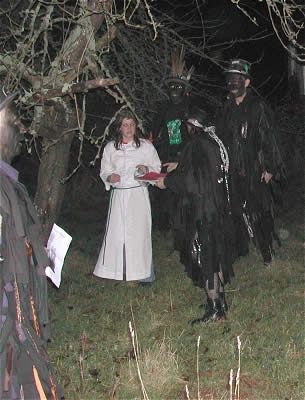
Which is kind of appropriate, as the most common use of the word concerns an old tradition of ceremonies of song and dance and drinking to bless the apple trees, warding off evil spirits and willing the tree to produce a crop for the coming year.

Wassailing also is a word used to describe carol singing in the streets, around new year, and also seems to have been a time when feudal masters were celebrated by their subjects, in response to their seasonal munificence.

The origins of these ceremonies have all been lost in time, but they seem to have more than a whiff of the Pagan about them. The old festivals of the passing of the winter equinox, and the hope of a coming spring. The early Church, as with other festivals, embraced it, and made it Christian. The songs of the wassailers became ones seeking the blessing of God.

So the most well known Wassailing song is this one;

Here we come a wassailing
among the leaves so green,
Here we come a wandering
So fair to be seen.

Chorus:
Love and joy come to you
and to your good Christmas too
And God bless you and send you a happy New Year
And God send you a happy New Year.

We are not daily beggars
that beg from door to door,
We are your neighbor’s children
whom you have seen before.

Chorus

We have got a little purse
of stretching leather skin;
We want a little money
to line it well within.

Chorus

God bless the master of this house,
likewise the mistress, too,
And all the little children
that round the table go.

Chorus

So- why on earth am I going on about this, I hear you ask?

Well, I have been part of groups of charismatic Christians who have tended to understand spirituality as a warfare, first and foremost. So all things come to be measured according to what significance they might have within this unseen war.

This insight is an important one. In Pauls letter to the Ephesians, we read this famous passage-

Finally, be strong in the Lord and in his mighty power. Put on the full armor of God so that you can take your stand against the devil’s schemes. For our struggle is not against flesh and blood, but against the rulers, against the authorities, against the powers of this dark world and against the spiritual forces of evil in the heavenly realms. Therefore put on the full armor of God, so that when the day of evil comes, you may be able to stand your ground, and after you have done everything, to stand.

An understanding flowing from these passages has led to a rejection of anything that has a hint of alternative spirituality- whether this comes from other religions, or perhaps even more so when Pagan traditions are invoked.

People seemed to express real fear that exposure to such things could in some way corrupt or damage us- we could be affected by a ‘Spirit-of….’, which could only be dealt with by those who practice deliverance ministry-releasing us from the bondage of evil influence on our lives.

This view of the world and the many things within it can lead to an intense exclusivity and isolation. Whatever the truth of the spiritual powers understood or suspected (and I should confess to a skepticism in some cases at least!) then I think it important to remember that like the festivals noted above, the early church seemed to have a very different way of working with the traditions and cultural symbols that they encountered.

Paul and the temple to the unknown God, recorded in Acts.

Peter and the Gentiles- the sheet from Heaven etc.

The establishment of early Christian shrines on pre-Christian religious sites that appears to have been common practice.

The example of the early Celtic Church and the use of pre-Christian images and symbols and practices to celebrate the new faith.

Is this corruption or syncretism? I do not think so. Accommodation with a spirituality that is damaging is indeed something that we should guard against- but boxing ourselves into fearful religious enclaves- this seems to me to be even more damaging.

We live in a post-Christian world here in the west, and increasingly, the world around us draws it’s spirituality from outside the Christian tradition. Like those early Celtic missionaries, we have no choice but to engage with this reality. The question that should concern us is how we bring Jesus with us as we move into an alien landscape. How do we live as Agents of the Kingdom in this foreign land?

So on this 12th night, let us put on the armour of the Living God and walk tall- secure in the knowledge that before Him, nothing will stand.

Why should the Devil have all the good apples?


Gaza- how do we allow the violence to stand unchallenged?

I was watching some footage of the violence in Gaza on the news today.

A house destroyed by a tank shell. A mother and three children still in the rubble.

Two small bays covered in blood and concrete dust carried into a hopelessly overwhelmed hospital, staffed by western volunteers. Lacking crucial supplies because of a blockade imposed by the same people who now send the bombs.

Ali posted a link to this film below. If you have any interest- sit down with a coffee and watch it through…

What are we to make of this?

There are two main perspectives it seems;

Israel the defender of the free against the forces of terror.

Israel came into being as a rag tag group of survivors of a Nazi Holocaust took control of their own fate. The Jewish Diaspora was called home, to the land promised by Yahweh.

From the very beginning, they faced overwhelming odds- first the British ‘peacekeeper’ force, who were overcome by the gallant Zionists (albeit using terror tactics.) Then, outnumbered several times, they fought back attacks from every point of the compass by the surrounding Arab nations.

These surrounding nations could not accept the reality of a re-established Jewish nation, and so set themselves on a war footing- committed to driving Israelis into the sea, and returning Palestine to the Palestinians.

But Israel got tough. It’s fighters tenacity and idealistic strength were more than a match for anything the Arabs could throw at them, so the Arabs turned to terrorism.

So Israel fights on still- sending planes and tanks into the hills and streets of Lebanon, and Gaza- in measured, professional response to the missiles launched and the suicide bombers sent.

Israel the victim, striking back.

This view of Israel seems to find a ready home within some Christian groups- most notably, right wing Evangelicals. I have always struggled to understand this. As far as I can make out, this seems to be for a lot of reasons;

  • Theological reasons- Modern Israel is seen through a set of Old Testament goggles. Israel is the promised land of the Jews, and so God will always favour Israel.
  • Escatological reasons- there are understandings of the ‘end times’ predicted by the book of Revelation that centralise Israel- as a necessary stage for the final dramas of the Human Race. As such, the watchers and readers of the coming great tribulation seem to value their understanding of this Biblical prophetic work more highly than human life- or at least, Arab human life.
  • Political reasons- the American Religious Right has become a powerful political force. Mingled in with this is a strong bias towards Israel- perhaps for the reasons above- perhaps also because of other business interests- that familiar relationship between political and economic power. The accommodation with the spirit of the age that the Book of Revelation may also be understood to be commenting on.
  • A lack of understanding because of a media bias. The film above makes this point very strongly. To hear a journalist of the stature of Robert Fisk describe just how strong the media blackout has been on any critical news reports describing Israeli aggression gives more than a little pause for thought.
  • A willingness to believe ‘Christian’ sources, and discount any information that emanates from contradictory sources- such as Amnesty International, the Red Cross, or even Christian Aid.

So- to the second understanding…

Israel the aggressor, the war criminal.

Here a different Israel can be seen.

A people formed in terrible adversity who went from the victims of genocide, to the perpetrators of terrible human rights abuses within a single generation.

This is a story of UN resolutions ignored. Of internationally recognised borders ignored. Of property and land destroyed and violated. Of thousands of women and children murdered.

And of an allegiance with the worlds only remaining superpower, with an unlimited supply of armaments.

Of thousands killed in the refugee camps of Lebanon. Rockets and shells fired into densely populated slums- full of civilians.

Of an on going occupation of the West bank, and Gaza- against specific UN resolutions. Whose brutalised young people, raised on stories of martyrdom and oppression, lacking opportunities for work, or the hope of any kind of stable life. Lacking all the advantages of a people who live the other side of the fences and walls that surround them- these young people then turn to the very violence employed by zionist terrorists only 50 years ago.

They put bombs on buses and in hotels. They strap explosives to their bodies and walk into school yards.

What should our response be?

I am a follower of Jesus. In his name, we stand as peace makers, healers, chain breakers and bringers of sight to the blind.

No-one carries a sword in the name of the Prince of Peace. Even if many (starting with Peter in the garden) have made that terrible mistake.

So let us stand with Jesus with the poor and oppressed- wherever they are, and whomsoever is the oppressor. Let us seek to understand, and never call this weakness. Let us seek to love, and never call this treason. Let us seek to reconcile and never call this surrender to terror.

And let us raise voices that hold to account those who wield the sword over the weak. Let us be never accommodate and excuse evil- even when it is wrapped in a flag, or the ideology of freedom.

Let us also remember some of the followers of Jesus who remembered the way of the Kingdom under terrible oppression.

Have we not come to such an impasse in the modern world that we must love our enemies – or else? The chain reaction of evil – hate begetting hate, wars producing more wars – must be broken, or else we shall be plunged into the dark abyss of annihilation.

Like an unchecked cancer, hate corrodes the personality and eats away its vital unity. Hate destroys a man’s sense of values and his objectivity. It causes him to describe the beautiful as ugly and the ugly as beautiful, and to confuse the true with the false and the false with the true.

The church must be reminded that it is not the master or the servant of the state, but rather the conscience of the state. It must be the guide and the critic of the state, and never its tool. If the church does not recapture its prophetic zeal, it will become an irrelevant social club without moral or spiritual authority.

Returning violence for violence multiplies violence, adding deeper darkness to a night already devoid of stars… Hate cannot drive out hate: only love can do that.

Quotes from Martin Luther King


Church: as garden, park, glen and meadow…

the-church-in-emerging-culture

I have been reading this book- ‘The church in emerging culture’, ed Leonard Sweet. It takes a look at where church is up to from 5 perspectives- Andy Crouch, Michael Horton, Fredrica Mathewes-Green, Brian McLaren and Erwin McManus.

I have lost my way with it a little- more because of the format I think. Each person writes a chapter, then the other authors get a chance to put in footnotes and comments. I like the idea, but in practice, it makes for a strange book- lots of the comments are congratulatory, or disagreeing whilst being terribly nice.

However, there is an introduction by Leonard Sweet in which he uses this image to make us think about the different ways of being church. I have simplified (because I had to- the bloke it too clever for me!) the discussion, and reproduce it here.

What do you think? Is this a good analogy?

I suppose the interesting thing is that flowers and fruit grow in all of these places- and they can all be very beautiful…

Garden- traditional church?formal-garden

An ‘enclosure’- fenced off enclave of righteousness. Rooted in traditions. Collaboration between divine gardener (God), master gardeners (ministers) and horticulturalists (theologians), along with the canonical seasons.

Fruit and flowers grow and are appreciated.

The outside of the garden is of little concern. The garden is shaped and hallowed.

The garden demands that we walk slowly, prune quickly, earn the flowers by hard work- composting them well with the goodness distilled from previous generations.

Alien seeds are not tolerated. Constant struggle to win back the garden from the encroachment of time and surrounding wilderness.

Park- evangelical church?phoenix-park

Made for walking. Tied together by paths and vistas. Taking the old story of nature, and reforming it in new ways.

Rather than setting up high barriers, the park regulates the space by RULES. It is open to visitors at appointed times and under the supervision of park-keepers.

Technology and innovation are employed in parks- fountains, play areas- things that attract visitors.

The park manager decides which features to include in the park, borrowing from a wide variety of flora and fauna- but does not do so uncritically- always striving to work within the opportunities given by landscape and tradition.

Glen- progressive church?welcome-to-glen-clova-scotland

The glen is an open and unprotected, surrounded by encroaching vegetation and forest.

It is defined by the relationship between landscape and soil fertility that allows settlement. The edges of the glen- its crags and steep slopes, require hard work to navigate. People avoid these places because of the fear of falling.

Glen dwellers revel in the mystery of the seed and season. They travel in packs of people of group consciousness. They are concerned with the cultivation of food from the land to feed the hungry, not about the beauty of gardens and parklands.

In the garden, you are what your parents planted- here, you are what your seeds become…

The people of the glen have to be highly adaptable and innovative to survive. The thin soil easily washes away, and new production methods have to be embraced.

However, in the Glen, tradition is powerful. People are more likely to look backwards than forwards. The reformers often seek to purify what already exists…

The meadow- emerging church?meadow-grass-blue-flowers

A tract of moist grassland where flowers and grasses grow in profusion- all muddled together. There are also boggy places with fragile mosses and lichens. Willows and shrubs also grow there. They just happen. They are not managed by humans. The are rich in botanical (theological) diversity.

They are what first grows after devastation- for example, a forest fire.

Meadows are then inventive, creative and developmental.

The plants that grow in the meadow are intermingled and to some extent dependent. A Flax will never become a meadowsweet, but they will grow side by side. Beauty is evident in each. Fruit grows amid flowers and weeds.

Dwellers in the meadow are not interested in rules or doctrines- but rather in images and relationships and stories that bring people together.

There may be no easy, well trodden paths, but the meadow invites you to run through it bare foot. In this way, every generation can cut its own path. Every generation can turn from a world in which we have tried to garden everything and walk free.

In the meadow, all parties are active, none are passive.

In the meadow, there is a high rate of invention, but a high rate of failure. Plants come for a while, but die away to be replaced by other plants, as the soil conditions and moisture levels change.