
Worship list 1

I have spent years participating with, and leading, groups of Christians as we worship God.

We always reminded ourselves that worship was a personal decision, made out of relationship and dynamic interaction with the Spirit of the living God, not something that just (or even always) happens in church meetings.

But it is clear that something special can happen when we gather together and make our worship collective…

But what is this?

After all the years of trying to understand this better, I have more questions than answers. Here are some of them

  • Why do we do it? Yes, I know we are supposed to, but what really motivates us?
  • How do we take our private offerings of worship, and collectively present them to God?
  • Or should we allow our worship to travel on the security and safety of tradition?
  • Is it good to be relevant and progressive in the style of our worship?
  • When do we do it, and what does it look like? Does it always have to be formal, ‘churchy’, and dominated by ‘worship professionals’- in my experience, these almost always have a posh guitar.
  • Is there more than music as a way of collectively worshiping?
  • What practices or attitudes of body and mind might HELP us to worship?
  • What might we expect Him to do as we worship? Is he distant, or active? Is he particularly active as we worship?
  • How much of our worship arises from individual choices or decisions?
  • What might we aspire to, how do we measure the worth of our worship?
  • How much arises as a response to that which is collective and shared – or even proscribed?
  • Does God inhabit the praises of his people, and if so, how can we meet him there?

Some of the answers to questions like this already have the shape of answers given to me by my church tradition. But these answers are rarely complete, but only partial.

How we work out our collective answers to these questions may be different for all of us. But if we do not ask them, my experience is that something in the middle of us starts to whither and die.

Perhaps we become bored and stale.

But could it be that God is bored too?

I have come to think that the enemy of faith is stasis. Even if not everything around us needs to change- we always do.

Osama, how the other half see him…

My friend Ali turned up this evening- he had been house sitting for his sister while she had been on holiday so I had not seen him for a few days.

Ali is a singular kind of guy, who has a taste for the kitsch… and his sister found something in the souks of Marrakesh that she knew she would have to take home for her brother. More of this later…

There is a phantom shadow on our age, cast by the missing outline of the twin towers of Manhattan. This shadow has unleashed a new kind of warfare that has global impact- the ‘war against terror.’ On the one side we have the big battalions bent on imposing rough justice in the name of democracy, and on the other, those who have come to see the west as representing everything wrong with this world of ours.

Many things define the difference found between the supporters of the different sides. One side is mostly rich, the other, mostly poor. But perhaps above all, the defining difference is that of religion. One side is predominantly white, Protestant Christian, the other, Muslim.

It is important I think, to understand the other– to walk a while in his shoes and mark the blisters on his heel.

Otherwise, we may fall to that familiar base human default of dehumanising those who are different, and even demonising those who disturb our understanding of normality.

It seems clear that the Muslim world has a different way of seeing this ‘war on terror’ than predominates even in my liberal, left-of-centre world view. For them, this war is a manufactured, imperialist, brutal assault on a whole way of life- a whole faith group. It is the logical outcome of a long line of injustice perpetrated by or supported by the west (and the USA in particular.) Israel, Kosovo, Somalia, Iran, the Kurds, Chechnya, Israel again, and again…

In this way of seeing the world, the ‘war on terror’ is all smoke and mirrors, behind which is OIL. And religion.

That is not to say that people necessarily condone terrorist violence, but they may understand it, and its root causes in a way that we are not able (or willing) to. Many may resent the further trouble Bin Laden has brought down upon the heads of the Muslim world when he attacked the ‘great Satan’ on September the 11th. But his motivation is clear, and his continued defiance of the whole might of the USA continues to give almost univeral satisfaction.

Back to Ali’s present.

With great ceremony, he began to set up some cheap plastic track on our coffee table. He then placed on the track a tank, driven by a bad representation of George W Bush, and in font of this, Osama Bin Laden, on a skateboard. The tank was battery powered, but the skateboard had a magnet whose polarity opposed a magnet on the tank, so as the tank whirred round the track, the skateboard was propelled in front of it, always out of reach.

Here is a phototof the two protagonists, for your viewing pleasure, and education…

Missionality?

To continue the Aussie theme began in my last post- we are just about to begin a study called Exilio in our house group. Thanks to Johnny Laird(http://johnnylaird.blogspot.com/) for the info about this wonderful (but very demanding) resource.

This is a resource produced by Aussie globe trotter Michael Frost and others. It is based on Frost’s book ‘Exiles’, and a study on the book of acts, and the whole point is to help us think about living Missional lives. Its available on this link http://www.forge.org.au/index.php/20070322143/FORGE/Forge-Australia-Info/Forge-Resources.html

This word missional seems to be on the up. Some folk in our group were a bit irritated by it. I suppose it is an attempt to recapture the centrality of mission in the life of Christians.

But for a much better definition- check out Tall Skinny Kiwi (Andrew Jones);

http://tallskinnykiwi.typepad.com/tallskinnykiwi/2008/06/missional-synch.html

Kanyini

Thanks to the heads up from Craig in Australia, I have been doing some research and thinking about the concept of Kanyini. Craig was kind enough to send this to me in connection to some ‘wilderness meditations’ we are working on- finding locations to provide cues and context for drawing close to God (some of this stuff can be found here; www.aoradh.org/index.php?option=com_content&task=category&sectionid=24&id=80&Itemid=62)

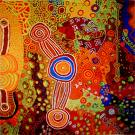
The concept of kanyini has been brought to us by a beautiful man called Bob Randall who grew up as an aboriginal boy on the outskirts of a cattle station in central Australia. His father was a farmer of Scottish extraction, but appears to have had no concern for him at all. Like 50,000 other black kids of mixed race (between 1910 and 1970) he was forcibly removed from his family, and sent to school hundreds of miles from home. He was forced to learn the rules of white culture- the clothes, the way of life, the religion. He learnt to appreciate the contradictions between the words of Jesus, and the actions of these, his followers. Since then, he has been a welfare worker, a songwriter, and author, and now, works with Australia’s black community.

To be a native Australian in these times is to be part of a community with huge problems- health, crime, substance misuse, soaring suicide rates. It is a community living in the shadows of the sky scrapers of new Australia, but also in the shadow of what amount to a genocide, in which everything about what has been described as the oldest culture in the world has been all but destroyed.

But it is also the story of a Diaspora of westerners (particularly Celts from Ireland and Scotland) often still under the shadow of their own experience of oppression and injustice, who become in turn the oppressors, murderers and rapists of a whole culture.

It is their story, but it is also ours. It is the story of what happens when we become disconnected from who we are.

Because to hear Bob Randall speak(check out the links below) is to feel the pull of something wonderful. He describes a culture where people are connected to land. Birds, trees, all living things- they are family. The proof of this connection is that we are… alive! And because everything is connected, everything is OURS, not MINE. Everything is already created in a perfect state and our job is to become part of it.

Bob describes his memory of life as a kid like this;

These were beautiful people, because they lived in a beautiful way.

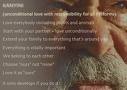
Bob’s concept of Kanyini feels right. It has simple truth- and seems to encapsulate the idea of community as I understand it should be. It has 4 components

  • belief system
  • spirituality
  • land
  • family

I very much recommend checking out the film about Bob from the schools site below, or there are other links to the Kanyini film on the second link.

www.teachers.tv/video/22396


www.wyldheart.co.uk/kanyini.html


Theology, encapsulated?

I was thinking the other day about how incredibly difficult it is to have theological discussion with people outside your particular circle. The language that we use to describe our experience and understanding of God can be so prescriptive.

It is almost as our liturgy and our doctrines become mutually incompatible if they vary from each other by more than, say 3-4%.

Having said that, it may be easier to find common grounds for discussion if there is greater variance! We might be talking at cross purposes, but we are less likely to shout “Heretic!”

My friend and former neighbour Terry sent me this recently, which kind of makes the point nicely.

Its just for a laugh- enjoy!

Several centuries ago, the Pope decreed that all the Jews had to convert to Catholicism or leave Italy. There was a huge outcry from the Jewish community, so the Pope offered a deal. He would have a religious debate with the leader of the Jewish community. If the Jews won, they could stay in Italy ; if the Pope won, they would have to convert or leave.

The Jewish people met and picked an aged and wise Rabbi to represent them in the debate. However, as the Rabbi spoke no Italian, and the Pope spoke no Yiddish, they agreed that it would be a ‘silent’ debate.

On the chosen day the Pope and Rabbi sat opposite each other.

The Pope raised his hand and showed three fingers.

The Rabbi looked back and raised one finger.

Next, the Pope waved his finger around his head.

The Rabbi pointed to the ground where he sat.

The Pope brought out a communion wafer and a chalice of wine.

The Rabbi pulled out an apple.

With that the Pope stood up and declared that he was beaten, and that the Rabbi was too clever. The Jews could stay in Italy .

Later the Cardinals met with the Pope and asked him what had happened?

The Pope said, ‘First I held up three fingers to represent the Trinity. He responded by holding up one finger to remind me there is still only one God common to both our beliefs. Then, I waved my finger around my head to show him that God was all around us. He responded by pointing to the ground to show that God was also right here with us. I pulled out the wine and wafer, to show that God absolves us of all our sins. He pulled out an apple to remind me of the original sin. He had beaten me at every move and I could not continue.

Meanwhile, the Jewish community gathered to ask the Rabbi how he had won.

‘I haven’t a clue’ said the Rabbi. First he said to me that we had three days to get out of Italy, so I gave him the finger. Then he tells me that the whole country would be cleared of Jews and I said to him that we were staying right here.

‘And then what?’ asked a woman.

‘Who knows?’ said the Rabbi. ‘He took out his lunch so I took out mine.’

Canterbury Cathedral

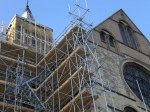
It is a long way down country from Scotland to the channel ferries in Dover, so we made a couple of stop over visits- one to stay with some old friends in Leyland, Simon and Ruth, the next was a hotel in Simon’s place of Birth, Canterbury.

We drove through rolling green ancient England- the way Americans always imagine it to be- old stone churches, and villages with narrow streets hemmed in with Tudor wooden framed houses. England is a beautiful, blessed place, for all it’s tortured twisted history.

Much of the breadth of this beauty and history is contained within this Jewel of a city, and it’s wonderful Cathedral.

Canterbury Cathedral is the first church of the Anglican communion of churches- the seat of Archbishop Rowan Williams. As we visited the Lambeth Conference was just beginning, along with the break away conference in Jerusalem of those opposed to what is seen as the ‘liberalisation’ of the Church. We still await the possibility that the Anglican Church will break itself apart- pulled in different directions by doctrinal emphasis and, of course, by that totemic issue of homosexuality- your stance towards this issue still seems to be the one that most accurately depicts which side of the split you are likely to place yourself.

As for us, we are tourists, on the outside of this debate, following the thousand year tradition of pilgrimage to this ancient place of worship.

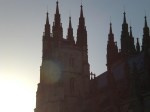
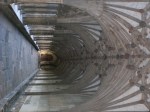
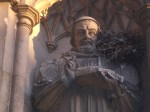
Canterbury Cathederal has seen it all before, and much worse- it is a place all too familiar with political intrigue and power mongering. But it is also a place of incredible, breath taking beauty- from the ancient crumbling carvings, to the high fluted ceilings that hold every whispered word like a breath. There is something ethereal about the very light that filters in through the ancient glass- it seems to take on the weight and the colour of the stones it falls upon. It was almost impossible, even for our Kids Emily and William, not to speak with bated breath…

Michaela told me recently that despite the decline in church attendance, number visiting and attending services in Cathedrals are on the increase. This, I suppose, is no surprise. It fits in with a post modern return to more ancient spiritual practices- an embrace of mystery and mysticism- and (perhaps) a romanticisation of ritual and ceremony.

We had time to attend the early Sunday morning communion service before rushing off to Dover. It was a simple service, with perhaps 50 folk sat in the choir stalls, no hymns, using the book of common prayer. Lots of the words used still remained in me in some deep memory cupboards- even beyond my rejection of these things. And the beauty of the language impacted me again, as spoken by a priest who inhabited them, and embraced their poetry, their sensibility…

We left reluctantly, and sat in the car stilled and at peace. It was time for some music of worship. Skip forward a millenia, and American worship music filled the car, on loud. I am comfortable with contradiction…

I sang along for a while, before tears made me stop.

Looking across as Michaela, I was not alone.

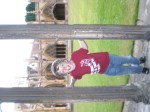
Here are some pics;

Blogged with the Flock Browser

Eileach an Naoimh

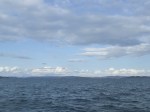
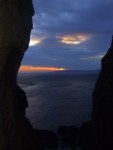
I have just been checking out some photos of a trip I took with some friends to the Garvellachs in May.

The Garvellachs are a tiny Archipelago of islands in the Inner Hebrides. They are uninhabited, and the only way of getting to them is by boat charter.

The islands are absolutely beautiful. Anyone who has ever visited and explored small islands like these will know that they are all different- and that being within their confined boundaries can be a very expansive experience. A chance to be at peace, to pray, worship, think, talk, sit around campfires, and seek shelter in caves.

The Garvellachs offer something else however. On one of the islands (Eileach an Naoimh) is an almost complete monastery dating back to the time of St Columba. Some say that this was the site that Columba used as his own place of rest from the busyness of Iona- the famed Hinba.

We spent three days full of gales, sunshine, and sunsets- sometimes scrambling over cliffs, sometimes huddled in ancient buildings, or in the privacy of our tiny tents.

It was a time of blessing- and so I offer here some photos, and another poem…

Eileach an Naoimh

Hard place
Stones ring and rattle
Upon this hollow ground

Soft place
Pillowing the prayers
Of a thousand saints
In the skein
Of tender years

Thin place
Between this wonderful world
And the next

Mysterious
Like the purple veins
Of a pregnant woman
Singing in those parts of us
We used to call
Souls

May 2008

The Garvellachs, Inner Hebrides

The mole

The other day I climbed a mountain.

I climb mountains for many reasons. I love to set myself against the challenge of steep rock. I stay within my boundaries of safety for the most part, but always there is the spice of adventure. It is an experience that is enhanced by the company of friends, although on the steep bits my fitness level does not allow much spare breath for talking. Increasingly however, I love to be in the mountains alone.

And these days have often become my times of pilgrimage. As I journey through wild places, and allow a crowded mind to empty before the simplicity of scrambling over rough ground, I suddenly find that it is possible for God to be heard through the static of my usual day. It is not that I do not try to listen normally you understand, it is just that He really needs to shout. And I can be so busy trying to do His job for him, that I forget that He is so much better at it than I am.

So, whilst not pretending to be in the possession of great spiritual insight, I would recommend finding a place of your own where you can linger, or even journey, with the Living God. I have a friend who has a special place along the Loch side, with a convenient tree stump. Another far more organised friend has a room in her house that she keeps just for this same purpose.

I love being in Mountains. I love the sweep of slope from green forest to the dark crags. I love the cloud as it wisps it way through the peaks, and the constant changes of light as the sun brings out every imaginable shade of green. Much more than this, however, I love to be in God’s presence.

I have known His closeness in the high mountains, and also in other places far more earthbound. Like a heavy perfume, resting and intoxicating with Joy and anticipation. Suddenly the air crackles as if electrified. The space becomes fertile and full of fecundity. Nothing else measures up, and once experienced, all we want is more. In every sense of the words, these are the mountaintop experiences of my life.

But God also speaks through the small, quiet things, given as gifts in the stride of the day. Pockets of grace to pick up, and carry on.

Mountains can be dangerous places. On the day in question I climbed into a blizzard, enjoying the need for crampons and ice-axe. And there, just above the snowline, stark against the white snow patch, I suddenly saw a bundle of dark brown fur. Tiny and vulnerable, it was a mole.

What was he doing here, so high above the valley floor? Far from the gardens and football pitches of my youth, into which the industrious creatures would push up their countless mounds of earth like mushrooms in the night. What did he find to eat up here? He certainly seemed to offer a very visible target for any passing falcon. There was surely little opportunity for tunnelling into this hard rock, unless he was equipped with blasting powder.

He saw me, and had a terrible fright. With legs buzzing like the wings of a bee, he shot over to a pile of rocks, and dived in. He was home, safe deep in a friendly cleft rock.

And into my head, popped this Psalm. I t could be written just for the moles of this world.

I run to you O Lord, for life.

I throw myself upon you

I plead that you accept me

Come down to where I am, and listen

Your caves are my hiding place

Your precipitous cliffs are my nesting place

Hide me in your depths

Be my guide in the climbs and the scrambles

You are my leader

You will never let me fall

My life is in your hands

You will never let me down

(From psalm 31)

The florida outpouring, and me…

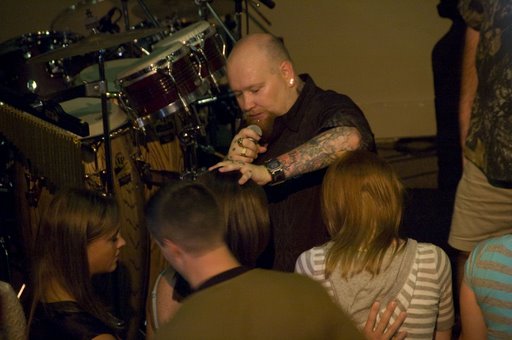
Most Christians will have heard something of
the latest ‘revival sensation’ to hit the Christian media from
Lakeland, Florida. Led by Todd Bentley, a controversial and hard
hitting preacher, it features amazing stories of healing miracles, and
people being raised from the dead.

You might know someone who has traveled to Florida to receive
‘impartation’, in order to carry the fire back to their own church, or
have attended meetings led by the Florida leadership team in Dudley, or
most recently East Lothian. Good people- hungry for God, returning on
fire…

Or like me you might have watched the ‘God Channel’ (Not something
my stomach can usually take much of, I confess!), as they screen long
services and sermons from Florida, complete with healing testimonies.
The images polarize people, and seem to demand that we adopt a position
in relation to them.

All around me, I hear Christians asking the same questions.

What is going on here?

Is this a move of God that has major significance for our times?

Can I afford to ‘miss out’?

Is there manipulation and hype going on here?

Where are the fruits seen in lives changed?

Where is the evidence that authenticates the miraculous healings?

Are events like this a natural consequence of a marriage between Evangelicalism and the mass media?

Have we been here before? I certainly feel a sense of Déjà vu .

I grew up in a traditional Church of England church in a small
Nottinghamshire town. Our church was turned inside out and upside down
by charismatic revival in the early 1980’s. Lots of heat and smoke,
lots of speaking in tongues and prophetic utterances. Everything
changed. Many people were hurt and left the church. Many others joined.

Since then I have been in and around Charismatic Christians for most
of my life. I still count myself a skeptical (perhaps sometimes
jaundiced) charismatic. I have seen wonderful things, but I have also
seen some absolute nonsense. I have felt compelled to seek after God as
revealed in Charismata, but repelled by the excesses of this in equal
measure.

So- I think back to the gentle beauty I saw in Spirit-filled
intellectuals like David Watson, to the dogmatic arrogant power used by
Colin Urqhuart, the other worldly soft-rock polish of Wimber and the
embryonic Vineyard movement, the shouting-laughing-gold teeth imparting
madness of the ‘Toronto blessing’, and so on…

Can I say that I found God in this journey? Yes.

Do I think that there was much that was oppressive, manipulative,
self-centred and just downright WEIRD in this journey? Absolutely!

I bear the scars. Growing up as a tortured adolescent, and adding
the need to validate your life and faith through the acquisition of the
gift of tongues, this will always leave some strange marks on your
psyche! But God seems to be prepared to commune with some strange folk.
He is amazingly tolerant I find…

So, back to Todd Bentley. Hero of the faith, or charlatan? You decide!

As for me, I don’t care that much any more. I am old enough to know
that chasing after God by attending large meetings where others say he
is to be found is not for me. If however God is in this, great.

I will stick to seeking God along with my community, in my town. If
He wants to zap us with a bit of Holy Spirit fire, I am up for it
though!

I read Jason Clark’s blog on this issue recently, and found myself to be more or less in agreement of everything he says…

http://jasonclark.ws/2008/06/10/todd-bentley-and-john-crowder/

Blogged with the Flock Browser

Tags: , , , ,