Church leavers research project- be part of the response!

Regular readers of this blog may remember previous articles and even podcast interviews with Dr. Katy Cross, who has been undertaking research trying to understand paths taken by people who leave church- the meaning they make and find, the connections they still seek and so on.

Katy is now towards the end of her research, and is entering a ‘creative response’ stage. There are a few ways you can be involved, but the first meeting on-line is Tuesday the 29th at 6PM. If you are on your own journey beyond church, but feel like understanding this better in community then this might be just the place for you.

There are two ways folk can take part:

  • By attending online workshops to discuss prompts and reflect together. You can sign up here to join in.
  • By writing up your own reflections in your own time, and emailing these to Katie here

As above, the first group is meeting on Tuesday 29th July at 6pm on MS Teams.

We hope that Katie will be able to join us on the Proost podcast soon to collect together some thoughts and conclusions about this very important research.

Why do I think this chat is so important? As with this post, there is lots of chat just now about what is emerging in terms of organised religion in the UK. After a long decline, some say (on currently very limited evidence) that there is a ‘quiet revival’ taking place here, with young people, and young men in particular, flocking back into Churches. If this is true – if we are seeing a reversal of the decades-long social trend away from organised religion – then it seems important to understand this and the social forces that might be at work.

On the other hand (and at present I remain in this camp) if this research turns out to be flawed, we also need to understand why so many people within the Church have siezed on it with such uncritical enthusiasm.

Meanwhile there is another conversation that is taking place – for example in Katy’s research – with those who have been activists, leaders and pioneers within the church, but no longer feel able to be part of formal religious structures. What happened ot these people? Where are they finding meaning? How might they shape and influence what happens next?

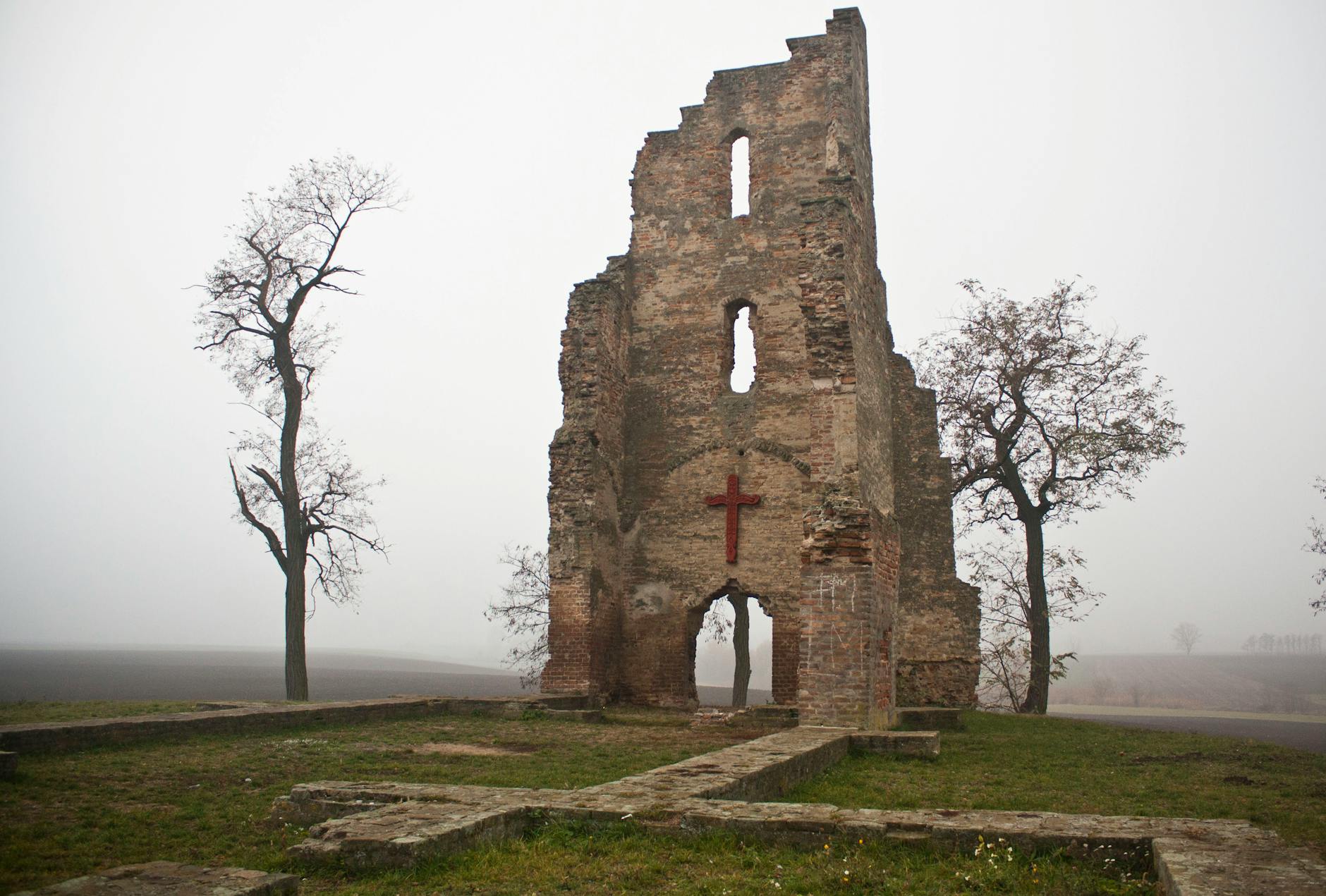
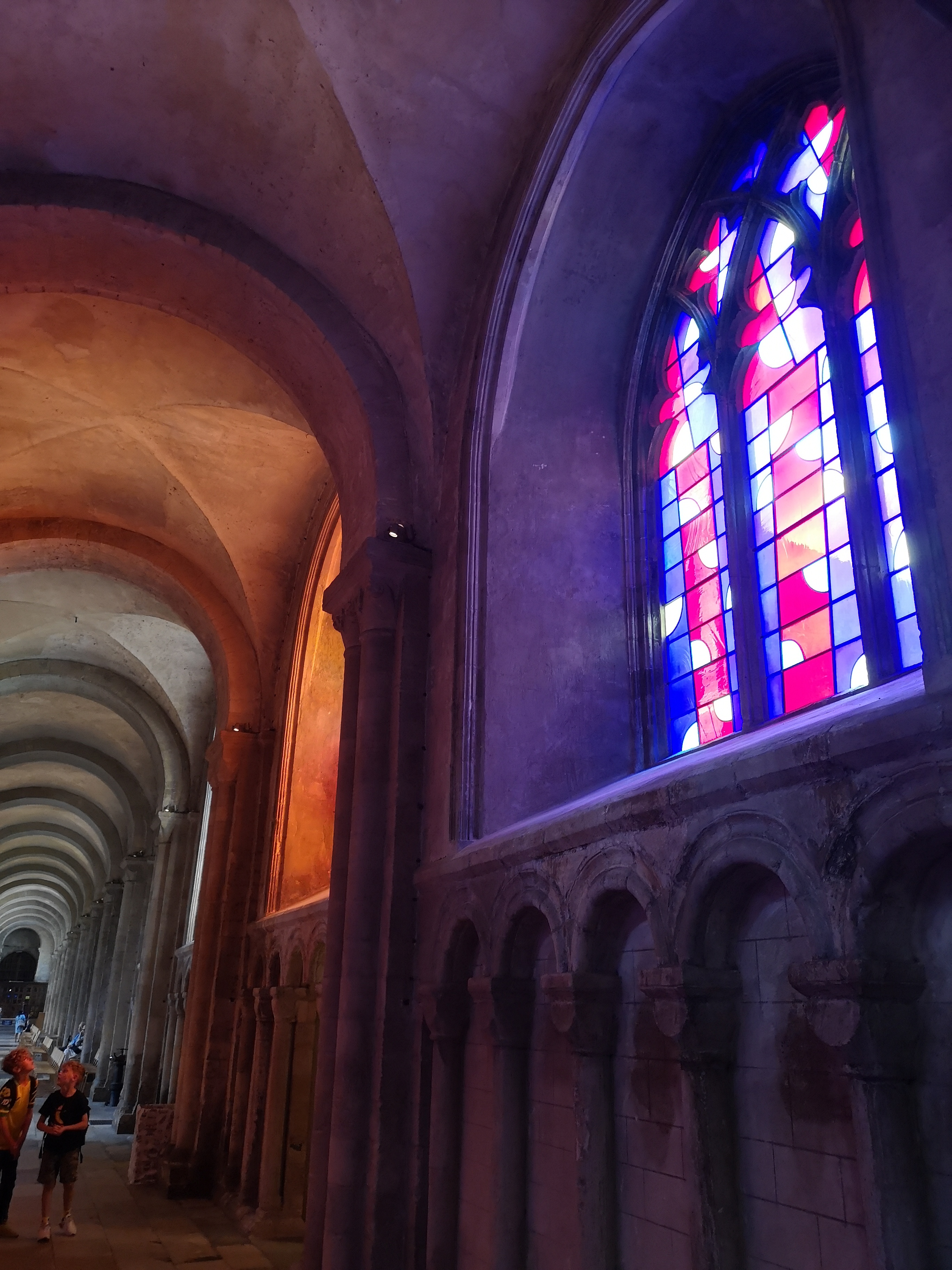
Photo by Zac Frith on Pexels.com

Even as I write this, I think too of dear friends who continue to work WITHIN the Church, to carry forward acts of grace and mercy, to serve an aging population with critical needs, to run food banks and toddler groups, to set up refugee support groups and to make simple beautiful acts of worship that enable people to deepen their spiritual experience. I think how exhausted some of them are, and how abandoned the conversation above makes them feel…

Things are changing, shifting, shinking and unfolding at the same time. This has always been the case, but it does feel like we are standing on anther threshold. Whilst we mourn what is lost, we can also be excited about what will come.

The ‘quiet revival’ – what does the research REALLY say?

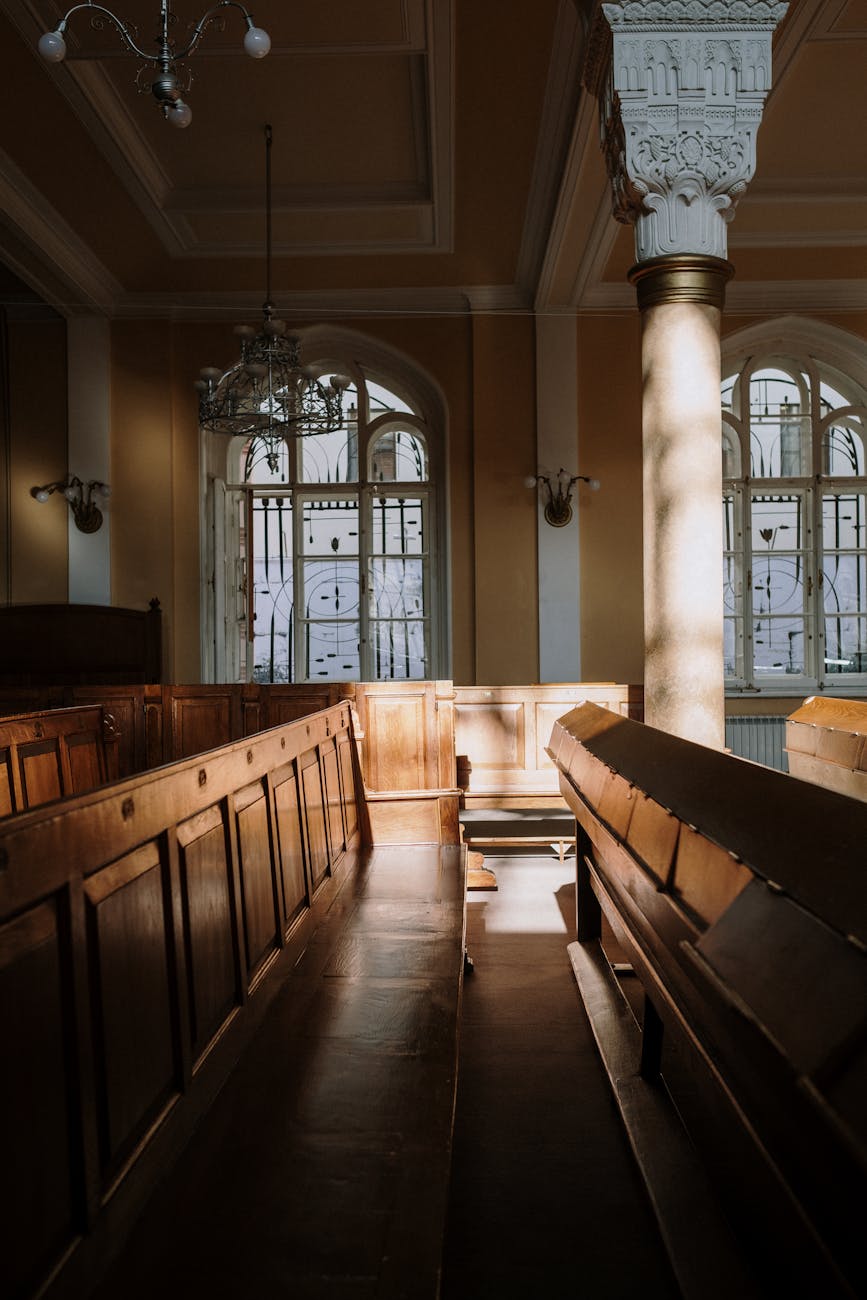
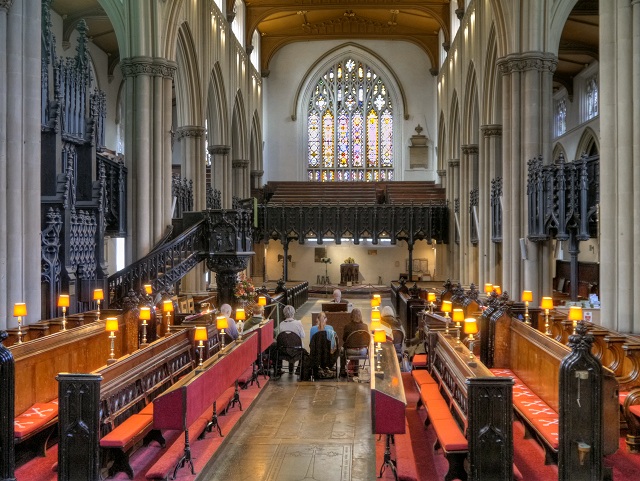
Leeds Minster (interior) by David Dixon is licensed under CC-BY-SA 2.0

The Bible Society commissioned a survey from Yougov – a legitimate and credible polling organisation – which they claim ‘busts the myth of church decline’.

You can download the full survey here.

Here are the headline claims, using the somewhat bombastic language from the Bible Society itself.

Key findings from The Quiet Revival 

Co-author of The Quiet Revival Dr Rhiannon McAleer says the report shows that what people believe about Church decline is no longer true. ‘These are striking findings that completely reverse the widely held assumption that the Church in England and Wales is in terminal decline,’ she said. 

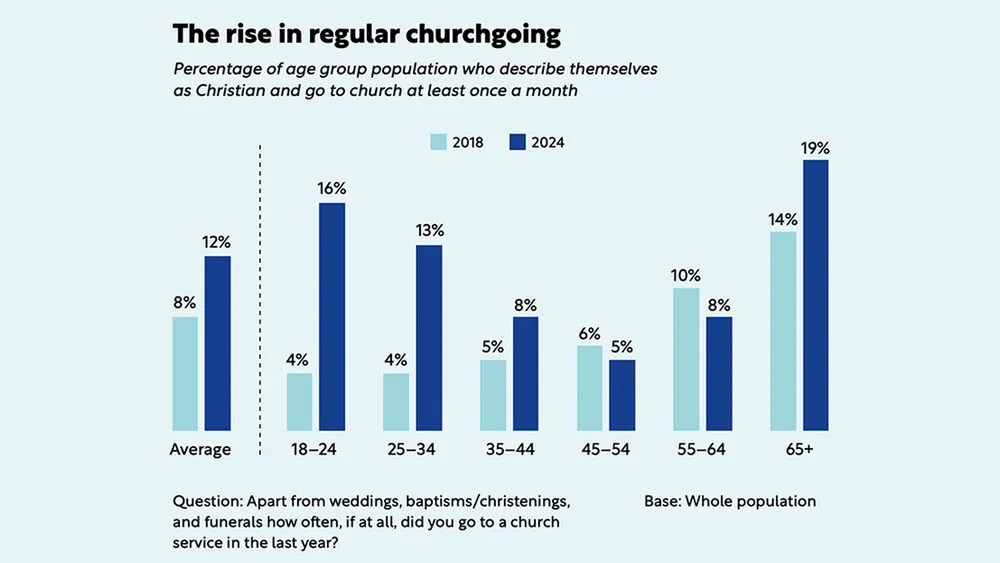
‘While some traditional denominations continue to face challenges, we’ve seen significant, broad-based growth among most expressions of Church – particularly in Roman Catholicism and Pentecostalism. There are now over 2 million more people attending church than there were six years ago.’ 

More men than women go to church 

The Quiet Revival shows that men (13 per cent) are more likely to attend church than women (10 per cent). And as well church decline being reversed, the Church is also becoming more ethnically diverse, with one in five people (19 per cent) coming from an ethnic minority. Close to half of young Black people aged 18–34 (47 per cent) are now attending church at least monthly, according to The Quiet Revival

It’s also great to see that Bible reading and confidence in the Bible have increased as well as church growth. Some 67 per cent of churchgoing Christians read the Bible at least weekly outside church.

This is the key statistic. It would seem to point to a massic uplift in church going, particularly in the 18-24 range. Young men now seem four times more likely to go to church than pre pandemic – at least according to this survey.

(For the statistics geeks, the actual data collected by the survey is here.)

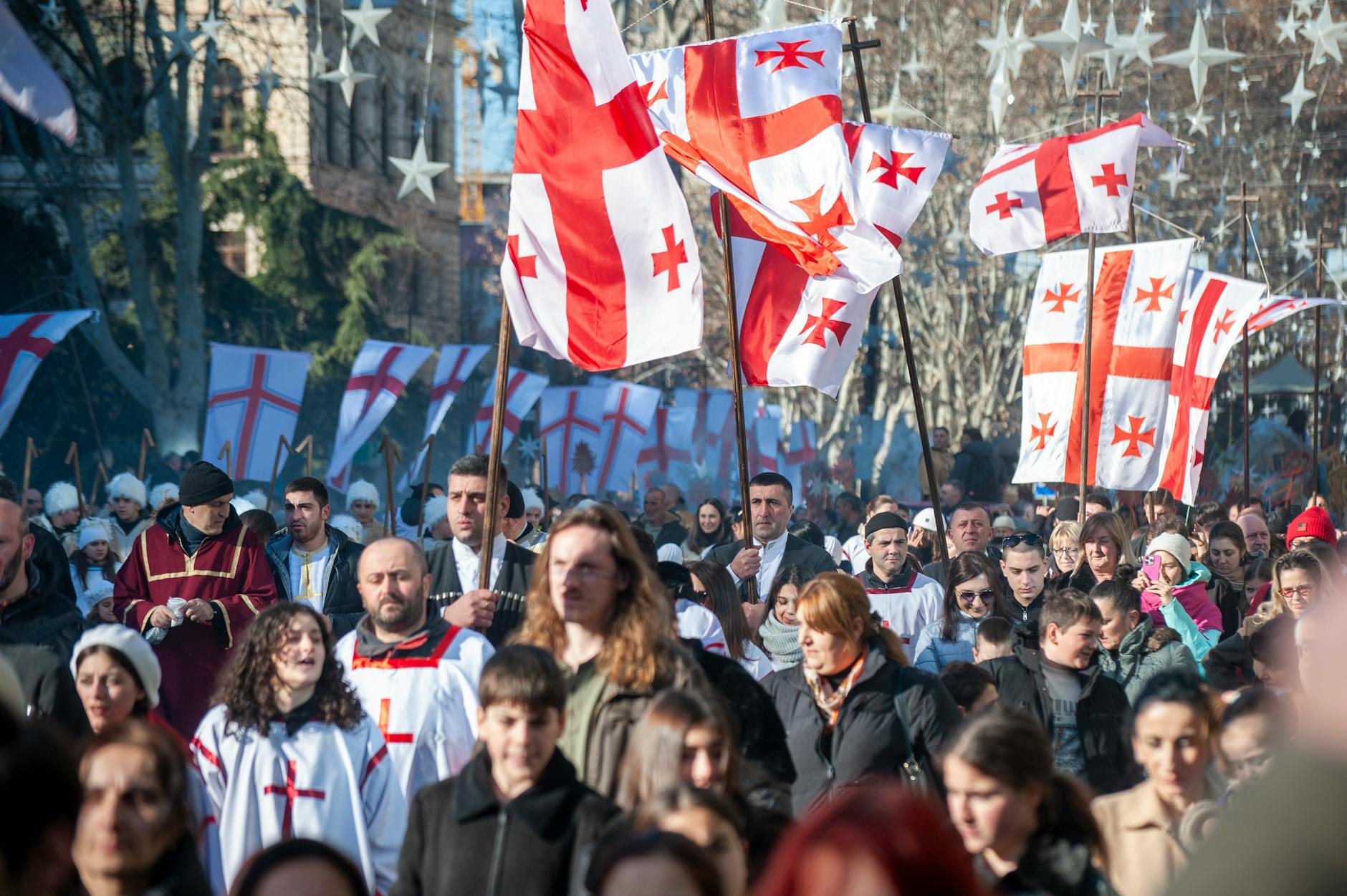
Church Services by Alan Stewart is licensed under CC-BY-SA 2.0

This rather startling survey has been greeted by some with incredulity. It seems to be describing a trend that has reversed a decades long decline in church attendance in the UK. Many have greeted it with rejoicing. Could this really be true?

There have already been webinars and conferences that are using the term ‘quiet revival’ to describe what people are claiming as a ‘move of God.’ The lesson, it is claimed, is that this is the beginning of an awakening of spiritual seeking in younger generations, and evidence of the fact that yound men in particular are searching for meaning.

This all sounds like a good thing, right?

We might not have noticed it, but are we seeing an actual revival?

So why do I feel a deep sense of scepticism? Is this just my post-church cynicism? I am on record as having very mixed feelings about the word ‘revival’ (this from 11 years ago for example) after being previously part of expressions of religion that saw this as the only valid aim of Christian activity.

I think it is much more than that, however. A long time ago I was a social science graduate, and if we had come accross a piece of research or a survey that had suggested a social phenomenon that was different to all other sources of data, we would have immediately placed it on the ‘need more examination’ pile. We would have to look at other sources of evidence and test any conclusions that might be made by exposing them to wider scrutiny and comparison. One survey is never enough to declare a brand new social trend…

particularly when other sources of information seem to directly contradict this survey.

For example, the British Social Attitudes Survey – the largest and most authorative survey of social trends in the UK – found no evidence of an increase of religious attendence, noting instead a continual decline.

It seems I am not alone in my sceptism. More or Less, the BBC radio 4 programme that explains – and sometimes debunks – numbers and statistics used in public life spent some time examing this issue today- it is well worth a listen.

Next, let me point you to this excellent piece on The Church Mouse Blog.

Here is how the Church Mouse frames the problem some of us have with this survey;

The most extraordinary claim is that, in the past six years (i.e., since just before the pandemic), the Church in England and Wales, across all denominations, has grown by more than half, from a total of 3.7 million regular worshippers to 5.8 million. The report says that it is largely the young who are driving this, in contradiction to our previous assumption that every generation is less religious than their parents.

The evidence for these claims comes from a large survey undertaken by a highly respected polling organisation, YouGov, that whether they had attended a church in the past month, among other questions. The same question set and methodology six years previously reveals a 56% increase in attendance.

And none of us noticed.

The Church Mouse goes on to say this.

Some of the churches where the Bible Society reported significant growth actually count the number of people who walk through their doors, and the numbers don’t match.

The most robust data set by a UK denomination is from the Church of England. Each church counts the number of worshippers during the same period each year, and the numbers are compiled to create a robust, consistent data set. The data shows that over the past six years, the Church has shrunk by between 10-20%, depending on how you count it…

…The same methodology can be applied to the data for the Catholic Church, the next largest denomination. The report said that it has grown from 23% of attendees in 2018 to 31% in 2024, meaning it would have grown from around 850,000 regular attendees in 2018 to 1.8 million in 2024, spectacular growth of almost a million regular worshippers.

The Catholic Church in England and Wales reported regular mass attendance down around 20% from pre-pandemic levels,  to 555,000 in 2023 from 702,000 in 2019. 

Between them, these two denominations have reportedly grown their regular attendance by almost 1.5m people, out of the total reported growth (According to the Bible society survey) of 2.1m, or over 70% of the total growth. But Church attendance data simply does not back that up.

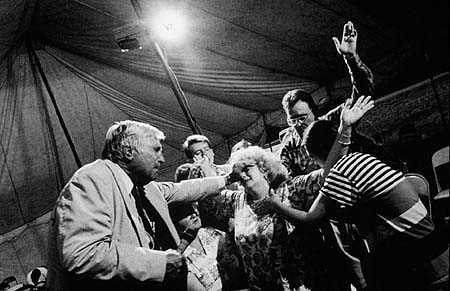
Is this all hot air intended to inflate church ego? (Sorry, could not resist in relation to the photo above.)

The simple answer is that we do not know.

But either way we need to explain why this survey is so different. Here are the possible reasons for this as I see them just now.

Data collection problems/survey bias

Yougov knows its business, but rougue findings from one-off polls and surveys are certainly possible.

Many have pointed out that saying you go to church is not actually the same thing as going to church, and people do seem to exagerate their church attendence. Might the fact that apparently more people have exagerated their attendence in itself be an indication of church being a more desirable option?

Or perhaps there was an error in earlier surveys, and in pew numbers collected by churches? All of them? Over decades?

Timescale

Has the survey picked up sometihng interesting that has happened in the last year? has the decline flattened out? Is there a new trend? The comparison figure of actual numbers collected by churches are all earlier. This seem implausable but…

What does ‘church attendance’ actually mean?

Must we include the many on-line expressions of faith – apps, streaming, etc etc? If so, perhaps people are now exposed to wider digital forms of church and so are including these in their answer?

What about Churches that don’t collect or publish stats?

Perhaps the increase is all in the non conformist, independent churches? There is other evidence that some of these are indeed growing, particularly independent and evangelical churches. The trouble is, this is from a lower base, and the Bible Society survey asked people to list their religious affiliation- leading to the claim of growth in mainline churches that simply is not evidenced by other sources.

Young men?

I have a slight discomfort about this, in that there appear to be other trends happening in that age group. There’s a growing divide between young men and women, with men increasingly drawn to conservative, traditionalist or right-wing political movements (while women tend to lean more liberal.) This trend, linked ot the influence of ‘Celebrity Christians’ such as Jordan Peterson is not one that I find comfort in. Might this be the reason for young men apparently seeing Church in a more positive light? The attraction here might then be narrow moral certainty rather than the teachings of Jesus.

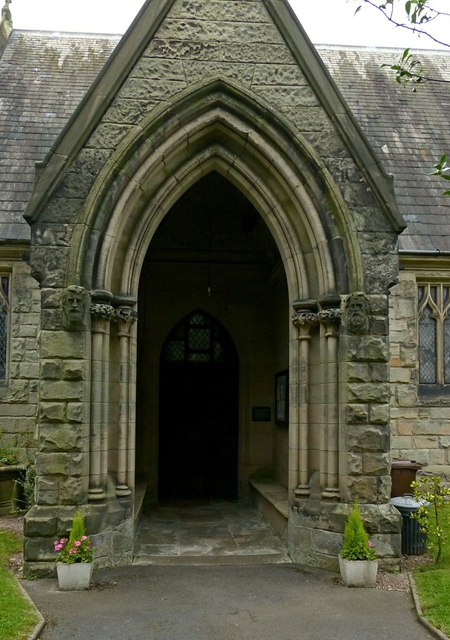
Church of St James the Great, Salt by Alan Murray-Rust is licensed under CC-BY-SA 2.0

My conclusions then…

This survey is interesting, but we need to treat it with a great degree of caution. There are major difficulties with drawing any conclusions based on this one survey, and the Bible Society itself has used language and great fanfare that I find highly questionable.

Whatever is going on is not revival.

It might hint at a change to come, but only time will tell.

ARTISTS CALL – weekend exploring the theme of Mycellium, with Proost.

fungus bowl, seatreeargyll.com

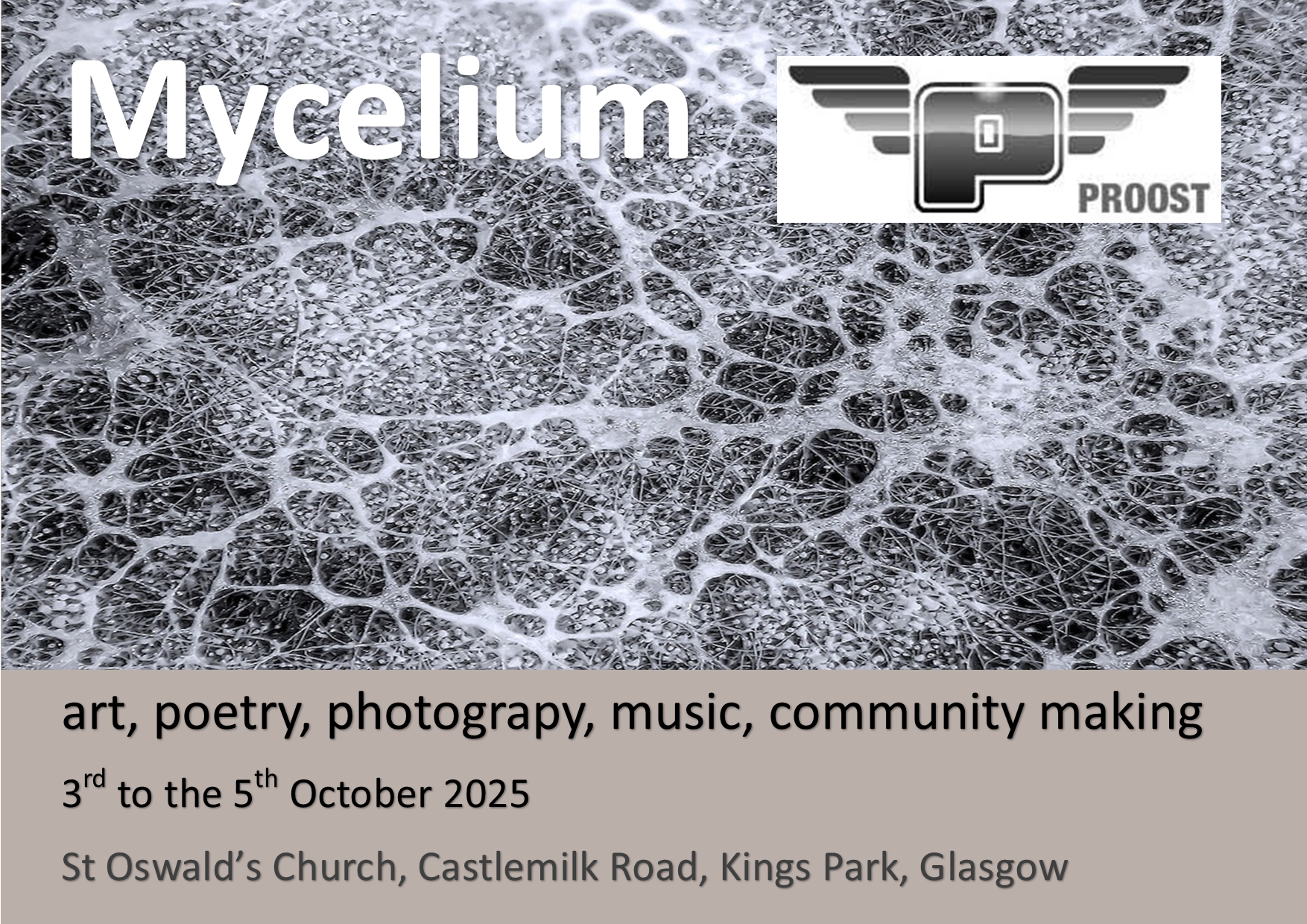
Here is a quick update on the Proost meet up for artists in Glasgow. First, the key details;

PROOST MEET UP, 2025

Date: 3rd October 2025 (6:00 PM) to 5th October 2025 (4:00 PM)
Location: St Oswald’s Episcopal Church, King’s Park, 260 Castlemilk Rd, Glasgow G44 4LB

Hosted by: Proost, in partnership with local Episcopal and Church of Scotland Churches
Cost: The gathering is free, with the aim of making this gathering as accessible as possible for all.
Accommodation: Informal hosting options are available for those who need them, and we’re happy to provide guidance on nearby accommodation options to help you make your stay as comfortable as possible. Let us know how we can assist you!

WHAT IS IT ALL ABOUT?

Many of you will remember Proost as it used to be- a publishing platform established on the edge of what we used to call ’emerging church’ or ‘missional groups’ or ‘alt worship’. It gathered a community of creatives who made poetry, art, video, music, liturgy and much more. For many of us, it gave a sense of belonging and connection – and ways to collaborate with other artists in both gathered and dispersed events. We live in different times now, but if anything, creatives need these connections more than ever.

We need art that engages, that challenges, that allows us to go deeper.

We need to hear from people who are otherwise marginalised.

We need to speak of justice and peace, so challenge where appropriate.

We need to take allow our art to connect with the deep spirituality of the earth.

The landscape of faith and culture has changed a lot in the decades since Proost first came on to the scene. Communication technology has made publishing easier, yet at the same time so much harder because of the sheer volume of content being produced. Funding streams and generating income is a massive challenge. Against all this, we have a powerful tool called community.

This is our dream for a new Proost- the means by which we combine our voices, our creativity and our resources to transcend the limitiations imposed by our context in service of justice. We think this is a holy pursuit, made ever more urgent by the crises gathering around us- wars, climate breakdown, inequality and political/economic impotence.

Much of this discussion has been taking place via two podcasts…

The main feed

The poetry feed

… and we have made a start with some collaborations around Advent and Lent.

But we feel that community also needs to make physical connections. We need to come together in one place, to share stories, to make plans and art together.

WHAT WILL WE DO?

The idea is simple- choose a theme and then invite people to respond to it using their art – music, poetry, painting, dance, pottery, photography, animation, video – or anything else.

We will make space for as many contributions and expressions of creativity as we can comb together in the form of installation or performance. The only limitation is that you need to bring those contributions in person!

We are so grateful to St Oswald’s Episcopal Church (King’s Park, 260 Castlemilk Rd, Glasgow G44 4LB) in partnership with local Episcopal and Church of Scotland Churches for generously hosting this weekend.

Installation space will be in and around the St Oswalds. (This will include a large mushroom-related ceramic offering!)

Performance opportunities will be via 1. A great big Ceilidh on Saturday night – dancing, hopefully interspersed with all sorts of other poems, songs and stories. 2. Sunday afternoon event. Both will be open to local people.

We want to keep Saturday day-time for discussion and chat amongst Proostians – working out together what seems important, and how this project might progress. There will be themed discussions led by different members of the team.

20250519_1500171594497244553114269

WHY MYCELLIUM?

This is the theme we have chosen for our meet up. Some of the reasons for this will already be in your heads, but here are some ponderings that might help unleash your own creative responses.

Soil science is advancing rapidly – we now need to stop thinking of soil as just inert dirt. It might be more accurate to regard it as a living entity all on its own – but if that is a little fanciful surely we need to understand that it is a complex ecosystem- one which almost all other land based life on the planet depends upon. Without soil, we die. Crucially, the role of mycelial networks in connecting, communicating and making communalities is increasingly being understood to be so much more important than previously thought.

Mycelium is the way that trees ‘talk’ to one another. Think about that- one life form relies upon another lifeform in order to share nutrients, warn of disease and so much more.

We modern humans tend to think about the natural world as being characterised by competition, the elimination of weakness and ‘survival of the fittest’. We have taken Darwinian ideas, misunderstood them and used them to justify our economics, our politics – even our spiritualities. The more we understand about mycelium, the more we need to think again.

Perhaps the ‘survival of the fittest’ might better be understood to mean that we survive best when we seek to fit with our context – when we seek connection and community.

What are we connecting with? Does mycelium only represent a way to understand human interrelatedness – with both each other and with the wider natural world? I would argue however that we might consider this connection to be much deeper than that.

These ideas have always been at the heart of the Christian story, not least the mystical traditions and the Celtic wisdom traditions, both of which have long emphasised that it is through God that all things live and have their being. In the Celtic understanding, God is to be found at the centre of everything, even us. We encounter him by going deeper.

Richard Rohr, in his magnificent book ‘The Universal Christ’ show us a different window into this way of understanding, in which the Christ is ‘another name for everything’ – the cosmic consciousness through which the universe expanded and came into being. We are all held in this commonality and invited to participate according to the deep truth of love.

As followers of Jesus, there seem to me to be so many other resonances here.

  • Unity and Oneness:

Jesus called for a unified community, where individuals, despite their differences, are “perfectly joined together” in their minds and judgments. 

  • Body Analogy:

He used the image of a body with many parts, each playing a vital role, to illustrate the interconnectedness and interdependence of his followers. 

  • Love for Neighbour:

Jesus emphasized the importance of loving one’s neighbour as oneself, which encourages cooperation and mutual support within a community. Compassion and love are a natural law that we need to be drawn towards.

  • Serving Others:

He demonstrated the importance of serving others, highlighting the value of helping those in need and working together for a common good. 

  • Collaboration and Partnership:

Jesus encouraged his followers to work together, emphasizing the importance of partnership in living as agents of the Kingdom of God.

HOW TO GET INVOLVED?

We need ideas, songs, poems, film, images, dance, liturgies. We will ‘curate’ these in advance and include as many as we can. HOWEVER- this is about community, so we need you to bring your ideas, not just to send them. We will make the event together.

We have some very limited funding, and the offer of some accommodation. We don’t want money to be an obstacle for anyone.

This is the start of a new thing. Come and help shape it. On saturday we want to explore ideas together- to talk of Poesis and dream of how art and spirituality move togther and miight lead us forward.

If this is interesting to you, what you can do is

SIGN UP VIA THE PROOST WEBSITE

This will not commit you to anything- we will keep you informed, that is all.

If you have ideas you want to talk through,or want to know more, or have questions, we would love to hear from you- you can get in touch via the website, or drop me a message via the comments below, or send me an e-mail at thisfragiletent@com

What religion do we need, and can we remake it?

If you are reading this (after glimpsing the title) then I am going to make an assumption that, like me, you think that religion can be/might become/sometimes is part of the solution to some of the difficulties that assail the world we live in. Sure, you might (like me) be deeply frustrated by the fact that it has failed to be this so regularly and in so many ways, but (like me) you perhaps still have this feeling that ideas matter, and that ideas of the spirit perhaps matter even more…

I was listening to Brian McLaren talking about his new book (which I have not read yet) Life after doom: wisdom and courage for a world falling apart. He defined the ‘problem’, or the things falling apart in four ways

  1. Crisis of the planet – the planet not being able to cope with the amount humans take nor absorb the amount of waste we give it back
  2. Crisis of the economy – Our economic survival seems to be based on continuing to consume more and more
  3. Crisis of our politics – Our political systems seem incapable of envisioning or implimenting alternative solutions, even when offered a pathway by science
  4. Crisis of our religion – our religious institutions are not able to bring to us a deep conviction of our responsibility or connection to the living world we are part of.
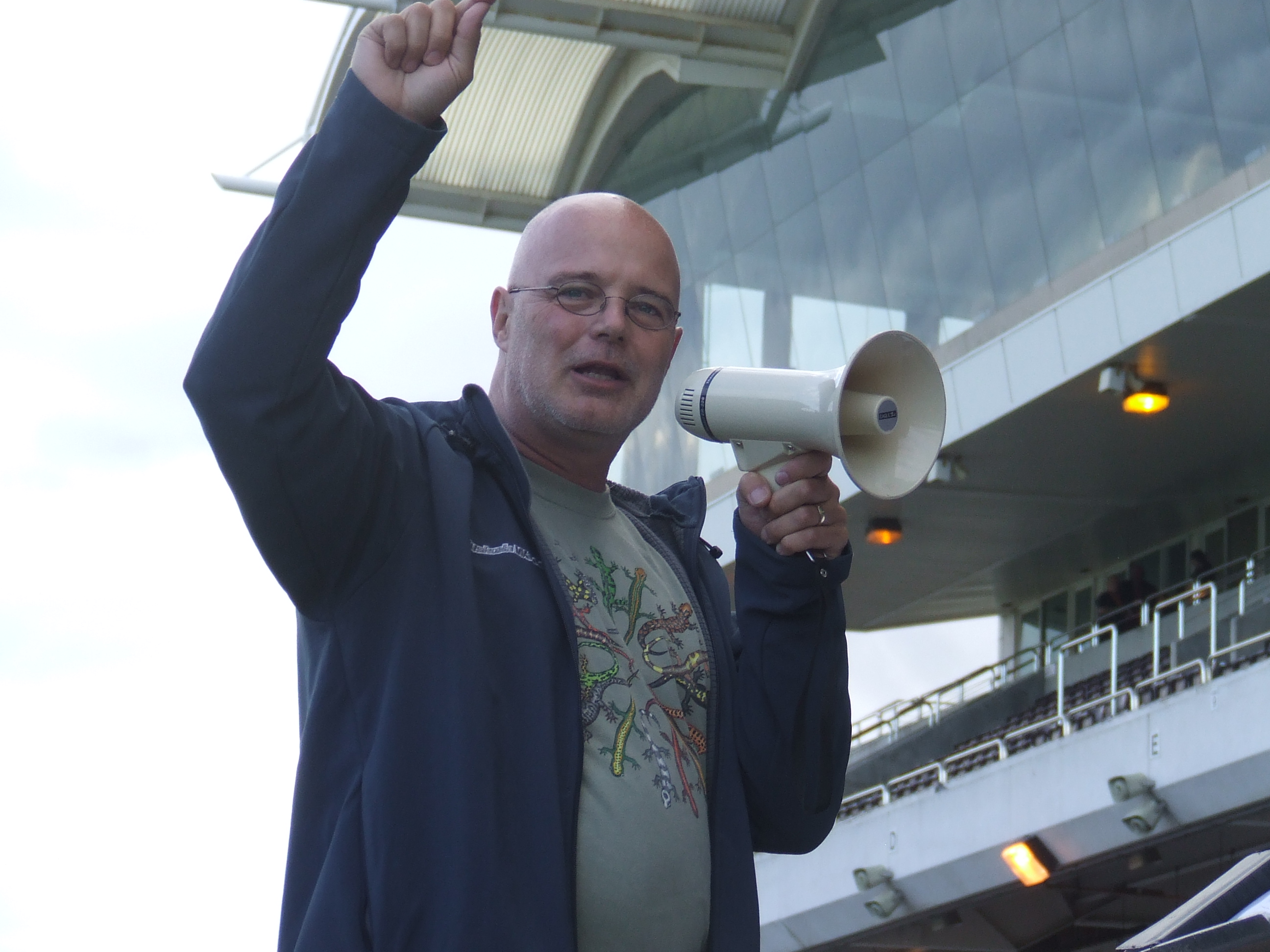
Brian McLaren makes do with a bullhorn after power failure at Greenbelt festival a few years ago..

I have written about all of these issues on this blog,but it is the last of the four crises that I have been thinking about of late. In fact, it has been a long term conversation with many of my friends too.

There is a similar-sounding issue that we might easily confuse this conversation with, aound CHURCH. I have spent too long on that journey… so much time has been spent trying to preserve the institution by making stylistic superficial changes in the hope that the centre can hold. I no longer think it can, but even if it does, how might Church inspire real change by doing business as usual? What dynamic ideas might be embraced without letting go of the old ones? The question I have begun to consider is whether it might be time to re-examine not just the flavours of religious institutions, but the fundamentals of the religion itself.

I should start by saying that I am NOT talking about inventing a brand new religion – I’ll leave that to the Scientologists. Neither am I able to comment on the reform needed in other faith traditions other than my own.

The religion that I both reject but also want to re-invent is the one named (perhaps despite his best warnings) after Jesus Christ, a historical figure whose teachings (I would argue) we have largely ignored.

Here is the thing – I don’t think I am alone. Back to those conversations with my friends. Most , like me, have left the institution of Church behind, but some are very much still within, working hard for change. The commonality between all of us is that we all long for something else, something better, but we all struggle to conceptualise what that is, and what it might look like.

I am going to try. It may take me a while. If you have thoughts or ideas that are triggered by my ponderings I would love to hear them- as long as you are kind.

From here.https://www.brin.ac.uk/figures/church-attendance-in-britain-1980-2015/

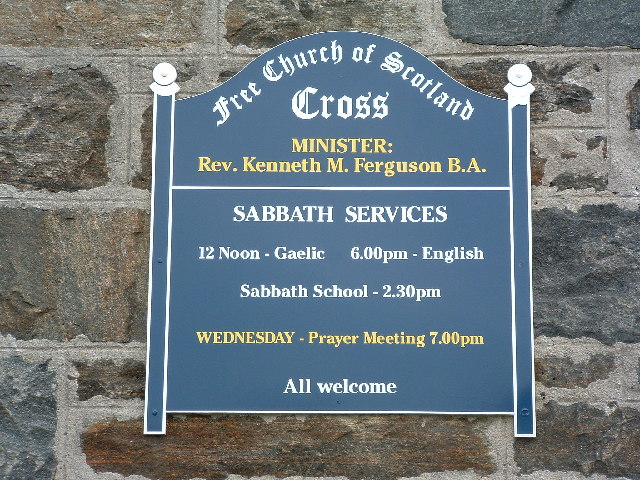
It is perhaps worth reminding ourselves of the reality of declining church attendance in the UK. It is not always a straightforward picture in the short term, for instance, some hard line conservative churches have actually grown in recent years- including the Free Church of Scotland and many Pentecostal or funamentalist gatherings – even though the long term trend is still downwards, some have seen significant increase in attendees.

But this brand of religion stays firmly within the ‘crisis’ territory outlined by McLaren above. The solutions they are offering – moral certainty in relation to homosexuality, gay marriage and the fear of Hell – do little to address the problems facing our age. In fact, given the dominance of American right-wing faith models across the whole world, we might argue that this religion is the problem, not the solution. It is at best a distraction, at worst, one that has fully accommodated itself with the same capitalist economics and politics that are throwing us towards destruction.

Photo by Jeff Stapleton on Pexels.com

It might be worth thinking about religion in terms of these different components’

  1. Origin story/ Messianic figure/ supporting documentation
  2. Core tenets/ docrine
  3. Mission and emphasis
  4. Community organisation

So this is where I will start… after I have done some more pondering anyway.

Leadership in small missional groups, reviewed…

IMGP6016

We took a trip up to Aberdeen yesterday to meet up with friends from Gairioch Church. As part of their planning/organisation, they have a bi-annual ‘sounding board’, where they invite some outsiders like us to come and be part of a conversation about where they are up to, where they are heading and to discuss challenges they are working through. Michaela and I always feel like frauds as what they have achieved is special, and the thought that we might have some expertise to offer seems to us a little silly- however, it all seems to come out in the conversation.

Yesterday a lot of conversation was caught up around the issue of leadership; particularly the kind of leadership that might be the best way to work with small groups of families and individuals engaged in what we have called ‘missional’ groups. It is an old theme for all of us involved in the essentially fragile practice of community. Some questions never quite go away;

  • How do we lead without becoming oppressive? How is power shared, or at least mitigated?
  • How do we lead in a way that does not create passivity and dependency on the part of those we journey with?
  • How do we lead in a way that creates safety, warmth and stability?
  • Who looks after whom?
  • How are specific responsibilities shared and encouraged?
  • Where does the buck stop?

Within my own community, these questions are still largely unanswered. We find temporary solutions only, which is a weakness but paradoxically also sometimes a strength.

My rough conclusions from conversation yesterday where that three things are vital in trying to deal with leadership in small groups; Context, purpose and developmental stage.

Context might mean the place where people meet, the nature of the group in terms of comfort with one another, experience of individuals within it etc. Leadership has to emerge from what the group is comfortable with. Our context is a small town in which most of our members have done with ‘religion’- we have been inoculated against the formality and rigidity of leadership structures, at least in part because of our own and others failure. Leadership for us had to be small. It had to be shared.

The purpose of small missional groups will of course have some variability. At times we work together on specific tasks- food banks, art installations, kids events, worship services, community projects. Some tasks clearly benefit from a leader, an organiser, an agitator. Someone needs to see the big picture and hold everyone else to account for delivering what they said they would deliver. This probably does not need to be the SAME person each time, as we all have different skills and experiences.

However, the starting point of most small missional groups is community. Our hope and conviction is that our activism will grow out of our connectedness, our common place of becoming. We are a constant experiment of turning an inside outside; of practising the art of love so we can learn to be deliberate in our love of others outside the group (an easy thing to write but an extremely difficult thing to achieve.)  If this is the ultimate purpose of our group then leadership is probably much more akin to facilitation. The role of the leader is to create safe space for others to adventure in, not necessarily to direct what happens within it.

Interestingly enough, the skill set required to create (or curate) this safe space is not one that many of we pioneering far-horizon kind of folk find easy to operate within. Safety and predictability bores us. Our pushing at the edges frightens others. This tension is very real to any of us who have been in these groups. Currently I am sweating within mine as most people are content with what is but I am wanting more…

Which brings me to the issue of developmental stages. Groups like ours have a trajectory that typically involves something like this;

dreaming – gathering – planning – forming – conflict – reforming (repeat last two stages several times) – ending.  

Leadership at different parts of the groups life may need to be very different. I think there is also a need for EXTERNAL leadership (or at least facilitation) at times to bring new perspectives and refreshment.

I have great hopes for Garioch church. They are a lovely bunch of folk who are asking all the right questions. The model of church – deliberately small enough to be around a table, but networked with bigger relationships – is one that really appeals to me.

If you are interested in this issue, you might be also find some use in a few previous ramblings on the subject;

Leadership, networking and the trajectory of pioneering groups.

Leadership in small missional communities.

Church in the margins- gender and leadership.

Rollins on leadership.

Leadership in the new context, lessons for post-charismatics.

Leaderless organisations.

Reflecting on the life of small ‘missional’ groups.

Leaving Church 2- discussions with Jason Clark…

(Part of a series of reflections around an exchange with Jason. The previous one was posted yesterday.)

open door, rock chapel

6. I’m not arguing for institutional church and reject the ‘black and white’ thinking that because we have buildings, staff, programs (alongside experiences and life changing growth), that what I say is aimed at promoting institutions. I actually believe we all believe to institutions, the current preference being for the self in consumer society. What imaginations drive the way we relate about church is what interests me the most.

You lost me a bit on that one I am afraid.

I think you may have been reacting a little to my suggestion that people who are part of large institutional Churches, with their paid staff and building/admin costs have a lot at stake when faced with people leaving. It is an understandable pressure on those whose life has been in faithful service of these institutions and each time someone leaves it can feel like a real kick where it hurts. It is hard to then maintain relationships and remain open to learning from that rather hurtful event. Those who remain will also likely see the leavers as having betrayed them in some way- they will now have become ‘the other’, and it will be a natural tendency to make easy judgments. Of course this works both ways. The end result is that the gap widens.

I would reiterate however that I am someone with a love for the Church- and am puzzled by my current situation on the outside (trying to find other ways to do church.) Gifted pastors are a treasure (I know several of them who need a pay rise) and in our climate a good roof is rather necessary.

But you also used that word ‘consumer’ again, as if leaving Church was primarily a consumer choice for most of us. Can I push you a little on this one too?

In an age where we have been hammered into being consumers above all else, it is not surprising that our Church members make consumer choices- including changing their religious outlet when better spiritual bargains come on the market elsewhere. But surely the same is true of those who stay. They are perhaps expressing consumer satisfaction- niche product though it may now be.

Are consumer choices not the main reason for individual Church growth in the UK? People leave to go somewhere else– where the music is better, the preaching more entertaining, the seats more comfortable, the congregation younger, trendier and more dateable. Are these always poor choices? Do we rail against this kind of consumerism when it delivers corporate success? (To be fair, I know that my friend Graham has really struggled with this in his Church.)

Also (and most crucially)- what alternative to consumerism is Church really offering? Is there a danger that we ask people to reject consumerism as far as church is concerned but change nothing else? Drive to church in the same cars, from the same big houses, full of the same gadgets? The logical extension of what you say might be to continue to attend a Church even if it tears you apart, as to NOT go would be to serve the institution of Consumerism.

There are other movements challenging consumerism head on- questioning the nature of our economic system, proposing cash-less transactions, time banks, trying to live simpler more sustainable lives based around shared common resources. I know Christians are involved in many of these movements but can you honestly say that Church is characterised by this kind of engaged criticism of the core of consumerism in our culture? I wish that we were, but most of our activists are fully engaged in something more pressing within the institution of Church…

Can we really complain of consumer choices within a Church that is fully participant in the consumer marketplace?

I would suggest that people (like me) leave Church for other reasons too. To categorise leavers as somehow having sold out to easy consumer choices might risk not listening what is going on at a deeper level. It also means that re-engagement with Church for people who have left is that much harder.

7. My post was not a diatribe against non attenders trying to get them to attend. The future of the church is not in attendance, but in participation. I just think people mistake non attendance with participation. We are all attending something weekly, and participating on ways of life, the only choice is what sets the agenda for that participation and regularity.

But given that your post was in relation to people attending corporate worship, what is the difference between attendance and participation? Can one participate without attending? The fact is that we attend less and less ‘club’ like activities as a nation- increasingly we live in interior spaces, with the odd foray into collectivised consumer ‘events’. I suspect that, like me, you would regard this as problematic on all sorts of levels, but it is a fairly well understood trend that Church has a few possible responses to;

  1. We can condemn it as another example of what is wrong with the sinful world.
  2. We can demonstrate an alternative in the form of a flowering of all that relational Holy Spirit fruit. People would then know the Church by the love we have for one another.
  3. We can take note of the new social landscape and start to re-imagine a Church that fits within it.

I would sadly suggest that there has been too much of 1, not enough of 2 and 3 is a work in poor progress. (This is a generalisation from my limited perspective, and is certainly not intended as a description of any one Church!)

8. I get tired of being pitted against fresh expressions, and consider my church to be one. But having new christians, sundays, and facilities means we are instantly labelled as institutional. Again a black and white correlation I don’t accept 🙂

Sorry if you felt that I did that in my earlier comments- I certainly did not mean to. I was more suggesting that the Fresh Expressions movement was an attempt to move Church away from corporate worship in the more traditional sense- as in meeting to sing and hear preaching in a large building.  Again, not that there is anything in the slightest bit wrong in doing just that, my suggestion was that the cat gets skinned in many different ways.

9. The state of the church in the UK is dire. If I wasn’t planting one, I’d probably struggle with the ones local to me. I hope I’d choose the one that offended me the least and let me serve, give, pray and engage in mission with others. I’d want to be part of the solution and not just walk away, which is what I hope I have done.

Me too.

But there might come a time when we all have to walk away. Your reason might be different to mine, but our hope is that the faith journey would not end there- rather we would be looking to start again.

We usually have to start small- with a few friends. Some of us will be carrying wounds and scars from the leaving. We may avoid using words like ‘Church’ and we will be suspicious of how people use power. What we start will be very fragile, shot through with the same imperfections as we are. Most of our projects will not survive- particularly without support from Church.

What this support looks like is unclear, but we will probably not be easy to support as we will be very sensitive to (perceived or actual) judgementalism. We will tend to keep away from those in Churches who do not understand the journey we have been on.

Church may chose to ignore us, watch us inevitably fail but this would be a dreadful mistake. Many of the people I have spoken to who find themselves outside Church are the very ones who have been the Church planters, the worship leaders, the youth workers, the street preachers, the messy church makers, the alternative worshipers. They burned out on Church, but are people of vast experience. They can not go back, but they might go forward with the right kind of encouragement.

10. Context is everything, and I fear people reading the comments here will do so without listening to my talk and the context within which it was made!

Fair point Jason. Observer bias in blogging is pretty hard to fight! I hope I have not been disrespectful of your comments in responding in the way that I have.

All the very best to you and yours.

Leaving Church 1- discussion with Jason Clark…

rainbow church, Dunoon

A few days ago I wrote a post reflecting on some thoughts by Jason Clark on leaving Church. The sort of issues Jason raised included;

  • whether a ‘Churchless faith’ is possible
  • the centrality or of gathered corporate worship
  • the rise of consumer choice as a determinant for Christians as they decide to stay or leave church
  • the dangers of allowing faith to collapse into private spaces, private lifestyle choices

If you are interested in this debate, I suggest you go and read Jason’s post (and listen to his podcast), as well as reading my post in response.

There were some great comments on my piece, including a poetic one from Sam and a deeply heartfelt one from a dear friend (and the Pastor of the church I attended before we moved to Scotland.) Jason also took the time to make some further comments, and I decided to extend the discussion a little in a couple of further posts.

I do so because people continue to leave Church and even though I have been a leaver too, I am certainly not done with church. I think that what both Jason and I have in common is a hope for the kind of Church that is a an engaged, hopeful, critical part of our society. One that tries to work out what living the radical call of Jesus might mean in THIS culture, not the Victorian one. What this looks like for me is small community in all its fragility and brokenness. What this looks like for Jason is large urban growing Church, in all its fragility and brokenness. We need both. Our contexts dictate that they must be different.

My journey through Church has led me to be very critical at times yet it is obvious that Church is very much alive. Many good things are happening all over the country. People are engaging in acts of service to their communities because the Church enables this. You only need to check out the website of my old Church, or Jason’s church to see this.

Jason made ten points in relation to this discussion, and I intend to split my responses to them over two posts. The first part of this is below.

I would repeat my deep respect for Jason (although we have not met.)  This debate feels rather retro really- blogs used to be full of these kinds of discussions 10 years ago. We have all moved on to tweets and short status updates now. So- those of you who persist in reading all this stuff are part of a future-retro elite, and I salute you!

KIlmory chapel door

1. Context: I’m not speaking to a US context, the talk was for my church community in the UK. I am convinced more than ever that the future of the church in the UK depends on communities of faith not disappearing into private spaces, but to have a vibrant public life. That is in contrast to the civic religion of Sunday services by many churches that are more about cultural religion than faith communities.

Making generalisations about what church is, where it locates itself and whether some forms are more vibrant/cultural than others was not the point of my post. Rather I was concerned to understand what it meant in MY context, and in my community.

My experience has taken me towards a small community that meets in private spaces but seeks also to provide worship events in public spaces. This was in part because a feeling that Church (with many glorious exceptions!) has often become a no-go zone for the vast majority of the local population. The ‘public’ meeting is anything but- it has become a private club for a dwindling minority. Sure, we talk evangelical language, but engagement with our local communities was mostly confined to hoping that they realise that we were right all along.

I know I am describing a kind of church that is NOT like the one you lead, and that many churches are fighting to change to become something else- more missional, engaged, vibrant etc. But that is your journey, I was speaking of mine.

I mention this not because I want to defend my position, but rather because I really do not think I am alone.

My friend Graham (and former Pastor down in England) rightly pointed out in his comment on my entry into this debate that my small community (Aoradh) is ‘church’. Some of our members still also attend ‘Church’.  Many of us were people who left Church. I suppose my point is that we are a bit of a melting pot- all trying to make sense of what is happening in a changing an challenging context. We respond to the reality we are faced with through the set of goggles that we are given…

2. My talk and post was not about Sunday attendance. I have no interest, as I mentioned at the start of the talk, about Sunday attendance, and calling people to that. Being church is all too often reduced to Sunday attendance, by those who attend and those who don’t. Two sides of the same coin – those just turning up thinking they are doing something and those established by their non attendance as the measure of having done something.

Apologies if I misrepresented you, I think I responded to your use of the words ‘meeting together for corporate worship’, which is usually understood to mean Sunday services. Of course, ‘corporate worship’ might mean many things.

I think every church tradition would echo your words about church not just being about Sunday. It certainly has never been this for me- in fact at some points of my life I have spent most of my available non-employed time doing church related activities. Most of this was focussed inwards though; it was planning activities for services of varying descriptions, organising music, having meetings, even doing one-to-one pastoral work. All of it felt very necessary. This was often exciting, it gave my life urgency and purpose. It was often exhausting.

The best of what I have experienced was good indeed, shadowed by inevitable human imperfections, but as to whether all the activity I was involved in was necessary, even advisable- the jury is out on this one I think.

3. I was focused on something I do believe as mentioned in 1 above as key to the church having any future. Christians will need to figure out a way to not collapse church into private lifestyles. Too much of evangelical church dispenses religious goods and services to people to fit around the lives they were making elsewhere. The logical extension to this, is to collapse church even further until it is just a resources for experience and private God spaces. I believe the church is about real concrete communities, like the household codes in the NT, visible and able to transform communities by living and being something other than personal interest groups.

I very much agree with you about how church has become as much consumer driven as the western world it is part of. I am also convinced that finding ways of living dependent lives in real community is part of the way that people of faith can show a real alternative. Sadly I am not sure that this is always a defining characteristic of Church- what we tend to form are what Scott-Peck calls ‘Pseudo communities’ (there is a discussion about this from the perspective of my community here.)

Another friend (who is a NT scholar) cautioned me once about the way we tend to suggest that our way of doing church is reflective of the NT idea of community (every new church development seems to claim this!) Firstly, we no longer live in the NT world, and have a poor and partial understanding of their culture and context. Secondly, Church tend to owe more to Victorian ideas of service to establishment than it does to embattled scattered persecuted 1st C Roman citizens/slaves.

What we do know about the NT church though is that it tended to meet in private spaces. The transformation it achieved was often in spite of persecution which prevented the visible gatherings that you seem to advocate.

I like your warning against a collapse of Church into just being a resource for ‘experience and private God spaces’. One criticism of Western Evangelicalism is that it has fallen into the trap of ‘Therapeutic Moralistic Deism’- offering a psychological God who will make your life happy if you follow a certain moral code. Church has followed the same individualising trend as the rest of the world – it offers individual salvation and an individual bonus-reward scheme.

I am not sure however the degree to which continued attendance can be seen to mitigate against this kind of privatised individualism. Perhaps we should leave this kind of church.

4. There is a current trend in thinking we can separate a relationship with Jesus from the church. We can’t, that’s the myth of consumer and secular imaginations.

You also used the word ‘myth’ to suggest describe Churchless faith. How are these things mythological? Is it because you believe they only exist in imagination? If so, they are powerful myths shared by many. Even if we are all wrong, then the relationships between church/Jesus/individuals have become a very poor one in lots of cases.

If people did not separate their belief in Jesus from their relationship with the Church then how does the church become challenged, changed? How can it respond to what may be prophetic critique? Jesus himself was hardly conformist after all.

That is not to say that we do not learn in community and in respect for those who have gone before us– I like Karen Ward’s differentiation between small and big theologies- the latter being those of our forefathers, the former being what we work out in small community. I think this is perhaps another one of those both/and paradoxes, but not a ‘myth’ surely?

On a personal level I had no choice but to go through a very painful experience of separation. I have spoken to many others who have done the same. This had little to do with consumer choice and a lot to do with survival of faith (it was touch and go for a while) by rediscovering Jesus in the midst of what can only be described as traumatic loss. To suggest that this was an easy consumer decision is to profoundly misunderstand the hurt that many people who have been through this process experience. I think this was at the core of my original response to your blog post, although I did not articulate it clearly at the time.

5. I’m not naive (at least I hope I am not), I spend a great deal of my time exploring the problems of church, and it has many. But on the other hand I do believe there is also a problem of Christians who don’t understand how to relate to church at all, that is not the fault of the church. It’s a two way problem.

I know and respect your thinking on lots of aspects of Church having been dipping into you blog for years!

But I must push you a little on this- if an institution is no longer doing the work it was intended for, is it reasonable to blame the people who no longer find it useful? That seems like a rather Stalinist argument to me!

The now rather antiquated debate around the so called ‘emerging church’ was founded on a dissatisfaction on Church and a hope for what might be developing. The question many of us still ask is what did all those blogs and conferences and books actually achieve? I suppose this is still a work in progress, but if all we did was open up some space for theological debate then it is an entirely unfinished project.

For people like me, the issue was not to try to preserve what was withering before our eyes, but rather to look in hope and expectation for what was becoming. Like a starving man grabs for bread we seized hold of ideas – missional church, new monasticism, fresh expressions, forest church etc  – some of these things were lovely, but could not really be regarded as a new stream of church, just different flavours of what was there already.

Even more worryingly for those of us whose theology had gone through something of a revolution, some Churches appeared to be doing very well- those whose version of religion was all hard lines and narrow doctrine.

Meanwhile people continue to leave Church…

Part two, including a discussion about consumerism, tomorrow.

2014- could this be the year we start to reclaim Christianity from Capitalism?

rainbow church, Dunoon

I am not into making new year’s resolutions- I tend not to keep them. However this time of year is the time to take stock, to dream of what might be ahead.

As well as the personal stuff it is a great time to wave some spiritual litmus paper in the stew of culture that we swirl around in. What is there that we can celebrate? What should we protest? How does the life of Jesus within us open us up to new ways of living in this new year?

A year or so ago, I wrote a post reflecting on the relationship between Capitalism and Christianity. This seems even more relevant now as austerity measures hit the poorest and weakest in our economy. Something is wrong– not just at an economic level, but rather in our very ways of being.

There are some encouraging signs that the Church is starting to realise this however- and that we need to be the voice of instability, not conformity. Sometimes it seems that our religion is like smoke blown into a hive while the honey is stolen. The Pope appears to understand this, as does Archbishop Welby.

The problem, it seems to me, is that church often claims to be separate from society (the old sacred/secular duality) at the same time as being indistinguishable from it perhaps in the following ways (as listed in my earlier post but with a few refinements and additions.)

  1. By emphasising personal, individual salvation above all else. The only useful purpose of mission is to save people from hell after they die. This means that active engagement in any other activities (particularly ‘social issues’) is downgraded, or even downright suspicious. For many these activities are only really acceptable if used as a trojan horse to smuggle in the gospel message.
  2. By embracing success culture. We use the same corporate structures, we reward our religious successes as we would our CEO’s, we value hard measurable outcomes, we construct programmes about personal empowerment and success.
  3. We make mission a kind of hostile take over. Business success involves out-performing the opposition, and rejoicing in their bankruptcy. We need to sell more, penetrate all markets, dominate the marketplace, crush to opposition.
  4. Christianity became a lifestyle choice that required no change to the way we live our economic lives. Yes, I know there is the old ‘tithing’ argument around Evangelical churches, but we drive the same cars, live in the same houses, take the same holidays, fill our lives with the same gadgets- or (and here is the sting) even if we do not have these things, we aspire to them. St Jobs is venerated in many a trendy Christian Church every time people meet.
  5. We bought into lives characterised by individualism above the collective. The model given to us by the life of Jesus and the early church was all about learning to live in loving community- how we live for one another, how we hold things in common, how we find ways of including the poor, the weak. Can we still hold these things as defining characteristics of church?
  6. We failed to demonstrate any kind of radical alternative. The best that we have been able to offer is how to live as better Capitalists- more sensible, more responsible, with greater probity. The Protestant Work Ethic lives on- in each one of us who finds comfort in our pews as much as our pension fund (even if both are more sparsely populated than previously.)
  7. We did not see injustice, inequality, poverty, unfair taxation, usury, over-consumption, environmental destruction, as any of our business. Which relates to point 1.
  8. Even where there was visible discomfort with Capitalism, we lacked any coherance, we lacked leadership, we did not become a critical movement. Rather we splintered and focused on totemic side shows live homosexuality and women bishops- all of which destroyed our credibility to speak prophetically into our culture anyway.
  9. Our mission to the poor was conditional on redeeming them to become like us. Difficult one this, but stay with me. There are lots of examples of Christian engagement with the poor, from the good old Salvation Army right through to the new food banks. However, these activities might be seen as cleaning up the edges of Capitalism– but also justifying the dominant ethos. It encourages us to lift people back into becoming productive consumers – just like us. This fails to engage with any idea that we need to become more like them; that the problem is caused by people just like us.
  10. We forgot that the Church exists not to give us a better life, but to serve the lost and the least. If we are serving the lost and the least, how can we have convinced ourselves that our unsustainable greedy lifestyles are God-given rewards for our moral superiority- which we Brits built an Empire on, and then passed the baton to the USA?
  11. We failed to form partnerships with other grass movements for change. Because anything outside of the walls of our particular church is suspicious, we are reluctant to engage with all those good ‘holy’ groups whose members are seeking to redeem and restore- the environmentalists, those working for social justice etc.

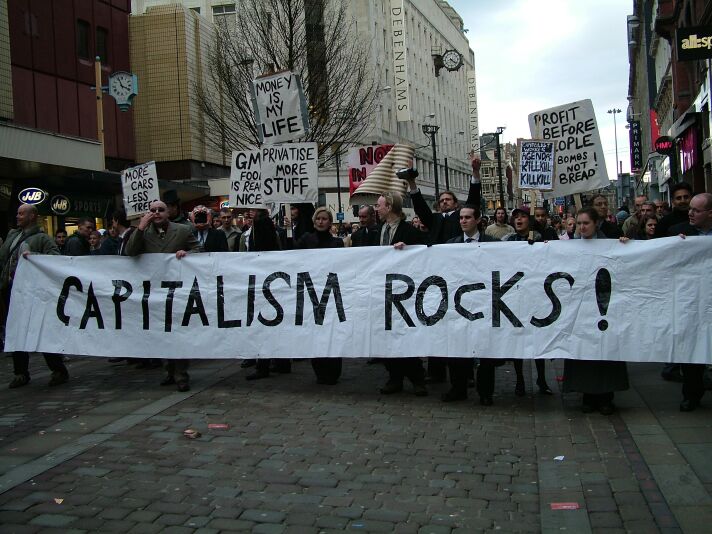
Occupy London Stock Exchange protest

I am not happy to leave this list just as a set of negatives, so here are my hopes/prayers for the Church in 2014;

  1. May our evangelical zeal be set free from the tramlines of heaven/hell. May our concept of salvation be much more gracious and generous, and may our evangelists be empowered to be agents of the Kingdom of God.
  2. May we see success for what it always is- a distraction from our call towards personal weakness, humility and love.
  3. May we stop competing.
  4. May we be among the first who chose to live differently- more simply, less driven by crazy consumerism. May we be a new kind of Amish people- not rejecting of technology, but neither enslaved by it.
  5. May our living draw us together, rather than forcing us apart.
  6. May our way of living be genuinely different- may we be consumers of less, wasters of less, sharers of more. May we party hard, love greatly, laugh a lot and weep when the time is right for weeping. May we be the first to demand products that last, that are updateable, that do not denude the environment or depend on the slavery of others and the raw materials dug out of some other part of the world for our own benefit.
  7. May we be angered by injustice, by poverty, by destruction of the beauty all around us, and may we express this anger in protest, in art, in full engagement.
  8. Rise up people who would show the way- give them a prophetic voice. Lead us out of our concrete wildernesses.
  9. May we see first the value in the other, not the rightness in ourselves.
  10. May we see our privilege for what it is; the inverse of the poverty of others.
  11. May we look for beauty and shine light on it. May we seek out flavour to savour with our salt. May we find out where Jesus is and try to join him there. May we seek partnership and friendship with other groups.

Let this be the year of a different kind of revolution…

capitalismrocks

Dunblane…

Dunblane Cathedral


On the 13th of March 1996 a man marched into Dunblane Primary School and started shooting kids. 16 children died and one adult.

On Sunday, Michaela and I visited Dunblane. It is a sleepy town, famous only as the town in which tennis player Andy Murray grew up. In fact, he was a pupil in the school during the shooting. It is a small town steeped in gentile prosperous tradition. How on earth do people make sense of such horror? Even all these years later?

What is the place of faith in understanding and finding peace?

I have no answers to these questions really- my children did not die, I was not part of the wider community. I can not begin to presume to understand what the journey might have been like for these people. I do know however that the degree to which experience is collectivised, shared, held in common, can become an essential part of this journey for many.

And for this, I am grateful for the Church. Not because it has answers- easy explanations are an insult. Not because it has skilled pastors, after all there are many more highly trained in counselling the bereaved. Not because the Church can expect to be the point where people gather any more at times of crisis.

But having said all this, where else would people go? Who else can listen to the cries at funerals? Where else can people be to share their grief, their anger, their survivor guilt, their hopelessness?

Standing in the ancient Cathedral building in Dunblane, amongst all those medieval carved stones and brass memorials to men and women long gone, stands a new memorial;

Doing church the new/old way…

a church under reconstruction?

Michaela and I have just had a really lovely trip up north to spend some time with friends who are part of Garioch Church. We had been asked to be part of something called a ‘sounding board’- a group of people from outside the church who meet a couple of times a year to reflect on where the church is heading, and what challenges it is facing. We were looked after by Andrew and Jane magnificently and it was a privilege to hear something of their story, not least because it enabled us to reflect anew on our own.

Garioch is an area on the outskirts of the city of Aberdeen- a string of villages over a 10-15 mile area. It is a largely affluent place, with pockets of deprivation, fueled by prosperity from the oil industry. We had never spent any time in that part of Scotland before, and in many ways it felt like a different Scotland to the one we knew. It was busy, bustling, full of industry and people had a pace of life very different to our small west coast town.

The church has been trying to find a way of being authentically present in this new context. What they have done is really interesting and genuinely innovative. Rather than seeking to follow a familiar model of church planting, which goes something like- small group of people with lots of energy start a gathering, invite friends, it grows and so house becomes too small so they rent a hall, it grows so they need to buy own hall, appoint staff, etc, they did this;

Gairioch church wanted to remain based around homes, families, small community. They wanted to be a local, connected expression of faith- engaged in their small context. What they now have are three thriving home groups which are the focus of ‘church’. Once a month they meet in a school hall where they can make a bit more noise and feel a wider sense of connection.

Simple huh? Sounds very like that elusive but often used idea of trying to connect with a New Testament idea of what church looked like?

Alongside this deliberate emphasis on the small, they have found themselves having to grapple with some familiar themes- what does leadership look like in this context? How do you survive community? How do you continue reaching out when there is so much to do within the social context of community itself? What does teaching look like when traditional ‘preaching’ no longer fits? What about all the children? How do we manage all these competing demands with such limited time?

It was rather special to see them feeling for answers to all these questions- to appreciate the freedom that allows them to try, and the long tradition of Christian collectives who have done the same.

My own small community feels special too. We are different, in that we are one (rather isolated) community, and in many ways the pressure to lead, to organise, to manage is very different. As a result of this we are less hierarchical, more driven by the need to be joint travelers, not leaders and followers. This made for some interesting parts of our discussion at the sounding board day. How much do we as leaders, in taking responsibility, remove this in both obvious and more subtle ways from the people we lead?

I came home inspired, humbled and also grateful for the fact that people remain inspired by Jesus towards the new. That Christians in these times are still looking for new ways to love better, to live better, to serve better.

Yesterdays post was a rather cynical one about church names- I removed it as although a whiff of controversy in blogging is usually a good thing, I never like giving offence, and it turned out that some friends of mine have a church whose name I accidentally lambasted. As part of yesterdays post however, I said this, and I will repost it as a prayer for our churches everywhere!

I think the words of Jesus lead us on a path emphasising a whole different set of principles. Rather than our success he promised that the last shall be first. Rather than our satisfaction, he promised a hard road. Rather than storing up comfort and riches he pointed us towards the lost and the least.

When Church is defined as being the provider of success and abundance I also cringe for those whose experience has NOT fitted into this shiny stereotype. People who even whilst in this kind of environment feel unable to share pain and brokenness. People whose lives fall apart for no apparent reason.

I pray that the people in the shiny Churches grow in to abundant life, so that they can become a well of blessing for the rest of us whose lives are full of beautiful aching brokenness…

I think we can take heart and courage, because good things are growing in the cracks of Old Church.