Emerging children…

Michaela told this story the other day-

Once there was a large cruise liner voyaging across a wide ocean. It was full of people of all ages, who appreciated the safety and security offered by the experienced crew. Landfall was predictable and always on time, and although there were many storms, most of these could be by-passed or ridden out thanks to the ships stabilisers.

The crew of the liner were skilled at the production of all sorts of entertainment- balls, grand dinners, deck sports and above all- childrens activities. The kids were able to have fun, and this gave the parents to opportunity to do thier own thing, without any anxiety about what the kids would be up to.

But some of the passengers became restless. The life on board was just a little too predictable, and the ports of call organised and booked long in advance. For some, what was needed was a new adventure- the call of the high seas, and the beckon of the distant unexplored shore.

So they packed their belongings into small boats, said their goodbyes, and set out with their families on the blue sea.

And as they left the liner, someone shouted-

“But what will you do with the kids?”

We had a discussion at the Tautoko weekend about kids in these new forms of emerging church/small missional community/fresh expression (or what ever the current term that we are trying out is.)

Of course, the kind of church or community who might use one of these labels are varied. Some are embedded within more traditional church structures- complete with Sunday schools, youth groups and dedicated support structures for the development of young Christians.

Other communities are like mine. Groups of families and individuals who find themselves doing church in a more isolated situation, and kind of making it up as we go along. And those of us who are parents often worry. Because this experimental freedom is great for us- it was our decision (or perhaps our calling) but what about the kids?

How will they learn the stories of faith if not through Sunday school?

How will they absorb the Christian tradition unless through participation in a Church? (Note the capital C.)

How can we take a risk with their souls- the risk that we might be reducing the influence of Jesus on their formation, and so on their future and even eternal lives?

These are questions that Michaela and I have worried about. We no longer attend formal church, but live out faith in small group meetings, housegroups and in planning worship events in public spaces. It is exciting for us, but just ‘normal’ to our kids Emily and William. What legacy are we leaving in their lives?

Back to the discussion. The room contained parents of kids from about-to-be-born right up to 18. We talked about our experiments with family worship and Jonny described how their kids had grown up in as part of the Grace community. Others talked about the value they still found in their kids attending Sunday schools.

Despite the variety of opinion- some strands emerged that were meaningful to us-

  • Guilt and anxiety comes all too readily to parents. Particularly around the bringing up of our children towards and understanding of faith.
  • Perhaps we entrust this responsibility to others too readily. And this trust has a mixed reward- in our own memories, and in terms of those who survived Sunday School into adulthood with a live faith.
  • Involving our kids in something that contains all our passions and hopes rather than just reluctant duty must be a good thing! In this way perhaps we can impart something deep and real…
  • But HOW we involve the kids is important. Naz described housegroups where adults met to do their thing- to meet their own spiritual needs- and the kids had a great time running riot in the house or garden!
  • We decided that sharing FOOD was important.
  • And that taking kids seriously- and trusting them to contribute- was vital.
  • We also noted the importance of mentoring and deliberate inclusion from OUTSIDE our kids immediate family. So perhaps this might be another member of the community recognising a skill or passion and inviting our young people to use it.
  • Finally we noted the fact that kids seem to be able to deal with modular and perhaps even contradictory experiences of faith. Our kids typically combine small group meetings, youth groups weekends, major events like Greenbelt Festival, along with forms of church that we might find rather difficult.

I am glad that we left the big ship and set sail in our small one. I only hope that the journey is full of blessings for kids.

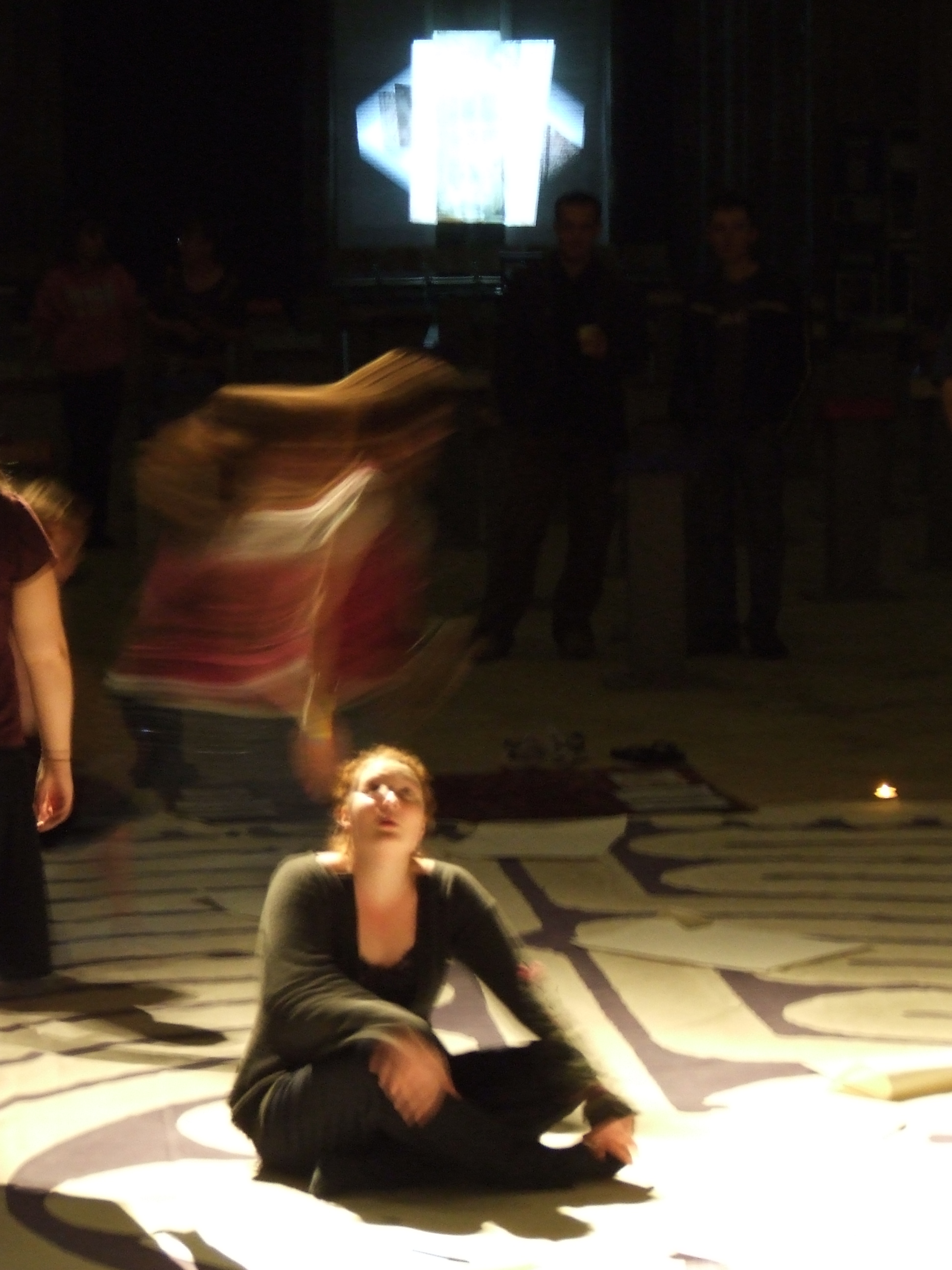
I love this picture, taken of a little girl dancing in Gloucester Cathedral during the Tautoko gathering last year. It represents the freedom that I hope for for my own kids-

Tautoko network…

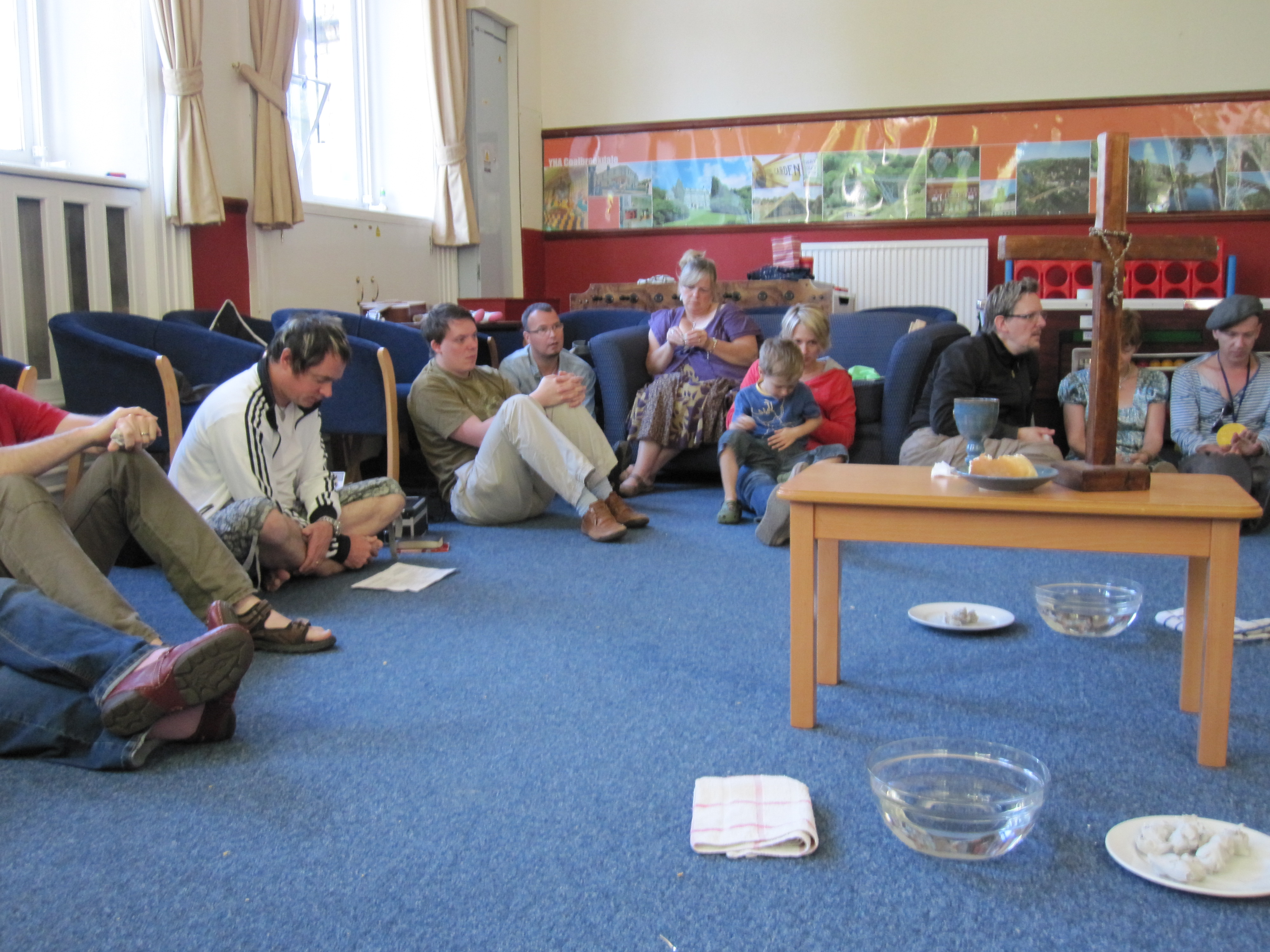
Michaela and I are just back from a lovely weekend down south- attending the Tautoko network gathering in Ironbridge, Telford. Our friends and fellow Aoradh members Simon and Helen went down this year which made it all the more special.

Tautoko (apparently a Maori word meaning a group that seeks to support/uplift others) is a network of people who are involved in emerging church/small missional communities/new monastic communities/alternative worship. This is how the network defines itself-

A network of uk based mission practitioners and communities who are restlessly trying to follow Jesus in the midst of a changing contemporary culture.

To share the journey with others who face similar mission challenges.
For mutual friendship, encouragement, solidarity, support, gift giving, discernment, resource sharing, ideas and learning.
To see what emerges as creative people connect.

Ethos:
Open set
Spin free
Generous
Vulnerable
Questioning

What I like about the network, is that it does not make unreasonable demands on already busy people, or take itself too seriously. It is rather disorganised (although there are moves afoot to bring a little more organisation) and characterised by friendship.

Because of our rather isolated location, the chance to meet up with others and share ideas, hopes and stories is always a real delight. It was great to see some familiar faces, and some meet others for the first time.

I will post a few thoughts relating to conversations later.

Thanks to Jonny, Naz, Gareth and Mark who put effort into the planning and leadership this year!

Some photies-

Tautoko network weekend…

We are away on a road trip tomorrow. We are driving first to Nottinghamshire to take Michaela’s mum home, the leaving the kids there with her while we go off to the Tautoko network weekend in Coalbrookdale, near Telford- not far from the famous Iron Bridge.

The weekend is a chance to get together with others who are into new ways of doing church/mission/worship. It is a very informal affair- and we are really looking forward to it.

I am not looking forward to the drive though. And we have a fairly late start as I have to entertain Argyll and Bute’s chief executive all day in Helensburgh.

Heres hoping that she is blessed with brevity…

Networking weekend- emerging/missional/alt.worship etc…

We are heading down to Telford to the Tautoko gathering in a few weeks. This is a chance to spend a weekend sharing ideas and hopes and prayers with other people who have found themselves doing similar things in and around the edges of established church.

There are some places left on the weekend- Check out Jonny’s description– (He has a thing against capital letters I reckon?!)

for a few years there has been a network of leaders/communities that initially got together off the back of al hirsch and michael frost’s visit back in 2005 and following on from various blah… events round the country. it grew out of alt worship and emerging church friendships. every so often there is a gathering of the network and there is one coming up in june. it’s a pretty low key affair – mainly hanging out and conversation with some space for talking around issues and some prayer and worship. we usually stay in a youth hostel to keep it cheap.

the next gathering is in june – info is here. if you think you fit with the description around the network below you’d be welcome to join us – just book in or e-mail me if you want to know more. there are spaces left on the weekend that we’d love to see filled…

The tautoko network was originally formed out of friends connected with alternative worship, emerging church, or missional communities. Why? Well mainly because we love hanging out together. The network was made a bit more intentional/formal recognising that there were plenty of others involved in the same kind of stuff who didn’t necessarily have the history of friendships but could gain a ton from being part of it. These were the words we put together to describe why it exists and they still seem a pretty fair reflection…

  • To share the journey with others who face similar mission challenges.
  • For mutual friendship, encouragement, solidarity, support, gift giving, discernment, resource sharing, ideas and learning
  • To see what emerges as creative people connect.

And the ethos/values we try and shape the friendships around are…

Open set | Spin free | Generous | Vulnerable | Questioning

Alternative worship, retrospective…

(I love the photo above by the way- it was one of those accidental images, taken in the half light of Gloucester cathedral last year.)

I have been thinking a lot more recently about ‘alternative worship’.

I think for many of us, the precursor to these new form of worship and spirituality was charismatic soft rock worship. In the past our spirituality was expressed almost exclusively through weekly climactic events- ecstatic music and inspirational preaching. This form of worship tailed into boredom and irrelevance for many- at the same time as people began to realise that it was possible to rediscover and re-invent many older spiritual practices- and to encounter these in smaller and less hierarchical communities.

Others found their way into alt worship through a dance/club sub culture- which was extremely influential in the early days. Still others were seeking to discover authenticity in more traditional liturgical environments.

Can I point you towards this podcast which digs into the background and history of the movement.

It features an interview with Jonny Baker– who, for those who might not know of him, is one of the movers and entrepreneurs of all sorts of interesting church and community projects, including the worship community Grace, a co-founder of the outlet for lots of resources that is Proost and part of the CMS team who are encouraging so many good things, particularly in the C of E, but also around the world. Jonny has been very encouraging to me personally- around the writing I have done, but also as part of the wider network of small groups doing different mission/community/worship things. A good bloke- with the experience and intelligence to say things that are worth listening to.

This podcast digs into the where alternative worship came from, in all its messy creativity, but also asks where we are now.

I think we are at  a point where we need to re examine what alternative worship means- this for both personal local reasons, and for wider ones. In terms of the wider issues first-

The clue is in the title- ‘alternative’. What are we an alternative to? And at what point does someone need to find an alternative to the alternative? it is a term that was formed in change- but of course change soon become establishment, and needs further change.

There appear to me to be different strands already developing. There are some small but high profile urban groups, whose efforts are focused on creating high concept art. These groups are great as exemplars and as inspiration, but most of what they do- in terms of resources, skills and the sub cultures they grow out of- are beyond the rest of us. Perhaps for some they are even alienating and confusing.

Other alternative worship forms appear to be being incorporated and embraced by traditional church- as a way of bringing life and renewal to old structures. Of course there is always the danger that this becomes window dressing for the same old same old.

Then there are groups like mine. Fragile collections of disparate people who are perhaps not trendy or well resourced, but are trying to use skills that we have forgotten that we possessed and (far more importantly) trying to learn how to love each other, despite all the usual obstacles. Here the focus rapidly shifts from doing exciting stuff and being involved in a ‘new thing’, to how we can live with each other in the presence of our hurt and brokenness, and how we can lay ourselves down to worship in a way that is authentic and true despite all this baggage. I suppose this is not alternative worship- it is just worship– perhaps using a wider tool bag to assist us along the way.

For me, this is partly about laying down our ‘art’ and embracing community. Not a thing that I find easy at all. It is also about radical involvement and inclusion- and allowing worship to arise from your context. Our group has many people who are talented ‘craft’ people for example, and a few poets. So we tend to have lots of cutting and sticking and some lovely poems. We are less driven by technology. But should others come who have these skills, the trick will be to involve and encourage…

Holy space

Some of these issues feel very real and pressing to me at the moment. This for two reasons.

Firstly, Aoradh is still in the middle of a rather developmental transition at the moment. I think we will survive, but at times I have wondered. It is nothing even faintly surprising to anyone who has ever been part of small pioneer groups- all the familiar issues of ethos, focus, the need for honest open relationships and to challenge certain behaviours in a loving and caring way. Oh, and that old issue that we have avoided- LEADERSHIP.

We have been meeting to talk about these things, but this has taken so much energy that we have had little left to be creative and passionate about worship- which kind of defeats the purpose! However, we now have a few things on the horizon, which brings me to the second point.

We are keen to keep our focus LOCAL- finding spaces and partnerships in our own local community. But along side this, we have been invited to participate in some larger national events- like Greenbelt and the new Solas festival. It is an honour to be invited, and also potentially great as a boost for what we are about, and a chance to discover new ideas and friendships. But it also brings into focus some of the issue above.

For instance Greenbelt alt worship has changed. We are being asked to throw ourselves into a creative soup with some other groups to create a day long session. This involves a whole lot of negotiation and on-line collaboration with groups whose ethos and philosophy may well be very different from ours- whose context and constituent parts demand a very different style and approach. Mark Berry has stepped forward to curate and co-ordinate the day we are involved in, and it is going to be fascinating to see how these things come together.

The early discussions have had an interesting effect on my group. We all have different levels of comfort with uncertainty, and some of the e-mails flying round have led to a kind of general retreat, as they have dealt with concepts and ideas that seem beyond us. We are in a developmental phase, but some of my friends are just stepping backwards.

I found myself wondering whether alternative worship is  in danger of becoming a showcase for the kind of experiential celebrity driven ‘performance’ that I was glad to leave behind when I stopped leading large scale soft rock worship services.

The heart of this thing (I think) is how we encourage one another as we stumble towards Jesus, and of creating deliberate communal spaces to share this journey.

I have found so much life and encouragement around alternative/emerging/missional practices. But they are just words after all…

    New monasticism comes of age…

    The concept of a new kind of monastic community has fascinated me.

    Perhaps because I lack discipline in life, and so practising a deliberate spiritual rhythm has seemed both extremely attractive but rather out of reach.

    New monasticism has gathered interest as a rather trendy form of church community- growing on the edge of ’emerging’ stuff. It has links with the 24-7 prayer movement, as well (of course) as much older traditions. It has a radical edge that is also attractive to me.

    Today- driving back from Lochgilphead in the darkness after a long meeting- I tuned to radio 4, and caught the end of ‘beyond belief’, which included interviews with a member of Moot, and a general discussion about- new monastic communities. It was a searching discussion, which asked some important questions about the nature of monastic life, and whether this new monastic stuff really involved the same amount of ‘giving up’ and setting out on a real path of self sacrifice. Commitment is not for life- but for a season. Perhaps until the inevitable small group conflict begin! You can listen again on the i player- here.

    It is also clear that some of the new communities do not seem to regard themselves as standing in the same tradition as the old monastic way of being- but rather seeking a deeper life (not necessarily overtly Christian.)

    It is worth checking out the interview on the Moot site with Shane Claiborne.

    I see there is a new Ning site- New Monasticism Network.

    My own small community is in the process of chewing over what we mean by ‘community’.  We are going through what I can only describe as a 4 year barrier- when we are having to look to re-examine ourselves. It has been painful and challenging, if necessary. New labels and concepts are not for us at the moment- rather we just need to remember to practice the disciplines of friendship and love.

    Because the formation of any small community, as previously discussed, can be a process of such incredible highs, and such terrible lows. Jonny Baker pointed out these posts by Ian Adams. I really liked what he had to say, which seemed loaded with wisdom- and I suspect, hard experience!

    In any community there will be always be a lot of focus on what we do. That’s fine – the actions of the community, its surface life – are important. But behind the activity is something less obvious, more subtle, and perhaps even more important. This is what I think of as the spirit of the community.

    Almost every family, project, team, society or business has a spirit or value system, often unrecognised, and sometimes less than positive. Gracious or greedy, caring or care-less, transparent or manipulative [or a mix of those] – the spirit of a community is how it feels to encounter it – and the spirit of thing has the power to create something beautiful – or to trash it.

    Because these small groups of ours- they are very fragile. They need loving and nurturing. Sometimes we just want to walk away- and perhaps there is a time to do just that. But they also offer such hope and life.

    So, whatever your label, may you find friends and fellow pilgrims to travel with. It is the Jesus way…

    More on the ’emerging’ word (weary sigh…)

    If this is a new issue for you, it might be worth reading some earlier posts on this blog- here, here and here.

    I have been reading various blogs and comments about the jolly old Emerging Church. It all went something like this-

    TSK kicked it all off here. In an interesting piece of reflection, he suggested that EC had progressed to a point where the early radicalism and controversy had more or less subsided, as ideas from the early debates and conversations are increasingly adopted by mainstream churches. Here, for example in the UK, by the Church of England, the Methodists, the Church of Scotland and the United Reformed Church amongst others.

    TSK also gave a list of more global church developments that have moved from left wing to become more mainstream in this post.

    The kiwi feller is far better placed than me to make general statements about the state of the Emerging world. However, he seems to have tweaked a dragons tail. Others, notably Tony Jones appeared to feel that TSK was saying that the EC was OVER. So he had a bit of a go- taking a swipe at a couple of other church movements along the way.

    Then there was the inevitable (and rather graceful I thought) response  from TSK here. And other issues started creeping in- marriage, homosexuality, Marx… how I weary of these shallow self defeating arguments. I have met some of the folk involved, and communicated with others. They may be good folk, but this kind of discussion is not good.

    It seems an inevitable progression of fragile allegiances of activists however. Eventually they collect as many reasons to disagree as they do to co-operate… and we followers of Jesus continue the same discordant path that we are so familiar with over the last 2000 years.

    If this is how we in the EC (or whatever we come to call it) deal with one another- then perhaps we have no right to any kind of organisational future…

    I spent a couple of days chewing on it.

    The first thing that surprised me, is that I found I did not really care whether the EC was ‘over’ or not. I think I would have done previously. Perhaps this in itself is an indication of some kind of change afoot…

    I should be clear that I still hold the term (and the conversation that is around it) in great affection. It is still a label I find useful- in terms of defining who I am, and the streams of good things and good people that it connected me with.

    Here in Scotland, it seems to me that we still need connection, encouragement and hope for new things. We are some distance behind other parts of the UK in engaging with the decline of church, and the post modern realities of an unfolding new Scotland. It seems to me that we have more need for the label here still…

    As I see things from Dunoon, we still face some real challenges here.

    If TSK is right, and established church is adopting the ’emerging’ stuff- then I for one celebrate this. These ideas can be carriers of new life into our declining faith organisations.

    But I fear it too. Because establishments tend to kill movements in the cage of their own tradition- or dilute the ideas in a brew that has too many existing constituents for the new yeast ever to succeed. Also-  activists are not good at joining, and tend to be unwelcome in polite circles.

    To put it another way- ’emergence’ can be seen as a lifeboat for sinking ships of faith. A way for the empty pews to fill, and leaky roofs to be made secure again. A way of returning to the past. A change of language but business as usual.

    For people like me, this will never be enough.

    What we hoped for was a new move of the Spirit of God- inspiring and shaping us to think new thoughts about the mission of Jesus. Driving us out of our narrow traditions and religious boxes to where the people are. Not in order to hit them with our bible clubs and capture them for the Lord, but rather to serve and bless wherever we can.

    Has this happened already?

    Perhaps in a thousand small ways, it already has. A very different kind of revolution.

    An emergence…

    Advent prayers rising…

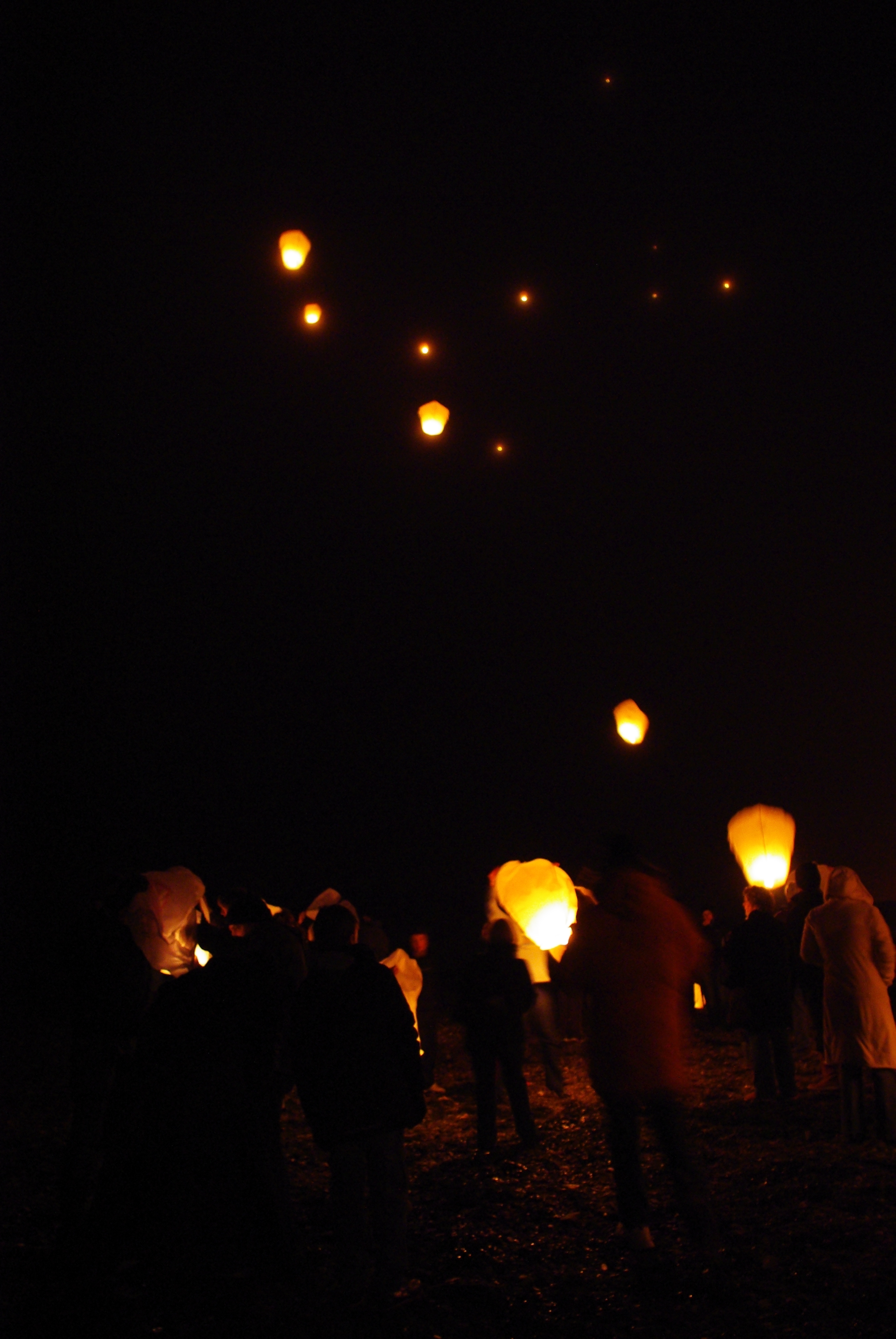
    We are back in this evening after another day spent out on Dunoons West Bay, serving mulled wine, mince pies, and having lots of good conversations with folk as the came to collect Christmas trees.

    We had also set up some meditation things, did some music (oh my fingers!) and were selling Sky lanterns with the intention of inviting people to write prayers/thoughts on them, and participate in a massed sky lantern launch.

    Why did we do it?

    1. To encourage people to be reflective and conscious of the season of Advent- a way for people to become more Spiritually aware, and open again to the Spirit of God
    2. To support work to raise money for CLANN (Community leisure development) and Christian Aid.
    3. To make a lovely spectacle that will linger in people’s minds
    4. To bring people together- and allow community to flourish, in all it’s different forms

    And it was great!

    We had a mixed blessing with the weather- it was calm, dry, but the Clyde was masked in freezing fog, and echoing with the mournful fog horns as ships passed out to sea.

    However, the sight of the lanterns going off up into the mist was wonderful- eery, moving and affecting.

    What was even better was the numbers of people who came and took part this evening- from schools, community projects, families, individuals.

    Michaela described one family who lit the lantern, then stood together around it as it warmed up, arms around one another in silence. Then they let the lantern rise up into the night sky. Whatever their prayers were, may they be blessed…

    Here are the promised photos- Andy took some more, so I will hopefully get to post a few of his soon.

    Mental illness and spirituality…

    I had a good chat with our friend Kathryn tonight about spirituality and mental health problems.

    Kathryn has been studying with ICC in Glasgow and has a passion for working with people who have problems with mental illness. To this end, with her husband Bobby she has been running a furniture recycling/reallocating project- in her spare time that is, as well as her day job!

    She also has this idea for a kind of friendship group where people who have mental health problems (and lets face it, this is many of us at some point in our lives.) This has formed part of her studies, and tonight was a chance for us to talk through some of this stuff- which was great, not just because it was good to see Kathryn again, but also because this subject kind of beats in my heart.

    The bias that I feel Jesus had towards the poor and broken, and the hope that we feel for a new way of being- categorised by grace, and radical inclusion, according to the rules of the New Kingdom- these things are all in there for me.

    As part of her project, Kathryn asked me to consider some questions- which I found surprisingly hard to answer given that this is an area of constant reflection. In particular she was interested in how church might provide help and assistance to people experiencing mental ill health.

    Here are some of the things that I was chewing on-

    I want to suggest that all of us are potential sufferers of mental ill health- including many people within church. We too easily start with an ‘I’m OK, you are not OK’ way of thinking- which leads us to believe that we have the answers to other people’s problems. Perhaps in part, we might actually be part of the cause!

    We often fail to acknowledge MH difficulties amongst people within church- the stigma is as strong, if not stronger, against mental ill health within church as without- because we add assumptions about spiritual weakness to all the other negative assessments.

    Another assumption we tend to make is that our job as Christians is primarily to bring people inside the club by making them realise that they are outside. Our job then easily becomes to invite people into our buildings, and hope they will then become like us. The support available within church for people who have MH problems has often been far from perfect, and very poorly integrated with other community resources.

    Christian groups/churches seeking to support and provide care for people experiencing mental ill health easily fall into lots of traps. I would include some of these-
    The evangelical trap- Our real (covert) motivation is to convert. Most folk see this coming and run a mile. Some may indeed convert- repeatedly. The difficulty is that conversion does not make the illness go away, and we may find ourselves being dishonest and conditional in the way we offer love and support.
    The therapy trap- Christians tend to do bad therapy. Bad therapy often does more damage. It is easy to inadvertently be the ‘expert’ and then let people down when we fail to deliver.
    The dependency trap- Sustaining relationships with people who have experienced real damage can be extremely hard. If people find something that is helpful and supportive, it can easily become a full stop. The dependency that begins can be an impossible burden for those running groups also, leading to broken promises and further alienation and rejection.

    My strong feeling is that Christians ought to be attracted to failure, rather than being seduced by success.  I also believe that Jesus calls us to the poor in spirit.

    But I am not sure that he calls us to ‘rescue’ people- rather that he asks us to practice a form of radical inclusion.

    I think too that all streams of ‘therapy’ have a thing at the heart of them- for CBT it is about therapeutic allegiance, for person centred counselling it is ‘unconditional positive regard’ and for psychoanalysis it is ‘transferance’. All these seem to me to carry something of Jesus about then- they are related to LOVE. They are in some senses a Christian heresy.

    I wonder whether we might yet work out how better to understand the relationship between Spirituality and mental health problems? Is this something that Emerging Church might yet do better?

    To accept that our fallability is not a sign of individual weakness, or spiritual corruption, or demonisation. It is just part of who we are.

    Part of what it is to be human. Even extra-human.

    Where are all the ‘Emerging’ Catholics?

    We just had a lovely weekend catching up with our friend Maggy Cooper.

    Maggy is originally from Australia, coming over to the UK to become a Nun, before moving into secular work with adults with learning disabilities. She currently works as a community leader of a L’Arche community.

    Although she remains Catholic, Maggy began to attend the church we attended in England, Calvary Christian Fellowship in order to learn and share with others from a different Christian tradition. She has been a bridge into a new world for many of us over the last 10 years or so…

    So through Maggy I heard about people like Jean Vanier and Henri Nouwen. And she opened up for me a whole new stream of contemplative understanding of the life of faith. Maggy has years of experience as a prayer guide, and in leading retreats- now most commonly at St Beuno’s in North Wales.

    Talking to Maggy is always a blessing.

    But perhaps the common language that she and I have most in common is that found in and around the ’emerging church conversation’. She reads more books than I do on the subject (some of my friends will find this difficult to beleive!) and  the excitment offered for the future by the ideas and thoughts coming out of the EC debate seems to fit naturally with her Catholic faith.

    Indeed, it has been very noticable how much of the ’emerging’ movement has embraced older contemplative practices- in many ways this could be describing a healing of rifts formed by the Reformation- a bringing together of different Christian traditions.

    Which kind of makes me ask again- where are all the other Emerging Catholics? I have met a few. Some of them are returnees to the church that they had previously rejected- like Vince down in Ayr. For him, the EC has made it possible to speak about things that previously had no words, or at very least were unmentionable.

    This is particularly important here in Scotland, where sectarian division runs deep and toxic.

    In this pluralistic world, movements still require leadership– and given the rather conservative stance the Pope takes on most matters Spiritual perhaps this is difficult thing to do within the Catholic Church.

    One voice that will be increasingly familiar will be that of Fransiscan Preist Richard Rohr, and his Center for Action and Contemplation in New Mexico USA. He even gets a mention in ChristianityToday.

    Here are a couple of clips of him speaking…

    I am not interested in seeing us all the converge on a common form of faith. How boring and lifeless that would be! I am fascinated to see these common streams emerging in the different traditions however.

    And at the heart of this has to be a kind of generosity to one another’s view points.

    I would love to hear about Catholic movements that I have missed…