The Siege of Münster and the Anabaptists, via Melvin Bragg…

The cages hanging from a church in munster which held the corpses of the anabaptist leaders

Another great programme on Radio 4 the other day- available as a podcast for your listening pleasure here.

This one digs into the story of the Anabaptist attempt to create a New Jerusalem in the city of Munster during troubled times in 1534.

I had not heard about this tragic part of church history before- and am grateful to old Melvin for waving it at me through the ether. It is a case study from the beginnings of the protestant experiment- in the early days of the old reformation. Much of what we children of this reformation have come to accept as the bedrocks of faith can be seen in the various sects and streams of the Anabaptists. They were the pioneers.

Indeed if you will forgive me for being partisan for a moment- they were the radical activists of the ’emerging church’ of their day.

But as this programme points out, they were a disparate bunch, who regarded persecution as signs of God’s election- so justifying some pretty odd wacky ideas too. So alongside adult Baptism, the leading of the Holy Spirit, the authority of Scripture (now widely available of course thanks to the technological revolution of the printing press) there were leaders who claimed to be the Godly ordained successors of David, or Gideon, and to claim Biblical justification for polygamy.

Oh- and the Anababtists of Munster thought that the world was about to end- and in such a context, murder, despotism and all sorts of evil became legitimate means to an end…

As ever, we grasp some things of the Kingdom of God, whilst confusing and even perverting others.

Perhaps above all, this is case study of what happens when Jesus (or at least his most fervent followers) and politics are thrown together in troubled and changing times.

Add in a dose of charisma, a dollop of religious zealotry, and the result is bloodshed and destruction.

I think one of the biggest lessons we children of a new unfolding reformation need to learn is that Christians are called to lay down power in the name of love and service.

Or the funeral fires of Munster will have burned for nothing.

Church- moving forward to the 1930’s?

1930s

Just read this really interesting post by TSK.

The comparisons of the economic circumstances of the ‘naughties’ with the great depression of the 1930’s are not new, but the implications for church in this context offered by TSK certainly are (to me at least!)

Partly this is because the erosion of funding experienced by faith based organisations has passed me by- the church things I am involved in require no external funding- and the ‘missions’ that we have been involved in have all been done on a shoestring. I suppose that as long as members of my group have had collective personal resources that we can use together, we are pretty recession proof.

And this is what TSK seems to be saying. He makes the following predictions/comments about the likely moves in church over the next ten years-

The church in the West will use up much of this coming decade to rebound from the financial recession and to restructure in a more sustainable way, much like the church did in the 1930’s after the Great Recession which started about 1929.


In a concerted effort to get church ministry on a solid financial footing, or to start new ministries with a diminished budget, many traditional churches will offer their buildings mid-week as micro-business enterprise labs and will become micro-credit unions for their local communities. The word “fellowship” will regain its meaning of sharing and risk-taking. Emerging church energies will be re-directed from creative worship arts to creative social enterprises which will enable long term sustainability. In both realms, women will come to the front as some of the most successful missional entrepreneurs.

This seems very important. The activities of many of the small ‘alternative worship/missional/emerging groups that I am aware of have tended towards re imagining worship- in terms of what is meaningful and authentic, but perhaps has also have had more than a whiff of exclusivity. We are starting to build community, but my conviction is that the strength and vitality of our enterprise has to be found in deeper and more loving community- and there is nothing like adversity to forge us together! I have noticed that in the middle of most of these groups is a person gifted with the spiritual gift of hospitality. they are the glue, and the oil, and the heart of the thing. Many of these people are women. In this new context- this feels like the most appropriate way to ‘lead’.

Creative social enterprises may well be the way to go- But I work for the public sector here in the UK, so I am not best placed to comment.

1930′ s writings from theologians Barth and Bonhoeffer will continue in their popularity (no-brainer) but we will also revisit Dorothy Day (USA) and Dorothy Sayers (UK).

Barth and Bonhoeffer I know, but Day and Sayers- must do some reading…

Having already “re-traditioned” and “re-sourced” our theological and missiological base for church and mission, we will feel more confident to launch out further into the world with transformational models that will change the world without draining the next generation’s resources. The next decade will be a time of sustainable outreach, measurable by a far more holistic criteria of success.

So this sounds like the possibility of church offering models of intervention- in the same way that social change happened in the 1930’s through small scale social projects and missions. Big, corporate level stuff is no longer viable, or no longer trusted. The alternatives are local, community generated and sustainable within local resources.

I hope TSK is right in this. It remains to be seen whether church can really make an impact for good in these rather troubled and vacuous times.

It is my impression that the 1930’s also saw a dominance of a form of Christianity that could be seen as ‘liberal’, left wing, socially motivated and engaged. This seems another echo with today.

Hmmmm…

TransFORM- missional community formation…

Look past the impossibly hip language, and plethora of piercings friends, as this stuff could spell the future of church- particularly this side of the Atlantic.

Check out what is all about here.

Vodpod videos no longer available.

more about “TransFORM- missional community format…“, posted with vodpod


Meeting and hoping with friends in Largs…

IMGP6324

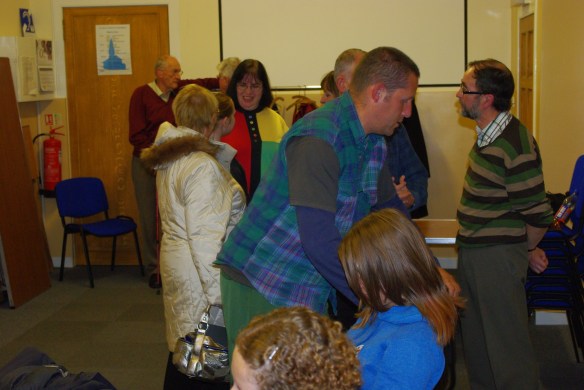
We just spent a lovely couple of hours meeting with some people in Largs.

This was a networking meeting set up by Dave Wilson, to give  an assorted bunch of people the chance to meet up, share stories, and begin to imagine what being a Christian might mean for those of us who find ourselves longing for a more real and authentic way of expressing our spirituality and mission in the 21st century.

There were a couple of folk there who are members (companions?) of the Northumbria Community– a new monastic group that I knew little about, beyond the name. I hope to get to know more.

Then there were a couple of others who had found life in or around Charismatic Catholic organisations.

And many of our stories included much brokenness and pain- the damage that we can do to one another in the name of doctrine and denomination.

There were 4 of us at the meeting from Dunoon too- we set up a few worship stations, and Nick and I played a little music, but to be honest, the conversations were the important bit.

Dave asked the question ‘What next?’, and there was a reticence about wanting to name this as a ‘new thing’- rather people just wanted to meet again, and see what might happen- see what links begin to be made, and where the Spirit will lead us next.

I love meetings like this- full of hope…

If you are in the area (West Scotland) and want to be part of future meetings, drop me a line…

Looking for hope and learning to live it…

Following on from my rather negative piece, reflecting on my reaction to Rollins’ book, I have been doing some more thinking about the process of change…

Deconstructing the institution of Church (particularly evangelical church) has been perhaps the primary preoccupation of the debate that has been described as ’emerging church’. For me, this was absolutely necessary- and part of the inevitable process of change. However, it may be necessary, but it can never be sufficient for the formation of a movement- let along a movement of the living, recreating God…

What has been nagging at me (and many others) is this simple question- what next?

  • This is a theological question- the need to examine again what assumptions and core values drive (or sometimes OBSCURE) the mission of the church.
  • It is also and organisational question- what is church- what does it look like? How is it resourced/led/networked/held accountable?
  • It is a personal question– in terms of the call to be transformed by our encounter with Jesus, but it is also a collective question, in the sense that we (the church) are the collective agents of the New Kingdom. We ought then to be the best hope for our communities, our towns, our planet. How will we seek to become this?

McLaren describes institutions (see clip below) as ‘preservers of the advances made by previous generations.’ in seeking to CHALLENGE and deconstruct, we have to accept that we are also PART of this institution- to a lesser or greater degree. There is still so much to celebrate, so much to preserve. For many, the issue is not the need to destroy (although I confess that I have longed for a few well lit fires in my time!) but rather then need to find new EMPHASIS.

Just in case this sounds too tame, too conformist for you- I should make clear that my small ‘church’ community is right outside any formal institution of church- and could be (perhaps is) regarded as dangerous and heretical by some of my more reformed colleagues. However, when we reflect on what we are, and what we do- our preoccupations, our core values, our practices- they are not new.

So what will our (perhaps pivotal) generation pass on to our successors? What values will they need to either protect, or deconstruct and reform?

What is the mission of God for this our time- the personal one, the local one, and the global one? These are the voices I look for now- the Apostolic ones…

I think this was what was behind my disapointment with Rollins’ book. It was clever, well written, well developed, full of lovely little parables, but despite this, did not connect me with a hope for the future- what might be being built, not just broken down.

I watched the following clip this morning- not because McLaren is always right, but I genuinely think that this man has an Apostolic voice. Listen friends, and let hope rise to action!

Emerging church- the debate continues…

There has been some more chat on various sites about EC. The usual questions are being examined again- is the term useful? Did the ’emerging conversation’ promise much and deliver little? Does it still have any use or relevance?

emerging church

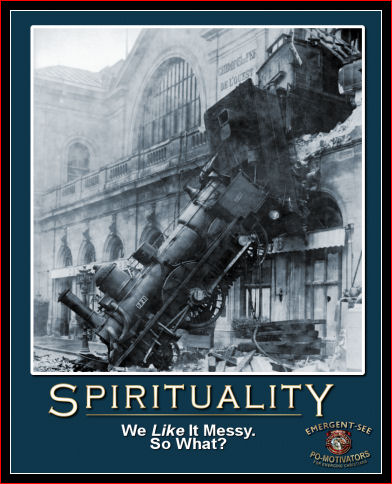
Creative (if rather unsympathetic) posters from here!

Followers of this blog will know that this has been a recurrent theme-

Back in September, I posted another review from the blogosphere- here.

Then in January, I spoke about the fact that our group had decided to stick with the word ’emerging’ for now.

Then in February, I asked what is emerging?

Then Jonny Baker pointed us to this post a week or so ago, which he responded to in a great post entitled

if you are disillusioned you’d better ask yourself…

Then there is a really good post from the Emergent village website- here, that responds to some of these discussions. As ever, it is useful to remember that Emergent Village (often foreshortened as ‘Emergent’) is one of the conduits for conversation about emerging church- but does not claim to represent, or even lead, the conversation. It is worth re-stating this, as some of the key figures in Emergent- Doug Pagitt, Brian McLaren, for example- have attracted much criticism, and controversy. I have an awful lot of respect for both, but neither would claim to lead anything called ‘the emerging church’.

mssnl

I spent some time thinking about where I am up to with the ’emerging church conversation’ (I always feel I have to use parenthesis around the phrase!)

I realised that I feel really quite comfortable with the label now. For me, it has brought me into contact with greatly positive and inspirational people, ideas and resources.  I do not see myself as a member of ‘The emerging church’, because I still think that ’emerging church’ is a verb, not a noun.

Neither does the small church group I am part of call itself an ’emerging church’, although we might continue to hope that we are being drawn forward into new things by the Spirit of God.

Over on the Emerging Scotland ning site, Vicki Allen asked the question- ‘what does emerging mean to you?’ and encouraged people to list three things that were meaningful to them. I thought about it for a while- and then settled on these three-

1. The freedom to re-imagine and re-discover COMMUNITY.

2. The freedom to re-imagine and re-discover THEOLOGY- particular ‘small’ theology (by this I mean theology that is respectful of our inheritance, but interested in it’s application to our own locality and community.)Add New Post ‹ this fragile tent — WordPress

3. The freedom to re-imagine and re-discover the MISSION of the Kingdom of God.

I remain grateful for Emergent, and the emergence of rich ways of understanding the nature of our engagement with Jesus in our post modern context.

The rest, well that is up to Him.

sprtlty

opnnss

Networking with alt. worship folk…

tautoko

We heard about this meeting of the Tautoko network and Michaela and I are hoping to go. Thanks for the invite Laura!

This is what it is all about;

It’s been too long but finally a weekend gathering has been planned for the tautoko network in July 2009 at the Coalbrookdale Youth Hostel in Shropshire. We really hope you will join us. It will be a relaxed weekend to chill out, catch up, share and cook some choice food and drink, reflect, worship and pray together, with plenty of space for conversation.

The tautoko network was originally formed out of friends connected with alternative worship, emerging church, or missional communities (funny old thing language eh?!). Why? Well mainly because we love hanging out together. The network was made a bit more intentional/formal recognising that there were plenty of others involved in the same kind of stuff who didn’t necessarily have the history of friendships but could gain a ton from being part of it. These were the words we put together to describe why it exists and they still seem a pretty fair reflection…

  • To share the journey with others who face similar mission challenges.
  • For mutual friendship, encouragement, solidarity, support, gift giving, discernment, resource sharing, ideas and learning
  • To see what emerges as creative people connect.

And the ethos/values we try and shape the friendships around are…

Open set | Spin free | Generous | Vulnerable | Questioning

Sounds really good…

Said Michaela- ‘wouldn’t it be lovely to go to something like this that we were not responsible for?’ I think I know what she means.

Protestant sectarianism and emerging church…

The history of Protestantism is littered with division and conflict.

Reformation of what has already been reformed.

Schisms of schisms.

Battles over whose truth is truer and whose understanding of scripture is most enlightened.

The legacy of these truth wars can be seen in the countless Protestant descriptive labels/denominations. Here are but a few as they occur to me;

Lutherans, Wesleyans, Reformed Weslyans, Methodists, Free Methodists, Primative Methodists, Baptists, Southern Baptists, Reformed, United Reformed, Assemblies of God, Anglican, Church of Scotland, Episcopal, Quaker, Shaker, Amish, Menonite, etc etc.

This list is in part a noble one. We have learned much from the men and women of God who have celebrated faith within these organisations. Such variety speaks of the freedom that people felt to follow after God in the way they understood him, away from the central powerful control of older forms of religion. It also is a story of fervency, of revival, of movements of the Spirit across whole communities, of great leaders who were bold and true.

But there is a dark side, measured by truth promoted over love and grace, and in a serial fracturing of the unity of the Spirit. Such division can be seismic in terms of the violence done to community in the name of Jesus.

I wonder if this kind of spiritual development can become addictive and even infectious. Almost as if all new Protestant church movements carry a destructive gene within their DNA…

Scotland has had more than a fair share of this splintering and fragmenting. Take the recent very public difficulties seen in the Free Church of Scotland, which splintered as recently as 2000.

I have used this picture before- taken in a small West of Scotland town about 7-8 years ago. Two churches so close that they are almost touching- but separated by a chasm of doctrine. I should add the proviso that I do not know either of these churches, and the image may miscommunicate entirely. But I think it makes a valid point about a certain characteristic of Protestantism…
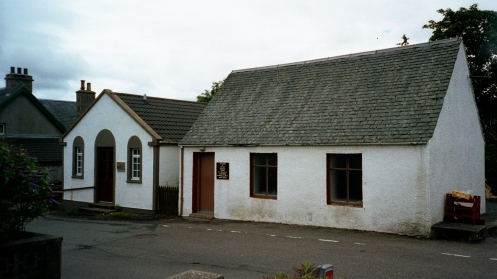
two-churches

How did we come to this, we followers of Jesus?

How did Agents of the Kingdom of God, sent out into a broken world to form revolutionary cells characterised by love, somehow sign up instead to be driven towards such segregated exclusivity?

Is this more about psychology than it is about theology? Our tendency to seek a point of expansion and accomplishment, and to measure it against others around us- elevating ourselves by finding others wanting.

I wrote this poem in an attempt to understand these things in myself-

Diplomacy

We meet and move about one another
Probing, exploring borders
Negotiating
Presenting our petition
And revealing this badge of office-
Sewn on sleeves whilst our hearts stay hidden
Revealing carefully edited glimpses
Of whom we want to be
But are not yet.

Then begins the measuring
Of the size of armies
The bore of canon
And the reach of your rockets
As we carefully deploy our camouflaged troops
To occupy the high ground
To hide uncertainty behind
A cloak of accomplishment
And capability.

Sometimes it seems that who I am is only revealed
In understanding what you are not
In seeing you
And finding you wanting
In mapping out your strongholds
And avoiding them
And raising up my tattered flag
Above this uncomfortable alliance.

Why is this important now?

Because I think that this is a real challenge to those of us who are part of the ’emerging church’ discussion, particularly here in Scotland. Some questions-

Is ’emerging church’ just another Protestant reformation- another fractious denomination in the storming and the forming- throwing stones at those whose truth is not our truth, looking around and finding others wanting.

Or are we a break from modernist Protestantism- a more generous, open, embracing movement that seeks unity, not uniformity and is willing to learn humility and to value the other.

Are we Protestant at all? Where are the emerging Catholics?

If something new and hopeful continues to emerge, in all its flawed beauty- how do we(or even SHOULD we) nurture and sustain whatever we become without following a familiar pattern of splinter and schism?

From my point of view, the story is mixed.

Emerging church has no form and no structure- at least in Scotland. It is not a descriptive definition of any way of doing church- rather it is a loose affiliation of malcontents and hopefuls, defining themselves rather by the fact that they are prepared to question and seek.

And because we are human, friction is inevitable. People compete for prominence, and justify themselves by the rightness of their cause, or the small success of their activity.

But brothers and sisters- I find myself longing for something else. Something a little more of the Kingdom, and a lot less of the Empire.

Something characterised by tolerance and love. (Even as I am intolerant and unloving.)

On forgiveness rather than defensiveness. (Even as I defend and find it hard to forgive.)

Of a willingness to enjoy one another without the need to compete. (Even as my own insecurity drives me to do the opposite.)

And a determination to see community as the origin and the means for all things- with one another and with Jesus. And that the quality of these interactions should become the measure of our success. (Even with my own history of broken community, and the wounds I carry because of this.)

This is the church I long to see emerging.

I have not desire to be part of another schism.

Is it possible that we overemphasised the Bible?

perspective

Emphasis is all.

I had a conversation tonight with my friend Nick. We were talking about some planning he was getting into for a programme of Bible study for young people. He was talking about the need to get into the basics of Christianity, and how many of the young people (and some of the older ones) had very little basic knowledge of the tenets of our faith.

I thought about this for a while, and genuinely wondered about what these tenets were- and what I would teach young people if I was in Nicks shoes.

The ’emerging’ conversation has shaken loose a lot of fixed positions for me. It has helped me see that a lot of the things I held to be basic building blocks for faith were perhaps not always so solid- but rather required robust examination. It made me wonder again about an approach to faith that started with one small group of people telling another larger one what it needed to know- facts and figures of faith that they needed to internalise in order to be a proper Christian.

In my discussion with Nick, I found myself making the following statement-

“I think we modern Christians made two particular mistakes in our attempts to engage with God.

  1. We overvalued the Bible- wanting it to provide for us a textbook that creates a Christian, in the same way that a blueprint could make a balsa wood model plane.
  2. We overvalued the need to get our doctrine sorted- the finding and adopting of correct positions in relation to all aspects of faith.

That is not to say that these things are not both wonderful and important- but simply that we over-emphasised them- making them perhaps the only way that Christians could discover God. In order to make this stick, we had to pretend that there was only one way to read and understand the words, and to suppress all less tangible and less ‘objective’ spirituality- rendering it untrustworthy and dangerous.

Sure, the Charismatic movement came along and added a whole new experiential encounter with the power and wonder of God, but ultimately, I would argue that the modern Protestant faith was grounded on the two points above.”

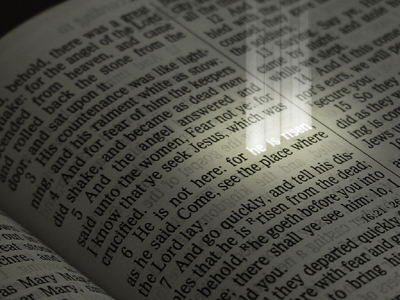
This statement is shot through with faultlines, but I think, on the whole, I stand by what I said.

bible-page

If I am right (and many would strongly disagree!) does it matter?

Does it matter as we seek to engage with young people? Do they not just need to be given some basic truth before we get all post modern and mystical? Perhaps they do. Perhaps the trampoline bouncing that Rob Bell talks about as an image of theology can only really begin once we have set up the trampoline.

But alongside the importance of the written words of the Bible, and the need to establish doctrinal beginnings- I think I would gently suggest that the emergent conversation might challenge us to add in other emphases too. Because people of faith have always encountered God through many other means.

So I am convinced that rightness of doctrine is not the precursor to being acceptable to God. It may be a consequence of this, but as far as I can see, God seems to tolerate a fairly wide spectrum.

And the Bible is wonderful- but many have lived lives in the name of Christ but have never seen one- either because they could not read, or because the canon of scripture as we know it today simply did not exist, or because the Bible was not available to them.

So what other ways to encounter God should be emphasised?

Perhaps we can only start by looking back to the spirituality of pre-moderns, and use this as a set of goggles to consider our own culture. There is much there that we would reject, and count our blessings that we are this side of the reformation- but still…

We see people seeking to engage with God through living encounters– through hardship, pilgrimage and through community. We see lives of service and humility. We see the importance of shared ritual and engagement with God in the passing of seasons and in connection to every day experience.

So might we learn from this as we seek to encounter God in our new changing context? Might we learn again the vitality and meaningfulness of the mundane, and the wonder of small adventures in which the wind of the Spirit blows us into the path of all sorts of opportunities to be shaped and changed?

The Bible will continue to be a gift to our new generations. There will be others too.

Poverty and the emerging church…

So- are ’emerging churches’ and the people that use the label middle class and self absorbed with their own little slice of post modern spirituality?

Check out this discussion thread, in which Paule Ede, who lives and works in a tough part of Glasgow as part of an ‘Urban Expression‘ church plant. I think the discussion rapidly got a little heated, which is a shame as it seemed to be digging into something that is very important. I have a lot of respect for the things that Paul was saying, and for the challenge it ought to bring to those of us whose lives are led in a different direction.

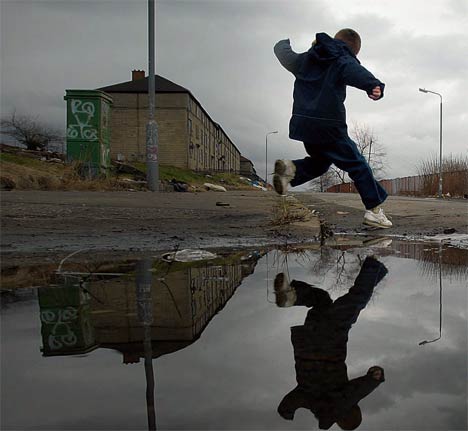
Poverty is not romantic. It is rarely a choice, and always brings the aspiration of escape. It brutalises and robs people of health and opportunity. But the presence of such inequality in our world is as much as anything, our shame. It’s presence in our streets and cities is a sign of our failure.

poverty2804_468x431

A consistent theme on this blog has been that of social justice. I have lived my life convinced that the call of Jesus is perhaps first and foremost towards the poor, broken and hungry. It pushed me towards a certain understanding of spirituality, and into a career in social work, and mental health work in particular.

But we can be creatures of contradiction and self congratulation in the face of contrary evidence. I live in a big house in a beautiful place. I have a fairly new car, and a well paid public sector job. Like most men I have a weakness for gadgets. I have accumulated lots of STUFF- most of which I do not really need. In short, I live a life like most of the other people in our affluent suburbs.

I discussed this with friends in my small ’emerging’ community the other day, and my thinking changed a little.
My own group is in Dunoon. Dunoon is a fairly affluent area, although has a significant underclass of folk who ended up here, almost washed up ‘doon the watter’ from the big city. We too have lots of difficulties- drugs, under age drinking. We also are a culture that has more than it’s fair share of loneliness, isolation and brokenness.

Last week we watched a Mike Frost DVD as part of a study we are doing around the book ‘Exiles’. Frost was thundering eloquently and movingly about the nature of our calling as Christians to get into ‘Dangerous criticism’ of the empire we are part of (Subordinate and secondary perhaps to our call to BLESS the empire where we can.) He spoke a lot about consumer driven over consumption, and the poor. Following on from the discussions on this blog, I began to shrink a little into the chair I sat in, in my big house, well heated and full of my friends.

But during the discussion that followed I looked around the room with tears in my eyes. Three of us have had serious mental health problems, two addictions, several have long term chronic illnesses, others carry other wounds. Some are on benefits, others are in work. Some will have a posh holiday this year, others will go camping when they can. But we have found a place of friendship and acceptance from which we are seeking means to bless others- particularly the poor.

Then there is the work and activity we do that is a direct result of the faith within us and the call of Jesus. I started to make a list of things that we are connected with-

One of us volunteers on the committee of a local addictions charity.

One runs the ‘time bank’
One supports volunteering opportunities and helps small community groups
One manages a charity that helps homeless young people
Two others work as life coaches and run stuff for young people
Another does suicide awareness training
Another is a counselor and has a particular interest in bereavement issues
Another is seeking to get allotments established to allow folk to grown their own food
Another has set a local charity to refurbish play equipment on the west bay
Another works in Greenock to help kids get some meaningful work experience
Another is a volunteer at a local old folks home
Another is a student who is studying addictions
Another is a reporter in the local paper, campaigning around justice issues

Does this get us ‘off the hook’ then?

Well, no.

I think the call of Jesus on our lives is always destabilising, always calling us out of comfort into the journey with him. As soon as we think we have it sorted- no matter how challenging the context, then we are destined to fall flat on our faces, or descend into mundanity. This is challenge for those of us in the emerging church as much as it is for any other church grouping.

And one of the ways that people who have lots of stuff are always going to be challenged is in relation to our comfort and wealth. We are challenged not because these things are bad, but because they can so easily be idolatrous and ensnaring.

So for those of us with big houses and cars- what use are we putting them to? How dependent are we on stuff in the chase for happiness and fulfillment- whether or not we have it, or just WANT it?

These are not easy questions, but Jesus knew that- remember the rich young ruler who Jesus ‘looked at with love’.

The emerging church, in it’s theologising and pontificating is indeed a middle class phenomenon. Perhaps it’s true test will be how it lives out the call of Jesus towards the poor.