Transcendence…

Light obscured

Not in the ‘other worldly’ sense, the God who is removed and distant. For me, Transcendence means something hyper-real, something that saturates the ordinary, but which somehow connects us with the divine.

in a previous post I tried to define it like this;

… I mean the experience of God in the ordinary. The incarnation of the maker of the universe within the temporal, messy world in which we live and love.

Transcendent moments fill our lives if we look for them. And the more we attune ourselves to the looking the more we see.

They are everywhere in the natural world; sunsets, new leaves, mushrooms in caves, the lick of new born fur, the light of the moon on still water, the smell of rain on dry earth, the sea that goes on for ever. All these things will happen whether or not we are there as witnesses. But when we look in a certain kind of way a hollow space opens up in the middle of them into which we can meet with something transcendent. Into which we can invite/be invited by the living God.

They are everywhere too where humans also are. In conversations, in touch, in the longing for justice, in the decision to forgive, in the deciding to repay hurt with love, in the listening and in the laughing. Because God is a God of communion. God commands love, and love requires direction. Perhaps above all, the transcendent God is immanent when we come together in community.

They are encountered in art, because art can become a bridge to something beyond our business. Films, books, poems, paintings, sculptures, music.

They can even be encountered in church – for me, especially when we sing, when the chordal voices find the vault of the building and make it vibrate.

I have been thinking about what all this might mean to us again, and wrote this;

.

Unpregnant

.

In the corner of my gaze something moved

I blinked

Reminded of almost imperceptible stars

Sky all black like bruises

Pricked with harsher things

.

Did I form you out of some ancient river bed?

Did I raise you up on poles?

Are you just déjà vu

For the deluded last few

Will science yet prove us all fools?

.

Then the night whispers

Like an unknown breath on puckered skin

Like the scent of sea to a sailor

Like a poem whose words are not yet spoken

Like an unpainted painting

Or a song still yet to be sung

Like a reed still yet to be fluted

Or a string that was never strung

Like the silence when echoes have faded

Like an unpregnant womb

Still waiting

Ways to pray in public places…

pints of beer

It has been a long day. I was off early to Lochgilphead as I was a trainer on a course for social workers who are about to participate in our emergency out of hours duty rotas across Argyll. Part of todays task was to look at some child protection issues- including the inevitable photographs of injuries that been inflicted on kids- little boys with cigarette burns on their feet and tiny girls with finger bruises wrapped around their faces. I am always broken a little bit when I see these photographs.

So I should be- but this relates also to my own childhood memories, fractured as they are.

However, in the midst of all this, I had a transcendent moment. Don’t get me wrong- no angels sang, there was no whiff of incense or pure white lights. What I was captured by was the sudden depth of the Kingdom of God- woven through everything, and this thing called the shalom of God. What might it mean to hope for a future in which the lion will lie down with the lamb, and in which all things are made new?

A world in which parents do not damage children, and damaged children do not do damage in turn? A world where love sets the agenda in more things than not?

Come the evening I was sat in a pub with some friends. We have been meeting to discuss a book by Brian McLaren called A New Kind of Christianity. Tonight however we did discuss the book, but I suggested we try to find a way, in the busyness of the public bar, to pray.

I started with something that we had used on an island recently, in the middle of a wilderness with eagles riding the late spring storms over our heads. I thought that if God was there, then he was here too.

  • I asked people to find a place of quietness inside themselves- to find a neutral spot on wall or table to look at, and to focus on their breathing
  • Next I asked them to listen to the sounds all around them in the pub. The hubbub of conversation, the chink of glasses, the scrape of knives of plates, phones ringing jokes raising burst of laughter. I asked them to notice as many different sounds as possible and acknowledge each one
  • Then I asked them to listen again to deeper sounds- the sounds behind the sounds. As we do this, a remarkable thing happens. The hubbub kind of fades and blurs together- it ebbs and flows like the sea, and behind it all are other noises- the hum of all creation. Some people still noticed things like the ringing of a bell on the till, or the footsteps of a lovely friendly waitress
  • I then asked people to imagine that the sound behind the sounds was the music of God. God in and through it all, rejoicing in the beauty of us all. Rejoicing in the drinks, the food and the lives being shared. It was not hard to do so.

Next I passed round a pen and paper, and asked people imagine what God might want for all these people in the bar. What might he hope for them. I asked people to write something down, and to fold the paper over so the next person could not see it, then pass it on.

This is what people wrote, in no particular order;

Eternal life

Freedom!

I see your heart and know your sadness and want to bring you my peace.

Peace, hope, love and understanding

Shalom

Peace

And there, with a pint in my hand, it was holy.

God is God…

Time for some music.

Here is a song written by Steve Earle for Joan Baez;


I believe in prophecy.
Some folks see things not everybody can see.
And,once in a while,they pass the secret along to you and me.

And I believe in miracles.
Something sacred burning in every bush and tree.
We can all learn to sing the songs the angels sing.

Yeah, I believe in God, and God ain’t me.

I’ve traveled around the world,
Stood on mighty mountains and gazed across the wilderness.
Never seen a line in the sand or a diamond in the dust.

And as our fate unfurls,
Every day that passes I’m sure about a little bit less.
Even my money keeps telling me it’s God I need to trust.

And I believe in God, but God ain’t us.

God,in my little understanding, don’t care what name I call.
Whether or not I believe doesn’t matter at all.

I receive the blessings.
That every day on Earth’s another chance to get it right.
Let this little light of mine shine and rage against the night.

Just another lesson
Maybe someone’s watching and wondering what I got.
Maybe this is why I’m here on Earth, and maybe not.

But I believe in God, and God is God.

Chalke on homosexuality- video

My last post on this issue at the moment.

I feel I must say sorry to my friends who are troubled by my take on this issue- angered even. My last post was unfortunately rather flippant and did not do justice to the depth of the issue. All I would say is that I do not do this because I am drawn towards controversy for its own sake. I do it because I have come to believe that the church has got its attitude towards gay people badly wrong.

We isolate people at their point of greatest need. We place them on the outside with no possibility of acceptance and inclusion. In another e-mail recently I found myself saying this;

human sexuality is highly complex- some people can indeed change their sexual behaviour to a certain extent, but the harsh fact is that most can not. The implication for this majority then is that God created them with a different sexuality, but who they are will never be acceptable to His people on earth- short of a half life of loneliness and struggle. The end results are high suicide rates, mental illness, isolation and some people end up living in (not always healthy) ghettos where they feel safer. Despite a shift in societal attitudes gay people still live in fear of all sorts of prejudice.

The other end result is that they are driven away from the church and from God. We have two friends whose children grew up in the church but always knew themselves to be ‘different’. Both are now far far from the church. I also have friends who deal with their sexuality by keeping secrets- trying to display surface acceptability. What they long for are stable, monogamous, loving relationships- and to be accepted and loved by their peers.

All of these friends will describe their utter incomprehension at being told that they are loved, but that their sinful lifestyles can not be accepted. They would describe their sexuality as fixed from the earliest age- in the same way as others have blond hair. The arguments about original sin make no sense to them- and they would point to others who are born with a physical disability, who used to be excluded but are no more.

The reason why we in the church have adopted the position we have is based on our interpretation of scripture. This has been a crucial journey for me- in trying to understand what these scriptures mean, and to set them in the wider context of the life Jesus calls us to.

And a long time ago I decided that if I was going to make an error in my theology, I would err on the side of grace. I would err on the side of love. I would err on the side of acceptance.

What I think we need is for people who have an apostolic voice to speak on this issue with love as the primary imperative.  People who are prepared to risk the storm that will surely fall on their heads- risk their jobs, their reputation, even losing their friends.

Step forward Steve Chalke;

http://player.vimeo.com/video/57125373

Steve Chalke raises his head above the parapet on homosexuality…

steve chalke

My mate Simon pointed me to this article, written by Steve Chalke, of the Oasis Trust, and published in this months Christianity Magazine. For those who do not know this publication, it is the voice of Evangelicalism in the UK- read by mostly fundementalist, bible-first, charismatic (with a small c), conservative (also with a small c) Christians. I used to read it myself years ago, but found that it made me too cross.

In this instance however, well done to the magazine for giving air to Steve, who has no doubt summoned down the wrath of many of its readers on his head, but in doing so has opened up an important debate from on the ‘inside’.

Here are some of the things he had to say;

I feel both compelled and afraid to write this article. Compelled because, in my understanding, the principles of justice, reconciliation and inclusion sit at the very heart of Jesus’ message. Afraid because I recognise the Bible is understood by many to teach that the practice of homosexuality, in any circumstance, is ‘a grotesque and sinful subversion’, an ‘objective disorder’ or, perhaps slightly more liberally, ‘less than God’s best’.

Some will think that I have strayed from Scripture – that I am no longer an evangelical. I have formed my view, however, not out of any disregard for the Bible’s authority, but by way of grappling with it and, through prayerful reflection, seeking to take it seriously. My prayer, in writing, is therefore to encourage a gracious and mature conversation around an extremely important pastoral and theological issue that impacts the lives of so many people…

In autumn 2012 I conducted a dedication and blessing service following the Civil Partnership of two wonderful gay Christians. Why? Not to challenge the traditional understanding of marriage – far from it – but to extend to these people what I would do to others – the love and support of our local church. Our service also gave them the opportunity, surrounded by their family and friends, to publicly recognise their dependence on God and their need to be part of a supportive Christ-centred community to strengthen them in fulfilling their promises to one another.

Too often, those who seek to enter an exclusive, same-sex relationship have found themselves stigmatised and excluded by the Church. I have come to believe this is an injustice and out of step with God’s character as seen through Christ. I leave it to others to debate whether a Civil Partnership plus a dedication and blessing should equal a marriage or not. But I do believe that the Church has a God given responsibility to include those who have for so long found themselves excluded…

In my view, although motivated by a laudable concern for inclusion, many of the arguments that have been constructed in the attempt to soften or nullify what is the clear and uncompromising stance of Scripture unintentionally end up clouding the real issue – one of wider hermeneutics rather than simply exegesis.

Through my hermeneutical lens, the Bible is the account of the ancient conversation initiated, inspired and guided by God with and among humanity. It is a conversation where various, sometimes harmonious and sometimes discordant, human voices contribute to the gradually growing picture of the character of Yahweh; fully revealed only in Jesus.  But it is also a conversation that, rather than ending with the finalisation of the canon, continues beyond it involving all of those who give themselves to Christ’s on-going redemptive movement.

Rather than condemn and exclude, can we dare to create an environment for homosexual people where issues of self-esteem and wellbeing can be talked about; where the virtues of loyalty, respect, interdependence and faithfulness can be nurtured, and where exclusive and permanent same-sex relationships can be supported?

Tolerance is not the same as Christ-like love. Christ-like love calls us to go beyond tolerance to want for the other the same respect, freedom, and equality one wants for oneself. We should find ways to formally support and encourage those who are in, or wish to enter into, faithful same-sex partnerships, as well as in their wider role as members of Christ’s body.

I end where I started; in the coming months there will be huge and often heated debate around gay marriage. I am committed to listening and trying to understand the intricacies of the arguments on both sides. But, whatever the outcome and whichever side of the debate we find ourselves on, my hope is that as Christians we face what I think is the central issue – what does real, Christ-like, inclusion look like?

For those who want to engage with the theology of his argument, I recommend reading the article in full.

And in the mean time, I commend you Steve for using your apostolic voice to raise this issue in such a thoughtful and gentle way. I know this is an easy thing to do when someone agrees with your own opinion- it is much harder to feel respect for those on the other side of a debate.

Let us hope that there may yet be a time when the Church can be a place of radical inclusion of out groups- which is after all the Jesus way.

 

Johan’s ark…

Johan Huibers poses with a stuffed tiger in front of his Noah's ark

I want to laugh at this.

Huibers, a Christian, used books 6-9 of Genesis as his inspiration, following the instructions God gives Noah down to the last cubit.

Translating to modern measurements, Huibers came up with a vessel that works out to a whopping 427 feet (130 meters) long, 95 feet (29 meters) across and 75 feet (23 meters) high. Perhaps not big enough to fit every species on Earth, two by two, as described in the Bible, but plenty of space, for instance, for a pair elephants to dance a tango.

Johan’s Ark towers across the flat Dutch landscape and is easily visible from a nearby highway where it lies moored in the city of Dordrecht, just south of Rotterdam.

Gazing across the ark’s main hold, a huge space of stalls supported by a forest of pine trees, visitors gaze upon an array of stuffed and plastic animals, such as buffalo, zebra, gorillas, lions, tigers, bears, you name it. Elsewhere on the ark is a petting zoo with actual live animals that are less dangerous or easier to care for — such as ponies, dogs, sheep, and rabbits — and an impressive aviary of exotic birds.

Silly Dutch bloke- who had a dream and decided to build an ark- based on the original Biblical measurements (or as near as we can get to them.) It is unclear whether the lenient Dutch drug laws had anything to do with the enterprise. At least he appears to prefer his Tigers to be made of plastic.

I believe he intended to sail it up the Thames during the Olympics- not sure if he was refused permission or if the animals were tardy in their arrival.

I say want to laugh, but actually, what an amazing object Huibers has made:

I could turn all theological and ask questions about the God who was so angry with us all that he decided to wipe out the world apart from a couple of each and the odd pious family.

But lets leave that for now shall we. If the ark visits the Clyde I will visit arm in arm with Michaela. Two by two…

Words and silence…

A lovely poem appeared in my inbox today courtesy of Minimergent (a more or less daily e-mail from Emergent Village.)

It hit a nail on the head.

I have been thinking a lot of how I struggle to pray- how words tend to be hollow- presumptuous, pompous, self seeking. How it seems as though I am speaking more to myself than to God at times.

And how I tend to fill everything I do with words- because words are the medium of my understanding, my meditation, my artistic endeavour.

So this poem makes a suitable prayer. Wordy though it may be;

I who live by words, am wordless when

I try my words in prayer. All language turns

To silence. Prayer will take my words and then

Reveal their emptiness. The stilled voice learns

To hold its peace, to listen with the heart

To silence that is joy, is adoration.

The self is shattered, all words torn apart

In this strange patterned time of contemplation

That, in time, breaks time, breaks words, breaks me,

And then, in silence, leaves me healed and mended.

I leave, returned to language, for I see

Through words, even when all words are ended.

I, who live by words, am wordless when

I turn me to the Word to pray.

Amen.


Madelaine L’Engle  ‘The Weather of the Heart’

The blessing of darkness…

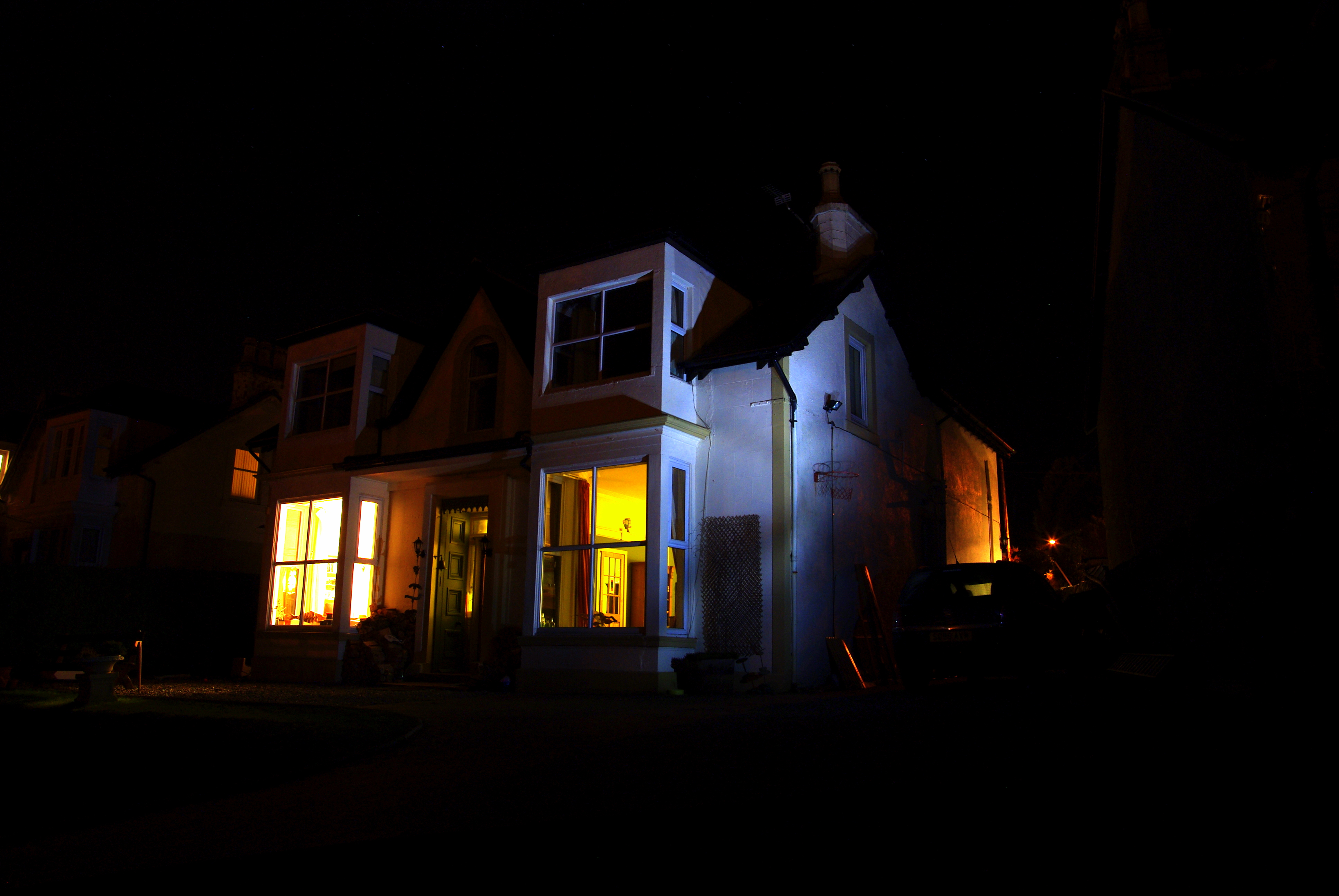
(Our house lit by a bit of slave ‘flash painting’ work on a long exposure.)


Last week we had a lovely couple staying as guests in our annex from London. This was their first time in Scotland, and they were blown away by the beauty, and even more so by the peace and quiet.

One of the things they mentioned too was darkness. The kind of darkness that you only get at some distance from light pollution that bounces off clouds and leaches into every corner. Their reaction to a walk up our drive at night was a combination of fear and wonder.

All of which led me to think about the juxtaposition of light against dark, goodness against badness, truth against falsehood, etc. All those old polarities; one of which we ascribe to God, the other we blame on the flesh or the devil.

One of which can not exist without the other.

So, light can only be understood in the knowledge of darkness. As Jesus put it;

…the people living in darkness
have seen a great light;
on those living in the land of the shadow of death
a light has dawned.

Matt 4:16

I started to think about how all of these things might exist in the mind of God.

And the Darkness became purple again.

Local discussion forum thingy…

We have had a house group at our house for a number of years- some dear friends, a pot of tea and lots of chatter. However, for some time now I have been thinking that it is time to move on into something new. We have floated the idea of starting a local discussion- probably in a pub.

The are a few reasons for this- groups like ours (no matter how lovely) can simply become too familiar, too safe- and the Lion of Judah is not a tame lion. I just think it is time to step out again a little.

Next, those of us who were part of all the ’emerging church’ discussions/conversations/debates/slanging matches perhaps became a jaded with the same theological merry go round. Post modernity, post evangelicalism, post charismatic- we all embraced the questions but had no certainty about where the road might be leading- and that was fine.

But there comes a time when a new direction for our theological journey begins to become a little clearer. All those questions start to find some kind of answer, even if incomplete and held lightly.

Of late, there have been some discussions about ‘teaching’ within Aoradh. I was rather shocked at first as I was not that sure I wanted to teach anyone anything. I was happy to learn alongside others as we journeyed together, but the idea that other people should be shaped and moulded by  my (or one of my friend’s) knowledge and wisdom was rather beyond me. At first the whole idea of it seemed a step back towards something that I was glad to leave behind.

But of course, St Paul talked about the gifts given to the body of the church- apostles prophets teachers miracle workers healers helpers organizers those who pray in tongues. I am no longer given to treating the suggestions of St Paul to the people in Ephesus as a blue print for the organisation of ‘church’, but neither am I going to ignore him either!

Having said that, there are a few other positions in St Paul’s list above that still have no certified incumbents. Whilst I hope that we can be respectful of church tradition, I have no real desire to start a journey towards a new clergy. Rather let us use the passion and talent that we can, and encourage the same in others around us. If we have a teacher, let him/her teach.

Or let us just gather to learn together- this still sits much easier with me.

So- if you are in the Dunoon area, do you fancy being part of a discussion group?

My working idea has been to use some of the questions proposed by St Brian of Mclaren in his book ‘A new kind of Chrisitianity’;

1. What is the overarching storyline of the Bible?

2. How should the Bible be understood?

3. Is God violent?

4. Who is Jesus and why is he important?

5. What is the Good News?

6. What do we do about the church?

7. Can we find a better way to address the issue of homosexuality?

8. Can we find a better way of viewing the future?

9. How should followers of Jesus relate to people of other religions?

10. How can we translate our quest into action?

I am determined that any of these discussions has to start and end with respect for a diversity of opinion- and even to embrace this, and if we start to fight truth wars than we will not continue!
Up for it?
Here is a taster of St Brian, talking about Questions 9- pluralism;