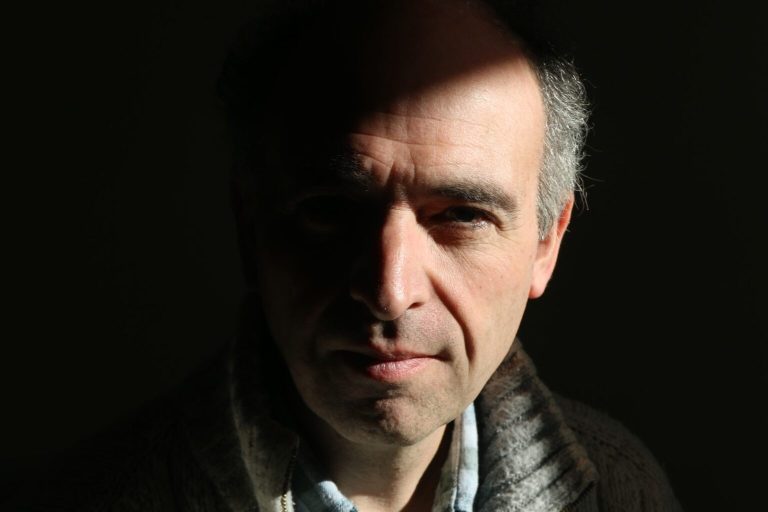
The other day I had the great pleasure of making a journey into deep Argyll, over Loch Fyne by ferry (whilst it was still dark) then up to the Isle of Seil, to meet with poet, novelist and artist Kenneth Steven. The pretext of this visit was to record a podcast, but the truth is, it was about time we met! Two blokes, both about the same age, both living in Argyll, both writing poetry inspired by the spirituality of wild places – oh and we have connection to Iona and the Iona community too. How was it that we did not already know each other?
Kenneth and his wife Kristina were the perfect hosts- despite an earlier failed attempt to record over the internet which I messed up by getting the time wrong! They live in a beautiful place and I very much enjoyed our chat. We hope you do too!
You can listen on Spotify, Apple or Youtube – Here is the spotify link;
If you don’t already know Kenneth’s work, here is the blurb from his website.
Kenneth Steven is first and always a poet. To survive as a literary author he’s had to become many other things as a writer – he translated the Norwegian novel The Half Brother, he’s a children’s picture book and story writer, he’s an essayist and a feature writer – but it’s poetry and the love of poetry that lies at the heart of it all. His volume of selected poems Iona appeared from Paraclete Press in the States a couple of years ago. His numerous collections have sold many thousands of copies, and he has a strong name as a poet thanks to the poetry-related features he’s written and presented over long years: his programme A Requiem for St Kilda having won a Sony Gold for Radio 4.
His poetry has been inspired primarily by place. He grew up on the edge of the Scottish Highlands with a profound awareness of that world: his mother’s people were Gaelic speakers from Wester and Easter Ross. It’s the wildscape of Highland Scotland that pours through his pen.
It’s that same wildscape he seeks to capture as a painter. He and his wife Kristina live on the Scottish west coast, and it’s the ever-changing colours of sea and sky he loves so much: the myriad blues and the incredible beauty of the light.
Kenneth runs his own podcast, available to those who support his work through patreon- we very much encourage any of you who are able to reach out. We need out poets more than ever!
One of the delightful things about our Proost project is that it enables us to walk the edges and find others that are doing the same. We try to gather some of this edge walking via our two podcasts- one that has a more general focus (and includes trying to do Proost ‘buisiness’ out in the open), the other one gathering poets and poetry- as this seems to have always been a strong and important strand of what we are about.
Today I was delighted to listen and share this conversation;
Where does poetry go? What is it for? How might it be used in the service of justice, peace and reconciliation? How does this relate to spirituality?
In this episode, our Talitha talks to the poet, musician and activist Samara Pitt about her practice, her songs and her love of words. In particular, she describes a process of turning poetry into song – an almost magical process…
Samara describes herself like this;
Samara is a 7th generation coloniser-inheritor living on the unceded land of the Wurundjeri Woirurrung people in the hills outside of Naarm/Melbourne.
She has lived and worked in several different intentional communities, most recently at Gembrook Retreat where the community invites people on to the land to encounter God in creation and to equip each other to live a soulful life.
She loves singing, singing with others, and putting music to words that help us listen more deeply to Country and to soul. Drawing on the liturgical tradition of sung refrains as a congregational response to the reading of a psalm, she has just started to compose short songs based on the repetition of short phrases, designed to help us dwell with the emotion and beauty of words and harmonies. They are also a grateful tribute and offering to the writers.
You can find more of Samara’s work – and support it – here.
Here is Samara’s account of her poetry choices for this episode.
Shaun Tan is one of my favourite writers and illustrators working in these lands now called Australia. His books are haunting and beautiful. and help me to look at the ordinary through the lens of wonder and imagination. This is taken from his book Tales from the Inner City which explores the mythic presence of the more-than-human world in the midst of our cities.
The lyrics come from Kerri ní Dochartaigh’s book ‘Thin Places’, a mix of nature writing and Troubles memoir about growing up in in the midst of violence in Derry and the role of nature in helping her find peace and healing.
Gout Gout is an up and coming Australian sprinter who gave the most poetic statement I’ve ever heard from an athlete in a press conference, when he was asked if he still feels normal. I found another slam poetry style quote from him about how he ‘steps light but presence heavy’, and then added my own line imagining the cycle of preparing for, running and coming down after races.
I found these lines in a book by Chris Anderson called ‘Light when it comes’. Based on the spiritual practice of ‘examen’, these words suggest that we turn to face darkness rather than flee from it.
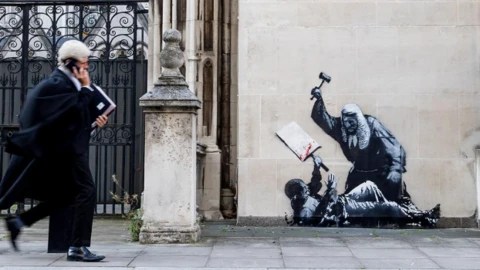
Why? is it because it is ‘good’ art? I am not sure how to judge such a thing. Is it because it is brave and fearless in the face of unyielding bureacracy? Perhaps there is some of this here. Is it because it captures a mood- a national feeling against an unjust law? I hope so. God knows, we need our post-modern Prophets even more than the ancient Israelites did.
There remains something else too that makes me slightly uncomfortable- the celebrity mystique of protest art that is allowable somehow because it has been owned by the establishment – permissable as a democratic safety valve that pretends towards non-conformity whilst at the same time playing the art game as well as everyone. The Banksy machine is very well oiled after all…
He even made a self-aware film in which he describes the rules of the machine…
Michaela tells me that the inverse snobbery in me never allows me to fully enjoy anything that is popular, and this skews me towards art that is made on the edge, the fringes rather than the centre. The irony here is that I love art that challenges our culturual assumptions injustices but in order to do this, it has to break through the algorythms somehow to reach large numbers of people… just as Banksy has managed. For art to engage, it has to find vehicles that will allow it to travel.
Here is a case in point. I was recently asked to supply some poetry for an art exhibition entitled ‘A colourful world’. The idea was to place some poems on coloured cloth and drape them in the entrance. I suggested this poem from 2014 as it seemed to fit the theme rather well. Each three-line verse taking a different colour as inspiration. It was my attempt to consider the beauty and brokenness of this wonderful life that we have, in all its different colours…
Blue hangs like a limp flag above him
Stirred only by half-a-breeze
Always waiting for tomorrow
.
Light falling through these trees
As if through ten green bottles
Hanging on for the fall
.
In a crush of commuting greys she wore bright orange
Less to draw attention to herself, more in blazing protest
Against complicity, against the curse of ordinary compliance
.
Yellow says hello
As the summer strips the grass to straw
And flowers forget their gazing upwards
.
Red bowl of the sun in a darkening sky
Curtaining so fast that I reach out
Grasping as to cup it, to keep it close
.
Pink flesh unfolds like a flower
This fragile child, as if fearing the late frost
Now wrapped up safe in mother
.
The night is purple, not-quite-dark
Wide open like the mouth of a whale
Or the space between stars
.
Black like before-life, like un-pregnancy
Like before the big bang roared outwards into us
Before love made anything possible
.
Grey like the day she came to say “The time has come for leaving”
The sun itself was choked by cloud
The very sea was weeping
.
Water falling down on these old rocks
Gilding them with liquid silver
This normal place, anointed
.
Age has turned your hair pure white
Like the soul that dances in you
You are cathedral and I, your evensong
.
Sunlight makes alchemy from mountains
Now gold in the evening mist
Far beyond the wealth of kings
.
Brown like the ground where we lay down
The earth is pillow-soft
And waiting
After accepting this suggestion , the curator later gave me a print-out of the poem with crosses next to the verses he wanted. Black, pink and brown where all out, as was white. He only wanted ‘positive’ verses, or ones he could understand. He wanted a kind of ‘Hallmark’ poetry that was pretty, ornamental, but unchallenging. When I suggested this was not the way that most of us experienced this colourful world, or wanted to engage with it through art, he told me that I would have to deal with the ‘complaints’. In the end, we did use most of the poem, but it left me thinking again about art gatekeeping.
What does this look like at my end of the market? Where are the organisations that would foster/network/encourage/publish this kind of art?
Of course, in this internet age, we are all our own agents, our own publicists… each one of us has the same chance, right? The same access to the communal megaphone? Except it does not seem to work like that. In a world in which we all have access to mass connection, it has remains as true as ever that the media IS the message.
Art that challenges can not play by the same rules. It must find other ways to support and sustain itself.
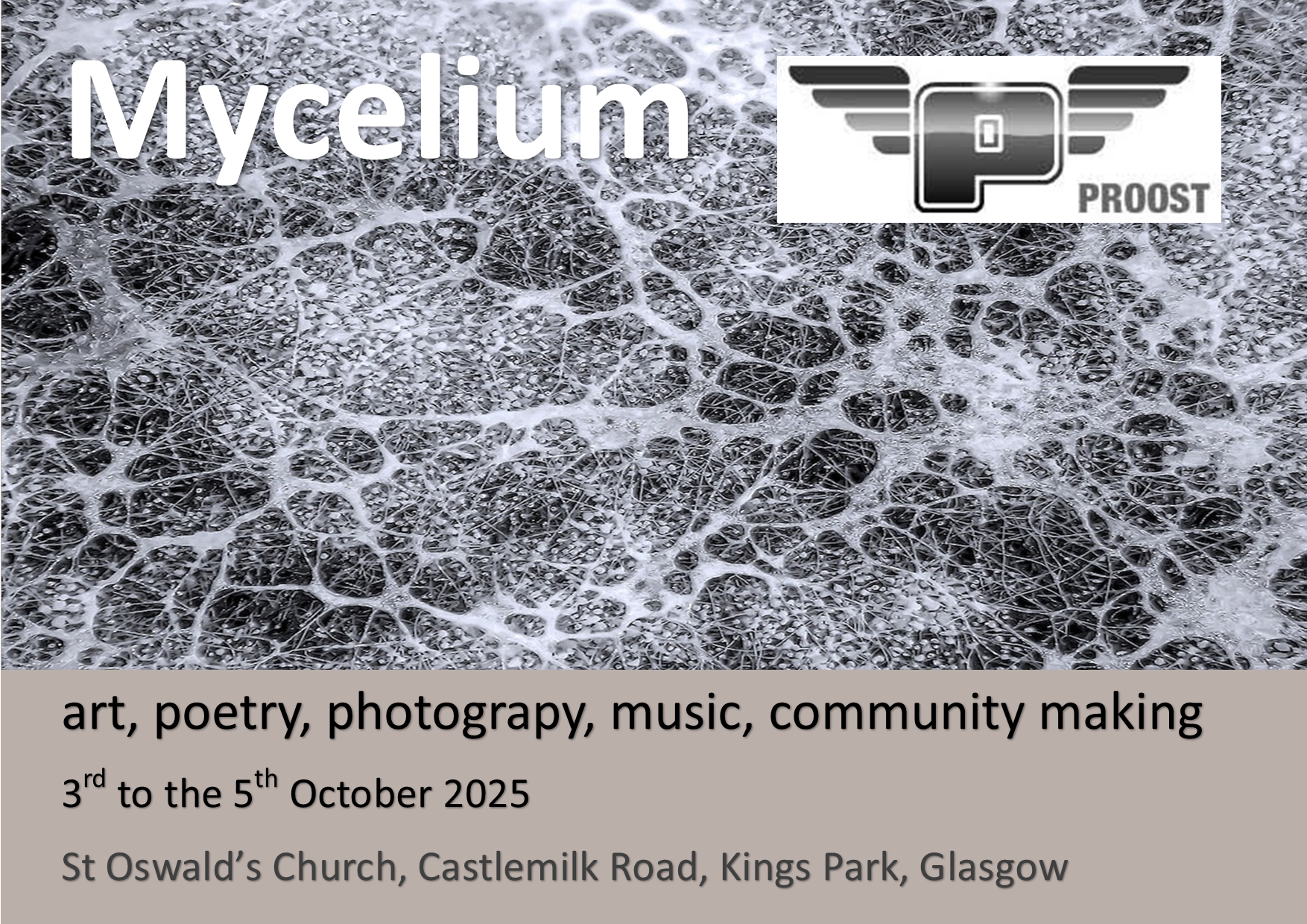
It is for this reason that I am involved in the Proost project, which is an attempt to network and bring together a community of artists around the intersection between faith and social justice. This is not about selling product (although this has to be part of it) rather it is about finding a collective voice.
This meet up is a chance to be part of what Proost might become. We would love you to be part of it.
Saturday will be a day for networking, sharing ideas and making art together.
There will be a ceilidh in the evening!
Sunday will be outward facing, inviting the wider community of Castlemilk into spaces we have created. There will be live Raku firings and other installations.
We are very grateful to St Oswalds, Kings Park Parish Church and to the wider diocese for hosting and trusting us.
I have been loving the start of the daily lent posts over on the proost.community blog. If you are needing something to give pause and focus during this season, you might want to check it out.
Even better, we are looking for contributions- poems, music, art, anything really.
Because today’s post was my poem, I thought I would replicate it here.
Spring window, Otter artwork by Sarah Woods.
This morning, up here in Scotland at least, the sun is shining, the sky is blue and the sea flat calm. If you had no connection to the world we are part of – if we were truly able to live in this moment alone – then it would be a day to truly glory in. In an age of smart phones and media feeds, many of us find this impossible. There is a background noise to our times that is oppressive. I will not list the reasons for this – you know already.
There is something that unites many people on all sides of the political spectrum just now – a sense that things are not right, that deep within our culture, our economics, our political systems, our ways of living life, something is not working.
Does this dichotomy remind anyone of anything? How about the beginning of 2020?
That was another glorious spring, with a different kind of oppressive background noise. It might be difficult sometimes to remember, this is not the first time that humans have lived like this. This is not the first epoch of injustice, of super-rich so-called-superheros, of wars and division making. Think about it.
So this morning I offer one of my own poems, written back in that 2020 springtime. It became part of a book illustrated by Si Smith.
Human races
The upright ape ascends from knapped flint to Silicon chip. He scratches sonnets in split slate and Solves problems (almost) as fast as he makes them. His alchemy promised gold, but instead just turned the Lights on, lighting a road ahead called Progress.
There is nothing new under the sun; the circle is still Unbroken. Empires rise whilst others fall; ours was Not the first at all. It turns out that our times were never Linear (just oscillation) and that for every page of Knowledge gained, another is forgotten.
But what are we, if not whisps of the same Spirit? We carry in us the same am-ness as all things that ever were, Hidden under thin skin and hubris, waiting for those moments Beneath stars or trees or tenderness when we remember; It is all about connection.
It has been a while since I have posted any new poetry here. This is not because I am not still writing, rather because the way that poetry allows me to explore ideas (which this blog is primarily about) fluctuates.
Today however, I am going to share a brand new poem, which makes some rather profound theological statements – ones that I know many of my friends will find troubling.
I’m not going to explore them here – at least, not yet. I am not even sure that I agree with them all just now.
This is one of the gifts of poetry – it can become it’s own voice, its own person. As well as a way of exploring then externalising, poetry can go further than this, and be part of a dialogue even with its author.
The dialogue does not even need to find agreement. It might be possible to hold more than one perspective – as if our theological constructs are just different poems.
It is in this space that this poem sits just now. In committing the words to keyboard and screen, I am able to stand back and consider them as if they were not mine.
Except they are mine. In writing them, I was consciously breaking through some barriers into places that feel new.
Annoucing a new poetry thing (and looking for collaborators)
Before Christmas (on this blog and elsewhere) we curated a series of beautiful contributions of poems, videos and songs produced by what is starting to feel like a developing Proost community. It was a lovely thing to be part of and this has given us an interesting template for future collaborative work.
During this run of daily posts, in the busy days of preparation, when it seems we have so little time for reflection, we released two poetry podcasts. These followed a simple format – three poets each reading two poems then talking about them in the round and allowing them to take us into deeper connection. I participated in both and they were profund, beautiful and even sacred.
If you have not had the chance to listen to them yet (and given the pre-Christmas pressure, you are forgiven) then here they are.
The first featured two Australian poets, Talitha Fraser and Stevie Wills. It was extraordinary.
The next featured two old friends of mine, Mark Berry and Ali Matthew. There was no guarantee that the magic of the first poetry pod would be repeated, but afterwards it felt like I was emerging from a great forest or an ancient cathedral.
In reflecting on these sessions, we think there is so much here that we want to continue. The sense of community, a genuine exchange of hearts, the way that poetry always takes us deeper, the conversation about things that matter, the mutual ancouragement of voices and poems that might otherwise never be heard. The deep generous spirituality woven through it all.
In other words, these podcasts seem to gather so much of what we hope that the new Proost is all about…
…so we want to make this a new regular podcast stream.
The idea is to develop a small team of people to ‘chair’ these discussions and for each podcast to involve at least two more poets on each episode. To connect with these poets, we will be casting the net as wide as possible, looking to connect with poetic voices who are exploring spirituality through this medium – after all, is not poetry first and foremost a spiritual discipline?
If you are interested in this, please drop me a line. If you know of other poets that we should be talking to, then it would be great to hear about them.
How this all develops will depend on the community that gathers around it – as with all Proost activities – but it genuinely feels as though this simple format offers a brand new way to do reflection and spiritual adventure.
Came across this poem recently, by Catholic poet Les Murray-
Religions are poems. They concert
our daylight and dreaming mind, our
emotions, instinct, breath and native gesture
into the only whole thinking: poetry.
Nothing’s said till it’s dreamed out in words
and nothing’s true that figures in words only.
A poem, compared with an arrayed religion,
may be like a soldier’s one short marriage night
to die and live by. But that is a small religion.
Full religion is the large poem in loving repetition;
like any poem, it must be inexhaustible and complete
with turns where we ask Now why did the poet do that?
You can’t pray a lie, said Huckleberry Finn;
you can’t poe one either. It is the same mirror:
mobile, glancing, we call it poetry,
fixed centrally, we call it a religion,
and God is the poetry caught in any religion,
caught, not imprisoned. Caught as in a mirror
that he attracted, being in the world as poetry
is in the poem, a law against its closure.
There’ll always be religion around while there is poetry
or a lack of it. Both are given, and intermittent,
as the action of those birds – crested pigeon, rosella parrot –
who fly with wings shut, then beating, and again shut.
Not quite sure what I think of this, but liked the fact that it made me think!



 this fragile tent