I played cricket yesterday. It was the first match of the season, which we won, despite dropping at least 15 catches (I have a black finger of shame) and enjoying many comedy moments. So it was, stiff and sore, that I ventured into the garden early this morning to attend my ‘church’.
The birds sang hymns.
Deer in the thicket were present but unseen like the Holy Ghost.
I planted onion sets like one might lay down gifts at the altar.
I wove and tied up live willow as if wrestling with theology.
I mark my blessings one by one. No matter what may unfold in the future, I count this day – its beauty, it’s promised companionship and the health I now enjoy – as a gift I should treasure…
…and it all made me think about the earth that sustains us. The community that carries us. The inter-relatedness of everything…
…and the spirit (that I sometimes call god) who holds it all together – or perhaps it would be better to say ‘who loves it all by becoming what s/he loves’
A few months ago, I started a conversation with some people about indiginous spirituality. I had this itch that I wanted to scratch to do with how the Celtic tradition that I had found so deeply compelling might have some things in common with other indigenous spiritualities, so I reached out, looking for others who had connections and knowledge that I lacked.
Celtic idigenous traditions
My quest faced lots of problems. Firstly, reaching a definitive understanding of my own tradition is far from easy. The indigenous religion of the Celts stretches back thousands of years into myth and legend so it is hard enough to say much that is certain, and even harder to understand meanings that belong to a former culture and time. What little is known about the pre-Christian Celts mostly comes to us through highly questionable records of an occupying Roman Empire. Christianity came to these islands and first assimilated, then colonised the tradition, burying it under layers of ‘progress’. Some have tried to tell the Celtic story anew in order to make it meaningful – to me and others – but it can be hard to tease apart the facts from the fancy.
Perhaps this is part of the appeal to spiritual nomads and outsiders to institution like me. What we know as ‘the Celtic wisdom traditoin’ has a malleability that allows us to make it fit into whatever we want it to fit. It has subjective utility, but might be seen to lack authentic objectivity. In acknowledging this reality, it is then for each of us to decide whether the benefits outweigh the disadvantages.
For me, they most certainly do. Perhaps this is because I am a poet, more driven by spirituality of the mystical kind. Travelling in this tradition connects me with something visceral deep inside. It is a ‘feeling’ as much as an intellectual acceptance. I quite understand why friends of mine, more driven by systematic interpretation of scriptures might take a more cautious view.
Like all religious technologies, we must travel with a certain caution, looking around for other perspectives- paying particular attention to those that Empire has marginalised.
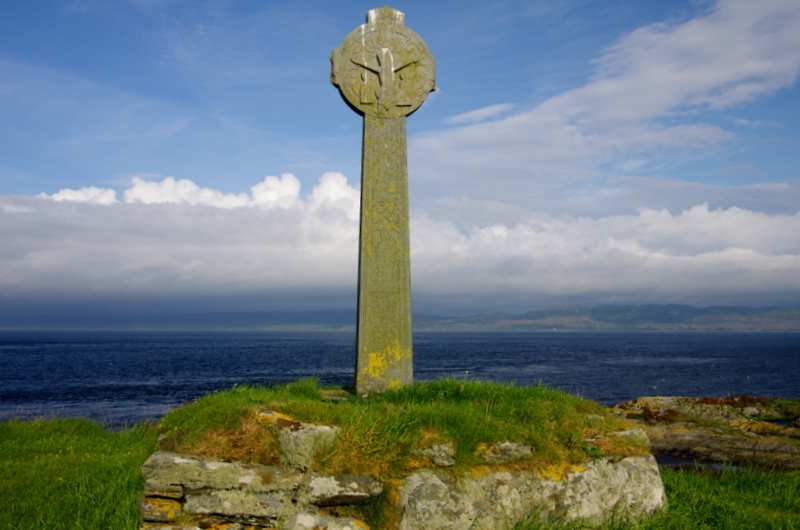
Celtic cross, Inner Hebrides, West Scotland
What do we mean when we talk about the ‘Celtic wisdom tradition’ then?
We have some tantalising clues in the form of stories and legends. Mostly these are survival traditions out on the fringes of the Celtic world- which like all cultures colonised by empire, retreated to the distant edge of its former hearlands – Atlantic coasts and islands or to rural Ireland and Wales.
We can also have some clues about the nature of this tradition from what is absent and outcast from mainstream religion. By this, I mean things that have been suppressed and persecuted that once belonged to ordinary believers. I have said more of this before, here for example. Many others have described and lamented what happened when indigenous, authentic and local spiritualities become subject to the priorities of institution and Empire.
Finally we know it as a deep ‘yes’ that we feel in our souls when we hear about ideas like ‘original goodness’ and hear how all things are connected and held together.
Colonialism and Christianity
Across the world, almost all indigenous cultures have been subjected to our colonial expansion – from St Kilda to Sarawak, through Australia and the Americas and so on. The Celtic experience might have begun earlier, but in many ways it was the same. Religion was an essential part of the ‘civilision’ of ‘native’ cultures – a conquest of the spirit alongside economic or geographical.
There is a problem here for followers of Jesus, in that Christianity has often been the religion of the worst and most oppressive forms of colonialism. I think however that the Celtic experience might heip us to decolonise Jesus from the religion that was made in his name. If we are right to describe Celtic Christianity as an assimilation of a the teachings of Jesus with pre-existing ideas, in such a way as to deepen and give further shape to the connections to earth and spirit, then we might conclude that this version of Christianity did not have at least some of the oppressive overtones that came later. Perhaps colonialism was done to Christianity as much as facilitated by it.
This does not get Chrsitianity off the hook. It remains a religion of the middle east, defined and propogated by the West, that grew and expanded because of the pursuit of Empire and profit.
Perhaps we should burn it all down and start again… but where do we start? How far back do we need to go? Whose teachings and example might be most helpful? Is there really a purer, less compromised, older and more true indigenous spirituality that we can still encounter?
This is still my quest, and it led to me reaching out towards some other people who were trying to make sense of the spirituality they were encountering via indigenous people in their parts of the world- two very different parts of Australis, Canada and Middle England. It has been an interesting journey so far… five white people, trying to make sense of black, brown and red religion.
Can we make connections with other indigenous cultures?
Part of my motivation fot this journey has been a desire to remake/rediscover a religious story that was more earth-connected, more able to provide us with a mass movement away from the damage we are doing to eco-systems. It was this ‘earth connectedness’ I felt in my Celtic roots that seemed to find echoes in other indigenous traditions – connections to land and place, to animals and holy mountains, to the spirit in other things. At least, this is what I had heard glimmerings of in films and books.
Perhaps there was more than this. I started to wonder if all the condemnation of ‘primative’ religion I had grown up with – which was characterised as animistic, or pagan, or pantheistic – had lost some things that really mattered. We were told of the foolishness of a belief that trees or rocks or lizards have spirits. How backwards to worship simple totems or forest spirits. After all, we have the wisdom of the Bible. Look where that got us.
I remembered well the simple goodness of Bob Randall’s Kanyini;
I first encountered Bob as a commentator on cultural breakdown, whilst I was working as a social worker amongst men and women in mental health services, within broken communities in the UK, not Australia. Back then, any implications for religion seemed secondary. Now they seem inseperable.
But in the face of so much variety, so much diversity, is it really possible to make any general statements about indigenous spirituality? Can we claim that it is more ‘earth connected’ or more authentically human? Is it ‘better’ than what we have have experienced in our religious institutions?
This is the conversation I have been having with my four friends from far away – more of this to come.
I will leave you with a quote from the First Nations Version New Testament. This is a book written in English by a first nations pastor in America, working first with prisoners, later with others trying to reconcile the words of the Bible with their own culture and it’s colonial history. Here are the beatitudes, through first nations eyes.
It is the same, but also very different.
BLESSINGS OF THE GOOD ROAD Matthew chapter 5
3“Creator’s blessing rests on the poor, the ones with broken spirits. The good road from above is theirs to walk.
4“Creator’s blessing rests on the ones who walk a trail of tears, for he will wipe the tears from their eyes and comfort them.
5“Creator’s blessing rests on the ones who walk softly and in a humble manner. The earth, land, and sky will welcome them and always be their home.
6“Creator’s blessing rests on the ones who hunger and thirst for wrongs to be made right again. They will eat and drink until they are full.
7“Creator’s blessing rests on the ones who are merciful and kind to others. Their kindness will find its way back to them—full circle.
8“Creator’s blessing rests on the pure of heart. They are the ones who will see the Great Spirit.
9“Creator’s blessing rests on the ones who make peace. It will be said of them, ‘They are the children of the Great Spirit!’
10“Creator’s blessing rests on the ones who are hunted down and mistreated for doing what is right, for they are walking the good road from above.
11“Others will lie about you, speak against you, and look down on you with scorn and contempt, all because you walk the road with me. This is a sign that Creator’s blessing is resting on you. 12So let your hearts be glad and jump for joy, for you will be honored in the spirit-world above. You are like the prophets of old, who were treated in the same way by your ancestors.
SALT AND LIGHT
13“As you walk the good road with me, you are the salt of the earth, bringing cleansing and healingto all. Salt is a good thing, but if it loses its saltiness, how will it get its flavor back? That kind of salt has no worth and is thrown out.
14“As you walk the road with me, you are a light shining in this dark world. A village built on a hill cannot be hidden. 15No one hides a torch under a basket. Instead it is lifted up high on a pole, so all who are in the house can see it. 16In the same way, let your light shine by doing what is good and right. When others see, they will give honor to your Father—the One Above Us All.
FULFILLING THE SACRED TEACHINGS
17“When you hear my words, you may think I have come to undo the Law given by Drawn from the Water (Moses) and the words of the prophets. But I have come to honor them and show everyone their true meaning. 18I speak from my heart, as long as there is a sky above and an earth below, not even the smallest thing they have said will fade away, until everything they have said has found its full meaning and purpose.
If you are reading this (after glimpsing the title) then I am going to make an assumption that, like me, you think that religion can be/might become/sometimes is part of the solution to some of the difficulties that assail the world we live in. Sure, you might (like me) be deeply frustrated by the fact that it has failed to be this so regularly and in so many ways, but (like me) you perhaps still have this feeling that ideas matter, and that ideas of the spirit perhaps matter even more…
Crisis of the planet – the planet not being able to cope with the amount humans take nor absorb the amount of waste we give it back
Crisis of the economy – Our economic survival seems to be based on continuing to consume more and more
Crisis of our politics – Our political systems seem incapable of envisioning or implimenting alternative solutions, even when offered a pathway by science
Crisis of our religion – our religious institutions are not able to bring to us a deep conviction of our responsibility or connection to the living world we are part of.
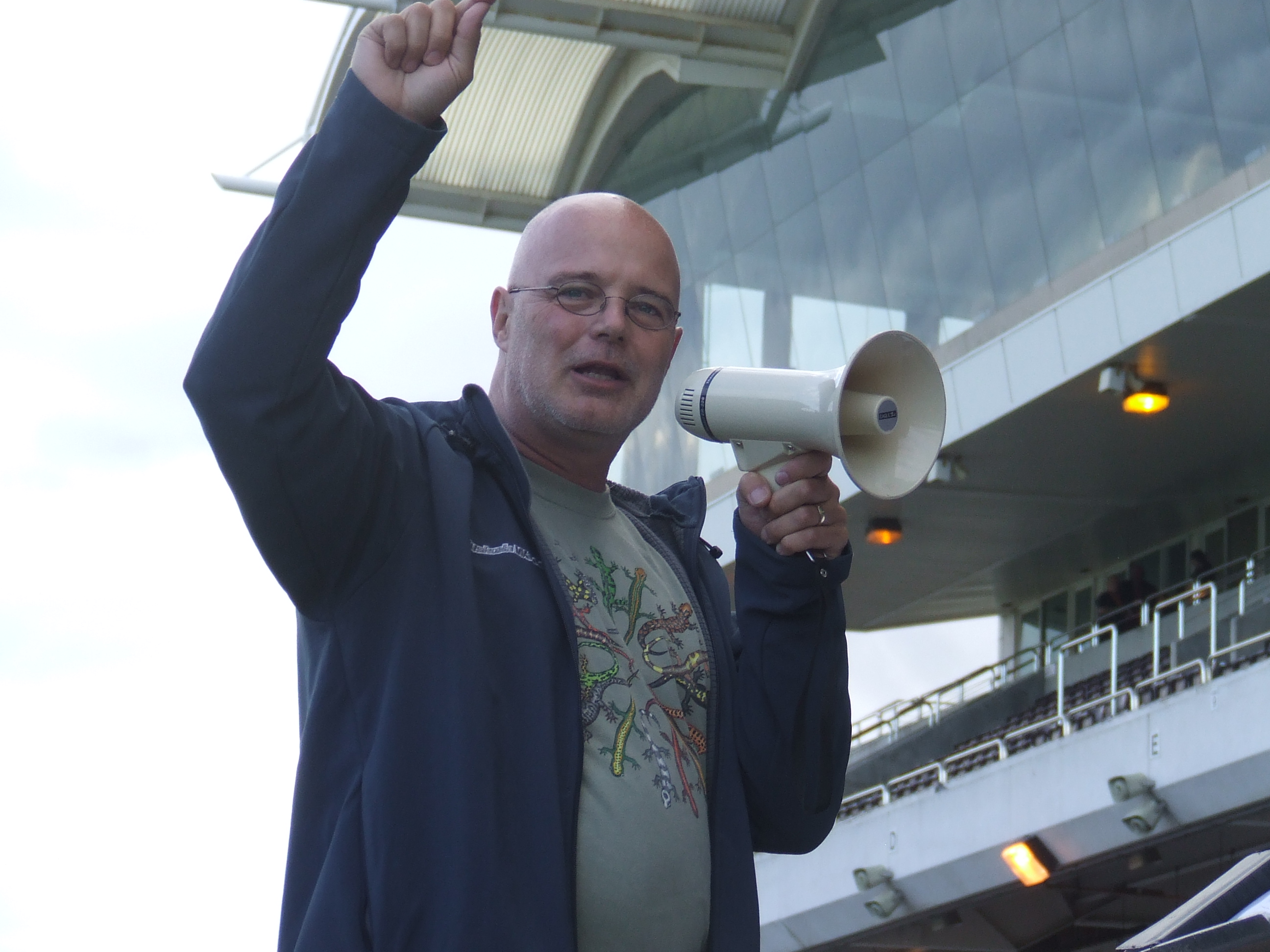
Brian McLaren makes do with a bullhorn after power failure at Greenbelt festival a few years ago..
I have written about all of these issues on this blog,but it is the last of the four crises that I have been thinking about of late. In fact, it has been a long term conversation with many of my friends too.
There is a similar-sounding issue that we might easily confuse this conversation with, aound CHURCH. I have spent too long on that journey… so much time has been spent trying to preserve the institution by making stylistic superficial changes in the hope that the centre can hold. I no longer think it can, but even if it does, how might Church inspire real change by doing business as usual? What dynamic ideas might be embraced without letting go of the old ones? The question I have begun to consider is whether it might be time to re-examine not just the flavours of religious institutions, but the fundamentals of the religion itself.
I should start by saying that I am NOT talking about inventing a brand new religion – I’ll leave that to the Scientologists. Neither am I able to comment on the reform needed in other faith traditions other than my own.
The religion that I both reject but also want to re-invent is the one named (perhaps despite his best warnings) after Jesus Christ, a historical figure whose teachings (I would argue) we have largely ignored.
Here is the thing – I don’t think I am alone. Back to those conversations with my friends. Most , like me, have left the institution of Church behind, but some are very much still within, working hard for change. The commonality between all of us is that we all long for something else, something better, but we all struggle to conceptualise what that is, and what it might look like.
I am going to try. It may take me a while. If you have thoughts or ideas that are triggered by my ponderings I would love to hear them- as long as you are kind.
It is perhaps worth reminding ourselves of the reality of declining church attendance in the UK. It is not always a straightforward picture in the short term, for instance, some hard line conservative churches have actually grown in recent years- including the Free Church of Scotland and many Pentecostal or funamentalist gatherings – even though the long term trend is still downwards, some have seen significant increase in attendees.
But this brand of religion stays firmly within the ‘crisis’ territory outlined by McLaren above. The solutions they are offering – moral certainty in relation to homosexuality, gay marriage and the fear of Hell – do little to address the problems facing our age. In fact, given the dominance of American right-wing faith models across the whole world, we might argue that this religion is the problem, not the solution. It is at best a distraction, at worst, one that has fully accommodated itself with the same capitalist economics and politics that are throwing us towards destruction.
A final look at Hartmut Rosa’s reframing of modernity, this time in order to place his thinking alongside some other broad themes.
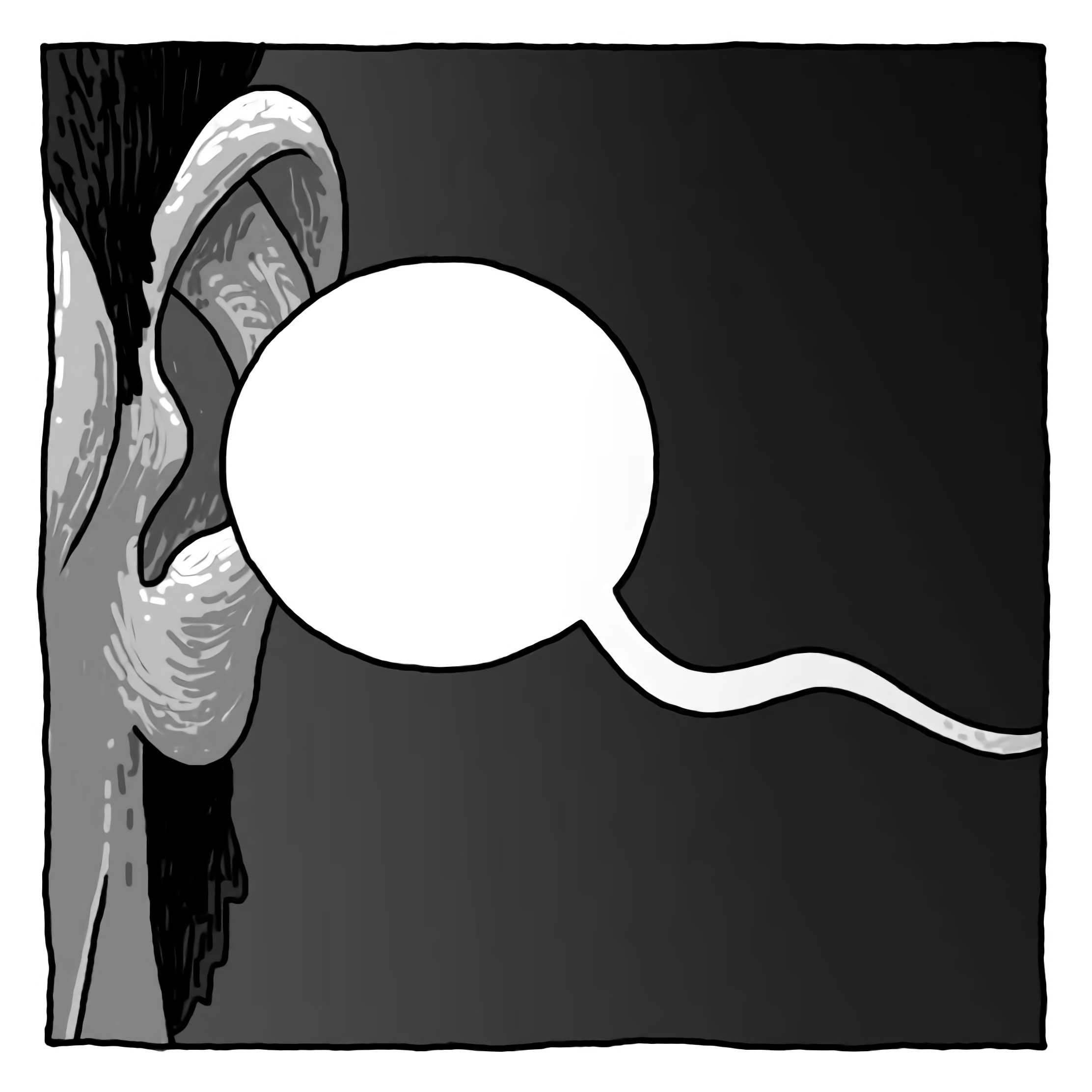
Image by Si Smith, from After the Apocalypse
This post might be stating the obvious, but I wanted to sketch out a few ways that Rosa’s description of our human condition has resonated with many other themes explored on this blog. Here they are then, in no particular order…
Downshifting/slowing down/degrowth
If I am evangelical about anything these days, it is to encourage people to step back from those high pressure, high consumption, high stress lifestyles that can trap us in cycles of mortgage making and shiny-stuff-owning. Our experience has been that even when we percieve this way of living to be toxic, we find it extremely difficult to stop. Perhaps this is a cultural pressure, an mutual anxiety about being left behind or losing significance, or even falling into poverty and non-citizenship. Perhaps too this is an ecomomic issue, given that unsustainable growthism is built in to the very DNA of our ideas of what a ‘good’ economy might look like.
But even as I have tried to go against the flow – as I have turned towards simpler ways of life, as I have dug my veg beds and put up my poly tunnels – I have often wondered what difference I was making, even to myself. It has felt indulgent, a lifestyle new middle class dream in which I remake a paradise for me and mine. Is it credible that enough people might follow this path to make any kind of difference to the ecocide we are inflicting on the natural word?
Rosa had similar questions, and this led him away from ‘slowing down’ as a solution towards the more difuse and (dare I say) ‘spiritual’ idea of resonance. He pins his flag of hope to a solution dependent on a mass increase of connection to the essence, or the ground of our being, via deeper appreciation and communication with the natural world, or with the great beyond, or with art. Is this a crazy idea?
After the apocalypse
Perhaps it is crazy, but this idea oddly mirrors the arc of my last book – the collection of poetry entitled After The Apocalypse (Si Smith’s wonderful images for this book are all over these posts). I began writing the work for this book before the pandemic, as a kind of passive/active resistance to the rise of so many political and economic powers I found deeply troubling- the swing to the far right and the mainstreaming of lies and dishonesty, often in service of those who were happy to prioritise short term profit over climate or social justice.
In the end, because of the intervention of the pandemic. the book fell into three parts- before (protest) during (silence and enforced slowing down) and finally after, which dared to hope for change… even if the only way I could envisage this change was in a wider turn towards meaning, towards spirituality and connection with the earth.
Rosa would call this resonance.
It did not feel enough. I wanted to tear down border walls, remake the world better, liberate captives and feed the hungry. But given that none of these things were available to me (and even if they were, I am not the Messiah) what is left is to go deeper into the world, to live more fully and to connect with those I am in community with, both human and non human. If enough of us do this, then surely the wall will fall anyway.
(Celtic) Spirituality/Mysticism
It will be of little surprise that when Rosa talks of resonance, I hear it first and foremost as a spiritual matter.
Even the detail of how he described the process of resonance – in terms of how we feel a call towards something…
Phenomenologically speaking, we all know what it means to be touched by someone’s glance or voice, by a piece of music we listen to, by a book we read, or a place we visit. Thus, the capacity to feel affected by something, and in turn to develop intrinsic interest in the part of the world which affects us, is a core element of any positive way of relating to the world. And as we know from psychologists and psychiatrists, its marked absence is a central element of most forms of depression and burnout. Yet, affection is not enough to overcome alienation. What is additionally required is the capacity to “answer” the call: when we feel touched in the way described above, we often tend to give a physical response by developing goose bumps, an increased rate of heartbeat, a changed blood pressure, skin resistance, and so on. Resonance, as I want to call this dual movement of af<-fection (something touches us from the outside) and e->motion (we answer by giving a response and thus by establishing a connection) thus always and inevitably has a bodily basis. But the response we give, of course, has a psychological, social, and cognitive side to it too; it is based on the experience that we can reach out and answer the call, that we can establish connection through our own inner or outer reaction. It is by this reaction that the process of appropriation is brought about. We experience this kind of resonance, for example, in relationships of love or friendship, but also in genuine dialogue, when we play a musical instrument, in sports, but also very often at the workplace. The receptive as well as active connection brings about a process of progressive self- and world transformation.
Does this not sound like a mystical experience? An embodied call and response to something deeper than ourselves that ultimately is transformative?
Image by Si Smith, from ‘After the Apocalypse’
More than this, there is something about resonance that takes me back into my appreciation of the Celtic Wisdom tradition, which might be understood as first and foremost about connection with the great spirit that holds everything together. In other words, we resonante because we connect with the truest form of ourselves, which is god.
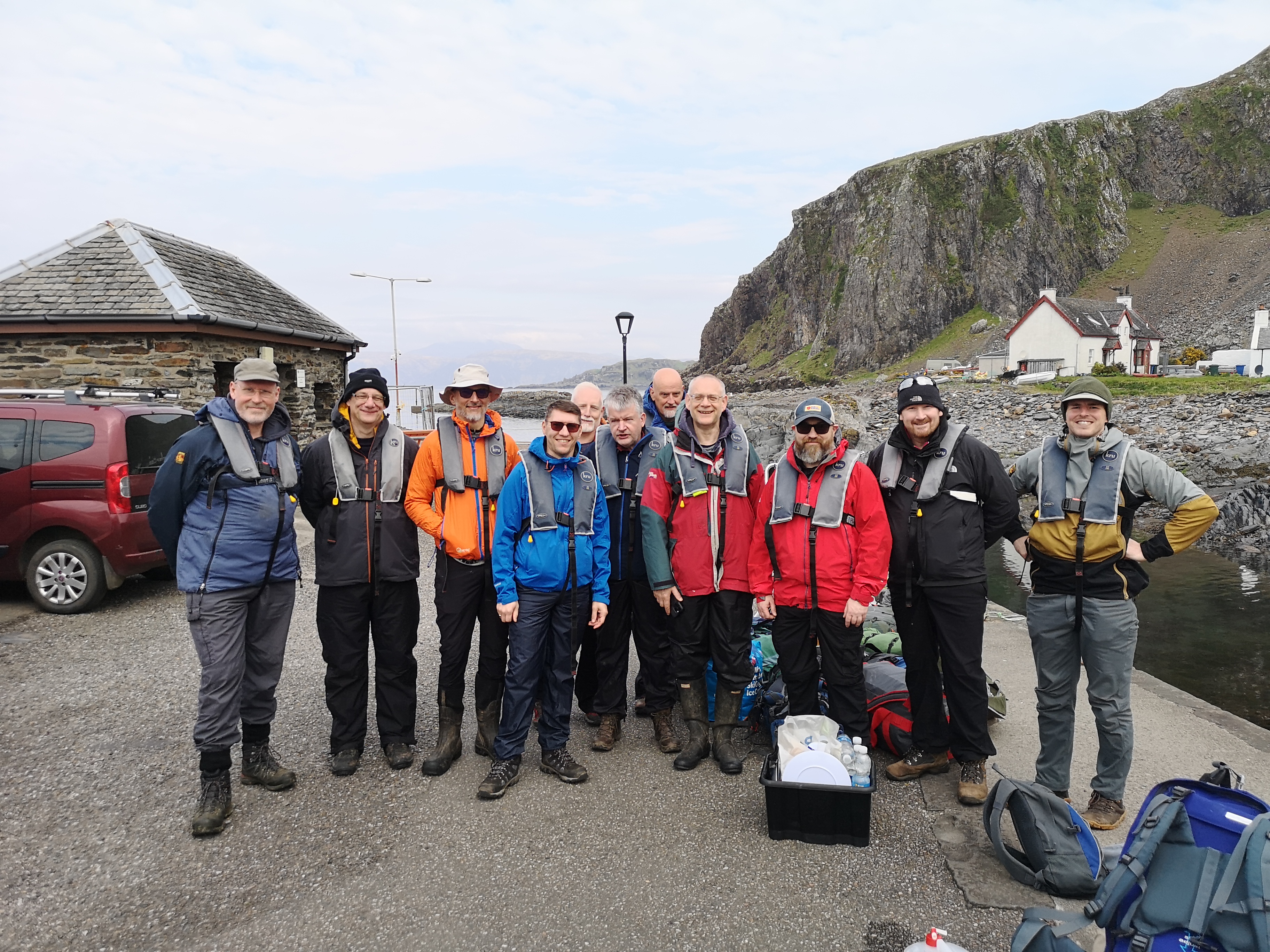
I am just back from leading a gathering of friends into what we call our annual ‘wilderness retreat’. These events have played a central part in my life now for… a long time. Decades. I could go back through the archive on this blog and chart each and every trip, remembering each one for a moment, or moments, but I would rather remember them in the form of friendship.
This year, 12 of us went back to an island called Garbh Eileach, exactly ten years after we were last there. It is part of an island chain called The Garvellachs, two islands down from the famous Eileach an Naoimh, with its monastery founded by St Brendan himself. Garbh Eileach is a different beast entirely, wild and wooded, exploding with life. While we were there, we saw deer, slow worms, white tailed eagles, golden eagles, a whale, some dolphins, seals, and innumerable other creatures, feathered, furred, scaled, crawling or swimming.
The island is also crawling with ticks. This caused a collective panic when we first landed. It would be possible to write a whole blog piece on this panic alone- on the ‘leadership’ nature of resolving it (which I carefully avoided as much as I could) and on the way that vulnerability in wild places might be psycologically and spiritualy significant – but this is for another time.
After all, no paradise is perfect.
Every year I spend a long time thinking about what we will ‘do’ as part of these retreat events. This usually comes down to a few ideas, a few scribbled words, along with a subdivision of time into ‘silence’ and ‘togetherness’ (although these are not mutually exclusive). The chat can be blue and profane, then will come a moment of deepest beauty and profundity. It is my experience that not only are these not mutually exclusive either, rather one can enable the other. The raw, earthy business of camping in wild places tends to be rather destructive to ‘nice’ facades, although some find this more true than others.
Unsuprisingly, given the recent output on this blog, this year my head was full of celtic spirituality, with the god who hides inside every living thing- even in us – discoverable not through addition but through subtraction, not by hiding our woundedness from the divine out of shame or condemnation, but by looking beneath it and through it, to that most foundational part of our being, which is god.
The mix of people who attend usually sorts out over the months and weeks- friends, and friends of friends. People have to drop out for all the usual reasons, but the boat usually stays full with others who take up empty slots. I hate to turn people who want to come away, but the limiting factor is always the transport – it is the only ‘cost’ – the boat charter being costly and tends to be in multiples of 12.
I confess to feeling slightly uncomfortable with the mix prior to this trip. Several of my dear friends could not come, so there were a number of new faces. Whilst I love to share these trips with new people, there is always a ‘getting to know the ropes’ phase. Not to mention missing my long term companions, because that is what these trips are for- to linger in wild places with people I love, and to dream of God, whatever of her remains within us.
It turns out that there is plenty.
One of the things we talked about on our trip was the old Celtic idea of an ‘Anam Cara’. Some of you will know the late John O’Donohue’s book of the same name, or even have heard the term used at weddings. It might have become mixed in with a lot of other celtic words and ideas that become so portable that they lose their meaning and power. So let’s reclaim it.
Anam Cara is not just a good friend, it is that friend who knows you. The one whom, when you are with them, you defend the least and share the most. More than that, Anam Cara is that friend who makes you a better person, just because of their friendship.
Not because they necessarily are better, more knowledgable, more spiritual, more mature.
Not because they are your elder, or your ‘mentor’ – at least of the one-directional kind. Top-down relationships are different. They can feel unequal. One big, the other small.
Anam Cara relationships are a soul deep connection that is somehow ‘enough.’
A connection that makes you more complete.
A connection to someone else which somehow intensified your own individuality, whilst simultaneously making us belong to something bigger.
Anam Cara is biased towards you – they are on your side – but they are not bind to your faults and limitations. In fact, because they know you, they know the faults better too – they may even call you out on them. You might do the same for them.
Anam Cara is something I have longed for most of my life.
Somehow, through these annual trips to make retreats to the wilderness, I have made connection with not one, but several people who have become to me, my own Anam Cara.
I have wondered how I came to be so blessed, and this made me realise that there was another ‘personhood’ in this Anam Cara relationship, and it is this.
The island.
If this sounds mystical and fanciful, perhaps it is, but allow we to explain myself.
For some time now, I have thought of god in a very different way to the God I was brought up with. Rather than God, the distant disciplinarian, who pre-judged me even before I was born, who made no allowances for my broken beginnings, whose favour seemed to rest only on my compliance with a narrow set of judgemental rules and commands (having said a single prayer that got me through the door), I instead began to catch glimpses of a god who loves things indiscriminately, wildly, with no thought of propriety or decorum. This god loved us so much that he unleashed herself on the world in the form of the Christ, who wears a coat of a million colours and in these parts of the world, many of them are green.
Then, through immersion in the Celtic wisdom tradition, it occurs to me that people have thought this way about god for thousands of years. Here is the god who animates blades of grass, who is in the weave of sinews that flex in the leg of a deer. Here is the god who lifts the arms of trees and is to be seen in snakes and crack addicts alike.
Remarkably, this is the god who lives in me. More than this, this is the god who IS me- not because I am god, but because through god, I am, and within me, is god. Because of my woundedness, the baggage I carry, the things I do to distract myself, the things I do that I should not and the things I should do but do not, then god is often obscured, deep inside, but she waits still, because like my Anam Cara, she is biased. She is after all, love.
As I seek to move in and to further understand this wisdom tradition, it seems unsurprising that when we linger in quietness in these wild places – particularly in the contained space of small verdant islands – our awareness of god who loves things by becoming them is closer. It enters into our relationships even, broken and imperfect as they surely are.
I feel a deep love for my friends, for those I share these islands spaces with. Sometimes this bursts out of me in unregulated and embarrassing ways. This is in part because I know them to be good, to be loyal, to be true, even to be slightly biased towards me and I towards them.
In part also, I blame the island, which embraces us all.
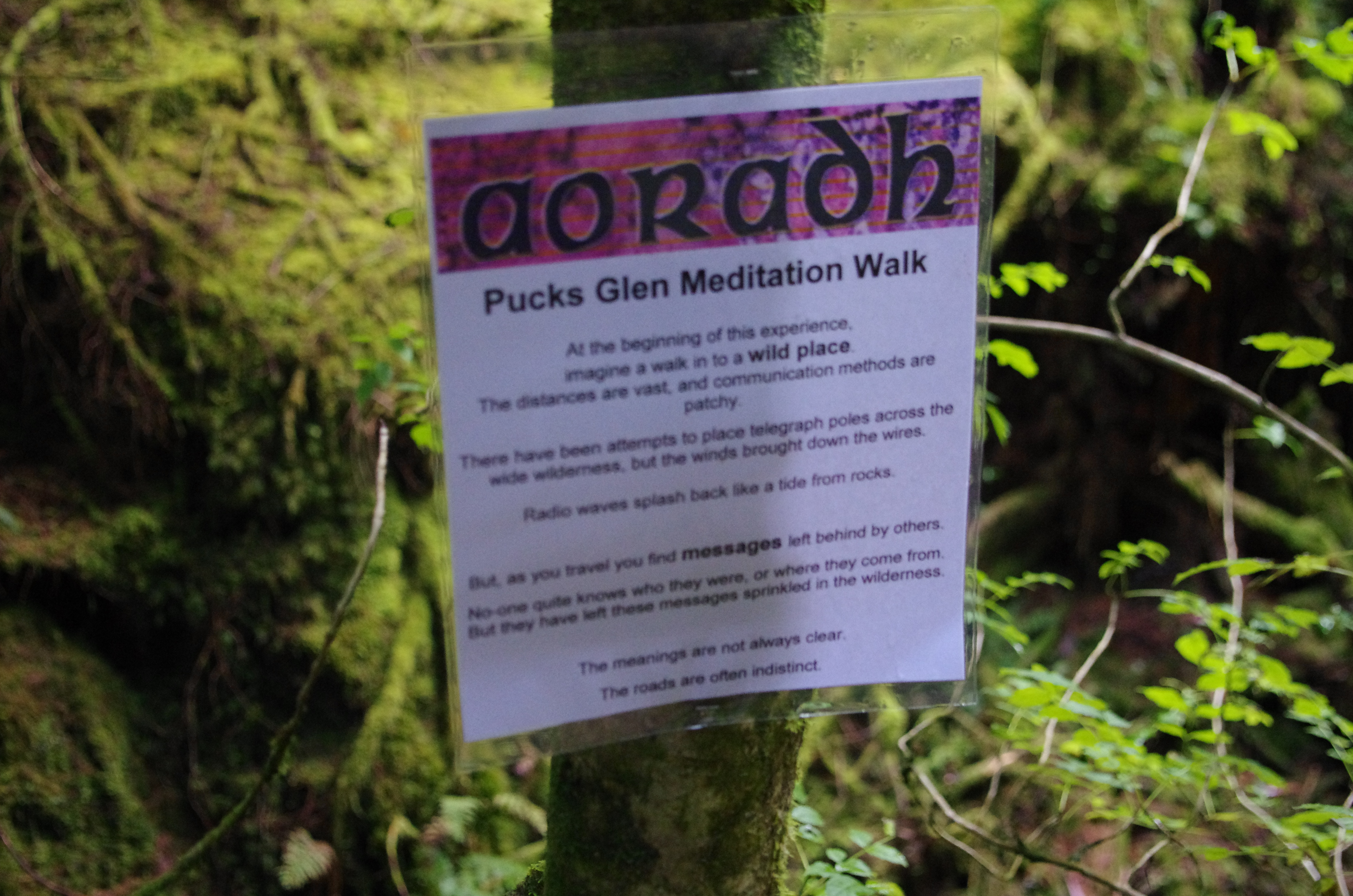
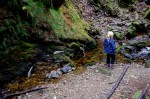
We are just back after deconstructing the installations and stations in the lovely Puck Glen, which formed Aoradh’s contribution to Cowalfest. It felt like a real shame to take them down, as even today the Glen was full of people who were visibly affected by what they were encountering.
This is the second time we have used Pucks Glen in this way, and I have ideas about other things I would love to use this magical place for- watch this space to see if they ever come in to being.
As ever, if anyone wants to know more about what we did, or wants a copy of some of the resources feel free to get in touch.This time our contributions went something like this;
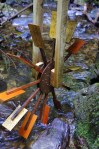
A water wheel spinning from a bridge in the darkest part of the Glen, asking people to think about the fact that it was energised by silver streams that had come from above.
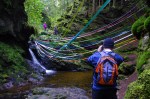
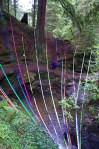
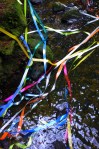
Ribbons of all sorts of colours anchored to the top of a waterfull then fanning out over a pool. The path goes under the ribbons, in a way to make people part of the waterfall- with some suggestions to think about Streams of Living Water.
A way side shrine, with candles and a wooden carved cross.
‘Leaping’ silver fish on flexible stainless steel rods, anchored to the bottom of the stream, moving as the water rushes past. An image of freedom- where the spirit of the Lord is…
Large dry leaves (from Benmore Gardens) and pens at the top of the Glen, with an invitation to write on the leaves and drop them into the water- letting go, repentance etc.
Prayer flags, asking people to raise their own ensign- things that they want to be animated by the wind of the Spirit.
A wooden frame to look out over open country through.
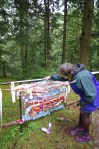
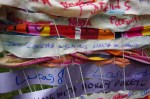
A Loom, with an invitation to write names of special people who make up their community- the gifts of the Spirit being so much to do with getting on with each other.
Poetry on large PVC banners in and amongst the trees from another previous Aoradh event on a theme of ‘A time to…’
Speaking/listening tube- a long plastic drainpipe up into the tree canopy with a horn on one end and a speaking cup on the other- with an invitation to listen and speak prayers.
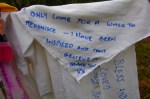
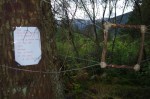
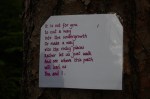
Also all the way through the Glen were small bits of poetry- what we called ‘messages’.
At some point over the weekend someone vandalised the installations- always a surprise given it’s location. Much of the poetry was ripped off or had disappeared altogether, as had the carved wooden cross. I can only assume that someone had a problem with the Christian starting point of what we were offering. This was balanced however by so many people who seemed to have found it so lovely, and had engaged with it using the materials provided. It really was a lovely thing to be part of…
“I am not religious, but I am spiritual.” How many times have you heard someone say this? I suppose, given the devaluation of the word ‘Christian’ with western culture, and the post-modern slide into an elastic pluralistic individualism it is one of those sentences that increasing numbers of us would use to describe themselves (as can be seen from the recent Census data.)
Despite my continued attempts to hold to the ways of Jesus, the idea of a religion-less spirituality appeals to me too; leaving behind all the baggage and rigidities of proscribed doctrine and setting off on my own spiritual adventure…
People who said said they had spiritual beliefs but did not adhere to a particular religion were 77 per cent more likely than the others to be dependent on drugs, 72 per cent more likely to suffer from a phobia, and 50 per cent more likely to have a generalised anxiety disorder.
They are more likely to suffer from a range of mental health problems than either the conventionally religious or those who are agnostic or atheists, found researchers at University College London.
They are more disposed towards anxiety disorders, phobias and neuroses, have eating disorders and drug problems.
In addition, they are more likely than others to be taking medication for mental health problems.
Professor Michael King, from University College London, and his fellow researchers wrote in the British Journal of Psychiatry: “Our main finding is that people who had a spiritual understanding of life had worse mental health than those with an understanding that was neither religious nor spiritual.”
…The researchers concluded: “We conclude that there is increasing evidence that people who profess spiritual beliefs in the absence of a religious framework are more vulnerable to mental disorder.
“The nature of this association needs greater examination in qualitative and in prospective quantitative research.”
What is going on here then?
Firstly, we must look at the numbers a bit more closely- the study is not huge even though statistically significant;
The study was based on a survey of 7,403 randomly selected men and women in England who were questioned about their spiritual and religious beliefs, and mental state.
Of the participants, 35 per cent described themselves as “religious”, meaning they attended a church, mosque, synagogue or temple. Five in six of this group were Christian.
Almost half (46 per cent) described themselves as neither religious nor spiritual, while the 19 per cent remainder said they had spiritual beliefs but did not adhere to a particular religion.
Members of this final group were 77 per cent more likely than the others to be dependent on drugs, 72 per cent more likely to suffer from a phobia, and 50 per cent more likely to have a generalised anxiety disorder.
They were also 40 per cent more likely to be receiving treatment with psychotropic drugs, and at a 37 per cent higher risk of neurotic disorder.
The interesting thing is that this study is in contrast with a lot of previous research about the impact of religious belief on measures of psychological and sociological health- which sees faith has having clear benefits, even if more recent research has suggested that some of the self esteem benefits depend on the wider societal norms towards religiosity.
Accepting that this research may simply be a rogue study, there seem to me to be a few possible reasons why those who consider themselves Spiritual (but nor Religious) (SBNR) might appear to be vulnerable as a wider group.
Self selection
The link may well not be causal, but correlational. Perhaps those of us who are spiritually seeking outside the edges of organised religion are doing so because life has driven us there. Perhaps even our negative experiences of church has driven us there. It is hardly surprising that we might be seen to be stressed, troubled and even unwell. These things are not necessarily measures of the futility of the journey, but more part of any real human experience- part of the process of changing, becoming, learning to inhabit our own skin. We learn far more about ourselves in crisis than we ever do in prosperity.
The question might remain as to why this is NOT also the case for the religious? Are they not also being challenged, shaped and changed by their contact with scripture/teaching/existential challenge? All I can say is that in my experience in Churches, this is rather rare. The pews offer comfort more than adventure.
In this sense, the idea of spiritual travellers on the road, nursing wounds on the way seems not necessarily a negative- rather it offers hope for our humanity. Despite it all, we still strive for connection with the divine.
Belonging
A lot of the presumed benefit of religion at both a sociological and psychological level seems to be the given sense of belonging, of inclusion and connection to a wider family. Even accepting that in-groups can have all sorts of other problems, this benefit appears to be rather universal. It should not be surprising then that those who are attempting spirituality without community do not experience this benefit.
I have written elsewhere about my conviction that we experience the divine through scripture, through revelation, but perhaps most through community. We humans were made to love- and this is not an abstract proposition divorced from the mess of human contact. Nothing strips us bare, opens us up, sustains us, breaks us down, wounds us, heals us, like community. I also beleive that our approach to theology should also be one of ‘small theologies’ (HT Karen Ward) worked out in community- in respect of ‘big theologies’, but not enslaved to them.
Having said that, it seems that there are surface benefits too in just demonstrating some kind of collective respectability- even if this depends on a wider societal respect for the religious badge that we wear. I confess to less concern about this kind of religiosity. It sounds too much like the stuff that Jesus had no time for.
The lesson here then might be to encourage our spiritual seekers to connect with one another. In these times of total (but fleshless) communication, the deeper community connection described above is a rare commodity, and where it happens it is a precious flame that we should nurture.
Believing
Finally, I have been thinking about the nature of faith itself. We have many models- faith as journey, as destination, as therapy, as national identity, as absolute truth, as means of rescue from hell. From the outside all of these organised expressions of faith appear rigidly codified, doctrinal, dogmatic. They seem to demand blind observance of rules and regulations often policed by male power. Small wonder that we would be suspicious about joining such an organisation. Small wonder that pilgrims remain outside the sites of pilgrimage.
However, I am reminded of this;
Spirituality requires context. Always. Boundaries, borders, limits. ‘The Word became flesh and dwelt among us.’ No one becomes exalted by ascending in a gloriously colored hot-air balloon. Mature spirituality requires askesis, a training program custom-designed for each individual-in-community, and then continuously monitored and adapted as development takes place and conditions vary. It can never be mechanically imposed from without; it must be organically grown in locale. Askesis must be context sensitive.
Perhaps like others who are more comfortable with being SBNR I prefer to regard faith as a journey of engagement with the God-in-all-things. To look for the marks left by Jesus on the whole of creation. But in doing this, It has become clear to me that in order to journey we need a means to travel. We need a road, and shoes to walk it with.
Like it or not, this means of travel is religion.
It is the corrective to the self centred me-first spirituality that can often characterise SBNR journeying. You know what I mean- a pick and mix spirituality tailor made to make me feel better about the choices I have made, and the lifestyle I want to live. A situation where morality and love of strangers are elasticated around our own comfort zone. (Not that these characteristics are not to be equally found in churches of course!)
It challenges us towards connection to others who have journeyed first.
To all of those SBNRs out there- I think you are the hope and the conscience of our generation. The depth and meaning you find in the mess of western civilisation will be recorded in art, law, history and handed on to the generations to come- so may you journey well…
Spirituality requires context. Always. Boundaries, borders, limits. ‘The Word became flesh and dwelt among us.’ No one becomes exalted by ascending in a gloriously colored hot-air balloon. Mature spirituality requires askesis, a training program custom-designed for each individual-in-community, and then continuously monitored and adapted as development takes place and conditions vary. It can never be mechanically imposed from without; it must be organically grown in locale. Askesis must be context sensitive.
I have been asking myself whether I agree with this- whether it is only possible to make a spiritual journey within defined boundaries. Because I suppose that defined boundaries in this case could also be described as ‘religion’.
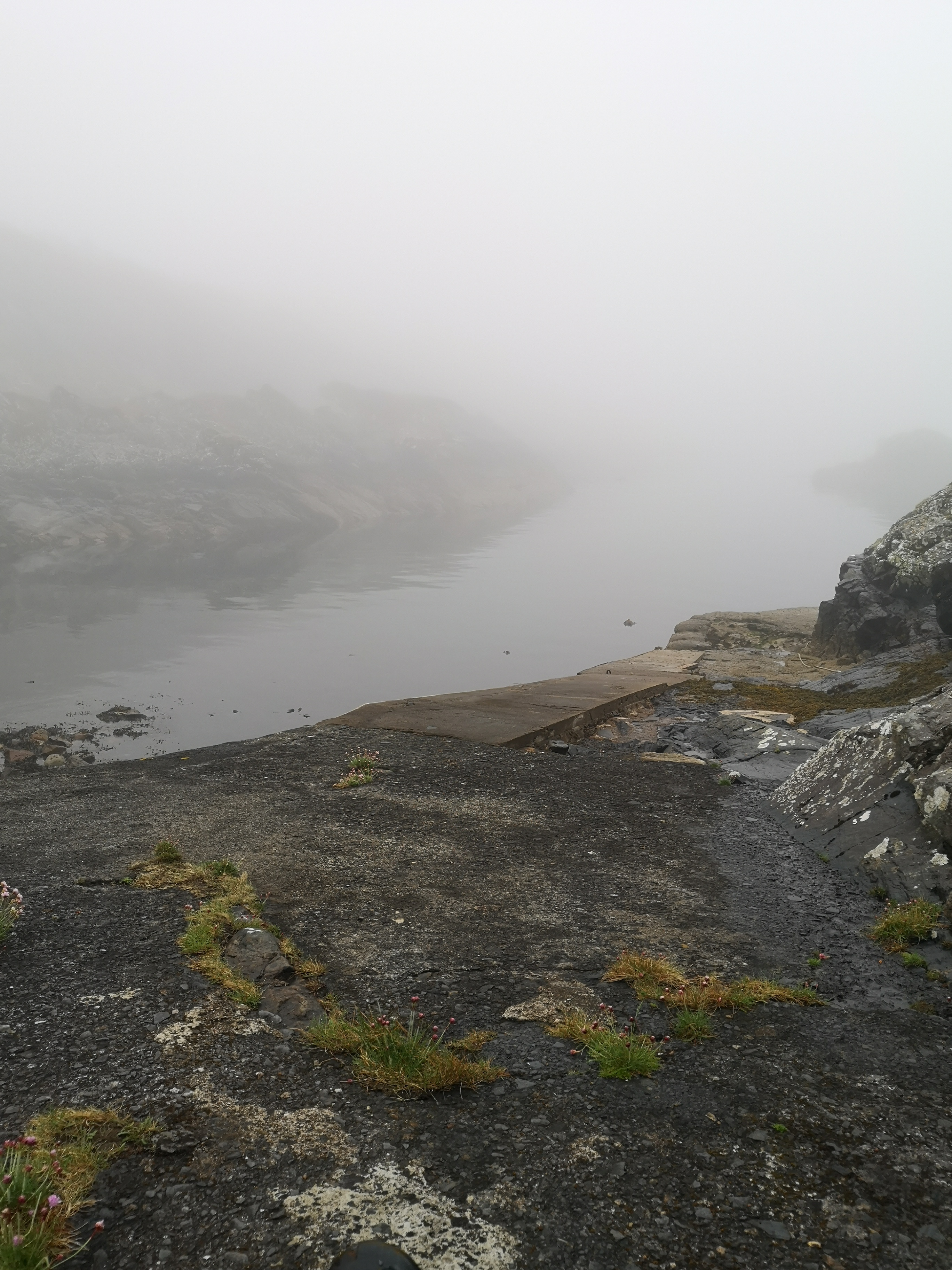
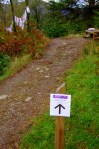
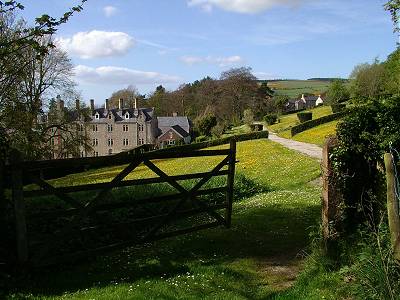
My thought so far is that Peterson is probably right- it is just that I prefer my boundary fences to be like the one above- present in symbolic form mostly, used as a guide when the mist comes down but for the most part a set of posts that I can meander in and out of whilst looking towards the big picture beyond.
After talking about it for a while, I have finally booked myself to attend an 8 day silent retreat at St Beuno’s Ignatian Spirituality Centre. I will be going towards the end of January.
I feel keenly the pivot point of my life.
I am 45 years old, and not done with adventure. I carry within me the wounds of a troubled childhood and sometimes it seems as if I am still 17, but at the same time I am no longer a child. The man I have become stands on shaky ground, but I am not ready to find a safe corner and watch TV just yet.
Increasingly though, I am aware that adventure does not just take place in the physical environment- in fact if it is to have any real value it is always a spiritual quest.
I also feel strongly that spirituality of this sort can not have, as a primary aim, the promotion of ME. There is a kind of spirituality that seems to grow from secular ideas about self actualisation and personal growth. They make an idol out of self, and this is not really compatible with following Jesus. So, whilst I might hope for satisfaction as a by product, the aim is to connect with something deeper, something outside me, so that I am better equipped to be an Agent of the Kingdom of God. In this way the internal journey connects again with the journey outwards.
I have no idea what the outcome of spending days alone with myself and God might be.
And lest this all sounds a bit pompous and self important, I am a bit scared.
There was an amazing story in the Guardian the other day about the discovery of some neolithic remains in Orkney. This is hardly surprising on the face of things- Orkney is covered in neolithic sites like pimples on a teenage face.
However, this site seems to have caused amazement in the archaeological world;
“We have discovered a Neolithic temple complex that is without parallel in western Europe. Yet for decades we thought it was just a hill made of glacial moraine,” says discoverer Nick Card of the Orkney Research Centre for Archaeology. “In fact the place is entirely manmade, although it covers more than six acres of land.”
Once protected by two giant walls, each more than 100m long and 4m high, the complex at Ness contained more than a dozen large temples – one measured almost 25m square – that were linked to outhouses and kitchens by carefully constructed stone pavements. The bones of sacrificed cattle, elegantly made pottery and pieces of painted ceramics lie scattered round the site. The exact purpose of the complex is a mystery, though it is clearly ancient. Some parts were constructed more than 5,000 years ago.
I love this story as it asks so many questions about who we are.
The place where we grew from in these islands appears not to be some southern soft plain. This complex is much older than Stonehenge, and a level of sophistication far beyond.
These people emerged from the background of creation (like Adam and Eve) then learnt how to survive (like Abel) before starting to farm (like Cain) then to trade and commune with one another (like Babel.)
And in the middle of it all, they searched for meaning, for spiritual significance, for connection with the heavens- so much so that they dedicated huge resources and time constructing these temples.
Whatever uses they put the temples (if indeed that is what they were) we will never know- and like any spirituality, it can never be understood in the abstract anyway- only in the immersion.
The temples are also a reminder that whilst we may have so much still in common with these ancient Orcadians, things also change- often in ways we may not expect;
Equally puzzling was the fate of the complex. Around 2,300BC, roughly a thousand years after construction began there, the place was abruptly abandoned. Radiocarbon dating of animal bones suggests that a huge feast ceremony was held, with more than 600 cattle slaughtered, after which the site appears to have been decommissioned. Perhaps a transfer of power took place or a new religion replaced the old one. Whatever the reason, the great temple complex – on which Orcadians had lavished almost a millennium’s effort – was abandoned and forgotten for the next 4,000 years.












 this fragile tent