It has been a while since I have posted any new poetry here. This is not because I am not still writing, rather because the way that poetry allows me to explore ideas (which this blog is primarily about) fluctuates.
Today however, I am going to share a brand new poem, which makes some rather profound theological statements – ones that I know many of my friends will find troubling.
I’m not going to explore them here – at least, not yet. I am not even sure that I agree with them all just now.
This is one of the gifts of poetry – it can become it’s own voice, its own person. As well as a way of exploring then externalising, poetry can go further than this, and be part of a dialogue even with its author.
The dialogue does not even need to find agreement. It might be possible to hold more than one perspective – as if our theological constructs are just different poems.
It is in this space that this poem sits just now. In committing the words to keyboard and screen, I am able to stand back and consider them as if they were not mine.
Except they are mine. In writing them, I was consciously breaking through some barriers into places that feel new.
Annoucing a new poetry thing (and looking for collaborators)
Before Christmas (on this blog and elsewhere) we curated a series of beautiful contributions of poems, videos and songs produced by what is starting to feel like a developing Proost community. It was a lovely thing to be part of and this has given us an interesting template for future collaborative work.
During this run of daily posts, in the busy days of preparation, when it seems we have so little time for reflection, we released two poetry podcasts. These followed a simple format – three poets each reading two poems then talking about them in the round and allowing them to take us into deeper connection. I participated in both and they were profund, beautiful and even sacred.
If you have not had the chance to listen to them yet (and given the pre-Christmas pressure, you are forgiven) then here they are.
The first featured two Australian poets, Talitha Fraser and Stevie Wills. It was extraordinary.
The next featured two old friends of mine, Mark Berry and Ali Matthew. There was no guarantee that the magic of the first poetry pod would be repeated, but afterwards it felt like I was emerging from a great forest or an ancient cathedral.
In reflecting on these sessions, we think there is so much here that we want to continue. The sense of community, a genuine exchange of hearts, the way that poetry always takes us deeper, the conversation about things that matter, the mutual ancouragement of voices and poems that might otherwise never be heard. The deep generous spirituality woven through it all.
In other words, these podcasts seem to gather so much of what we hope that the new Proost is all about…
…so we want to make this a new regular podcast stream.
The idea is to develop a small team of people to ‘chair’ these discussions and for each podcast to involve at least two more poets on each episode. To connect with these poets, we will be casting the net as wide as possible, looking to connect with poetic voices who are exploring spirituality through this medium – after all, is not poetry first and foremost a spiritual discipline?
If you are interested in this, please drop me a line. If you know of other poets that we should be talking to, then it would be great to hear about them.
How this all develops will depend on the community that gathers around it – as with all Proost activities – but it genuinely feels as though this simple format offers a brand new way to do reflection and spiritual adventure.
This week and next week there will be two Proost podcast episodes released, featuring interviews with musicians. The first one (out already) is with the rather wonderful Ant Clifford, of the band Lofter. Next week we will hear from our lovely friend Yvonne Lyon.
These chats are part of our on-going pondering as to the shape and purpose of a revival of Proost, an old publishing organisation. It might be interesting to note that before the old Proost took on the role of publishing loads of written material, video and animation etc. it was first concieved of as a record label.
The questions we are trying to explore are some of these;
What role does music take in our spiritual lives? More than just soundtrack, might it actually shape us in real and meaningful ways? If so, how?
What kinds of music might we want to showcase? Who might help us navigate a world we know little about, particularly the music being made by non-white,non-male, non-middle-class people like us?
What is the difference between worship music and ‘music of the spirit’ of the kind we are most interested in?
Who is making this kind of music? Are there people out there who should be heard, but are struggling with an indifferent music money machine?
Is there a need for a simple network to support grass-roots music that seeks to make a difference?
We have an inkling (particularly following these two conversations) that musicians need connection, just like all artists do. In fact, there may be particular reasons why musicians need this more than most. The music business has taken such a pounding in the last few years. The rise of streaming services has placed all the earning power out of reach of all but the biggest stars, and the pandemic left many performing artists in a hole. Meanwhile rising energy costs are forcing many vanues that previously supported live music to close.
As Yvonne points out, music is also relational at heart. The image of the tortured bedroom genius, making tracks on a laptop, might have some basis in reality, but actually, music flies when it is made in community, when it sparks between different creative inputs on different instruments. It comes alive when people listen. It creates a space in which people can transcend, almost uniquely.
But it can also be a hard road, and musicians need one another.
A few months ago, Michaela listened to one of those business webinar things aimed at small creative businesses, where they were talking about different ways for artists like us to make a living from what we create. The idea was that we could use Patreon as an exchange, in which people give monthly support in return for a sliding scale of content and ‘rewards’.
I confess, I was skeptical, but the reason we are still able to make a living through what we create is because Michaela works so hard to make it work so we gave it a whirl. To our (or mostly my) amazement, a number of people signed up.
This seems to me to be a miraculous and wonderful thing – that some people who I have never met would see something of value and beauty in what we make, so that they feel prepared to support us financially. Our lifestyle is nor lavish and so these small acts of support make a big difference.
How does it work? Well, check it out for yourself, here.The seatree patreon has four tiers, unlocked by different subscriptions, which include things like
access to a private video of yours truly reading a poem
a handwritten anotated poem
a monthly gift
a piece of seatree pottery each month.
The other thing I have discovered is how much I have enjoyed making these short videos. I hope our patreons will understand if I share one of these here as a sneak preview;
I came across this project a while ago, and got very excited by it.
A lot of my writing on this blog has been an attempt engaged criticism with our economic/political/cultural malaise. I suppose I am seeking to make sense of where we are up to, and looking for what is changing, for good or ill. This means that some of the discussion in this blog has delved into the shady world of economics and that I find it impossible to avoid political statements.
But I am not an economist, or a politician. I approach these things as a writer, a poet, a person interested in theology. You will understand my interest then when I read about the Dark Mountain Project. This is how they describe themselves;
The Dark Mountain Project is a network of writers, artists and thinkers who have stopped believing the stories our civilisation tells itself. We see that the world is entering an age of ecological collapse, material contraction and social and political unravelling, and we want our cultural responses to reflect this reality rather than denying it.
The Project grew out of a feeling that contemporary art and literature were failing to respond honestly or adequately to the scale of our entwined ecological, economic and social crises. We believe that writing and art have a crucial role to play in coming to terms with this reality, and in questioning its foundations.
The first thing that the project did was to publish a manifesto, funded by a crowd funding appeal, which sets out what they are about. If this is of interest it is well worth reading the whole thing, but here are a couple of extracts that made me shout YES!
The myth of progress is to us what the myth of god-given warrior prowess was to the Romans, or the myth of eternal salvation was to the conquistadors: without it, our efforts cannot be sustained. Onto the root stock of Western Christianity, the Enlightenment at its most optimistic grafted a vision of an Earthly paradise, towards which human effort guided by calculative reason could take us. Following this guidance, each generation will live a better life than the life of those that went before it. History becomes an escalator, and the only way is up. On the top floor is human perfection. It is important that this should remain just out of reach in order to sustain the sensation of motion.
Recent history, however, has given this mechanism something of a battering. The past century too often threatened a descent into hell, rather than the promised heaven on Earth. Even within the prosperous and liberal societies of the West progress has, in many ways, failed to deliver the goods. Today’s generation are demonstrably less content, and consequently less optimistic, than those that went before. They work longer hours, with less security, and less chance of leaving behind the social back- ground into which they were born. They fear crime, social breakdown, overdevelopment, environmental collapse. They do not believe that the future will be better than the past. Individually, they are less constrained by class and convention than their parents or grandparents, but more constrained by law, surveillance, state proscription and personal debt. Their physical health is better, their mental health more fragile. Nobody knows what is coming. Nobody wants to look…
…We imagined ourselves isolated from the source of our existence. The fallout from this imaginative error is all around us: a quarter of the world’s mammals are threatened with imminent extinction; an acre and a half of rainforest is felled every second; 75% of the world’s fish stocks are on the verge of collapse; humanity consumes 25% more of the world’s natural ‘products’ than the Earth can replace — a figure predicted to rise to 80% by mid-century. Even through the deadening lens of statistics, we can glimpse the violence to which our myths have driven us…
…We do not believe that everything will be fine. We are not even sure, based on current definitions of progress and improvement, that we want it to be. Of all humanity’s delusions of difference, of its separation from and superiority to the living world which surrounds it, one distinction holds up better than most: we may well be the first species capable of effectively eliminating life on Earth. This is a hypothesis we seem intent on putting to the test. We are already responsible for denuding the world of much of its richness, magnificence, beauty, colour and magic, and we show no sign of slowing down. For a very long time, we imagined that ‘nature’ was something that happened elsewhere. The damage we did to it might be regrettable, but needed to be weighed against the benefits here and now…
…Creativity remains the most uncontrollable of human forces: without it, the project of civilisation is inconceivable, yet no part of life remains so untamed and undomesticated. Words and images can change minds, hearts, even the course of history. Their makers shape the stories people carry through their lives, unearth old ones and breathe them back to life, add new twists, point to unexpected endings. It is time to pick up the threads and make the stories new, as they must always be made new, starting from where we are…
…
We believe that artists — which is to us the most welcoming of words, taking under its wing writers of all kinds, painters, musicians, sculptors, poets, designers, creators, makers of things, dreamers of dreams — have a responsibility to begin the process of decoupling. We believe that, in the age of ecocide, the last taboo must be broken — and that only artists can do it.
Ecocide demands a response. That response is too important to be left to politicians, economists, conceptual thinkers, number crunchers; too all-pervasive to be left to activists or campaigners. Artists are needed. So far, though, the artistic response has been muted. In between traditional nature poetry and agitprop, what is there? Where are the poems that have adjusted their scope to the scale of this challenge? Where are the novels that probe beyond the country house or the city centre? What new form of writing has emerged to challenge civilisation itself? What gallery mounts an exhibition equal to this challenge? Which musician has discovered the secret chord?…
…
This response we call Uncivilised art, and we are interested in one branch of it in particular: Uncivilised writing. Uncivilised writing is writing which attempts to stand outside the human bubble and see us as we are: highly evolved apes with an array of talents and abilities which we are unleashing without sufficient thought, control, compassion or intelligence. Apes who have constructed a sophisticated myth of their own importance with which to sustain their civilising project. Apes whose project has been to tame, to control, to subdue or to destroy — to civilise the forests, the deserts, the wild lands and the seas, to impose bonds on the minds of their own in order that they might feel nothing when they exploit or destroy their fellow creatures.
Against the civilising project, which has become the progenitor of ecocide, Uncivilised writing offers not a non-human perspective—we remain human and, even now, are not quite ashamed — but a perspective which sees us as one strand of a web rather than as the first palanquin in a glorious procession. It offers an unblinking look at the forces among which we find ourselves….
So, uncivilised as it might be, let us rise to the challenge! They are having a meeting at Whiston Lodge in Scotland next year- I may even try to get along…
I noticed that one of my favourite musicians is involved in the Dark Mountain Project- the wonderful marmite on toast songwriter Chris Wood. I feel an uncivilised song coming on…
I love the beginning of new adventures- the chance to allow new things to unfold.
This one involves a commitment to meet with my friend Paul on a regular basis, and spend some time doing some deliberately spiritual practices, and writing about them. The idea is that we take a few hours and walk into the wilderness, talk, think and meditate.
On a bench.
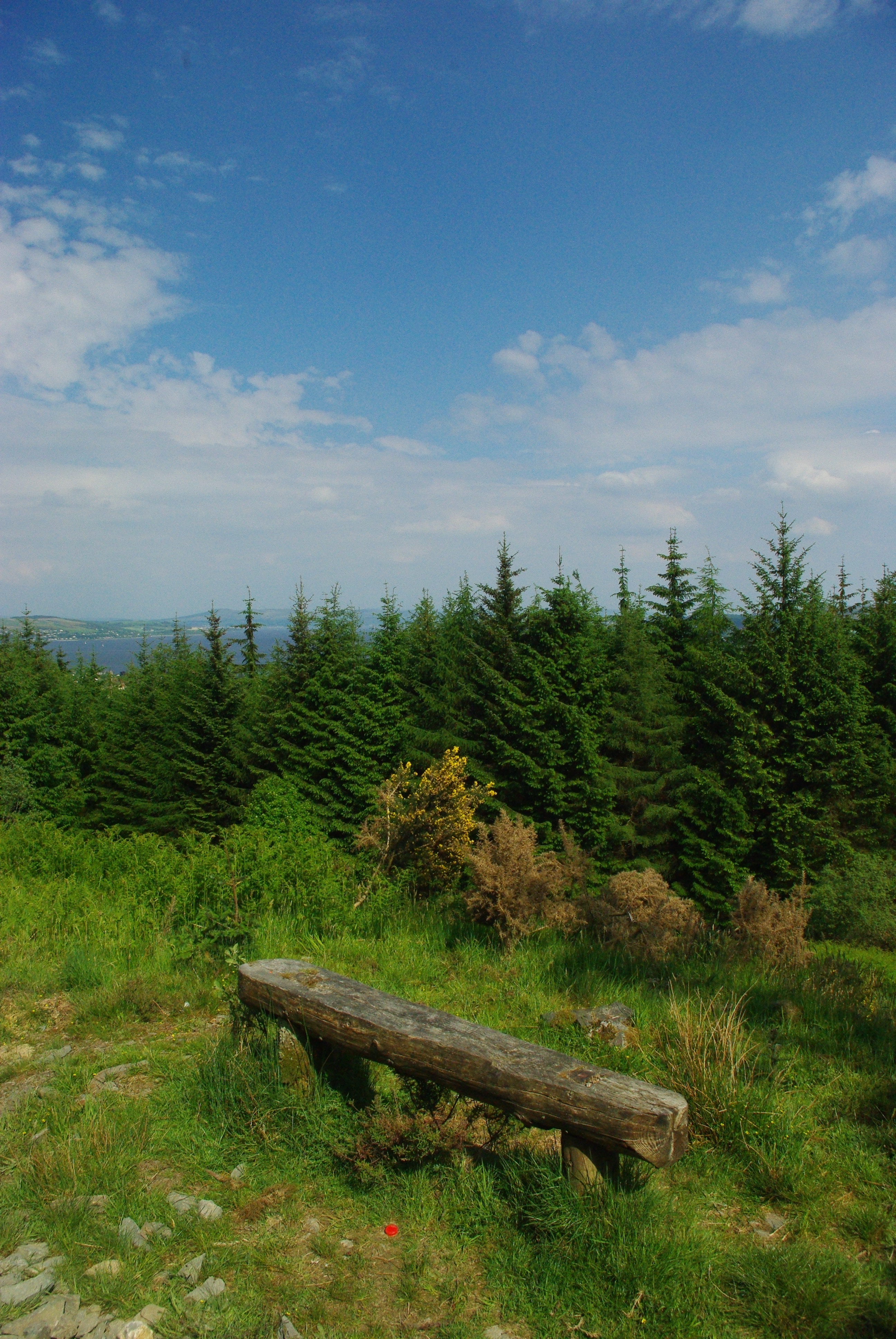
This was today’s bench, in the hills above Dunoon…
Today we used one of my favourite psalms-
1God, I’m not trying to rule the roost, I don’t want to be king of the mountain.
I haven’t meddled where I have no business
or fantasized grandiose plans.
2 I’ve kept my feet on the ground,
I’ve cultivated a quiet heart.
Like a baby content in its mother’s arms,
my soul is a baby content.
3 Wait, Israel, for God. Wait with hope.
Hope now; hope always!
Psalm 131 (The Message)
As I reflect on these ancient words, I am concious of a soul that is not content, and a heart that is unquiet.
I am puzzled too as to what things David was writing about that were ‘too great’ for him (at least in the un massaged version.) He was a king after all- but perhaps a king all too aware of his failings.
And I wonder whether I really want to stop dreaming grandiose plans- it is part of who I am. I kind of believe that our dreams should lie just beyond our grasp- just outside our comfort zones…
But in all of this, I am so aware that I need to hold on to hope.
Hope for life lived in communion with good friends.
Hope for life that is rich and deep and saturated with the things of God.
Hope for life that measures it’s meaning not by a kind of success that rots the soul.
Hope for life that is life-giving to others.
And in awareness that in this life there are no guarantees- no easy short cuts. But there are moments when what has been grey can become saturated with new colour.




 this fragile tent