Salt and light…

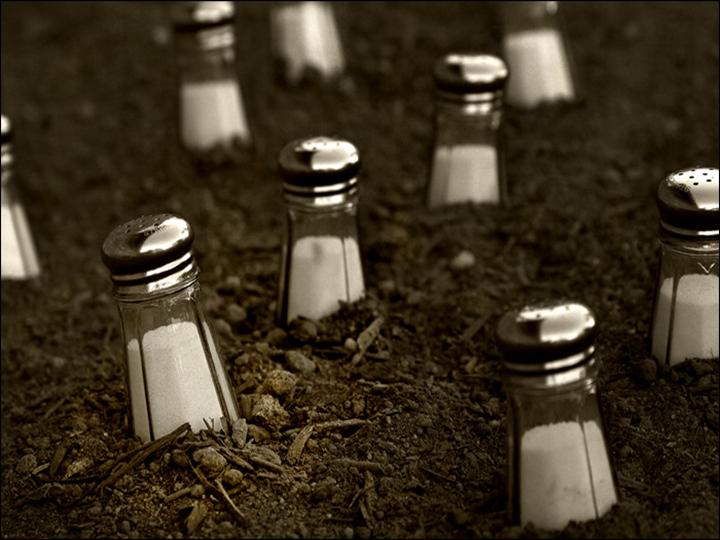
SaltOfTheEarth1.jpg (JPEG Image, 720×540 pixels)

Matthew 5:13-16

13“You are the salt of the earth. But if the salt loses its saltiness, how can it be made salty again? It is no longer good for anything, except to be thrown out and trampled by men.

14“You are the light of the world. A city on a hill cannot be hidden. 15Neither do people light a lamp and put it under a bowl. Instead they put it on its stand, and it gives light to everyone in the house. 16In the same way, let your light shine before men, that they may see your good deeds and praise your Father in heaven.

What does this mean?

For years, I kind of thought it was all about personal morality. And I suppose, it is.

I also thought that it was about evangelism. And I suppose, it is.

But I heard something today that brought me to a broader meaning. A Chinese minister speaking on radio 4 this morning said something like this.

We are called to be salt of the earth, and light to the world. This is not the same thing as making the whole earth salt, or setting the world on fire. Rather we are called to bring out the flavours of all the mixed ingredients that we come into contact with, and shine light to illuminate things of all shapes and sizes.

Not the same thing as salting the whole earth or setting the world on fire.

Could it be that the deepest meaning of what Jesus meant by these words is those of us who live according to the rules of the Kingdom of God- we are to seek beauty and grace, and truth and justice and shine light on it? And by salting it, we are to bring out the flavours of grace and hope wherever we find them?

Because, in doing this, the Kingdom is advanced.

Blogged with the Flock Browser

1 Corinthians 13

Even if I pack the Albert Hall with the power of my salvation message

Or my books require their own Amazonian warehouse

If the God Channel carries my healings back to back

And I make theology the sport of masses

Should I become the spider

In the World Wide Web

And Google all for Jesus

…but I have no love

Then I am like a dropped biscuit tin

In an empty kitchen

I am a like a bad busker in a windy street

Competing

With a massed brass band.

And even if I can predict the future price of a billion stocks and shares

Or know the coming weather

If my wisdom knows not the limit of Oxbridge

Nor lacks the ears of those with power

If I know all the words of God for this our time

And shout them loud

…but I have no love

I am nothing.

I am like a stain on the shirt

Of a crack addict

I am like a dandelion

Growing in the gutter

Of a derelict building

If I should I sell my penthouse flat and

Give my widescreen TV to Oxfam

And if I walk into a war zone

Waving flags of peace

Or become the world’s best known eco-warrior

And single handedly heal the Ozone hole

And even if all this should cost my final breath

…but I have no love

Then I am empty

Like the pockets of a gambler

Or the stomach

Of a starving child

Like a road laid

To nowhere

Like a life lived

For nothing

8.8.08

Emerging church- a useful label?

In our small group in Dunoon, Scotland, we have only fairly recently started using the term ’emerging church’ in a way that is not wrigglingly self conscious.

This was in part because although our group has many of the characteristics of what the EC supposedly represents, we have never agreed that this is the label or yardstick that we would use. It is only as other Christians have attacked us for being ’emerging’ that some of us have had a look at this label again, and thought- yes, that kind of fits.

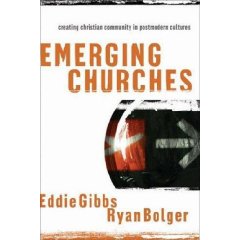
But it is not as if the label is well defined anyway. The 2006 Gibbs and Bolger book ‘Emerging Churches took a well researched swing at this, and I found it really helpful- but to be honest, I also had this feeling that if you look at a diverse movement of Christian activists and malcontents, and search for common strands- you then become responsible for creating a movement as much as defining one.

I wonder if there is also a kind of intellectual snobbery about not wanting to be defined. Many of us have escaped from solidity and predictability in the way we practice our collective faith, and the last thing we want to rush towards is another denomination.

Perhaps others felt the same way- the Methodists, or the Anabaptists- do you think in the beginning, with all the excitement and promise of something new, that they enjoyed the fluidity and freedom of lack of form and structure- and they enjoyed the lack of definition too?

I see that Andrew Jones, AKA http://tallskinnykiwi.typepad.com has started a survey asking whether we should ditch the label altogether. He is suggesting ‘Emerging missional church’ as a possible alternative- although this seems likely to raise lots of issues too. Andrew does a great job of putting some structure to these concepts here though. I am looking forward to hearing him speaking at Greenbelt festival in a couple of weeks…

Other so called EC leaders have already dropped the label too, like Rob Bell. Brian McLaren also appears to wish there was a better term. Someone put together some clips on youtube that gathered some of these thoughts.

This clip hints at some of the battle lines that are revealed when the EC label is invoked. I suspect that some of this heat alone might make leaders under fire want to find a better label.

I suppose ultimately, we will no longer be emerging- but emerged. And then we will submerge, to be replaced by another generation who emerge all over again. And God bless them as they challenge all of our cherished and no doubt concreted and inflexible doctrines and practices!

But as for me, I am not ready to get rid of the label yet. Apart from anything else- it gives us somewhere to navigate from.

And it might help us find fellow travelers of like hearts and minds to support and encourage, because Lord knows, we certainly need this.

Here in Scotland, some of us are in the early stages of trying to network more effectively- if you want to know more about this, then check out this earlier post

Confessions of a bored choirboy

I have a confession to make. I suspect I will regret it, but here goes anyway…

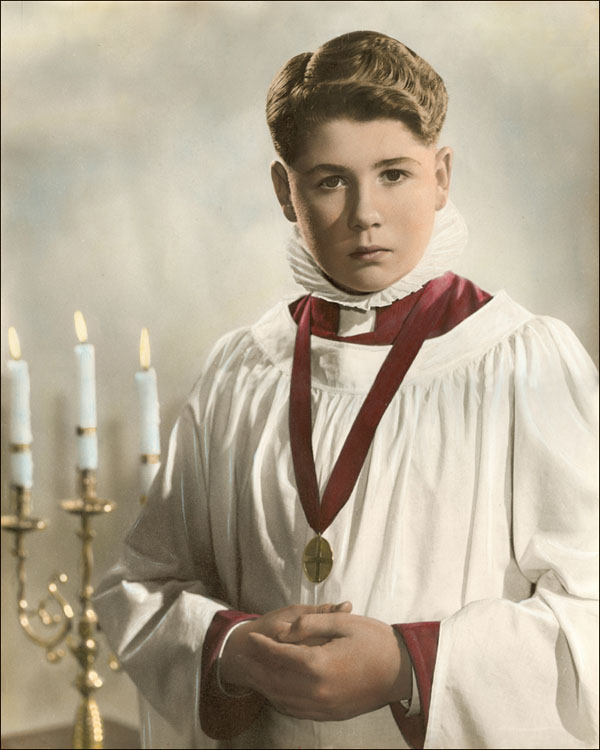
As a boy I was in an Anglican Church choir (the photo above is not me, but I suppose my mother aspired to me looking like this!) I had to sit through many evensong services, complete with voices happening somewhere in the distance that sounded totally unintelligible. I still remember the extreme boredom, and the suffocating religious atmosphere. (It is very strange to me how moving I have found some liturgical Anglican services recently- I must be getting old!)

I found that I had to do all sorts of things to cope with the extreme boredom. I was an imaginative little boy, so fortunately it was not a terminal experience, neither for myself, nor ultimately, my faith.

When counting the panes in stained glass windows and feathers in old ladies hats had been exhausted, I would fall back on another trick. We all wore cassocks and starched cotton chalices, and I found that if you put your head into your chalice, you could enter another world! The light in there was lovely, and you could imagine the shapes and sounds that penetrated your secret space where the wild animals or soldiers outside your tent in deepest darkest Africa or the Arctic or Mansfield, or wherever.

I always imagined that no-one knew about my little game, as no-one ever commented or clipped my ear, but given that I was sat in full view of the congregation, people must have seen what I was doing.

After a while (and after a lot more droning), the tent game too became boring, and I had to think of something else. But again, being a resourceful lad, I used what was available to me, so still with my head inside the tent, I hit upon this other game.

The weave of the starched cotton had imperfections that showed up as darker patches. I discovered that if you took careful aim, you could try to hit one of these spots with a little blob of spit.

This usually passed the time quite agreeably…

It amused me now to think of what the good congregation of St Thomas’ Kirkby in Ashfield made of this choir boy with only white-blond hair showing above the cassock, and strange stains appearing on sparkling white chalice!

It makes a useful metaphor don’t you think?

Question- how was the service today dear?

Answer- Lots of spitting at spots…

Blessed are those who are persecuted…

Blessed are they who are persecuted because of me…

Blessed are the unfashionable

Blessed are those who dare to be

Different

And blessed are those who receive the scorn2273church_in_poso.jpg

Of others, because they know me

Blessed are those who are guilty

By association

And blessed are those who become the subject

Of gossip

Blessed are they in stunted careers

And broken friendships

Blessed are those who

Know rejection

Because of my name

january_jan11guantanamobayarrivalproc.jpg And blessed are the prison bars

Blessed is the lash

Blessed are the roaring lions

Blessed are the broken bodies

Bless this human

Trash

Bless them in their suffering

Bless them in their pain

And give to them

The keys to my

Kingdom

From ‘the beatitudes’- the whole thing is here.

Blogged with the Flock Browser

Rob Bell on quantum physics and Hebrew poetry…

We watched a DVD from Rob Bells recent ‘Everything is spiritual’ speaking tour. He pours out these facts and figures onto huge whiteboards- what a mind the bloke must have (or some kind of special auto cue prompter!) Here is a clip from the DVD- there are a few more on you tube but it is worth getting hold of the DVD and letting is wash over you.

The message that comes through all the incredible complexity is that of the Creator God, in whom all things are made, and who sustains everything. Everything, then, is spiritual.

Bell seems to draw a familiar conclusion about the power of the poetry in Genesis…

One thing that concerns me about this approach to science and faith, is that there is a danger of relegating the creator to a ‘God of the gaps’.

By this I mean that we look to science for explanations for all things. Where science fails to fill in all the blanks, we turn to God. As science advances, then God shrinks. He is pushed into the narrow spaces- in this case, into the quantum spaces…

You could say that this God of the gaps has been the logical outcome of the age of enlightenment. And Christians have fought this truth battle in the backyard of enlightenment- on the terms dictated by modernity.

But science and faith- they ask different questions, and the answers- they find their agreement only in God.

Creation/evolution 4- Genesis

02.jpg (JPEG Image, 260×357 pixels)

So what of the poem from the beginning of the Bible? What relevance does it have to our understanding now? How does the poetry of three thousand years ago shine light into our post-modern lives? We people of faith tried first to deny the science, then to reconcile it within the framework of scripture. I choose to do neither. I choose instead to stand on both power of the poem, and the awesome scope of the story revealed through science.

God spoke “Let there be light!” and light exploded into the universe. God saw that light was good, and he separated night from day- it was evening then morning – day one.

God spoke “Sky” between the waters, and separated the air from the waters. It was evening then morning – day two.

God spoke – let the waters gather to one place, and let dry land appear, and it was so.
God spoke – earth – cover with green vegetation and trees, bearing fruit and all good things. It was evening, then morning – day three.

God spoke and made the lights come out in the day and at night, made lights to mark the seasons and the days and the years. And he made lights to take charge of the day, and another the night. It was evening, then morning-
day four.

God spoke and the ocean swarmed with fish and all sea life. Then he filled the air with flying creatures and told them to prosper and reproduce. It was evening, then morning – day five.

God spoke and said earth- generate life! Every sort and every kind- cattle and reptiles, and wild animals, insects. And let us make human beings in our image- reflecting our nature, and responsible for the fish of the sea the birds of the air, and the animals of the land. He said “prosper, fill the earth, take charge! I give you every seed bearing plant on the face of the earth for food, and to every animal, I give every green plant” It was evening, it was morning- day six.

On the seventh day, God looked at all He had made, and saw that it was good. He rested.

Adapted from ‘The Message’

As I read this poem, it speaks to me of the wonder of God, as He sets forth the explosion of unfolding creativity. As His imagination formed stars and planets rushing outwards in a massive expanding burst of light. As his planet Earth was formed and positioned in the heavens, and formed its atmosphere. Its atmosphere thinned and revealed the sky above, with the sun for warmth by day, and the moon at night. And then bursting into our fossil record comes all the fish and fowl and beasts of every colour and shape, until, right at the end of the creative story, came humans, who were gifted with the skills to reflect and emote and abstract their experience- in the image of God. Made for relationship.

And I start to connect again with the heart of God in the middle of this poem. He saw all, and it was good. His love for what he made was great, and nowhere was it greater than for this last creature, this human, to whom he gave the special dominion over the whole of his creation.

This poem sings with wonder and joy and the very essence of who we are, and why we are, and what we have become. It dances around science like a butterfly out of a net.

There are other poems in the early part of the Bible. They tell the story of the descent of mankind and our loss of the place of innocence. They tell the stories of our passage from hunter gatherers to inquisitors and tamers of the land – a process of unfolding history that divides peoples from the heart of God, and then from one another. But these are different poems, and different stories.

So let us rejoice in the poem of life, and its origins in the mind of God.

Blogged with the Flock Browser

Creation/evolution 3- science…

Scientists are developing their own story of life. At present, it goes something like this;

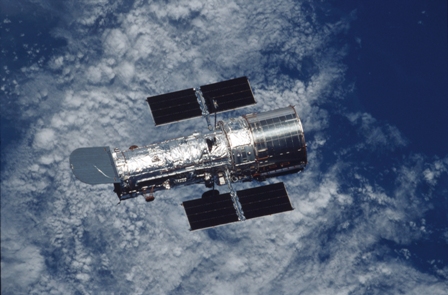
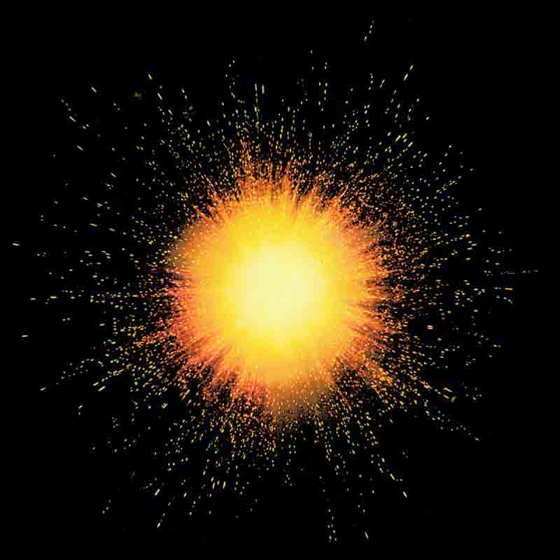
Some of the most exciting areas of scientific discovery today are thought to be in the field of Astro-physics. The Hubble telescope, now in orbit around the earth, out from the obstruction of our atmosphere, has been able to see much further into space, and in doing so, to see light coming to us from further back in time. Through examination of what are thought to be the oldest stars, and by measuring the apparent rate that the universe is expanding, scientists have suggested a new age for our universe, of between 13 and 14 billion years old. This means, according to the predominant (physical) theory of the origin of the universe that around 13 billion years ago, out of nothing, something happened, and in a mighty explosion of unimaginable force, time as we know it began. Particles of cosmic dust formed globules, some burning bright as stars, others taking their orbit around these stellar objects and forming planets. The universe continued to expand – to get bigger.

EVERYTHING that we see around us is made up from molecules and elements that were spewed out into the universe by this one event- what scientists have somewhat unimaginatively called “The big bang”. More than this- look at your hand. It too is made of star dust. because, about 4.6 billion years ago, a small planet was formed, on the edge of one of the spiral arms of a small galaxy of stars- as a swirling mass of debris accreted and took on spherical form. We have come to see this planet as Earth, our home.

The conditions on this planet eventually became just right for the beginning of another process – life. For about a billion years, the earth was ‘without form and void’. But from around 3.4 billion years ago, we can find evidence in the rocks of microbes. Nobody knows WHY these primitive forms of life began. Some early research suggested that the right chemical reactions happened to allow for the production of amino acids, perhaps through the characteristics of the chemistry on early Earth, or maybe in the deep sea vents where volcanic heat stirred the seas. Others have suggested that organic matter was deposited on earth by comets, although it is not clear where the comets came from. We do not know whether it was ONLY on our planet that these conditions existed. We still wait to see if early forms of life developed on our neighbouring planet, Mars.

It was not until about 600 million years ago that we see the first evidence of multi-cellular life on Earth in the fossil record. However, diversity seems to have remained constant, perhaps even declining, until approximately 200 million years ago. Then there was an explosion of diversity- all the marine invertebrates, including many that no longer exist, plus plant life on the land. No-one knows why this diversity suddenly appears in the fossil record, although there are many theories- from levels of oxygen in the atmosphere, to more complex theories about cell structures. All subsequent forms of life on earth are substantially similar to the animals that came to be from this period- vertebrates, invertebrates, arthropods and so on.
The carboniferous period, from about 360 million years ago appears to have been hot and humid. Huge trees forested the land, but there were no flowers yet, and no grasses. Bony fish were found in the ocean, and somehow, some of these fish formed the ability to become amphibian. In the air were seen huge insects, including one with a 14 inch wingspan!

The Permian period, from around 286 million years ago, was typified by cooler climates- and many land animals began to take their place on our planet. However, at the end of this period, and for no clear reason, many of these animals became extinct. It took another 100 million years for this diversity to recover.
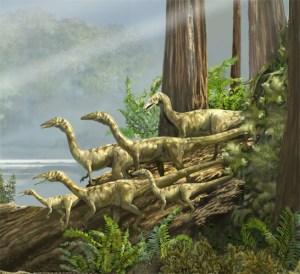
The next age, often called the Age of Reptiles was from around 245 million years ago. This period includes time of the Triassic and the Jurassic dinosaurs. They dominated the animal life of the planet for 150 million years, then disappeared, again for no clear reason. Giant meteor strikes have been suggested, but no-one knows for sure.
Next, the age of mammals – from around 65 million years. Mammals had been around for much longer of course, but during this period, they (and eventually, we) dominated the planet. Different species ebbed and flowed, some displaced by others as land masses move and reform, others varying hugely in size and shape as time places different demands on their adaptability. And we mammals were extremely adaptable.

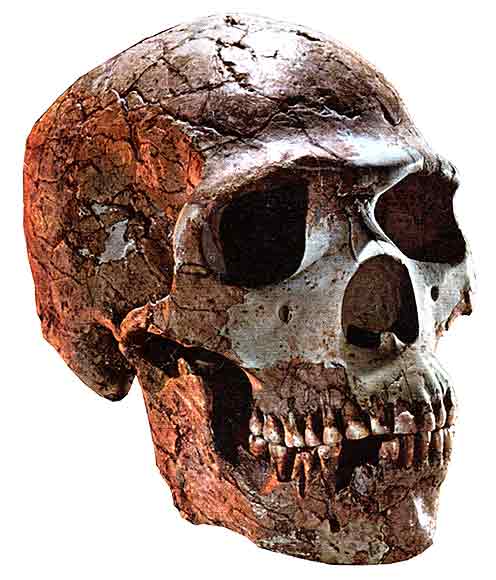
The first hominids (Apes closer to human form than to that of the ape) lived in Africa about 7 million years ago. Around 2.5 million years ago, Homo Erectus appeared in Africa, with a brain almost as large as ours, and began to make use of tools and perhaps, fire. The first recognisably human remains date back to around 250,000 years ago, and have been called Neanderthals. They had, if anything, slightly larger brains than us, and evidence of their communities, and the residue of their lives, can be found in caves in a northern climate ravaged by advancing and receding ice sheets.
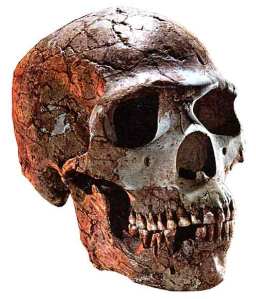
From about 50,000 years ago, there has been a mass extinction of animals in many different parts of the world. All herbivores of over 1000kg disappeared in Europe and America, and 75% of all animals between 100-1000kg. The rise of mankind, with our hunting skill, and communal organisation is the only logical explanation.

Around 30 million years ago, Neanderthals disappeared. They had been replaced, over some time, by what we now know as Modern Humans, who had first left records of their existence about 100,000 years ago in Africa. Palaeontologists have speculated that Neanderthals, despite their big brains, lacked something that the moderns had.

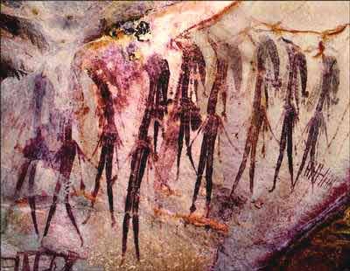
Their tools appeared primitive and poorly designed, and although they lived in social groups, there was little evidence of that oh-so human thing, abstract thought. The modern humans, on the other hand, from around 40,000 years ago, left cave art, jewellery, sophisticated tools. It was almost as if, by a freak genetic mutation, ‘humanity’ was switched on! Evidence has emerged recently however that suggested that this modern human behaviour started at least 30,000 years earlier in South Africa, where geometric carved pieces of Ochre and impressive tools were discovered from an earlier period. Human thought and abstraction seems to have been unfolding- emerging- for some time.

We stand as evidence of all that is amazing about the story told by scientists- of an unfolding story of life, beginning from nothing then gathering a fragile foothold, until at the very end of history, humans appear and make the world their own. We conquer mighty rivers, remake the building blocks of our planet into new composites and use the facts of our understanding to travel through the air, to communicate and to destroy one another. And some say that we are at the edge of destroying our planet because of our headlong rush to accumulate more and more.

This is the story given to us by the best scientific study and theorising.
Creation/Evolution 2- poets and butterflies

The first poem of the Bible concerns the origin of the world- the sweep of creation from formless void to the teeming tangle of animals, vegetables and minerals that make up this wonderful place that we live in. And perhaps most of all, this poem concerns the place of men and women in the order of things – our position in the mind and heart of God, as he unfolds his masterpiece.

This poem of the origin of all life has been one of those battlegrounds that men have argued over for centuries. Modernity, in all its scientific and analytical rigour, pinned the poem to board like a butterfly, and for a while, seemed to destroy its shape by pulling it a part – by measuring its width and depth, and finding no industrial application. From this world view, the poem is an irrelevance – it has no value to our understanding. Like the butterfly, its beauty and simplicity are categorised and filed, at best as a decoration to ornament the progress and rise of mankind.

Some religious people still try to defend the words of the poem. They too have it in a glass case of their own. For them, it has become a sacred artifact. Its words are open for analysis, but only by those who have the looking glass of correct doctrine, and anything that appears to question its absolute truth must be challenged and nullified, lest the power of the words be stolen.

But poems, like butterflies, were never meant to be pinned to boards, or kept in cases – they need to fly. Perhaps the truth of a butterfly can be measured in terms of its constituent parts, but much more than this, we understand the essence of the creature in the light of an early summer day, flickering and dancing in and out of the flowers, seeking nectar and spreading pollen – its flight seeming both impossible and triumphant.

I believe that the poem of life that has been given to us in Genesis is true. I am not a scientist, or a theologian – I am a poet. For poets, truth is given not as a blue print, or a mathematical equation, although these things are wonderful and creative in their own right. Poems bring meaning and beauty in the abstract, in order to make clear the obvious. They are often far more concerned with the why questions than the what, or the how. Poets should have no fear of scientists, who speak a different language.

As for those of us who have faith in the Creator God, I think we should also have no fear as we read the poem of life from the beginning of Genesis. We do not need to defend, or to stand against the scientific community. It makes us look stupid. Think of those folk in an earlier age who found their world view challenged by those who said that the world was not flat, and that rather than the sun turning around the earth, in fact we seemed to orbit the sun. This was the theological dynamite of the medieval age, and as such, was an idea suppressed by the religious powers of the day.

But God is not defined or limited by science – His was the art that birthed the science in the first place!

Big bang

Great big bang

In the universe
Who decides
Which way is up
And which is down
Or is it just
Perspective?

And who lit the fuse
For the big bang
Or was all happenchance
Unconnected?

And who holds the stars
As they spin on strings
And turns the worlds
On poles?

Who fired the comets
Out of view
And opened up
Black holes?

You might see these
As loaded questions
Meant to mould you in my image

But I have no simple certainties
Just a pilgrim’s search

For knowledge

26.3.06