This is partly because I have not written any recently- these things tend to come in batches. I have also been busy writing some other stuff.
I thought it time to post an old poem though…
For my day job, I work with people who have mental health problems. In one of the towns where I manage staff, there have been a spate of suicides recently. This time of year, when the days are short and stormy, and the nights are dark and cold- it can be fatal for those of us for whom life already is hard.
Each and every time this happens, the impact on the whole community is dreadful.
A few years ago, we lost someone I knew well- another victim of a life caught up in alcohol use. I watched him slowly washed away- work, family, home, cognition- all that he had been- and each and every role dissolved, until all that was left was his fragile humanity.
And this was beautiful. He would have given away his last penny. He would have shared his last sip and last drag of rolling tobacco.
And one day, we broke down his door because he had not been seen for a while. And what was left of him had become part of the bed he died in.
I was one of the few mourners at his funeral, and wrote this poem;
Brothers and sisters, life is short
A magical, miracle thing
That marches by- at first all shiny buttons
Then ragged worn, battle done.
So, in drab but polished municipality
I watch as a man is laid to rest
As his empty husk is processed- be it kindly
And hear a minister talk of faith and love
And speak some tender words to family
Who gather to say goodbye to a man they hardly knew
And I am grateful
Thankful that in this weary way
We humans still value dignity in death
For life is precious
Light flickers, then goes dark
Neville lived and now is gone
And father, lover, brother, son
Soldier, husband, drinking man-
Will be seen no more.
And as the blue velour curtains close
I think of the man entering eternity
Leaving few ripples, no disturbance
Needing no fanfare to his passing
Just sadness for a gentle soul
Time gone, now in everlasting
I thought it worth checking out as there seem to be some parallels between Canada as a culture and Scotland. And because these clips suggested it might be worth while…
The next one kind of hits the spot with me- the reason why I blog and use a website, and why I am persevering with the Emerging Scotland thing
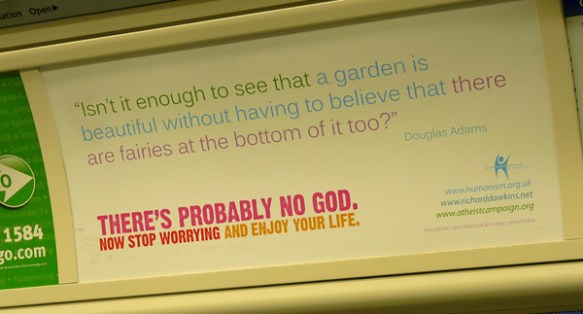
Ron Heather, a bus driver from Southampton turned up for work last week, and found himself faced with a vehicle emblazoned with advertising paid for by an Atheistic campaign, with the slogan- ‘There is probably no God, now stop worrying and enjoy your life.’ Ron, as a Christian, found this objectionable, and so told his employers that he could not drive the bus. Ron seems to be a good bloke from the little we can see of him, and his dilemma heart felt and honest. Check out the story here.
But the story of the campaign is a fascinating one for many of us. It seems to shine a light on the place of faith and belief in our time and context, and perhaps it may yet enable healthy debate and discussion.
So- what is it all about?
Step forward the first protagonists- atheist campaign.org (It is well worth checking out their website.)
The campaign, interestingly enough, seems to have started as a REACTION to bus campaigns about judgment and sinners burning in lakes of fire run by Christians! Here is some footage from the launch;
Toynbee and Dawkins- the heavy hitters behind this campaign- are interesting figures. One a broadsheet columnist, and intellectual- the other a scientist who has a brilliant but flawed reputation. Neither of them are people who could be thought to have their finger on the pulse of post modern Britain. In fact, Dawkins in particular seems to me to be regarded as a severe and arrogant figure, whose rationalistic determinism is particularly modern.
Then we have the counter reaction from Christian Voice. Here is a quote from their director Stephen Green
‘According to one national newspaper, ‘some atheist supporters of the campaign were disappointed that the wording of the adverts did not declare categorically that God does not exist, although there were fears that this could break advertising guidelines.’
‘Well, I believe the ad breaks the Advertising Code anyway, unless the advertisers hold evidence that God probably does not exist.
‘The ASA does not just cover goods and services, it covers all advertising. The advertisers cannot hide behind the ASA’s ‘matters of opinion’ exclusion, because no person or body is named as the author of the statement. It is given as a statement of fact and that means it must be capable of substantiation if it is not to break the rules.
‘There is plenty of evidence for God, from peoples’ personal experience, to the complexity, interdependence, beauty and design of the natural world. But there is scant evidence on the other side, so I think the advertisers are really going to struggle to show their claim is not an exaggeration or inaccurate, as the ASA code puts it.
The Christian evangelist is not concerned by fears that his complaint will lead to atheists complaining about Christian adverts. ‘I am sure many of them have complained about Christian advertising already,’ he said, ‘but a statement such as “The Bible says ‘the wages of sin is death but the gift of God is eternal life through Jesus Christ our Lord'” is entirely factual. The Bible does say that. The statement “Jesus said, ‘I am the way, the truth and the life – no-one comes to the Father but by me,'” to take another example, is a Biblical quote, from the same Bible which is part of our Christian Constitution and upon which witnesses promise to tell the truth in Court. The Bible is, to coin a phrase, our Bible.’
So, the battle is joined over whether you can ‘prove’ God exists, and predictably, for some Christians the proof is to be found in the didactic statements taken from the Bible(the King James version of course)- and so that is enough. For others, this argument is akin to believing in Klingons because we saw them on Star Trek.
Again- it is well worth checking out the Christian voice website. The message given is that Britain is a land that is sliding into a cess pit of sin, promiscuity, perversion and homosexuality. Christian voice casts itself as a lone voice speaking for the truth of God in the middle of a the Godless heathen, who are all heading for the fires of hell, lest they heed the warning.
In reading it I find myself, even as a Christian, alienated and ashamed of what these people have made of the Gospel of Jesus. I find myself disagreeing with both the substance and the tone of the message. It sits at such odds with everything that I understand the Gospel of Jesus to be about.
But what might be the outcome of this little splash of media attention given to we people of faith, and the militant evangelists of atheism?
I have mixed feelings- and feel another list coming on!
As a Christian, I find the atheist slogans upsetting- but think that they have as much right to display them as Christians have to display our evangelical messages.
Some of the Christian slogans make me feel just as uncomfortable!
I wonder whether this is a real opportunity for people to think again about God, and rather than a negative campaign, this might encourage people to ask questions and in fact, draw them closer to God?
This battle seems to belong to an earlier age- a time of Christendom and modernism. It seems to me to engage with a debate about spirituality that most people have no interest in at all. It is as likely to alienate people from Dawkins and his disciples as it is to turn them from God.
Is our role as Christians to ‘defend the faith’ or to ‘defend God’? Is it to set ourselves up as moral arbiters for our society- pointing the finger at the ungodly and the sinful wherever we see it? Or is it rather to let others know our allegiance by the love we show for one another?
A link to a collection of worship resources, including a setting of a prayer thought to be by the Elizabethan adventurer Sir Francis Drake- he of the cloak-in-the-mud and the bowling-whilst-the-Spanish armada is approaching fame. (Or was that Walter Raleigh?)
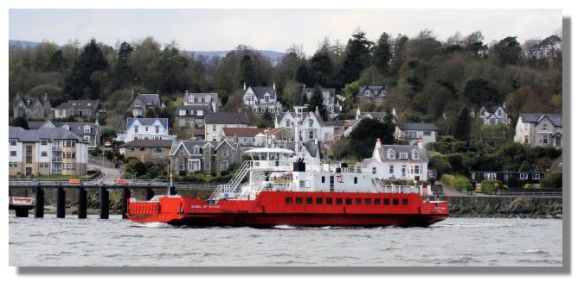
I had a long day in Helensburgh today- meeting some of my staff, and chairing some reviews. I caught the ferry home amongst the usual mix of commuters and weekend holiday makers-grateful to be heading home.
It has been a tough week- more because of my old internal demons that from time to time drag me back to places that I hoped to leave behind.
Waiting for me was an e-mail someone had sent to the Aoradh website.
Most such e-mails are friendly inquiries or greetings, and this one started in this vein- a woman who is retiring to Dunoon with her husband from abroad, and had been checking out the church situation over here on the internet, and so found her way to our site.
And one article had upset her sufficiently that she felt the need to e-mail to let us know.
This was not for the usual reasons that have brought us to conflict previously- doctrine, Biblical interpretation etc. It was rather because she found something that I had written judgmental and unkind.
Ouch.
It is always harder, I think, when things that you think yourself to be strong in, are found wanting by others. By this I mean that I consider myself to be a pretty tolerant, kind person, who goes to great lengths to be fair and just to others when I can- although I have my petty moments as my friends will tell you! The whole ethos of Aoradh had always been to stand for unity and love, against that brick wall kind of Christianity that finds others wanting.
But here it was- clear evidence that someone else saw me, or at least something I had written, in an entirely different light.
What this lady objected to was this article– and in particular, these words;
There is a new kind of prosperity however, fuelled by the idolatry of the house worshippers. We have a new middle class, who disgorge from the Western Ferry terminal every weekday evening, home to their semi-rural idyll after a hard day in the big city. At the edges of the town, new identikit houses spring up overnight, expensive designer accessories, fitted kitchens and all.
I replied to her e-mail, apologising and trying to explain that this was a piece of creative writing where I was trying to come to terms with being an incomer in this town, and to understand what formed it’s character. I was groping to understand the town’s economy- and the centrality of property. I was wondering in my own mind if the obsession with owning and renovating property (as seen constantly on the TV as well as locally) had become the way that we measured life.
I was wondering if property had become the god of our age.
Now shown to have feet of clay as prices tumble and the credit gravy train derails.
What this ladies motivations for expressing her disapproval, I have no way of knowing. Perhaps the words I wrote were badly chosen- and I certainly have no wish to offend. Perhaps she tends towards the argumentative and dogmatic- a character trait not unheard of within our churches. Perhaps she has a romantic view of the ferry journey over to Dunoon, and my words spoilt a precious image for her.
Was I being unkind and judgmental?
I am not sure. But I still think that these questions are important ones- to ask ourselves.
Because I have a great big rambling house by the sea. I try to use it for others, and fill it with music and friends and fellowship. But I know that it is a source of ego strength- in all its faded glory.
So I bring it again to God, asking him again to use it, and me. I can do nothing else.
As for the complaint- soon the lady concerned will begin her own transplanting into new soil. May she find the kind nutrients and generous watering she requires…
I came across this today, posted by a facebooking friend. It took me back- to the days when i was a student, and the world was a heady mix of possibility and dysfunction…
I had forgotten what a great song it is.
And how the words mean something to my current situation that has been transformed by time.
In a recent post on his Missional Tribe blog ‘beyond missional’ Frank Viola asked some questions about the effect of the current financial global crisis on Churches, and indeed the Kingdom of God. You can read his post here.
It has been a regular theme of my pondering, and of course, my blogging! See here and here.
It seems that many Church groups and organisations, built as they are on a financial platform that depends on a stable prosperous Western capitalist economy, are beginning to feel the pinch. Church, in this form, is embedded within the dominant economic realities of the day. In it’s organisation at least, it is no different from any other business or institution- it has mortgages, profit and loss, staffing costs and maintenance costs.
Some suggest that the Western world is undergoing a massive shift. Capitalism is reforming, in the face of a crisis as big as it has ever faced before. Some are even asking again whether a system based entirely on expanding the ways in which people can be made to want MORE is sustainable. Particularly as the system also depends on huge inequalities between the consuming countries (in the West) and sweatshops and mines of the South,
Crisis has this way of holding up a mirror through which we can see ourselves from a different perspective. Some Christians are starting to ask again whether this really is the only way to live- and how this reflects our calling as agents of the Kingdom of God.
Perhaps this challenge also falls on our institutions. Has the way that we have done church easily become based on a consumer choice?
Church, becomes a shiny supermarket, at which we buy spirituality- packaged to be portable within our context.
In my country (Scotland) this is less and less relevant, as people simply no longer visit our spiritual supermarkets. For some this is because they have lost their market appeal. I wonder if this is also time for people of faith to stop stacking product, and hoping customers will come to buy. It is time to remember that the church that Jesus loves is built of flesh, and has no steeple…
And to remember again the words of Jesus from Matthew chapter 5, where he calls us to a radically different way of living…
Lest I descend any further into polemic, I am forced to confess my own dependence on this context- my mortgage, my car, my gadgets. And buildings- they have their uses, particularly in our climate!
But I no longer feel the need to put my resources (money time and energy) to sustaining an earthly institution.
Frank Viola quotes Beuchner;
“I also believe that what goes on in them [support groups] is far closer to what Christ meant his Church to be, and what it originally was, than much of what goes on in most churches I know. These groups have no
buildings or official leadership or money. They have no rummage sales, no altar guilds, no every-member canvases. They have no preachers, no choirs, no liturgy, no real estate. They have no creeds. They have no program. They make you wonder if the best thing that could happen to many a church might not be to have its building burned down and to lose all its money. Then all the people would have left is God and each other.”
~ Frederick Buechner, Quoted on pg. 277 of Reimagining Church.
I have found myself part of such as small group as described above, called aoradh. We meet in houses, or village halls, or pubs. We have no paid staff, and things can be pretty chaotic, as we do not have any leaders either. We look for partnerships and create spaces where we can, seeking to be a community who are faced outwards.
This way of being is strangely credit-crunch proof I find!
Another great collection on Radio 4’s start the week programme. Listen again to it here.
There was this fascinating discussion about KINDNESS, relating to this new book, co written by a psycho analyst Adam Philips and Historian Barbara Taylor.
They appear to take the view that our society has retreated from kindness as a way of interacting and engaging with the people around us. We assume that we are no longer inter-dependent and needful of others, and so kindness becomes identified with a kind of weakness and vulnerability.
They go as far as to suggest that we tend naturally towards kindness, but learn to suppress this as we grow into our culture. All Kindness, suggests Philips, is a RISK- but a risk that is transformative in the taking.
There is a review of this book in Guardian by Mary Warnock where she says this
Kindness to others arises out of sympathy. As the authors note, there is much evidence that other animals besides human beings (or “men” as they properly designate them) can enter into the sufferings and fears of others of their kind. But it is human animals alone who, because of their imaginative powers, can enter into the feelings of other people far removed from them, whom they cannot see or touch, but whose plight as fellow-humans they can share
In the Gospel of St Luke, a lawyer is told by Jesus that to live well he must love his neighbour as himself and, when he further asks who is to count as his neighbour, Jesus answers with the story of the good Samaritan, for many the very essence of Christianity. Kindness here arose spontaneously, not in obedience to any rule, in fact in defiance of convention. But as Christianity became increasingly ecclesiastical and hierarchical, with the consequent corruption of the priesthood, the good Samaritan was forgotten.
The new Protestantism declared man to be fundamentally sinful, such good actions as he could do dependent on the grace of God; and so the possibility of natural kindness disappeared.
So we come back to Jesus, and his call to live for a radically different agenda, according to the rules of a New Kingdom. And one of the watch-words of this new kingdom- is kindness.
It is one of those fruit listed by Paul as evidence of the indwelling of the Holy Spirit. (See here for some more ponderings on this.)
When we come into contact with kindness at a point of real need, we rarely forget it. It lives on in our souls. As Paul said in 1 Corinthians- all sorts of other loud and visible manifestations of faith will clang like gongs and then fall silent- but love will last for ever.
Which makes me think again about the myth of the super-Christian. I am interested in the stature aquired and the adoration we give to some of our leaders- perhaps for their charisma, their vision or their oratory power. When one of these paragons of Christianity falls from Grace, how dreadful it seems… how shocking.
Might this be because we measure spirituality according to a strange criteria? We equate knowledge with understanding, declaration with practice and power with ordination from on high.
Might we best return to a simple measure- of kindness shown, and a skew towards grace in all things. These are the leaders I look for. Jesus has ruined the others for me!
If you are like me, you will have been indulging in a little self examination- thinking about how life has been, and what possibilities the new year might bring.
Perhaps you have had thoughts of stepping out the old routines, and opening up some new things- finding new places, new connections and deeper spirituality.
Perhaps you are ready for some adventure. Small ones perhaps- not all of us are Bear Grylls!
Anyone fancy some fish by the way?
Assuming that this is not your fancy- how about joining us for trips into the wilderness to find something slightly more palatable?
We are planning some trips out into the wild places hereabout- to find places where we can appreciate the beauty of the mountains and hills about us, and also to use some of these spaces for group and individual meditation. These will mostly be based within Argyll, Scotland- or in the Cowal Area, where we are based.
Nick and I have been working on some wilderness meditations- some of which are on the aoradh website- here. We would very much appreciate some folk who are willing to be our guinea pigs (or should I say, Red Squirrels) as we give them a wider road test.
As part of this, a few of us are planning a trip to a small uninhabited island on the bank holiday that begins Friday the 1st of May. We have not finally decided the venue for this yet- there are a couple of possibles, and it rather depends on transport. Past trips away have included trips to Coll, Little Cumbrae and the Garvellachs.
The format of these trips has been that people are prepared to be self supporting- with their own camping and back packing gear. We will then make our own small community for a weekend, in a beautiful, wild and uninhabited space.
For the weekend trip, there may be some transport costs- but that is all, we are not interested in profit- but rather in friendship with each other and a deeper relationship with God.
So we are clear about the legalities of this- we offer a partnership- not a package tour. You come at your own risk!
For those who need to be more organised- we have set some dates for later in the year when we hope to organise one day events- which will include a mediation around a ‘found’ space in the wilderness- caves, rivers, mountains etc.
I posted earlier some thoughts about the situation in Gaza, and the response of Christians to Israeli aggression (See here.)
I made a parallel post within the blog network missional tribe– and mentioned a friend of ours who has just returned from Bethlehem where she was working for the Church of Scotland. Jen is not well at the moment- so here’s a prayer for her quick recovery.
Wouldn’t you know it, I had a comment from Chris Hoskins, who had met Jen on a recent trip to Bethlehem!
Chris mentioned a story of hope from Bethlehem, which I thought worth a mention. The news is still full of such pain and violence, that the hope of peace is something that seems to me to be worth nurturing wherever it is seen.
The other think that I struggle with is with my own powerlessness. The internet gives me some kind of voice, but is a passive medium for the most part. Perhaps there may be a way to lend support to something real and tangible…









 this fragile tent