It has been said (much to Audrey’s disgust!) that to be a member of Aoradh you need to keep chickens…
Not sure what that says about us all- but 4 of us now have them, or are planning to.
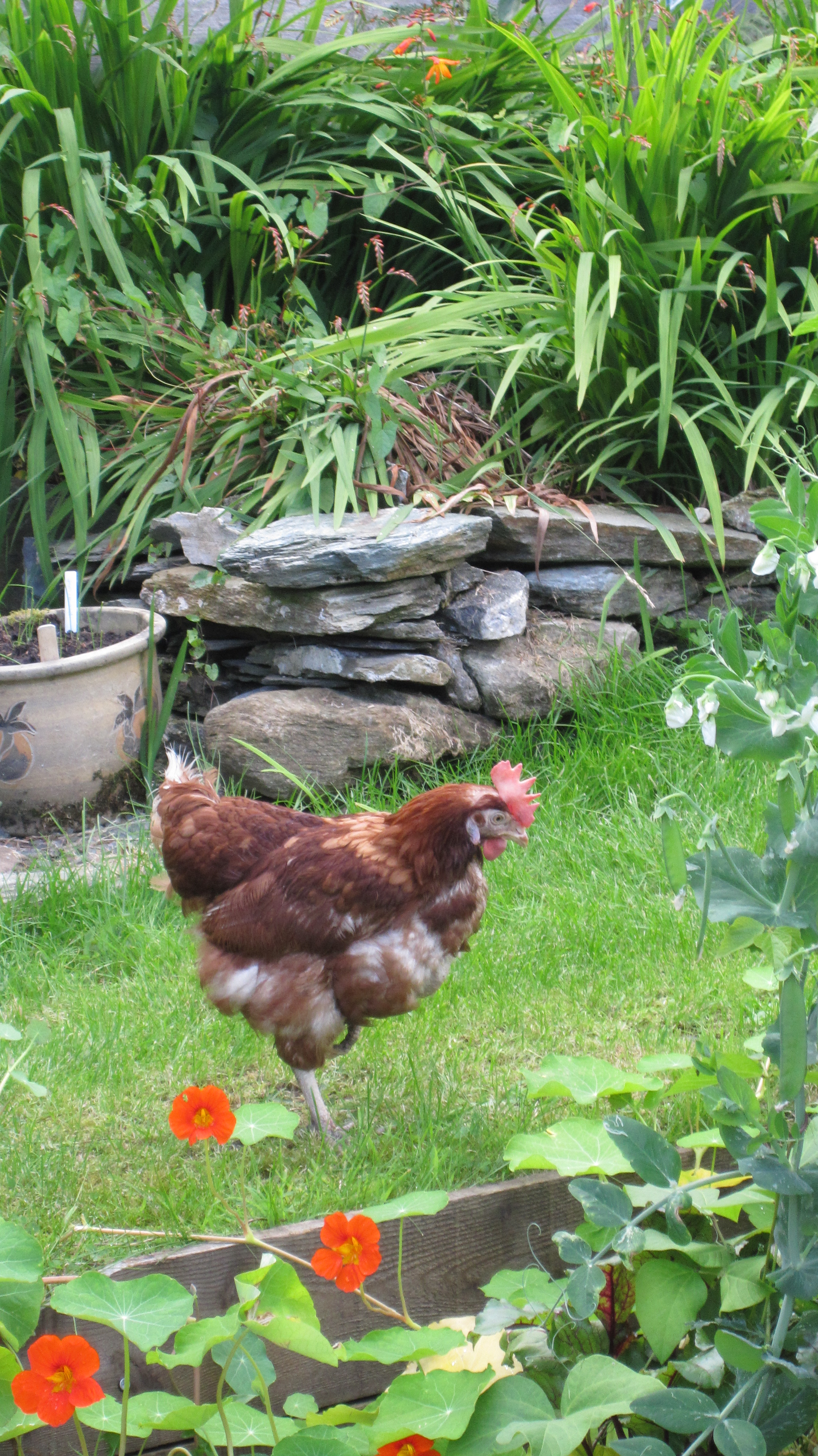
Our birds have settled in now, after just a couple of weeks. They started out timid and traumatised, scared of their own shadows. Then over the next few days, they explored further and further out of their coop into the garden- going a few meters extra each day.
The kids have been so involved with them- running out each morning to check for eggs, picking them up to help them get used to being handled, and reporting on their activities hour by hour.
We are getting two eggs a day at the moment- we think that one of the chickens has not started laying. The eggs really are delicious- big, with dark yellow yolks.
And despite my rather unsentimental attitude towards animals, they are very endearing creatures. They do such odd things- Today one of them had a fight with a bumble bee, and yesterday, one had a peck at a friends bum as she liked to look of a zip on her trousers.
Some tips so far in case you are considering joining in the chicken owning craze-
Preparation- get your garden chicken proof first- decide which areas you are happy for them to roam, and fence off as appropriate.
So far ours have not done too much damage- although we lost a salad crop, and we have a regular chicken poo collection- if you are happy to take the risk, then focus on your boundaries.
Putting them away in the coop at night is no trouble at all- they like going to bed at dusk, but try it in the middle of the day when they are mid peck, and it is a different ball game!
A decent coop is worth the £60 that you spend on it- being so much easier to keep clean.
Chickens (even battery ones) love to explore, and peck at interesting things- give them plenty to do.
They are great fun- the very best kind of pets- ones that put food on your table!
Just came across this clip of a very 1980’s Bruce Cockburn singing a song from the 1989 album ‘Big Circumstance’-it takes my straight back to being a student, full of protest and political conciousness…
Following on from my somewhat negative previous post, I have just been reading a couple of reports from this conference.
The discussion focused on the future of Christianity in the USA- and this is clearly potentially very misleading. The global growth of Christianity is a very different discussion. However, the influence of American Evangelical Christianity on the UK religious scene is huge- all the TV channels, the publishing juggernaut and the big name preachers. We watch changes there with interest, knowing that the impact of these changes will be felt this side of the Atlantic.
Brian McLaren believes that over the next period, the Conservative Evangelical denominations (protestant and Catholic) in the USA will “constrict, tighten up, batten the hatches, raise the boundary fences, demand greater doctrinal, political, and behavioral conformity, and monitor boundaries with increased vigilance.”
He believes that this will drive out many, whilst increasing the anxiety and ‘bunker mentality’ of those left inside the denominations. At the same time, he sees a new coalition forming-
That new coalition, I believe, will emerge from four main sources:
Progressive Evangelicals who are squeezed out of constricting evangelical settings.
Progressive Roman Catholics (and Eastern Orthodox) who are squeezed out of their constricting settings.
Missional mainliners who are rediscovering their Christian faith more as a missional spiritual movement, and less as a revered and favored religious institution.
Social justice-oriented Pentecostals and Evangelicals — from the minority churches in the West and from the majority churches of the global South, especially the second- and third-generation leaders who have the benefits of higher education.
Scott McKnight points out that Conservative Evangelical Mega churches in the USA (and I believe,the UK equivalents) are in fact growing. He does not believe that ‘Evangelicalism’ is made up of one stream- believing that some incarnations will be around for a long long time to come.
However, what he sees as now having ended is the old ‘Evangelical coalition’-
The evangelicalism that formed in the 1940s and 1950s, more accurately called “neo-evangelicalism,” was a reaction to strident forms of fundamentalism, a call to serious intellectual engagement so that evangelicalism could gain both theological and academic credibility again, and a formation of a big tent coalition to work together for evangelism and theological development. By and large, this big tent coalition combined the Calvinist and Wesleyan segments of evangelicalism, found places for Christian colleges, parachurch ministries, missionary societies, and a plethora of magazines and radio stations, and gave a privileged place to evangelical leaders like Billy Graham and Carl Henry.
But perhaps the most powerful piece was by Philip Clayton who had this to say-
A major national survey recently published in USA Today shows that 72 percent of “Millennials” — Americans between the ages of 18 and 29 — now consider themselves “spiritual but not religious.” Even among those who self-identify as practicing Christians, all of the traditional forms of Christian practice have sharply declined from previous years: church attendance, Bible study, prayer. Doubts are higher, and affiliation with the institutional church is sharply lower. All of us who are still connected with local congregations already know this pattern, up close and personal. Still, it’s sobering to see the trends writ large; after all, we’re talking about almost three-quarters of younger Americans!
The decline of traditional churches and denominations will presumably continue, so that by 2020 the effects will be as devastating in the U.S. as they already are in Europe. (On a typical Sunday, for example, 0.5 percent of Germans attend church.) Numerically, two-thirds or more of mainline churches will close their doors or struggle on without a full-time pastor. Denominations will merge in order to be able to maintain even minimal national staffs and programs. A larger and larger proportion of those who still go to church will attend large “mega” churches, those with 2,000 or more attendees on an average Sunday.
Clayton issued what he called a ‘call to church’-
We churchpeople were the center of American society since this nation was founded. We enjoyed power and prestige; we were the center of the action; we counted presidents, educators, and industry leaders among our numbers. But those days, it appears, are over. We still have a crucial role to play in the world. But it’s no longer a world that revolves around us.
This new role actually makes it easier for us to model ourselves and our communities on the Head of the church, who “has no stately form or majesty that we should look upon him” (Isaiah 53:2). As Dwight Friesen puts it in Thy Kingdom Connected, the church can no longer be a “bounded set,” defining itself by the people and ideas it’s opposed to. We now have to be a “centered set,” pointing toward — and living like — the One whose life and ministry we model ourselves on. If we can’t communicate our Center with power and conviction, no one’s going to listen. Oh, and by the way: we have to find ways to do this that don’t sound or look anything like the church has looked over the last 50 years or so.
Finally, Clayton talks about an age of experimentation in church-
What does “church” look like when you take it out of the box, replant it, and let it grow organically? It’s going to stretch and challenge you; it’s going to take openness to forms and practices you’ve never seen before:
churches that meet in pubs, office buildings, school classrooms, or homes . . . or virtual churches, like those at SecondLife.com;
churches that have no leader, or have leaders who don’t look like any pastor you’ve ever known (OMG, what if they have piercings?);
pastors who are hosts to discussions, who can listen long and deep to doubts and questions before presenting the answers on which they center their lives;
churches that don’t have buildings, denominations, pastors, or sermons; that don’t meet on Sundays; that consist mainly of people who don’t call themselves “Christians”;
churches whose participants are drawn from many different religious groups; churches full of “seekers”; churches that consist mostly of silence (like the Quakers) or of heated discussions between participants.
Not only conservatives will wonder and worry where one should draw the line. And that’s the point: we’ve now entered an age where we no longer know how to draw lines, because the old criteria just don’t work anymore — except to exclude the vast majority of the people whom we hope to interest.
All this sounds very familiar from this side of the Atlantic. We are much further down the line that it all.
We have our Evangelical enclaves- who tend to be exclusive, embattled, and increasingly fuelled by an agenda that looks either to African or American Mega churches. Despite their vigour and apparent success, they are largely irrelevant to the larger cultural situation- and their engagement with mission is simply to attempt to create more ‘converts’ to their own kind of belief system. These churches feel to me to be about marketing and mass consumerism.
And then we have the huge majority of spiritually interested consumers, who may have been inoculated against Christianity, but not against Jesus.
And then we have a growing number of experimental pioneers, whose methods are increasingly being adopted by the mainstream traditional churches- through things like Fresh Expressions-
We live, my friends, in interesting times, where change is normal, and the future uncertain. But I have no doubt that church will continue, and that the mission of Jesus will be carried forward into new generations. Some will resist any change fiercely, others will embrace it.
We had a lovely evening tonight with friends, discussing life, childhood, faith and children.
Drinking wine and listening to good music.
One of our friends described her son as ‘not clubbable’- meaning that he was not comfortable joining in-groups. Such groups are scary, exclusive, and make too many demands that he does not necessarily want to be committed to on a week by week basis.
Does this remind you of anything?
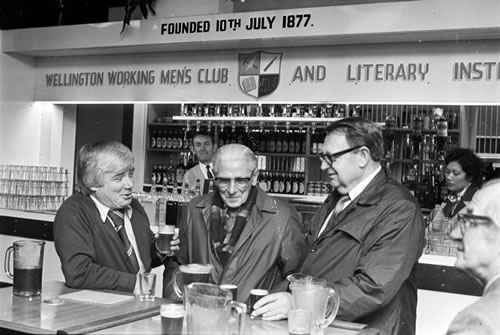
The decline in membership of unions, bowling clubs, debating societies, womens institutes, working men’s clubs etc etc.
And churches.
Perhaps we are increasingly not churchable.
Or perhaps churches can no longer behave like clubs…
Aoradh are going to be doing a few worship things again- participating in a day long worship event along with Sanctus 1 and Safespace. I just checked the GB website and see we are not mentioned as participants! How rude.
As part of the worship, we are providing a great big loom, into which people will be encouraged to weave in the names of their community- here is the loom frame in front of our house-
We are also doing a couple of liturgies- one around communion, with a really lovely piece that Audrey wrote, and another based on the Community of God- the Trinity, with our bit focussing on the Father.
If you are at Greenbelt this year, it would be great to see you- we will be in the New Forms cafe for most of the day on Saturday…
I pulled out an old piece of writing I did thinking about fatherhood, and have been doing some work on it. Here are a couple of sections I am playing with-
There has been a fair bit of soul searching/life-style-evaluating on the old tent. Perhaps it is just evidence of an unfolding mid life crisis- blogging style.
How middle class!
I grew up in a single parent family, to a working class mother. We had very little money.
I do not want to pretend that we had nothing- there was always food and presents at Christmas- but the shadow of poverty was always on us. Second hand clothes, and even home made clothes singled us out for terrible bullying at school, and every single activity was overshadowed by worry about COST.
My mother was very good at squeezing some kind of security out of the state benefits that supported us, but her constant anxiety about the cost of repairs to the house,or replacing a lost coat led to terrible rows.
So it was that from an early age, it was drummed into me that the only life worth aiming for- the only one that was acceptable- was one based on middle class values.
Education
University
Sobriety
Responsibility
Professional employment
Property ownership
Security
Adrift as I was as a young man, this was the island that I swam towards. A suburban world of respectability, gainful employment and financial comfort. Or at least, being in a position where money was not something that ever needed to be worried about.
But I never really reached this point. This is the great middle class trap- when is enough? When do we achieve safety? How many stocks and shares, how big a pension pot, how recently should the house have been re-painted?
Alongside these motivations have always been dissonant and equally powerful ones- arising from my faith (not needing two shirts on my back, camels not fitting through eyes of needles etc) and my left leaning politics (property is theft, international trade and inequality etc.) Life then is lived in the presence of internal conflict and discomfort.
But having started down this path- how do you change direction?
My conviction is that most of us simply can not. Life is simply too full of obligations and compromises. And there can still be blessing, beauty, and grace in this middle class life. There are still people who open up their suburban lives and homes to the other and from this part of our demographic come the committee members, the community activists, the fund raisers and the protestors against many an injustice.
Some of us are forced to change direction by crisis. Redundancy, mental/physical ill health or some other extraordinary life event that disturbs our innate conservastism.
Outside of this, change takes such courage. Like standing at the edge of a cliff and daring yourself to jump in the direction of a crumbling ledge in the middle distance.
The sort of courage demands a great confidence. Confidence of purpose, and clarity of vision. A willingness to embrace risk and uncertainty.
And for me, confidence was always absent. It was lost somewhere aged 8, and I never really found it again. Confidence belonged to those other middle class kids, who were able to embrace risk and uncertainty whilst beginning from a firm platform.
But standing here I now am.
Daring myself to jump. Or waiting for a push.
Here is a poem from a few years ago;
Michaela loves that time when evening turns to dusk
When streetlights shine with purpose
But people have not yet drawn their curtains
.
There laid naked by approaching night
The secrets of some other sitting room
Are shelved
Are stored in boxes from Ikea
In two dimensions
Animated by the ubiquitous TV sets
Flickering from the corners
.
Arm in arm we share clandestine glances
Whispering our words of approval or approbation
And walk on into our own lives
.
There was a time when we watched in aspiration
Building middle class castles in our minds
Safe within suburbia
Dreaming of a day when we too would know the security
I heard someone discussing health care today- the usual discussion about self inflicted health problems, such as those associated with smoking or obesity.
Discussions like this usually make me feel uncomfortable- many of us think that we ought to be healthier- take more exercise, loose some weight. It has been a guilt on me for most of my life.
But that is not the point of this post.
Because the counter argument that was made really made me think. It went something like this-
What is this obsession with making life longer– as if this were the main reason for life itself? Why should every thing that we do be governed by the fear of death?
Why do we measure life quantity so rigourously- in terms of years, months, days and hours (as well as the cost of maintenance through health care?)
Whilst at the same time we have lost sight of any reliable qualitative measure of life- despite all the lifestyle choices that we are bombarded with- the holidays, the houses, the constructed leisure experiences, the pressure to consume ever more produce that fills life with all things shiny and new…
What makes for a ‘good’ life?
I suppose for many of my friends, this might include varied experience, travel, relationships, family, economic security, fulfilment. All of these things are good.
But is this it? We live as long as we can, and if we are lucky we might have some laughter, some love and consume a fair bit?
No. Something in me rebels against the hollowness- the shallowness– of this kind of life.
As was the writer of Ecclesiastes-
13 I devoted myself to study and to explore by wisdom all that is done under heaven. What a heavy burden God has laid on men! 14 I have seen all the things that are done under the sun; all of them are meaningless, a chasing after the wind.15 What is twisted cannot be straightened; what is lacking cannot be counted.
(Chapter 1)
But there is more.
There is life that is not lived as an avoidance of the inevitable, with added entertainment.
It is a way of life that seeks human connection, human service, and the life of the Spirit of God within us. The way of Jesus.
This kind of life is not easy and clean or overly concerned with safety or security. It is more likely to be messy, unpredictable and even downright dangerous.
But this is the kind of life I long for. Because the alternative seems like no life at all.
Michaela’s step father Robert died recently- the shadow of death fell across us, and we still live with the grief and loss. But life is such a precious, wondrous, joyous thing. Let us not waste it in the pursuit of quantity.
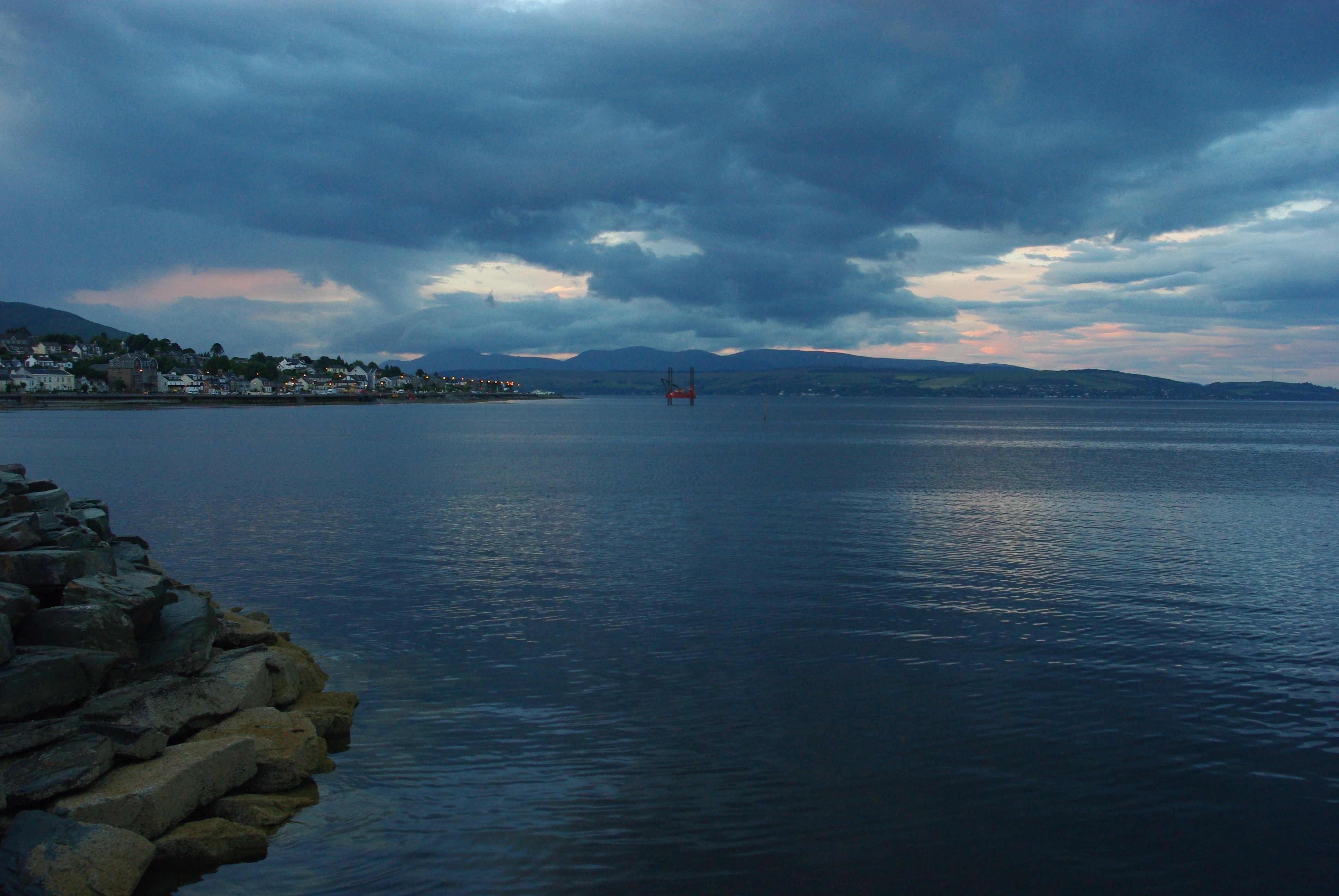
I was admiring the dramatic sky over the Clyde this evening (about 9PM) so I took my camera down to Dunoon pier to take some photos-
There is a bit of a rig doing something to the water works- but it looks a bit like an oilfield has been found just off Dunoon!
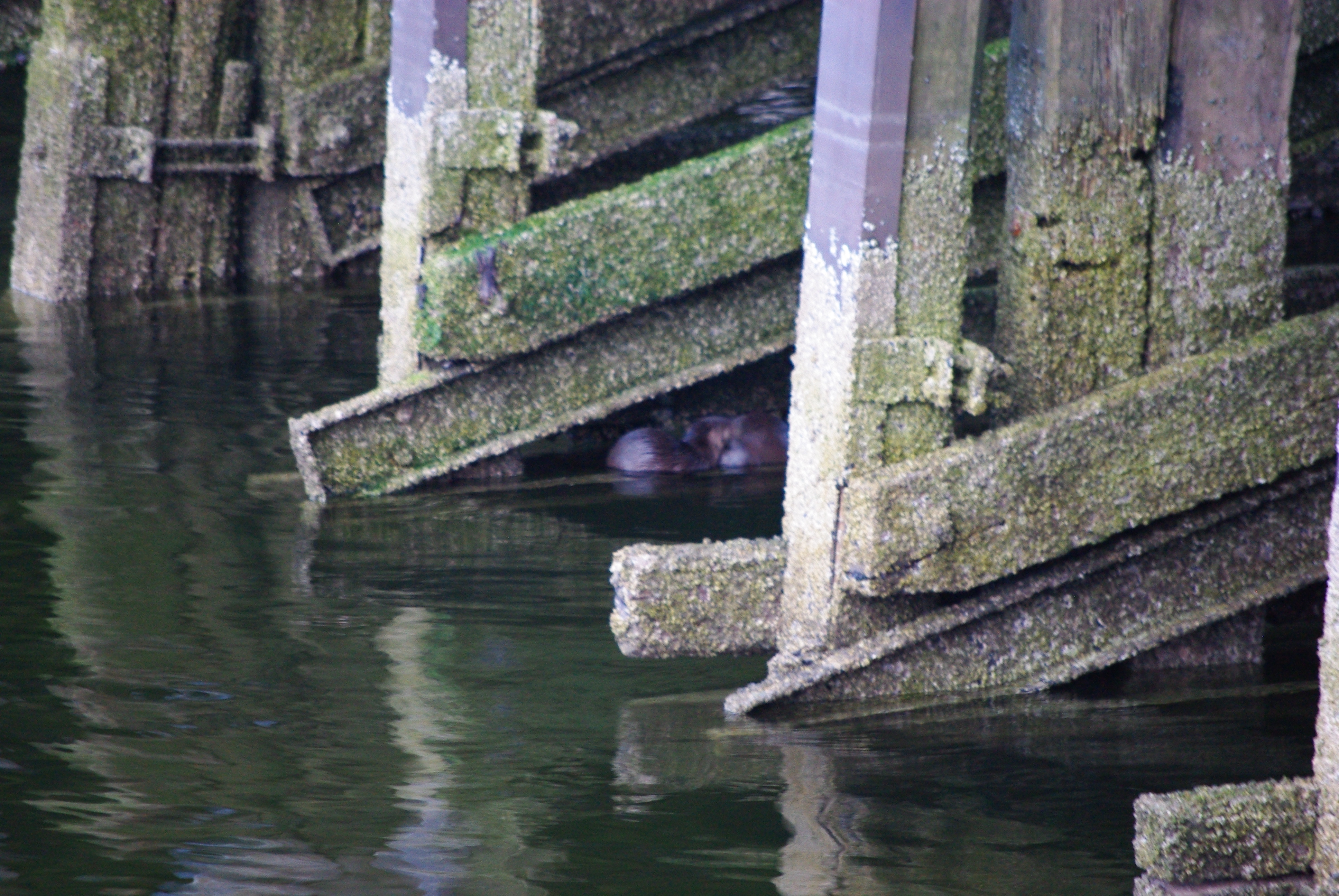
I decided to change to the longer lens, and while I was fiddling (of course it would be whilst the camera had NO LENS!) swimming in front of me, less than 10 metres away, were two otters.
Yes- OTTERS!
I could not believe my eyes.
I attached the lens as fast as I could, but this was my first effort, as they rolled over one another playfully-
Oops. Well it was very dark, and I was very excited.
I have never seen an otter in the wild before- and here they were, in Dunoon? Right in the centre, under the pier? On holiday perhaps?
I wondered whether I could be seeing something else- a couple of cats learning to swim? Mink? But actually, two otters at play that close are not easily mistaken for anything else.
They saw me watching them, and swam to the old pier, where they paused and watched me. So here are the photo’s-
I believe that otter have been spotted in all sorts of urban areas along the Clyde, even in Glasgow. But I have not heard of them being seen in Dunoon.
A couple of young otters on their way out along the Clyde perhaps? Doon the watter for a holiday?








 this fragile tent