Tested to distraction, Myers Briggs and the like…

myers-briggs-personality-test

So here is how it goes for most of us.

The company/organisation/bureaucracy that you work for is in trouble. There have been rumours of cuts and financial black holes for months. Anxiety gathers like dust on every workstation. Eventually the inevitable happens- it is announced that there will be a ‘restructuring’ of the workforce.

Because our managers are human too (and soon to be subject to their own version of the same) it is possible that a firm of consultants will be brought in- people with relevant expertise in helping other organisations through the ‘essential modernisation process.’ Their skill set is to bring anonymous quasi-scientific ruthlessness to bear in such a way that changes appear inevitable, inexorable.

They will no doubt set up meetings with individual members of staff, who will be subjected to ‘evaluations’ and ‘reviews of job role’. This process will almost always miss the crucial ingredients for the productivity or otherwise of your team- it will not be able to deal with the bullies or the psychopaths, who will probably find the process entertaining, motivating invigorating.

To add to the feeling of objectivity, the consultants will also employ various forms of psychometric testing to measure our supposed fitness for the job roles we are undertaking.

The most common of all being the Myers-Briggs Type Indicator (MBTI.)

Within a few short months, a handful of people will have succumbed to stress related illnesses or high blood pressure. Strangely, unless they decide to jump ship, their employment will probably be safe- although they are very unlikely to rise any further in their organisation. Rather they will be given a backwater to swim quietly in until the next reorganisation.

A few others will be made redundant. Some of them will have made a positive choice in this direction- it is better to have your fate in your own hands of course.

Many more will be in lower paid jobs. There will be fewer middle managers, and staff will be increasingly called ‘autonomous professionals’.

It is a dirty job, but someone has to do it.

Sorry about that- I felt the cynicism building up in my fingers like lactic acid as I typed away…

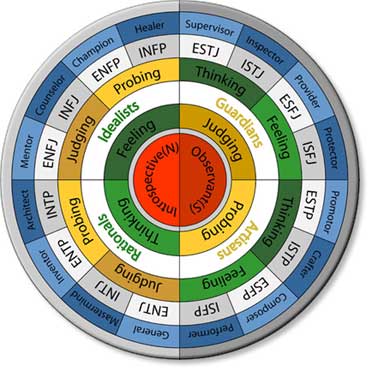
But back to the point of this piece, the Myers Briggs Type Indicator and its many imitators.  It was developed by a couple of ladies during world war two who had become fans of the wild and wonderful work of Carl Jung. Jung had this view of personality as being made up of dichotomies- polar opposites that we all find ourselves fixed upon; our ‘type’. This from Wikipedia;

Jung’s typological model regards psychological type as similar to left or right handedness: individuals are either born with, or develop, certain preferred ways of perceiving and deciding. The MBTI sorts some of these psychological differences into four opposite pairs, or dichotomies, with a resulting 16 possible psychological types. None of these types are better or worse; however, Briggs and Myers theorized that individuals naturally prefer one overall combination of type differences.[1]:9 In the same way that writing with the left hand is hard work for a right-hander, so people tend to find using their opposite psychological preferences more difficult, even if they can become more proficient (and therefore behaviorally flexible) with practice and development.

The 16 types are typically referred to by an abbreviation of four letters—the initial letters of each of their four type preferences (except in the case of intuition, which uses the abbreviation N to distinguish it from Introversion). For instance:

  • ESTJ: extraversion (E), sensing (S), thinking (T), judgment (J)
  • INFP: introversion (I), intuition (N), feeling (F), perception (P)

All of this has a real seductive truism to it- it manages to place us all in a pigeon hole that we are all more or less happy with as it all feels very neutral and more or less supportive of some of our good qualities. Where is the harm in that?

Well, as with all these things, it depends on the use we put things to. If we are going to use something like Myers Briggs as a blunt instrument to knock people into jobs like we would a pit prop, then we need to be pretty sure that it is testing something real, something that makes sense on more levels than our employers organisational convenience right?

Because there is a vase array of criticisms of Myers Briggs. It is simply not used by psychologists- even the ones who are prepared to concede the validity and usefulness of individualised psychometric testing.

This from the Guardian

The trouble is, the more you look into the specifics of the MBTI, the more questionable the way it’s widespread use appears to be. There are numerouscomprehensivecritiques about it online, but the most obvious flaw is that the MBTI seems to rely exclusively on binary choices.

For example, in the category of extrovert v introvert, you’re either one or the other; there is no middle ground. People don’t work this way, no normal person is either 100% extrovert or 100% introvert, just as people’s political views aren’t purely “communist” or “fascist”. Many who use the MBTI claim otherwise, despite the fact that Jung himself disagreed with this and statistical analysis reveals even data produced by the test shows a normal distribution rather thanbimodal, refuting the either/or claims of the MBTI. But still this overly-simplified interpretation of human personality endures, even in the Guardian Science section!

Generally, although not completely unscientific, the MBTI gives a ridiculously limited and simplified view of human personality, which is a very complex and tricky concept to pin down and study. The scientific study of personality is indeed a valid discipline, and there are many personality tests that seemingly hold up to scientific scrutiny (thus far). It just appears that MBTI isn’t one of them.

The lure of a quick fix. An easy simplification. MBTI appears to me to be to psychology what astrology is to astronomy- it uses some shared language but that is about it. It has entered our hospitals, our schools, even our churches….

We are not captured in this narrow set of words about who we are. Sometimes we are both and. Sometimes we revert to ‘type’, often re transcend it. Let us escape the bloody tramlines- whatever ways we do it.

And as I write this, I will be accused of over simplifying MBTI, of dismissing its usefulness. No doubt people will say that those of my type always tend to do these things.

My reply will be that when quasi scientific quackery rises so far as to become a force for narrow stereotypical judgements it becomes a force of empire, and the empire should be resisted.


 

Paulo Coelho on Jesus…

Paulo Coelho

Great article in The Guardian today- an interview with author Paulo Coelho. Here he is, taking about Jesus;

The Jesus of the gospels was, Coelho argues, similarly contradictory. “Jesus lived a life that was full of joy and contradictions and fights, you know?” says Coelho, his brown eyes sparkling. “If they were to paint a picture of Jesus without contradictions, the gospels would be fake, but the contradictions are a sign of authenticity. So Jesus says: ‘Turn the other face,’ and then he can get a whip and go woosh! The same man who says: ‘Respect your father and mother’ says: ‘Who is my mother?’ So this is what I love – he is a man for all seasons.”

Like Jesus, he’s not expressing a coherent doctrine that can be applied to life like a blueprint? “You can’t have a blueprint for life. This is the problem if you’re religious today. I am Catholic myself, I go to the mass. But I see you can have faith and be a coward. Sometimes people renounce living in the name of a faith which is a killer faith. I like this expression – killer faith.”

Coelho proposes a faith based on joy. “The more in harmony with yourself you are, the more joyful you are, and the more faithful you are. Faith is not to disconnect you from reality, it connects you to reality.”

In this view, he thinks he has Jesus on his side. “They [those who model their sacrifice on Christ’s] remember three days in the life of Jesus when he was crucified. They forget that Jesus was politically incorrect from beginning to end. He was a bon vivant – travelling, drinking, socialising all his life. His first miracle was not to heal a poor blind person. It was changing water into wine and not wine into water.”

Worship thingy…

IMGP4218`

We are starting a new worship thing next Sunday night- a simple, quiet,  mainly music led thing. We have not given it a name as this would imply greater pretension than we have been able to gather.

Regular readers of this blog will know of my ramblings around the use of music in worship- I am a reformed ‘worship leader’ in the auditorium stylee- and thought never to return. However, I still love to play and sing and the question that I have found myself asking continually concerns what role if any singing songs of worship may play in our on going journey away from CCM monoculture.

Following thoughts gathered during a recent silent retreat I decided to set aside angst and just sing.

Andrew, a friend and local Episcopal vicar/priest/canon/ pope (pick suitable title!) had already asked if we could do something like this- something primarily about private worship, made collective in the small sense, and so we decided to go for it.

If this is of interest to anyone local, you are more than welcome to join us- 7.30, Holy Trinity Church, Dunoon.

Half and hour to an hour of music, quietness and contemplation.

If it feels like it has the wind of the Spirit, we might even give it a name…

Generation self?

Emily poi 1

I read a really depressing piece in the Guardian not long ago. Here is an extract;

Has Britain raised a new “heartless” generation of children of Thatcher – and, arguably, of Tony Blair? Does this mark the slow death of solidarity? Or has the received wisdom on the imagined journey through life, from hot-headed radical to self-satisfied reactionary, never been all that true?

Guardian/ICM poll is only the latest piece of evidence suggesting that the left’s defining value of solidarity is in considerably shorter supply among the young than the old. A rising generation that finds college expensive, work hard to come by and buying a home an impossible dream is responding to its plight, not by imagining any collective fightback, but by plotting individual escape.

The desolate atomisation of what we might dub “generation self” – today’s twentysomethings – poses a profound challenge for the left over the distant horizon. But it is not a challenge that shows up yet in the headline figures for voting intention, where pensioners remain considerably more conservative and everyone else’s propensity to put a cross in the Tory box remains much of a muchness. Rather, the staunch individualism of the young emerges when they are probed about deeper attitudes. This even manifests in areas like thewelfare state, despite young people being far more likely than their older compatriots to be unemployed.

A full 48% of 18- 24-year-olds, and 46% of 25- 34-year-olds disagreed with a statement suggesting that most unemployed people receiving benefits were “for the most part unlucky rather than lazy” – almost twice as many as in the over-65s group, where only 25% disagreed with the statement.

That gulf on welfare between the age gaps is a strong one: even despite the relatively small samples of each age group, the gap was easily big enough to be statistically significant.

Attitudes on a few other issues also showed a split, albeit not quite so stark: 24% of 18- 24-year-olds disagreed that it’s important to get to know your neighbours, versus just 11% of over-65s. Younger people were also more likely to disagree that they were proud to be British, although an overwhelming majority at all age groups express patriotism.

All this taps into a very familiar story- of how we are letting loose a generation who are disconnected, self absorbed, individualised to the point of atomisation and view everything as commodities to be consumed.

Except…

I have a daughter who is 17, and pretty much plugged into the mainstream- so much so that she calls me an aging hipster for my refusal to conform.

Now perhaps the child of a social worker and a community worker was always going to be gifted with an out sized social conscience but Emily is passionate about social justice, she loves nothing better than to celebrate a friends birthday or to arrange a gathering.

I think each generation has a crisis of confidence in the next one. Perhaps this is ours.

That is not to say that each generation does not need to find it’s own soul. Usually it seems to be found in adversity or mobilised by the eruption of a totemic issue. Mine was cast by the destruction of industry and the miners strike- and we had a name for our pain- Margaret Thatcher.  What is there today?

Well, there are people like Emily.

I might call them (but she would not necessarily use the same language) ‘Agents of the Kingdom of God’. A residue of grace in the middle of us.

And then they slept…

Today we planned a picnic to celebrate mothers day, but the blue skies turned black where the wind was from…

squall on the clyde


Soon the snow flurries hid the world from view behind a boiling curtain of giant flakes;

IMGP4197


Some would see this as a challenge to test our mettle. Not my family.

They slept;

IMGP4215


Ecomonomic lie number 3- austerity affects us all…

Austerity

Back to my little mini series about economics. Don’t expect deep learned insights- I did study economics as part of a social science degree 25 years ago, but I was a very poor student. However, there are many approaches to economics- here are a few;

Technical/systematic- clever people who claim to understand the ebb and flow of the complex currents that move in the deep oceans of international finance. They know the difference between M1, M2, and M3. They advise the powerful and hold the fate of millions within their sterile computer generated models. Here, the economy is a desperately complex, ever changing thing, that is not just human in origin, it is supra-human. We are all subject to it, in the same way as the Ancient Greeks lived in the shadow of Mount Olympus. The gods are capricious, mysterious, vengeful and unmoved by ephemera. Our high priest-economists are expected to placate the gods, but they are after all gods and so there is the constant threat of earthquake wind or brimstone…

Political- I contend that most politicians know very little about point 1. They have to pretend they do, like the emperor and his new clothes. They have to pretend to be in control of the gods. They have to present deep ocean complexity in the form of simplistic decisions. All the better if the issue can be polarised, and if their are people/groups to be blamed. So we see two narrative techniques being employed at present-

  1.  The economy is constantly compared to a household spending plan. It has to be about prudence, good management, respectability- the image is a solid middle class family who budget carefully for their two holidays, their new sofa and retirement plan. Except that the economy bears no resemblance to a middle class household budget. Houses can not print their own money for a start. They can not set their own tax rates, they can not invest huge sums in education or health or in nuclear arsenals. And of course not all households are the same. Some are broken, bankrupt.
  2. The other narrative I have already hinted at- it is the narrative of blame. Our lifestyles are under threat from the fecklessness of the poor or the tidal wave of immigrants- the strivers are carrying all these skivers on their backs. We no longer talk about social class because stratification in our society has fragmented- but in case you are in any doubt, check out any mumber of tabloid newspapers- the Express, the Mail, the Sun. They are full of stories of benefits dodgers, single mothers getting posh social housing, dark skinned swarthy outsiders who are clogging up our hospital wards. For a while, the bankers got some mud thrown at them- but mud does not stick to shiny power for long.

The economics of justice- There is another approach to economics of course- one which both politicians and technical economists are aware of, some even motivated by- it is the analysis of the flow of capital from the poor to the rich, and the operation of the machine that makes this happen. It points us to the conquest of poor countries, whose raw materials are used to make the toys of the rich. It also points us to the remarkably persistent and stable gulf between the rich, healthy, educated minority and the rest- both globally and locally.  I make no excuse for this statement; these are the economics of the Kingdom of God.

Two stories sum up this gulf within the UK at the moment. Firstly, this one;

Lamborghini Veneno

The eurozone may still be in recession, but there is little gloom at the Geneva motor show, where Lamborghini, Ferrari, McLaren and Rolls-Royce have launched luxury supercars costing up to £3m each.

While European car sales dropped by 3.3m last year – the equivalent of a car company the size of Fiat failing to sell any cars at all – super-luxury cars are rolling out of the showrooms in ever increasing numbers.

“Most the world is suffering from recession, yet there are clearly people who can buy a Lamborghini at €3m (£2.6m) a pop,” said Paul Newton, auto analyst at IHS Global Insight. “Bentley, McLaren, Rolls are all doing well. There is clearly a market for the most expensive of cars, whereas the mass market manufacturers are nearly all suffering, especially in Europe. It’s the definition of a two-speed economy.”

Philip Harnett, product manager of Rolls-Royce’s latest €245,000 Wraith model, launched at the Geneva show on Tuesday, said that while the global economy was in the doldrums “some people are doing very well and they want to reward themselves”.

He said it was important for staff morale that high-flying company executives continue to buy the most luxurious cars. Executives told him that “the day I turn up for work in a Morris Minor is the day the staff will start to worry”.

(From the Guardian Tuesday 5 March 2013.)

Then, by way of contrast, this story;

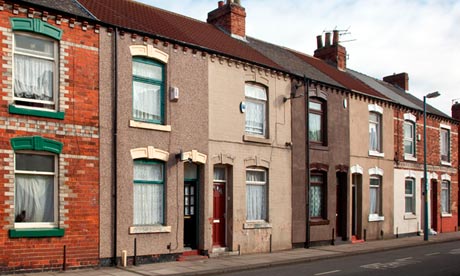
Houses in Middlesbrough

One of the most acute concerns about the government’s so-called “bedroom tax” – which from April will force anyone “underoccupying” social housing to either downsize to a smaller property or face a cut in their housing benefit – is the severe shortage of smaller properties available to move to.

The National Housing Federation suggests there are 180,000 social housing tenants underoccupying two-bedroom homes in England, yet fewer than 70,000 one-bedroom properties are available.

From 1 April, anyone living in social housing who has one unoccupied bedroom will have their housing benefit cut by 14%, rising to 25% for households with two spare bedrooms.

Maureen Hagan, 58, lives in a three-bedroom property in Grangetown, Middlesbrough, with her 18-year-old granddaughter, whom she took in five years ago. She will now see her housing benefit cut by 14%, even though she says she requires the extra bedroom in order to meet standards set by social workers, as she is fighting to bring another young relative out of foster care and into the family home.

She feels that the welfare reform is out of sync with the rate of inflation, and calls for the government to prolong the introduction of the cuts. She spoke of her recent struggles to meet utility payments: “That was before that bedroom tax on top of everything else. What am I going to do then?”

Hagan expects to face a £14 cut to her housing benefit each week – more than half her weekly shopping budget.

“I can’t afford to buy makeup. I’d like to buy it but I can’t. I’d like to buy my own clothes; the charity shop’s my clothes shop, and it has been for a number of years.”

(The Guardian, Friday 8 March 2013)

Both of these extremes are a direct result of the current economic circumstances affecting us all. One part of our society profits- gets richer, amuses themselves with more toys.

The other folk (whilst watching Top Gear on Sunday night) have decisions to make about whether they move house because they are mere grit in the cogs of the system. Their fate is irrelevant to the ultimate prize. If they can not consume, they have no value.

We are not all ‘tightening our belts’, or ‘feeling the pain’. We are not all making the same sacrifice.

There are of course other possibilities. Some are about managing the economy better- taking a Keynesian approach to stimulating our economy again. But this does little to change the game- it just clarifies a few of the rules.

Poverty is not a choice, it is an economic necessity to ensure growth. The alternative is revolution- if not of the Marxist kind, then perhaps the Jesus kind, which takes the emphasis off power, and puts it on love. Against this there is no law.