Aoradh Pentecost Bonfire…

Just back from our Pentecost bonfire meet on Ardentinny Beach. It was great!

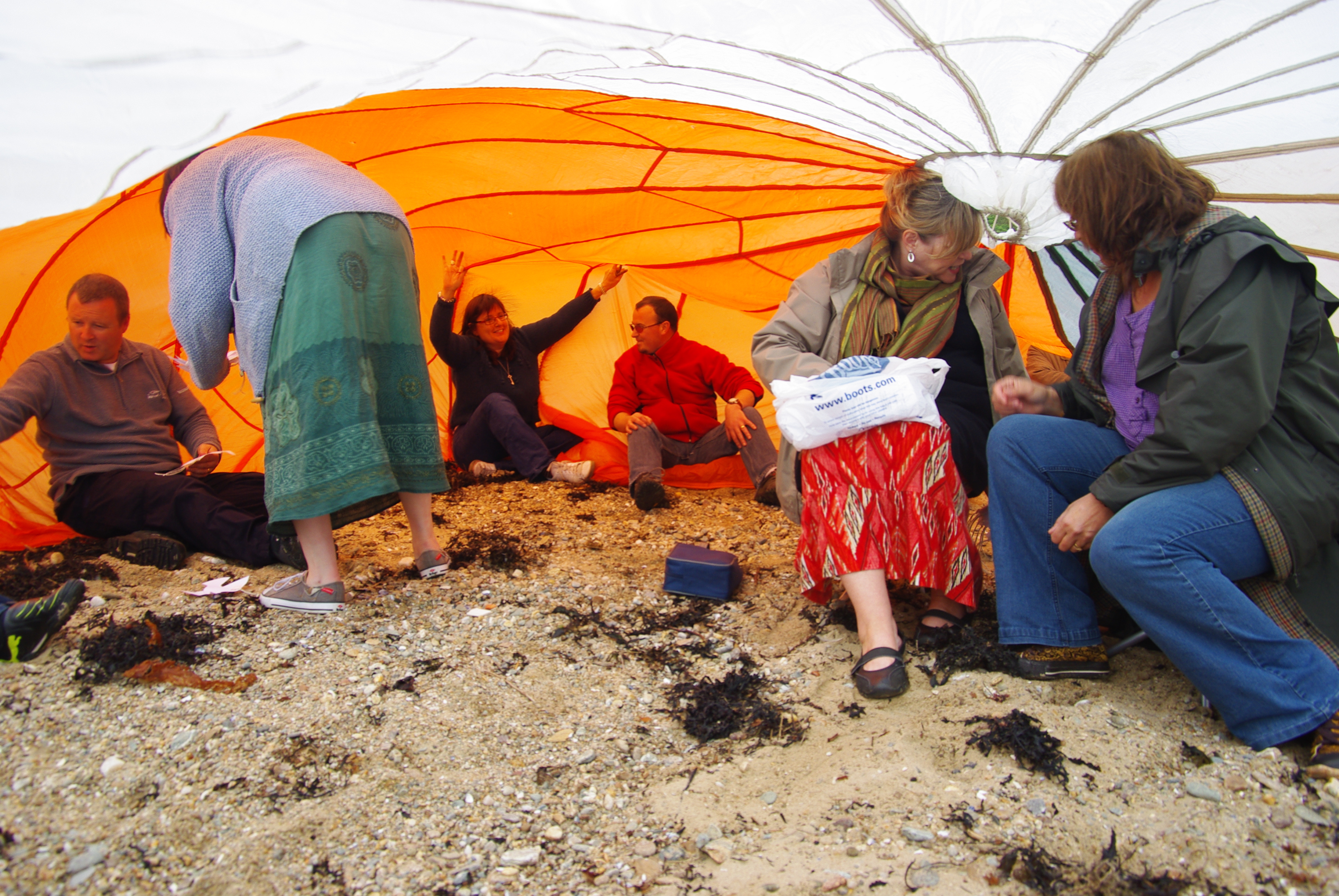
We went all 80’s and did some parachute games! I have not done this for years, and it was a hoot!

Then we scooped the edge underneath and sat in our own flappy tent- whilst Paul told the story of the disciples in the upper room, and coming of the Spirit. A great gust hit our parachute tent just as he got to the mighty rushing wind bit too!
Then we put prayers on paper doves, to hang in the trees.

Then we read the passage from Galatians 5 where Paul talks about the fruit of the Spirit- here are a few bits, with my emphases-

Galatians 5, 13-26

It is absolutely clear that God has called you to a free life. Just make sure that you don’t use this freedom as an excuse to do whatever you want to do and destroy your freedom. Rather, use your freedom to serve one another in love; that’s how freedom grows.

My counsel is this: Live freely, animated and motivated by God’s Spirit. Then you won’t feed the compulsions of selfishness. For there is a root of sinful self-interest in us that is at odds with a free spirit, just as the free spirit is incompatible with selfishness.

But what happens when we live God’s way? He brings gifts into our lives, much the same way that fruit appears in an orchard—things like affection for others, exuberance about life, serenity. We develop a willingness to stick with things, a sense of compassion in the heart, and a conviction that a basic holiness permeates things and people. We find ourselves involved in loyal commitments, not needing to force our way in life, able to marshal and direct our energies wisely.

Since this is the kind of life we have chosen, the life of the Spirit, let us make sure that we do not just hold it as an idea in our heads or a sentiment in our hearts, but work out its implications in every detail of our lives. That means we will not compare ourselves with each other as if one of us were better and another worse. We have far more interesting things to do with our lives.

Each of us is an original.

And recognising that we needed help, we then made a long prayer flag out of strips of foil with words from the passage above on- then flew it in the wind from a kite pole.

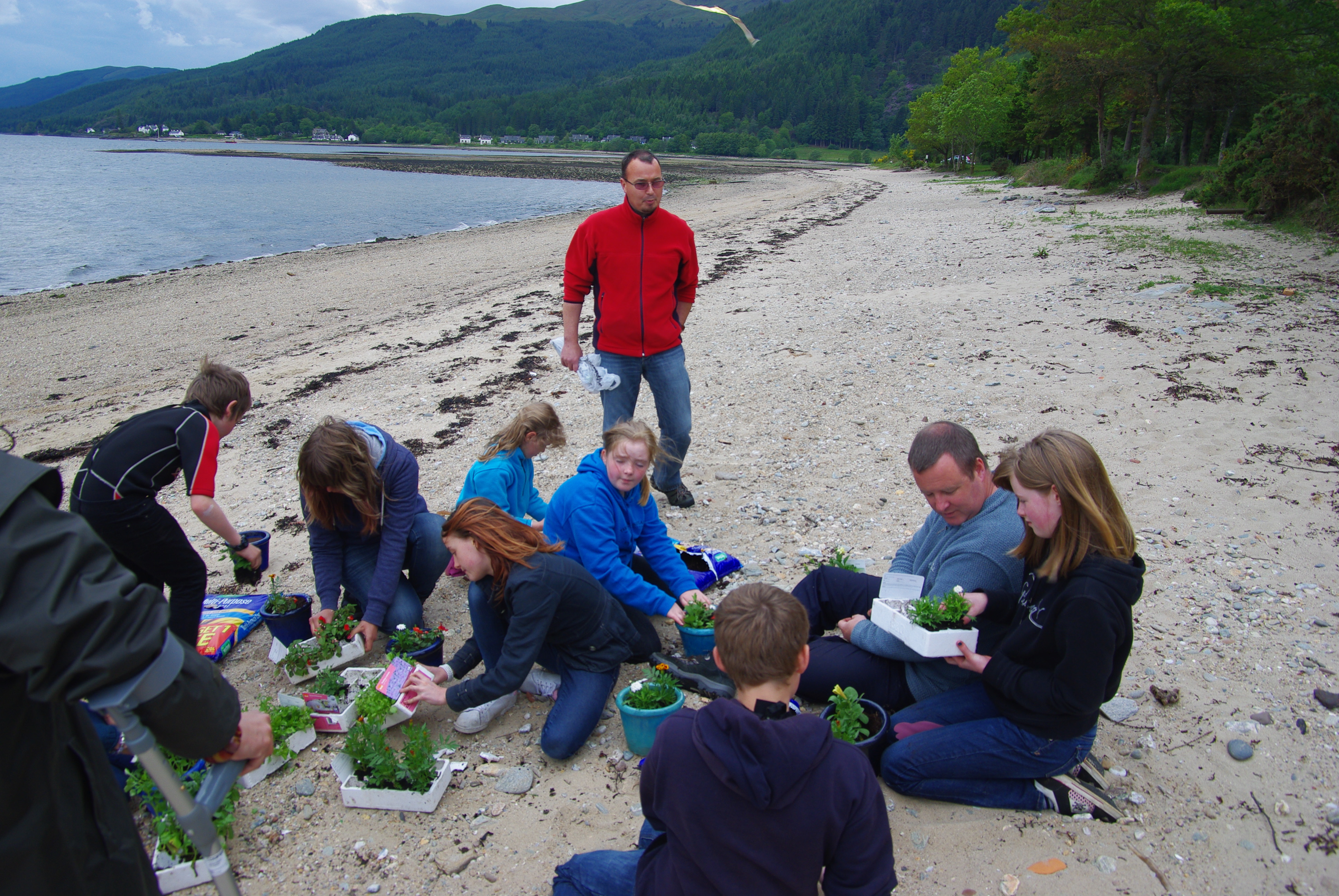
Finally, as a way of thinking about moving back into the world, we planted some flowers in tubs, and committed ourselves to placing them on other people’s doorsteps as a kind of guerrilla gardening project. Ours are already placed!
Oh- then we had a barbecue, and ate a lot.

Andy brought his camper van and gas barbie, so we ate well, and we ate in luxury!
Aoradh daily meditation- Justin’s lovely poem…

After a short break, Aoradh have continued the daily meditation by e-mail thing.

I think we had a break because life gets in the way of such daily production- particularly when only a few folk are really keen on the discipline of writing daily, or creating daily.

But we have started again- with help! If you would like to be added to the circulation list, and so receive a (more or less) daily e-mail, drop me a line

Thanks to the joy of the internet, connections are possible over hundreds- even thousands of miles, so it is that we have had two ‘guest’ contributors to our daily meditations last week and this week.

Last week we had a lovely selection of quotes and pictures from Dorothy Neilsen.

This week, poetry by Justin Heap (from Nashville, Tennessee, USA) which I am really looking forward to as, well- poetry is my thing! And also because Justin can write like this- his first meditation of the week…

You will die. Let these be words

to prove hope in light of faith,

words to grow heavy on the chest

to prove light in hope of faith,

that resurrection always

follows death in this kingdom.

Take what you will, taw and busk,

for rich soil always welcomes poor

seeds looking to change, to live.

Thanks Justin- beautiful!

Pentecost bonfire tomorrow…

So- we remember the beginning of church, through the inspiration of the Spirit of God coming to live in and through us.

If you are local- come and join Aoradh for our Pentecost beach bonfire- Sunday, 3.30 on Ardentinny beach. Bring something to throw on a BBQ, but more importantly- bring yourself!

I saw this clip today- and it hit me with what a wonderful thing the church is- full of hope and good things…

And on a day when Archbish Williams got himself in to some controversy by making some political statements (well done Rowan I say!) here he is speaking about Pentecost-


Father Ray comes out…


I have been thinking a little about this issue again recently- partly because of the film above, but also because sexuality is a subject that always seems to get people in the church steamed up.

The other day, my nephew Josh posted a link on FB to this organisation in America- Truth Ministry- Healing From Homosexuality Through Jesus Christ.  Josh was not particularly complementary- and I have posted about my feelings in relation to these ‘ministries’ before- here and here for example.

The root of all this has nothing to do with therapy- and little to do with ministry- rather it is all to do with how we understand scripture.

Father Ray seems a decent bloke- although the film above (despite his stated wish to avoid controversy and upset) was clearly made as a political statement by a man who is not averse to risk taking. It does humanise the debate again though- which is something I am a lot more comfortable with than trying to make rigid theological arguments.

I wonder when this will all be behind us? I think it will be one of those things that we (the Church) will look back on and wonder how we got so steamed up about it all.

Thy will be gun…

Thanks to Graham for this- it hits at the heart of the ‘Christian Nation’ nonsense, at a time when the worlds only superpower is starting to decline…

America stands in a long line of previous Empires who employ Jesus as a military-industrial figurehead to justify all sorts of things that are simply incompatible with any understanding of what Jesus died for. From Constantine to Queen Victoria.

The uncertainties over the emergence of the New Testament…

Above is an image of fragment p52– first half of the second century after Jesus- a credit card sized fragment of the Gospel of John- possibly dating from less than 50 years after the book of John was written.

However, we do not have a complete book of John until hundreds of years later. How many copies of copies of copies of copies were made before P52 came into being? How many since? How many different language barriers crossed? How many different cultural contexts mixed within?

A couple of hundred years ago, John Mill looked at 100 early manuscripts written in Greek- 30.000 places where the Greek texts differ from one another. Most do not matter- accidental mistakes by scribes. Leaving out words, verses- even pages.

Some matter rather more- some appear to be intentional variations from the copied text- where the text appears to be changed to match with a developing theology. The changes get rid of potential problems in subtle ways.

Does any of this matter?

Well if you are a follower of Jesus- YES. Even if you are not- it matters too, as the building blocks of so much of our culture were made from understandings (or sometimes misunderstandings) of these scriptures.

Christians from my tradition were schooled in the idea that the collected works of the Bible are the inspired complete and sufficient work of God. The writings are reliable, and contain no contradictions that we are not capable of coming to some understanding of, given the correct interpretive goggles.

The problem, of course, with this way of interpreting the works of the Bible, is that it is all or nothing. The Bible is either the BIBLE, or it is nothing. It is either sacred, or it is worthless. We are back into the range of what Richard Rohr, and others, calls the error of ‘non dual’ thinking.

But other Christians will point to a different way of understanding scripture- as a gloriously imperfect set of writings that record the attempts of people to engage with a mysterious Living God, and to live in the ways of his son Jesus. In these writings, we see mirror images of ourselves, and saturating the whole- is the love of God, and the call to adventure in the cause of the Kingdom of God.

In this understanding- it is not either or- but both-and. The books of the Bible were written by people whose work was inspired by engagement with the Spirit. But they might also contain elements that are flawed, partisan and from a cultural and historical context alien to ours. The writings might well have been shaped by translators and copyists over the years- because they were always invested with such meaning- or employed to support a meaning that may never have been there in the first time. Some of this shaping is subtle, and may even have not been intentional.

This debate is contained really well in this debate (the voice seems to be out of sync with the images though!)


I recently confessed to a leaning towards what I would describe as a more human origin in the authorship of our scriptures- and how accepting this is not a negation of these writings, but might also bring a sense of release and freedom from an ill fitting straight jacket of legalistic religiosity. Most of this was in relation to a reflection on the Old Testament passages that I had found so difficult. How about the works that record the words and deeds of Jesus?

Because this is even more important for we, his followers.

So- here is my current take on these things too…

Jesus is described in the book of Peter as a ‘Stone to make men stumble and a rock to make them fall.’ This possibly applies more than anything to our religion- given Jesus’ intolerance of the rigid doctrines of his day. Therefore we might expect our religion to be tripped up by- Jesus. And out religion is often codified by our interpretation of the Bible.

The New Testament is a collection of some outrageously revolutionary books written by early seekers after the New Kingdom. They did not get it all sorted. They were not God-parrots, but God-seekers.

Our role is to test scripture, as well as to be tested by it. We are to be not passive receivers, but active engagers, listening for the voice of the Spirit, and paying particular attention to the life and examples found in the stories told about Jesus.

All scripture is USEFUL- said Paul. He was not able to say ‘essential’ in the same way as others understand it now- as much of it was not yet written in his time. Which suggests yet again, that we might sometimes be guilty of over emphasis- even idolatry.

But it remains our starting point, our rudder and our trampoline.

Lets bounce.

Stages of faith…

I was listening to a discussion about ‘adult faith’ the other day- Richard Rohr and Ronald Rolheiser.

They were talking about how faith develops and changes over the course of a life, suggesting that most of us are pretty black and white (‘conservative’ in Americanese) at first- and in fact, we ought to be. It is important to decide where we stand, what we believe and who we are going to journey with.

But if spirituality is a journey home- then what? What do you do when you have formed your place of home? Do you just relax and play spiritual golf?

Or do you constantly replay the first-half-of-life journey? Rohr suggests that many Christians and many churches do just this- we play the same cycles of guilt/angst/truth/significance games. We continue to get caught up in comparing ourselves to others to find our own place of ascendancy- both as individuals and groups.

Rohr told a story of some old priest who said that he spent the first half of his life wrestling with the Devil- all that struggle with sinfulness- but as he got older, he described spending the second half of life wrestling with God, which was much harder. He started to ask questions, and encounter those things called mystery and doubt.

All this reminded me of many recent conversations with friends- including Paul, who told me about Fowler’s stages of faith development. The account as described on this link is all a bit mechanical- Paul told it better, so I am going to create my own version made up a bit of a mixture- some of Fowler, some of Paul and a lot of my own experience.

So, it goes something like this. I am not sure however that I would regard these stages as necessarily linear and progressive in nature, I wonder if we all move between different ones, whilst operating mostly out of one. Neither would I necessarily see these as a hierarchy, with the last one being superior to the others- although ultimately, we are all pilgrims, going home (wherever or whatever that might be.)

Primal faith

The world is a big and scary place- and if our primary need is for warmth, shelter, food and the security. The need for God is almost like a need to believe in the coming of spring during winter. So we make the God we need-from wood and stone if need be, or from individual portable components taken from the understanding of others. God is an invisible puppet master, or fairy god-father; mostly benign, but sometimes unpredictably wrathful and punishing. So we look for rhythmics patterns in the world about us, and transmit our hopes and dreams onto what we see.


Literal faith

The world is full of things that are RIGHT, and things that are WRONG. God is the bringer of justice- and is commissioned into a kind of faith that is made up of clear black and white boundaries. We, his followers, are active in our mapping of these boundaries, and in categorising those who lie outside of them. We then set up brightly lit gatehouses and invite those on the other side to travel through- in order that they might become just like us (right.)


Conventional faith

Safe within our boundaries, the question is- what next? We are ‘right’, but are some righter than others? Our task then becomes to conform. To homogenise. Faith as a journey is less important than faith as a process of ‘maturing’ spiritually- measured in terms of external conformity to the conventions of the religious institutions we belong to.


Reflective faith (crisis of faith?)

Is that all there is? Many of us find ourselves struggling with old certainties- re-examined by life. Faced with people whose experience challenges ours, or circumstances of suffering and loss, what had seemed so concrete is now revealed to be full of cracks and holes. Some seek to fill in these holes with remixed plaster- to make the whole seem whole again. Others pick at the cracks and overeemphasise them, alongside all the solid stones that they are embedded within. Some lose faith entirely. Others decide that the boundaries that seemed so secure need to be transcended.


Universal faith

By this, I do not mean necessarily faith that has no boundaries, no certainties- but for many, once the old ones become undermined, we have a reluctance to build new ones. We become captivated by the open, generous possibilities of the God of Mystery. Some call it enlightenment, but I think a better description is ‘being open to the falling of new light’. WHAT we believe becomes less important- as does the need to defend and protect what we once held as being ‘right’. Rather, let us become pilgrims again- heading towards as much as ever arriving. Grateful for company, and givers of hospitality.


A bit more on (un)belief…

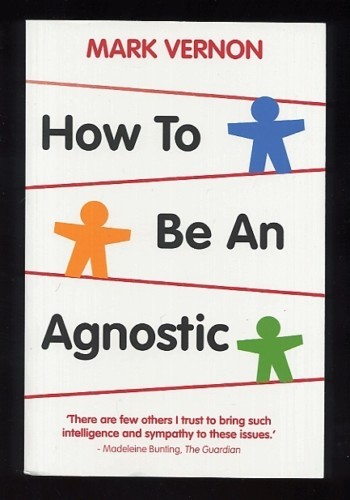
Michaela noticed a little article in the Spirited Exchanges newsletter mentioning this book

Mark Vernon, an ex Anglican Priest, concludes that

“both mental health and spiritual flourishing appear to require a skilful toleration of darkness and doubt, which explains why people often prefer to cling to what they claim to know…Certainty sells in science and religion. But as Thomas Aquinas realised, the best we can do when talking about God is to understand what God is not, and be open to what God might be, beyond our comprehension. It’s also known as faith.”

There is also a radio programme which you can listen to here, with Mark Vernon in conversation with David Jenkins, the former Bishop of Durham, Karen Armstrong, Ann Widdecombe and a variety of scientists and philosophers.

I particularly liked the discussion with David Jenkins- whose name I knew in the past as a kind of enemy because of his apparent questioning of many of the things which I was told were essential parts of being a follower of Jesus. “The most Christianity can be” he said, “is a pilgrimage.”

He appears to be the other side of whatever crisis of faith he had- and to be comfortable with doubt.

Which has some interesting parallels to my post here.

Aoradh daily meditations, Psalm 148, Sunday…

13 Let them praise the name of the LORD,
for his name alone is exalted;
his splendour is above the earth and the heavens.
14 And he has raised up for his people a horn,
the praise of all his faithful servants,
of
Israel, the people close to his heart.

   Praise the LORD.


That is the wonder of this God of ours-


Majesty that is humble of heart

Favouritism that is not exclusive

Shaper of supernovas

Who also made-

Me


Let the Hallelujahs ring

Aoradh meditations, Psalm 148, Saturday…

Praise the LORD from the earth…
11 kings of the earth and all nations,
you princes and all rulers on earth,
12 young men and women,
old men and children.

You powers of the government
Bow down
McDonalds and the CIA
Bow down
Economists of the IMF
Must bow down
.
You powers of the killing machines
Bow down
Pinochet and Stormin’ Norm
Bow down
You who live by the sword will all one day
Bow down
.
You powers of the media
Bow down
Makers and breakers of kings
Bow down
Celebrity cooks and reality Queens
Bow down
.
For I have walked the wild country
And watched the sun slipping slowly down
Turning green to gold
Working alchemy before my very eyes
.
I have seen the mountains
Lifting up their faces to the sky
Gathering in the starlight
So beautiful it makes me want to cry
.
And I can hear a voice- its calling me
Can you hear the voice?
It says-
.
Look upon my works you mighty

And weep