favourite words 1- ‘liminal’

I like words. Some words I like a lot.

I love the way that some words draw you into themselves. They give a little, but suggest so much more.

Some words contain whole sermons. One of them is this one;

lim·i·nal adjective
Etymology: Latin limin- limen threshold.

1 : of or relating to a sensory threshold
2 : barely perceptible
3 : of, relating to, or being an intermediate state, phase, or condition : in-between: Transitional.

As Christians, we come into an understanding of our position caught between this temporal world and the next. We are people whose allegiance is to a New Kingdom- the one Jesus spoke about again and again. A Kingdom that is both here and now, but also promised and yet to come.

We are called to be ‘in’ this world, but not ‘of’ it.

It is this present-future tension that we Christians live in. We exist in a space that is pregnant with the presence of Christ, and filled with hope for what is to come.

You could say that we Christians occupy a time and place that is liminal.

We live in the presence of the imminence…

Liminal spaces are always interesting. They are places of transition and change. They are characterised by possibilities of other realities, as yet unknown. In such places, we may be aware of the certainty of change, and to remain there requires a surrender to mystery.

They are also places that demand the exercise of faith. Without this decision to step out of the known, into the unknown, then we confine our experience to one dimension, whilst existing in the felt presence of the other. Perhaps this is sufficient for some, because liminal places also may be places of danger.

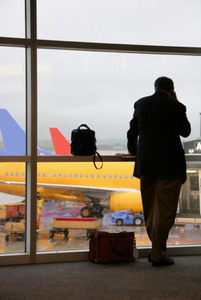
Borders, airports, stations – human constructs of transition – are all too familiar to us. We seem to linger at these places often in a state of heightened unconsciousness. We close down our senses, isolate them from reality in the air conditioned, plate-glass processing space of the terminal buildings. Distracted by duty free shopping, we step off into the unknown…

Is it possible that we begin to live our lives like this? Distracted and deadened, blindly following others down corridors, weighed down by baggage and cheap perfume…

The New Kingdom Jesus calls us to participate within stands before us, mysterious and largely unknown. But we have some clues about what might be useful there- what might be considered of value.

But ultimately this place of imminence that calls us demands a step into wonderful, but scary mystery.

Closing the ears of God

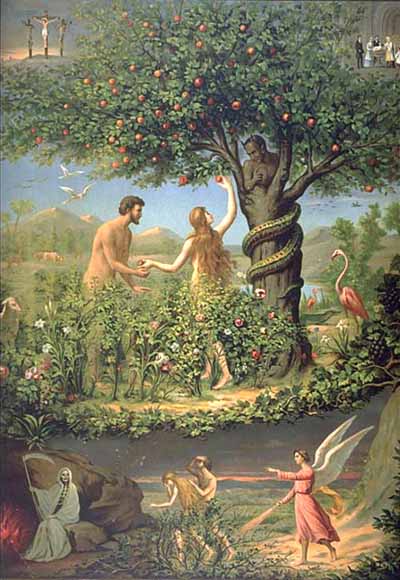
original-sin.jpg (JPEG Image, 400×580 pixels)

Heres a question;

Does sinfulness stop God hearing our prayers?

By this, I mean, if we approach him with unconfessed sin cluttering up our lives, does this mean that our prayers bounce off the ceiling? Or at very least, are we less likely to attract his attention- he is very busy after all…

Or perhaps it is a positive reinforcement thing- God blesses those who are pure, and withholds his blessings from the sinners?

I suppose I grew up with a firm idea that this was indeed the case. I can’t remember if anyone specifically told me this- but I think they did.

I certainly remember it being used as a possible reason for someone NOT being healed at charismatic healing services- a kind of blame-the-victim mentality which seems dreadful to me now.

Where does this idea come from? I am trying to think of verses in the Bible that would suggest this, but can not think of anything obvious (can you?) There are some OT stories of God punishing the nation of Israel by turning his face from their sufferings, and there often seemed to be consequences for leaders and kings who sinned and refused to heed the voices of the prophets.

But, if anything, there seems to be repeated evidence in the Bible to suggest that God did not wait for purity (even the ritualistic kind) before he engaged with people.

Abraham and his incestuous offspring
Moses the murderer
Saul
David
Jeremiah the reluctant.
Hosea and his prostitute wife.

And when we come to the new testament, and the coming of the New Kingdom, the evidence that God loves first and judges later is every where.

Mary and Joseph- mother and step father to God, imperfect vessels who carry and care for the King
The ramshackle bunch of losers who became the disciples
All the sinners whose company Jesus seemed to prefer to the religious folk of his day
Roman oppressors
Tax collectors
Women whose bodies made them untouchable

You get the picture. So how about you and me? I am often consumed by an awareness of my own sinfulness- the whole thought, word and deed bit. The stuff the I do once, and the habitual stuff, that I seem to do again and again, almost as if I have no control over myself, and as if it does not matter. When confronted by an awareness of the presence of God, I still bear shame…

Can God still use me? Has he still used me, and loved me and blessed me in spite of what I am?

Earlier I posted my feelings about the so called Florida outpouring, and its leader Todd Bentley (see here.) I see that Todd Bentley has stepped down from leadership amidst a broken marriage and allegations of adultery. Does this make the whole outpouring thing invalid? Even if you thought that the ‘outpouring’ was all smoke and mirrors before the allegations, then I would suggest that the Todd Bentley’s apparent frailties say nothing concrete about the incarnation of God in these happenings. We should rather pray that Bentley and those around him find a way through the Brokenness and hurt, and acknowledge that any leader in the public eye as he has been must have been under intolerable pressure.

But…

Let us never come to accommodate and tolerate sinfulness within us. Let us never respond to the God who is willing to love, in spite of what gets in the way, by taking him for granted. Rather let us turn again towards his ways.

Let us start from now, and seek forgiveness. And because God imposes no conditions on his mercy- neither then should we.

Blogged with the Flock Browser

Community… the journey into we

For much of my life, I have longed for community.

I have experienced flickers of what this might mean- but only in shadow, and sometimes only in hindsight.

The motivation for community comes through my understanding of the way Jesus called us to live- a collaboration of imperfect people who make a decision to love and to lay down self in order to serve others. And in doing this, others might see the Father God reflected in their gathering and their living.

If I look honestly at myself, this longing for community also arises from my own need to find a place of acceptance and security. A home from which to adventure, and a place to return to for healing and encouragement. (Perhaps in this longing, community starts again to be about ME?)

And mixed in with this is a sort of unexpressed idealistic theory that tells me that if we are able to move towards a pure community- then all things will be possible. Broken people will find healing, creative people will find expression. Needs will be met through sharing and burdens will be carried together. And because this community will shine like a beacon into its context, then it will become infectious- missional.

Kind of reminds you of the stories in the book of Acts? These stories have always been my inspiration. The homes opened up, the holding of things in common, the motivation towards the poor. Above all, the resting and the working of the Holy Spirit…

So, what gets in the way?

I know from my own experience that community is not always benign. Sometimes, the closer we get to one another, the more damage we do- the old hedgehogs analogy. The more we open up our lives, the more our facades of niceness are eroded, and the inner grasping kids emerge into the gathering.

Some people bring a toxicity with them that most communities will struggle to contain. There were people like that in the early church- Paul mentions them, and advises his friends to have nothing more to do with them. I bear the scars of broken and hurtful relationships- like we all do. I still torture myself in the making of decisions to walk away.

Then there is the issue of leadership and power. It will always become an issue at some point. Some take power deliberately, and use it indiscriminately for their own ends. Others are surprised to find that something of themselves has become oppressive to others almost unwittingly.

But perhaps above all, in Christan communities, we have lost the meaning of WE, and allowed our spirituality to be centred on the ME. WE have allowed our connections to one another, our way of living, and our spirituality, to be indistinct from the world about us.

I have spoken elsewhere about Kanyini, and how the original Australian people understood community. Once lost, this community is in danger of loosing themselves. We Christians began as people defined by community. It was out identity, and the beauty of it changed the world for ever.

But now, we see an overwhelming emphasis on personal morality, private experience, and even the accumulation of personal wealth, health and happiness. The danger is that people come to gather together in churches that are removed from the dirty messy stuff of life, to celebrate an abstract form of collectivism that is almost like a fossil version of the real thing. We forget our calling, our identity as people defined by our communality, our communion together, with God.

I have no answers of course- this would imply that I have sorted this out, and I certainly have not. But neither am i prepared to let go of my idealism.

I will lay down again for friends, knowing that I will be trampled on at times.

I will open wide the doors of my house, even though I resent the intrusion.

I will believe that this network of people God placed me within has a transformative power- not just for the community itself- but for all who are blessed by contact with it. And where the contrary is true- I will ask forgiveness for my own imperfection.

And I will chose to believe that where we gather, there is God in the midst of us…

The management regret….

Stress on Flickr – Photo Sharing!

I have had a bellyfull of managers this week. I have to be careful, because I often become a breeding ground for a depressing cynicism about my work.

I am a Social Work Manager to earn my mortgage, but at times I look around and wonder if I have been cast on a foreign shore amongst some kind of fish people who breathe a different substance and speak in bubbles.

There is a certain kind of management culture that values one dimensional toughness, and measures progress by the attainment of irrelevant goals. Failure to fit in to a certain stereotype is punished subtly and unsubtly- and I am never really going to fit in- both as a choice and as a consequence of the way I am made.

On good days I feel that I have a whole set of skills that mean that I can do my job in my own particular way, and do it well.

But then I spend time with management colleagues who rail against the failures of their staff and have no good words to say about anyone but themselves, and how they are going to sort out the slackers that work for them. And I fear for those people- who will no doubt become slackers, even if they are not already.

And I a brought up sharp by a higher management who do not treat members of staff fairly and with respect- even though their rhetoric (which they even seem to believe) suggests otherwise.

And I am angry with myself for my complicity, and my inability to challenge or walk away.

But I am a person who believes that God uses us as Trojan horses to gain entrance into the very fabric of our humanity, and there to tend the fragile but tenacious seeds of the Kingdom.

So as I wheel my horse into the office for another day of solutionless problems, what should be my calling?

To find precious integrity, and to hold on to it- not as a position of superiority, but of survival.

To see people not as a reluctant resource that requires the insertion of a rocket where the sun don’t shine, but instead as creatures of unique gifting and abilities. To search for strengths, not failings, and encourage them out.

To build bridges not battlements between groups of staff.

To understand the need for boundaries, but not to hide behind them.

To be first, an Agent of the Kingdom

Blogged with the Flock Browser

Greenbelt,

Well, for good or ill I have persuaded Michaela to come along to Greenbelt this year, along with the kids Emily and William (Emily was desperate to go so took no persuading at all!) This means taking the kids out of school as the school hols are different in Scotland to those in Englandshire.

This years speakers include Brian McLaren and Philip Yancey, and I am very much looking forward to hearing them both. Music looks less exciting, but there is always something that grabs you that you had not heard of (I really enjoyed ‘Over the Rhine‘ last year.)

Greenbelt gives me the feeling of connection with something bigger- something vital and creative, and fills me with hope for the people of Jesus in this country.

It is a chance to meet up with some old friends, particularly Mark and Dee from Wales. It will be good too meeting up with Si Smith, and perhaps getting to meet some of the Emerging Scotland folk…

It looks like we might be performing some of ’40’ also at a Proost lounge evening during the festival (see here for details of 40, or check out the ‘my writing’ bit of this blog- here.)

Hope to see you there!

Blogged with the Flock Browser

Choosing my religion


I was thinking today about the huge variety of Christian groupings and denominations. I get so tired of the antagonism and suspicion that we have for one another…

One of the inescapable facts that those outside the faith hit us with is the divided, sectarian nature of our denominations. Many of them split, then split again. Always there is the spectre of TRUTH looming over discussions- we share so much, but the devil (if you see what I mean) is in the detail.

Even within a particular denomination, it seems that there is considerable variation in emphasis from group to group, church to church.

So, assuming that we are looking for a spiritual home, how do we choose? What influences our eventual choice?

I suppose you have to return to TRUTH- but, beyond the core tenets of our faith, what might be true for me might not be so for you. Either we accept that most of us have got our choice of faith community WRONG, or perhaps God is prepared to deal with variation. Perhaps he even likes it!

So there must be other factors that influence our choice of church and its associated theology.

  • Background/upbringing? We are all someone’s children. Perhaps we follow, perhaps we reject and forge a rebellious path…
  • Influential friends? People we admire and are influenced by will of course leave their marks on the way we think about faith.
  • Past baggage? Most of us have had some bad as well as good experiences of church- either through leadership issues, or broken relationships. With this baggage on board, we are less likely to get on a similar train (to mix a terrible metaphor!) Neither are we likely to look favourably on the opinions of those who may have hurt us.
  • Personality type? We are all so different in the way we are wired. Some of us are more confrontational and risk oriented, and may thrive in a dynamic noisy atmosphere. Others are more contemplative, or organised- and will look for environments that fit.
  • Convenience/lack of alternatives? If you live in an isolated area or have limited mobility, then I suppose your choice is made for you! Locality locality locality…
  • Special interest? I think many of us look for something fairly narrow- a social or sociable agenda, the presence of lots of single available men/women, or good music. The rest, well so long as it is not too intrusive…

Increasingly, it seems that people are less likely to remain loyal to any particular brand. Everything is global, and the right to CHOICE is trumpeted everywhere. It remains to be seen what implication this will have to our churches.

What is clear though, is that diversity is here to stay.

Blogged with the Flock Browser

Emerging church- a useful label?

In our small group in Dunoon, Scotland, we have only fairly recently started using the term ’emerging church’ in a way that is not wrigglingly self conscious.

This was in part because although our group has many of the characteristics of what the EC supposedly represents, we have never agreed that this is the label or yardstick that we would use. It is only as other Christians have attacked us for being ’emerging’ that some of us have had a look at this label again, and thought- yes, that kind of fits.

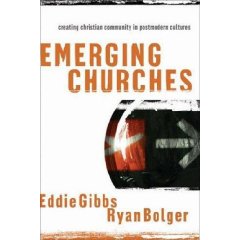
But it is not as if the label is well defined anyway. The 2006 Gibbs and Bolger book ‘Emerging Churches took a well researched swing at this, and I found it really helpful- but to be honest, I also had this feeling that if you look at a diverse movement of Christian activists and malcontents, and search for common strands- you then become responsible for creating a movement as much as defining one.

I wonder if there is also a kind of intellectual snobbery about not wanting to be defined. Many of us have escaped from solidity and predictability in the way we practice our collective faith, and the last thing we want to rush towards is another denomination.

Perhaps others felt the same way- the Methodists, or the Anabaptists- do you think in the beginning, with all the excitement and promise of something new, that they enjoyed the fluidity and freedom of lack of form and structure- and they enjoyed the lack of definition too?

I see that Andrew Jones, AKA http://tallskinnykiwi.typepad.com has started a survey asking whether we should ditch the label altogether. He is suggesting ‘Emerging missional church’ as a possible alternative- although this seems likely to raise lots of issues too. Andrew does a great job of putting some structure to these concepts here though. I am looking forward to hearing him speaking at Greenbelt festival in a couple of weeks…

Other so called EC leaders have already dropped the label too, like Rob Bell. Brian McLaren also appears to wish there was a better term. Someone put together some clips on youtube that gathered some of these thoughts.

This clip hints at some of the battle lines that are revealed when the EC label is invoked. I suspect that some of this heat alone might make leaders under fire want to find a better label.

I suppose ultimately, we will no longer be emerging- but emerged. And then we will submerge, to be replaced by another generation who emerge all over again. And God bless them as they challenge all of our cherished and no doubt concreted and inflexible doctrines and practices!

But as for me, I am not ready to get rid of the label yet. Apart from anything else- it gives us somewhere to navigate from.

And it might help us find fellow travelers of like hearts and minds to support and encourage, because Lord knows, we certainly need this.

Here in Scotland, some of us are in the early stages of trying to network more effectively- if you want to know more about this, then check out this earlier post

Rob Bell on quantum physics and Hebrew poetry…

We watched a DVD from Rob Bells recent ‘Everything is spiritual’ speaking tour. He pours out these facts and figures onto huge whiteboards- what a mind the bloke must have (or some kind of special auto cue prompter!) Here is a clip from the DVD- there are a few more on you tube but it is worth getting hold of the DVD and letting is wash over you.

The message that comes through all the incredible complexity is that of the Creator God, in whom all things are made, and who sustains everything. Everything, then, is spiritual.

Bell seems to draw a familiar conclusion about the power of the poetry in Genesis…

One thing that concerns me about this approach to science and faith, is that there is a danger of relegating the creator to a ‘God of the gaps’.

By this I mean that we look to science for explanations for all things. Where science fails to fill in all the blanks, we turn to God. As science advances, then God shrinks. He is pushed into the narrow spaces- in this case, into the quantum spaces…

You could say that this God of the gaps has been the logical outcome of the age of enlightenment. And Christians have fought this truth battle in the backyard of enlightenment- on the terms dictated by modernity.

But science and faith- they ask different questions, and the answers- they find their agreement only in God.

Creation/evolution 4- Genesis

02.jpg (JPEG Image, 260×357 pixels)

So what of the poem from the beginning of the Bible? What relevance does it have to our understanding now? How does the poetry of three thousand years ago shine light into our post-modern lives? We people of faith tried first to deny the science, then to reconcile it within the framework of scripture. I choose to do neither. I choose instead to stand on both power of the poem, and the awesome scope of the story revealed through science.

God spoke “Let there be light!” and light exploded into the universe. God saw that light was good, and he separated night from day- it was evening then morning – day one.

God spoke “Sky” between the waters, and separated the air from the waters. It was evening then morning – day two.

God spoke – let the waters gather to one place, and let dry land appear, and it was so.
God spoke – earth – cover with green vegetation and trees, bearing fruit and all good things. It was evening, then morning – day three.

God spoke and made the lights come out in the day and at night, made lights to mark the seasons and the days and the years. And he made lights to take charge of the day, and another the night. It was evening, then morning-
day four.

God spoke and the ocean swarmed with fish and all sea life. Then he filled the air with flying creatures and told them to prosper and reproduce. It was evening, then morning – day five.

God spoke and said earth- generate life! Every sort and every kind- cattle and reptiles, and wild animals, insects. And let us make human beings in our image- reflecting our nature, and responsible for the fish of the sea the birds of the air, and the animals of the land. He said “prosper, fill the earth, take charge! I give you every seed bearing plant on the face of the earth for food, and to every animal, I give every green plant” It was evening, it was morning- day six.

On the seventh day, God looked at all He had made, and saw that it was good. He rested.

Adapted from ‘The Message’

As I read this poem, it speaks to me of the wonder of God, as He sets forth the explosion of unfolding creativity. As His imagination formed stars and planets rushing outwards in a massive expanding burst of light. As his planet Earth was formed and positioned in the heavens, and formed its atmosphere. Its atmosphere thinned and revealed the sky above, with the sun for warmth by day, and the moon at night. And then bursting into our fossil record comes all the fish and fowl and beasts of every colour and shape, until, right at the end of the creative story, came humans, who were gifted with the skills to reflect and emote and abstract their experience- in the image of God. Made for relationship.

And I start to connect again with the heart of God in the middle of this poem. He saw all, and it was good. His love for what he made was great, and nowhere was it greater than for this last creature, this human, to whom he gave the special dominion over the whole of his creation.

This poem sings with wonder and joy and the very essence of who we are, and why we are, and what we have become. It dances around science like a butterfly out of a net.

There are other poems in the early part of the Bible. They tell the story of the descent of mankind and our loss of the place of innocence. They tell the stories of our passage from hunter gatherers to inquisitors and tamers of the land – a process of unfolding history that divides peoples from the heart of God, and then from one another. But these are different poems, and different stories.

So let us rejoice in the poem of life, and its origins in the mind of God.

Blogged with the Flock Browser

Creation/evolution 3- science…

Scientists are developing their own story of life. At present, it goes something like this;

Some of the most exciting areas of scientific discovery today are thought to be in the field of Astro-physics. The Hubble telescope, now in orbit around the earth, out from the obstruction of our atmosphere, has been able to see much further into space, and in doing so, to see light coming to us from further back in time. Through examination of what are thought to be the oldest stars, and by measuring the apparent rate that the universe is expanding, scientists have suggested a new age for our universe, of between 13 and 14 billion years old. This means, according to the predominant (physical) theory of the origin of the universe that around 13 billion years ago, out of nothing, something happened, and in a mighty explosion of unimaginable force, time as we know it began. Particles of cosmic dust formed globules, some burning bright as stars, others taking their orbit around these stellar objects and forming planets. The universe continued to expand – to get bigger.

EVERYTHING that we see around us is made up from molecules and elements that were spewed out into the universe by this one event- what scientists have somewhat unimaginatively called “The big bang”. More than this- look at your hand. It too is made of star dust. because, about 4.6 billion years ago, a small planet was formed, on the edge of one of the spiral arms of a small galaxy of stars- as a swirling mass of debris accreted and took on spherical form. We have come to see this planet as Earth, our home.

The conditions on this planet eventually became just right for the beginning of another process – life. For about a billion years, the earth was ‘without form and void’. But from around 3.4 billion years ago, we can find evidence in the rocks of microbes. Nobody knows WHY these primitive forms of life began. Some early research suggested that the right chemical reactions happened to allow for the production of amino acids, perhaps through the characteristics of the chemistry on early Earth, or maybe in the deep sea vents where volcanic heat stirred the seas. Others have suggested that organic matter was deposited on earth by comets, although it is not clear where the comets came from. We do not know whether it was ONLY on our planet that these conditions existed. We still wait to see if early forms of life developed on our neighbouring planet, Mars.

It was not until about 600 million years ago that we see the first evidence of multi-cellular life on Earth in the fossil record. However, diversity seems to have remained constant, perhaps even declining, until approximately 200 million years ago. Then there was an explosion of diversity- all the marine invertebrates, including many that no longer exist, plus plant life on the land. No-one knows why this diversity suddenly appears in the fossil record, although there are many theories- from levels of oxygen in the atmosphere, to more complex theories about cell structures. All subsequent forms of life on earth are substantially similar to the animals that came to be from this period- vertebrates, invertebrates, arthropods and so on.
The carboniferous period, from about 360 million years ago appears to have been hot and humid. Huge trees forested the land, but there were no flowers yet, and no grasses. Bony fish were found in the ocean, and somehow, some of these fish formed the ability to become amphibian. In the air were seen huge insects, including one with a 14 inch wingspan!

The Permian period, from around 286 million years ago, was typified by cooler climates- and many land animals began to take their place on our planet. However, at the end of this period, and for no clear reason, many of these animals became extinct. It took another 100 million years for this diversity to recover.

The next age, often called the Age of Reptiles was from around 245 million years ago. This period includes time of the Triassic and the Jurassic dinosaurs. They dominated the animal life of the planet for 150 million years, then disappeared, again for no clear reason. Giant meteor strikes have been suggested, but no-one knows for sure.
Next, the age of mammals – from around 65 million years. Mammals had been around for much longer of course, but during this period, they (and eventually, we) dominated the planet. Different species ebbed and flowed, some displaced by others as land masses move and reform, others varying hugely in size and shape as time places different demands on their adaptability. And we mammals were extremely adaptable.

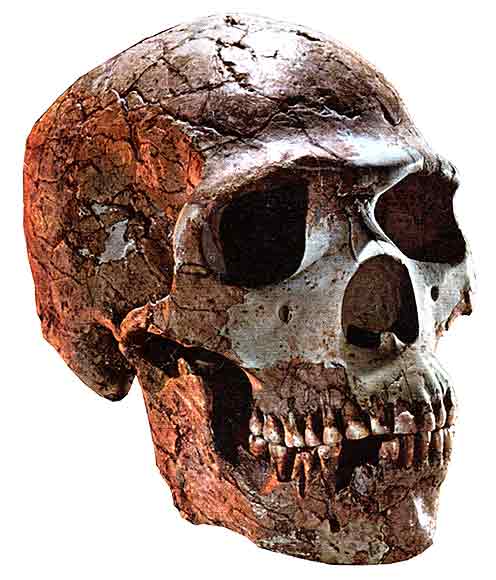
The first hominids (Apes closer to human form than to that of the ape) lived in Africa about 7 million years ago. Around 2.5 million years ago, Homo Erectus appeared in Africa, with a brain almost as large as ours, and began to make use of tools and perhaps, fire. The first recognisably human remains date back to around 250,000 years ago, and have been called Neanderthals. They had, if anything, slightly larger brains than us, and evidence of their communities, and the residue of their lives, can be found in caves in a northern climate ravaged by advancing and receding ice sheets.

From about 50,000 years ago, there has been a mass extinction of animals in many different parts of the world. All herbivores of over 1000kg disappeared in Europe and America, and 75% of all animals between 100-1000kg. The rise of mankind, with our hunting skill, and communal organisation is the only logical explanation.

Around 30 million years ago, Neanderthals disappeared. They had been replaced, over some time, by what we now know as Modern Humans, who had first left records of their existence about 100,000 years ago in Africa. Palaeontologists have speculated that Neanderthals, despite their big brains, lacked something that the moderns had.

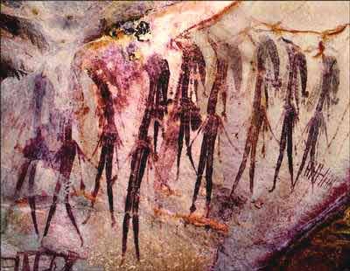
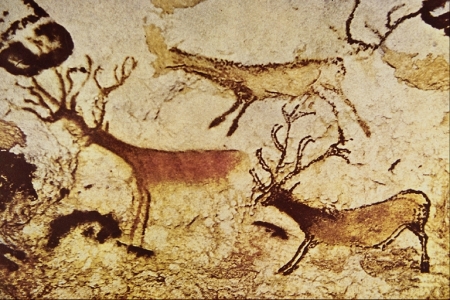
Their tools appeared primitive and poorly designed, and although they lived in social groups, there was little evidence of that oh-so human thing, abstract thought. The modern humans, on the other hand, from around 40,000 years ago, left cave art, jewellery, sophisticated tools. It was almost as if, by a freak genetic mutation, ‘humanity’ was switched on! Evidence has emerged recently however that suggested that this modern human behaviour started at least 30,000 years earlier in South Africa, where geometric carved pieces of Ochre and impressive tools were discovered from an earlier period. Human thought and abstraction seems to have been unfolding- emerging- for some time.

We stand as evidence of all that is amazing about the story told by scientists- of an unfolding story of life, beginning from nothing then gathering a fragile foothold, until at the very end of history, humans appear and make the world their own. We conquer mighty rivers, remake the building blocks of our planet into new composites and use the facts of our understanding to travel through the air, to communicate and to destroy one another. And some say that we are at the edge of destroying our planet because of our headlong rush to accumulate more and more.

This is the story given to us by the best scientific study and theorising.