See you there, or when we get back…
From last year…
athens_olympic_stadium_greece_2.jpg (JPEG Image, 600×391 pixels)
Stuart Cutler, whose blog I enjoy, said something interesting about sport here
He said “when you deconstruct any sport, it is ridiculous…”
I reckon he’s right. It set me thinking about something else-
A phrase used by a Roman poet to deplore the declining heroism of the Romans after the end of the Roman Republic, and as the Roman Empire began. “Two things only people desire- bread and circuses”. In times of unrest, the Roman governors threw huge spectacles, and handed out free bread.
At present, the Olympics fill our screens, but it seems only a sneeze since the football world cup raised a million hopes and dreams for English football fans. Flags waved from suburban windows and on car aerials. There was probably another song in the charts about football coming home, badly sung by an embarrassed set of England footballers. And the sun shone on the hopes of the whole nation, at least for a while…
I suppose I am a sports snob. I love cricket, and so got all worked up over the Ashes win over Australia (we were soon humbled by the return matches in Australia, which we lost 5-0!) but I am genuinely bemused at the effect of watching some men kick a ball about on a football field.
It has been suggested quite seriously by economic and political analysts that the success or otherwise of the England football team (and perhaps that of other nations too, even Scotland!) has a measurable effect on the nation. People’s spending patterns change, they impregnate one another more or less frequently, they vote differently, and crime and public order offences fluctuate like the league table itself. Such is the power of public entertainment, filtered through mass media, to a population hungry for meaning- for significance rather than the mundane predictability of life.
The Romans knew this, and perhaps little has changed, apart from the forms of entertainment themselves. They used to idolize men who fought and killed for entertainment. We now just reserve our thirst for blood for whoever the current England manager is. Why would anyone want that job?
But I too also love those moments of magic when a man or woman transcends what all have the right to expect, pushing beyond every psychological and physical barrier, and against all the odds, winning the prize.
A sublime goal scored by the 18 year old Michael Owen
A 6 smacked high over the boundary and into the crowd by Andrew Flintoff, right into to the hands of his proudly watching father (who promptly drops it),
And the time when I heard about Eddie the Eagle strapping on his milk bottle bottom glasses and launching himself from his garden shed, in training for the Olympic ski jump.
I remember these moments. As much as they can be, in a disposable age, they become almost eternal- they are public property, the milestones of our lives. We store them away like songs and smells that always take us back to particular time and place, and in their own way, they are as beautiful as sonnets.
But it is not enough. How can we elevate football or cricket or rock music or package holidays or anything for that matter, to become the pre-eminent point of emotional and spiritual expression in our lives? It seems to me that so many of us have let these manufactured things become the mechanism for fulfillment and borrowed success in our lives. We fill the voids in our lives with off-the-shelf imitations of reality, sanctioned and given shared legitimacy by TV. As with all things, it is hard to go against the flow.
We could talk about the state of the earth, of inequality, of poverty and starvation of children, of global warming and the melting polar icecaps. Or about the death of conversation, the end of community, and the breakdown of family life. But it is all a bit earnest, a bit oppressive. The issues are too big for us to grasp, and anyway, we are all entitled to a bit of a rest at the end of a working day, right? A bit of down time, a good match?
Yes, but time goes by so quickly. We start out full of optimism, and all too soon our children have grown, and mortgages have become the millstones that tie us to jobs offering little beyond a wage check. I believe in an eternal perspective, which offers a life in so many more dimensions. And in a God who sends his Spirit amongst the crowd, stirring like a wind on the waters, reminding us of what it means to be made in the image of a creative, Creator God, softening us from the plastic wrapping of our lives, bringing in life and love and freedom. Calling us to be so much more than passive observers of the TV screens-
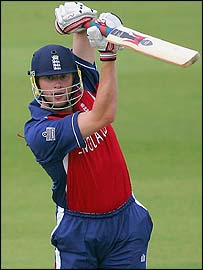
But to see Flintoff in his pomp, humbling the mighty Australians, making them look like children bowling at their older brother, punching a smooth extra cover drive, then rocking back and smashing a square cut of withering power past a startled baggy green cap…

Here is some footage of Bruce Cockburn playing the guitar. I think this bloke is incredibly talented- both as a guitarist, and a poet. I love his lyricism, but I discovered him because he had something to say- from the tradition of the traveling troubadour/protest singer.
Enjoy!
(He is not an idol really, but we all need hero’s I reckon!)
Even if I pack the Albert Hall with the power of my salvation message
Or my books require their own Amazonian warehouse
If the God Channel carries my healings back to back
And I make theology the sport of masses
Should I become the spider
In the World Wide Web
And Google all for Jesus
…but I have no love
Then I am like a dropped biscuit tin
In an empty kitchen
I am a like a bad busker in a windy street
Competing
With a massed brass band.
And even if I can predict the future price of a billion stocks and shares
Or know the coming weather
If my wisdom knows not the limit of Oxbridge
Nor lacks the ears of those with power
If I know all the words of God for this our time
And shout them loud
…but I have no love
I am nothing.
I am like a stain on the shirt
Of a crack addict
I am like a dandelion
Growing in the gutter
Of a derelict building
If I should I sell my penthouse flat and
Give my widescreen TV to Oxfam
And if I walk into a war zone
Waving flags of peace
Or become the world’s best known eco-warrior
And single handedly heal the Ozone hole
And even if all this should cost my final breath
…but I have no love
Then I am empty
Like the pockets of a gambler
Or the stomach
Of a starving child
Like a road laid
To nowhere
Like a life lived
For nothing
8.8.08
We are buying a new car.
As ever in this process, the concept of NEED becomes a very elastic term.
The council for the defence of this profligacy is something like this;
The council for the prosecution is a little harsher of course.
But, whatever the verdict, and whatever the personal angst- the deed is done.
I have played the game
And learned to look
Through your narrow angle lens
Never noticing
Refraction
I have tried to sketch around a shadow
And from those half formed drawings
I concreted my soul into a shape
That contorted
And chaffed
And all along I tried not to look
At this elephant
In the middle of the room
Tasseled and castled
Ready for the spice filled forests
Where it will trumpet in the face
Of tigers
And though I am scared
By the size of this unknown beast
And the places it could take me-
Bring me a ladder
Or lend me a friendly trunk
And lets go.
5.3.07
gene-robinson.jpg (JPEG Image, 350×350 pixels)
I heard the controversial Bishop Gene Robinson speaking on Radio 4 this morning. He was asked some pretty searching questions, including one about whether he was being deliberately provocative in order to force the Anglican community to change their position in relation to homosexuality. I thought he responded graciously and was impressed with his suggestion that he was testifying to what he felt God was calling him to.
Agree of disagree- this is a brave man. He apparently has bodyguards, and wears a bullet proof vest because of death threats against him, and he runs the gauntlet of abuse wherever he goes. Check this out-
http://news.bbc.co.uk/1/hi/uk/7504472.stm
The bishop is a fellow blogger, and you can check out his own story on this link-
http://canterburytalesfromthefringe.blogspot.com
I have had quite a few discussions about homosexuality recently. I have Christian friends who have recently had to face up to this in a real way as close family members have come ‘out’.
This is such a divisive, polarising issue. For many, the Bible is categorical- homosexuality is an abomination, full stop. Any suggestion that openly gay people should be shown fellowship and love is then accommodation with evil. I could never agree with this. Philip Yancey in his book ‘Whats so amazing about grace?’ describes his own reaction to the ‘outing’ of a Christian leader in the USA as gay. His description of Christian protestors at a gay rights march is hard to feel anything for but shame.
Yancey also makes another gentle but hard hitting point. There are about three verses that make specific reference to homosexuality in the Bible, but several more that forbid marriage after divorce. Most Protestant churches (but not Catholic ones of course) over the last 30 years have moderated their position in relation to re-marriage, despite what the Bible clearly says. Don’t get me wrong- I am glad they have done this- and given people a second (or third) chance at happiness after the trauma of broken relationship. I have never heard a satisfactory theological reason why this is OK however, and other specific commandments remain inflexible.
In even asking this question, I suppose I will already be typecast as a liberal heretic by many. But I have no fixed opinion in regard to the theology of sexuality. I suppose this is a bit of a cop-out- but there appear to be many variations on this- not just the polar opposites represented by Robinson and the Anglican ‘Evangelicals’.
Faced with people whose sexuality is different from ours, who might (Lord help them) seek to attend our Church- what should our response be? Would you rather they were inside, or outside?
Faced with a real person, hurting and seeking after the living God, would you make relationship conditional on sexuality?
I think my answer to these two questions is yes, and no. How I work out the rest will be an adventure with God.

Today I received my bouzouki.
I ordered it many months go from Freshwater folk instruments, and it seemed like it would never come. When it did, there were some problems, which I have yet to sort out with Dave Freshwater, but it is a beautiful thing.
I have wanted a bouzouki for ages… I love the sound they make. For the uninitiated, a bouzouki is a guitar sized Mandolin- 4 strings, each doubled, with a fret board around the length of a guitar fretboard. It makes a sound that, once heard, is very different to guitars, and opens up all sorts of other tonal possibilities. It was originally a Greek instrument, restrung and adapted into Irish folk music by people like Donal Lunny.
One of my favourite bands, ‘A Show of Hands’ use them a lot, and I love the driving energy the closely grouped strings give to fast folk.
For the purists, my instrument is tuned to G D A D, which gives lots of ‘drone’ strings, and lots of lovely open chord sounds. It has been hand made from solid woods, and has a Fishman pick up system.
And it makes me happy to sit in the fading light and fiddle around with the strange familiarity of such a beautiful new instrument.
But, gnawing away at me is this word…. idolatry.
For musicians (not sure if that really includes me, but stay with me…) instruments easily become objects of drooling worship. A good guitar does not make a bad guitarist good, but it certainly makes him/her a whole lot cooler.
Did I NEED a bouzouki? Of course not.
Does owning one improve the quality of my life, or enable me to serve others more effectively? Not really.
So, Lord forgive this man and the grasping teenager within.
And let me learn again that what I have, you gave me, so that I in turn, may be a blessing to others.
But thanks
For bouzouki’s
What might turn our minds to God?
What brings us to worship? What motivates us within it?
I have not go this sorted yet. But the seeking seems very important. It was this that became the centre of the group called ‘Aoradh‘ that I am a part of.
I started to make a list that was relevant to me, and to some of my friends;
- An encounter with the transcendent, which left us hungry.
- The desire to live out this worship in a way central to the whole of life.
- Jesus.
- A desire to break down barriers between the so-called sacred and the real world.
- Dissatisfaction with what has been, and longing for more…
- A longing for creativity, colour and vitality in worship.
- A longing to be authentic and true in our worship.
- New ideas freely available – just a mouse click away.
- Freedom taken or given, so that we can make our own worship.
- The experience of community, with worship as a natural consequence.
- An interest in art as a theological and spiritual tool.
- An appreciation of the many rich traditions of Christian worship.
My friend Ali turned up this evening- he had been house sitting for his sister while she had been on holiday so I had not seen him for a few days.
Ali is a singular kind of guy, who has a taste for the kitsch… and his sister found something in the souks of Marrakesh that she knew she would have to take home for her brother. More of this later…
There is a phantom shadow on our age, cast by the missing outline of the twin towers of Manhattan. This shadow has unleashed a new kind of warfare that has global impact- the ‘war against terror.’ On the one side we have the big battalions bent on imposing rough justice in the name of democracy, and on the other, those who have come to see the west as representing everything wrong with this world of ours.
Many things define the difference found between the supporters of the different sides. One side is mostly rich, the other, mostly poor. But perhaps above all, the defining difference is that of religion. One side is predominantly white, Protestant Christian, the other, Muslim.
It is important I think, to understand the other– to walk a while in his shoes and mark the blisters on his heel.
Otherwise, we may fall to that familiar base human default of dehumanising those who are different, and even demonising those who disturb our understanding of normality.
It seems clear that the Muslim world has a different way of seeing this ‘war on terror’ than predominates even in my liberal, left-of-centre world view. For them, this war is a manufactured, imperialist, brutal assault on a whole way of life- a whole faith group. It is the logical outcome of a long line of injustice perpetrated by or supported by the west (and the USA in particular.) Israel, Kosovo, Somalia, Iran, the Kurds, Chechnya, Israel again, and again…
In this way of seeing the world, the ‘war on terror’ is all smoke and mirrors, behind which is OIL. And religion.
That is not to say that people necessarily condone terrorist violence, but they may understand it, and its root causes in a way that we are not able (or willing) to. Many may resent the further trouble Bin Laden has brought down upon the heads of the Muslim world when he attacked the ‘great Satan’ on September the 11th. But his motivation is clear, and his continued defiance of the whole might of the USA continues to give almost univeral satisfaction.
Back to Ali’s present.
With great ceremony, he began to set up some cheap plastic track on our coffee table. He then placed on the track a tank, driven by a bad representation of George W Bush, and in font of this, Osama Bin Laden, on a skateboard. The tank was battery powered, but the skateboard had a magnet whose polarity opposed a magnet on the tank, so as the tank whirred round the track, the skateboard was propelled in front of it, always out of reach.
Here is a phototof the two protagonists, for your viewing pleasure, and education…