Evangelii Gaudium…

joy of the gospel

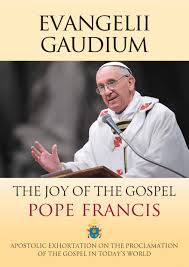
We got a present in the post today from our friend Maggy. The note with it said something like ‘I am not given to reading Papal documents as a matter of course, but this one is different’. So different that she sent a copy to us!

This one is the first such document to be written by Pope Francis, and could be seen as his personal agenda, his manifesto, for his papacy. He has called it Evangelii Gaudium, or The Joy of the Gospel. You can read it on-line here, which I had tried to do, but given up. It is much easier to read in paper form so thanks Maggy!

The ‘Gospel’ that Francis talks about ‘Evangelising’ is a very different Gospel that the Evangelicals that I grew up with would recognise. For them the Gospel was simply this- repent, because unless you say the sinners prayer you are going to hell. Francis’ Gospel is about the truth of Christ growing within us, so that as we experience his profound liberation we become ever more sensitive to the needs of others.

Francis is also concerned that the church may be a poor church, for the poor. Here are a couple of quotes which immediately light me up;

“Just as the commandment ‘Thou shalt not kill’ sets a clear limit in order to safeguard the value of human life, today we also have to say ‘thou shalt not’ to an economy of exclusion and inequality. Such an economy kills. How can it be that it is not a news item when an elderly homeless person dies of exposure, but it is news when the stock market loses two points? This is a case of exclusion. Can we continue to stand by when food is thrown away while people are starving? This is a case of inequality. Today everything comes under the laws of competition and the survival of the fittest, where the powerful feed upon the powerless. As a consequence, masses of people find themselves excluded and marginalised: without work, without possibilities, without any means of escape.


“Human beings are themselves considered consumer goods to be used and then discarded. We have created a ‘disposable’ culture which is now spreading. It is no longer simply about exploitation and oppression, but something new. Exclusion ultimately has to do with what it means to be a part of the society in which we live; those excluded are no longer society’s underside or its fringes or its disenfranchised – they are no longer even a part of it. The excluded are not the ‘exploited’ but the outcast, the ‘leftovers’.”

I look forward to reading more of the story that Francis would encourage us to see ourselves part of- the good news Gospel story that our world desperately needs to hear anew.

And I will contrast it with the other stories, like this one.

I will read other stories through the shape given by the Gospel.


2014- could this be the year we start to reclaim Christianity from Capitalism?

rainbow church, Dunoon

I am not into making new year’s resolutions- I tend not to keep them. However this time of year is the time to take stock, to dream of what might be ahead.

As well as the personal stuff it is a great time to wave some spiritual litmus paper in the stew of culture that we swirl around in. What is there that we can celebrate? What should we protest? How does the life of Jesus within us open us up to new ways of living in this new year?

A year or so ago, I wrote a post reflecting on the relationship between Capitalism and Christianity. This seems even more relevant now as austerity measures hit the poorest and weakest in our economy. Something is wrong– not just at an economic level, but rather in our very ways of being.

There are some encouraging signs that the Church is starting to realise this however- and that we need to be the voice of instability, not conformity. Sometimes it seems that our religion is like smoke blown into a hive while the honey is stolen. The Pope appears to understand this, as does Archbishop Welby.

The problem, it seems to me, is that church often claims to be separate from society (the old sacred/secular duality) at the same time as being indistinguishable from it perhaps in the following ways (as listed in my earlier post but with a few refinements and additions.)

  1. By emphasising personal, individual salvation above all else. The only useful purpose of mission is to save people from hell after they die. This means that active engagement in any other activities (particularly ‘social issues’) is downgraded, or even downright suspicious. For many these activities are only really acceptable if used as a trojan horse to smuggle in the gospel message.
  2. By embracing success culture. We use the same corporate structures, we reward our religious successes as we would our CEO’s, we value hard measurable outcomes, we construct programmes about personal empowerment and success.
  3. We make mission a kind of hostile take over. Business success involves out-performing the opposition, and rejoicing in their bankruptcy. We need to sell more, penetrate all markets, dominate the marketplace, crush to opposition.
  4. Christianity became a lifestyle choice that required no change to the way we live our economic lives. Yes, I know there is the old ‘tithing’ argument around Evangelical churches, but we drive the same cars, live in the same houses, take the same holidays, fill our lives with the same gadgets- or (and here is the sting) even if we do not have these things, we aspire to them. St Jobs is venerated in many a trendy Christian Church every time people meet.
  5. We bought into lives characterised by individualism above the collective. The model given to us by the life of Jesus and the early church was all about learning to live in loving community- how we live for one another, how we hold things in common, how we find ways of including the poor, the weak. Can we still hold these things as defining characteristics of church?
  6. We failed to demonstrate any kind of radical alternative. The best that we have been able to offer is how to live as better Capitalists- more sensible, more responsible, with greater probity. The Protestant Work Ethic lives on- in each one of us who finds comfort in our pews as much as our pension fund (even if both are more sparsely populated than previously.)
  7. We did not see injustice, inequality, poverty, unfair taxation, usury, over-consumption, environmental destruction, as any of our business. Which relates to point 1.
  8. Even where there was visible discomfort with Capitalism, we lacked any coherance, we lacked leadership, we did not become a critical movement. Rather we splintered and focused on totemic side shows live homosexuality and women bishops- all of which destroyed our credibility to speak prophetically into our culture anyway.
  9. Our mission to the poor was conditional on redeeming them to become like us. Difficult one this, but stay with me. There are lots of examples of Christian engagement with the poor, from the good old Salvation Army right through to the new food banks. However, these activities might be seen as cleaning up the edges of Capitalism– but also justifying the dominant ethos. It encourages us to lift people back into becoming productive consumers – just like us. This fails to engage with any idea that we need to become more like them; that the problem is caused by people just like us.
  10. We forgot that the Church exists not to give us a better life, but to serve the lost and the least. If we are serving the lost and the least, how can we have convinced ourselves that our unsustainable greedy lifestyles are God-given rewards for our moral superiority- which we Brits built an Empire on, and then passed the baton to the USA?
  11. We failed to form partnerships with other grass movements for change. Because anything outside of the walls of our particular church is suspicious, we are reluctant to engage with all those good ‘holy’ groups whose members are seeking to redeem and restore- the environmentalists, those working for social justice etc.

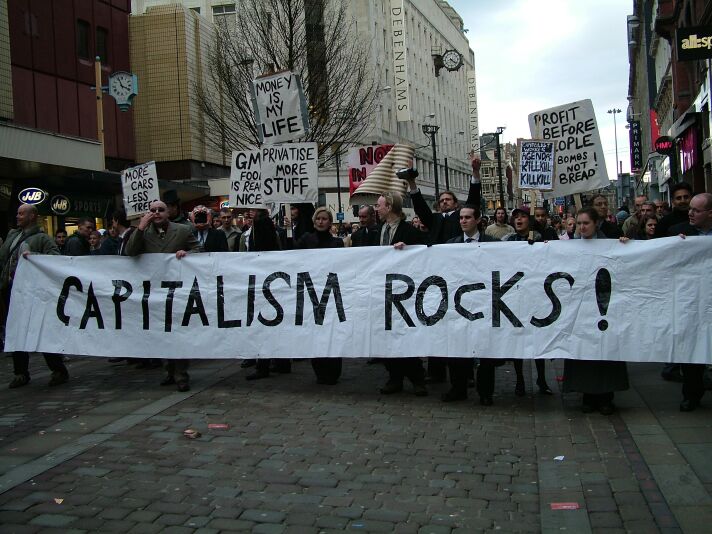
Occupy London Stock Exchange protest

I am not happy to leave this list just as a set of negatives, so here are my hopes/prayers for the Church in 2014;

  1. May our evangelical zeal be set free from the tramlines of heaven/hell. May our concept of salvation be much more gracious and generous, and may our evangelists be empowered to be agents of the Kingdom of God.
  2. May we see success for what it always is- a distraction from our call towards personal weakness, humility and love.
  3. May we stop competing.
  4. May we be among the first who chose to live differently- more simply, less driven by crazy consumerism. May we be a new kind of Amish people- not rejecting of technology, but neither enslaved by it.
  5. May our living draw us together, rather than forcing us apart.
  6. May our way of living be genuinely different- may we be consumers of less, wasters of less, sharers of more. May we party hard, love greatly, laugh a lot and weep when the time is right for weeping. May we be the first to demand products that last, that are updateable, that do not denude the environment or depend on the slavery of others and the raw materials dug out of some other part of the world for our own benefit.
  7. May we be angered by injustice, by poverty, by destruction of the beauty all around us, and may we express this anger in protest, in art, in full engagement.
  8. Rise up people who would show the way- give them a prophetic voice. Lead us out of our concrete wildernesses.
  9. May we see first the value in the other, not the rightness in ourselves.
  10. May we see our privilege for what it is; the inverse of the poverty of others.
  11. May we look for beauty and shine light on it. May we seek out flavour to savour with our salt. May we find out where Jesus is and try to join him there. May we seek partnership and friendship with other groups.

Let this be the year of a different kind of revolution…

capitalismrocks

Happy New Year…

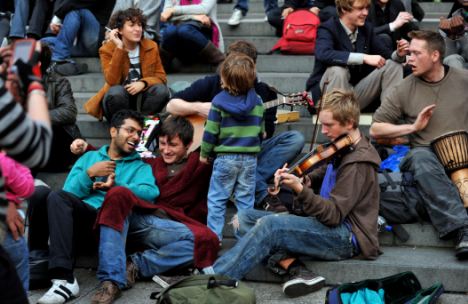
music montage


It is the morning after the night before.

We had a night full of music and friendship- this morning my fingers are very sore as playing for hours is a rarity for me these days. Head is OK though as I was restrained in the drinking.

Blessings to you all this new year.

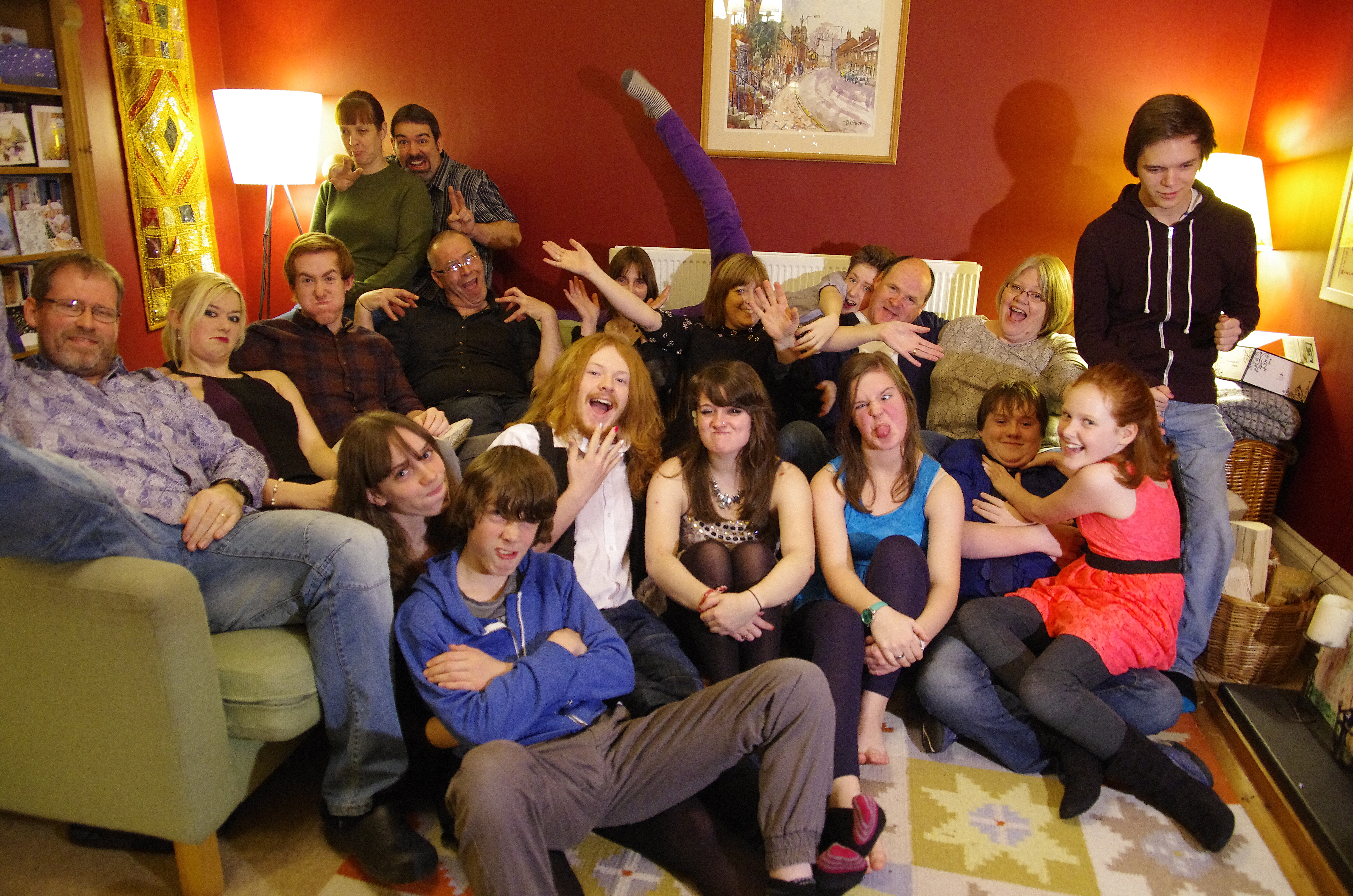
This is our group photo of those actually sleeping at the house;

_IGP5498

Brett Lee V. Piers Morgan…

A wee late Christmas present to myself this…

There is a cricket series going on down in Australia at the moment between England and Australia. These two sides have history, and encounters between them are always to be savoured. In my case this means ridiculously late nights, although at present England are being hammered into the ground.

William and I (who both play as much cricket as weather and family allow) often discuss what it must be like to face up to one of the fast bowlers, tearing in and trying (literally) to knock your head off. Anyone who thinks of cricket as a sedate gentlemanly sport should think again- even at club cricket level there are many bowlers far too fast for me and I have the bruises to prove it.

Fast bowling is about intimidation. Facing up to someone who has the ability to put the ball either at your feet or bouncing into your ribs at real pace is a test for anyone. Good batsmen always seem to have much more time- no idea where they get it from of course, as the ball will take about half a second to get to you from leaving the bowlers hand.

Abrasive motor-gob Piers Morgan, fresh from his spell as a news anchor on CNN (taking on the American gun lobby) fancies himself as something of a batsman. In fact, he has been slanging off the ‘pathetic’ England team for their apparent cowardice in the face of the Aussie quicks, suggesting that they should just ‘grow a pair’. He reckoned that he could manage just fine, so challenged the very quick former Australian fast bowler Brett Lee to send down a few at him.

Here he was on twitter beforehand;

I’ve only got a few teeth to lose, you’ve got a whole reputation that’s going to be shattered.

It did not go well;

He tweeted: “Full injury list post @BrettLee_58 showdown – cracked wrist, bruised rib, and massive egg on back of head from…the throw-down guy.”

He added: “For the record, I didn’t actually see a single one of @BrettLee_58 ‘s deliveries. But I felt 4 of them crashing into my flesh.”

Lee replied: “@piersmorgan that’s what happens when you talk it up.”

On reflection, perhaps I will leave facing fast bowling to my son.

Potting on boxing day…

glaze

We have had a lovely Christmas day. Just the 4 of us and a slow day listening to music, laughing a lot, eating too much and watching cheesy films. I had some lovely gifts (thanks everyone!) and enjoyed helping Will put together his new bike. Emily has been in great form too, making us all laugh like drains- mostly with her, occasionally at her.

There is only one potter in our family- and this is Michaela. However, she lets me play around with clay from time to time. Usually she gets a bit fidgety whilst looking over my shoulder but that is fine with me.

I enjoy mixing up ceramics with metal and wood to make things that speak of the sea. The glazes we use are mostly sea colours- you never quite know what magic will happen in the kiln though. I have also been using some shapes to impress into the wet clay to make celtic crosses and the like. What better way to spend Boxing day?

Here are a few of the things I have been making;

A Christmas sermon that cost a man his job as a minister…

frank schaefer

And what a sermon. Here it is in full.

It was given by Frank Schaefer (no, not that one– different spelling) who was defrocked by the United Methodist Church last week for officiating at his son’s marriage to another man.

Whatever your theological stance on this issue (it will not surprise you that I am with Frank) you have to admire this man’s courage.

Frank said this;

Being a United Methodist minister is the only way I know how to minister. All of my children have been baptised in the United Methodist Church. It was our church. This is our church.

I knew that I had to confess what in my heart I knew to be true, and I had to stand against the church – not the entire church – but the institution of the United Methodist organisation to say “I believe that this rule is discriminatory and wrong”, and I knew I had to tell my lawyers that.

And so when I sat in the stand, and it came to that moment to share about my true faith, and to stand against the church. I was sick to my stomach. And I was thinking, “can I actually get those words out”? And as I was in that moment, I looked out into the room, and I saw my family. Behind my family there were people sitting. Some of the people were from this church, wearing rainbow stoles. And all of a sudden it was like I could feel their prayers, and I heard myself say to the jury: “I will put on this stole, this rainbow colored stole, as a sign that I will from now on stand in advocacy of the LGBT community of our church”.

And I heard myself say, “I want you to know, that if I am going to be a United Methodist minister tomorrow, I will not refuse ministry to anyone based on their sexual orientation.”

And I heard myself say:

I can no longer be a silent supporter. I will always be an advocate and I will tell the church that these laws are discriminatory. And that we treat our LGBT brothers and sisters as second-class Christians, and that the hate, the hate speech of the church has to stop.

What’s in a name? Jim Crow Rock again…

Western ferries passing jim crow

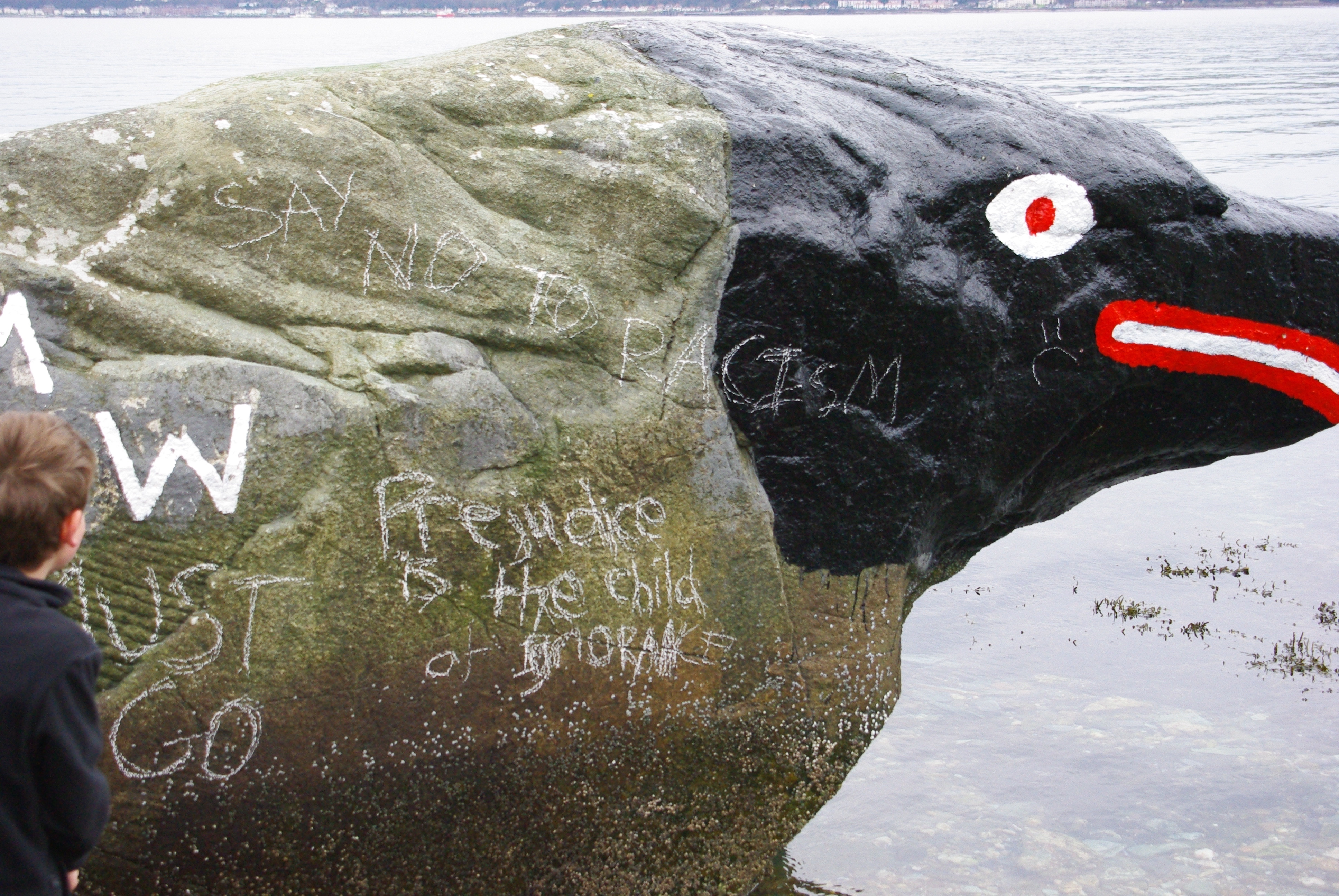
Regular readers will be aware of this stone on Dunoon’s foreshore, close to my house. You will also be aware that I have tried to engage in debate locally about it’s origins, given that it carries two markers that have clear racist associations- it is decorated with familiar ‘Blackface‘ markings, and is labelled ‘Jim Crow Stone’.

This debate continues to be a rather difficult one as the rock divides people fiercely. Those who tend to object to the rock are more typically ‘incomers’ who are not thought by locals to have a right to comment. For their part, they grew up with the stone, as an innocent backdrop to playing on the shore. For them it was a crow, not a racist statement.

I wrote a letter to the local paper a couple of weeks ago, in the wake of the death of Nelson Mandela, suggesting a information board, where we might discuss the different opinions about the rock, and talk about the slave connection through Clyde trade, as well as the Blackface minstrel shows that happened in this area. To be honest, I did this with some trepidation as I expected to get a bit of a kicking from outraged locals.

However, this has not happened. Most conversations I have had with people have been broadly supportive of the idea. There was only one letter in the paper in opposition- and this one concerned itself with the history of the rock. The correspondent insisted that the rock could NOT be racist as it’s name pre-dated the ‘Jim Crow Laws’ in the USA.

There does appear to be some evidence of the name ‘Jim Crow Stane’ on early charts- as if it was used as a navigational marker, as early as the 1700’s.

However to suggest that this closes the argument, that the markings on the rock then become innocent, is clearly (in my view) nonsense. Folklore gets changed and adopted according to the mores of the times. The name of the rock, and the use of the term ‘Jim Crow’ as a pejorative label may (or may not) come from an era before the decoration, but the association with racist images and ideas does not. T

I wrote a reply for the local paper- again I do not know if they will publish it. Here it is though;

Dear Editor

Thanks very much to John A Stirling for his thoughtful reply to my previous letter suggesting an information board next to Jim Crow rock. John appears to believe that the historical points he makes close the argument about the origins of the decorations on the rock. I am afraid they simply do not. History is rarely value free and in this instance, far more complex than what John would have us believe.

John suggests that the rock cannot have racist connotations as its name pre-exists the Jim Crow laws in America. However this ignores the fact that these laws were grouped under the name ‘Jim Crow’ precisely because this was a pre-existing pejorative name that had been in common usage for Black people since at least the beginning of the 19th C. The song ‘Jump Jim Crow’ (written in 1828) perhaps popularised this stereotype but it is more likely to predate the song considerably.

The words ‘Jim Crow’ fell out of common usage possibly because they became increasingly associated with racist laws adopted by most States, and which were gradually removed from American statute over a period of 50 years of protest by brave people, some of whom lost their lives in the process. Previously ‘Jim Crow’ would have been used in the same way as the word ‘nigger’. Are we really happy to give unexamined space on our shores to such words?

Even if John is right, and the name of the rock pre-dates racist associations, the ‘blackface’ image that is painted on it now remains one that Black people recognise immediately as a racist stereotype. Again- do not take my word for it, ask the Jim Crow Museum (who have expressed horror at our rock) or the Racial Equality Unit.

Whatever the debate around this rock, at present it stands as a potentially offensive historical oddity. It will continue to divide us into people who are troubled by what it represents and others who fiercely defend it as an innocent local folklore.

Once again however, if we were to put up a display making clear the nature of this debate, perhaps we might yet transform the rock into something that both John and I can take mutual pride in. We can keep the rock in place, celebrate it even- whilst also owning the darker parts of our history.

Growing up as a scrounger; confessions of a child of the welfare state…

school-photo

Here I am, aged about 8 or 9, on the back row of my class picture from Croft Primary school. Someone posted this picture on Facebook and it all came flooding back. I am the one in the strange yellow t-shirt and the odd pudding bowl haircut.

My sister and I were part of a one parent family, existing entirely on welfare benefits. We lived in a reasonably comfortable house- a suburban semi detached that my mother had bought before she married my father. It was a difficult short marriage and she was left holding the babies, bitter and isolated.

Growing up a child of the welfare state in the 1970’s was possibly the best time to do so. Family credit, child benefit, free school meals, clothing vouchers, even help to pay for some school trips that otherwise we could never have been part of. Don’t get me wrong- we had very little, but my mother was very good at scraping together every last penny. But the chronic shortage of money dominated every waking hour- leaving lights on or wasting food was a sin punishable by violence. I lost a coat once and did not dare go home- hiding in the fields for hours.

There was food in the house- in the early days my mother fed the babies rather than herself, but as time went on, she began to stockpile dented tins and dried lentils. She is in her 70s now and still does- her kitchen cupboards are full of foodstuffs well past their sell by date but she can not begin to throw out. When you have been hungry and have had nothing, the fear of this returning cuts deep.

I mention all this because when I was a child, benefits were worth considerably more in real terms than they are now, even before the axe that our current government has taken to the welfare benefits system.

If I had been born 35 years later, it seems almost certain that I would have been one of the 500,000 people that would have needed to visit a food bank in order to eat.

Today the Christian charity who run many food banks spoke out in condemnation of the Work and Pensions secretary, Iain Duncan Smith. They have been trying to meet with him to discuss how they might work together to help families better. IDS refused. In fact, he did not even stay till the end of a commons debate on the issue this week.

The government agenda is clear. The problem is not poverty, as anyone who is poor should either get themselves a job or manage the benefits they get better. Neither is the problem benefits cuts- these are proportionate with the need manage national debt, and everyone has to do their part. IDS suggested that charities like the Trussell Trust are just scaremongering, following a lefty political agenda. The problem is that some people are scroungers, wasters, layabouts- addicted to hand-outs from the state. Wanting to sponge off the taxes of hard working people.

This agenda has been so well peddled by the government and the right wing media that even people on benefits (perhaps particularly them) come to believe it of themselves. Escaping from this kind of sense of failure is incredibly difficult. It also plugs into a certain kind of base me-first middle class mentality. Do you remember the study that I quoted here?

Another paper, published in Psychological Science, found that people in a controlled experiment who were repeatedly exposed to images of luxury goods, to messages that cast them as consumers rather than citizens and to words associated with materialism (such as buy, status, asset and expensive), experienced immediate but temporary increases in material aspirations, anxiety and depression. They also became more competitive and more selfish, had a reduced sense of social responsibility and were less inclined to join in demanding social activities. The researchers point out that, as we are repeatedly bombarded with such images through advertisements, and constantly described by the media as consumers, these temporary effects could be triggered more or less continuously.

Any discussion about welfare is always ideologically loaded. The facts, such as they are, tell a rather different, more complex story. Check out this article that seeks to tackle some of the myths.

When confronted by an ideology/political view/power statement that scapegoats marginalised and dis-empowered people it is time to sit up and take note. It is time to ask searching questions of those in power. Above all it is time to listen to the voices of those who are being scapegoated. Everything within me says that this is what followers of Jesus should be doing right now- listening, challenging, engaging.

foodbank

Anyone who has ever spent time with people whom life has broken and pushed to the ragged edge will know that survival is the goal- forget recovery, forget healthy environments for children to thrive within. The margins, slim though they were, that I grew up within are now simply gone. 

A radio interview with some people visiting a food bank today heard how people were not able to take food that needed to be cooked, as they simply could not afford the energy to cook with.

Most of us instinctively think of people who use food banks as ‘other’; ‘not one of us’. Despite my rather different circumstances in 2013 from 1973, I can not say that. The people at the food banks- they are just like me.

The weather turns ugly…

wild weather, the clyde

We are being treated to a series of storms up here in the north- It seems that we are having another one every second day. It has been quite a nature-show.

We all start to wonder about the over used phrase ‘global warming’. Is this the cause of the apparent increase in volatility of our Atlantic weather systems? Or is it just a variation within normal?

Whatever, the storms we complain about in the UK (even here on the Wild West) are nothing compared to the weather systems that kill thousands in places like the Philippines. Is there evidence that the increase in super storms might also be down to climate change?

There is some interesting discussion about all this on Climate Radio– reflecting on the Warsaw Climate Talks back in November.

The science is ever more categorical about the fact of climate change, but also about the potential for positive action;

The latest report from the Intergovernmental Panel on Climate Change released in October showed us that in the absence of an effective international agreement we are on a high-emissions scenario racing towards an inhospitable 5 degree world of escalating extreme weather. It also showed us that if we switch rapidly to a low-carbon pathway it is still technically possible to limit warming to two degrees centigrade.

The responsibility still lies primarily with us in the rich West. For example, the US are responsible for around a third of the worlds carbon emissions, despite the shift of much ‘dirty’ industry towards the East.

We might lose the odd fence, the odd roof tile. There is a lot more at stake.