It is snowing outside- cold flurries blowing in from the sea. The hills behind are thick with the stuff, but the salt air has kept us clear. Somehow without the snow on the ground it seems even colder.
Well friends, it looks as though we will be selling our lovely old house.
It has been quite a journey over the last year or so. Back in 2012 I took redundancy from my job as a social work Area Manager. It was a move into the unknown really- I wanted to write more, and to find a more creative way of making a living. Of course the first thing we had to do was to consider our costs- foremost of these was our house.
We started out with a bit of an epiphany- perhaps the house could be part of the means by which we could support ourselves. It used to be a hotel (it had 9 bedrooms then!) but we had slowly renovated it to be a family house, in which we loved to offer hospitality to others. Michaela also ran craft evenings and pottery classes.
So, we took advice from wherever we could, transformed a couple of bedrooms, and offered our annex out for holiday lets. It was all brand new to us with more potential than certainty in everything we did. Along the way there was the inevitable investment in all sorts of things- renovations, furniture, websites, graphic design, on line publicity.
We have a shared narrow driveway up to the house, which goes over land belonging to a neighbour. After they were refused planning permission to convert outhouses into holiday accommodation, they complained to the planning department about what we were doing. More than this, they engaged high powered planning consultants to fight their corner. What may have started as sour grapes seems to have became a campaign of righteous indignation.
Despite previous verbal advice that we did not need planing permission to do the small scale things we were using the house for, the planning department decided that the combination of things were not commensurate with a domestic dwelling, even with the historical usage of the house. They advised us to submit a planning application to convert the house to a hotel. We did this after great complication and expense, over a year ago only to be told in the last month that it would need to go to the planning committee (local councilors) but planning officers would recommend a refusal.
At committee, local councilors were split in their opinions and decided on a site visit to talk to us all and consider things anew. It all hinged on the vehicular access. This has not happened yet.
In the interim however, we were hit with the news that huge amounts of money would need to be spent on the house because of building control/fire regulations. Remember that we only have two bedrooms (out of 6 in our part of the house) that are used for B and B, but these will need to be sound proofed, new fire proofing added to walls, door added to the top of the stairs, etc etc. These adaptations are not needed for a small B and B, but are for a ‘hotel’.
It was the final straw.
So, we decided to revert to plan A- it is time to sell up, simplify and find a place where there is enough space to live and to set up workshop space for pottery etc.
Now begins another phase in our lives- the end of something, but perhaps the beginning of something else. It means packing up our family home, dealing with a decade of accumulation, and finding something new. It also means developing different ways of earning a living. As they say, there ain’t no money in poetry, that’s what sets the poet free.
It would be easy to feel great bitterness- towards our neighbours (who seem to have a history of being involved in neighbourhood disputes) and towards the blind bureaucracy of the local council. We are determined to feel bitterness towards neither. People act out of their own frame of reference and many are unable to transcend this, either because of rules and regulations or because of personalities.
There are some things worth fighting for, but there is also the path of grace.
My friend Pauline gave me this book recently and asked me to read it. Eckhart Tolle began his ‘spiritual journey’ after experiencing a transcendent experience; an awakening. He thinks that this awakening is available to us all;
Christians have lauded such experiences (usually called ‘conversion’) for our whole history- from the beginning of our religion with St Paul on the Emmaus road. There was a time in my immersion in charismatic evangelicalism when people seemed to compete with one another to tell as dramatic a conversion experience as possible. Services were organised around ‘testimony’ which usually told how BAD someone used to be, until Jesus saved them and the Holy Spirit zapped them into sublime peace. I am forced to remember that the people who shared these transformations often seemed rather untransformed to me. But perhaps this is unkind- I am a work in slow progress, so who am I to criticise anyone else’s experience of faith?
Christians are often amazed to discover that these ecstatic conversion experiences– religions events- are not confined to the Christian faith.
Ekhart Tolle takes strands from all the world religions to point us towards a deeper, better life, not just for ourselves but for the planet. His language is laced with mysticism – much of what I find to be beautiful. However, I also find myself distanced from it all. I think this is because I am suspicious of quick fixes.
As a troubled child, struggling with an often abusive and emotionally deprived situation, I longed for some kind of tangibly unequivocal experience of the divine. This was less about ‘proving’ God, and more about proving me. It would mean that I was worth something, that I was somehow blessed, accepted. In my mind it also meant that the sinfulness that I knew I contained would be instantly dealt with- and I was hugely aware of how sinful and useless that I was. Ultimately I came to realise that this kind of spirituality was damaging for me- and exposed me and others to all sorts of potential abuse and manipulation.
Everyone is looking for a miracle cure. If only I take this drug, do this thing, follow this ritual, have this product, marry this girl/boy life will be OK. To be fair, Eckhart Tolle is not suggesting instant transformation for us all, but I suspect the wild popularity of his book is based on the fact that he offers a non-specific one- size-fits-all spiritual route to enlightenment within a modern consumer culture.
It feels like the difference between an Oprah Winfrey therapeutic TV event – in which we watch someone apparently deal with their past – and the reality of long term therapeutic engagement, in which two steps forward are often followed by three steps back. Over nearly half a century in and around Christians, my experience of spirituality fits far more with the latter than the former.
Having said all this, there seems no doubt that people are transformed by one off religions events. People are converted, changed, enlightened, filled with the Spirit. Some of these people are inspired to do wonderful things as the result.
Can this be replicated in the hearts of the hopeful, or are transformative events like this in themselves rare, precious? I have been in the presence of many Christian charismatic leaders that have promised ecstatic transformation to others as a matter of course. As I look back on these experiences now, then I am forced to conclude that the hundreds and thousands of people who prayed earnestly for such a transformation did not experience it, even if at times we pretended that we did. This might be about the need to conform to in group pressures, but it seems that it might also be related to a deeper yearning we have for a connection to the divine.
It is not surprising really- psychologists have been trying to understand these events for years;
Ultimately, despite the complex arguments about evolutionary group selection, religious experience is only ever fully understood from the inside.
We of faith might also counter some of Jonathan Haidt’s points about evolutionary usefulness of cohesive religion by suggesting that we are skewed this way because we are body, mind and spirit. On other words, we all come into the world with that thing we used to call a God-shaped hole.
I have just come to value a spirituality that starts with an understanding of what is broken and what is beautiful in all of us. From there, we can start to learn again that word love, both for ourselves and more importantly, those all around us.
It is a great film- exposing the raw underbelly of the racism that was a formational part of the development of the nation that became the USA. It has to be said that we on this side of the Atlantic are ultimately culpable, but our convulsions in relation to racial equality have been more subtle on the whole.
Think about it though- slavery is entangled with much of our society that might be regarded as our sickness- our addictions to tobacco and sugar, our morning coffee pick me ups. The slavery age set the tone for the rapid economic expansion based on huge profits for an elite. In many ways we all stand on the backs of slaves.
What the film did quite well was to convey how ‘good’ people could come to accommodate such a great evil as slavery- how they regarded black people as less-than. Even there however, I found myself wondering if the film was guilty of showing us the drama through a set of goggles that were entirely of our age- it is impossible not to engage with these black actors as wholly rounded emotional beings, which is of course something that was almost impossible to do from a 19th C perspective.
The film also seemed to show two Americas- the evil South, and the north in which black people lived in nice middle class houses and had the respect of all their peers.
History teaches something slightly different- about how pervasive the imagery of the chicken loving, feckless, sexualised, untrustworthy and unclean negro had become. This stain on blackness spread all over the world- including the free states. Black people were not chained, but neither were they regarded as equal partners. This was true also in my country.
Some would argue that this remains the case today- demonstrated by just about every social statistic you care to examine- educational and vocational achievement, health, mental health, prison numbers, poverty, life expectancy etc etc.
What is it then that makes race such a stubborn social discriminator? Why should the colour of our skin really make any difference to all the things listed above? In the past eugenicists argued it was simply because black people were lower down the evolutionary ladder- they were closer to the monkeys, and therefore good at sport, but not as intelligent as the rest of us. Despite the science of eugenics having been shown to be totally bankrupt, the conclusions peddled by this despicable chapter in the history of science still has resonance with instinctive prejudices that people carry.
There was a point in the film (slight spoiler alert!) where Solomon is free, and standing in front of his family. It is no moment of triumph- rather he is broken, weeping. He has been nothing and he has come to believe this of himself. He has nothing to offer his family as he is nothing.
This is what prejudice does to us- it erodes our sense of self. This is what the ruling classes can never quite understand about the poor. The current discussion about ‘benefits scroungers’ in the UK seems to involve a government made up of privileged people asking why are these people living like this? Why do they not get up and get on? What is wrong with them? They fail entirely to understand the denuding impact of poverty and prejudice on body and mind. From their perspective of ‘everything has always been possible’ they have no concept of how people can become so restricted by circumstance.
American literature has been trying to understand this phenomenon in relation to race for many generations now- from Harriet Beecher Stowe’s Uncle Tom, through Mark Twain’s Tom Sawyer and Huckleberry Finn, onwards into Alex Haley’s Roots. It has always felt like the nation is lagging behind the literature. Perhaps this generation might be the one to finally put away the prejudice, but is seems we still have a long way to go.
We came out of the cinema today and immediately thought of our local murky past- symbolised by Jim Crow Rock.
I maintain that these things matter, because even though the physical chains have been taken off, there are still many hidden chains that are laced through our societies. Changing this is the work of centuries.
In Sweden, despite the mythology of the almost-egalitarian welfare capitalist state, apparently the rich are getting richer and the poor poorer. It is the way of the world, and despite never having been to Sweden I feel a sense of disappointment.
The idea of the existence of a stable, well ordered nation populated by reasonable (if slightly dull) people, dressed in cardigans and listening to too much euro-pop exists for us like some kind of promised land. So much so that the countries of Scandinavia are touted as role models by those selling us the idea of an independent Scotland. We can be like them too if we vote for independence.
Perhaps we can, and I hope that Sweden finds its way back to the principles that gave birth to their national identity- something about being ‘humble towards life, and humble towards success’ (a quote from a recent TV programme about Sweden.)
The Swedes have a word that has no direct translation into English- one of those that I reckon we should borrow. it is this one; Lagom;
The Lexin Swedish-English dictionary defines lagom as “enough, sufficient, adequate, just right”. Lagom is also widely translated as “in moderation“, “in balance”, “perfect-simple”, “optimal” and “suitable” (in matter of amounts). Whereas words like “sufficient” and “average” suggest some degree of abstinence, scarcity, or failure, lagom carries the connotation of appropriateness, although not necessarily perfection. The archetypical Swedish proverb “Lagom är bäst“, literally “The right amount is best”, is translated as “Enough is as good as a feast” in the Lexin dictionary. That same proverb is translated as “There is virtue in moderation” in Prismas Stora Engelska Ordbok (1995).
Enough is as good as a feast. I like that.
Knowing when enough is enough is the trick though.
I received this today from Heather- looks like a really good project so I thought it worth a plug! Anyone out there who is interested, contact details for submissions are below.
CALL FOR WRITERS AND ARTISTS
Exhibition Title: “Love. Loss. Hope: the Art of Easter, 2014”
Initial Response Deadline Monday 10th February 2014 at 12:00 noon
Exhibition Dates: Good Friday 18th, Saturday 19th April, daytime and evening (Exhibition may be extended slightly, enquiries are being made)
Location: King’s Factory, Unit 4, Smithton Industrial Estate, Smithton, Inverness, Scotland IV2 7WL (Home of King’s Fellowship) The exhibition will be spread in a route throughout this modern commercial unit build – display space dimensions vary considerably.
Works: We greatly encourage submissions across all creative media including screen-based. Writers, please consider visual text artforms. Works can be offered for sale.
Background: The exhibition will reflect on a series of incidents in Jesus’ life as he moves towards the cross and his death. But ultimately the exhibition is about love, loss and hope.
The Bible narrative will be already supplied in printed and audio recordings – leaving you free to interpret or respond to any part of an event.
The exhibition will be grouped into separate areas for each Easter event plus a reception area and a reflective area. We invite you to exhibit in any of these categories:
Garden of Gethsemane
Jesus is betrayed and arrested
Jesus condemned by Sanhedrin
Jesus denied by Peter
Jesus judged by Pilate
Jesus scourged, crowned with thorns
Jesus takes up his cross
Jesus is helped by Simon to carry cross
Jesus meets the women of Jerusalem
Jesus is crucified
Jesus promises kingdom to the thief
Jesus entrusts John and Mary to each other
Jesus dies on the cross
Jesus laid in the tomb
The reception room theme is “love”, showing Christ’s love in his life, and the Last Supper. The last exhibition room is a reflective space, themed “hope”.
Aim of Exhibition: “To adore is a Door”. As these works of adoration are placed together in a sensitive setting, I believe that they will become a spiritual door to the reality of Christ. My prayer is that exhibition visitors encounter him in this space.
This is a Joint Production of King’s Fellowship and Blue Flame.
One of the more surprising facts about the UK as we continue to experience our economic recession is the fact that crime rates continue to fall. In fact, the most recent crime survey suggests that last year we recorded the lowest crime rates for 32 years, (since the start of the current survey in fact) and the trend is set to continue.
There are some interesting variations- murder rates and violent crime has reduced significantly, as has burglary and car crime. Shoplifting is up however, as are other survival crimes like pick pocketing.
What can we take from these apparent changes to the way we live together in the UK? Firstly we can be grateful that despite the scare mongering, we live in a such a safe, secure part of the world. Small comfort if you are one of those affected by crime, but you are in a much smaller group than you might have been previously. However, I am not sure that this fact is reflected in public perceptions of their safety. Back in 2011 it was reported that two thirds of the public thought that crime was increasing in their area, despite clear evidence to the contrary. We might conclude from this that our communing is still dominated by fear and suspicion.
We can also be grateful for the skill, commitment and effectiveness of our police forces.The news stories about corruption are noteworthy because they are so rare. The UK police services are simply the envy of most of the world. Perhaps the fall in crime rates is simply because many of our criminals have been caught- they are safely away in prison. Certainly, numbers of people in our prisons are very high; England and Wales has the highest per capita incarceration rate in Western Europe. It should be noted however that crime rates are falling in countries who make much better use of non-custodial and restorative justice measures, which research shows again and again are more effective in rehabilitating prisoners. (Although the research is highly problematic and politically/morally charged- see here for a good discussion comparing UK and US research. Interestingly there is a mention of Evangelist Chuck Colson’s Prison Fellowship Ministries, who appear to have achieved staggering turnarounds for many of the hundreds of thousands that attend their meetings. )
Accepting that sometimes prison is required as a last resort, or even a first resort when the offence is serious enough, do we really need to remove so many people from society? Should we not be more concerned with keeping them anchored (or reconnecting them) to the moral/psychological/social societies they are part of? Ideas of punishment and justice for the victims of crime are important, but surely most people would be more concerned to know that prison was an investment in turning around the lives of offenders- giving them a real new start? The opposite seems to be happening however- lower tariff offences seem to be a way into a criminal career that is fast tracked rather than derailed.
The new super prisons in the UK, built and managed by private companies, warehouse offenders in larger numbers than ever before. There are huge concerns about levels of violence, and suicides are on the increase. The argument is that these private prisons can incarcerate a person at a fraction of the cost of state prisons. What happens in terms of investment in rehabilitation is also predictable. It costs money.
So- crime is falling, but our prisons are full to bursting capacity. Our media continues to support a climate of fear and so no one really questions what is happening in our judicial system. Who profits from this, we have to ask? Companies like G4S are certainly making lots of money, despite damning reports into their operations. Call me an old conspiracy theorist, but I also kind of feel that there are other forces here- there is a political investment in being ‘tough on crime’. There is also a political usefulness in keeping a level of fear and anxiety within wider society- it greases the wheels of power and give the powerful a mandate to manipulate.
But back to the crime figures. If we can not explain the figures in terms of judicial effectiveness, what might explain the fall in crime? Could it be that we are simply becoming a more civilised society? That we are more law abiding? It would be nice to think so, but I wonder if the real reason is not about our increased civilisation, but rather our increased isolation.
Quite simply, if we do less with one another, then it follows that we also do less to one another. Increasingly Britons spend their time in front of screens, distracted and dulled. Our collective experiences are arrived at in cars full of empty seats or on trains plugged into devises that keep us in an electronic bubble. We live vacariously through the lives of celebrities or virtually via on line gaming.
It is good that we are safer from crime, even if we do not feel it.
It is scandalous that we do not take a harder look at the failings of the judicial system that imprisons so many Britons on our behalf. (Check out the Prison Reform Trust for more on this.)
Here I go again. I keep thinking that I will stop talking about this rock, and then I get sucked in again. This time I am responding to another letter in the local paper suggesting the rock can not be racist in origin or association for a whole set of reasons that seem to me to be at best questionable.
History is never value free- it tells the story we want it to tell, despite the best efforts of historical research methods. It serves our own world view.This was demonstrated most clearly recently by Michael Gove, our rather dreadful Education Secretary, who had a go at ‘left wing’ historians who described the first world war as an unnecessary slaughter in which lions where led by upper class fools. Gove suggested the first world war was in fact a ‘Just War’ in which Britain and her Allies responded heroically to German imperial expansionism. The reality of course is far more nuanced and complicated than can be painted by narrow dogmatic historical interpretations.
What story am I wanting my history to tell? Am I too captured up in a Marxist approach that sees history a struggle by the weak against the powers of empire?
Perhaps I am- but at the same time, I think that a history skewed towards an appreciation of the poor and disenfranchised is needed more now than ever. We live in a time of recession. We know that in such times there is a tendency to scapegoat, to caricature, to blame. For a brief while it was all the fault of the bankers. Now it is the fault of the benefits scroungers.
So every time I leave my front door and see the rock above, I find myself thinking of these images;
…and I end up composing another letter to the paper. The last one, honest!
Dear Editor
Thanks once again to John A Stirling for his detailed and helpful reply to my previous letter suggesting an information board next to Jim Crow rock. He makes several statements about the rock, which I would like to examine further. I do this with some reluctance as my original suggestion was an attempt to bring together polarised opinion, not engage in more sectarian opinionising.
A lot of our discussion has been about the origin of the name given to the rock, and whether the words ‘Jim Crow’ were understood at that time to represent a racist stereotype. John feels that this cannot be the case as 1) the rock was so named prior to possible American slave connections (as early as 1726) and 2) back in 1726 there were no houses in the area so the rock was unlikely to attract the attention of local residents. There are some leaps of logic in these statements that you must judge for yourself, but the truth is we are unlikely to ever know for sure.
John also mentions an often repeated local belief that the name of the stone relates to a local builders yard. One of my friends researched this possibility as part of an educational dissertation- spending time digging into records, both locally and in Lochgilphead. He was unable to find any evidence for the existence of such a business. Again, this is not to say it did not exist, more that we are unlikely ever to know for sure.
Next John mentions the possibility of the word ‘Crow’ being derived from ‘Croadh’- Gaelic for cattle and perhaps related to old Drover’s routes. However it seems to me unlikely as the rock is well away from known Drover’s routes (the nearest one being a crossing at Ardentinny.) However, once again, we are unlikely to ever know for sure.
John pointed us also to the apparent change in how the rock has been decorated- which appears to have become ever closer to what we understand as a ‘Golliwog’. Early photographs (1905) do indeed show the rock decorated with something more primitive, and with teeth. Could this have actually been meant to represent a crow? If so, why not with a yellow beak and with no teeth? Interestingly, there are other ‘Blackface’ stereotypes that include exaggerated teeth. However no one reading the words ‘Jim Crow’ in the 19th Century is likely to have missed the association with black people. Therefore it is perfectly possible that an existing local land mark was co-opted to a new racist purpose. Once again however, we are unlikely to ever know for sure.
What we do know however is that this area owes much of its early prosperity to the slave trade- from well before 1726. We know that in the great age of Clyde Steamers people promenaded the sea front and visited a many places of entertainment. We know that one of the most popular forms of entertainment were the Minstrel Shows. We know that racism has done terrible damage to millions of people the world over, and that one of the means by which this was perpetuated within popular culture was through the remarkably persistent Blackface stereotypes.
We can also be pretty sure that in anywhere else in the world, if the words ‘Jim Crow’ were emblazoned on a rock next to a Golliwog painting people would assume (rightly or wrongly) that it was making a racist statement. They might expect some kind of explanation as to why local residents allow such a thing to remain unexamined, unexplained, unchallenged.
So, we have a choice as to how we respond to this. We can accuse/deny, or we can display our uncertainty in a way that shows to others that we understand it, and have learnt something from the last few hundred years of local and international history.
Which brings us back to my suggestion of an information board.
You are supposed to get more placid, easy going, calmer as you get older but I think I might be bucking the trend.
People have always described me as a calm, easy going person- particularly, it has to be said, those who do not know me well. Perhaps the reality was that for much of my younger years I was scared of my shadow and far too keen on showing a calm competent exterior to cover over the insecurities within. Simply put, I wanted to please people, not to draw attention.
But at the age of 46, I find myself in a place where life has done most of its becoming, some of its being and may even be looking into its declining. Life, for the most part, has been very kind to me. I am loved (despite it all) and I have learnt how to love in return. I have what I need plus a little bit that I do not. I live in a rich country that has known internal peace and stability for my whole life.
So what makes me angry? I can not pretend towards being totally absent from grumpy old man syndrome so this might well be a factor. However, the anger in me is pushed by a conviction that this world we live in has contained within it some terrible disappointments. Is this really as good as it gets? Is there not more than this, better than this?
Growing up I was told that God would sort everything out- probably soon (a second coming of Jesus) but certainly ultimately. The second coming has been delayed it seems and if we do live in the ‘end times’ then God is taking his own sweet time to get it all over with. And in the meantime there are all those peddling a kind of religion that sees itself as a great big hoover for the righteous and the rest can just go to hell. And it makes me angry.
I grew into a society that despite the looming possibility of nuclear war still thought that all of the world’s problems could be solved by technology. But then came global warming and we seem powerless to change our greedy needy addiction to consumption even though it is killing us. Technology seems to be a means of giving separation from the problems; they look different when viewed through a screen. And it makes me angry.
But what makes me angriest of all at the moment is that despite a thousand years of history, we in the UK seem to becoming ever more feudal. The rich barons gallop by in their Ferrari’s and sneer at the great unwashed. And to convince themselves of their rightful place of election they demonise, denegrate and stereotype. They make poor-porn like the unbelievable shite that is Benefits Street. And whilst the poor lose out in a thousand cuts, the rich get richer. They get more stuff. And it makes me ANGRY.
I heard a story today of someone who had been without benefits for three months. The person had been working previously, but mental health problems had made it increasingly difficult and they lost their job. A shattered self confidence was made worse after a ATOS assessment regarded the person as fit for work. The end result was that they stopped leaving the house. The machinery of unemployment benefit was impossible. It was hard enough to breathe. Hard enough to think. Every day becomes a competition between distraction and overwhelming dread. Death seems a valid option.
Add into this the current nastiness in the media, and in the mouths of government ministers, about scroungers, wasters, smokers, gamblers, and the self esteem of people already near rock bottom falls further. Anyone who has seen this kind of defeat close up, or experienced it for themselves, knows these words to be what they are- pure propaganda used to justify a social policy geared towards wealth creation for those who already have wealth.
And it makes me incandescent.
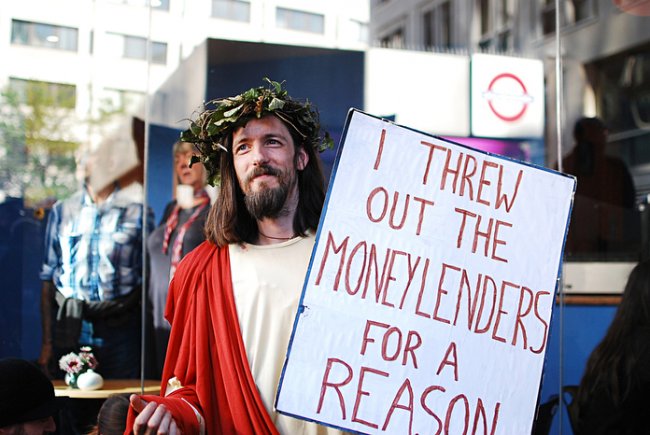
Lest I give the impression that I am some kind of Jesus, turning over tables of injustice in the white heat of righteous indignation, I also get angry at computers that do not work, at my wife when she does not deserve it and my kids when they do.