You can tell I am not sleeping much at the moment…
I decided to play with the layout of TFT. The old wordpress theme (Chaotic soul) has been in place for over 5 years so it was time for a change. I am still not sure about it all though- I was trying to tidy it up, make it look more on trend, but seem to have found a new theme then customised it more or less to how it was!
I have been thinking a lot about revolution- not the violent bloody guillotine kind, more the Jesus kind- the explosion of light in the middle of our thinking that means that living the old way seem ridiculous.
I worry that it is too late for me and for my generation. We lost our passion, our ideology, our religion. It was already being poisoned by toxic consumption when the wars in the Gulf killed it dead. What replaces this for most of us is that most pernicious anti-doctrine called cynicism. Those of us in whom some old light survives are tired and so easily distracted by trivia, sport, shiny product.
The gap between hope and aspiration is a dreadful one. We hoped for a world that was not being eaten away piece by piece by the rich North at the expense of the poor South. We hoped for societies who are learning to find harmony, community, justice, compassion. We hoped to break free from the cycles of materialism that corrupt and commodotise the lives of rich and poor (although particularly the rich.) We hoped for so much more than plastic life with built in obsolescence.
Instead we accommodate. We compromise our compromises. We watch TV. Our lives slip by with advert breaks. In an age of total communication I often find myself with three screens flicking three different sets of information at me at once. I outsourced my humanity into cyberspace; I live only on screen now.
Most of us know this to be true, and so we find ourselves on an instinctive search for something with meaning; mountaintop experiences, adrenaline rushes, screaming rock concerts. But because of the internet, because we are tired, distracted and outsourced, most of the time we look for meaning via our screens. Like the one you are reading this through right now.
And there is meaning/truth/beauty out there. Facebook is full of it- all those video clips, quotations, posters that get posted and re-posted millions of times. Clips like this one;
Don’t get me wrong- this is lovely. It might even contribute to making shifts in people minds towards grace. But at the same time do we really think that these kinds of formats can bridge the gap between hope and aspiration that I mentioned above?
You may also point me towards the way that savvy campaigning organisations have used social media platforms to get their messages across- flashmobs, direct protesting, bombarding of websites, on line petitions etc.
But if we are honest, as soon as we hit ‘share’ on most of these posts, we kind of think that our job is done right? As soon as I have written something full of faux-pathos on this blog I feel like I have liberated a captive or two, fed some hungry child or restored their sight.
But nothing has changed. Not really.
There was a great interview with Uruguayan President José Mujica in The Guardian today. He is an old revolutionary Marxist, friend of Che Guevara, who is now the leader of perhaps the most progressive country in South America. This is from the article;
“I’m just sick of the way things are. We’re in an age in which we can’t live without accepting the logic of the market,” he said. “Contemporary politics is all about short-term pragmatism. We have abandoned religion and philosophy … What we have left is the automatisation of doing what the market tells us.”
The president lives within his means and promotes the use of renewable energy and recycling in his government’s policies. At the United Nations’ Rio+20 conference on sustainable development last year, he railed against the “blind obsession” to achieve growth through greater consumption. But, with Uruguay’s economy ticking along at a growth rate of more than 3%, Mujica – somewhat grudgingly, it seems – accepts he must deliver material expansion. “I’m president. I’m fighting for more work and more investment because people ask for more and more,” he said. “I am trying to expand consumption but to diminish unnecessary consumption … I’m opposed to waste – of energy, or resources, or time. We need to build things that last. That’s an ideal, but it may not be realistic because we live in an age of accumulation.”
Asked for a solution to this contradiction, the president admits he doesn’t have the answers, but the former Marxist said the search for a solution must be political. “We can almost recycle everything now. If we lived within our means – by being prudent – the 7 billion people in the world could have everything they needed. Global politics should be moving in that direction,” he said. “But we think as people and countries, not as a species.”
Mujica and his wife chat fondly about meetings with Che Guevara, and the president guesses he is probably the last leader in power to have met Mao Zedong, but he has mixed feelings about the recent revolts and protests in Brazil, Turkey, Egypt and elsewhere. “The world will always need revolution. That doesn’t mean shooting and violence. A revolution is when you change your thinking. Confucianism and Christianity were both revolutionary,” he said.
But he is cynical about demonstrations organised by social networks that quickly dissolve before they have a capacity to build anything lasting. “The protesters will probably finish up working for multinationals and dying of modern diseases. I hope that I am wrong about that.”
The revolution does not need tanks to break down it’s barricades- those who want it to fail only need to sit back and watch it become tired, distracted, outsourced.
I hope I am wrong too. I suppose that the very presence of leaders like Mujica gives us hope, even if he is 78.
I hope that there are still people who have the courage to act as well as to observe quirky three minute clips on Youtube.
Following on from yesterdays post, I sent a letter to our local paper. This is not something I make a habit of- in fact this will only be the second such letter I have sent. The previous one was not published- and was triggered by the same issue.
At that point I took exception to a rather poorly researched story in the paper after the rock’s Golliwog face has been painted over by a protester. (NO- it was not me, although some of me wishes it was.) It made no reference whatsoever to the Blackface tradition, nor to the objections raised to the decoration on the rock by others, not least the Racial Equality Unit.
Today I sent this to the editor. I am expecting a backlash- lots of people will be very angry. However, I walk past this stone several times a day, and each time it makes slightly ashamed.
Letter for Dunoon Observer
6.12.13
Dear Editor
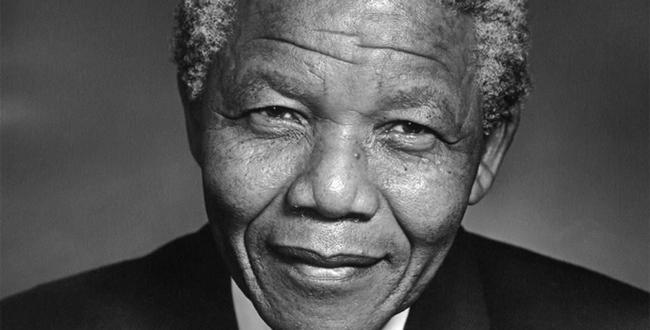
The death of Nelson Mandela seems like a very good time to take another look at some of our own racist history. In doing so we very soon have to concede that the prosperity of this area owes much to international trade; shipping, sugar, tobacco and slavery. It is to the credit of Britain that as well as participating in slave trading we did much to end this practice at the beginning of the 19th Century. However, many would argue that we replaced slavery with Colonialism.
Alongside this, our attitudes towards the non-white people of the world has often been to view them as less-than. We supported this with entrenched prejudice and even with the so called ‘science’ of eugenics. These ideas found expression in our politics (segregation, apartheid) and also in our popular culture.
One of the most pervasive cultural carriers of this prejudice were the ‘Blackface’ caricatures that developed the world over- the Golliwogs, the Minstrel shows, Zvarte Piet and Jim Crow. Understanding how these have been a channel for racism is not easy, but they are commonly understood to allow culture to reduce the feared outsider to a figure of derision. A feckless, chicken loving, sexualised layabout who steals washing from the line, but is good at singing and dancing.
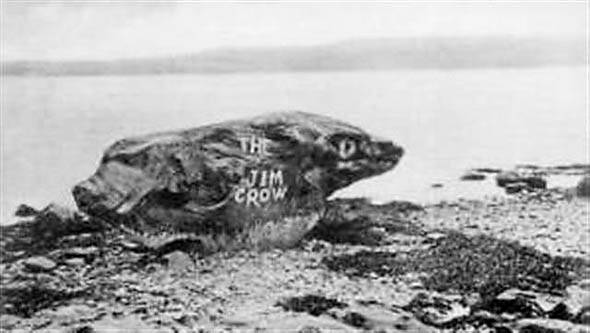
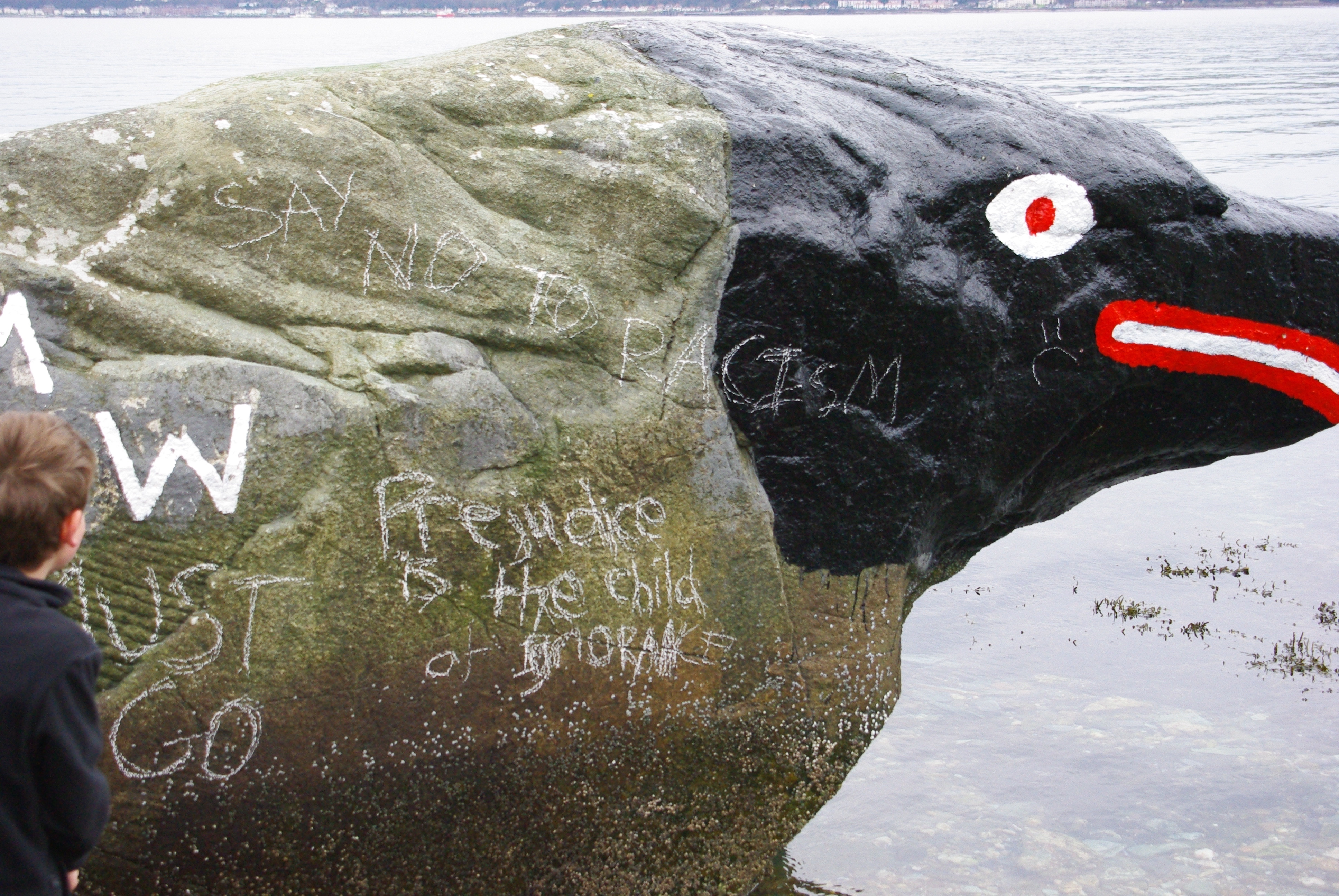
Which brings us to our own Jim Crow Rock, Only in Argyll does anyone seriously suggest that this has no racist origins. The Jim Crow museum in the USA expressed horror, the Racial Equality Unit is clear about its ‘Blackface’ beginnings, outsiders stand and look puzzled. When confronted with these outside perspectives, our response has often been to become angry and defensive, refusing to engage in any real discussion about the origins of the rock.
So, here is a suggestion; as a memorial to the late great Nelson Mandela, why do we not invest in an information board on the foreshore next to the rock? It could say some of these things;
It could acknowledge the local controversy, and disagreements about the origins of the decoration. It could deal with the role of the Clyde in the slave trade. It could talk about Blackface caricatures and the minstrel shows that were performed here in Dunoon’s heyday. It could talk about the Jim Crow Laws in America, and how they enforced segregation, prejudice and apartheid.
Above all, it could transform a local curiosity from something that is at best controversial (if not downright offensive) into something that we can all feel pride in the ownership of once more.
The great man is dead, and world leaders are tripping over themselves to cosy up to his memory. In the process, he becomes like some kind of neutral mirror in front of which others preen themselves.
He is a freedom fighter, a champion of western capitalist democracy. (Forgetting that he was also a communist revolutionary.)
He is the man of peace who chose the path of non resistance. (Forgetting that despite all the pressure to do so, he never renounced the need for an armed struggle against the state.
He is the icon of international statesmanship by which all others are measured. (Forgetting that a few short years ago many regarded him as a terrorist- including much of the Conservative government under Thatcher.)
He was the civilised face of Africa, the educated black man. (Contrast this with the way that our newspapers talk about all other black politicians in South Africa since.)
None of this should diminish the man, but it might be regarded as creating a degree of confusion, particularly as we consider the degree to which the racism that kept Mandela locked away in prison for so many years has really changed. Did his release and subsequent elevation to international sainthood mean that the battle was won?
We live in a world in which racism, of both the direct and indirect kinds, is alive and well. We still live in fear of the outsiders, who will take our jobs, ruin our NHS, steal our homes and drain our resources. When these outsiders are black or Asian, this seems to add a higher degree of concern. Australians have almost banned non-white immigration. Unfair trade relationships ensure that the white West will continue their economic ascendancy at the direct cost of the poor south- who send us their minerals and produce our goods for us. The abolition of most formal apartheid systems (African, American) has done little to change the distribution of wealth and power between black on white people, both within societies and across nations. Beware those characterisations of passive-Mandela that allow us to forget this- it does the memory of the great man no favours.
We the privileged have a reciprocal responsibility to act out the gift of it with grace. Part of this might be to confront the injustices that we inherit- both to understand the cost of this privilege, but also to confront our propensity towards self justification. This seems all the more important as the people in power line up to put a slice of Mandela in their top pockets.
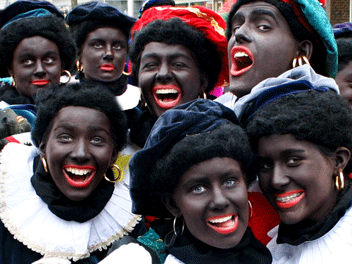
In the spirit of ‘minding our privilege’ (a rather useful American phrase) I was reminded today of two other stories that carry more than a little of the old racist divisions. The first one is this one, concerning the tradition of Zwarte Piet or ‘Black Pete’ in Dutch traditional Christmas celebrations.
As the Netherlands gears up for its annual Saint Nicholas celebration on Friday, the festivities are in danger of being overshadowed by a growing row over his helper and clown, “Black Pete”.
While families exchange presents and eat cakes to welcome Santa Claus’s slimmer and more sober ancestor, criticism of the crude depictions of his sidekick, known locally as Zwarte Piet, has reached the United Nations.
The clown is usually portrayed by a white person in blackface, who goes around offering sweets to good children and, according to legend, threatens to collect naughty ones in a sack to be taken to Zwarte Piet’s home in Spain. But he is increasingly reviled by critics as a racist relic of Christmases past.
Momentum has been growing against the custom, in part thanks to campaigners such as Quinsy Gario, a poet and activist born in the former Dutch colony of Curaçao who was arrested two years ago for wearing a T-shirt with the slogan “Black Pete is racism” at a Saint Nicholas parade in the city of Dordrecht. Gario’s message is that the tradition perpetuates crude stereotypes.
The criticisms of Zwarte Piet have stung the Dutch, 91% of whom seem to want to keep it as part of their tradition, and will say it is harmless, and the black face is just because Piet comes down chimneys. However, the roots of the tradition seem to go back to ideas of good (St Nicholas) overcoming evil, and chaining the devil to service. The Devil of course, is African. He is less-than-human, a worthy recipient of our projected fears, hidden behind all the grease paint and derision.
Zwarte Piet reminds me very much of another blackface image that is a lot closer to home- about 100 meters in fact, the controversial Jim Crow rock;
The blackface/Golliwog imagery of Jim Crow and Zvarte Piet are a direct link with the racism that justified slavery, that built the wealth of the West, that created colonialism, that gave birth to apartheid, and that Nelson Mandela gave his life to confront head on.
Perhaps a fitting memorial for his death might be to take another look at this history, and to mind our privilege.
Dunoon folk- I have said this before, and I respectfully say it again;
“… there can be no doubt that the painting of the ‘face’, with its exaggerated red mouth, is a typically caricatured image of a black person, as popularised by the American entertainer T.D. Rice in the nineteenth century. […] I feel certain that black visitorsfrom outside would see this as somewhat insulting […] as a derogatory reference to their skin colour and origins.”
So – are we sure that this is just a little bit of harmless local colour? And even if it is just that- are we really comfortable with the associations that are being made, and the offence that this might carry to the descendants of slaves who had to fight on for generations against the oppression of the Jim Crow laws?
If the rock is to stay, then we need to tell these stories.
If we are to keep the face on the rock- then let us also put a big sign on the foreshore dealing with the darker side of our past…
This was the question asked of Guardian Editor Alan Rusbridger by MP Keith Vaz whilst he was being quizzed about the papers exposure of what western security forces were doing in our name to spy on ordinary people.
The story of how a former NSA contractor Edward Snowden has exposed the shady practices of our security services is a rather fascinating one, but I find myself lingering on this question- “Do you love your country?”
It seems such an un-British question. Love of country seems to be a prerequisite for anyone involved in public life in the US, but not here. We are usually slightly embarrassed by such displays of public patriotism- such things belong to an age of imperialism, or perhaps to the extremism of the English Defense League.
I have not even heard friends who are fervent supporters of Scottish independence say that they love their country- not through lack of passion and commitment I am sure, but rather because most of us are simply not sure what such a phrase might mean.
Does it mean blind unswerving partiality and loyalty to everything that our country contains- north or south of the border? Does it mean being prepared to die to ensure that our ascendancy is continued or enhanced?
Does it mean a love of place- the shape of the land and the history contained in each and every stone?
Does it mean a love of SOME parts of what might be contained within ‘country’, and even a loathing of others?
I am British- somewhere inside. I find this difficult to define- as an English/Irishman living in Scotland. I am grateful for the gentle green climate of these beautiful islands, and for the slow pragmatic evolution of our welfare state.
But (in the words of many a school report) we could be doing better…
Does this mean that I love my country? I think the word love is meaningless when applied to something to huge, so complex. I love my wife, I love my kids, I love vinegar on my chips and cricket bats and Bruce Cockburn’s music. But my country?
I think the job of my country is to provide the graceful just framework for us to learn to love each other better. As soon as we start with the flag-worship nonsense too much gets hidden in the shadows.
It is nearly 10 AM on the morning after. 4 people are up in the house- out of (I think) 35. I had around 4 hours sleep, but these days wake when the day calls me rather than listening to what it needs. Just thought I would post a few photos from last night for those of you who were not able to join us to dance Emily into adulthood!
It was a a great night- we had a piper, a great band (Canned Haggis, who are simply the best combination of musicianship and encouragement in the dance,) solo spots from Skye, Hannah and Rachael, conversations with lots of friends, and just about everybody danced. I danced a lot- in fact this morning I feel like I have been on an SAS selection course.
Here is some evidence of it all (taken with no flash in an almost dark room so apologies for the motion blur!)
Today Emily is 18! I am heading off to collect her (along with an assortment of friends) from Stirling University.
Cue whirlwind weekend with a house full of old friends, and the odd room full of students sleeping in Mondian shapes.
Tomorrow night we Ceilidh the Scottish way, with a piper and everything.
I know we fathers are all proud of our daughters, but I think I have more reasons than most because of whom she is,what she is becoming, and the life she brings to every space she graces…
It is official. If you are religious, you are also likely to be stupider than those who have no faith.
On a day when the Mayor of London has made the dodgy science of intelligence testing newsworthy in what even the Deputy Prime Minister called ‘unpleasant, careless elitism’ I thought it was time to come out of the closet and tell you what you knew all along; I am a thickie.
I would say ‘I am Sparticus’ but I am not sure how to spell it, and anyway you probably would not get the reference (if you are religious too.)
A meta-analysis of 63 studies showed a significant negative association between intelligence and religiosity. The association was stronger for college students and the general population than for participants younger than college age; it was also stronger for religious beliefs than religious behavior.
What might this be caused by?
Are we thick BECAUSE we are religious, or do we believe because we are too stupid not to? Does God disengage our brains somehow, or are smart people too smart for God?
The study does make some guesses at what this might be about;
Three possible interpretations were discussed. First, intelligent people are less likely to conform and, thus, are more likely to resist religious dogma. Second, intelligent people tend to adopt an analytic (as opposed to intuitive) thinking style, which has been shown to undermine religious beliefs. Third, several functions of religiosity, including compensatory control, self-regulation, self-enhancement, and secure attachment, are also conferred by intelligence. Intelligent people may therefore have less need for religious beliefs and practices.
So, they think that smart people out think the need for God, and can find the resources offered to them by religion through other means.
Interesting that the effect is most noticeable in the avowed belief rather than actual religious practice…
I have not read the whole study, as I am too thick to need access to academic downloads in the press of my unintelligent life, but the first thing I think we should point out is that the usefulness or otherwise of intelligence tests is a battleground within psychological study, albeit one that I will not even try to bother your pretty little heads with.
My sister challenged me to right something lighthearted here, and leave behind all the heavy economic/theology etc for a while, at least in part because some of it was making her cry (which in my book is no bad thing!)
I tried sis, I tried, but then I come across this;
I am trying not to get too excited by this old man. He is after all human, and like all of us, will be shown to have clay feet. But in the meantime he makes my heart dance.
At last someone is using a traditional seat of global power to speak the words of Jesus into the madness of our age. Those in power are rattled. The small people are engaged.
People get crucified for this kind of thing you know.
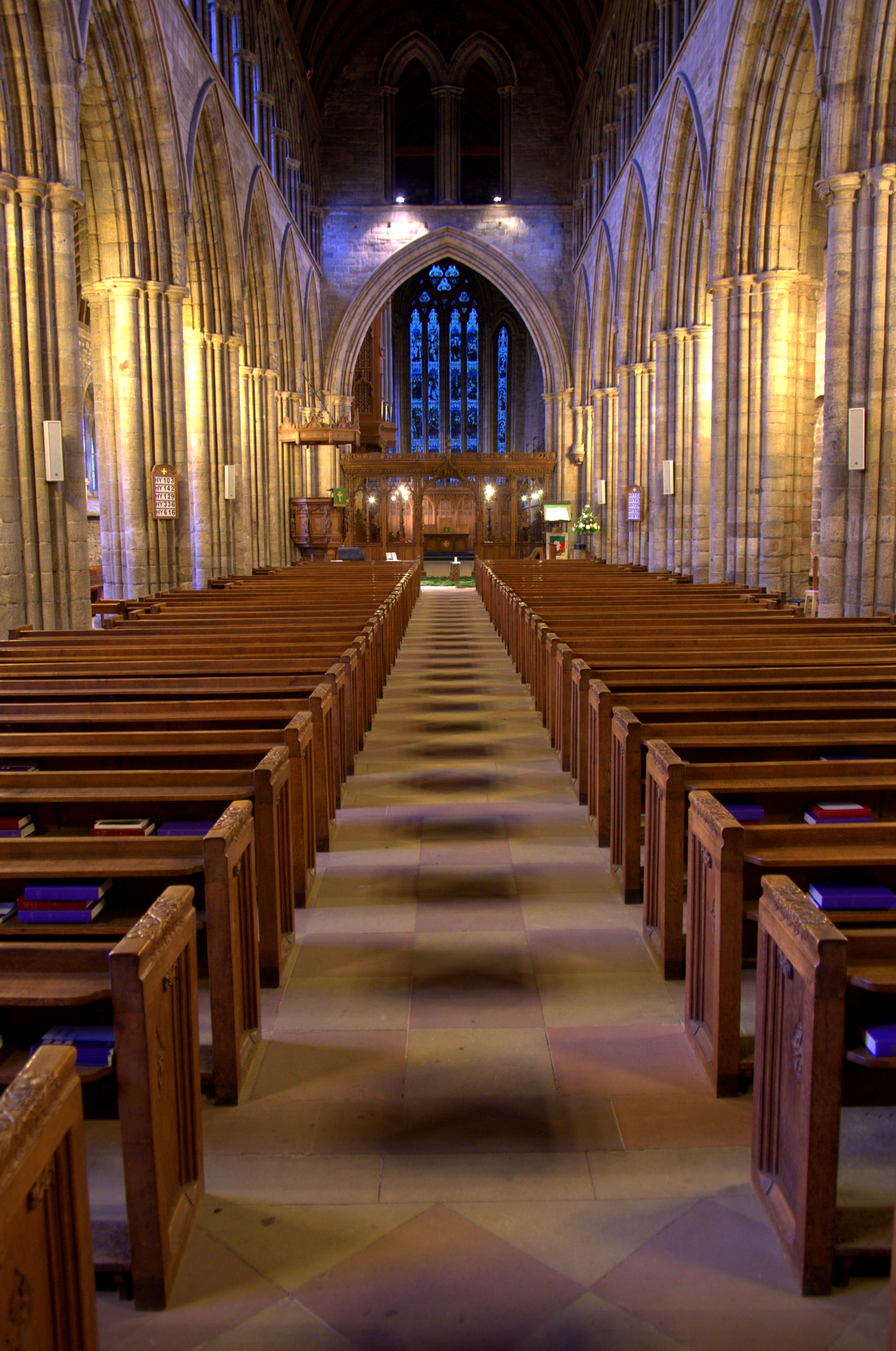
On Sunday, Michaela and I visited Dunblane. It is a sleepy town, famous only as the town in which tennis player Andy Murray grew up. In fact, he was a pupil in the school during the shooting. It is a small town steeped in gentile prosperous tradition. How on earth do people make sense of such horror? Even all these years later?
What is the place of faith in understanding and finding peace?
I have no answers to these questions really- my children did not die, I was not part of the wider community. I can not begin to presume to understand what the journey might have been like for these people. I do know however that the degree to which experience is collectivised, shared, held in common, can become an essential part of this journey for many.
And for this, I am grateful for the Church. Not because it has answers- easy explanations are an insult. Not because it has skilled pastors, after all there are many more highly trained in counselling the bereaved. Not because the Church can expect to be the point where people gather any more at times of crisis.
But having said all this, where else would people go? Who else can listen to the cries at funerals? Where else can people be to share their grief, their anger, their survivor guilt, their hopelessness?
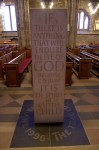
Standing in the ancient Cathedral building in Dunblane, amongst all those medieval carved stones and brass memorials to men and women long gone, stands a new memorial;