Being ‘spiritual’: it is bad for you?

sundial and one of the three Lichfield spires

“I am not religious, but I am spiritual.” How many times have you heard someone say this? I suppose, given the devaluation of the word ‘Christian’ with western culture, and the post-modern slide into an elastic pluralistic individualism it is one of those sentences that increasing numbers of us would use to describe themselves (as can be seen from the recent Census data.)

Despite my continued attempts to hold to the ways of Jesus, the idea of a religion-less spirituality appeals to me too; leaving behind all the baggage and rigidities of proscribed doctrine and setting off on my own spiritual adventure…

However, Sam Dawlatly kindly  sent me a link to a story in the Telegraph. Here are a couple of quotes;

People who said said they had spiritual beliefs but did not adhere to a particular religion were 77 per cent more likely than the others to be dependent on drugs, 72 per cent more likely to suffer from a phobia, and 50 per cent more likely to have a generalised anxiety disorder.

They are more likely to suffer from a range of mental health problems than either the conventionally religious or those who are agnostic or atheists, found researchers at University College London.

They are more disposed towards anxiety disorders, phobias and neuroses, have eating disorders and drug problems.

In addition, they are more likely than others to be taking medication for mental health problems.

Professor Michael King, from University College London, and his fellow researchers wrote in the British Journal of Psychiatry: “Our main finding is that people who had a spiritual understanding of life had worse mental health than those with an understanding that was neither religious nor spiritual.”

…The researchers concluded: “We conclude that there is increasing evidence that people who profess spiritual beliefs in the absence of a religious framework are more vulnerable to mental disorder.

“The nature of this association needs greater examination in qualitative and in prospective quantitative research.”

What is going on here then?

Firstly, we must look at the numbers a bit more closely- the study is not huge even though statistically significant;

The study was based on a survey of 7,403 randomly selected men and women in England who were questioned about their spiritual and religious beliefs, and mental state.

Of the participants, 35 per cent described themselves as “religious”, meaning they attended a church, mosque, synagogue or temple. Five in six of this group were Christian.

Almost half (46 per cent) described themselves as neither religious nor spiritual, while the 19 per cent remainder said they had spiritual beliefs but did not adhere to a particular religion.

Members of this final group were 77 per cent more likely than the others to be dependent on drugs, 72 per cent more likely to suffer from a phobia, and 50 per cent more likely to have a generalised anxiety disorder.

They were also 40 per cent more likely to be receiving treatment with psychotropic drugs, and at a 37 per cent higher risk of neurotic disorder.

The interesting thing is that this study is in contrast with a lot of previous research about the impact of religious belief on measures of psychological and sociological health- which sees faith has having clear benefits, even if more recent research has suggested that some of the self esteem benefits depend on the wider societal norms towards religiosity.

Accepting that this research may simply be a rogue study, there seem to me to be a few possible reasons why those who consider themselves Spiritual (but nor Religious) (SBNR) might appear to be vulnerable as a wider group.

Self selection

The link may well not be causal, but correlational. Perhaps those of us who are spiritually seeking outside the edges of organised religion are doing so because life has driven us there. Perhaps even our negative experiences of church has driven us there. It is hardly surprising that we might be seen to be stressed, troubled and even unwell. These things are not necessarily measures of the futility of the journey, but more part of any real human experience- part of the process of changing, becoming, learning to inhabit our own skin. We learn far more about ourselves in crisis than we ever do in prosperity.

The question might remain as to why this is NOT also the case for the religious? Are they not also  being challenged, shaped and changed by their contact with scripture/teaching/existential challenge? All I can say is that in my experience in Churches, this is rather rare. The pews offer comfort more than adventure.

In this sense, the idea of spiritual travellers on the road, nursing wounds on the way seems not necessarily a negative- rather it offers hope for our humanity. Despite it all, we still strive for connection with the divine.

Belonging

A lot of the presumed benefit of religion at  both a sociological and psychological level seems to be the given sense of belonging, of inclusion and connection to a wider family. Even accepting that in-groups can have all sorts of other problems, this benefit appears to be rather universal. It should not be surprising then that those who are attempting spirituality without community do not experience this benefit.

I have written elsewhere about my conviction that we experience the divine through scripture, through revelation, but perhaps most through community. We humans were made to love- and this is not an abstract proposition divorced from the mess of human contact. Nothing strips us bare, opens us up, sustains us, breaks us down, wounds us, heals us, like community. I also beleive that our approach to theology should also be one of ‘small theologies’ (HT Karen Ward) worked out in community- in respect of ‘big theologies’, but not enslaved to them.

Having said that, it seems that there are surface benefits too in just demonstrating some kind of collective respectability- even if this depends on a wider societal respect for the religious badge that we wear. I confess to less concern about this kind of religiosity. It sounds too much like the stuff that Jesus had no time for.

The lesson here then might be to encourage our spiritual seekers to connect with one another. In these times of total (but fleshless) communication, the deeper community connection described above is a rare commodity, and where it happens it is a precious flame that we should nurture.

Believing

Finally, I have been thinking about the nature of faith itself. We have many models- faith as journey, as destination, as therapy, as national identity, as absolute truth, as means of rescue from hell. From the outside all of these organised expressions of faith appear rigidly codified, doctrinal, dogmatic. They seem to demand blind observance of rules and regulations often policed by male power. Small wonder that we would be suspicious about joining such an organisation. Small wonder that pilgrims remain outside the sites of pilgrimage.

However, I am reminded of this;

Spirituality requires context. Always. Boundaries, borders, limits. ‘The Word became flesh and dwelt among us.’ No one becomes exalted by ascending in a gloriously colored hot-air balloon. Mature spirituality requires askesis, a training program custom-designed for each individual-in-community, and then continuously monitored and adapted as development takes place and conditions vary. It can never be mechanically imposed from without; it must be organically grown in locale. Askesis must be context sensitive.

Eugene Peterson

Under the Unpredictable Plant

Perhaps like others who are more comfortable with being SBNR I prefer to regard faith as a journey of engagement with the God-in-all-things. To look for the marks left by Jesus on the whole of creation. But in doing this, It has become clear to me that in order to journey we need a means to travel. We need a road, and shoes to walk it with.

Like it or not, this means of travel is religion.

It is the corrective to the self centred me-first spirituality that can often characterise SBNR journeying. You know what I mean- a pick and mix spirituality tailor made to make me feel better about the choices I have made, and the lifestyle I want to live. A situation where morality and love of strangers are elasticated around our own comfort zone. (Not that these characteristics are not to be equally found in churches of course!)

It challenges us towards connection to others who have journeyed first.

To all of those SBNRs out there- I think you are the hope and the conscience of our generation. The depth and meaning you find in the mess of western civilisation will be recorded in art, law, history and handed on to the generations to come- so may you journey well…


journey's end

Things to do on NYD…

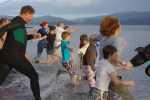
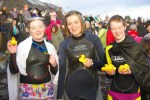
You could take a wee swim in aid of charity? We did;

Happy New Year!

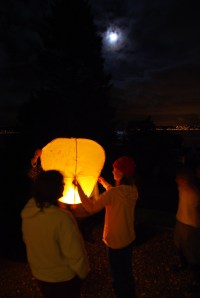
All saints eve sky lantern


Another year.

May 2013 bring to you many good things.

It is nearly 2AM and we are enjoying some peace after a lovely evening with friends old and new. We let off a couple of sky lanterns, one to remember the year gone and one to express hope for the year to come. We also used this simple ritual;

1.

We stand on the threshold of another year

The old one is gone and the new one is still mystery

And we offer you our prayers

We watch them rise to you

2.

Last year was full of good things;

Friendship, laughter, music, art

New experiences,

New achievements

For these things we offer you our praises

We watch them rise to you

3.

For some of us the year gone by has had times of great difficulty

The loss of a people who are dear to us

Life has darkness as well as light

So we give to you all those memories-

All those times when doubt, fear and pain were close at hand

We watch them rise to you

4.

The future belongs to you Lord

Each breath, each heartbeat

So we give you our hopes

We offer you our projects

We offer you our dreams

We watch them rise to you


Return to Kanyini…

A few years ago I wrote about this film on TFT;

Back in 2008 I wrote this;

The concept of kanyini has been brought to us by a beautiful man called Bob Randall who grew up as an aboriginal boy on the outskirts of a cattle station in central Australia. His father was a farmer of Scottish extraction, but appears to have had no concern for him at all. Like 50,000 other black kids of mixed race (between 1910 and 1970) he was forcibly removed from his mother, and sent to school hundreds of miles from home. He was forced to learn the rules of white culture- the clothes, the way of life, the religion. He learnt to appreciate the contradictions between the words of Jesus, and the actions of these, his followers. Since then, he has been a welfare worker, a songwriter, and author, and now, works with Australia’s black community.

To be a native Australian in these times is to be part of a community with huge problems- health, crime, substance misuse, soaring suicide rates. It is a community living in the shadows of the sky scrapers of new Australia, but also in the shadow of genocide, in which everything ans almost everyone who was part of the oldest culture in the world was all but destroyed.

It is also the story of a Diaspora of westerners (particularly Celts from Ireland and Scotland) often still under the shadow of their own experience of oppression and injustice, who become in turn the oppressors, murderers and rapists of a whole culture.

It is their story, but it is also ours. It is the story of what happens when we become disconnected from who we are.

Because to hear Bob Randall speak is to feel the pull of something wonderful. He describes a culture where people are connected to land. Birds, trees, all living things- they are family. The proof of this connection is that we are… alive! And because everything is connected, everything is OURS, not MINE. Everything is already created in a perfect state and our job is to become part of it.

Bob describes his memory of life as a kid like this;

These were beautiful people, because they lived in a beautiful way.

Bob’s concept of Kanyini feels right. It has simple truth- and seems to encapsulate the idea of community as I understand it should be. It has 4 components;

  • belief system

  • spirituality

  • land

  • family

I am reposting this partly because I found the film in full (as above), but also because I think that this list is a good one to consider as we look again at the year to come this is a good place to start.

If life for the people in this film started to unravel as they lost connection with the things above- might the same be true for us?

How do we challenge this, for ourselves and our communities? Our connection to something we can believe in/live for, our connection to the divine, our love of where we are located, our existence within an extended family (whether or not we have blood ties.

May 2013 be your year of Kanyini.

Magnolia…

red walls

Life is too short for magnolia

Let’s splash the old walls with new paint

Mix me purples and blues

Like a two day-old bruise

And gold like the robes of a saint

.

Where does it come from, magnolia?

Not from the wild places I’ve been;

Brown eggs in a nest

Bright robin red breast

And oceans of deepest sea-green

.

What is the point of magnolia

When rain is by rainbows replaced?

It’s the space left behind

When colours go blind

It’s like life being leached from a face

Imagining something better…

change-1

The lovely low days between Christmas and New Year offer to some of us the privilege of a bit of stock taking- asking those important questions about where we are now, and where we might be going.

I have been doing a lot of this of late, and will be doing some more- but one thing I am increasingly convinced of is the need to consume less, to make more with my own hands, to produce, to craft and to live more simply. Unfortunately over the past few weeks this has actually meant repeated trips to consumer-hell; IKEA and other temples to Capitalism. This is because we are setting up a guest house in a relatively out of the way corner of Scotland, and there are only so many things that you can knock together out of driftwood. It feels very wrong though.

I came across this today;

“But even in the much-publicized rebellion of the young against the materialism of the affluent society, the consumer mentality is too often still intact: the standards of behavior are still those of kind and quantity, the security sought is still the security of numbers, and the chief motive is still the consumer’s anxiety that he is missing out on what is “in.” In this state of total consumerism – which is to say a state of helpless dependence on things and services and ideas and motives that we have forgotten how to provide ourselves – all meaningful contact between ourselves and the earth is broken. We do not understand the earth in terms either of what it offers us or of what it requires of us, and I think it is the rule that people inevitably destroy what they do not understand.”
― Wendell BerryThe Art of the Commonplace: The Agrarian Essays

Which chimed with something else…

I read somewhere that Journalist Mark Hudson proposed 4 stages in our relationship with stuff;

  1. Wanting it all– life is about seeing stuff, wanting it, collecting it, playing with it, wanting the stuff other people have that is better than ours.
  2. Getting rid of it all- As we head out into the world, we no longer need all those treasures of our childhood- we put it in bags, lofts and dustbins. Experiences become more important
  3. Buying it all back again- We crave the stuff we used to have, and the feeling of security, pleasure and fulfilment we get from surrounding ourselves with walls of stuff.
  4. Getting rid of it all again. As we get older, we become more discerning about the stuff we want to hold on to. And we begin to worry about all the sorting out our kids will have to do.

And of course, we can not take it with us on the next journey. How many journeys to the tip and the charity shops will we all be making in the next few days?

The problem is- how on earth can we do it differently- how can we live a better way of being?

Time for another quote;

“We have to create culture! Don’t watch TV, don’t read magazines, don’t even listen to NPR. Create your own road show  The nexus of space and time where you are now is the most immediate sector of your universe, and if you’re worrying about Michael Jackson or Bill Clinton or somebody else, then you are disempowered, you’re giving it all away to icons, icons which are maintained by an electronic media so that you want to dress like X or have lips like Y. This is shit-brained, this kind of thinking. That is all cultural diversion, and what is real is you and your friends and your associations, your highs, your orgasms, your hopes, your plans, your fears. And we are told ‘no’, we’re unimportant, we’re peripheral. ‘Get a degree, get a job, get a this, get a that.’ And then you’re a player, you don’t want to even play in that game. You want to reclaim your mind and get it out of the hands of the cultural engineers who want to turn you into a half-baked moron consuming all this trash that’s being manufactured out of the bones of a dying world.”
― Terence McKenna

I don’t know much about this bloke- I think he was a bit of a Hippie ‘herbalist’, but I find myself in agreement.

I am longing for life that does not conform to the same tired, self destructive, addictive patterns. Not just talking about this kind of life- but actually starting to live it, now, in the new year, 2013. Because how much time is left?

Next year is going to be our year of new beginning. I am not exactly sure how this will go, but let the wild rumpus begin…


My mate Andy has too much time on his hands!

Find him some DIY to do Clare- quick- or at very least some dishes…

Otherwise he will post yet more embarrassing video clips of me on YouTube.

This (I think) was taken clandestinely during one of our ‘wilderness retreat’ trips. Dancing is not usually encouraged, but I must have come over all 1970’s.

I am looking forward to spring though- Christmas day is past, and the uphill climb through the hard soil of winter can begin…

TFT Christmas card 2012…

IMGP3179

Sometimes darkness lies with open arms

Casting no shadows;

No zones of jagged uncertainty

The folded black is bosom-soft

An iris around the eye

Could it be that dark is not opposed by light

But is the place where light is falling?

For the night is not defeated by starlight-

It is anointed.

At the edge of this suburban half light

Beyond the reach of neon

Darkness is waiting

Like pregnancy

For light to be born

IMGP3178


May you be richly blessed this Christmas.