Burns day…

Today is Burns day.

For the uninitiated, this is a big day up here in Scotland. There will be many a haggis piped in and much raising of whisky glasses along with ceremonial readings of Burns poetry. It is possible that somewhere in this wonderful world that there are other great poets whose memory is celebrated by a national day all of their own – the poets of ancient Persia perhaps – but if so, I do not know of it. This fact alone singles out Burns as special.

(There is an interesting article in the Guardian today about William Barnes, a Dorset poet, also a farmers son who wrote in his own dialect.)

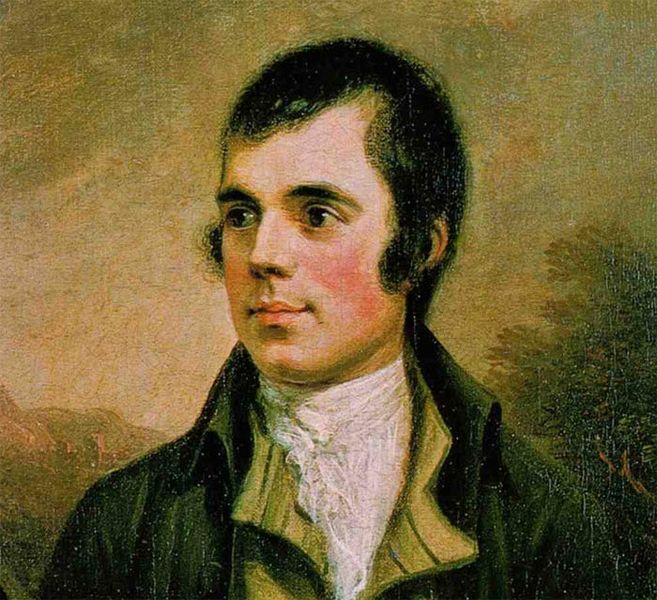
Burns was a man who packed an awful lot into his 37 years of life. Before he died in 1796 he had been a farmer, a book keeper on a Jamaican slave plantation, a tax man, a part time soldier, a song writer and (of course) a poet of power, subtlety and gifting who was able to speak with an authentic voice.

Burns personal life was no less colourful. Jacobite, Freemason, Socialite, Womaniser (who is said to have had many illegitimate children.) Lover whose poems immortalised Highland Mary, whose statue stands above her (and my) home town still –

Burns died young after living hard. He was a man of many contradictions; a supporter of revolution who collected taxes; a campaigner for liberty and justice who worked on a slave plantation; a socialite and friend of the rich and powerful whose wife and many children lived in real hardship, particularly after his death.

Why did his poetry endure? How did it become to be so identified with Scottish culture?

Burns was a fierce nationalist, and his Jacobite leanings had become very fashionable in the century after his death thanks to the Victorian romantic vision of ‘Bonnie Prince Charlie’ and the reinvention of Highland heritage and regalia by Sir Walter Scott, who had known Burns. Although Scott, a Unionist, would certainly not have approved of this one;

The other force that propelled his on going fame was the establishment of Burns nights by friends of Burns shortly after his death. The huge popularity of Freemasonry at the time carried this tradition all around Scotland and into Northern Ireland, as Lodges began to celebrate Burns night with food, whisky and poetry.

Burns endures because his poetry capture something of what Scotland believes and hopes itself to be – fierce, proud, simple, direct, passionate, defiant, independent minded. The fact that he was a bit of a rogue does him no harm either.

But enough of this- time for some poetry. I confess not to find Burns easy but then how many of us read Shakespeare for fun? But occasionally something lyrical and beautiful breaks through. I tend to find myself drawn to the songs he wrote-

A Fiddler in the north

Amang the trees, where humming bees,

At buds and flowers were hinging, O,

Auld Caledon drew out her drone, And to her pipe was singing, O:

‘Twas Pibroch, Sang, Strathspeys, and Reels, She dirl’d them aff fu’ clearly, O:

When there cam’ a yell o’ foreign squeels, That dang her tapsalteerie, O.


Their capon craws an’ queer “ha, ha’s,” They made our lugs grow eerie, O;

The hungry bike did scrape and fyke, Till we were wae and weary, O:

But a royal ghaist, wha ance was cas’d, A prisoner, aughteen year awa’,

He fir’d a Fiddler in the North, That dang them tapsalteerie, O.

Tapsalteerie=topsy turvy. Work the rest out for yourself!

Then there is this beautiful song (with Dick Gaughan’s version of the lyrics below.)

Now westlin winds and slaughtering guns
Bring autumn’s pleasant weather
The moorcock springs on whirring wings
Among the blooming heather
Now waving grain, wild o’er the plain
Delights the weary farmer
And the moon shines bright as I rove at night
To muse upon my charmer

The partridge loves the fruitful fells
The plover loves the mountain
The woodcock haunts the lonely dells
The soaring hern the fountain
Through lofty groves the cushat roves
The path of man to shun it
The hazel bush o’erhangs the thrush
The spreading thorn the linnet

Thus every kind their pleasure find
The savage and the tender
Some social join and leagues combine
Some solitary wander
Avaunt! Away! the cruel sway,
Tyrannic man’s dominion
The sportsman’s joy, the murdering cry
The fluttering, gory pinion

But Peggy dear the evening’s clear
Thick flies the skimming swallow
The sky is blue, the fields in view
All fading green and yellow
Come let us stray our gladsome way
And view the charms of nature
The rustling corn, the fruited thorn
And every happy creature

We’ll gently walk and sweetly talk
Till the silent moon shines clearly
I’ll grasp thy waist and, fondly pressed,
Swear how I love thee dearly
Not vernal showers to budding flowers
Not autumn to the farmer
So dear can be as thou to me
My fair, my lovely charmer

And finally, a quote from Thomas Carlyle, speaking of Burns

Granted the ship comes into harbour with shrouds and tackle damaged, the pilot is blameworthy… but to know how blameworthy, tell us first whether his voyage has been round the Globe or only to Ramsgate and the Isle of Dogs.

Burns travels far.
 

The return of the protest song…

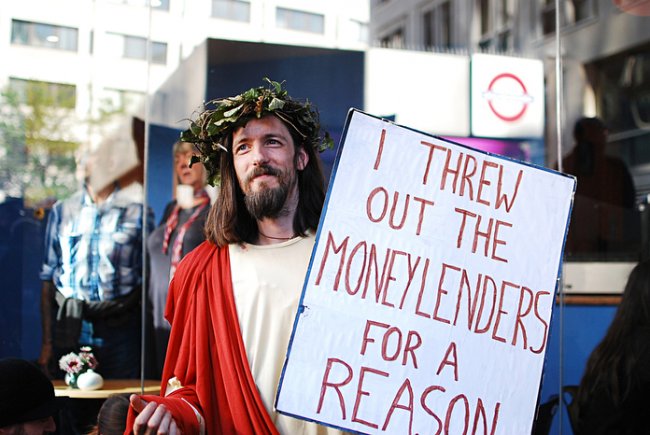
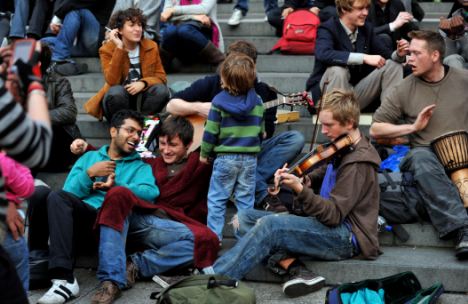
The Occupy London movement have launched their own music channel, along with an album entitled ‘Folk the Banks’.

More from the Guardian here.

The first album, called Folk the Banks, has a cover designed by the artistJamie Reid, who stuck a safety pin through the Queen’s nose on the Sex Pistols’ behalf all those years ago. This is not punk, though, but – as the title suggests – folk music.

Adam Jung, an activist from the US who is the driving force behind the project, believes the organisers have made the right choice of musical genre. “Folk makes sense because it’s traditionally the music of protest,” he said. “It’s the music of the people. It’s very appropriate for the first album to come from that tradition.” And even if this one doesn’t take off, there are already four others in the pipeline.

The 17-track album includes work by Tom Morello of Rage Against the Machine, Billy Bragg, Anaïs Mitchell, Ani DiFranco, Sam Duckworth and the stalwart anarchist collective Chumbawamba. Yours in exchange for a donation, it will be distributed digitally and, the organisers hope, on vinyl.

Vinyl! I hope to be able to get hold of this…

The power of song to communicate ideas and to allow passion to flower in the very heart of us all remains strong. Sing on I say- we need you.

Man flu…

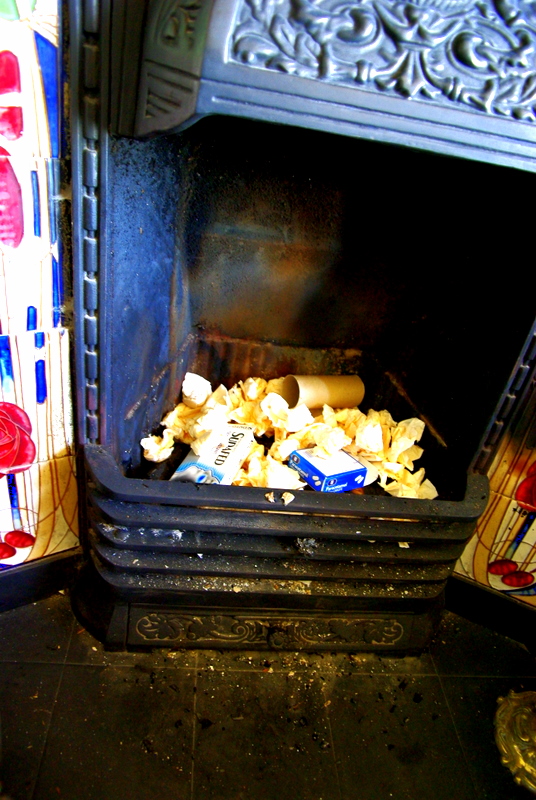
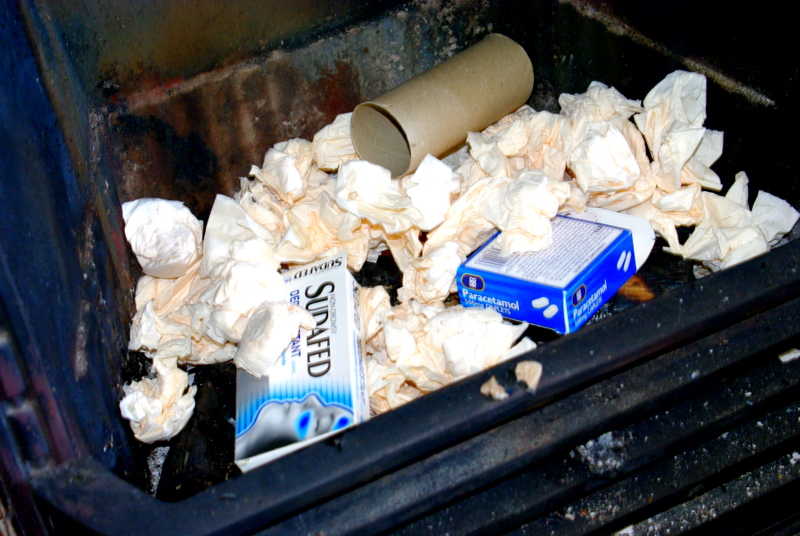
I could explain to you just how ill I feel right now after two nights with no sleep, lungs coughing up things the colour of moss, and a head like a blender…

…but I am too ill to write. Count yourself lucky.

Instead I offer you these photographs of our fire place after one mornings action –

Community and the social core…

I joined this site recently, thanks to a contact on my blog because of an old post about Poverty and the Emerging Church.

‘Our Society’ is helping to join people together for good – to exchange ideas and information and encourage community action, and as such it seems like something to shine light and sprinkle salt on.

The site is focussed south of the border at present, so it would be great to get some Scottish participation.

Gavin Barker sent me this power point in relation to work he has been doing to map areas of social deprivation;

<div style=”width:425px” id=”__ss_11131652″> <strong style=”display:block;margin:12px 0 4px”><a href=”http://www.slideshare.net/Gavman/imd-our-society&#8221; title=”Mapping deprivation and co-production” target=”_blank”>Mapping deprivation and co-production</a></strong>

The slides about the importance of connections and ‘social capital’ are very familiar, but the idea of a ‘social core’ was less so to me.

The measure of our societies depends to a large extent on the community activists at the heart of our towns, which Gavin describes as the ‘social core’ who tend to be

•Middle aged
•Have higher education qualifications
•Owner occupiers
•Actively practice their religion
•Have lived in the same neighbourhood for at least 10 years
•Over 60% of middle aged females would be counted as part of the civic core
~
These folk will do 72% of the civic participation, 79% of the charitable giving and 87% of the voluntary hours.
~
Gavin also talks about the ‘inner core’ – the 7.6% of the population who do 22%, 40% and 49% of the above.
~
I would add to this (from a small town Scottish perspective) that these people are also often incomers- that is, migrants into the area, or ‘white settlers’ as they are disparagingly known.
~
You could legitimately argue that the description of the social core above is simply those who can afford to spend time, money and energy on these things. Other people are caught up in surviving. However; whatever the reason, whatever the motivation, thank God for them, particularly in these times of disconnection and fragmentation.

Scottish independence?

So, the issue of independence for Scotland from Great Britain is at the top of the political agenda.

Tory leader, David Cameron decided to force the issue and in the process managed to give a political boost to the Scottish Nationalists – any posh London Tory who tries to flex his or her muscles up in Scotland is going to be resisted by 90% of the population up here. As someone said, there are more polar bears in Scotland than Tory members of parliament!

I have written before about my own take on all this which is pretty much along these lines-

  • I am an English/Irishman, living in Scotland. Most of us are part of a similar mix when you scratch the surface.
  • I have an innate suspicion of nationalism as I can’t think of a single instance of nationalism being a force for good
  • Rather nationalism is often associated with ‘us first’ – defended boundaries, exclusivity and sectarianism.
  • This is particularly the case in when politics starts to use history as a justification. It all becomes distorted and dishonest

Does this mean that the 5.2 million people who live in Scotland (8.5% of the total UK population) could not benefit from independence? The answer to this of course is that no one really knows. The economic case is yet to be argued, not to mention the wider political implications for the whole of the UK. The argument has been really stuck at some kind of romantic notion of ‘Scottishness’, which is of course defined AGAINST as much as defined by.

Defined against the English that is.

Typified by the proposal (by the Scottish Nationalist Party) to hold a referendum on the 700th anniversary of the Battle of Bannockburn. Because Robert the Bruce has more to teach us about our politics than all those intervening years of Empire and conquest (apparently.)

Is it possible to love your country without seeking to denigrate your neighbours? I hope it is for the sake of the future of these islands. I hope we can promote the politics of reconciliation and respect. I suppose nationalists in Scotland would argue that this is only possible when there is an equal partnership, or even genuine self determination.

I read this recently, which paints a strange picture of views on this issue either side of the border –

The poll shows that while a substantial proportion of Scots (40 per cent) back independence, 43 per cent want to remain inside the United Kingdom.

However, among English voters – who would not get a vote in any referendum – there is a clear lead for those who support independence for Scotland (43 per cent) over those who want the Union to be preserved (32 per cent).

Most Scots admit their nation would be worse off after independence (41 per cent) than better off (38 per cent), while 51 per cent of English think the Scots would be worse off.

Some 61 per cent of English people, moreover, say the current formula which sees higher government spending per head in Scotland is unjustified – a similar finding to 2006.

Among Scots, 53 per cent think that the spending system, known as the Barnett formula, is justified while 21 per cent do not agree.

So will it happen?

At the moment I would say that the odds are against, but I hope that over the next year the questions asked will be much more sophisticated ones, rather than just the agenda that is set by the Edinburgh Tartan Elite.

Blowing away the cobwebs…

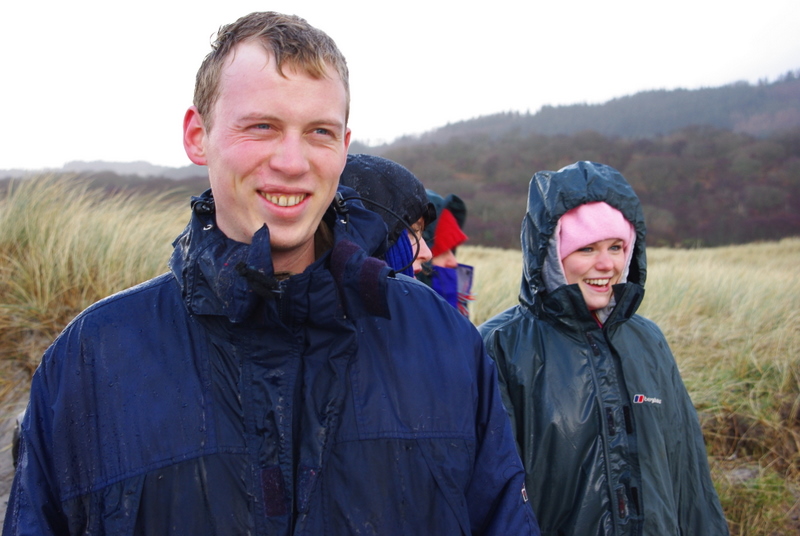
This weekend our eldest nephew Josh and his girlfriend Alice are up to stay with us. It has been a great day- we took them over to Ostel Bay, wrapped up against the wild wind.

Rain hail and sleet came across a massive sky in horizontal sheets, curtaining off the island of Arran in the distance, then parting to give a tantalising glimpse through and beyond. You could lean into the wind like a cushion.

Lovely.

The blessing of uneasy questions…

After a long week, I kind of need a cave for a while, but this came in today from the Emergent Village minimergent…

May you (and I) be richly blessed in this kind of way.

A Franciscan Blessing 

May God bless you with discomfort at easy answers, half truths, and superficial relationships, so that you may live deep within your heart. Amen.

May God bless you with anger at injustice, oppression, and exploitation of people, so that you may work for justice, freedom and peace. Amen.

May God bless you with tears to shed for those who suffer from pain, rejection, starvation and war, so that you may reach out your hand to comfort them and to turn their pain into joy. Amen.

May God bless you with enough foolishness to believe that you can make a difference in this world, so that you can do what others claim cannot be done.

Amen.

The bowl…

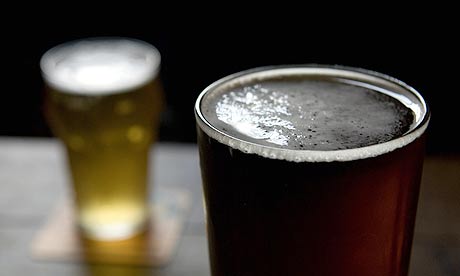
My mate Simon and I went for a pint the other day, which is actually something I do fairly infrequently these days as there is usually something that gets in the way.

The simple act of a pint or two and a table to sit and talk around has been about as close as most of we blokes get to a deep spiritual discussion – although this too seems to be a practice that is dying. Pubs here can not make a living unless they convert to restaurants. As we all know, this is not a sign of people drinking less but is more to do with the availability of cheap booze for consumption in our private spaces.

Anyway, the reason I mention this is because Simon and I were talking about our community (Aoradh) during our trip to the pub. We are thinking about offering a session to Greenbelt Festival in the ‘talks’ category under the strapline of something like ‘Don’t do it like us’.

All of these buzz words that have been applied to communities like ours in the wake of what we used to call ’emerging church’- alternative worship community, missional community, new monastic community. They all feel slightly pretentious and self serving to be honest. It feels like these labels belong to others in an urban context – trendy people who have big glasses, sharp haircuts and jeans with a baggy gusset that hangs to the knee.

Yet Aoradh has now been around for almost 6 years. It has developed and changed, stumbled then got up again, and we continue to experiment with a form of faith community fairly rare (as far as we are able to understand) certainly in the Scottish context.

Something that Simon said the other day in the pub has stuck with me. As we tried to map what we were and what we have become, he said something like this;

“We are an unhealed community.”

Simon was thinking about the people in our group who have serious illnesses, and the fact that our life of faith has to contain the awareness of sickness, brokenness and imperfection.

As I have thought about this, it seemed  important. It is not that our group is characterised by sickness – far from it –  but rather that we all have to live with the idea of a God who is real in the ordinary. A God who is not a magic talisman of success, but rather walks with us through the difficult times too.

There is also within this a challenge for faith- because we are  forced to confront the idea of a God-who-does-not-heal. A God who abides within brokenness, and lives within the uneasy question and the honest doubt.

Or even more challenging- a God-who-heals-sometimes, and some people. But not me.

My Michaela had a long term incurable illness (Ulcerative Collitis) that affected her from the age of 14 until 34, when all symptoms abruptly disappeared.  It is an open question and a grateful acceptance all wrapped up together.

All of which leads me to the Bowl.

In the recent winter storms, an old tree at the bottom of our garden was blown down, unfortunately into our neighbours garden;

A friend of ours was borrowing my chainsaw (through our local ‘timebank‘), as he is a wood turner, and I mentioned some pieces of wood from this tree. Some of it was dried already by age and the effect of the ivy that had dried out and hardened the wood. When he heard this he was excited.

Peter took the wood and promised a bowl for us out of it.

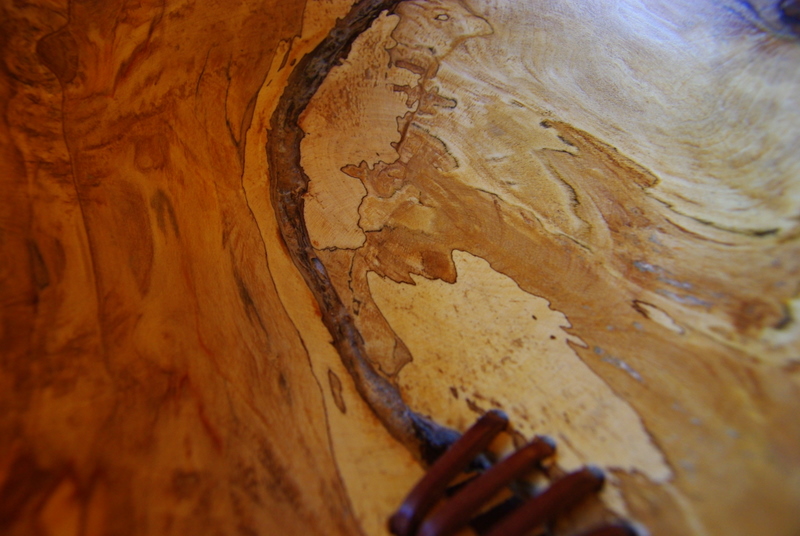
Amazingly, later that same day, he turned up, with this-

It is a lovely thing. A tree from our own garden, grown over who knows how many years, then spelted with sickness and disease before finally being broken by a storm.

Transformed by the craftsman.

Not healed or restored, but shaped and made beautiful.

Carved into the shape of service and hospitality.

As good an image for the hopes of community as anything else I can come up with…

Doubt…

I stood before this edifice of faith

And it was magnificent –

The curve of the certain arch

The immovable pillars

The knowing eye in all this carving

The soaring ceiling shaped by countless songs of praise

~

But there was this penetrating drip of doubt

I could ignore it for a little while

Until the swelling laths shed horse hair plaster

And the stalactites point down from on high

The end of everything

~

Like any fool under falling stone all I could do was move

Out into the sunlight and the gentle rain

Looking backwards to see what might still be standing

Whether it might be anything more than just a

Magnificent ruin

~

But a ruin holds age with pride

Through the open vault light falls dappled into shadow

And the song of birds blows in on the wind

Looking forward to a few things…

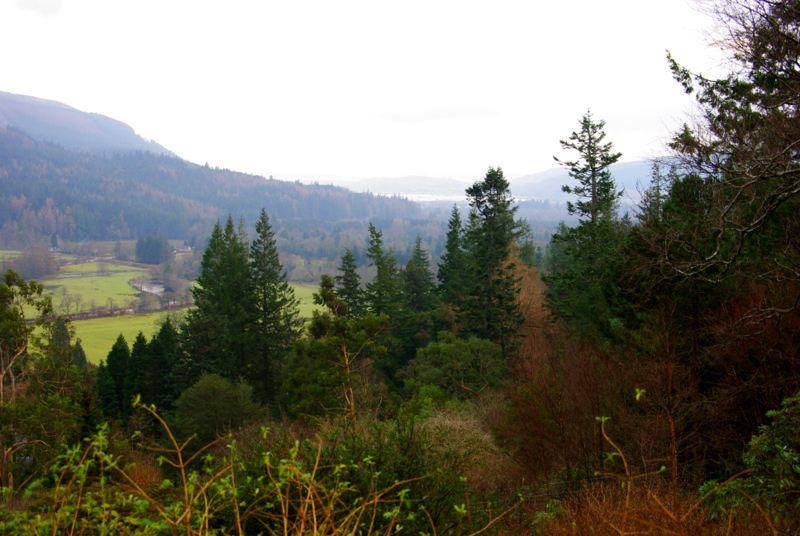
This photo was taken looking out from the viewpoint at the top of Benmore Gardens today, where we took a picnic today, along with some friends. It somehow made me think of the year to come; looking forward into 2012. It suddenly seemed so hopeful and exciting to look forward, rather than looking back…

I love to have things on the horizon – distant goals/projects/destinations that I can move towards, even if getting there involves some graft. I think this is always even more important to me in the dark months of the year. So I started to write a list.

Yesterday we worked hard in our cellar, to continue the process of converting the space down there to a working pottery. Michaela and Pauline’s Blue Sky Craft Workshops will be planning some sessions down there. Watch this space if you are interested. I’ll post some photos when I have managed to build some of the workbenches down there.

Talking of craft/art we have  been asked if we want to use the exhibition space in Benmore Gardens- to fill it up with carvings and craftings. This is a lovely challenge, as it is a big space, and so it will need some big pieces, possibly combining work from different members of our group. Time to get in the workshop, and tidy all the things that have come out of the cellar into some kind of order!

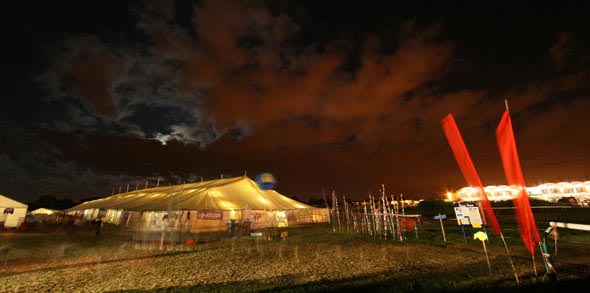
Then there is the distant Greenbelt festival- which has become increasingly important to me also. I have a few ideas for poetry/audio installations that I am gathering soundscapes and ideas for. Not sure if it will happen, but the creativity it sparks in me is grand.

In all this mix is lots of uncertainty. A job that has been under threat for two years but may be about to finally end. Other plans to downshift and start all sorts of other micro enterprises have been long in the planning, but this will be the year one way or another, when things will change.

Then there is the Wilderness Retreats that I am planning with my mates Simon, Nick and Paul. I am really looking forward to these. I hope some of you will join us.

Then there are all the activities of the community I am part of – Aoradh. We meet to eat and laugh and pray, and to plan creative ways to celebrate our faith. Next year we are already talking about collaborations with others, bench meditation spots, community gardens, labyrinths, prayer rooms.

And to mark progress towards the new season, today Will and I attended the first of the years indoor cricket net sessions. We spent a couple of hours bowling, being bowled at and facing a bowling machine. Magic. It is hard to imagine the warm days full of the sound of leather on willow, but this too will come.

As I look at this little (incomplete) list, I feel blessed, excited, hopeful, humble, grateful. And perhaps just a little overwhelmed.

May your horizons be full of good things too!