
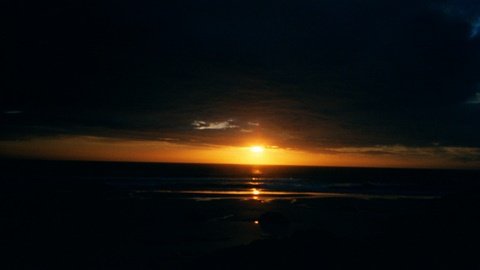
Lovely moon rising yellow over the Clyde, black as a hunting cat. I should go to bed, but here I am taking photographs…

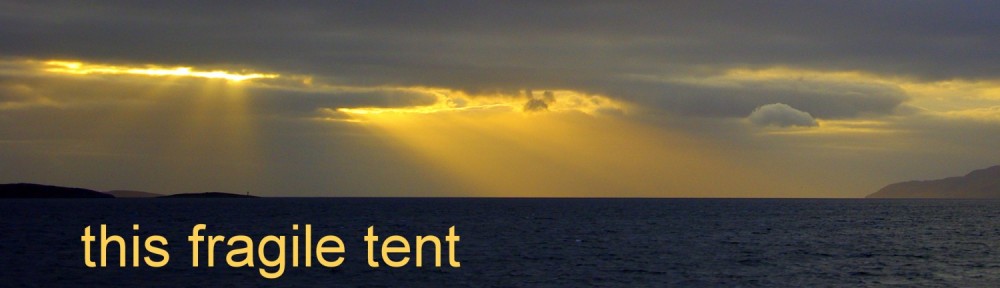
Lovely moon rising yellow over the Clyde, black as a hunting cat. I should go to bed, but here I am taking photographs…

Life is for living – for drinking deep from the well of experience. That is why many of us believe that wild places are so special; they take us out of our narrow protected bubble and open up something deeper, more eternal.
A fulfilled life is a difficult thing to measure. Very soon we start to use nebulous words like ‘well being’, ‘happiness’ and ‘satisfaction’.
We may also have to acknowledge that life is a process – a journey. Some would call this journey a process of ‘maturity’, others would say ‘enlightenment’, others still would call it ‘personal growth’. All these ideas contain the idea that life, in all its joy and difficulties, should embrace transformation; movement from one state of being to another. Standing still is unlikely to be healthy and ultimately it will likely prove impossible.
For a while, many of us (particularly men) come to believe that a fulfilled life is one characterised by success. And because we are competitive creatures there has to be some means of measuring this success so we are always heading for the next achievement, the next conquest, the next acquisition.
I was reminded of this again today listening to a radio discussion about psychopathy with Jon Ronson, author of this book–

The word ‘psychopath’ is one of the most overused and emotive terms employed by the media in relation to mental illness, but Ronson’s book goes far beyond the stereotype. He qualified to use the Hare Psychopathy Checklist, and became, by his own admission, something of an obsessive Psychopath spotter.
Whatever you believe about the usefulness of labels like this, the fascination with the sort of people who can commit such acts of appalling cruelty apparently guilt free is almost universal. All the more sobering then is the statistic that roughly 1% of people can be regarded as psychopathic.
Rather than getting stuck with all the high profile serial killers and despots, Ronson’s interest takes us more towards the very place of madness at the heart of our society. At the same time as vilifying psychopaths as not-human ‘others’, he argues that there is something psychopathic about our society, and that many parts of our society actually reward psychopathic tendencies.
Consider this – one of the two ‘factors’ in Hare’s checklist–
Factor 1: Personality “Aggressive narcissism”
- Glibness/superficial charm
- Grandiose sense of self-worth
- Pathological lying
- Cunning/manipulative
- Lack of remorse or guilt
- Shallow affect (genuine emotion is short-lived and egocentric)
- Callousness; lack of empathy
- Failure to accept responsibility for own actions
It is easy to see how an individual with these kind of characteristics could succeed in much of society. It is impossible not to start thinking of people we know, bosses we have had.
I went to hear psychologist Oliver James speak at Greenbelt Festival last year (you can download the talk here.) One of the things I remembered him saying was that in all his dealings with the rich and powerful, including several Prime Ministers, he had yet to meet many who he would regard as psychologically healthy.
However, Ronson goes further than this and suggests that the very institutions of our society can become psychopathic. Banks that loan what they know can never be repaid, therefore condemning people to financial indebtedness for the rest of their lives. Health systems that thrive on the sickness of the population. The creation of all sorts of addictions to gadgets and shiny product in order to ensure profit.
It is almost as if the process of becoming – whether we understand this as a spiritual, psychological or simply biological development – has been replaced by a process of conquest, where success at almost any cost is the only thing that matters.
But success is fickle. The journey to the top is often followed by the journey back down again.
Back to this maturity/enlightenment/personal growth thing. Most of us come to a point when we realise that success is rarely a route to any kind of lasting happiness (even if this is a legitimate aim for any of us.) A life that cuts us off from the social animal that we humans are and replaces this with narrow acquisition is a kind of madness – all the more so for the fact that it is a collective madness.
So for those of us who are climbing to the top, may we succeed. May our enterprises go from strength to strength. But may we also remember that success without ethical responsibility and without the mess of all that humanity may indeed still be success, but it may also be the cause of our own destruction – both individually and collectively.
I watched this today (courtesy of the Emergent Village ‘minimergent’)
This from their website
All over the world there are Wayseers who struggle, who hide their gifts, because they don’t realize what they are. We are here to find Wayseers throughout the world and let them know how important they are to humanity. We are here to turn Wayseers on to their rare aptitude for leading transformation.
When the Wayseers of the world are awakened to their true calling on this planet, a massive shift in the human condition will occur. Wayseers are the change agents of humanity – the innovators, the healers, the visionaries, the spiritual leaders, the entrepreneurs, the ones who are here to lead humanity into alignment with the Way.
I think I like it. Or at least some of it
I like the idea of the need for agitators, damaged malcontents who will not be defined by their limitations. The passion for something better, something other, something more creative and beautiful.
What I am not so sure about is the degree to which we exalt the ‘event’ over the ‘ordinary’, and the idea that we can all be ‘extra ordinary’ if we believe strongly enough.
And perhaps the ‘out there’ charismatic presentation is just a bit too God channel to sit easily with most of we Brits. The handsome bloke who comes and tells us that we are part of the special 10%. And he has product to shift.
There is also this strange feeling of activism as an end in itself – divorced from dogma, or from ideology, or cause. We want transformation, but we do not define what we are transforming to- this will work itself out if we follow ‘the way’. ‘The way’ is enough- the ‘calling’ we all carry. As I think of this, it seems to me to reflect a real shift in society – even a shift in me.
Society is less interested in what you believe, more in what lights you up. And just about anything goes man, what ever turns you on. And right now, we all need to be turned on to something new- the old stuff is over, bring on the next…
But I too feel the pull of this thing called ‘the way’. It seems to me that the Kingdom of God (as I would call it) is located within and without the followers of any one religion. Jesus broke all those barriers for ever. The way is enough- the calling to follow, to journey with love in an uncertain direction.
It seems to me that the Kingdom of God beats like a pulse in all of those things associated with ‘the way’ listed above.
Perhaps I should take up skateboarding.

An episode of ‘The Simpsons’ on TV this evening and made me laugh out loud- often. It was called ‘Thank God it’s Doomsday’, and centred around Homer watching a move called ‘Left Below’, then becoming convinced that the Rapture was about to happen.
Rather reminiscent of this.
The only clip I could find that was not dubbed into Russian was this one-
I noticed this on FB the other day (Thanks Ian Emery.)
…when the Gospel story is accompanied by a fog machine and light show, I always get this creeped-out feeling like someone’s trying to sell me something. It’s as though we’re all compensating for the fact that Christianity’s not good enough to stand on its own so we’re adding snacks.
But more importantly, I want to be part of an uncool church because I want to be part of a community that shares the reputation of Jesus. Like it or not, Jesus’ favorite people in the world were not cool. They were mostly sinners, misfits, outcasts, weirdos, poor people, sick people and crazy people.
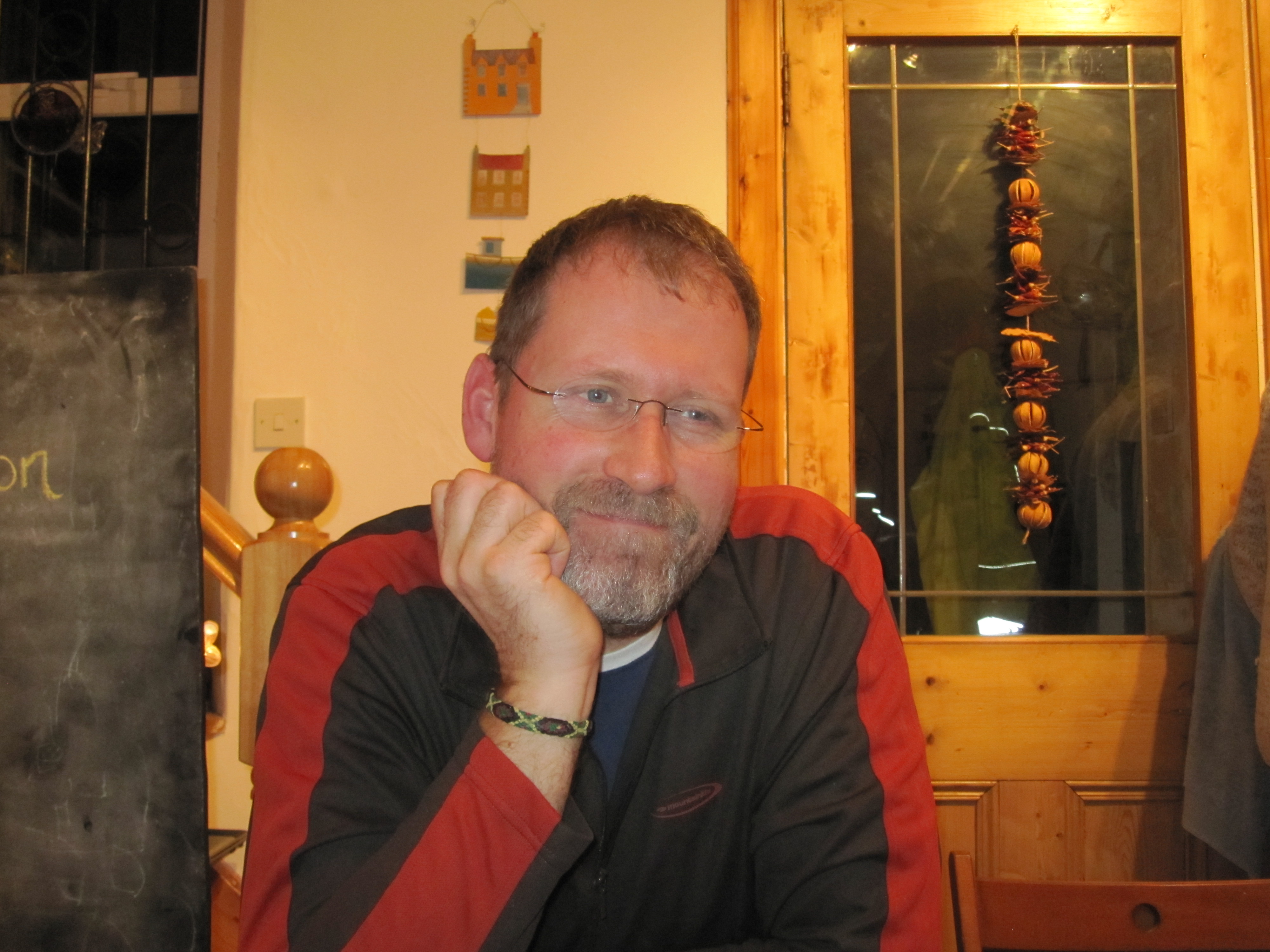
I liked it because (and I know this might be a surprise to some of you) I am not cool.
I never have been cool, and never will be a trend setter. Thankfully, there comes a point in life when you do not care much about coolness any more. We sink into the stew of middle age and bob like dumplings. In case you needed evidence-
Now don’t get me wrong, I am sure Jesus loves cool people too, but I sometimes wonder if it might be easier for camels to pass through the eyes of needles than it might be for cool people to…. you get my point.
Emerging church became Missional church, and some folks wanted to stay out on the trendy edge, using words like ‘Hipster Christians‘ and ‘Christian pirates’ but it left me rather cold- and I think this is why-
We have one place for the uncool people—our ministries—and another place for the cool people—our church services. When we actually bump into one another, things can get “awkward,” so we try to avoid it.
The truth is we’re all guilty of thinking we’re too cool for the least of these. Our elitism shows up when we forbid others from contributing art and music because we deem it unworthy of glorifying God, or when we scoot our family an extra foot or two down the pew when the guy with Asperger’s sits down. Having helped start a church, I remember hoping our hip guests wouldn’t be turned off by our less-than-hip guests. For a second I forgot that in church, of all places, those distinctions should disappear.
The article is from an American church situation, but this seems rather familiar.
We are all guilty of seeking significance for ourselves, our ministry and our ‘art’. But it is good to be reminded that these are not the measures of fruitfulness used in the New Kingdom. Paul preferred to describe ‘Fruit of the Spirit’, which emphasise things like love, kindness, gentleness, peacefulness, self control.
No mention of coolness.
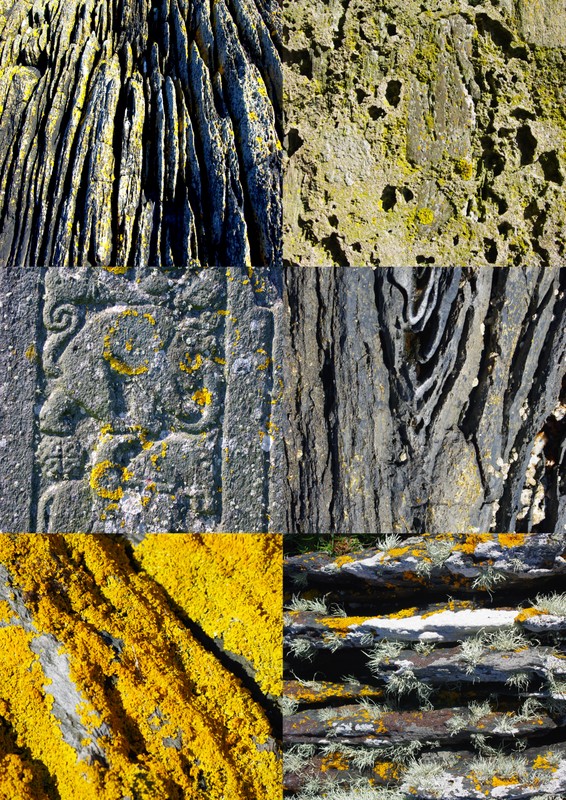
Now that the New Year is with us, lots of us are looking forward into all sorts of busyness. It could be also that you are seeking to plan in some periods of retreat, and if so, you might like to consider this…
We are planning a new venture for this year- along with three of my friends from Aoradh, we are organising a series of ‘Wilderness Retreats’. These retreats form part of several micro enterprises that have grown out of what we do – a way of integrating faith with life which I am finding very exciting and hopeful. The ideas and activities have emerged from yearly retreats that we have been doing as a community for many years now – usually with invited ‘guests’ – and also from other forms of worship using wild locations that we have been experimenting with.
The retreats have been special experiences for us, for some of the following reasons-
If the possibility of being part of something like this excites you, then please get in touch!
It might be possible to make this trip part of a bigger trip up to Scotland, or even part of a trip to the UK! If you want some advice as to options- again feel free to get in touch.
These retreats are not intended for hard core outdoor fitness types. You do not need to be ultra fit or prepared for the north face of the Eiger. If you can hop around rocks, and can cope with the possibility of being cold and wet with stoicism, then this is enough.
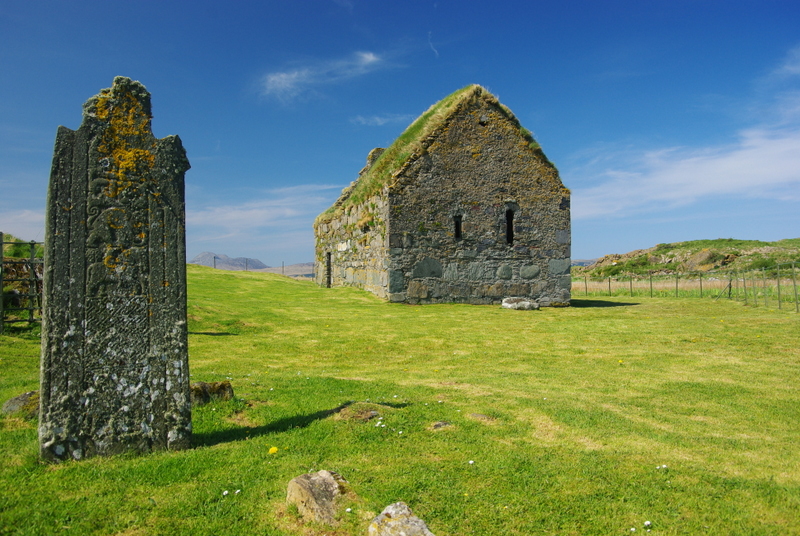
Here is some information from our publicity shot-
Do you love wild places?
Are you looking to find time to rest and reflect?
Are you hungry to make a deeper spiritual connection?
If so, we would like to invite you to come and be part of one of our wilderness retreats…
Wild places do something to the soul…
Here in Dunoon we are on the fringes of some of the most amazing wild places; lochs, mountains, forest, seascapes and small uninhabited islands. Opportunities for being immersed in wilderness – with all the glory and all the vulnerabilities of this – are everywhere.
Following an old Celtic tradition, we have been looking for ways to allow the shape of the landscape to become the means by which we might approach the divine; caves, rivers, mountain tops, small islands.
There is no better place to do this than here – the west coast of Scotland, and the small Argyll islands in particular, are marked everywhere by the passage of other pilgrims, for example the many monastic sites from the time of the missionary Celtic saints.
We invite you to journey with us into this generous tradition. All are welcome – from all faith backgrounds, or none.
There is information about some of our previous trips here-Jura, Eileach an Naoimh, Scarba, The McCormaig isles.
Our retreats typically take place over a long weekend – Saturday to Monday.
They involve creating a small temporary community on one of the small uninhabited islands of the Inner Hebrides. These are stunningly beautiful places, rich in history, wildlife and the kind of peace that has to be experienced to be believed. All of our locations are well off the beaten track – they can only be reached by boat charter.
They are WILD places- exposed to the elements, with no amenities or comforts. Participants on these trips need to be prepared for this! Please have a look at the kit list and general comments.
We will do the organisation, put together a programme and itinerary, charter a boat and provide spiritual exercises and activities to use together and alone. Each retreat will have at least two retreat leaders.
We will then lead you through the retreat, using a combination of times of sharing, times of silence and led meditations. Activities can be tailored to the needs and interests of the group- including varying degrees of challenge.
For the year ahead, we have two weekends fixed for retreats-
(Deposit of £50 payable on booking. Full cost will be required if participant cancels later than four weeks prior to the event.)
If you are part of a group who are interested in another weekend, it may be possible to arrange a trip for you.
It is also possible to set up ‘mini expeditions’ for small groups/families. These would be typically for a day, or an evening. Contact us for details.

Today we spent an hour or so emptying the glen of poetry, prayer flags, multi coloured ribbons and water wheels. I like this way of doing church!
A few bits and pieces had been taken by the wind- so if you are up there and see the odd plastic packing box or garden cane with poetry attached, I am afraid we lost one of each.
The water wheel was torn loose at some point over the last couple of days, but managed to twirl away through the worst storms in memory – not bad for something made of scraps and bits of skateboard.
We placed a letter box at the end of the walk for prayers/comments, and it was full of lovely things- people who were clearly moved by the experience – some who had lost loved ones recently, others who were just here on holiday and stumbled across it whilst out for a walk.
People had obviously used the different interactive bits, despite the extreme weather- the leaves to write on and throw in the stream, the prayer flags, the weaving.
May you all carry some blessings into this coming year.
The last few photos-


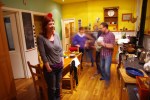
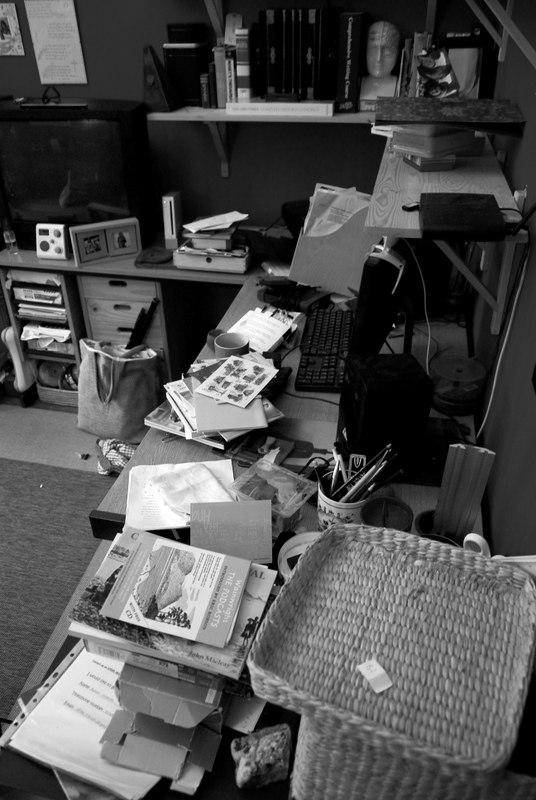
Michaela is tidying out our study/music room- she is intent on taking over the desk to use for her various craft activities.
It has accumulated more stuff than it is possible to imagine; file full of music, bits and pieces from old events we have done with Aoradh, laminated meditations, programmes, random data CDs, cassette tapes (remember those?)
Through the day yesterday she would find me and ask if I wanted to keep something. My instinctive answer was always ‘Yes’, but usually it went in the bin anyway. Lots of it concerned my old scribblings – songs, poems, stories, articles for magazines. I seem to have kept not only the final version, but in some cases I have several draft copies too.
There were lots of things that made me cringe, and grateful to put in the bin. But I did find some things that I might rework or at least keep as some kind of record of the past.
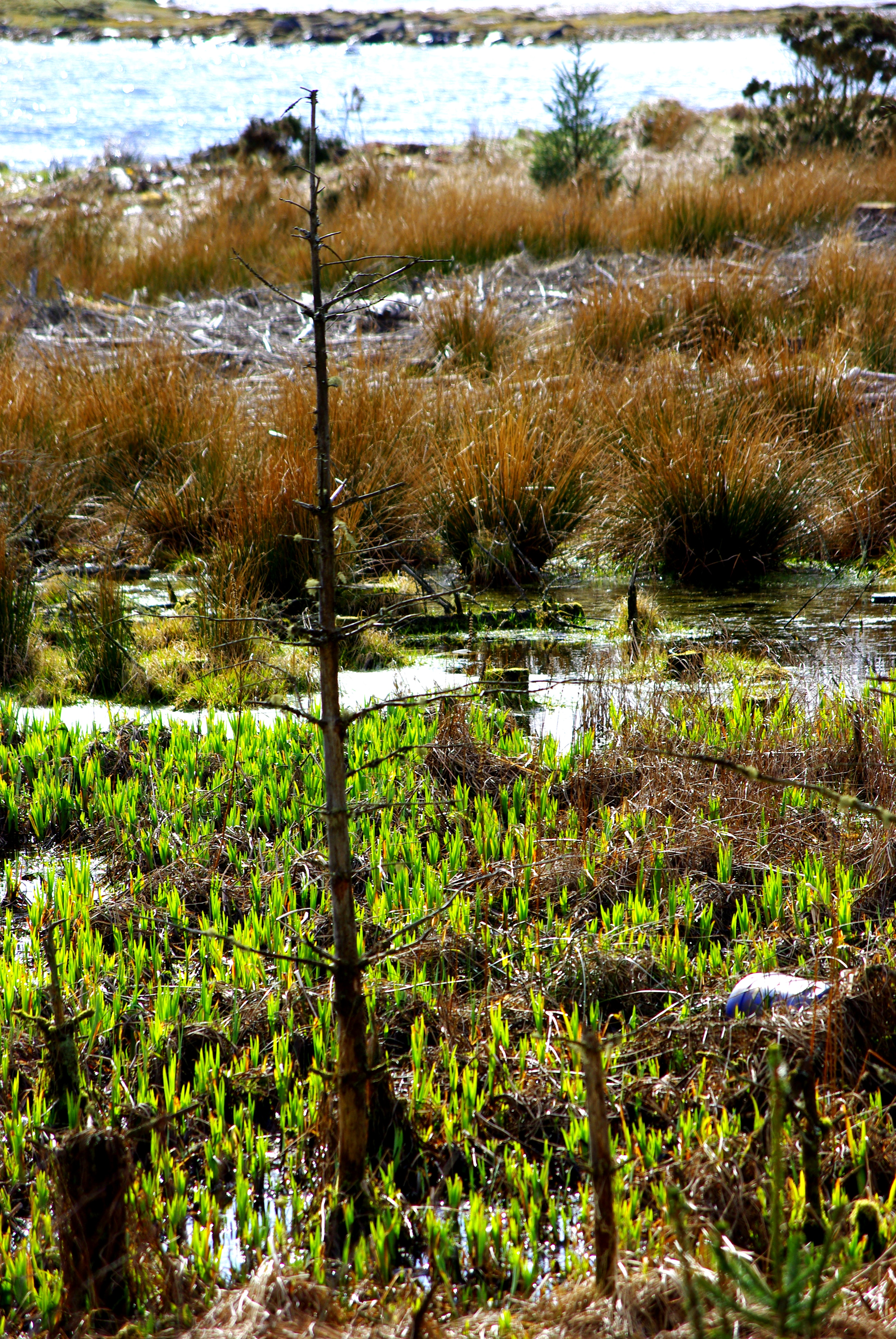
I found this poem, hand written in an old notebook. I think it must be from around 10 years ago, written whilst on holiday.
I decided to reproduce it here not because it is particularly good- but more because the winter is hard, and it is good to remember that this too shall pass.
There will be a time again of gentle air alive with birdsong and the smell of warm soil.
Highlands, early summer
~
Haze on the horizon
Hiding the far hills
Rocks nestling in the new grown heather
Bright green bracken still soft in the sun
~
Flax heads bobbing and swaying in the blue breeze
Are ghosts of an older age, gone now
Like the moaning voice of the cuckoo
Carried away on the wind
~
The earth sighs with the content of early summer
Not yet full of buzz and hum
No sign yet of anything brown
All is sinewed and strong
If under ripe
It is a time for the joy of it
Not the end product

Just had an interesting discussion with my daughter. Emily is 16, lovely, intelligent, part of a middle class nuclear family, surrounded by good friends and enjoys a situation of safety and security. She lives in a quiet, relatively crime free part of the UK, one of the richest countries in the world.
In many ways, you could say that she has won the life lottery.
This would be unfair of course-life has this way of challenging all of us in some ways- she is having to learn to cope with dyslexia, and to develop her own individual self confidence, which is difficult enough for any of us.
But what this highlights to me is the issue of equality. Equality of opportunity is the watch word for our current political elite. Borrowed perhaps from the American dream, we cling to the idea that in a vibrant market driven capitalist economy, our measure of success is determined by our ability, more or less.
I suppose in many ways I stand as some kind of evidence of this- the child of a single parent, brought up by the welfare state, educated to degree level, now more or less middle class. However…
There is a devastating critique of this idea by Deborah Orr in today’s Guardian. Here are a few extracts-
The idea is that as long as there is “equality of opportunity”, then a highly competitive economic system that naturally sorts people into “winners and losers” – let’s call it a meritocracy – is perfectly reasonable. But the rhetoric is laughably fallacious. In a system that divides people into winners and losers, you can’t have “equality of opportunity”. The children of the winners will, broadly, always have the advantage. The children of the losers will, broadly, always have the disadvantage, theinability, if you will.
Welfare dependency is not a cause of society’s problems, but a consequence of them. Sadly, it is in the febrile interest of all mainstream politicians to continue pretending that it’s the other way round. The belief that you can transform society by prodding at welfare is similar to the belief that you can untangle knots by pushing at the ends of string.
What might this mean for those of us who are about to hand over our responsibilities to Emily’s generation? Will we saddle them with the same addictions to capitalist excesses? Or will we (and in turn they) find a different way untie the knots?
It is difficult to know where to begin on the macro scale- back to earlier discussions about the Grand Correction. But it is perfectly possible (if extremely challenging) to begin on the individual scale…
Some of this might be about an attitudinal shift, away from blaming the victims of our system-
Humans are not born equal, and individual vulnerabilities are not always easy to identify or to repair. Those who are stronger need to look after those who are weaker. It is precisely because humans are not good at doing this – it’s not in our aggressive, predatory natures – that so many people shrug at their inability to clothe, feed and house themselves. At the very least, this failure of the able should be recognised, rather than dressed up as a failure of the unable. Until it is, it’s hard to see how a better future can be imagined, let alone planned for.
But my greater hope is in Emily, and the desire for us to yet live together in a way that is less concerned with protecting what we have as we seek to gain more, and more concerned with sharing and supporting others, and living our lives in connection.
If anyone can do it, she can.
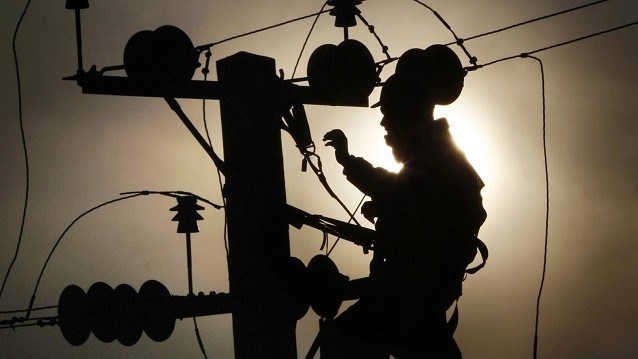
We are increasingly utterly dependent on what comes to us through cables. I know this to be a fact, as I have spent most of today coping with the consequences of what happens when the cables stop delivering.
Since the big storm on Tuesday, parts of Argyll have had no electricity. Other parts have had an intermittent supply. It has taken a whole army of blokes spending three days and nights in the hills and forests tracing fallen lines, disentangling them from trees, reinstating the masts that were blown down and the transformers that burnt out.
The consequences of this are obvious- or at least is seems so at first. The lights will go off. And the TV- oh, and the computer of course.
But then you start to remember other things- the telephone system, even if the supply that keeps the line is live, probably will not work as your telephone will require power, as we expect it to do lots of things other than just being a telephone. You will get cold as the heating system will be controlled and pumped by electricity.
Slowly you start to realise that everything is controlled by computers. And computers are great, but get very sulky if you remove their supply of amps. They are very greedy for amps. So (as we found out) trying to set up an emergency kitchen, as the gas supply was still working, was futile as all the appliances need electricity too- even the gas hob, which shuts itself down without the extractor hood working.
I also heard that the phone lines on Bute stopped working as the emergency generator was kept behind a door controlled by- electricity. Oops.
Then, the longer the electricity is off, the more serious things start to get. You can not buy food, as no one pays with money any more- we all pay by computer. Also, all the chilled food in the supermarket goes off immediately.
Finally, there is the fact that even the care that we provide to many people is dependent on technology. Increasingly we care for our frail elderly by computer. It is cheaper. We use door alarms, pressure mats, intercom systems, and all sorts of other sensors and switches.
The effect of this on our communities has been interesting- in some it brought out the best. Neighbours who went the extra mile, supermarkets who opened their doors, people sharing warm firesides and warm soup. But then there were those who would ring the council and demand to know why we had not visited them or someone else to make things OK in some way- as if we had endless resources, and perfect knowledge.
The lessons for us as individuals are sobering- the weather seems to be changing here, and we can probably expect more of the same. Simplify your life from some of the gadgets. Keep some candles and cans in the cupboards. Make a note who which of your neighbours might need a bit of extra help, and knock on the door to have a conversation (you remember those- from before Facebook and MSN.)
And in cases of extremis, decide which one is going to get eaten first.

