Lessons from my big sister-

I spoke to my sister today on the phone. It is always so good to speak to her, as she lives away down in Nottinghamshire, so we are not often enough in the same place.

We got into the usual conversation about God-projects that we are involved in. She and I know each other so well, that this one of those God-affirming kind of conversations usually- even when we are not very gracious or graceful in the way we describe particular people or things.

She described a youth Alpha course she is holding at her house- with 20 young people crammed in, all eager and hungry for knowledge…

And she described her own feelings of inadequacy (despite her very obvious gifts), and how she had to feed all these young people despite being flat broke after a whole series of added expenses this month.

But then she said that she had been thinking a lot recently along these lines;

Go with just what you have in your hands.

Nothing else.

You need to be no-one, but you.

You need nothing other than what you have.

The stuff that you think you need, the skills you admire in others- all this is a distraction- a delusion.

So in her case, this involved cooking a huge lasagna from veg grown in the garden, and feeding souls.

Good on you sis.

Lazarus laughs again…

There are many people mentioned in the margins of Bible stories… some by name.

There is the Gentile-convert-to-Judaism-convert-to-Christianity called Nicolas of Antioch, chosen as one of the seven stewards in Acts chapter seven- along with Stephen, the first martyr. Nick from Antioch- what was his story then? Spiritual gypsy perhaps? A bit of a hippy? But considered trustworthy enough to be given a role as a servant of the embryonic church, and mentioned by name for thousands of years to come…

Later recorded though (By Irenaeus- see here) as starting another Gnostic sect and getting his doctrine all Hippy-shaken.

Then there is Simon the Leper. Mentioned a few times, including as providing a feast for Jesus in his house in Bethany (Mark chapter 14)- you may remember this as the time when a woman broke an alabaster jar of expensive perfume and poured it on the head of Jesus- almost as if she had some idea that soon he would be anointed for burial… who was she- and what motivated her towards this act of excess- what had she seen in Jesus- how had he touched her life?

But back to Simon the Leper. How did he get his name? Was it because he was an extremely spotty kid and the cruel nickname stuck?

Or perhaps he really had been a leper?

If so, why was he mingling with people and not away in a leper colony with the other unclean people, outcasts, not party throwing?

Could it be that Jesus healed him? And after he showed himself to the priests, and was declared clean, he returned home, and his story was known far and wide?

We know that Jesus had some other friends in Bethany, whose story is more well known- the wonderful story of Lazarus, perhaps the most hen-pecked of people in the Bible, sandwiched between Mary the starry eyed dreamer, and Martha the houseproud (if grumpy) hostess.

It is the stories behind the stories that are fascinating- the filling out in three dimensions of these half glimpsed characterisations. Mary, who in many traditions was the same woman who broke the jar of perfume, and was known as Magdelene, from whence she had returned to live with her brother, under some kind of shameful cloud.

And after the events of the story- what happened to these people? Did they make the journey to Jerusalem to watch the triumph and tragedy and then glory of what we now know of as the Easter story?

Were they in the upper room when the Spirit came in power?

Was Lazarus the same man who went as a missionary to what is now Cypress, and whose bones still lie in a shrine there? Did his sisters go with him? Did Martha give those Cypriots what for when they trod dirt onto her clean floors?

So here is something I stumbled on that retells some of Lazarus’ story again- enjoy!

Braveheart, Inchailloch and Scottish/English history.

Back in the spring Ali and I took a canoe trip on Loch Lomond, and spent some time exploring the island of Inchailloch. Check out here for some details of this wonderful place…

The island was the site of an ancient nunnery, sacked by the vikings, and for hundreds of years was the burial ground for Clan McGregor- Clan of the famous Rob Roy.

dscf1159.jpg

My Daughter Emily told me that her school, like the good Scottish Grammar school that it is, is studying Scottish history. And in order to aid their 12 year old understanding, the kids are shown the Mel Gibson film ‘Braveheart’.

It is just possible that Emily told me this to wind me up, as she has heard me rant about this film. It takes so many liberties with history that the very idea of it being shown in school is enough to make me grind my teeth! You know the stuff- the wild and free Highlanders, living in high minded moral purity in the pure mountain air, are set upon by the despotic English, who receive their just deserts from the edge of a rusty Claymore…

Ignore the fact that the film Americanises and romanticises the story, re-drawing the characterisations to make the blockbuster market-friendly. Can we really learn anything from this view of history beyond the reinforcement of narrow stereotypes?

The narrow views that live on in football rivalry, and a kind of anti-Englishness that is understandable in part, but is a prejudice that is justified in many circumstances where people should know better.

But I am an incomer- born in England, with an English/Irish ancestry. Therefore this talk will get me into trouble…

I am well aware that I can never fully understand what it means to grow up as a Scot, and to learn to define yourself against the old enemy… with hostilities now ritualised and categorised according to the modern age. But I grew up as a working class northern English lad, in Thatcher’s fractured Britain. My English forebears experienced forced industrialisation and unrbanisation, and became the workers who fueled an empire, but reaped none of its benefits. The death of the UK as an industrial power was our story too. I say this because we all have out stories of ancestral hardship. Some of them are shared…

And my father is Irish, a Catholic from Northern Ireland. He comes from a town called Strabane, scarred still by bombings, shootings and violence, and polarised into groups defined by skewed historical inherited memory.

This redrawing of history to suit a particular prejudice is often the recourse of the powerful. In our case in Scotland, it seems to me that it is also something indulged in by our small nation, in order to justify chip-on-the-shoulder victim mentality. Ouch. That is harsh- but is there truth in there somewhere?

Scotland, in this view of history, is the proud wild nation, whose heart is to be found in the mountains of the North West. It has been beaten down and oppressed by the neighbourhood bully from the south for hundreds of years, but still, it’s heart beats strong and proud.

But when you look at the realities of history- these things are not so clear. The clearances were perpetrated by the English were they? Or was it the English-centric Scottish nobility? Were the famous and tragic battles fought in the name of Scotland, or were they as much Scottish civil wars, with only one outcome possible when one grouping has a modern, well equipped army on its side?

And what of these pure proud Highlanders?


On Inchailloch one of the graves is marked with the Clan McGregor motto- interpreted on the board above.

If unsure or if there is any back-chat, kill.

These were the times that the mythology of Scottish history sprang from. Desperate times, when old Clan loyalties may as easily been applied to local rivalries, or cattle stealing as to the cause of noble Scotland. Where life was brutal, and brutalised, and the domesticated folk in the south grew up in fear of the Highlanders coming south to raid and rampage, in perhaps the same way that we fear terrorist attack today. The Highlanders could be said to be Al Quieda, the IRA and the Taliban all combined into one for 17th and 18th Century lowlanders…

And we know that this was the mythology that was eventually exploited and wasted by the weak and foolish Bonnie Prince Charlie, as he followed his own power-hungry agenda, in the hope that France would support his cause. Resulting in a time of terror, then of terrible and vengeful persecution by the victorious English army that casts its shadow even today, 200 years later.

I love this country. If we move towards greater independence then let us do it with honesty and respect for the shared history of these islands.

And let us stop this small minded prejudice, that interprets everything through a set of distorted goggles. These sorts of narrow mind sets have been the cause of violence and hatred, and may yet be again.

We Scottish Christians, let us be people of peace and reconciliation. Where there is hatred, let us bring love.

Even to the English.

Blogged with the Flock Browser

Lost coins

The M6 unrolls it magic carpet in the early evening light
And the hills of Lancashire draw me close in welcome.
Though my life is blessed now in a land of milk and heather honey
Still I look across this scarred land
Softened by green growth
Seeded with my memories
And feel close to home

Rivington
Alan, Peter and me
Pounding and panting up the steep tracks
To rest and recuperate at the heady height of the Pike.
Above us only the TV masts poking the whispy cloud,
As in front the lights of Chorley flicker on.
Horwich is hidden by the curve of the land
And in the far distance, the flat lands meet the sea at Blackpool.

Closer, held in the folds of the fields
Along the old roads
Stand stone houses, built out of the quarries at our feet
Falling into the creases of the earth like lost coins
Hidden treasures.

Here was my world.
My place of communion.
My Eden
Or so it seems with hindsight.

Now I pass through, driving south
And a little rain makes the road ahead darker
In the warm car, surrounded by a sleepy family
I grip the wheel gratefully
But with a sadness
Move on.

© Chris Goan 24.5.05.

Gray theology revisited…

Earlier I posted a discussion about how we form our thoughts (our theology) towards God.

I confessed to being afflicted by a tendency to see the gray areas when others see black and white. Whilst I would not necessary wish my affliction on you, I have come to realise that it brings to me something that can be valuable as a spiritual tool in following after God.

I have come to believe that God reveals himself in the margins, in the cracks and crinkles of life. Perhaps this is because we have relegated him to this place only in our business and modern idolatry.

There are many big noise Christian leaders who appear to suggest that they have a mandate from God to bring him stage centre, and let him treat us to tricks and religious entertainment. The God Channel is full of this stuff. Forgive me if I seem judgmental and harsh- I too have longed for God’s tangible, measurable presence. But I have been around enough of this hot air to understand it for what it often is, and to be repelled by it.

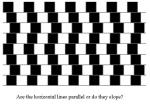
My experience of God is more like the squares above.

The solid blocks are like our theology- fixed and orderly and predictable. Constructed into an organised and seemingly complete brick wall. But God is not contained by the bricks, even though he might be willing to be encountered within them…

So as you look at the bricks, there he is in the corner of your vision. But impossible to pin down, Impossible to define and domesticate…

Here are some more illusions to further illustrate the point, and to have a bit of fun at the expense of your psyche (click to enlarge);

Blogged with the Flock Browser

How do we come to our understandings of God?

I have been thinking a lot about how we come to hold a set of beliefs and understandings towards God.

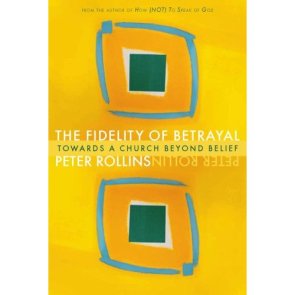
I have found Pete Rollins (part of the Belfast based IKON group) two books really challenging- he has this way of using parenthesis or slashes to convey something of the complexity and essential unknowabilty of our fumblings towards theology. Check these out if your head can cope with this;

One of the problems/blessings (to get all Rollins-esque!) of my particular personality is that I tend to see more gray than black and white. Where others see a simple issue- he is wrong, that is truth, this is what the Bible means by this, this is what is wrong with the world/the organisation/the church- I find myself always saying yes, but…

This is not always helpful. It can result in lack of clarity and prevarication. It can skew me towards a fence sitting position that has lots of questions, but finds no firm ground for to walk forward on. Kind of like some critics would categorise the emerging church do you think?

But how about theology? Is this not all about TRUTH? If we loose sight of the essential propositions that we hold in common, then all is lost, surely? This is how I was brought up. There were some gray areas, but these were overshadowed by the towering edifices of truth that we were given and encouraged to stand on like high stone walls.

So faith converted to theology (our theory and thoughts towards God) in this way;

Except, for me, this never really worked. I spend too much time with people to ever think that simple answers to complex human questions will suffice.

This sometimes leaves me at a place of dissonance with other more concrete but sincerely held theological positions all about me. At times it challenges my faith itself, but I have come to believe far from being a negative thing, this process of engagement, doubting and testing is in fact the very stuff of faith.

And that the ambiguities and difficulties brought to us by our reading of scripture and engagement with the wonders and mysteries of God will always result in a degree of uncertainty and struggle- and it is through honest engagement in this struggle that we encounter the Living God.

Or perhaps this just suits my personality, and so I make my theology accordingly?

This is the question that has been occupying my thoughts recently. Do we always tend to make an Icon out of our own perspective, and seek out others who will agree with us, and therefore make it seem more true, more dependable and therefore give it an illusion of universality?

Perhaps then, we form our theology a little like this;

If this is true, then does it matter?

Perhaps not. Perhaps this is a human trait- the gift of individual perspective.

Where It seems to become problematic is when we think that we are right, and everyone else is therefore wrong. It might be that you have been part of a group or denomination where version one of the theology-receiving model is enforced- leaving no room for any of your own exploration. This can be abusive and damaging.

So can the opposite- let us never be guilty of making God in our own image!

Which of course, unless you agree with me- you are/are not!

Ananias and Sophira- help me with this someone!

So, what it this story all about?

In our little group, we have been doing a study on the Book of Acts, as part of an ongoing attempt to consider the place of Christians in post-Christian, post-modern Britain. (We are using ‘Exilio’, a study on the book ‘Exiles’ by Michael Frost- see here for more information.)

We have just spent some time chewing on this very difficult passage in Acts 6. Here is the story

The early church has begun in a blaze of Holy Spirit fire, and these early followers of Christ came together in beautiful communities, sharing and caring for one another, and giving us a glimpse of heaven.

Then Ananias and his wife Sophira, perhaps to gain influence or status, sell a piece of land, and present the money to the apostles for the communal good, or at least they present some of it- they keep back some for themselves, but pretend that they have given all.

Peter challenges first Ananias, who lies, then drops down dead. Then his wife turns up, and rather than consoling her, Peter asks her the same question, she lies too, and Peter has a few harsh words to say to her, before she too drops down dead.

And everyone was consumed with the fear of the Lord… Well, you would be wouldn’t you…

It is a story that I struggle with. Did God kill these people? If not, what did- an overwhelming sense of guilt? Peter? Was what they did so bad? Have you and I not done worse- and yet lived to feel the guilt, and perhaps seek the promised forgiveness?

The next story is about the squabbling over the handing out of food to the poor- and the need to appoint stewards to keep the hand-outs fair to all concerned. But there is no mention of any of the moaners or unfair dealers being cut down in judgment.

This is (I think) the only story of instant punishment of sinners in the New Testament. It seems like an old testament kind of story…

So why is this story in the Bible? What is God seeking to teach us as we read this? In our discussions we came up with a few possible answers-

  1. The God of the Old Testament is the same as the God of the new. We attempt to understand him as cuddly and predictable at our peril.
  2. The sin was to break the unity of the spirit in a time of when this was a beautiful reality. A sin against the spirit is the only unforgivable one.
  3. Sin cannot exist with such holiness as was known then.
  4. God did not kill them, nor Peter, rather they died from their own overwhelming conviction of sin.
  5. The story is incompatible with the wider story of God as revealed by Jesus, and should be read as allegory, pointing us to broad principles.
  6. The issue is how we read the Bible, and how we understand context…
  7. God is mystery. We will never understand or be able to conceptualise all that he is.
  8. The issue is about money, greed and the idolatry of possessions, and it’s destructive affect on community.

What do you think folks? Any thoughts gratefully accepted…

Blogged with the Flock Browser

Greed, Capitalism and Gordon Gekko…

I had an early start this morning- leaving the house at 7.30 am for a two hour drive. As ever, BBC radio 4 was my faithful companion on the road…

And of course, the morning news was full of the current world financial crisis, brought about by the so-called ‘credit crunch’ and the collapse of an American bank sending shock waves round the world’s stock markets.

We await to see whether the giant insurance firm AIG, responsible for trillions of dollars investments, will topple and fall over also.

We are finding out that when a butterfly flaps in the windows of a wall street office, then not even a post office account in sleepy Argyll is unaffected by the resultant tidal waves of monetary insecurity.

And no-one seems to have any clear idea of what happens next. It is almost as if the animal that we created now has a will of its own, and a malevolent will at that… The radio carried interviews of doom mongers, and other folk seeming to suggest that the worst was over, and we just needed to stop the panic, which was the cause of the whole thing in the first place.

And then there was this other discussion- about the nature of the capitalist system itself, and the greed at the heart of it all.

And we remember again the words uttered by the fictional stock broker Gordon Gekko in the 1987 film ‘Wall Street’ (played brilliantly by Michael Douglas)- Greed is good…

Gekko has become an iconic figure, acting as an archetypal capitalist, but in the process asking questions about the meaning and nature of a culture built on the pursuit of MORE, always MORE. Capitalism, and neo-liberal economics rule the economic roost at the moment, and no-one seems to be able to challenge the ideological truth of ‘trickle-down’ benefits of the creation of wealth, and the release of entrepreneurial aspiration, red in tooth and claw.

This morning, world renowned economists were asked whether they thought that this crisis had been brought about by greed. Both replied that they thought that it had. They thought that some greed was needed- but there had been too much!

They described how a long period (16 years) of economic growth had resulted in complacency and increased risk taking on the part of bankers, stock brokers and financiers. And how ‘rocket scientists’ (a euphemism for people who design ever more complicated financial products in order to seek out profit) have designed complicated financial processed that are not understood by most of the people whose companies are selling them.

Many of the huge profits generated by the banks have been made by selling and buying products with borrowed money. Sometimes, the borrowing ratio to the assets of banks can be 30-40-even 50 to 1. This is fine as long as there is lots of money sloshing around the system, but it only takes a few variables to change- interest rates, commodity and fuel prices, economic slow down, the rise of the Far East, etc etc, and suddenly, apparently impregnable banks are dreadfully exposed and vulnerable.

These are, after all, human institutions, made after our own image.

But we are made in the image of God are we not? And as a Christian, I find myself experiencing dissonance with any system that depends on greed and grasping as the engine of its very survival. Is there really no other way? Do I have to be complicit with this way of living?

I have a mortgage and a car loan from the Bank of Scotland. This bank has lost 40% of it’s share price in the last two days. Who knows what the future is for the BOS, and for my accounts?

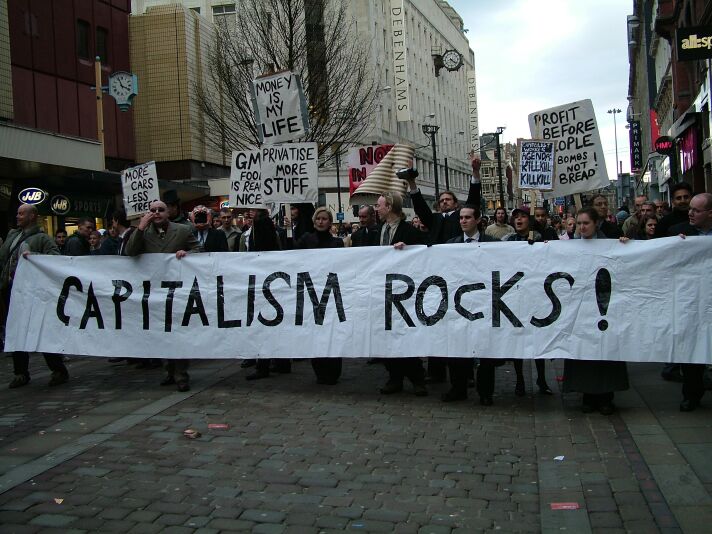
But, is this the most pressing economic reality pressing in on our culture? Is Capitalism really working? Or is it serving only the narrow interests of people like me, who experience many of its benefits at the expense of those who do not?

Is the real economic crisis to be found in a world in which things like this are ever present;
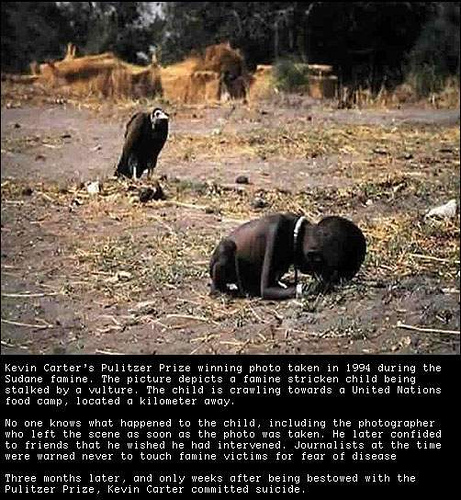
So what on earth can be, or should be our response?

I am humbled again. Reminded that my storehouse is not on earth, but in heaven.

And that when I serve the least of these, I serve Jesus.

Power dressing and incarnational spirituality

Suits.

Stuffed suits. Pin striped suits. Business suits. Power suits. Penguin suits.

Corporate uniforms.

Boys together in gentleman’s clubs.

Power. Control.

Management by the application of… image.

Or do I make too much of this?

Tomorrow I am going to a meeting in Lochgilphead for Social Work and Health managers, which is to discuss some governance issues thrown up by a redesign of Mental Health services (get the language there- ‘governance’ and ‘redesign’.) I will not wear a suit. I reckon I will be in a minority of perhaps, one.

Informality of dress seems to be trendy in some quarters. It is strange to me that within my social work department, things have gone entirely the other way for managers at least. The women, perhaps surprisingly, seem to escape this pressure for the most part.

Another redesign process recently replaced whole swathes of managers. The new folk often do not live in Argyll- they have not chosen to live and contribute to the communities they serve. That is not criticism- but it is just different.

For people like me, who try to find a way to carry that salt and light thing into the places I inhabit, the suits just seem to get in the way…

They seem like a barrier- a way to create distance between people.

I find myself at odds with the world about me… and the visible sign of this comes in the form of a table surrounded by men in dark suits.

I can see the point of this at times- the management thing- distance is sometimes required. But for me, this non-suit wearing has become my little point of rebellion, owing much to a lack of comfort with the work culture of my organisation- which at times seems highly toxic.

It is also how I choose to express something of my individuality- and my spirituality. I may yet be instructed to suit up-

But for now, the only suit I will wear regularly…

Is my birthday suit.