TFT Christmas card, 2017…

IMGP0650

Feast


Let Christmas day be fat and full

All bloated up by blessing.

Let joy belch out.

Let love be thine and stain like wine on

this old carpet.

Let tables groan under the weight of the elbows

Of many generations.

Let every plate be piled up high

Around raucous conversation.

May chocolate sauce thicken blood

To make our hearts beat

slowly.

Gorge your soul with goodness, friends

Then may slumber hold you

Kindly.


Two against the world…

Advent, day twenty two.

When I try to write dialogue, words are mostly shaped by two things; the character of the participants and the context they find themselves in. Applied to the Christmas story, we only have the merest hints of the characters of Mary and Joseph, but what a context. Two frightened people, sheltering in a stable, she close to term and about the give birth to a baby. Forget the portents and the back story Forget the angels and the prophecies and what we are left with is a man and the woman he loves, holding on to each other.

Dear friends, not everyone is blessed with companionship, certainly not for life. But we can all recognise the beauty in the story of two people, holding each other close and pushing the frightening world away.

Sometimes the story looks right back at us.

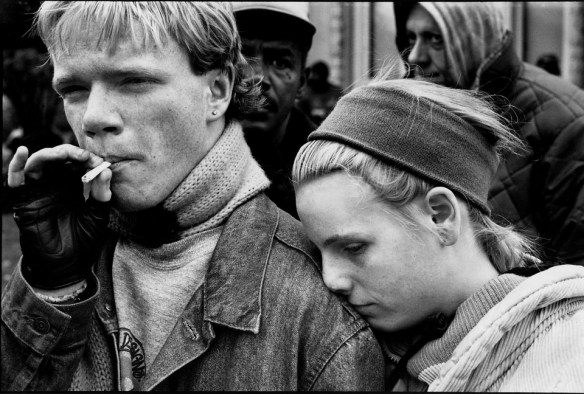
people-878512_960_720


The stable, BC


Hold me close, my gentle love

The night is cold and hollow

Make me a cave

Within your arms

And deep within I’ll

Burrow


See that floor all trodden down?

Let it be our carpet

Make me finest silk

Like buttermilk

From this feed-sack

Blanket


Let’s whisper dreams of things to come

When we are done with caring

When what we have

Will be enough

With a little spare for

Sharing


The light from stars is far away

It takes a long time falling

So just for now

It is enough

To hear your gentle

Snoring


Joy sometimes hides in shadows…

Advent, day twenty one.

Giles Fraser wrote a lovely piece for The Guardian yesterday, reflecting on preparing for the funeral of a friend, whilst Christmas unfolded around him.

Michael made a request to me when we were planning his funeral: he asked me to preach on the subject of glory. He remembered me speaking about that extraordinary Dennis Potter interview with Melvyn Bragg in which the TV dramatist – in the final stages of cancer himself – talked about his impending death enabling him to see things more clearly, including the beauty of the plum blossom outside his window: “The nowness of everything is absolutely wondrous, and if people could see that, you know. There’s no way of telling you; you have to experience it, but the glory of it, if you like, the comfort of it, the reassurance … not that I’m interested in reassuring people – bugger that.”…

We live in a world where experience is only valid if it can be digitised, but the process of digitisation mostly strips out the humanity, the brokenness, the inevitability of pain, replacing it with photographs and status updates selected to display the life we wished we were leading. The very opposite of the nowness that Potter was referring to. Bugger that.

Joy is not the absence of pain. It is not something that can be constructed or bought. Rather I think it is what happens when we connect with the beauty within one single moment. Mostly, in my experience, these moments are ones born in that part of our humanity where we are most vulnerable.

We joy in our children.

We joy at our smallness before a vast sparkling sky.

We joy as music breaks past our defences and thrills us to the soul.

We joy when we feel ourselves to be at the centre of a beautiful bigger story.

Joy ambushes us and reduces us to… tears.

Because the thing about joy is that it is a fleeting fickle thing and sometimes, despite our surroundings, it is absent…
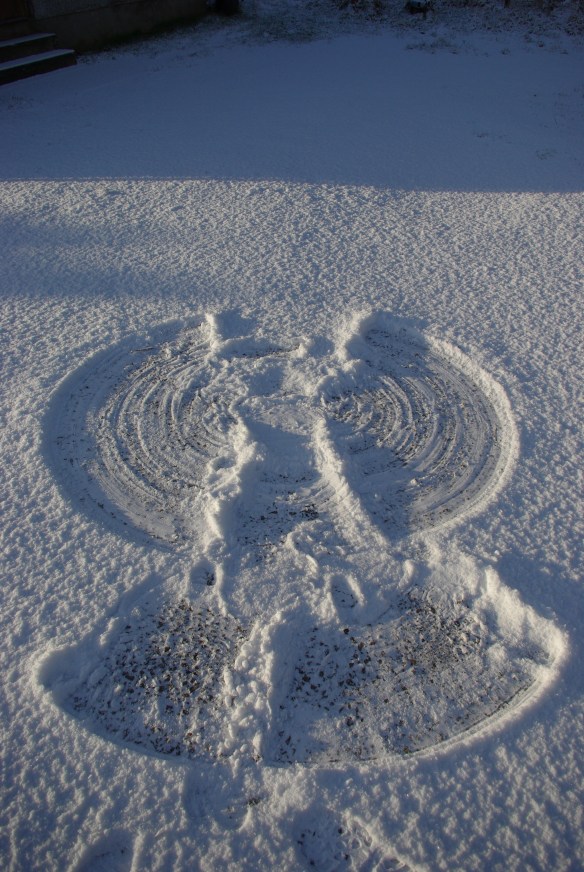
Snow angel

‘Joy to the world’ always sounds

ridiculously over-inclusive, from my

narrow perspective

lowered down in these city streets

obfuscated by all that is ordinary.

How about some joy more localised?

More specific

to the state I’m in?


What currency is joy counted in anyway?

What presents will it buy?

Will it float me far away on free air miles?

Will it sprinkle fairy dust on these small days of winter?


Or is just a celestial scratch card

Always scratched by

someone else?


Like a shepherd, I fear I would not recognise it

even if the Angel Gabriel visited me on some lonely hillside

Even if it fizzed in the mountain brooks

like victory Champagne.


Let alone glimpsed in bloody froth

as it slapped down on a filthy stable floor

at the furthest reach of a distant empire.


No choir, just the cries of a too-young mother

And a fart from the odd ruminant.


Joy to the world indeed.

To you whose hope seems stolen…

Advent, day twenty.

Did any of you watch Alternativity on BBC2 the other day? (If not, by the wonders of the i player, it is here.) It was a Banksy/Danny Boyle school nativity play with a difference- the kids were from Palestine and it was filmed in the shadow of one of the walls built to enforce a new kind of Apartheid by the Israeli neighbourhood bullies. It was the very opposite of slick and polished made-for-TV trash. It was full of real people, delighting in music and fake snow. Despite all the evidence to the contrary in that part of the world, it reeked of hope.

So, today’s poem dares to hope.

Starlight


To you whose hope

Seems stolen

Know this tender thing;

The bruised old sky above you

(Which seems to yawn indifference)

Is, in fact, leaking light.


Particles tumble down

Like this promise;

I am here

Where you are


For I know what you know

I see what you see

The walls you build are no protection

From starlight


My stars leave no shadow

And in this gentle light

Hope grows

Even snow

Becomes possible.


Stand up and be counted…

Advent, day nineteen.

I and  both my kids are dyslexic. We see through different goggles. Over a long career I discovered that dyslexia is not always a good fit with bureaucracy, which is a shame as this was my working world. Bureaucracy is concerned with order and control. If you can measure something, you can encompass it. You can own it.

The advent story has a contrast at it’s very centre between the bureaucratic imperative – mass movements of people conforming to a numbers game – and the individual human perspective – one family, one tiny child. The focus shifts from numbers to the preciousness of personhood.

Humanity is found in both; in our individuality, and out connection to one another. But it can not be measured. It transcends both.


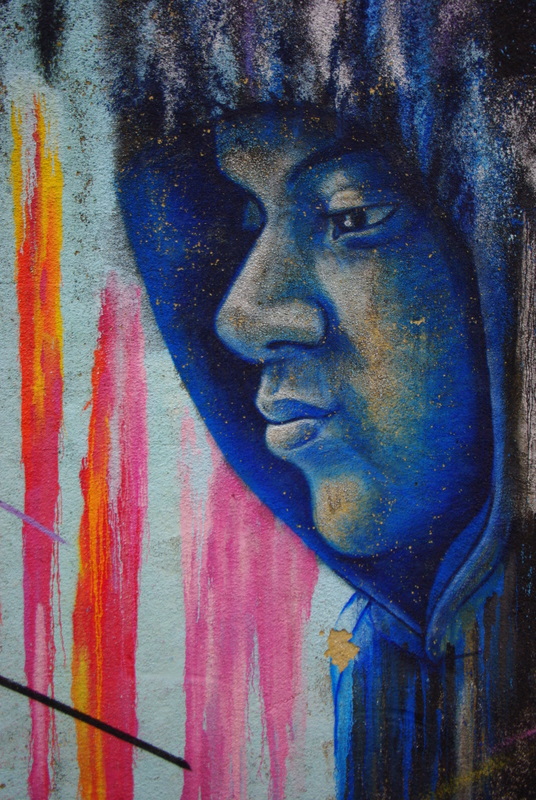
crowd, suits

Census


We started out so well

United against what was wild

This human animal was above all

Social


We did not live by bread alone

There were also rotas

We rose from naked ape

To hairless bureaucrat.


Order came out of chaos

So it could be counted

Each one of the beautiful creatures

Is rendered as data


There is the law

And the spirit

Quantity

And quality


There is me

And there are we.


They brought gold…

Advent, day eighteen.

These days, we mostly use plastic, because what we hold precious has all been manufactured. In China or Bangladesh probably.

These days, Michaela and I, we earn little but find that it is enough, at least for today. We make things with our hands to sell to others. We accept plastic. No-one has ever tried to pay in gold. What we do feels like hope, to us at least. We want to consume less, recycle more, live simply.

Of course however, this it is a choice possible only for the privileged. Let’s not kid ourselves, surviving in a world that values greed above all things is not easy, particularly when your access to credit is curtailed by great need.

So to those mothers and fathers who have increased the dark shadows of their debt to give their kids a Christmas time that they will remember, I say this. May you be blessed. May the sparkle of the lights on your trees be magical. May the tear of paper reveal items hallowed by love. May you be blessed.


gold

Gold


Why did they give you gold?

It is not as though you showed much preference for the finer things

Neither were you given to compromise where cash is concerned.

You were never that kind of King.


Perhaps it was a mistake – you were just a baby after all

Born in troubled times when life was cheap

A bit of the yellow stuff

Must have come in useful.


But you were no ordinary child

You could feed a thousand from a packed lunch

You could shower down manna with the morning dew

You trickled cool water from desert rocks.

Fishing nets bulged at your casual command.

You were there when mother earth incubated her

clutch of diamonds

So what need had you for gold?


Perhaps the value was not in receiving

(It is only shiny metal after all)

But rather in the giving.


Whatever gold I have

I offer to you.


It is yours.

Who knows what goes on between a man and a woman?

Advent, day seventeen

She was a virgin, or so they say.

Bishops have been cursed from the pews for suggesting otherwise.

But the remarkable part of the story we focus on today is the virgin’s husband, who, believe it or not,  loved her anyway.

IMGP1719


Joseph


A twist of hair breaks free from the binding

Flicks a lovely cheek –

Blushed as it is by the hard sunlight

And specked with road dust

– a sudden breeze sets it dancing


It is all too soon

I am not yet used to softer things;

The nape of her neck, the heady smell of her

Like earth after spring rain

And she, all but weightless in my arms


She shifts in the saddle, moans gently

I start towards her, but despite myself,

recoil

Heart-heavy from the bulge of her

This flesh of my flesh

Seeded by some other


So I take the reins and walk on

But wherever she goes

I go also

Small chairs…

Advent, day sixteen.

Many of us will be perched on one of these over the next few days, watching children in tea towels and donkey ears parade onto a stage, herded with only partial success by stressed looking teachers and nursery nurses.

I confess, I used to regard them as something to be endured, but now my kids are both well beyond such things and the distance of time shifts my perspective.

We hear so much about ‘the meaning of Christmas’. It seems to mean lots of things; being nice to people, mostly by buying them presents, or feasting and consuming to excess.  Now, I am not one of those who thinks that this country has a God given right to call itself ‘Christian’- there is too much darkness in that story after all. However, when we see what we have done with the birthday of Jesus, it is hard not to despair.

Then there is the sitting on small chairs business, the point of today’s poem…

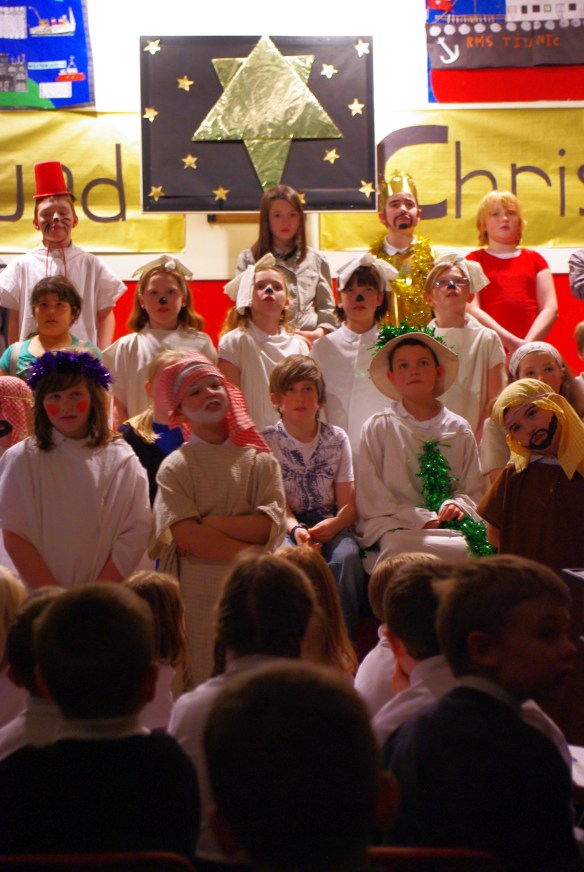
nativity play 2


Nativity


Just another nativity play;

Kids in tea towels and cardboard donkey ears

A tinselled angel picking her nose, and

A manger knocked together by Joseph’s dad

From bits of broken shed.

Jesus may be plastic, but Mary holds him close.

Cameras flash back from stars shaped from foil.

Despite my cloak of cynicism

I feel the approach of tears.


It is all so ordinary-

School chairs that turn us into giants;

The rank mix of stale milk and disinfectant;

The creak and boom of a poorly tuned piano;

That kid whose volume far exceeds his musicality;

We have all been here before.


Perhaps this is the point;

No facebook fanfare

No media circus

Messiah lies in a manger

Made from bits of broken shed


Frankincense…

Advent day fifteen.

We drove to Inveraray today to pick up our son, home from University for Christmas. It was cold, with ice still riming the road edges despite the corrosive salt. Snow lay in verges and in the fields, making the sheep seem bedraggled. It was early still, so the sun was low, lighting the white mountains with long wavelength light- the kind that is gentle; as much amber as white. It was all beautiful.

Michaela told me that this was her favourite time of year. But despite the beauty, I did not concur. There is a cruelty to winter. The cold makes things seem less than possible, or at least improbable. Of course, like all things, we know it will pass. The season will change again.

My favourite time of year is spring. I long for that moment when the ground turns and heaves with new life and you can smell the earth again. No longer sterile and cold, it seems to generate warmth of its own, despite the still-cold winds. In the forest, it scents the air like incense in a cathedral.

Like frankincense carried my wise men from warmer places, out East…

But for now, the ice remains.

Ice, loch Fyne, sunset


Frankincense


Hot tarmac kissed by a sudden shower.

Nuzzled nape of your slender neck.

How the newly turned soil

Exhales.

Cheap scent overheated

By teenage caresses.

Wool mixed with melting snow.

Coffee calling us towards the kitchen.


Baking bread.

The open sigh from crisp cotton sheets.

Superheated steam and well-oiled engine.

That first hint you are nearing the sea

As the air is seasoned by seaweed.

That medicinal miasma in deep pine forest.

Brand new carpet.

Wood smoke curled by early Autumn.


Washing fresh from the hanging line, then

Clasped beneath your chin s you fold it.

Frying potatoes.

Gunpowder zinging in November air.

Solder quicksilvered by a blowtorch flame.

Cropped turf on cricket pitch.

The ghost you left in this old coat

Opens the door to home.


And in the corner of the old church

Incense is still burning.

The violence of looking away…

Advent, day fourteen.

There was an article in The Guardian yesterday, describing some of the work of the UN special rapporteur on extreme poverty and human rights, following him on his fact-finding mission to examine the inequality and poverty that exists in the USA, the richest nation in the world. If you can bear to read it- you should.

It is a description of what happens when a nation declares war on the poor, at the same time as giving tax cuts to the already super-wealthy. Open sewers. Hookworm and other diseases normally only seen in the slums of the poorest parts of the world. People living in tents for decades with no benefits and no hope of better alternative.

Let’s not kid ourselves that this is only relevant to people living in the US. Our cultures are intertwined. Ideas that are pervasive in the US shape us too. They become ‘common sense’. In the US, the American Dream imposes a logic that suggest that everyone can succeed, if they are willing to work hard. Therefore, government spending that uses public money to assist the poor is seen as iniquitous,. The poor only have themselves to blame. Consider then, how this idea sits within our own welfare system, in a time of austerity.

In the article, someone uses the term ‘the violence of looking away’. We should take it on board, as if it was an antidote to the American Dream, or the British ‘skivers versus strivers’ equivalence.

There is hope to be found in the fact that there is a resistance. In the US, as described in the article, this sometimes comes from within the church.

I make no apology for bringing us down with a subject like this on our advent journey. Today’s poem celebrates the fact that Christmas is ultimately about the coming of our God to be amongst the poorest and weakest of us.

It is about a God who rejects the violence of looking away, replacing it instead with incarnation.

homeless people, church


Open the sky


Open the sky and let some light in

Let this night be night no longer

Let stars shine down in shafts of love

Illuminating the ordinary things

All down with dirt and common use

Let donkeys laugh out loud

For now the basest things

Are all silvered up in grace

Lubricated with kindness

For he is coming


Not to penthouses, or to plump our cushions of comfort

Or to stroke the fragile ego of celebrity

Not to strengthen the armies of the powerful

Or to expand their empty empires

Not to shape a new cathedral from seductive certainty

Or to doctor our old doctrines


He is not coming to the exclusive religious few

But to you;

The mess of you

All your brokenness

All your failure

He comes in the certain knowledge that

You will fail again


So open the sky and

let some light in