On self belief…

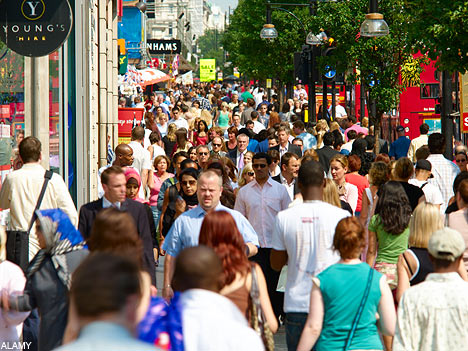
busystreetdm2310_468x351

There is a man who ‘busks’ on the street near my office. He stands just inside the underpass holding his nylon strung guitar awkwardly, unstrapped. He plucks at one string over and over again.

duh duh duh duh duh duh duh duh duh duh duh

He makes no pretense at melody. He utters not one word of song.

I walk past him regularly on my missions to meetings or for the odd sandwich. There he stands, motionless but for that monotone finger, staring zen-like at a point on the far wall, seemingly oblivious to the hand full of coins that some have dropped at his feet. Not by me, I hasten to add. I tend to shake my head in wonder. Surely he could just learn a chord for heavens sake?

However, the more I have observed him, the more I have come to think that there is something admirable, majestic even, in his stoical vigil. His total lack of artifice, of artistry, of concern for the judgement of others- it is remarkable. So much so that I find myself humming along to his droning string.

Hum hum hum hum hum hum hum hum hum hum

I have played guitar since I was 11 years old. But I could not have stood all those hours in that cold underpass and attempted to play for money. I would be too concerned about getting it right, about looking cool, about wanting people to be impressed by my art, by my skill. I would fuss over tuning and resonance. I would almost certainly fall short of my own expectations of myself.

So it is with many creative folk. To create we need to believe we have in us something worth creating. But self belief is a fleeting thing, often wafted away in the first breeze of public scrutiny.

Or at least that is how it often feels to me. It is almost as if each string I pluck makes nothing more than that same monotonous duh duh duh.

There he stands. And I walk by.

Send in the revolutionary heroes…

My son was wondering where they had all gone. He has heard of Mandela and Luther King and Ghandi- but he knows they are all dead and gone. The battles they fought belonged to other generations, not his (although perhaps the battles go on for ever in reality.) He wondered why there were no leaders like these around now. Where are the revolutionary heroes of 2015?

I was reminded of this song;

We thought about this, his mum and I. Perhaps heroes like this are only ever visible in hindsight- from the close perspective of history they are more nuanced and shadowed by compromise. Perhaps too the nature of our media twists and shapes the message so that it just becomes another piece of electronic background noise; at best something that flicks across your Facebook feed then fades back into ephemera.

Perhaps too the age of great ideological debates has been replaced by a homogeny of endless consumption; each and every thought and idea has value only because it generates hits on a server somewhere that also sells something.

Perhaps too that activism also has had to play by these rules. Movements like Occupy have eschewed ‘leadership’ in the traditional sense, moving instead for fluidity and protest modeled more on performance art- the sort of stuff that twitters well.

But sometimes you encounter someone to whom that rather cringeworthy word authentic can be applied to. Someone who is prepared to live in a different way. This is part of the dramatic appeal of Corbyn in British politics at present- for once, substance is elevated over style. Content is valued above communication.

For those of us who still long for flawed heroes, perhaps this will pierce the cynicism of these words. A real revolutionary hero.

Here you go son. He is not your generation- not even mine- but a hero none the less.

Falling leaves installation…

Falling leaves

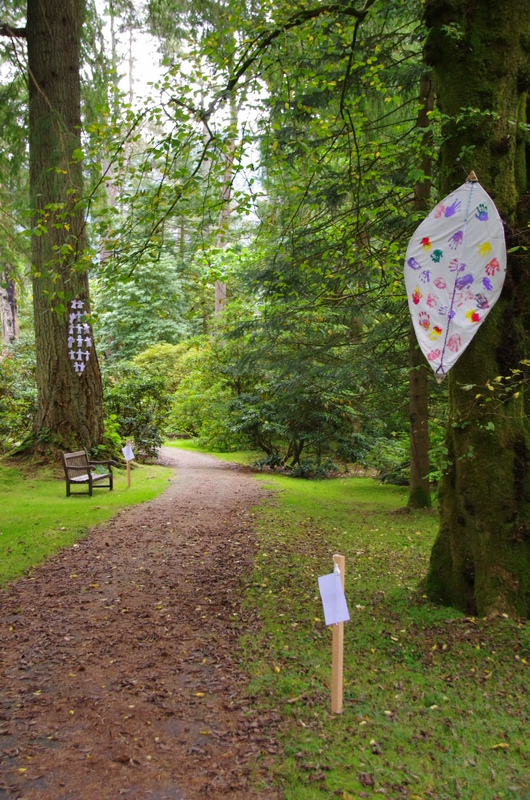
We went for a walk through the falling leaves yesterday.

This was the Aoradh (and friends) installation in Benmore gardens. We twinned the leaves with a poem- each one taken from this book, from the section called ‘Losing’.

Here is one of them;

Open hearts have to close sometimes

Rachel Edge

“Close the door, you’re letting all the warmth out.”

It’s autumn and the dying leaves are skittering over the porch, whistling over the concrete step.

The chilly gusts swoop and swirl round the doorframe, over my arms, making me shiver.

My heart aches like a cavitied tooth when it meets ice cream; cold right to the bone.

“But he might come back… I can’t close the door; what if he comes back?”

I look out on the bleakness, search for vacant signs of life.

They shake their heads, pitying me mutely.

“Close the door, love.”

I know. I know.

He’s gone

Some photos;

The politics of principle…

I listened to this speech. Every word made me frightened.

Not for the reasons that others are frightened- I have no fear of the radical left wing, in fact it is where I am most at home.

The fear I felt was related to something else- something to do with the fragility of hope. You see, just about everything that this man says makes my heart leap. AT LAST someone who has a loud voice is saying the things that I hold to be self-evident (even if he obtained this voice by accident and even if the assassins are hiding behind every corner he walks around.)

And as I hear him speak, I feel myself drawn in to the possibility that a real alternative to the suffocating me-first consumer-driven grubbyness that has overtaken life in the UK is possible. Perhaps we can start to care about the effects of poverty and inequality again. Perhaps we can raise our discourse above ‘the market knows best’ monotone. Perhaps we can once again be driven by principles that are based around humanity, respect, love even.

So why am I frightened?

Hope is a dangerous thing. Corbyn is not the Messiah, and even if he was, the Messiah that I believe in ended up crucified.

But nevertheless, how grateful I am that the Labour party (who have done much to destroy my hope in the last couple of decades) still have people like this man in their midst. He may well belong to an earlier age (the time of my political awakening in the 80s) when ideology was king, but he is a powerful reminder that politics based on pampering only those in power is a politics of despair.

Corbyn may never be elected as Prime Minister of this country, and I do not care. What we need from him right now is to hear a strong voice that challenges the status quo. A voice that reminds us of our duties to the poorest and weakest in society. A voice that points out that the fat old Emperor is stark bollock naked.

I am fearful that the very reasons why I like him (that honest naivety arising from pressure group politics, with its binary decisions about good/bad) might yet prove his undoing. His refusal to spin, to play the political game; it may yet mean that his voice can not be heard.

But in the meantime, still I dare to hope. Even on the basis of one speech, I dare to hope…

September comes…

oak leaves, autumn

A 25th wedding anniversary poem for my lovely wife. 

September comes

September hangs a little lower;

Each branch still be strong, but

Wearied now by the pull of

The brown old ground beneath

And I fear for all that fruit

For it must surely fall.

Yet how these trees are kissed with gold

 In our late summer blooming

Every bird still joins our song

And all the earth is turning

Let the fruit fall as it will

How else shall seeds be sowing?

Let us sit down beneath these trees

And take some time for loving


Falling Leaves event; calling creatives…

In the corner of our lounge we have a gathering stack of leaf skeletons, made from copper, wood and wire.

_IGP8739

These are intended to be blank canvasses for artists to make large leaf-art for this event. The leaves will be suspended to form an installation in Benmore Gardens.

We are looking for artistic collaborators- so if you are reasonably local and fancy taking a leaf to make your own contribution, please get in touch! You do not need to be an ‘Artist’ with a capital A- rather someone who has a story to tell on these empty leaves…

Here is a short piece of writing that hopefully gives some context and inspiration for the event;

We are all going to die.

There are no exceptions; no get-out clauses for the rich or the famous.

.

It is sometimes possible to live as though death is another country;

A place we know to exist but never plan to visit- Moldova perhaps, or Azerbaijan.

We come to believe that death happens elsewhere; in other houses, other families; to other people.

So it is that we hope to banish fear of the unknown

The terrible pain of separation.

.

But what if life itself is impossible without death?

What if a good life has to also embrace the inevitability its ending?

.

Like these leaves…

At first a dream in some distant DNA, secreted in the seed of some old spreading tree.

Budding in the harsh days of winter.

Unfurling shyly in the soft mist of the early spring, vulnerable to any late frost.

Spreading out into a canopy community, shouldering for space and light.

Frayed by the beaks of birds and the lash of summer storms.

Caught up in production, forgetting the play of the evening light.

And the singing sound of a warm breeze when it catches them all in concert.

Then comes the calling in of days; each one shorter than the next.

But rather than just let go, each clinging leaf becomes a blaze of colour.

For if the fall will surely come,

Let it be beautiful.

For though winter is dark

It can never put out the light

.

We humans live in a complex world defined above all by this one word;

Love.

.

May we learn to love most deeply in the dancing shadows cast

By falling leaves.

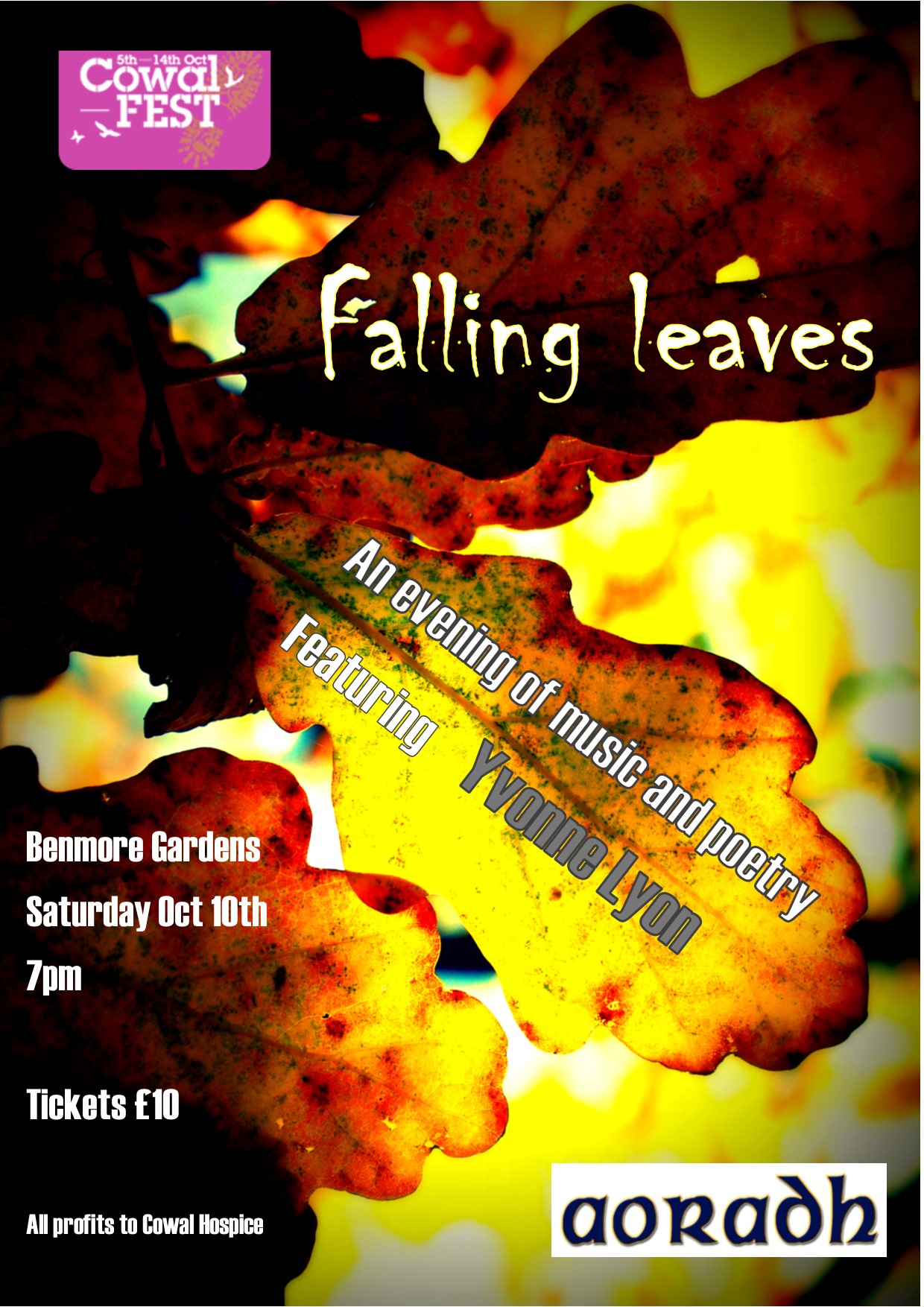
Alongside this event we will also have an evening of music an poetry in the lovely Benmore Gardens courtyard gallery. Music will be from Yvonne Lyon, whose new work is a collection of songs co-written by people reflecting on issues of hope and loss. It is sublime.

The poetry will be taken primarily from the section entitled ‘Losing’ from the Learning to Love book, and I hope to have some of the poets who contributed as part of the readings. Hope you can join us- tickets will be limited due to space being tight at the venue!

falling leaves poster

Norway road trip…

The hills are alive

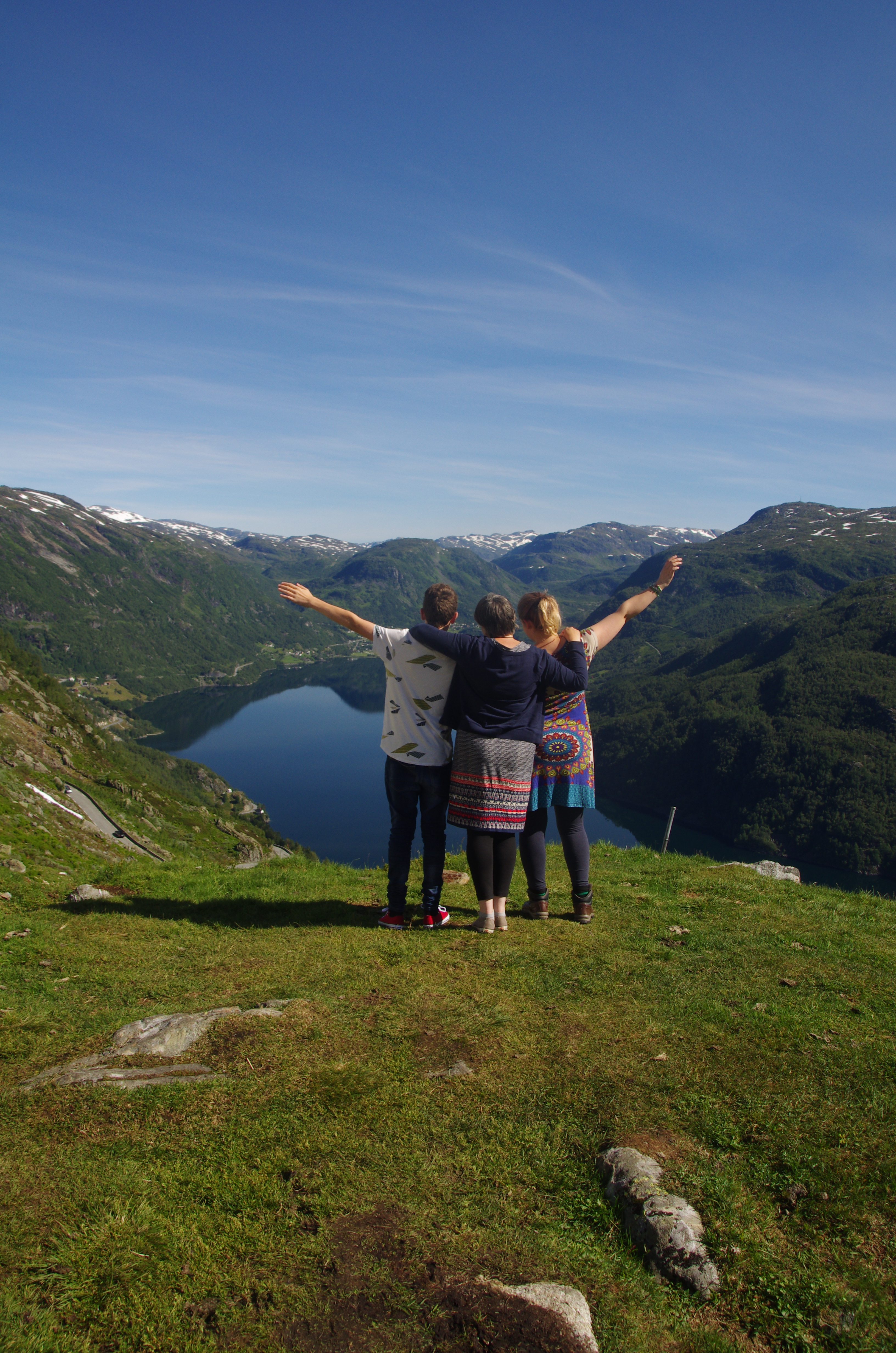
We are just back from a trip to Norway, a place I have long wanted to visit. In truth I was desperate for a holiday after a year of hard slog in my current job- something I rather hoped I had left behind. You know what I mean, that feeling of holding on in desperation for some kind of survival related break. Anyway, we spoke long and hard about where to go, and even considered one of those package tours but I simply could not face it. I have this dread of the thought of a package tour, even though I have never been on one.

As it happened, the planning of the trip to Norway made it clear to Michaela and I that having someone else organise your holiday for you might well have advantages!

Should you be thinking about a trip to Norway, here is what we did. The first thing that you should know is that it is an expensive place to go, so we decided to do it as cheaply as we could- we payed about £500 for air tickets (with extra baggage) and hired a car for 11 days or so (about £600) and then took tents and camping gear. We planned to spend between 70-100 quid a day and this already would mean this being the most expensive holiday we have ever taken. As it happens we spend more than this! Supermarkets (Rima 2000 being the cheapest) were about twice as expensive as here and meals out were two to three times more expensive (we only had one.)

We drove a lot of miles; down to the forests of the Swedish border, up to the high plateau between Oslo and Bergen then right round the southern coast back to were we started. The roads are stunning; Norwegians seem to have two national industries, one related to all things fish, the other tunneling through mountains. One tunnel corkscrewed down into a mountain for miles before emerging out of a cliff face onto a bridge over a fjord before the road entered another tunnel the other side.

Our favourite bits were the stunning high mountain passes, with all their snow patches and wildflowers. Bergen we were not so impressed with on the whole; to many cruise liners and ridiculous prices (we paid £16 for two ice creams!)

At the end of the day, we had a fantastic time and I would love to go back and explore the high latitudes. Need to save up though!

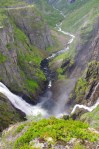
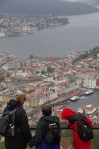
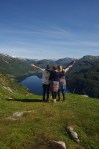
A few snaps;

Poverty and inequality, how it makes things worse for all of us…

shop window

How much is enough?

In considering the creation of poverty I have argued in previous posts that the narrative meaning we ascribe is vital. It is this story that underpins the lifestyle and the cultural exchange that pulls us towards the curated inequality that is increasingly at the heart of our society.

I would argue also that one of the other key sustaining factors of this narrative is this; fear. This comes in many forms; fear of losing what we have, fear of some kind threat posed by the other (immigrants, the great unwashed, drug using outsiders etc.) and fear of a loss of security that might send us spiralling downwards from whatever security we have carved out for ourselves.

The degree to which these two factors (Story and Fear) are deliberately employed by our ruling elite, or are emergent properties of a society sustained by the exultation of money and property is one of conjecture. There is clear evidence that current government policies are shaping this narrative towards vilification of the poor, framing poverty as primarily the result of poor choices, addictions and inadequate family structures. There appears to be a great reluctance to describe poverty in financial terms, or to acknowledge the role played by austerity and cuts to what had previously been regarded as essential services. This is not a new perspective on the poor however, rather one that has been given credence and confidence by circumstance.

For some time, alongside the narrative that has centred around the unaffordability and immorality of welfare benefits in a time of austerity (bolstered by the dominance of an American right-wing consciousness very different from traditional Conservatism) there has also been an acknowledgement in parts of the press of the excesses of the super-rich; tax avoidance, hedonistic excess and the sexual peccadillos of members of the House of Lords always sells newspapers. Despite the clamour against the bankers and stock brokers that arguably drove our economy into the recession that we still labour beneath, on the whole, the super-rich have never had it so good. Their wealth is increasing and the gap between their way of life and the poorest sections of society is now akin to that of Edwardian Britain.

What then of the rest of us? If (as I argued previously) poverty for some is the inevitable consequence of the wealth of others, what does this mean for those of us (like me) who have those badges of belonging to the comfortable class; mortgage, new-ish car, reasonable earing capacity and an accumulating pension pot?

Do these things make us happy?

Are they any guarantee of life satisfaction?

Do they represent a sustainable way of life?

Do they even represent a good life?

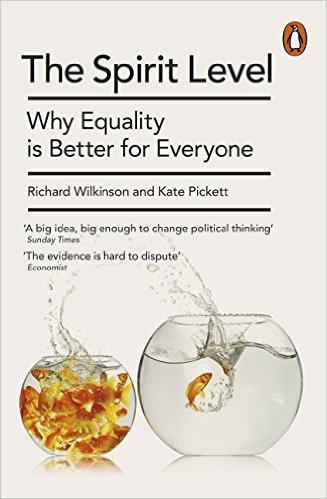
the spirit level

Leaving aside any moral/theological answers to these questions (compelling though they may be) there are some clues from research. Some of this was gathered together by Kate Pickett and Richard Wilkinson in a book called The Spirit Level. In this book they try to grapple with what inequality does to us, on an individual and a societal level. These quotes are from here.

The truth is that human beings have deep-seated psychological responses to inequality and social hierarchy. The tendency to equate outward wealth with inner worth means that inequality colours our social perceptions. It invokes feelings of superiority and inferiority, dominance and subordination – which affect the way we relate to and treat each other.

As we looked at the data, it became clear that, as well as health and violence, almost all the problems that are more common at the bottom of the social ladder are more common in more unequal societies – including mental illness, drug addiction, obesity, loss of community life, imprisonment, unequal opportunities and poorer wellbeing for children. The effects of inequality are not confined to the poor. A growing body of research shows that inequality damages the social fabric of the whole society. When he found how far up the income scale the health effects of inequality went, Harvard professor Ichiro Kawachi, one of the foremost researchers in this field, described inequality as a social pollutant. The health and social problems we looked at are between twice and 10 times as common in more unequal societies. The differences are so large because inequality affects such a large proportion of the population…

Most important has been the rapid accumulation of evidence confirming the psychosocial processes through which inequality gets under the skin. When we were writing, evidence of causality often relied on psychological experiments that showed how extraordinarily sensitive people are to being looked down on and regarded as inferior.

They demonstrated that social relationships, insecurities about social status and how others see us have powerful effects on stress, cognitive performance and the emotions. Almost absent were studies explicitly linking income inequality to these psychological states in whole societies. But new studies have now filled that gap. That inequality damages family life is shown by higher rates of child abuse, and increased status competition is likely to explain the higher rates of bullying confirmed in schools in more unequal countries.

 You can read more about the impact of inequality on social functioning here.

These appear to be stable, well understood phenomena, acknowledged even by organisations such as the IMF (who seem paradoxically intent on fostering and promoting inequality despite this.) The more unequal a society is, the more we all suffer. Inequality is kind of social toxicity that makes us all sick.

What do we do with this information? Can we strive towards equal distribution of wealth? Perhaps this is neither realistic nor desirable. There will always be variations. The point is that at present we are becoming more unequal here in the UK;

  • The proportion of households falling below society’s minimum standards has doubled since 1983
  • More children lead impoverished and restricted lives today than in 1999
  • 5 million more people live in inadequate housing than in the 1990s
  • 9% of households can’t heat their homes adequately today up from 5% in 1983 and 3% in 1999

Why is this not political dynamite?

Why are we not lining up to say that this is the greatest evil facing our society; the greatest threat to our so-called British way of life (rather than ramping up the fear factor and claiming these things for Islamic terrorism?

Poverty; what causes it?

Tegel Airport To Close In 2012

Poverty is not to be recommended- I have seen it; I have had some personal experience of it. It strips you of your becoming. It is like a leach sucking the life from everything you hoped for. There is nothing noble about poverty, nothing sexy. Even those who rightly pride themselves on rising from humble beginnings have only the benefit of hindsight.

Poverty however is best understood as the direct consequence of the wealth of others. I know, it sounds all too simplistic; too much like the impractical economies proposed by Marx, or by Jesus even. But think about it; poverty is caused above all by this one thing; inequality.

Not that we talk about this much any more. The Government is currently engaged in a redefinition of child poverty in the UK (previously defined as growing up in households with less than 60% of median income) towards something defined instead by an understanding of the so-called root causes of poverty, including family breakdown, debt and addiction. This seems to make sense at first, until you look at the evidence.

The government is influenced mostly by the work of the right wing think tank set up by Ian Duncan Smith called the Centre for Social Justice, who paint a picture of UK poverty that is tied up with bad parenting, highlighting cases of alcoholic, crack-addicted parents and parents who abandoned their children to play bingo and survive only by running up huge debts. Makes instinctive sense right? (Be honest.) Poverty in families is about dysfunctional parents. Don’t let the facts get in the way of such self-evident truth.

It is almost as if the very word poverty is now to be regarded as tainted. Duncan Smith announced recently that the Child Poverty and Social Mobility Commission is soon to be known simply as the Social Mobility Commission.

So, what really causes poverty? The Child Poverty Action Group has a list of ‘Child Poverty Myths‘ on its site that are well worth checking out. They make the point that dependency on alcohol and drugs and family breakdown are societal issues across both those who are poor and those who are wealthy, but are relatively rare in both social groups. Best estimates are that around 93% of benefits claimants do not regularly use alcohol or drugs in a dependent way, and over 60% live in two parent families.

Then there is the myth of ‘benefits dependency’; the suggestion that people are captured in a culture that enforces idleness and rewards worklessness. The logical answer is to make benefits so unattractive that people are forced to find work; a return to exactly the same kind of thinking that gave us the Poor Houses.

  • Data also shows that many claimants rely on benefits for only short periods of time. For example, 67 per cent of Jobseekers Allowance claimants find work within 6 months while a further 22 per cent are no longer claiming benefits after 12 months.2
  • Recent Department for Work and Pensions focus group research offers an interesting insight into job-seeking behaviour of a sample of claimants.3 It showed that while 22 per cent of the group were not actively looking for work, half of these dedicated their energies instead to their families, a statistic that speaks to other types of important work that claimants may undertake but which has no monetary value.

It is clear however that worklessness, or low paid, temporary work is very much a direct cause of poverty. Some people can not work, through sickness, family caring responsibilities, lack of adequate childcare or a general lack of work opportunities for their skill set.

Then there is the general denudation of benefits. They are worth so much less in real terms than they were previously. This from a TUC paper entitled Welfare Benefits – A necessity not a lifestyle choice.

Benefits in the UK are comparatively lower than other industrialised countries; with one of the lowest benefit rates relative to earnings. In addition the actual value of benefits in the UK has declined over the last thirty years due to a change in the policy of up-rating benefits. In the 1970s, benefits were increased in line with earnings or prices whichever was higher, over the last 30 years they have increased each year in line with prices only. Prices usually rise by less than earnings, since 1978 average earnings have grown about 1.6 percent a year faster on average than prices. The effect of this, as Peter Kenway (2009) shows us, is that while real consumption per head has risen to a level that is now more than double what it was in 1978, the real value of unemployment benefit has remained fixed at or 3 around its 1978 level. Numerous studies show that the current level of benefits are too low to meet current expenditure levels and what the general public think is needed to afford an acceptable minimum standard of living. The consequence of benefits not rising as fast as other forms of income is that the income of benefit recipients will fall further behind those in employment. This inevitably contributes to a widening of income inequalities.

There is that word again; inequality.

There was a fascinating discussion about social mobility last week. The social equality that Duncan-Smith is deliberately selling us is based on the old American dream; we can all succeed with the right levels of effort. What was revealed recently however was this; in order for poor children to succeed, rich kids have to fail, and rich parents do not like that very much, so create a kind of ‘glass floor’ to prevent their offspring falling. No surprises there.

So, what do we know about the causes of poverty? Of course it is possible to point to lots of individual factors; poor choices, missed opportunities, broken families, bad luck even. But what we know is that at a societal population level, these are symptoms much more than causes. People are in debt because they are poor, not the other way round.

The cause of poverty is unequal distribution of resources, unequal opportunities to thrive and prosper and a society in which the rich are getting richer and the poor are blamed as being the cause of economic woes that they are subject to, not the cause of.

Back to the Child Poverty Action Group. This from here.

“Producing a way forward for tackling poverty that doesn’t recognise that poverty is about money is pretty astonishing,” Imran Hussain, the director of policy for the Child Poverty Action Group, said.

“The government should be keeping an eye on issues like kids living with drug-addicted parents, but this is not the same as poverty. The government seems to be suggesting that income doesn’t matter.”

Fiona Weir, the chief executive of Gingerbread, the charity that supports single parents, warned that “further stigmatising single parent families will do nothing to tackle child poverty”.

“Family breakdown doesn’t cause child poverty. It is unaffordable childcare, low levels of maternal employment and poor wages that push families below the poverty line,” she said.