If this does not inspire you about the power of music to lift the human spirit then nothing ever will;
Life would be worthless without music, she said…
Reply

If this does not inspire you about the power of music to lift the human spirit then nothing ever will;
This blog has featured a lot of discussions about mental health. This is because I have served my time as one of societies psychiatric policeman- an Approved Social Worker in England, and a Mental Health Officer in Scotland.
I started out 25 years ago with a clear idea about mental illness- people who were ill did not always realise that they needed help. It was my job to try to make sure they got help. I had all sorts of different ideas about what this help should look like, and lots of frustrations with the psychiatric machine that I had to deal with, but fundamentally, the idea of mental illness itself was a stable reality within what I did.
Sure, we challenged the medical model (Illness-diagnosis-treatment (maintenance)) as this failed to take into account the social context in which some ones illness develops, but the dominant paradigm that affected work with people with ‘severe and enduring’ mental illness remained firmly medicalised. It was the only way to make sense of the psychic chaos we were faced with – hospitalise, medicate and sanitise it out of our immediate circle.
Increasingly I became a skeptic- not just of the machine, but the actual underlying concepts of ‘mental illness’.
It started many years ago when faced with young men and women who, once diagnosed with schizophrenia, were condemned to half-life at best. The medication we gave them to control their symptoms (particularly the ‘voices’) often did not work, and had such destructive side effects that everything would slowly slide downwards into a kind of suppressed humanity. Is this really the best that we could do?
Alongside this other movements were emerging. They were dangerous and threatening. One of these grew up in and around Manchester, where I was working, and was called ‘The Hearing Voices Network‘. It dared to suggest that hearing voices was a NORMAL human experience- not a symptom of ‘illness’. Rather it was a way of coping with trauma for the most part.
Rather than pushing the voices away, suppressing and chemicalising them, the HVN suggested we needed to embrace them, engage with them, understand them- even the destructive aggressive ones.
More recently we have has another movement- around the idea of ‘recovery’- living fully in the presence (or absence) of the ‘symptoms’ of mental illness.
None of these are easy concepts- they are really stories of life long journeys for people experiencing one of those ‘psychic civil wars’ that all of us go through to some extent.
What convinces me most about these revolutionary ideas in relation to mental health issues is the HOPE that they bring. The best that psychiatry can offer to many is ‘maintenance’. All the so called break-through s of the pharmacological machine that spend millions convincing doctors to use their new wonder drug have done little to change this. Suddenly however, people are saying clearly- The treatment you are offering me is NOT WORKING. I want something better for my life.
That is not to say that there are not people in the system who see it this way too. I heard this wonderful TED talk the other day. It is saturated with hope, and the raw joy of life…
Enjoy;
Check out this video, via the Moon Magazine.
I particularly liked this;
“…. the ‘I am right spirit’- self righteousness- and how this has to take a back seat…. If you just see Jesus in everybody, you are much better off…”
A friend pointed me to this clip- a speech made by a professor to young students. It resonated with me as in just a few short weeks my daughter is off to university. We sat and drank champagne last night to congratulate her on her exam results, and I wondered what lay ahead, and how we got here so quickly…
Here is the clip;
(There is a transcript here.)
A few years ago I wrote a post in which I suggested that kindness was perhaps the best measure we had of ‘spiritual maturity’. Let us hope that our children see it the same way…

Thanks to all of you who have sent in poems for this collection! We will now formally close the submission gateway on SUNDAY THE 18th AUGUST 2013- so if you are going to submit something, get on with it!
We now have poems from about 100 poets from all over the world and I have had a quick scan of most that have come in, and there are some great poems. Some have reduced me to tears- in a good way.
The next task is to break this down with the dreaded yes/no, then categorise it all to see what chapters need more material. We will then possibly need to go back to the people who have written poems we have chosen and ask them if they want to write something else for the categories that need more stuff.
So, we will be getting in touch over the next few weeks.
Just a word again to those whose poems we will not be including in this collection. Please remember that this is not a vote of no confidence in your writing- far from it- please write more! It is simply that we did not feel that your work quite fitted in with the collection. As we said previously we are simply not able to give any more feedback than this about work submitted- for obvious reasons of time, but also because we are not poetry critics – just fellow writers, with all the subjectivity that this brings to bear.
My friend Andrew Hill posted this on FB today, and it made me laugh out loud. Given the rather worthy tone of this blog of late, I thought it worth re-posting!
Also seemed relevant following a conversation yesterday with another friend who told me he had been at a wedding recently which featured an unhealthy smattering of 80’s worship songs, including the one about the trees of the field clapping their hands. He bet £5 that someone would shout ‘HOY’ at the end (if you do not know what I am talking about then be grateful.)
He won the bet however…
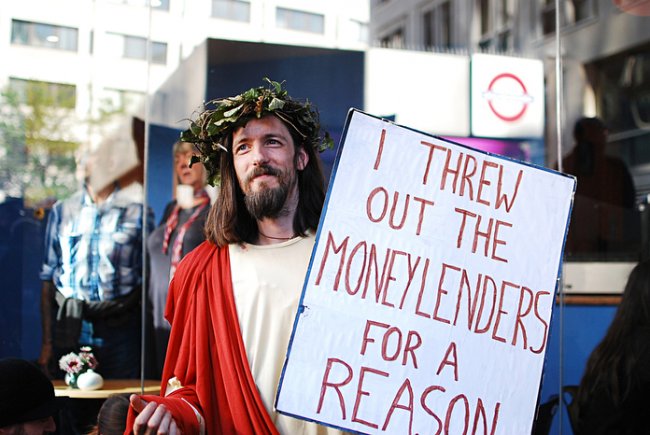
A bit of fun this- although laboured and rather too worthy.
I am still trying to write what I am calling ‘poetry of protest’ as mentioned here. This one might be more or less within the rules I set for myself then, but only just. Here it is anyway;
I do not agree
I do not agree with economists
Who monetise success
I do not agree that pounds or pence
Ever show us at our best
I do not agree the skin we’re in
Should make whom we’re becoming
I do not agree that some are born
To only test the plumbing
I do not agree with generals
Their guns can rot to rust
I do not agree, their meat machines
Cause in me disgust
I do not agree when those in power
Line the pockets of their friends
I do not agree that might is right
When the poor are thus condemned
I do not agree that we should comply
We are formed in evolution
I do not agree that nothing turns
This worlds in revolution
What stories does a nation tell to one another whilst in exile? How do they understand their nationhood from the perspective of a refugee camp or even worse, a slave colony?
Much of the Old Testament emerges from this context- the people chosen of God, coming to terms with who they no longer are and dreaming of restoration, justice, peace; living in a land where the lion can lie down with the lamb. These dreams and hopes were often personified in the idea of Messiah- a great leader who would defeat the oppressors, and lead the people away from refugee status and establish a New Kingdom.
I mention this because the news has contained quite a bit about immigration of late. In the UK (and in Australia too it seems) the political landscape has shifted markedly to the right. The tabloids have thundered on for years about a so called tide of ‘others’ who are arriving on our shores, sucking our NHS dry, demanding benefits, taking all our jobs, filling our social housing estates etc etc. This has now become the agenda of government.
The general consensus even within the Left wing is that this is an issue that it is no longer possible to be ‘soft’ on. Labour has to be seen to be defending our borders from the seething mass of the outsiders who want to become our neighbours.
It is almost impossible to separate the social facts from the politics (or the politics from the economics) in all this thundering about immigration. I am tempted to try to discuss some of the figures, and what they might mean, but that is not the point of this piece. This is rather about the stories we tell one another.
The stories we currently tell in the UK are dominated by this kind of thing;
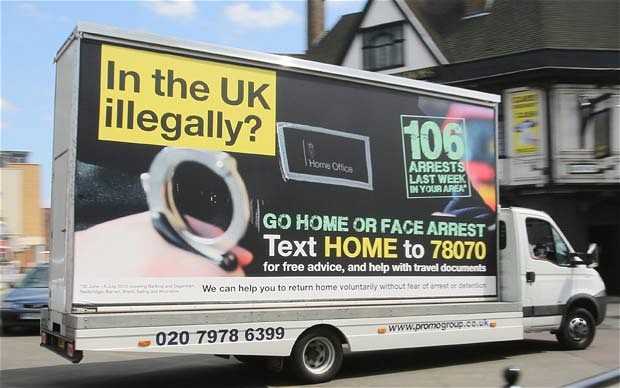
The government is experimenting with sending these vans around areas where lots of immigrants live, splashed with black backgrounds and pictures of handcuffs, offering to send people ‘home.’
The inference is obvious- you are not welcome here, we want you out and we are coming to get you. All this fits very well with a certain kind of story- the illegal immigrant as feckless and sneaky parasite, contaminating our country and its way of life with alien colour, religion and culture.
This story has been constructed from the mess of statistics surrounding immigration. Check out this article that dips its tows into this issue. A quote;
We know, for example, that the Office for Budget Responsibility thinks that immigration is good for the public finances in both the short and long run. We know that there is little evidence that immigration impacts negatively on jobs or wages; we know that immigrants are much less likely to claim benefits, and that they overall make less than proportionate use of public services like health. All of this research is based on government data on immigration and immigrants; the committee – and the government – would perhaps be better occupied highlighting the results and calling for further research in areas where we know less.
But I find myself desperate to hear other stories- ones that contain more grace, more humanity, even more plain intelligence. And for this, we can turn again to the stories of the Bible.
Stories of a proud nation, defeated by the rise of empire. Overwhelmed by global forces who have no interest in their God, their tribes, their history. Stories of people scattered, either by force or by economic necessity, to become the slaves and pawns of empire.
Then there are other stories, that tell the stories from the individual perspective. One of the most well known, if the most miss-interpreted, is this one;
Genesis 19
The Message (MSG)
19 1-2 The two angels arrived at Sodom in the evening. Lot was sitting at the city gate. He saw them and got up to welcome them, bowing before them and said, “Please, my friends, come to my house and stay the night. Wash up. You can rise early and be on your way refreshed.”
They said, “No, we’ll sleep in the street.”
3 But he insisted, wouldn’t take no for an answer; and they relented and went home with him. Lot fixed a hot meal for them and they ate.
4-5 Before they went to bed men from all over the city of Sodom, young and old, descended on the house from all sides and boxed them in. They yelled to Lot, “Where are the men who are staying with you for the night? Bring them out so we can have our sport with them!”
6-8 Lot went out, barring the door behind him, and said, “Brothers, please, don’t be vile! Look, I have two daughters, virgins; let me bring them out; you can take your pleasure with them, but don’t touch these men—they’re my guests.”
9 They said, “Get lost! You drop in from nowhere and now you’re going to tell us how to run our lives. We’ll treat you worse than them!” And they charged past Lot to break down the door.
10-11 But the two men reached out and pulled Lot inside the house, locking the door. Then they struck blind the men who were trying to break down the door, both leaders and followers, leaving them groping in the dark.
12-13 The two men said to Lot, “Do you have any other family here? Sons, daughters—anybody in the city? Get them out of here, and now! We’re going to destroy this place. The outcries of victims here toGod are deafening; we’ve been sent to blast this place into oblivion.”
14 Lot went out and warned the fiancés of his daughters, “Evacuate this place; God is about to destroy this city!” But his daughters’ would-be husbands treated it as a joke.
15 At break of day, the angels pushed Lot to get going, “Hurry. Get your wife and two daughters out of here before it’s too late and you’re caught in the punishment of the city.”
16-17 Lot was dragging his feet. The men grabbed Lot’s arm, and the arms of his wife and daughters—God was so merciful to them!—and dragged them to safety outside the city. When they had them outside, Lot was told, “Now run for your life! Don’t look back! Don’t stop anywhere on the plain—run for the hills or you’ll be swept away.”
Sodom and Gomorrah, so often a phrase used to describe depravity- particularly of the homosexual kind.
You know the rest of the strange old story- how Lot pleaded for the city to be saved, but how in the end he and his family escaped, only for his wife to look back and be turned into a pillar of salt. It is a story that has all sorts of uncomfortable echoes as we tell it within our culture. How do we understand the sexual politics? The treatment of women? What is God condoning and what is God regarding as reprehensible?
But here I want to offer you this story as an image of how a people might abuse outsiders within our communities– how we might see them as less-than-human, how we might be able to demonise them to project our own fears of the unknown, or to meet our own baser fantasies.
Lot and his family (along with the two visiting angels) are the heroes of the story rather than the city dwellers themselves, and this changes everything.
Let us be suspicious of the politics of hate and fear, wherever we see it, and let us listen carefully to the stories of real people. Particularly people in exile.
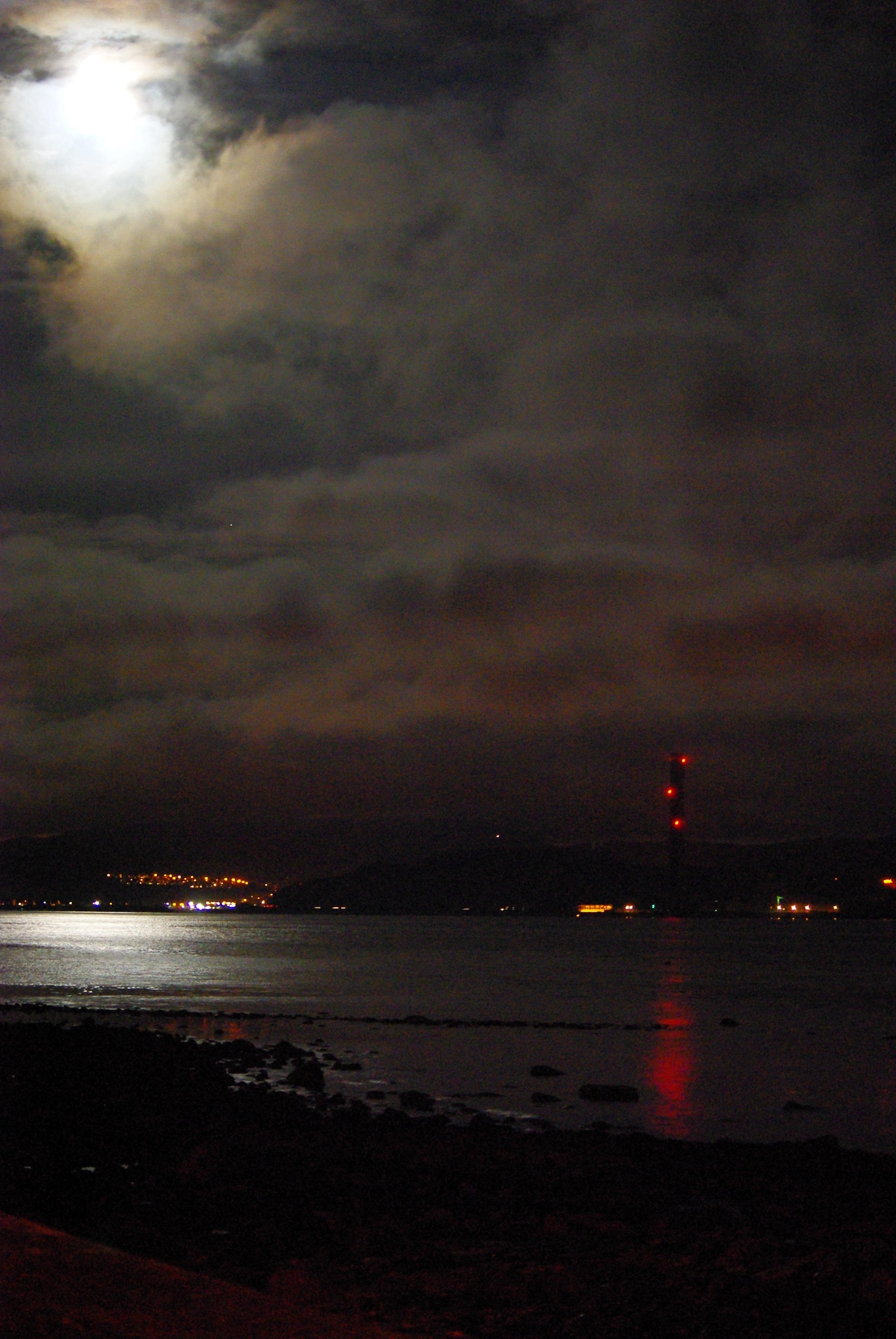
For years, the view along the Clyde has been dominated by the chimney from Inverkip power station. It is (or was) the highest free standing man made structure in Scotland; 20,000 tonnes of concrete piled 237 meters high.
The power stations was built in 1970, to be powered by oil, just before the oil crisis sent prices sky rocketing. The only time it has ever been used was during the miners strike in 1985, when it was switched on as some kind of black-leg to break the power of the National Union of miners, at goodness knows what cost.
Finally they have decided it has to go- it has no place in a globally warmed world with its dwindling oil reserves. There have been several explosive demolitions on the site, but this one was the big one- the end of the huge chimney.
Down it went, leaving a ghost of itself in a kind of dusty effigy…
I took some dodgy video from one of the bed and breakfast rooms in our house. Here it is (with commentary by Emily, Netta and myself!)

