God’s awkward squad; dissenting and the life of the Spirit…

History is littered with awkward difficult people who refused to conform. Their lives are often surrounded by conflict, particularly when their convictions confront the people in power. Think of all those Old Testament prophets.

What fuels this kind of dissent? It is often painted (by the after-the-event supporters of the dissenters at least) as a matter of conviction colliding with circumstance. I wonder however whether dissenters also are gifted/cursed with a particular kind of personality- a skew towards a simplistic world view, an arrogance even.

We can all think of people like this- they tend to be difficult to be around. Others shrink from the force of their opinion in groups, or retreat wounded from their harsh words and deeds. People I know who fit this category have often been an almost destructive force in the workplaces and groups I have been part of. They can often be far more focused on ‘the task’ than those whose task it is.

But, these people, for good and ill, are often those who we remember. They make milestones in our personal histories, and also in the history of mankind…
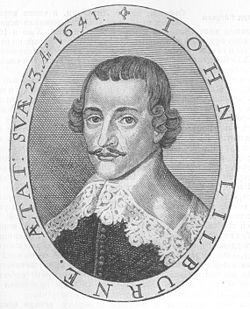
250px-John_Lilburne

I came across one such man recently when I was doing some reading about those dark times of the reformation (see this post on the Covenanters for example.) I say ‘dark’ because despite the tradition I come from celebrating this as a kind of glorious outpouring of freedom and enlightenment, it often took place in the context of much pain, bloodshed and heartbreak. The question I find myself asking over and over again is whether we can regard something as ‘good’ when so much evil is done in the name of Jesus. Can the ends ever justify the means?

I offer you this story by way of example (If you want to know more of the historical context that he lived in check out the aforementioned post);

John Lilburne aka ‘Freeborn John,’ 1614 – 29 August 1657

John was from a line of dissenters. His father was the last man in England to demand to be allowed to settle a legal dispute via trial by combat. By the 1630’s John was apprenticed to radical opponents of the religious times and already forced to flee to Holland because of his involvement in radical pamphlets.

He was a man whose bravery verged on lunacy. Whilst being whipped, pillaried and imprisoned, he continued unabated in writing, arguing and protesting what he called his ‘Freeborn rights‘. His writings about these were so powerful that he is credited by being a major influence on the fifth amendment of the American Constitution.

The English Civil War saw John become a soldier, rising to the rank of Colonel, a fiend of Oliver Cromwell. However, dissenters do not do well in terms of military discipline and he fell out with his superiors, and then, in April 1645, He resigned from the Army, because he refused to sign the Presbyterian Solemn League and Covenant, on the grounds that the covenant deprived those who might swear it of freedom of religion. In a time of religious extremism, John argued that he had been fighting for this Liberty among others, and would have no part of it.

Alongside such principled stands, John continued falling out with everyone around him- fighting vindictive public spats against former friends and allies.

He then redoubled his efforts to campaign for the freeborn rights of men. His views grew out of the radical movement known as ‘the Levellers‘, but John was more of a leaver than a joiner, so he refused to describe himself in this way.  He spent time in and out of prison, not just for his radical views, but also for his pursuit of former colleagues who he continued to attack in print.

And this became John’s life- fighting enemies to the left and right, raising high moral causes, in and out of jail, in and out of exile.

John began life as a Puritan, but ended it a Quaker. After all that violence, he had done with fighting, and came under the influence of a man of peace.

One epitaph written after his death was this one;

Is John departed, and is Lilburne gone!

Farewell to Lilburne, and farewell to John…

But lay John here, lay Lilburne here about,

For if they ever meet they will fall out.

Was this a great life? Certainly John did some great things but he seemed to be cast in the role of a stone-in-shoe for most of his life.

I am left pondering still the power of passion, faith and ideas, mediated through the mess that is humanity.

Thank God for dissenters.

And God save us from dissenters.

The measure of followers of Jesus, despite the context we are in, has to be the example that he set. He too was a dissenter, a table over-turner, a man who made no compromises to unjust ways of being.

But he was also a man who subordinated all things to love.

Rowan Williams on spirituality and whinging Christians…

rowan_1724695c

He always was worth listening to carefully. Sure he never got used to packaging up media friendly sound bites, and even though many counted this in a list of his faults whilst in office, I always loved the fact that there was depth and intellect in everything he said. I have wondered how his voice might develop after being released from all the pressure of his post.

Early signs seem to be business as usual. Here are a couple of extracts, courtesy of The Guardian;

Firstly on whinging Christians, by which I mean those who see Christians in this country as under some kind of attack from the forces of evil. Check out the pages of Christian Voice and you will see what I mean;

Christians in Britain and the US who claim that they are persecuted should “grow up” and not exaggerate what amounts to feeling “mildly uncomfortable”, according to Rowan Williams, who last year stepped down as archbishop of Canterbury after an often turbulent decade.

“When you’ve had any contact with real persecuted minorities you learn to use the word very chastely,” he said. “Persecution is not being made to feel mildly uncomfortable. ‘For goodness sake, grow up,’ I want to say.”

True persecution was “systematic brutality and often murderous hostility that means that every morning you wonder if you and your children are going to live through the day”. He cited the experience of a woman he met in India “who had seen her husband butchered by a mob”.

Nothing confirms some Christians in their sense of persecution more than issues around homosexuality- it is almost as if every legal/social step forward offered to gay people is seen as some kind of prod of the devil-horns into the side of the church. Considering the fact that gay people have suffered (and still suffer) actual persecution this always seems to me to be a terrible miss-representation of the Gospel.

Rowan Williams then started out on a wider theme- that of ‘Spirituality’;

Sharing a platform at the Edinburgh international book festival with Julia Neuberger, president of the Liberal Judaism movement, Williams launched a withering critique of popular ideas about spirituality. “The last thing it is about is the placid hum of a well-conducted meditation,” he said.

He said the word “spiritual” in today’s society was frequently misused in two ways: either to mean “unworldly and useless, which is probably the sense in which it has been used about me”, or “meaning ‘I’m serious about my inner life, I want to cultivate my sensibility'”.

He added: “Speaking from the Christian tradition, the idea that being spiritual is just about having nice experiences is rather laughable. Most people who have written seriously about the life of the spirit in Christianity and Judaism spend a lot of their time telling you how absolutely bloody awful it is.” Neuberger said she found some uses of the word self-indulgent and offensive. Williams argued that true spirituality was not simply about fostering the inner life but was about the individual’s interaction with others.

I am still working on a collection of ‘Spiritual’ poetry. I think I just found a quote for the introduction!


The season draws to an end…

william, cricket

William is back at school today- the summer holidays are over up here in Scotland.

A bit of a shock really- but it has been such an amazing summer here, full of hot long sunny days. We have not had a family holiday this year as everyone has been so busy with other things, and money is rather tight, but what I will remember this year as ‘the year of cricket’. All this sunshine has given opportunities to be out playing the beautiful game like never before up here in Scotland- in fact (much to Emily’s disgust) it has almost taken over our lives for the past couple of months…

Last week was a case in point. William played games of cricket on Friday, Sunday, Monday (one in Ayr, one in Stirling,) Tuesday (Ayr again) and has another match this evening in Galsgow. The Ayr matches were for the under 15’s regional side, in which he got wickets against very high quality opposition.

The years, they all too soon turn sepia…

The voices in my head: Eleanor Longden’s ‘psychic civil war’…

This blog has featured a lot of discussions about mental health. This is because I have served my time as one of societies psychiatric policeman- an Approved Social Worker in England, and a Mental Health Officer in Scotland.

I started out 25 years ago with a clear idea about mental illness- people who were ill did not always realise that they needed help. It was my job to try to make sure they got help. I had all sorts of different ideas about what this help should look like, and lots of frustrations with the psychiatric machine that I had to deal with, but fundamentally, the idea of mental illness itself was a stable reality within what I did.

Sure, we challenged the medical model (Illness-diagnosis-treatment (maintenance)) as this failed to take into account the social context in which some ones illness develops, but the dominant paradigm that affected work with people with ‘severe and enduring’ mental illness remained firmly medicalised. It was the only way to make sense of the psychic chaos we were faced with – hospitalise, medicate and sanitise it out of our immediate circle.

Increasingly I became a skeptic- not just of the machine, but the actual underlying concepts of ‘mental illness’.

It started many years ago when faced with young men and women who, once diagnosed with schizophrenia, were condemned to half-life at best. The medication we gave them to control their symptoms (particularly the ‘voices’) often did not work, and had such destructive side effects that everything would slowly slide downwards into a kind of suppressed humanity. Is this really the best that we could do?

Alongside this other movements were emerging. They were dangerous and threatening. One of these grew up in and around Manchester, where I was working, and was called ‘The Hearing Voices Network‘. It dared to suggest that hearing voices was a NORMAL human experience- not a symptom of ‘illness’. Rather it was a way of coping with trauma for the most part.

Rather than pushing the voices away, suppressing and chemicalising them, the HVN suggested we needed to embrace them, engage with them, understand them- even the destructive aggressive ones.

More recently we have has another movement- around the idea of ‘recovery’- living fully in the presence (or absence) of the ‘symptoms’ of mental illness.

None of these are easy concepts- they are really stories of life long journeys for people experiencing one of those ‘psychic civil wars’ that all of us go through to some extent.

What convinces me most about these revolutionary ideas in relation to mental health issues is the HOPE that they bring. The best that psychiatry can offer to many is ‘maintenance’. All the so called break-through s of the pharmacological machine that spend millions convincing doctors to use their new wonder drug have done little to change this. Suddenly however, people are saying clearly- The treatment you are offering me is NOT WORKING. I want something better for my life. 

That is not to say that there are not people in the system who see it this way too. I heard this wonderful TED talk the other day. It is saturated with hope, and the raw joy of life…

Enjoy;

The slide towards kindness…

A friend pointed me to this clip- a speech made by a professor to young students. It resonated with me as in just a few short weeks my daughter is off to university. We sat and drank champagne last night to congratulate her on her exam results, and I wondered what lay ahead, and how we got here so quickly…

Here is the clip;

(There is a transcript here.)

A few years ago I wrote a post in which I suggested that kindness was perhaps the best measure we had of ‘spiritual maturity’. Let us hope that our children see it the same way…

Proost poetry collection, closing date for submissions!

typewriterletters


Thanks to all of you who have sent in poems for this collection! We will now formally close the submission gateway on SUNDAY THE 18th AUGUST 2013- so if you are going to submit something, get on with it!

We now have poems from about 100 poets from all over the world and I have had a quick scan of most that have come in, and there are some great poems. Some have reduced me to tears- in a good way.

The next task is to break this down with the dreaded yes/no, then categorise it all to see what chapters need more material. We will then possibly need to go back to the people who have written poems we have chosen and ask them if they want to write something else for the categories that need more stuff.

So, we will be getting in touch over the next few weeks.

Just a word again to those whose poems we will not be including in this collection. Please remember that this is not a vote of no confidence in your writing- far from it- please write more! It is simply that we did not feel that your work quite fitted in with the collection. As we said previously we are simply not able to give any more feedback than this about work submitted- for obvious reasons of time, but also because we are not poetry critics – just fellow writers, with all the subjectivity that this brings to bear.


Worship music, Minion Style…

My friend Andrew Hill posted this on FB today, and it made me laugh out loud. Given the rather worthy tone of this blog of late, I thought it worth re-posting!

Also seemed relevant following a conversation yesterday with another friend who told me he had been at a wedding recently which featured an unhealthy smattering of 80’s worship songs, including the one about the trees of the field clapping their hands. He bet £5 that someone would shout ‘HOY’ at the end (if you do not know what I am talking about then be grateful.)

He won the bet however…