Sometimes, faced with a major change, we are full of the sense of opportunity. But if you are like me, these things ebb and flow- mostly as a result of fairly minor events that may have little real relevance to my future.
So an unexpected tax implication, or the failure of a small co operative venture, or even the harsh words of a friend- these things can feel like nails in a tyre.
Worry not however friends- I tend towards mercurial and what goes down will also rise. And as ever, I find melancholy makes me ruminate in word form;
Many of us who have been part of an overly concreted doctrinal system of belief have struggled to acknowledge doubt. It is almost as if any small incorrect belief would form a crack in the whole edifice of faith that might bring the whole thing tumbling down. To avoid this apocalyptic end to everything we have built our lives upon we contort ourselves into all sorts of defensive positions.
In my case, this involved two main strategies-
Do not go there. When you feel the approach of doubt, turn in the other direction. It is better not to ask the difficult questions as the answers might be too much to cope with. Distract yourself with narrower, safer issues.
Dishonesty. Better not to talk about doubt as this might infect others as well as yourself. You also might find yourself ostracised by the fervency and inflexibility of others.
Eventually of course something has to give or we become like stagnant pools, unable to flow, unable to sustain any kind of life. Faith fixed and defended becomes something else called religion. And religion belongs in the text book not in the soul.
For my own experience of faith is that belief and unbelief commonly nestle alongside each other. Indeed, I cant make any sense of a faith that doesn’t include unbelief as a powerful element. “My God, why have you forsaken me” is, after all, the cry of Jesus at the very centre of the Christian drama.
As with much that is of the soul rather than the brain, faith and doubt finds voice in poetry. Giles quotes a poem he read that forms part of a memorial for Israeli prime minister Yitzhak Rabin, murdered by a religious man because he sought peace.
From the place where we are right
Flowers will never grow
In the spring.
The place where we are right
Is hard and trampled
Like a yard.
But doubts and loves
Dig up the world
Like a mole, a plow.
And a whisper will be heard in the place
Where the ruined
House once stood.
Jonny Baker posted a batch of quotes from Walter Brueggermann, mostly from this book (which I promptly ordered.) They lit me up, as they would most people who write poetry. Here they are (thanks Jonny);
The overriding reality of the prophets is that they are characteristically poets. Poets have no advice to give people. They only want people to see differently to re-vision life.
Everything depends on the poem and the poet for our worlds come from our words. Our life is fed and shaped by our metaphors.
The enemies of the poem are the managers of the status quo.
The poets want us to re-experience the present world under a different set of metaphors and they want us to entertain and alternative world not yet visible.
These poets not only discerned the new actions of God that others did not discern but they wrought the new actions of God by the power of their imagination, their tongues, their words. New poetic imagination evoke new realities in the community.
We lose vitality in our ministry when our language of God is domesticated and our relation with God is made narrow and predictable… Predictable language is a measure of a deadened relationship in which address is reduced to slogan and cliché.
It is always a practice of prophetic poetry to break the conventions in which we habituate God.
Every centre of power fears poets because poets never fight fair… only a poem
I was also reading something on the blogosphere about the latest Mars Hill spat – Mark Driscoll throwing his weight around and playing power doctrine games. From the perspective of post post Christendom UK it all seems a but like a Tom and Jerry cartoon.
But this is a kind of muscular, dogmatic, controlling Christianity that exists here too. Some of the abusive manipulative religion mentioned here is sadly very familiar to me.
It is that truth thing again. All the effort put into right belief (as defined by our powerful leader.) I hate it because it is such a destructive, corrosive form of belief that may attract followers, but then tools them up with weapons of mass distraction.
Because it is all so un-Jesus like.
Jesus who taught in parables, so that people would find the kind of truth that sets us free, rather than chains our souls.
Who infuriated the religious leaders of his day because he broke all the rules – but broke them in relation to a higher, more loving way of being. Not rules, but principles. The greatest of all being LOVE.
Who constantly talked to people about some kind of mysterious ‘New Kingdom’.
All of which brings be back to poetry. Poetry as spiritual practice, as prayer, as celebration, as anger, as doubt, as mission, as worship and above all, as question.
At it’s best, poetry opens up, it does not close down. It wraps itself around questions, and rests within them, allowing the possibility of mystery, uncertainty and encounter.
So here are a couple more of Jonny’s quotes;
Poets speak porously. They use the kind of language that is not exhausted at first hearing. They leave many things open, ambiguous, still to be discerned after more reflection.
Very often people who hear poets want an explanation, which means to slot the words into categories already predetermined and controlled. Such an act however is the death of the poem… Good porous language does not permit itself to be so easily dismissed. It intends to violate and shatter the categories in which the listener operates.
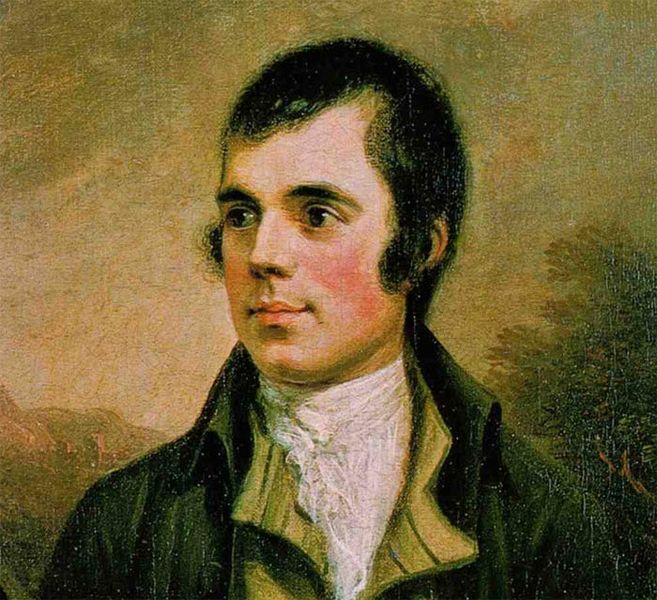
For the uninitiated, this is a big day up here in Scotland. There will be many a haggis piped in and much raising of whisky glasses along with ceremonial readings of Burns poetry. It is possible that somewhere in this wonderful world that there are other great poets whose memory is celebrated by a national day all of their own – the poets of ancient Persia perhaps – but if so, I do not know of it. This fact alone singles out Burns as special.
Burns was a man who packed an awful lot into his 37 years of life. Before he died in 1796 he had been a farmer, a book keeper on a Jamaican slave plantation, a tax man, a part time soldier, a song writer and (of course) a poet of power, subtlety and gifting who was able to speak with an authentic voice.
Burns personal life was no less colourful. Jacobite, Freemason, Socialite, Womaniser (who is said to have had many illegitimate children.) Lover whose poems immortalised Highland Mary, whose statue stands above her (and my) home town still –
Burns died young after living hard. He was a man of many contradictions; a supporter of revolution who collected taxes; a campaigner for liberty and justice who worked on a slave plantation; a socialite and friend of the rich and powerful whose wife and many children lived in real hardship, particularly after his death.
Why did his poetry endure? How did it become to be so identified with Scottish culture?
Burns was a fierce nationalist, and his Jacobite leanings had become very fashionable in the century after his death thanks to the Victorian romantic vision of ‘Bonnie Prince Charlie’ and the reinvention of Highland heritage and regalia by Sir Walter Scott, who had known Burns. Although Scott, a Unionist, would certainly not have approved of this one;
The other force that propelled his on going fame was the establishment of Burns nights by friends of Burns shortly after his death. The huge popularity of Freemasonry at the time carried this tradition all around Scotland and into Northern Ireland, as Lodges began to celebrate Burns night with food, whisky and poetry.
Burns endures because his poetry capture something of what Scotland believes and hopes itself to be – fierce, proud, simple, direct, passionate, defiant, independent minded. The fact that he was a bit of a rogue does him no harm either.
But enough of this- time for some poetry. I confess not to find Burns easy but then how many of us read Shakespeare for fun? But occasionally something lyrical and beautiful breaks through. I tend to find myself drawn to the songs he wrote-
A Fiddler in the north
Amang the trees, where humming bees,
At buds and flowers were hinging, O,
Auld Caledon drew out her drone, And to her pipe was singing, O:
‘Twas Pibroch, Sang, Strathspeys, and Reels, She dirl’d them aff fu’ clearly, O:
When there cam’ a yell o’ foreign squeels, That dang her tapsalteerie, O.
Their capon craws an’ queer “ha, ha’s,” They made our lugs grow eerie, O;
The hungry bike did scrape and fyke, Till we were wae and weary, O:
But a royal ghaist, wha ance was cas’d, A prisoner, aughteen year awa’,
He fir’d a Fiddler in the North, That dang them tapsalteerie, O.
Tapsalteerie=topsy turvy. Work the rest out for yourself!
Then there is this beautiful song (with Dick Gaughan’s version of the lyrics below.)
Now westlin winds and slaughtering guns
Bring autumn’s pleasant weather
The moorcock springs on whirring wings
Among the blooming heather
Now waving grain, wild o’er the plain
Delights the weary farmer
And the moon shines bright as I rove at night
To muse upon my charmer
The partridge loves the fruitful fells
The plover loves the mountain
The woodcock haunts the lonely dells
The soaring hern the fountain
Through lofty groves the cushat roves
The path of man to shun it
The hazel bush o’erhangs the thrush
The spreading thorn the linnet
Thus every kind their pleasure find
The savage and the tender
Some social join and leagues combine
Some solitary wander
Avaunt! Away! the cruel sway,
Tyrannic man’s dominion
The sportsman’s joy, the murdering cry
The fluttering, gory pinion
But Peggy dear the evening’s clear
Thick flies the skimming swallow
The sky is blue, the fields in view
All fading green and yellow
Come let us stray our gladsome way
And view the charms of nature
The rustling corn, the fruited thorn
And every happy creature
We’ll gently walk and sweetly talk
Till the silent moon shines clearly
I’ll grasp thy waist and, fondly pressed,
Swear how I love thee dearly
Not vernal showers to budding flowers
Not autumn to the farmer
So dear can be as thou to me
My fair, my lovely charmer
And finally, a quote from Thomas Carlyle, speaking of Burns
Granted the ship comes into harbour with shrouds and tackle damaged, the pilot is blameworthy… but to know how blameworthy, tell us first whether his voyage has been round the Globe or only to Ramsgate and the Isle of Dogs.






 this fragile tent