Retreat weekend…

Forgive the commercial, but…

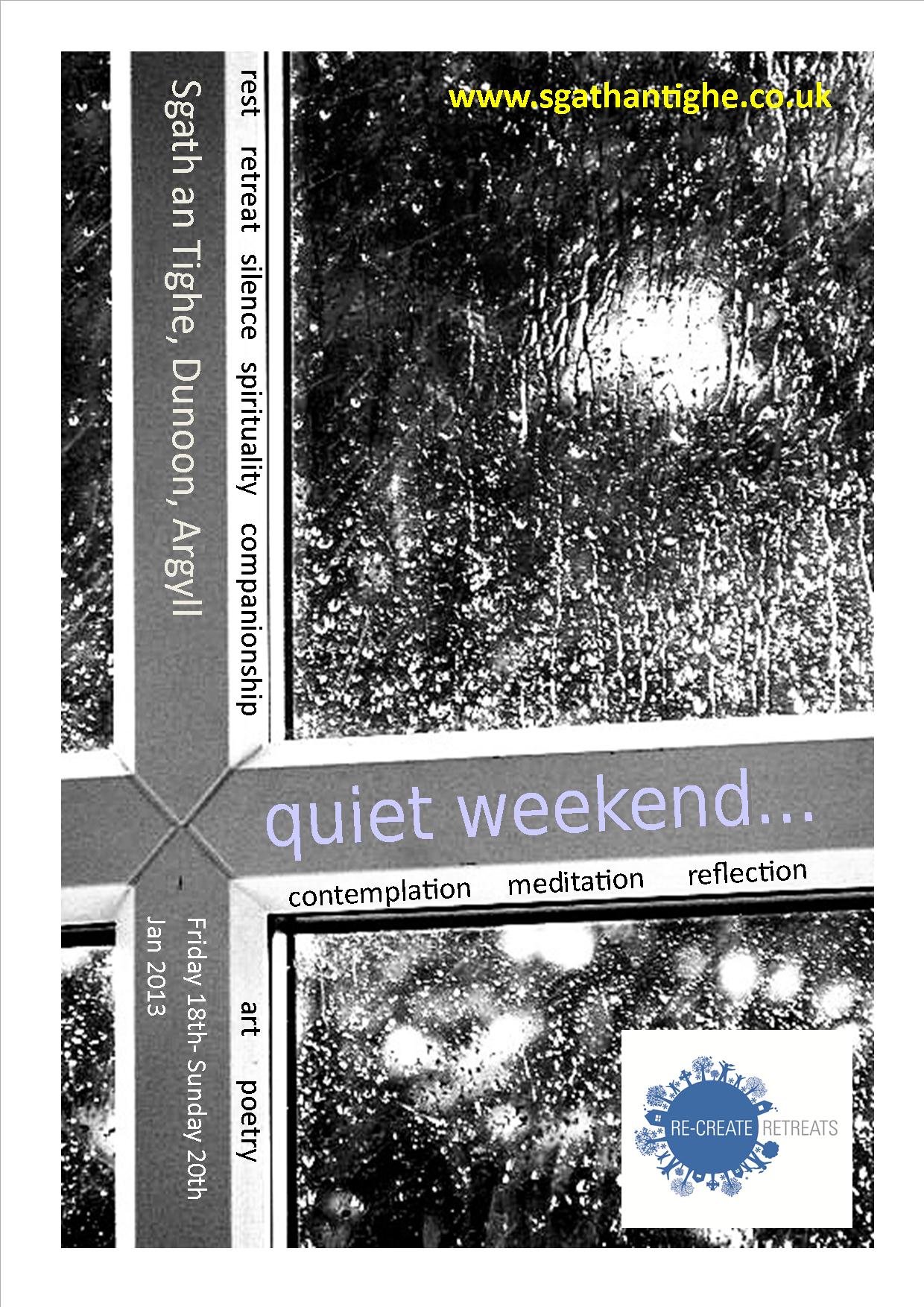
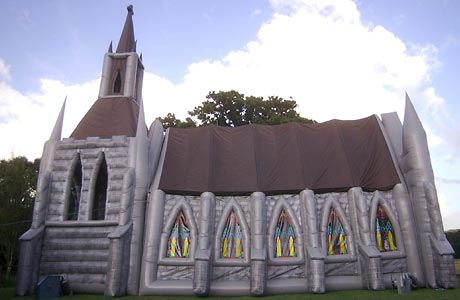
We are putting the finishing touches on our B and B/guest accommodation, and also planning the first of our retreat weekends up here in Scotland  (or the first of our ‘Recreate’ retreats anyway.)

If you are interested in starting out the next year with a period of reflection and retreat, this might be just the thing for you;

These weekends are intended to allow individuals and couples to set time aside to reflect, pray, meditate and share some evenings around a fireside. Our starting point for entering into meditation here is Christian spirituality- of a generous open kind.

The spaces at our house will allow for three double bedrooms, one twin, and one single, and it would be lovely to fill these.

We will divide our time into periods of silence – where guests are welcome to use prepared spaces in the house, the garden, or to take walks along the shore – and times of sharing.

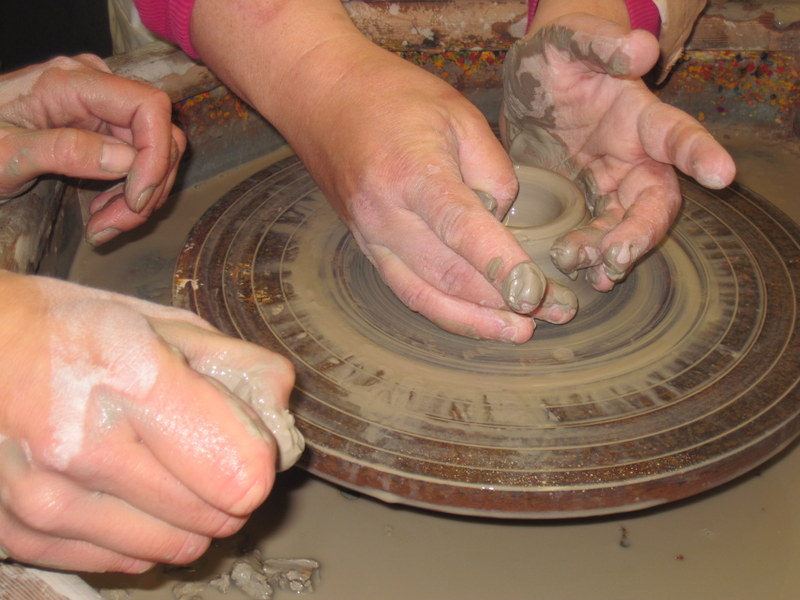
There will be an opportunity to be part of morning and evening rituals, and to use clay and other art materials to aid reflection and meditation.

We have decided to offer a discount for this first retreat, and so the total cost for the weekend (including accommodation, all meals, craft materials, etc) will now be £140 per person, with discount for couples or those who are happy to share a room. We think this is great value, and hopefully makes it possible for people on modest incomes to benefit from time out.

If you are interested and want to know more, drop me a line here- chris@aoradh.org


Why do Glaswegians die young?

Health inequalities- what causes them? Why do people in some parts of the UK have an average lifespan of years and years longer than people who live in other parts?

Glasgow is a case in point. Life expectancy at birth in Glasgow is the lowest in the UK –over six years below the national average for Glaswegian men (71.6 years, compared with a UK average of 78.2 years), and over four years below average for Glasgow’s women (78 years, compared with the UK average of 82.3).

In previous discussions, we suggested that this difference was primarily caused by pockets of extreme deprivation in the inner cities- an underclass who die young through high risk lifestyles skewing the statistics. However this may well not be the case.

This from the Guardian;

 …the conventional wisdom that Glasgow’s ill health is all down to poverty, bad diet and bad behaviour is, at best, partial and, at worst, misleading. Despite years of research and decades of evidence that something has gone terribly wrong in the heart of Scotland’s largest city, the underlying causes of Glasgow’s fatally poor health remain something of a scientific mystery.

Poverty alone doesn’t account for Glasgow’s dismally low life expectancy. Other British cities – Liverpool and Manchester, for example – have rates of deprivation every bit as high as Glasgow, yet their life expectancies are substantially higher. What’s more, even Glasgow’s most affluent citizens, those in the top 10% of the income distribution, die significantly younger than their counterparts in other British cities. At best, according to the epidemiologists’ calculations, deprivation accounts for less than half (around 40%) of Glasgow’s “mortality gap” compared with the rest of the UK. The other causes are still unknown.

This is quite a statement. For many years research had pointed clearly to the fact that poverty is the single most likely indicator of life expectancy. What other options are there that might explain the Glasgow situation then?

With colleagues at NHS Scotland and the University of Glasgow, Walsh has devoted much of the past five years to uncovering what makes Glasgow so different, compared with other, similarly deprived British cities. If you think deep-fried Mars bars are to blame for Glasgow’s ill health (as many English commentators seem to), then think again: obesity rates in the city are actuallylower than in some English cities.

Nor can Glasgow’s infamous penchant for alcohol and cigarettes explain the puzzle. According to the largest health surveys in England and Scotland, Glaswegians neither binge-drink nor smoke more than their peers in Liverpool or Manchester. Drug abuse (particularly heroin), knife crime, murder and suicide are all significantly more prevalent in Glasgow than in other cities. But that only prompts the question – why is this the case? What is it about life in Glasgow that seems to predispose some of its citizens to such destructive behaviours?

“Lots of people have their own pet hypotheses about it,” Walsh says. In a recent research paper, Walsh, McCartney and their co-authors, Chik Collins and David Batty, assessed no fewer than 17 competing explanations for Glasgow’s ill health. There are theories that blame the weather (perhaps it is vitamin D deficiency or chilly winters?), those that blame the data (perhaps Glasgow is simply poorer than it looks?), plenty of theories that blame the Glaswegians (a culture of hedonism, sectarianism or alienation) and still others that point the finger at the Tories (a “political attack” on Glasgow, conducted by Margaret Thatcher’s government). Some have more supporting evidence than others, but all are unproven, says Walsh. “The main thing to say is that it’s not going to be one thing. It’s going to be a combination of different factors interacting,” he says.

Point of death may not be the best measure of a life, and population wide stats tell little about individual experience- but I believe that this gap in life expectancy is a terrible blight on our country which should really be much higher up the political agenda.

The shape of the future church in Scotland?

We have just had an invite to this event;

AN OPPORTUNITY TO MEET WRITERS MICHAEL FROST & ALAN HIRSCH TO
CONSIDER THE SHAPING OF THE CHURCH IN SCOTLAND

10:00AM – 4:00PM

5TH DECEMBER INTERNATIONAL CHRISTIAN COLLEGE,
GLASGOW

7TH DECEMBER STEEPLE CHURCH, DUNDEE

11TH DECEMBER COMMUNITY CHURCH EDINBURGH

£25 INCLUDING LUNCH AND REFRESHMENTS

WEDNESDAY 12TH DECEMBER

COMMUNITY CHURCH EDINBURGH, 7.30 PM

A FREE EVENT, OPEN TO ALL, TO END THE TOUR

Almost ten years ago Australian authors Michael Frost & Alan Hirsch
published their hugely influential book The Shaping of Things to
Come. In it they offered both and analysis of the church of the West
and the culture in which it operates as well as a vision for what that
church might look like.

We are delighted to welcome Michael Frost & Alan Hirsch to Scotland
to offer a day of teaching, reflection and discussion about the future
shape of the church around the country. If you are passionate about
the church, its future and its role in society then this is a day for you …
come and join the conversation.

The all day events are £25, which regretfully might exclude some… I am still chewing on whether it will exclude me, which was something of a surprise- I have read various things by these blokes and the subject is right in the middle of my interests.

I think I am just a wee bit jaded of the constant picking over the bones of the Church. Let us just get on with being church. I also wonder slightly what we might learn about the Scottish Church from an Australian and a South African.

Having said that, the place of institutional faith and the degree to which it might be more ‘alive’ to the great commission is certainly worth chewing on.

Perhaps I will go after all.

Pottery workshops, Sgath an Tighe…

Last night Michaela and Pauline led the first workshop in the pottery in the cellar of our house.

It is really exciting to see this space coming alive- and to see beautiful objects being shaped out of what are essentially lumps of mud. Last night people spent some time at the potters wheel, and also made a slip decorated cake plate. Results were very impressive for first time potters!

Over the next few months we intend to spend time developing part of the old house into Bed and Breakfast, but already we have self catering accommodation available in our cosy annex.

If you are considering a break in Scotland, perhaps it might be worth combining this with some potting? We can tailor a residential potting experience!

If you contact us via our website, mention this blog and you will be eligible for a discount!

For locals, there are details of Michaela and Pauline’s craft courses here.

A few more photos from last night;

One step from eternity…

We have just been here;

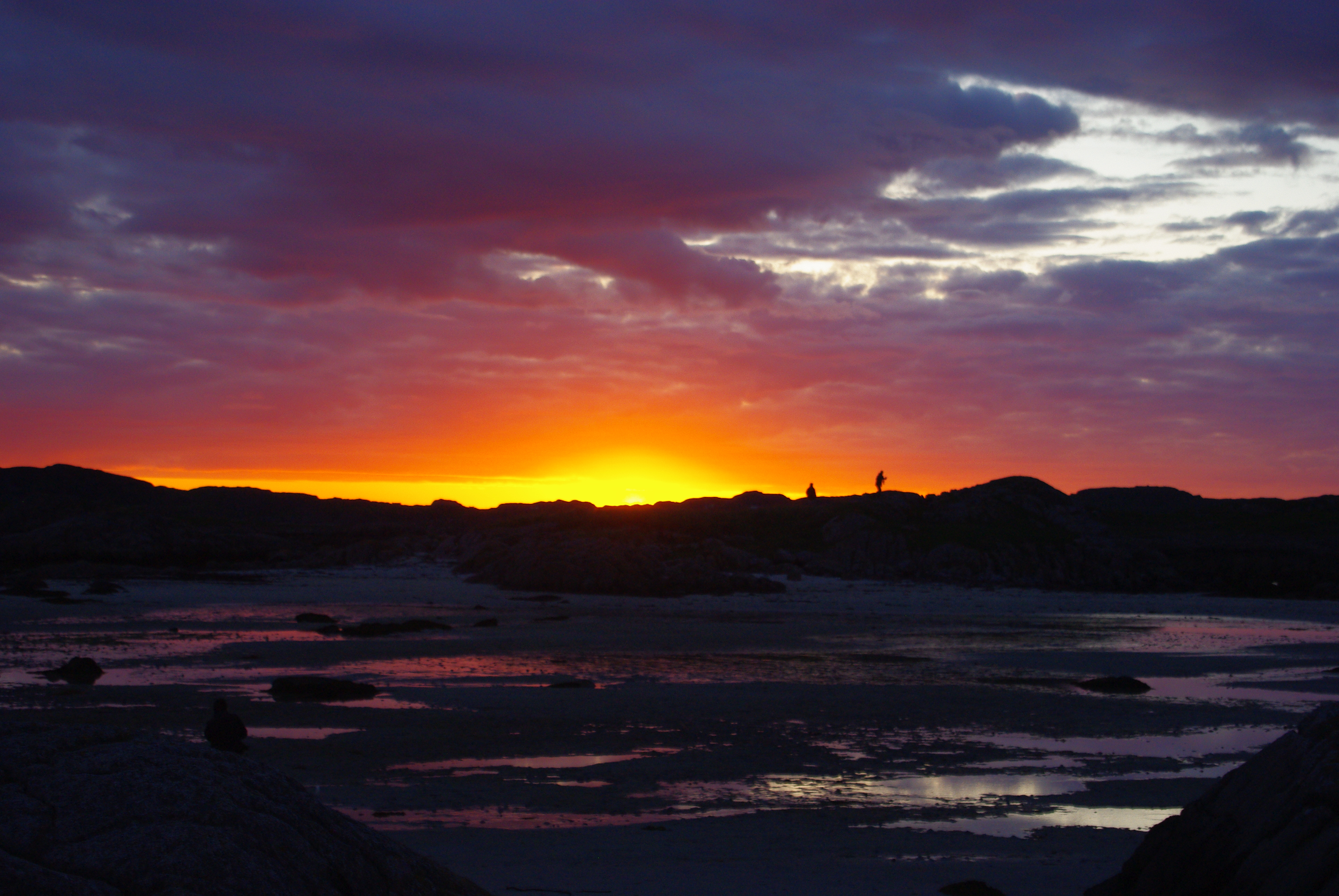
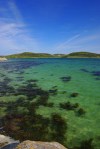
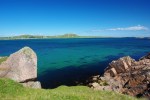
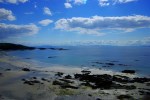
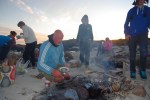
Along with some friends, we spent the long weekend camping on the Ross of Mull, overlooking Iona- which is the most beautiful place I have ever been to.

And here is the evidence;

We walked a lot, swam, ate, cooked bread and baked spuds in makeshift ovens made of sand and driftwood fires.

Whilst there we heard of the mother of one of us having become seriously ill in hospital. The distance and ferries stopped any rush to her bedside- all that was possible was to stay and pray. To sit in such beauty with such a burden must have been an incredible rush of emotions- but it felt as though the place, and our community, was holding us.

We are delayed only by our hearts beating.

And each one beats with all the treasure of the universe.

Visit Cowal gives us a plug…

The lovely Visit Cowal website has given our Wilderness Retreats a plug on their news section. Very charitable of them considering the retreats will not actually be held in Cowal, beautiful as this part of the world really is.

If you do not believe me- check out the site.

Incidentally, if you are considering a trip up north, then please consider our holiday accommodation. It can be booked through a whole host of online agencies- including the Guardian website, country cottages etc. It is also worth dropping me a line as we have a few owner bookings that we can use (particularly for loyal blog readers!)

We are moving towards our mixed-economy kind of way of making a living. Last night we had the first firing of the pottery kiln in our cellar. The house did not burn down! It is always a little bit scary to see the temperature gauge reach 1000 degrees centigrade inside something close to the floor of your house. We are still waiting for the contents to cool down to see what the firing will be like- watch this space!

Scottish independence?

So, the issue of independence for Scotland from Great Britain is at the top of the political agenda.

Tory leader, David Cameron decided to force the issue and in the process managed to give a political boost to the Scottish Nationalists – any posh London Tory who tries to flex his or her muscles up in Scotland is going to be resisted by 90% of the population up here. As someone said, there are more polar bears in Scotland than Tory members of parliament!

I have written before about my own take on all this which is pretty much along these lines-

  • I am an English/Irishman, living in Scotland. Most of us are part of a similar mix when you scratch the surface.
  • I have an innate suspicion of nationalism as I can’t think of a single instance of nationalism being a force for good
  • Rather nationalism is often associated with ‘us first’ – defended boundaries, exclusivity and sectarianism.
  • This is particularly the case in when politics starts to use history as a justification. It all becomes distorted and dishonest

Does this mean that the 5.2 million people who live in Scotland (8.5% of the total UK population) could not benefit from independence? The answer to this of course is that no one really knows. The economic case is yet to be argued, not to mention the wider political implications for the whole of the UK. The argument has been really stuck at some kind of romantic notion of ‘Scottishness’, which is of course defined AGAINST as much as defined by.

Defined against the English that is.

Typified by the proposal (by the Scottish Nationalist Party) to hold a referendum on the 700th anniversary of the Battle of Bannockburn. Because Robert the Bruce has more to teach us about our politics than all those intervening years of Empire and conquest (apparently.)

Is it possible to love your country without seeking to denigrate your neighbours? I hope it is for the sake of the future of these islands. I hope we can promote the politics of reconciliation and respect. I suppose nationalists in Scotland would argue that this is only possible when there is an equal partnership, or even genuine self determination.

I read this recently, which paints a strange picture of views on this issue either side of the border –

The poll shows that while a substantial proportion of Scots (40 per cent) back independence, 43 per cent want to remain inside the United Kingdom.

However, among English voters – who would not get a vote in any referendum – there is a clear lead for those who support independence for Scotland (43 per cent) over those who want the Union to be preserved (32 per cent).

Most Scots admit their nation would be worse off after independence (41 per cent) than better off (38 per cent), while 51 per cent of English think the Scots would be worse off.

Some 61 per cent of English people, moreover, say the current formula which sees higher government spending per head in Scotland is unjustified – a similar finding to 2006.

Among Scots, 53 per cent think that the spending system, known as the Barnett formula, is justified while 21 per cent do not agree.

So will it happen?

At the moment I would say that the odds are against, but I hope that over the next year the questions asked will be much more sophisticated ones, rather than just the agenda that is set by the Edinburgh Tartan Elite.

Scottish emerging church 2010- a view from the west…

Here it is again- the old EC term. Given one more airing…

I was a little sad about the demise of Stewart’s ‘Emerging Scotland’ Ning site-
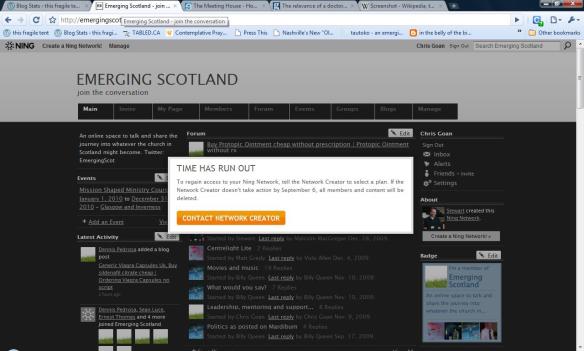
And so I thought that it might be time to consider again where we are up to North of the border, and throw out a bit of a challenge to others in Scotland who have used the term to do the same…

In many ways this is a continuation of thoughts begun here.

I think we up here were a bit slower to use the term than elsewhere, but there is no doubt that the ‘conversation’ has been transformative in many ways. The questions however remains as to how this might have played out in the specific Scottish context- as opposed to down south.

I will divide my response into two different parts- firstly my personal experience, and then my imperfect impressions of the wider context.

The latter comes with a warning- I am not a professional minister, nor at the centre of faith based organisations in Scotland. I do feel slightly qualified to express an opinion however as I have been thinking, talking, reading and seeking connections on these issues for several years now. I have met a lot of wonderful people, and felt an equal measure of hope and pessimism for the future of our churches. What I offer then, is the view of a knowledgeable and sympathetic outsider.

Firstly then, my own experience.

I arrived in Scotland in 2002, eager and enthusiastic to belong to a church up here, and to continue to find worshipful expression through music and community. My background previously was Evangelical/charismatic left-of-centre traditional church. I joined a local church, but increasingly found it difficult to stay in that context. I will not tell that story here, but it will be a familiar experience to many of you.

In an attempt to break out of the narrow spaces I found myself in and to seek a way of living out my faith that offered a real connection to my context and an honest engagement with my faith, I left formal church in 2006. This was not an easy decision- rather it was taken over a long period, with much pain and many sleepless nights.

So, with some friends, Michaela and I set out on something new. We started a housegroup, and Aoradh grew and changed- initially it was a group of people who wanted to do evangelism through art, but increasingly became less driven by grand plans to win converts, instead seeking partnerships and creating spaces to contain our own worship, and to host others.

In all this, I had discovered the ’emerging church conversation’. My theology was first destroyed, then renewed and lit up by new questions and new/old perspectives of God. I felt again a thrill about the life that Jesus calls us to for the first time in years.

But our little group was isolated and desperate for connection, mentoring and encouragement, so I spent some time looking around for similar things in Scotland- things we could learn from and lend support to. And I found very little. Sure the language of emergence was being used by some of the institutions- the Church of Scotland, and the International Christian College for example, but this did not seem to be converting to any kind of grass roots activism, or mutual support that we could plug into.

Neither did the established churches seem to have resources or energy that they could apply to supporting the embryonic groups that may have been emerging. They were caught up in a survival battle of their own.

In the absence of other networks sympathetic to the new ground we now found ourselves treading, I started a Facebook group, which very quickly picked up around 100 members. I also set up a couple of meets in Glasgow, and was keen to ask questions about whether people wanted more and closer contacts. Stewart then started the Ning site, and some meets took place in other places too.

The on line stuff flared up then died down like most on line networking. It has a short shelf life, easily becomes contentious and repetitive and the theological arguments become wearing very quickly.

I was still hungry for more- a network of people who were prepared to stand with one another- share resources and ideas, encourage fragile new developments and be committed to the kind of openness and generosity that is supposed to be the watchword of church.

I have made some good contacts, and still hope that out of these, more of the above may yet flow, but there is still no formal, or even less formal network in Scotland through which new groups can find encouragement and support. Our group has less need of this perhaps now- partly because we are further down the road, and have made a lot of our mistakes already, but also because we have made more connections with English based organisations.

What is left to me, is a desire to live an authentic, open, generous Christian life- looking outwards, not inwards, and seeking relationship and partnership with other individuals and groups wherever possible. Sometimes I think I am walking this path. Other times I feel lost in a tartan wilderness.

I have stumbled into conflict along the way too. I do not like conflict, and do not always handle it well. It tends to make me retreat and localise- which becomes then an obstacle for the very networking I believe is called for…

Along the way it has been difficult not to constantly make evaluations and judgements about the wider Scottish context. This is not easy, as we first need to ask whether there is ONE context. Our West of Scotland semi rural small town Highland context is very different to Glasgow, which is different from Edinburgh or Inverness.

However, I am committed to using a broad brush with careless abandon, so at risk of causing offence, here are my impressions-

  • ‘Emerging Church’ are words used in Scotland in the academy and the conference/general assembly. They have less relevance at the grass roots here than they do elsewhere.
  • Churches who use the language of emergence are driven most by desperation. They are looking for a new way to evangelise- to fill the pews and mend the leaking roofs.
  • The sectarian nature of religious development in Scotland still imposes rigid walls of suspicion between different faith groupings- not just the Catholic/Protestant divide, but between Protestant groupings too. This means that finding commonality through which ideas and support can be channelled is that bit more difficult up here.
  • No denomination has stepped forward to deliberately offer support emerging fledgling para church groups, as the C of E (and others) have done in England.
  • And the English stuff stops short of the border, as there is still this weary anti English stuff even in the church where we really should know better.
  • The dominant activism in Scottish church looks towards American models of Evangelism and as such is still fighting the old truth wars. This is a regressive force in our faith- the pressure this thinking brings to our ways of doing church is to call our dwindling population to greater fervour, purer understanding of the Bible and to pray for Revival in order to shake the population from their wicked ways, and some how take us back to the 1950’s.
  • Distances are greater, and population numbers and low density tends to make finding peers and like minds more difficult.
  • There are some new developments- Solas festival for example. But these do not yet seem to me to be associated with the fostering and development of new forms of church. Rather they are a new things done by people who are part of existing institutions. They are none the worst for that of course and it is early days for Solas (the first festival was this year) but perhaps this could be described as new wine skins for old wine. We need the fine old wine, but we also need sparkling new stuff, and new wine skins.
  • Then there is the class issue. Working class, underclass, middle class. Inner cities with huge problems with worklessness and addiction. Places where theological debate has no relevance, unless it stimulates action. Action not from the outside- parachuted missionaries- but more from the faith that finds new relevance in the broken places. Emerging church conversations have not shown themselves to be well equipped for this in Scotland.

Finally then- the challenge.

I have been quite negative above. And this is not fair, because I do not feel negative about the future of the people of faith in Scotland.

But I do feel that we have an opportunity that might just slip away.

An opportunity to forge an underground railway, along which we pass down the agents of the New Kingdom.

The challenge is to ask those of you who have a more complete view than me where my blind spots are. What am I not seeing? Where do my generalisations miss things that are happening? Where are the networks of support that transcend the old boundaries and carry genuine new hope?

And if I am more or less right, what should we do about this?
Scotland- top of the cocaine league…

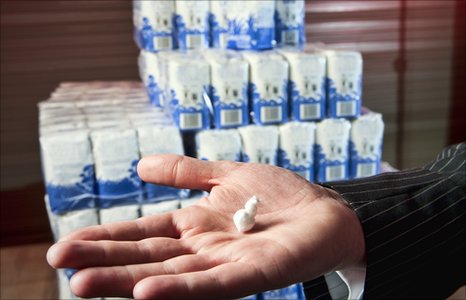
A story on the news this morning described a recent UN drug report which placed Scotland in the premier league (you could say the world cup) of drug using.

The study found 3.7% of Scots aged 16 to 64 use the drug each year, and that we have a thriving criminal network supporting its sale.

Which raises the question- why here? Why now?

What is it about our society that sustains and encourages drug use to this level?

And what might stop us wanting to escape reality in this way, and be more fully alive to this beautiful place, full of beautiful people?

Answers on a postcard to Alex Salmond…

The Proclaimers are in town…

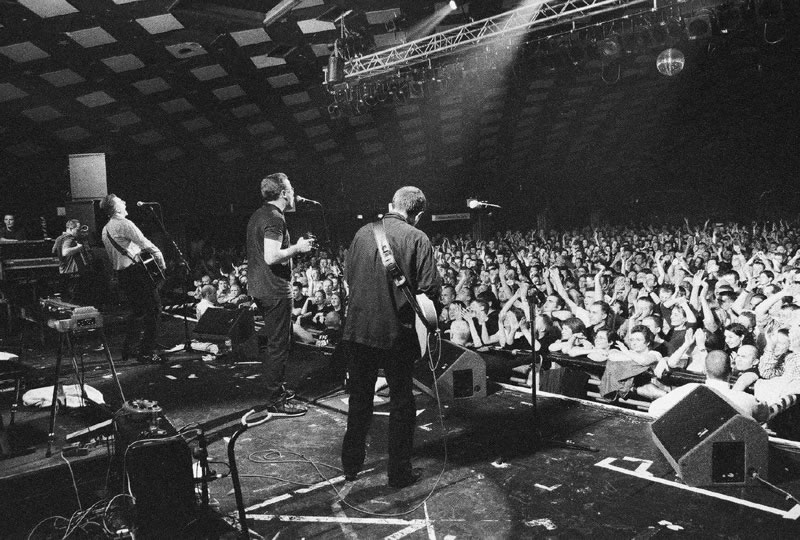
We are just back from the Proclaimers gig in Dunoon Queens hall. Ears still ringing.

A night with the Proclaimers is a peculiarly Scottish affair. They stand and deliver, lyrics half sung, half shouted- all in broad Scots. But there is a tenderness and thoughtfulness despite the style of delivery…

I wonder my blood
Will you ever return
To help us kick the life back
To a dying mutual friend
Do we not love her?
Do we not say we love her?
Do we have to roam the world
To prove how much it hurts?
When you go will you send back
A letter from America?
Take a look up the railtrack
From Miami to Canada
Bathgate no more
Linwood no more
Methil no more
Irvine no more.

From ‘Letter from America’

So in the old story I’ll bet that I came
From Gael and Pict and Angle and Dane
And a poor migrant girl who could not write her name
It’s a common old story but it’s mine just the same

All through the story the immigrants came
The Gael and the Pict, the Angle and Dane
From Pakistan, England and from the Ukraine
We’re all Scotland’s story and we’re all worth the same
Your Scotland’s story is worth just the same

From ‘Scotland’s story’

The whole night was a kind of tease- leading up to the orgasmic rendering of ‘I would walk 500 miles’- which has become a kind of Scottish unofficial anthem.

I kind of like this one though…