Gay marriage, and a reason to sing…

Yesterday I was talking about the power of singing. Today I saw this in the Guardian, and it made the hairs on the back of my neck stand up.

Whatever your views on gay marriage (and I have made mine pretty clear on this blog) you can not escape the burst of exuberant joy let loose in the NZ parliament. It was like captives being freed. What was lost had now been found;


New Zealand becomes the first country in the Asia Pacific to legalise same sex marriage. The public gallery in parliament breaks into song following the vote, singing the traditional Maori love song Pokarekare Ana. New Zealand is now the 13th country to legalise gay marriage, after Uruguay passed its law earlier in April

Meeting men from the internet…

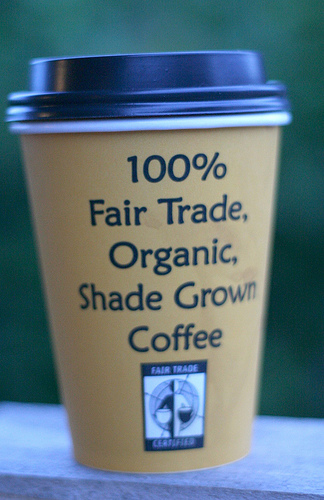
FairTradeCoffee


Just met a lovely bloke for a coffee in Glasgow. My kids laugh at me when I meet people in person who I have met via ‘tinternet- as if they might be axe murderers or something. However this was another meeting that bucked the trend, not only did I survive unscathed but had a really great conversation about all sorts of things close to my heart.

The meeting was with David Anderson, who is one of the leaders of Garioch Church, a baptist church unlike any other. What they are doing, to people who are interested in new expressions of church as I am, is fascinating. They have an ethos based around small house church gatherings, with an emphasis on community, living lives in connected and honest ways, but also networking these small gatherings, and meeting as a larger group a couple of times a month. Kind of sounds a bit familiar right? A bit New Testament?

Today we talked a lot about the ups and downs of community, and our hopes for a life of faith that escapes from the old religious ghettos.

We also wondered why the climate of religion in Scotland makes some of these things more difficult, at least on the face of things, than south of the border.

It was great to share stories, and to dream of how our communities, at different ends of the country, might support one another in the future.

I think my kids were slightly disappointed that he was not armed with an axe however.

The other bombs…

The media has been constantly picking over the terrible scenes from Boston yesterday- in particular some footage taken on a mobile telephone of the bombs going off- each time in slow motion. There is something fetishistic about it all, despite the utter horror.

At the same time we have had endless speculation about who did it, why they did it, and heard the eye witness testimony of anyone and everyone who was there and prepared to discuss what they saw, and how horrible it was.

Three people dead, over a hundred injured, all reduced to endless infotainment.

iraq-car-bomb

It may come as a surprise to hear that these were not the only bombs that exploded in the middle of packed innocent humanity yesterday. In a wave of bombing across Iraq, at least 27 people were killed and over a hundred injured.

The news told us next to nothing about these other bombs. They were not newsworthy. People in Iraq die all the time, and are not like ‘us’ – there is no shock value, no sense of righteous outrage therefore no airtime required.

Please do not misread what I am saying. The death of an 8 year old boy on the streets of Boston is appalling, despicable, dreadful. But so is the death of an 8 year old boy on the streets of Iraq.

The news has never been just a provider of neutral, bald factual information- it has always been a cultural construct. There was a discussion on the radio this morning about how in the past the news could be regarded as a unifying force- we gathered round the wireless at set times, and (for good or ill) the news collectified our sense of being- it told is who we were.

Those days are gone. Now we can not escape the news- it comes at us full speed from a thousand different sources. It is spewed out so fast and the media machine is so hungry, that content now is increasingly instant, but somehow entirely predictable and repetitive. Stories are slotted into grooves dependent on what we are thought to expect- what will hold our attention, and cause us to retweet items, and share them on facebook.

Is this a problem? When it supports western centric colour blind prejudice it certainly is. Perhaps there are other issues too. Check out this article. Here are a couple of extracts;

In the past few decades, the fortunate among us have recognised the hazards of living with an overabundance of food (obesity, diabetes) and have started to change our diets. But most of us do not yet understand that news is to the mind what sugar is to the body. News is easy to digest. The media feeds us small bites of trivial matter, tidbits that don’t really concern our lives and don’t require thinking. That’s why we experience almost no saturation. Unlike reading books and long magazine articles (which require thinking), we can swallow limitless quantities of news flashes, which are bright-coloured candies for the mind. Today, we have reached the same point in relation to information that we faced 20 years ago in regard to food. We are beginning to recognise how toxic news can be.

News misleads. Take the following event (borrowed from Nassim Taleb). A car drives over a bridge, and the bridge collapses. What does the news media focus on? The car. The person in the car. Where he came from. Where he planned to go. How he experienced the crash (if he survived). But that is all irrelevant. What’s relevant? The structural stability of the bridge. That’s the underlying risk that has been lurking, and could lurk in other bridges. But the car is flashy, it’s dramatic, it’s a person (non-abstract), and it’s news that’s cheap to produce. News leads us to walk around with the completely wrong risk map in our heads. So terrorism is over-rated. Chronic stress is under-rated. The collapse of Lehman Brothers is overrated. Fiscal irresponsibility is under-rated. Astronauts are over-rated. Nurses are under-rated.

News kills creativity. Finally, things we already know limit our creativity. This is one reason that mathematicians, novelists, composers and entrepreneurs often produce their most creative works at a young age. Their brains enjoy a wide, uninhabited space that emboldens them to come up with and pursue novel ideas. I don’t know a single truly creative mind who is a news junkie – not a writer, not a composer, mathematician, physician, scientist, musician, designer, architect or painter. On the other hand, I know a bunch of viciously uncreative minds who consume news like drugs. If you want to come up with old solutions, read news. If you are looking for new solutions, don’t.

Society needs journalism – but in a different way. Investigative journalism is always relevant. We need reporting that polices our institutions and uncovers truth. But important findings don’t have to arrive in the form of news. Long journal articles and in-depth books are good, too.

Dying is easy…

armchair

A poem written whilst reflecting on conversations with people contemplating suicide. Not one person, I hasten to add.

My previous post might suggest the reason for my preoccupation.

Dying is easy

She told me she was not afraid of death

No- she was ready

It was hanging like a curtain between us –

This last taboo

For her, death was just waiting

A vacant arm chair under her weary body

It promised nothing more

Than nothing

But as for me, I felt death to be

Foreign

A country I knew existed

But never planned to visit

Moldova perhaps

Belize

Dying is easy

She said

And I believed her


The last taboo…

A friend of ours gave us a book to read the other day. Nothing unusual about that, we are blessed with friends who know what moves us, and love to share things they have discovered.

However, this friend is from a different generation- she is almost 80 years old, and has lived a life of adventure. Her father was a famous movie producer/director, who fled from the Nazis and lived his life in England. She grew up in a privileged world, against which she rebelled, becoming an author, a book editor, and eventually meeting her husband, who had been a pilot in the war. They then spent much of their married life living aboard boats, making their last voyage out to St Kilda when her husband was almost 80. Sadly he died about 6 years ago. Since then our friend has travelled the world- Australia, China, India to name but a few of her destinations. In her deep grief she has decided to live life to the full.

Strange then that she is a firm advocate of euthanasia- the right to choose when and where she wants to end her life. Our friend is a firm atheist and humanist, and brings a fierce integrity to her understanding of death.

Or perhaps it is not strange at all. Perhaps the strangeness is to be found in our own attitudes towards death.

The book she gave us is this one;

seize the day

Marie de Hennezel is a gifted psychologist who works as part of a remarkable team of doctors and nurses in a hospital for the terminally ill.  In this eloquent book, she shares her unique perspective on what life and death really mean – and explores how talking about death, and facing up to it, can actually help us lead more abundant lives.

The men and women who come to the palliative-care unit do not always know that they are dying.  It is de Hennezel’s aim to bring them and their loved ones to this knowledge, and then to encourage them to live each day as fully and serenely as possible.  Through insight and humanity, and the unforgettable people she helps, we learn how precious the final days of a person’s life can be and how deeply moving it is to share these moments with someone else.

In an age where people hesitate to talk about dying, Seize the Day lends us the strength to confront the mysteries of death, gives us hope and celebrates the courage of the human spirit.

It is a beautiful book, full of life, grace and deep love of humanity.

Though I walk in the shadow of death, I will fear no evil. So says the psalm that we always hear at funerals. It has often occurred to me that when those words were written, the culture that sang them had no concept of an afterlife. By this I mean that the Old Testament makes no mention of life after death- it was not part of their religion, their culture or their understanding. Yet when we hear the words of Psalm 23 at funerals, we are using them precisely to give us hope of life beyond.

I make this point not as criticism- I too hope and believe that we are spirit as well as body.

However, it is worth thinking again about how our culture has sanitised and compartmentalised death almost as if to pretend it will never happen.

We come to believe that death can be defeated- by healthy life style, good eating, expensive health care. There is so much to distract us from the fullness of what life can be- all that entertainment, electronic isolation etc.

What Marie de Hennezel reminds us of is that we can choose whether we LIVE or not, but we can not choose whether or not we will die. And that to understand this makes us live in a way that transcends the temporal.

Our friend, approaching the end of her life, is putting her affairs in order. But she is very much alive.

 

Hermit…

hermit


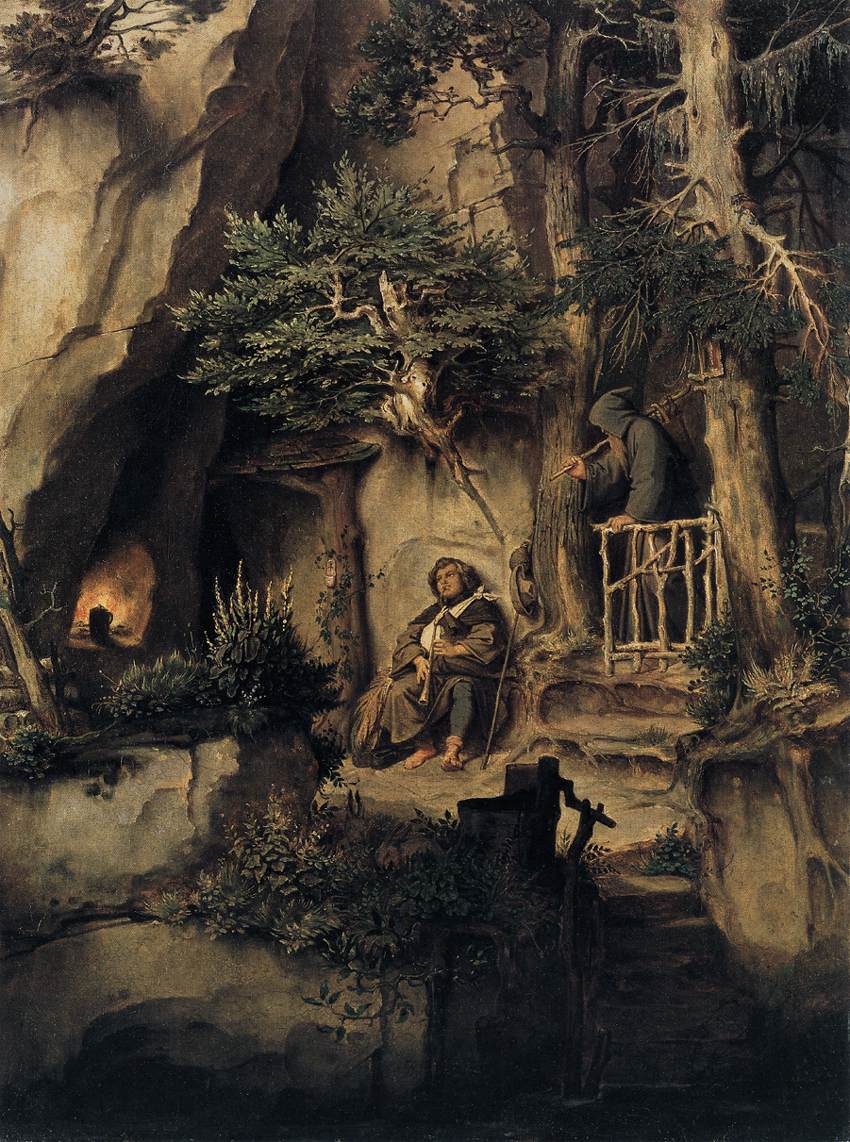
Have you been following the story of Christopher Knight, who aged 19 walked into the woods in Maine and lived there alone for the next 27 years, surviving by making raids at night to steal food and camping gear? He lasted all those winters with no fires lest he was discovered, wrapped in sleeping bags, until he was arrested stealing food in a trap laid for him. He is now in prison, exhibited like a circus freak.

Writing in the Guardian, Jessica Reed said this;

…for me, hermits, tramps and assorted train-hoppers are a source of hope. They remind me that no matter how caught up we might be in the rat race, there is always a way out. If towering buildings, fumes and overcrowded buses become too overwhelming, those freedom seekers remind us that we can make the choice to just opt out and hit the road. It’s not a lifestyle which would be adopted by many – the vast majority of us would never dare to leave our comfortable life behind – but it is there…

… those who truly master the art of the disappearing act acquire an unworldly quality: they become ghosts, mysterious presences, part of the local folklore, floating unshackled in the wild. This may not be what Thoreau had in mind when he spoke of transcendentalism, but for me it comes pretty close to transcending what capitalism expects of its subjects…

…If the truth be told, I really wish they hadn’t caught him.

I feel the same- sad that he is not still out there in his tent, reading the changes in nature, familiar with the birds and looking forward to everything that spring has to offer.

Which is strange, as I am at my most content when at home with my family. I love to be with my friends and hold on to a high ideal of community. But I entirely understand the longing for a cave or a shelter in the deep woods that is all my own.

There is of course a long tradition of seeking solitude and isolation in the Christian tradition. I always get the impression that famous religious hermits even then had something of a freak show value- they became some kind of celebrities and their stories live on even now.

There was Simeon Stylites for example;

On one occasion, moving nearby, he commenced a severe regimen of fasting for Lent and was visited by the head of the monastery, who left him some water and loaves. A number of days later, Simeon was discovered unconscious, with the water and loaves untouched. When he was brought back to the monastery, it was discovered that he had bound his waist with a girdle made of palm fronds so tightly that days of soaking were required to remove the fibres from the wound formed. At this, Simeon was requested to leave the monastery.

He then shut himself up for one and a half years in a hut, where he passed the whole of Lent without eating or drinking. When he emerged from the hut, his achievement was hailed as a miracle.[2] He later took to standing continually upright so long as his limbs would sustain him.

After one and a half years in his hut, Simeon sought a rocky eminence on the slopes of what is now the Sheik Barakat Mountain and compelled himself to remain a prisoner within a narrow space, less than 20 meters in diameter. But crowds of pilgrims invaded the area to seek him out, asking his counsel or hisprayers, and leaving him insufficient time for his own devotions. This at last led him to adopt a new way of life.

In order to get away from the ever increasing number of people who frequently came to him for prayers and advice, leaving him little if any time for his private austerities, Simeon discovered a pillar which had survived amongst ruins, formed a small platform at the top, and upon this determined to live out his life. It has been stated that, as he seemed to be unable to avoid escaping the world horizontally, he may have thought it an attempt to try to escape it vertically. For sustenance small boys from the village would climb up the pillar and pass him small parcels of flat bread and goats’ milk.

In this last and lofty station (15 M high, 1M square), the Syrian Anachoret resisted the heat of thirty summers, and the cold of as many winters. Habit and exercise instructed him to maintain his dangerous situation without fear or giddiness, and successively to assume the different postures of devotion. He sometimes prayed in an erect attitude, with his outstretched arms in the figure of a cross, but his most familiar practice was that of bending his meagre skeleton from the forehead to the feet; and a curious spectator, after numbering twelve hundred and forty-four repetitions, at length desisted from the endless account. The progress of an ulcer in his thigh might shorten, but it could not disturb, this celestial life; and the patient Hermit expired, without descending from his column.[3]

This degree of asceticism, to a lazy and easily distracted contemplative such as myself has a similar effect to the story of Christopher Knight.

The possibility of a life beyond what we understand is tantalising- not because it offers a real choice to us, but because it allows is to imagine a life beyond. A richer, more vibrant, more connected life; to the order of things, and to God.

where the wild things are

Iron Lady…

Margaret-Thatcher__2530139b

So far I have held back from commenting on  the death of Margaret Thatcher. She was perhaps the most dominant politician of my formative years, for good or ill. 

I have decided to write for her (or more accurately, for me) a poem…

Iron Lady

The iron lady

Like all things ferrous

Has turned to rust

And the girders that she

Used for bones

Are now ceremonial arches

Under which old ideologies are displayed

Like long dead dinosaurs

.

When I was a boy I ate her pumped up ice cream

But then, despite her chemical munificence

She took the milk from my school

Before, appetite whetted, she

Killed my community

And let loose the Yuppies

To feed on its twitching body

.

Some declare she saved the nation

From British Leyland

Others dance on the grave she made

From the split down middle England

Me, I breathe a rueful sigh

As the Lady

Turns at last

Looking back into empire…

Mount Stuart

Michaela was just showing me some of the photographs she sneakily took on our visit to Mount Stuart yesterday. Sneaky because they do not approve of people taking photographs. I always wondered why. Is it because the flash might affect the posh fabric, or because they want us to buy images from the gift shop?) She is not one for breaking rules, but makes an exception in the cause of the class consciousness (80s throwback there in honour of Margaret Thatcher.)

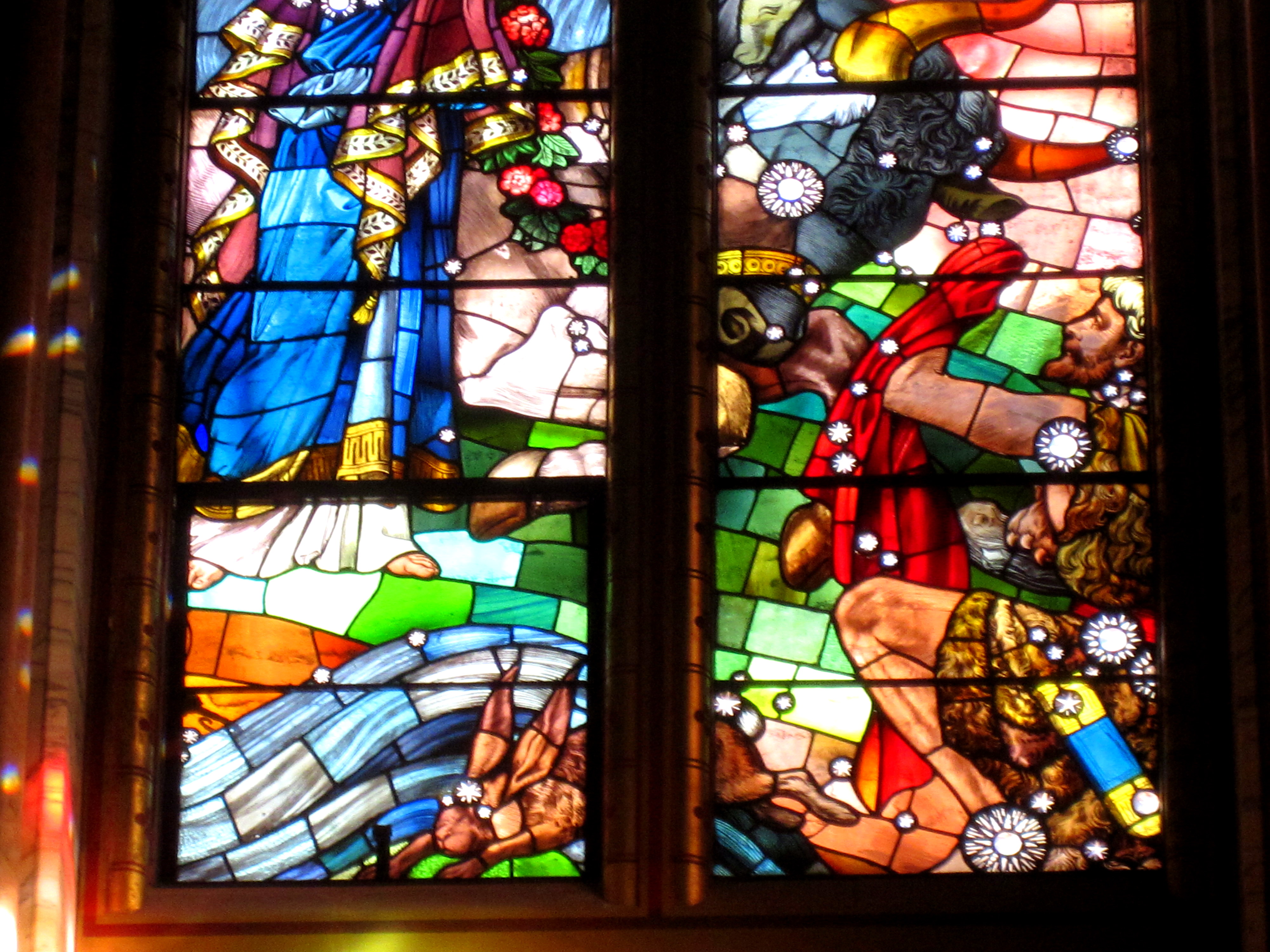
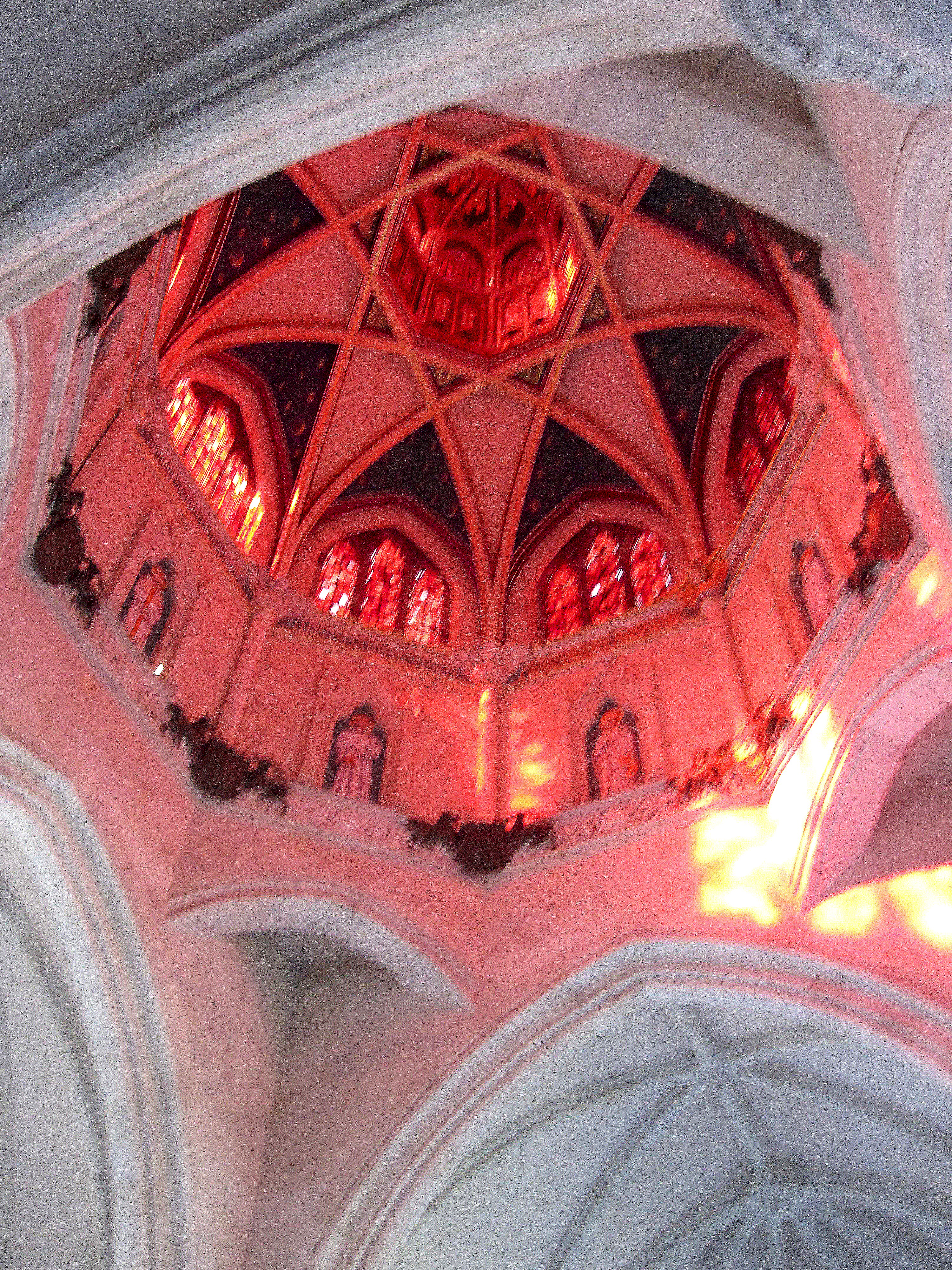
Mount Stuart (according to our tour guide) was one of the last great houses to be built in this country; the old one burnt down in 1877, so the owners set out to spend spend spend in high Victorian style- a display of wealth beyond what most people can dream of even now. Electric lighting, central heating, heated indoor swimming pool, every modern convenience, priceless paintings by old master, Gothic carving and painted walls, Stained glass. No expense was spared.

stained glass, mount stuart

Marble chapel, Mount Stuart

What was created was already going out of fashion as it was completed in the years before the first world war. Baronial towers, a marble chapel, religious imagery everywhere. It must have seemed like the centre of Gods order for the universe- the rich man at the centre of his own world.

The house was only possible because of one thing- vast quantities of cheap labour. In the building (involving years and years of work by hundreds of skilled craftsman) and then in the running (an army of gardeners, housekeepers, kitchen staff etc.)

The interesting thing is that, in some respects it was never finished. Each column and stone cornice in the house was to be intricately carved- but not all of it was finished. Our guide told us this was because so many people were killed on the slaughtering fields of the first world war that the skills were simply gone.

unfinished carving, mount stuart

You could argue that this war was the logical end for all this stacking up of empire plunder- a war that should of ended all wars. It did not work out quite like this though. And the interesting thing is that this massive house is still privately owned.

This from Wikipedia;

John Colum Crichton-Stuart, 7th Marquess of Bute (born 26 April 1958 in RothesayIsle of Bute), styled Earl of Dumfries before 1993 and from this courtesy title usually known as Johnny Dumfries, is a Scottish peer and a former racing driver. He does not use his title and prefers to be known solely as John Bute.[1] The family home is Mount Stuart House on the Isle of Bute

…He ranked 616th in the Sunday Times Rich List 2008, with an estimated wealth of £125m. (26th in Scotland with £122m in 2006)

He lives with his family in London and at Mount Stuart House, 5 miles south of Rothesay on the Isle of Bute, PA20 9LR.  In 2007 Dumfries House inCumnockAyrshire was purchased for the nation for £45 million.[5]

John Bute, a rich man, who is the son and grandson of many other rich men.

It really is difficult not to love his house- but the culture that made it possible still casts a huge shadow over all of us- and in many ways, our current government, stacked as it is with rich men who are the sons of other rich men, will be very at home there.

The road ahead…

IMGP4380

It is Michaela’s birthday today.

We took a day out to go over to Bute, just the 4 of us, in the crisp spring sunshine. We went to visit the Marquis of Bute at his magnificent pile, Mount Stuart.

His house was lovely.

It is unlikely to be affected by the bedroom tax.


Poetry of protest…

img_3671_student_protest_1

I have been thinking a lot about poetry that is prophetic– not in the sense of telling our fortunes, but more something that tells what we are- warts and all. Poetry that is an honest, engaged, hopeful critique of culture, and encourages us to think deeper.

There is a horrible danger of poetry like this becoming propaganda in the cause of whatever politics/theology/hermeneutic that we espouse. Poems like this are masturbatory- they pleasure only ourselves.  No matter what skill employed they are empty poems, blind to other perspectives. They claim to have answers to questions that are always nuanced.

I posted a poem yesterday entitled Welfare State which was my attempt to write  poetry of protest.

I had been increasingly angered by the actions of the current government in the UK, as they bring in sweeping changes to our welfare system. It all feels so unjust- making the poorest most vulnerable people pay for the excesses of the richest, and justifying this by vilifying  poor people as work shy, feckless. I wanted to use this anger to write something.

What I found though is that angry political poetry easily becomes exactly the kind of poetry I have described above- shallow self serving propaganda.

How then can we write the poetry of protest, of prophetic engagement, of challenge to empire in the face of injustice? I wonder if some of these principles might be of use (particularly for followers of Jesus);

  • If we are going to fight a cause, let it be for those who are the victims of power- the small people, the outsiders, those who the system has forgotten
  • It has to be honest. It has to be based on engagement with real people, real situations
  • It has also to start with ourselves– examining all that is beautiful and all that is broken in us, so that we can see it too in others
  • I think there is still a place for anger at injustice- but this anger needs to be yoked to love, or we become prophets of the clenched fist, not of the open hand
  • Perhaps the best approach is always to seek to humanise- and never to dehumanise (no matter how tempting this can be in relation to enemies of our cause)
  • It should not flinch from looking at ugly things, or be tempted by simplistic romanticism
  • It should be brave, because any protest will involve confrontation of those in power

This is a work in progress for me, but one that I feel keenly. I have this conviction in me that if we have a voice, we should use it – not just for saying pretty things, although there is beauty in this – but also to saying hard things, difficult things.

Art with nothing to say is simply wallpaper.