Hermit…

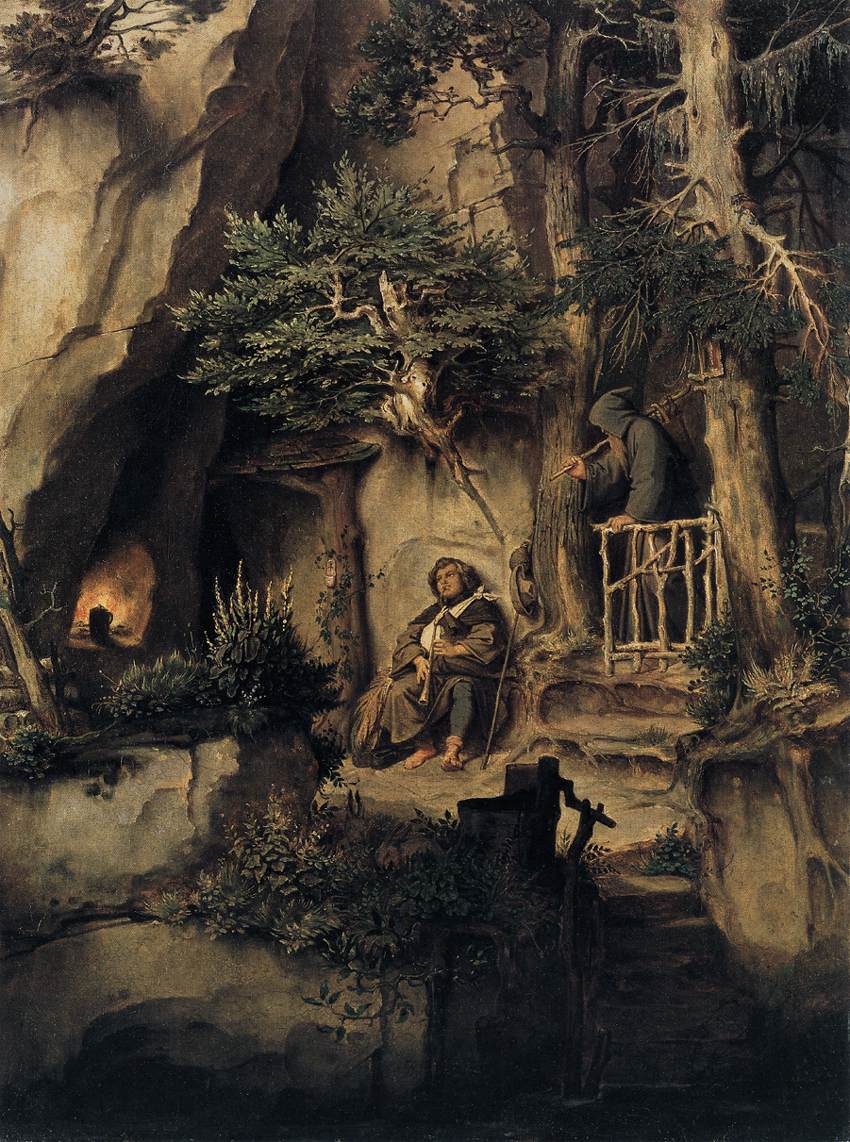
hermit


Have you been following the story of Christopher Knight, who aged 19 walked into the woods in Maine and lived there alone for the next 27 years, surviving by making raids at night to steal food and camping gear? He lasted all those winters with no fires lest he was discovered, wrapped in sleeping bags, until he was arrested stealing food in a trap laid for him. He is now in prison, exhibited like a circus freak.

Writing in the Guardian, Jessica Reed said this;

…for me, hermits, tramps and assorted train-hoppers are a source of hope. They remind me that no matter how caught up we might be in the rat race, there is always a way out. If towering buildings, fumes and overcrowded buses become too overwhelming, those freedom seekers remind us that we can make the choice to just opt out and hit the road. It’s not a lifestyle which would be adopted by many – the vast majority of us would never dare to leave our comfortable life behind – but it is there…

… those who truly master the art of the disappearing act acquire an unworldly quality: they become ghosts, mysterious presences, part of the local folklore, floating unshackled in the wild. This may not be what Thoreau had in mind when he spoke of transcendentalism, but for me it comes pretty close to transcending what capitalism expects of its subjects…

…If the truth be told, I really wish they hadn’t caught him.

I feel the same- sad that he is not still out there in his tent, reading the changes in nature, familiar with the birds and looking forward to everything that spring has to offer.

Which is strange, as I am at my most content when at home with my family. I love to be with my friends and hold on to a high ideal of community. But I entirely understand the longing for a cave or a shelter in the deep woods that is all my own.

There is of course a long tradition of seeking solitude and isolation in the Christian tradition. I always get the impression that famous religious hermits even then had something of a freak show value- they became some kind of celebrities and their stories live on even now.

There was Simeon Stylites for example;

On one occasion, moving nearby, he commenced a severe regimen of fasting for Lent and was visited by the head of the monastery, who left him some water and loaves. A number of days later, Simeon was discovered unconscious, with the water and loaves untouched. When he was brought back to the monastery, it was discovered that he had bound his waist with a girdle made of palm fronds so tightly that days of soaking were required to remove the fibres from the wound formed. At this, Simeon was requested to leave the monastery.

He then shut himself up for one and a half years in a hut, where he passed the whole of Lent without eating or drinking. When he emerged from the hut, his achievement was hailed as a miracle.[2] He later took to standing continually upright so long as his limbs would sustain him.

After one and a half years in his hut, Simeon sought a rocky eminence on the slopes of what is now the Sheik Barakat Mountain and compelled himself to remain a prisoner within a narrow space, less than 20 meters in diameter. But crowds of pilgrims invaded the area to seek him out, asking his counsel or hisprayers, and leaving him insufficient time for his own devotions. This at last led him to adopt a new way of life.

In order to get away from the ever increasing number of people who frequently came to him for prayers and advice, leaving him little if any time for his private austerities, Simeon discovered a pillar which had survived amongst ruins, formed a small platform at the top, and upon this determined to live out his life. It has been stated that, as he seemed to be unable to avoid escaping the world horizontally, he may have thought it an attempt to try to escape it vertically. For sustenance small boys from the village would climb up the pillar and pass him small parcels of flat bread and goats’ milk.

In this last and lofty station (15 M high, 1M square), the Syrian Anachoret resisted the heat of thirty summers, and the cold of as many winters. Habit and exercise instructed him to maintain his dangerous situation without fear or giddiness, and successively to assume the different postures of devotion. He sometimes prayed in an erect attitude, with his outstretched arms in the figure of a cross, but his most familiar practice was that of bending his meagre skeleton from the forehead to the feet; and a curious spectator, after numbering twelve hundred and forty-four repetitions, at length desisted from the endless account. The progress of an ulcer in his thigh might shorten, but it could not disturb, this celestial life; and the patient Hermit expired, without descending from his column.[3]

This degree of asceticism, to a lazy and easily distracted contemplative such as myself has a similar effect to the story of Christopher Knight.

The possibility of a life beyond what we understand is tantalising- not because it offers a real choice to us, but because it allows is to imagine a life beyond. A richer, more vibrant, more connected life; to the order of things, and to God.

where the wild things are

Iron Lady…

Margaret-Thatcher__2530139b

So far I have held back from commenting on  the death of Margaret Thatcher. She was perhaps the most dominant politician of my formative years, for good or ill. 

I have decided to write for her (or more accurately, for me) a poem…

Iron Lady

The iron lady

Like all things ferrous

Has turned to rust

And the girders that she

Used for bones

Are now ceremonial arches

Under which old ideologies are displayed

Like long dead dinosaurs

.

When I was a boy I ate her pumped up ice cream

But then, despite her chemical munificence

She took the milk from my school

Before, appetite whetted, she

Killed my community

And let loose the Yuppies

To feed on its twitching body

.

Some declare she saved the nation

From British Leyland

Others dance on the grave she made

From the split down middle England

Me, I breathe a rueful sigh

As the Lady

Turns at last

Looking back into empire…

Mount Stuart

Michaela was just showing me some of the photographs she sneakily took on our visit to Mount Stuart yesterday. Sneaky because they do not approve of people taking photographs. I always wondered why. Is it because the flash might affect the posh fabric, or because they want us to buy images from the gift shop?) She is not one for breaking rules, but makes an exception in the cause of the class consciousness (80s throwback there in honour of Margaret Thatcher.)

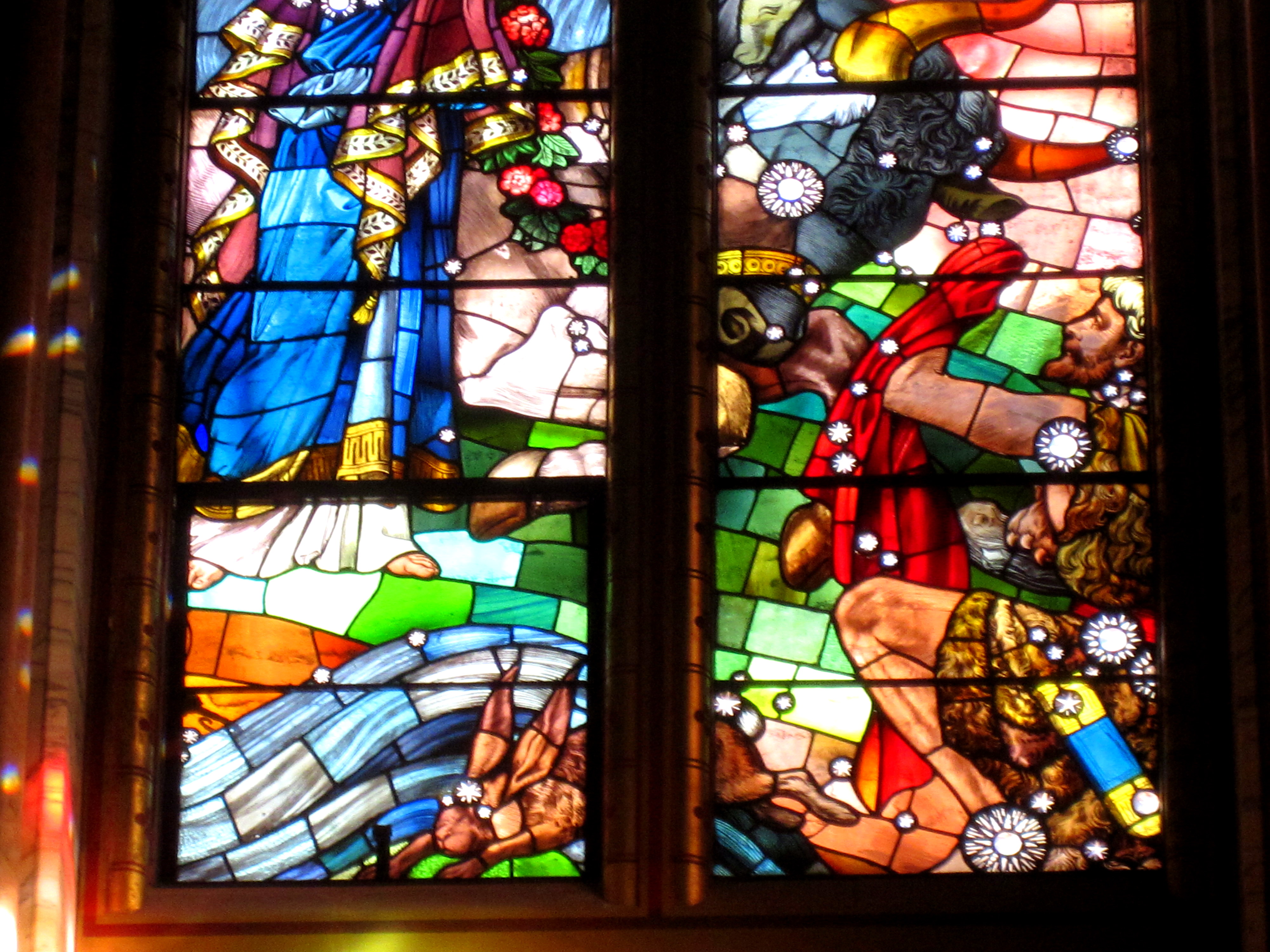
Mount Stuart (according to our tour guide) was one of the last great houses to be built in this country; the old one burnt down in 1877, so the owners set out to spend spend spend in high Victorian style- a display of wealth beyond what most people can dream of even now. Electric lighting, central heating, heated indoor swimming pool, every modern convenience, priceless paintings by old master, Gothic carving and painted walls, Stained glass. No expense was spared.

stained glass, mount stuart

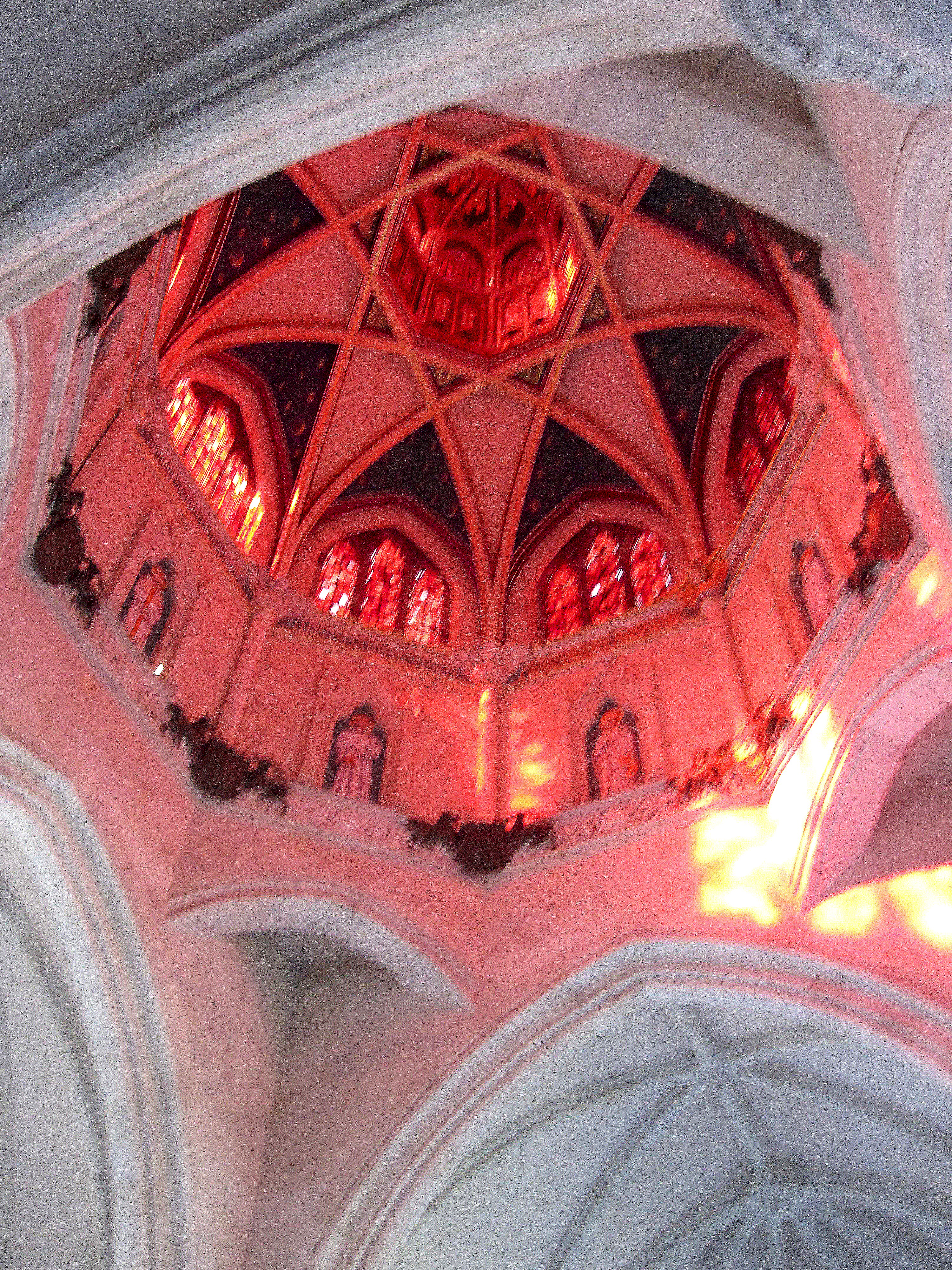
Marble chapel, Mount Stuart

What was created was already going out of fashion as it was completed in the years before the first world war. Baronial towers, a marble chapel, religious imagery everywhere. It must have seemed like the centre of Gods order for the universe- the rich man at the centre of his own world.

The house was only possible because of one thing- vast quantities of cheap labour. In the building (involving years and years of work by hundreds of skilled craftsman) and then in the running (an army of gardeners, housekeepers, kitchen staff etc.)

The interesting thing is that, in some respects it was never finished. Each column and stone cornice in the house was to be intricately carved- but not all of it was finished. Our guide told us this was because so many people were killed on the slaughtering fields of the first world war that the skills were simply gone.

unfinished carving, mount stuart

You could argue that this war was the logical end for all this stacking up of empire plunder- a war that should of ended all wars. It did not work out quite like this though. And the interesting thing is that this massive house is still privately owned.

This from Wikipedia;

John Colum Crichton-Stuart, 7th Marquess of Bute (born 26 April 1958 in Rothesay, Isle of Bute), styled Earl of Dumfries before 1993 and from this courtesy title usually known as Johnny Dumfries, is a Scottish peer and a former racing driver. He does not use his title and prefers to be known solely as John Bute.[1] The family home is Mount Stuart House on the Isle of Bute…

…He ranked 616th in the Sunday Times Rich List 2008, with an estimated wealth of £125m. (26th in Scotland with £122m in 2006)

He lives with his family in London and at Mount Stuart House, 5 miles south of Rothesay on the Isle of Bute, PA20 9LR.  In 2007 Dumfries House inCumnock, Ayrshire was purchased for the nation for £45 million.[5]

John Bute, a rich man, who is the son and grandson of many other rich men.

It really is difficult not to love his house- but the culture that made it possible still casts a huge shadow over all of us- and in many ways, our current government, stacked as it is with rich men who are the sons of other rich men, will be very at home there.

The road ahead…

IMGP4380

It is Michaela’s birthday today.

We took a day out to go over to Bute, just the 4 of us, in the crisp spring sunshine. We went to visit the Marquis of Bute at his magnificent pile, Mount Stuart.

His house was lovely.

It is unlikely to be affected by the bedroom tax.


Poetry of protest…

img_3671_student_protest_1

I have been thinking a lot about poetry that is prophetic– not in the sense of telling our fortunes, but more something that tells what we are- warts and all. Poetry that is an honest, engaged, hopeful critique of culture, and encourages us to think deeper.

There is a horrible danger of poetry like this becoming propaganda in the cause of whatever politics/theology/hermeneutic that we espouse. Poems like this are masturbatory- they pleasure only ourselves.  No matter what skill employed they are empty poems, blind to other perspectives. They claim to have answers to questions that are always nuanced.

I posted a poem yesterday entitled Welfare State which was my attempt to write  poetry of protest.

I had been increasingly angered by the actions of the current government in the UK, as they bring in sweeping changes to our welfare system. It all feels so unjust- making the poorest most vulnerable people pay for the excesses of the richest, and justifying this by vilifying  poor people as work shy, feckless. I wanted to use this anger to write something.

What I found though is that angry political poetry easily becomes exactly the kind of poetry I have described above- shallow self serving propaganda.

How then can we write the poetry of protest, of prophetic engagement, of challenge to empire in the face of injustice? I wonder if some of these principles might be of use (particularly for followers of Jesus);

  • If we are going to fight a cause, let it be for those who are the victims of power- the small people, the outsiders, those who the system has forgotten
  • It has to be honest. It has to be based on engagement with real people, real situations
  • It has also to start with ourselves– examining all that is beautiful and all that is broken in us, so that we can see it too in others
  • I think there is still a place for anger at injustice- but this anger needs to be yoked to love, or we become prophets of the clenched fist, not of the open hand
  • Perhaps the best approach is always to seek to humanise- and never to dehumanise (no matter how tempting this can be in relation to enemies of our cause)
  • It should not flinch from looking at ugly things, or be tempted by simplistic romanticism
  • It should be brave, because any protest will involve confrontation of those in power

This is a work in progress for me, but one that I feel keenly. I have this conviction in me that if we have a voice, we should use it – not just for saying pretty things, although there is beauty in this – but also to saying hard things, difficult things.

Art with nothing to say is simply wallpaper.

Welfare state…

children-were-classed-as-being-in-poverty-if-their-family-s-income-fell-below-60-of-the-median-average-income-143067855


Welfare State


The sofa split some years ago

The gas fire hisses as if

through broken teeth.

Colin tries to stir up hope

On the Baby Belling whilst the TV screen sucks

the kids in like flecks of dust.


A manufactured crisis for some pop star wannabe

Stabs out from the fat old tube.

The crowd scream – no wonder.

And Colin stares into the tangled noodles wondering

What might become of the children

For not one of them can sing.


But their faces, lit by cathode light

Are beautiful.


New FB page for Proost Poetry Collection…

typewriterletters

We have set up a Facebook page to support the gathering of poetry for an up and coming book.

You can see it here.

(Or if the link does not work (FB is always a difficult thing to link to) then just search for ‘Proost Poetry Collection’ on FB.)

Hopefully this can become a portal for questions, encouragement and support around this project. Please go and ‘like’ it/share it with friends.

Here is the first post- which hopefully gives a bit more flavour of what the project is all about;

Welcome friends.

This is the first post on our new page. We invite you to use this as a means of sharing ideas, discussion and to encourage one another as we seek to compile a collection of poetry.

Why are we bothering to do this? Well, I suppose firstly because some of us think that poetry is important. We need our poets now more than ever- we need to be challenged, to be stirred, to see through the surface of things into new and deeper meanings. In this way, poetry is closely related to prophecy – of the Old Testament kind – less about the prediction of shadowy future events, more about shining truth (a fickle beast admittedly) into our current situation.

Some would tell us that our culture has lost its soul and become merely what we consume. We have become a nation of short lived consumer events, connected by constant streams of media content. Poetry is the opposite of this. It has little or no monetary value, it can not be quickly consumed, and it has this way of asking questions more than providing easy answers.

There are lots of collections of poems out there of course- why another one? Well this one will be different for the following reasons;

1. It is a collection that is written by people on deliberate spiritual journeys. You could say this about most poetry of course, but we are particularly interested in what being a follower of Jesus might mean in our culture.

2. Having said that- we are not really looking for ‘Christian’ poems. By this I mean poems written from a narrow religious perspective, using the language and theology of Church (with a big C.) Poems like this tend towards propaganda- they close down the questions.

3. It is a deliberately open, non-elitist collection. We are happy to include works from published poets, but Proost exists to encourage, agitate and to give voices to those who would not normally be heard- the awkward squad, those who have the gift of not fitting in.

4. That is not to say that quality is not important too- but the way we understand quality is more to do with how well the poems become vehicles for other people to travel. Pure technical genius is not enough (but would be great!) Clever tricks with technique are not enough (Although they are fun if you are of a certain mind set!) However, words that move us, that catch the wind of the Spirit, that challenge, that question, that move us emotionally, spiritually- these are words we want to hear.

5. The collection is intended to be used for personal reflection. We think that arranging different poetic voices into broad themes allows access for people who do not usually read poetry. The success of the Bloodaxe books (Being Alive, Staying Alive etc) tells us that this format has value.

6. The collection is also intended to be a source of material for group use- to be read where groups of people gather, be that in churches or any other gathering. Some poems become new liturgy- ways that people can speak words together.

Finally, this is not a project driven by a desire for commercial success. Any profits made will be used by Proost in work to support  other emerging artistic talents. In the words of the song ‘There ain’t no money in poetry, that what sets the poet free’. We are able to reward contributors by offering a free download from the Proost site- a collection of all sorts of wonderful books, music, films. This will be one per contributor, irrespective of how many poems are included. We know that this is a meagre reward for your talents- but hope that you will nevertheless feel the satisfaction of being included in this book.

Let the poetry begin!

Chris

Casting bread on the waters…

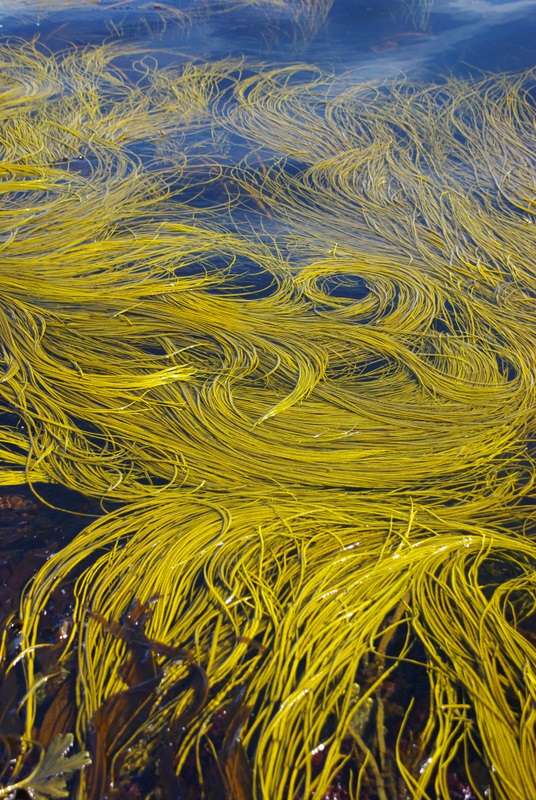
sea weed circles

Each year, over the May bank holiday, I go off with some friends to a wild place for a few days to make what we call a ‘wilderness retreat’. Our favourite locations are usually small uninhabited Hebridean islands- we are fortunate to be in reach of many.

Last year, after many years of our community (Aoradh) running these for ourselves and invited guests, a few of us made an attempt to offer them on a more ‘commercial’ basis to people looking to escape into the wild places for contemplation, meditation and companionship. We had some interest, but not enough to make a trip viable- mainly because of the charter cost of a boat to get us out to the islands.

In the end, we invited these folk to join our ‘comminity retreat’ which be going to Eileach an Naoimh, a tiny island that is part of the Garvellachs in the Ross of Mull. It is the site of a monastery founded by St Brendan- the nautical adventurer thought to have visited the Americas hundreds of years before Columbus.

One of the guys who is coming, I discovered, was from Nottinghamshire- my home county. I inquired further, and found out he lives very close to where I grew up, and where some of my family still live.

I then found out that he is the current minister of the church that I grew up in- St Thomas, Kirkby-in-Ashfield.

I have many mixed memories of this time- complicated by the fact that childhood was a rather difficult for reasons I will not go into here. Also, back in the 70s and 80s St Thomas’s was part of a Charismatic revival movement sweeping through the Anglican church in the UK, led by people like David Watson, Colin Urquart, David Pawson. I look back with complex mixed emotions- in many ways I long for the simplicity of the faith I had then but I also remember some rather difficult and damaging experiences.

I have lots of very good memories too however- a lot of it about music, and good people. It was the place my spiritual journey began, and for this I am very grateful.

The connection back to these times has been a surprise however. I am suddenly small again.

It feels like a cricling back- in a good way- to something that has been adrift on the waters for a while…

To emphasise the point- here I am, in a picture from the website archive. The blond haired boy in the middle with the great big smile;

unknown41


What makes a ‘good’ country?

flags

Michaela and I have spent quite a few hours sitting looking morosely into cups of tea, talking about the state of our country, and in particular, our government.

For those reading this outside the UK we currently have a concoction of two different parties governing our country, but the ‘crisis culture’ that has been bred by all the economic doom and gloom has allowed the Conservative party to bring about sweeping changes to our benefits system, or health system and our education system, whilst cutting taxation for people earning over £150,000 per annum by 5%. Much of what they have done has a direct impact on the poorest section of our population, and feels to some of us like an abomination.

For example, people who live in social housing, supported by housing benefit (which includes a high proportion of people who are disabled, sick, have mental health problems, or single parent families) will now be faced with losing money, or being forced to move home. If tenants are deemed to have one spare room, the amount of rent eligible for housing benefit will be cut by 14%. If they have two or more spare rooms, the cut will be 25%. Leaving aside the negative effect this will have on all sorts of aspect of peoples lives, the simple fact is that there are no one bedroom flats to move in to for many people!  Unfair, unjust changes like this are justified by this government by two things- a tabloid-like blame-the-poor attitude, and a constant reference to global ecnonomics.

All of which takes me back to the point of this piece- what sort of country would you want to live in?

I started making a list of the things I would NOT want to see in my country;

1. A large (and widening) gap between the ‘haves’ and the ‘have-nots’- enforced by law, tradition and the use of power.

In the UK, we have a remarkably stable upper echelon. People with money and power tend to be the children of other people with money and power. There appears to be evidence that this was reducing somewhat- at least in part because since WWII we had 40-50 years of political hegemony around the issue of equality- of opportunity, of health care of access to education. Power was taken by working people in the form of organised unions, and greater access to higher education gave people from poor backgrounds knowledge and skills they had never had before.

However, the UK egalitarian experiment was in many ways a very British one- it was not revolution, it was bureaucratic evolution. Progress was statistical, and statistics are always open to manipulation.

Along the way, we all became middle class consumers. The working class disappeared with the shipyards and the coal mines, leaving behind a broken underclass who were seen only as a threat, a burden, an expensive waste of resources.

And at the same time, the overarching idealistic imperative towards equality was allowed to slip away. We no longer talk about it. And many of the key elements of it are starting to killed one by one. Universal non-stigmatising benefits? All but gone. Free education, supported by a fair grant system to support people through universities? Gone. Universal health care from the cradle to the grave? Under threat from privatisation. Etc.

We may (and often do) argue about the nuts and bolts of all this- but the central over arching question- is our society becoming more equal, or more divided- has slipped off the agenda almost entirely.


2. A society where the rule of law is manipulated or ignored by the people in power, for their own ends, either at home or abroad.

Our comfort with this one in the UK seems to ebb and flow.  In many ways, we might see our justice system, and our sense of ‘fair play’ as essentially British. The fact that we are outraged when fairness is transcended is a sign of this.

However, many would argue that the assumption of British fair play has always been a canard. The Empire was not a selfless project to civilise the world with cricket and people wearing wigs- it was a means to exploit, to subjugate, to enslave even.

At home, the interplay between power and the law is a complex one, and something that requires constant scrutiny at the same time as people in power would keep secrets.

For which you need a free press, and open government.

So, a mixed bag this- we have some movements towards open government, at the same time as the press shoot themselves in the foot with all sorts of bad practices.

There have been some changes too to the way our system works- talk of jury-less trials, and the removal of legal aid from other aspects of law (for example, benefits appeals.) These things need to be resisted.


3. Individual citizens are not of equal value- most are expendable in the interests of those who are in power.

All animals are equal, but some are more equal than others.

All sorts of things can be used to excuse this kind of thinking- ideology, religion, economics, war against a common enemy (real or conjured up.)

At some points of our history, the UK has seen its citizens as cannon fodder, or an industrial resource. Currently it is not possible to do this openly thank God.

However, I have heard it said that the measure of a good society should be how we treat our prisoners, our poor people, our elderly, sick and infirm. This should be the first job of government- to govern on behalf of the weak, not the strong. The strong can look after themselves, the weak need to be empowered so that they can do the same.

If this is true, the UK has been doing poorly recently.


4. Freedom is waved like a flag, but defined against others, not inclusive of them.

I do not want to be part of a country still caught up in empire lust. However, even without military expansion, nuclear weapons and invasion of other countries, empire can still be a weight upon our nationhood.

We talk about freedom as some kind of inalienable human right- usually hand in hand with democracy and capitalism. Freedom is understood as ‘the right to live in the way that we are living’ with as little interference as possible in the form of taxation, regulation, or imposition by others.

However, this kind of freedom requires examination- particularly when it comes at huge cost to others- when it is based on unsustainable, inequitable trade relationships with poor countries, where it is destroying our environment.

Freedom-to also equally becomes freedom-from. We are free because we are not like you. Perhaps this is sometimes true- there are some despotic places out there. However, when this kind of freedom starts to exclude people in terms of colour, origin, religion, gender, sex- then it is no freedom at all.


5. Patriotism becomes nationalism becomes excluisivism, and it ticks like a historical time bomb.

I can think of nothing good that ever came out of nationalism- measured in terms of human dignity and grace. I say this as an outsider living in a country that is considering full independence from the wider UK. Perhaps this might be the project that proves me wrong but I see warning signs to the contrary- the easy negative stereotyping of the other, the co-opting of war stories that justify us against you, the distortion of history to cast ourselves as victims/heroes and the other as oppressors/villains.

In this kind of soil poisonous things grow.

The Bible struggles with all of this- it can be read as the story of a succession of empires as they rise and fall- eventually to be challenged by a totally different kind of Empire, called ‘the Kingdom of God’, in which the the rules are turned upside down- the first become the last, the poor are our conscience and love is our currency.

Patriotism belongs to empire- it has no place in the Kingdom of God.


I am British- somewhere inside. I find this difficult to define- as an English/Irishman living in Scotland. I am grateful for the gentle green climate of these beautiful islands, and for the slow pragmatic evolution of our welfare state.

But (in the words of many a school report) we could be doing better…


Calling all poets!

words1

I would really appreciate your help in getting the message out there about this project- if you are a blogger/facebooker/twitterer would you mind reposting?

For a while now, I have been chewing on an idea about putting together a collection of poetry.

From time to time people send me things they have written- asking for feedback. I always really struggle to give feedback- I want to be honest, open and encouraging, but poetry is really subjective. What I find however, is that there is almost always gold in the dust. Most people who write do so to get into the depth of things, and the process opens us up- in my view, it opens us up to God (however you understand this.)

Much of this writing is personal- like many of the things I write, its primary purpose is personal spiritual discipline. However, some poems have a life beyond this- and become vehicles that allow other people to travel. It is these poems that I am interested in.

We are used to being told that our poetic voices are worth nothing- either because poetry has become so elitist, or because we doubt our inner voice. Poetry also has little or no commercial value in the consumer culture that we live in. However, we believe that poetry is more important now than ever- we need our poets our prophets and our malcontents.

So, if you write poetry and you have material that you think may be helpful to the spiritual journey of other people, then you might like to consider this;

We are looking for contributions to an collection of poetry to be published by Proost.

We intend this is to be a collection of voices in and around the margins of our churches and will bring together poets whose writing is not normally heard to be a resource for worship, contemplation, prayer and even faithful prophetic criticism.

Poems should fit broadly into one of the following categories/chapter headings;

  • Faith/doubt
  • Becoming
  • Losing
  • The world is beautiful
  • The world is broken
  • Inside/outside
  • Wilderness
  • Laughing out loud
  • The far horizon
  • Learning to love

Notes on selection process;

We are looking for poems with something to say- poems that open us up rather than close us down. Poetry at its best can be challenging, disturbing, uplifting, transforming and much more. If you write poems like this we want to hear from you. We are not interested in reputation or CV- rather we want to encourage those of you with a poetic/prophetic voice to let others hear it.

We will select poems for the collection if they fit the broad (and generous) ethos of the book and if they are of a quality and spiritual depth that moves us. This means that some very good poems may not be selected. We hope that you will understand that we lack the resources to give feedback on the reasons for our editorial decisions.

We would impose no proscribed form on the poems, but broadly speaking poems should be no more than 35-40 lines.

You may send up to 8 poems– simply because we know how difficult it can be to choose. We hope that this too might be a way of gathering some more unusual voices- many of us have at least one pearl in amongst the pebbles.

Please send poems by e-mail to thisfragiletent@gmail.com

About Proost

Proost is a small publishing outlet aimed at gathering together resources from the creative edges of Church. Most of the material is made available for download- although hard copies of books can be purchased via a print-on-demand service.

As recompense for your hard work and creativity, poets published will be eligible for a free download of their choice from the Proost website- which is chock full of music, art, movies, worship resources and books.

We look forward to reading your poems!