Because of the direction I started down a few years ago now in trying to break out of the Christmas consumer driven craziness, I find that some things make me angry.
Those advertisements on the TV- with celebrities who supposedly do all their shopping for celebrity friends in some most unlikely store like Argos or Lidl. And then there are the advertisements aimed at parents through their children. I could mention some brand names, but it perhaps would not be fair as they are all up to the same sort of thing really.
After the anger comes other emotion that is most unflattering- smugness– the vaguely superior feeling that I am somehow ‘different’- not like them. Of course this is nonsense- we all live in the same consumer driven culture and it is so hard to go against the flow. Advertising works- on all of us at some level.
Then there is this other more corrosive emotion called cynicism. I think this is the worst of all. It drives us to sit back, sneer and to do nothing. It is not a force for anything but inertia. It sucks the joy and the wonder out of anything it comes up against. It is the enemy of life.
I think that our lives are journeys- through all sorts of stuff- towards the unknown. They are marked by many boundaries and transitions. We do not make these journeys alone, because we are communal beings. Neither do not journey without meaning because we humans search for the depth of things- we are spiritual beings. Therefore the celebration of season- birthday, feast day, wedding, funeral, etc- is ever more important.
As a person of faith I might have a particular reason to celebrate Christmas, but I also recognise that the role of the Church in mediating our transitions and life patterns has been largely broken. Christmas is little to do with Christ. Whilst some of us might lament this in our own lives, it is simply not something that we can impose on a mostly secular society.
There is that saccarine sweetness that is sold to us in Christmas card poetry and Hollywood films- something to do with the ‘spirit of Xmas’. Which is usually conjured up with pictures of shiny faces, snow scenes, candles and of course, that greatest modern consumerist invention, Santa Claus.
Oh dear, there I go again.
What then is left? After the anger and the cynicism what remains?
These are no small questions, because life is lived in the asking of them.
I have my own partial answers- which I try to work out creatively with my family and friends and small community. I am sure that you do too.
But first I need to set aside the cynicism, and find inside of me some wonder.
I was out at the Innellan Cricket Club Annual dinner the other night. A posh meal- an all male affair, with lots of long well libated speeches, lots of belly laughs and shameless in-jokes. It was a strangely alien environment for me.
Many of the people there were former members of the club (or associate members) and so there was a palpable sense of shared history. Matches narrowly won, or almost lost. Catches taken and dropped. Friends now no longer with us.
And of course, drunken cricket tours where men can once again be boys.
It was all good fun.
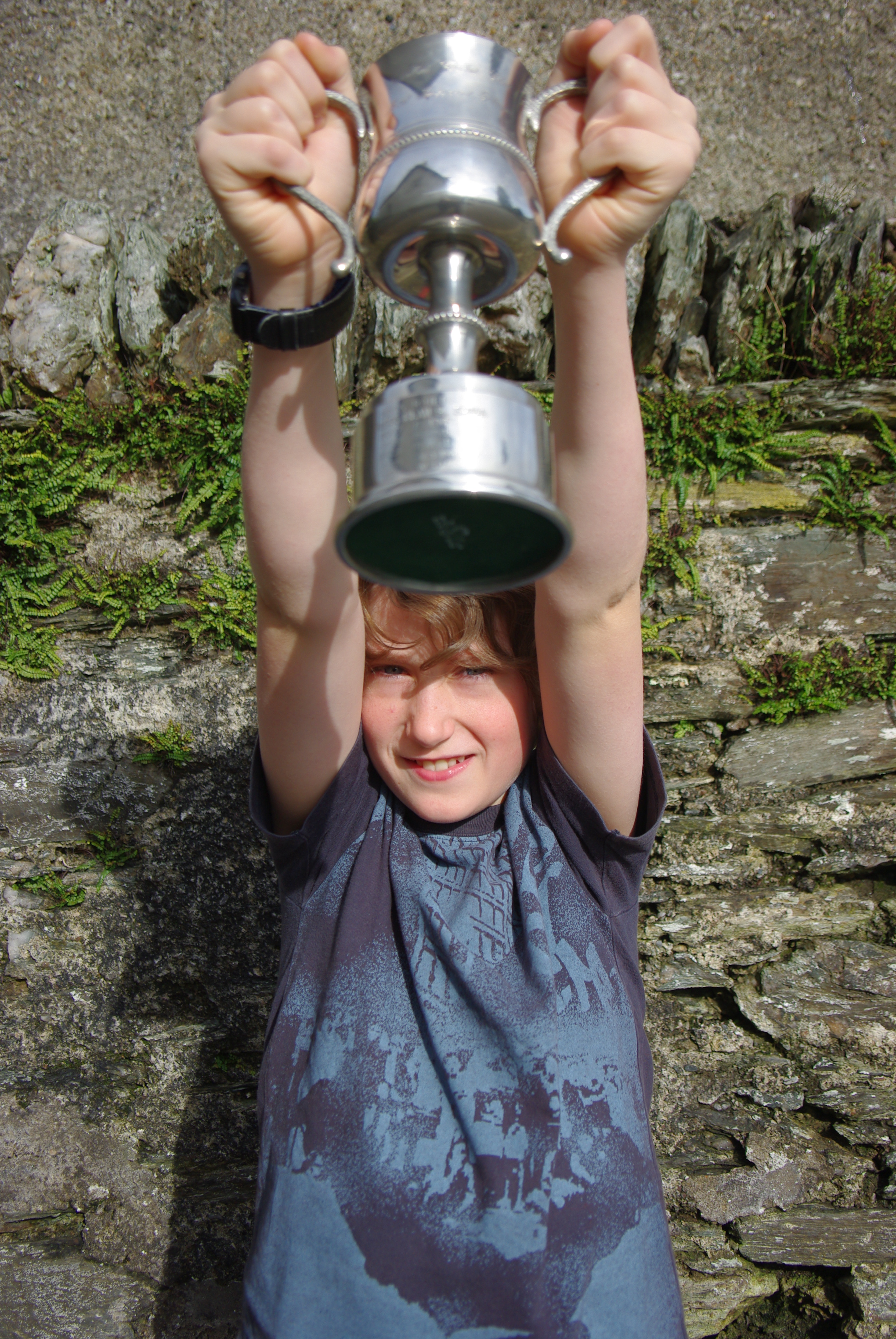
William was not there, but he was awarded the ‘most improved cricketer’ cup. Never was there a prouder boy (or father.)
Specifically, Carol suggested I watch the clip below. It is quite long, but makes for rather interesting watching.
I had not heard of this movement before, so spent some time researching what I could about what they are about, their core beliefs and campaigning aims. At first I was pretty suspicious to be honest- there is something about their website that made me instantly uncomfortable- it is a little too slick, too shiny.
TZM is another one of these internet generation organisations that grows not along the lines of corporations that are led and controlled from the centre, but rather grows virally by a network of connections, and a set of common evolving principles. It has vague, fuzzy edges, and slightly non specific goals. Rather than ‘leaders’ who are appointed and recognised, there appear to be some key voices, but the structure is deliberately local.
This is a familiar organisational structure to me- as it reminds me very much of the ‘Emerging church’ movement. Such organisations are always difficult to get your head around from the outside- as they appear to lack structure and substance. There is more about these kinds of organisations here.
But back to the specifics of what BenMcLeish had to say above-
I liked much of what he had to say- particularly his analysis/critique of the state of our current economic/political/environmental situation, which I find myself largely in agreement with. I might also echo some of his concerns about religion- although unlike him, I remain a believer.
I think the importance of a strong critical voice against the excess and over consumption of our wider culture is vital. I have been wondering for a while where this will come from, and where we might see examples of people living lives that are different- people that break from the flock and show a better way to live. I have been excited by these possibilities all my life, and so wherever I see these things being talked about, I am interested.
Unlike what Ben had to say above however, I have seen most of this kind of thing within faith based organisations. Sure, there are a lot of people within our churches and mosques and synagogues who are as sheep like as the rest of society, but there are also many whose beliefs lead them to aspire to something more. Within my own faith, I would point to the New Monastic movement, towards which my own little community makes a slight nod.
CS Lewis used to talk about Communism being a ‘Christian heresy’- in the sense that the impulse towards good things was in many ways Jesus-like. I think you could perhaps say the same about TZM. I have described previously my belief that the job of Christians is to watch out for wherever there is truth and beauty, then to seek to shine light on it, and to salt it to bring out the flavours. On this basis alone, I intend to keep an eye on TZM.
Which makes what is happening in front of St Paul’s Cathedral all the more interesting. The grand old Church of England have got themselves in a bit of a cafuddle- they want to be ‘nice’ to the young activists, but can’t quite deal with the mess of it all.
Having said all that- TZM seems to espouse some macro economic and political solutions to our current woes- these I find myself less inspired or convinced by. A futurist perspective like this, with grand predictions of the fragmentation of the current mechanisms of state and society, seems to me to be highly speculative. The grand idea of a money-less society, with resources allocated according to need (and administrated by think tank and committee) just seems to be rather fanciful on a national scale.
But not necessarily so on a local small community scale. This is where my interests lie. Ben speaks at the end about what individuals and families might do to look at their own patterns of consumption and life choices- a list of things that are very familiar to the aspirations of my faith community.
Does this organisation offer a real alternatives to our Capitalist consumer economy? Not yet. What it does do however, is to push back– to offer a visible critical analysis of what we are.
Thought it might be worth mentioning our holiday let again- If you are considering a wee break then you might like to think about a trip to Dunoon…
The Annexe has a double bedroom and twin bunks, an open fire and a DVD player for lots of late night films with a hot toddy. At £250 a week (or £45 a night) you are unlikely to find anything of better value.
It has been really lovely to have Graham and Victoria (along with Matthew and Ben) over the last week. Graham is a minister in North Yorkshire, and blogs here. After exchanging the occasional comment we met up for a pint when we were on holiday a couple of years ago- only to discover that Victoria and I used to work together in Bolton. It’s a small world.
If you want to know more (about the Annexe, rather than Graham and Victoria) then feel free to get in touch…
I watched Panorama tonight- telling the story of the mass eviction of a community of Travelling families from the site at Dale Farm.
If you are unaware of the background to this story, it involved the establishment of a settlement on privately owned land- leading to around 800 travelling people setting up permanent living arrangements- caravans, mobile homes. However, the site was established without planning permission, in the shadow of a sleepy affluent English village. Ten years of negotiations, court battles and exchanges of vitriol and hate followed.
On the one side, the outraged locals, who pointed to high crime rates, threats of violence and unruly behaviour. These folk have the rule of law on their side- and the local County Council. On the other side are travelling folk, whose leadership (if the Panorama film is to believed) is provided by a number of matriarchs. The Travellers are supported by an assortment of activists, from all ages and works of life.
It ended predictably- riot shields, rocks hurled at police, diggers smashing barricades. The Travellers lost their homes and were forced back out onto the road.
Stories like this polarise us too. Power wielded against the marginalised in the name of the rule of law will always feel (to me) WRONG. But neither can we blame those whose job it was to enforce the will of the court- who had to face their own trial of violence.
The issues for me are much longer standing. We have well over a thousand years history of regarding Tinkers/Gypsies/Romanies/Travellers as dangerous thieving, untrustworthy and less than human. There is absolutely no doubt that this has resulted in prejudice and even direct persecution.
That is not to say that there is no criminality within the Travelling community- but they follow a way of life that has been criminalised.
One of the most striking aspects of the Dale Farm situation is that Travellers have so few alternatives to illegal sites. There used to be law on the statute which obligated each and every local authority to provide designated travelling sites. These sites (where they remain) are not without their problems- but do at least offer safe places for families to settle for a while, and receive health and education. However, this law was repealed in 2004- by the then Conservative government, responding to another middle England tabloid backlash against New Age Travellers.
Many councils closed their sites.
The end result is that at any time, there are estimated to be around 3500 caravans with no legal place to stop. The options they face are to abandon their way of life and move into social housing (which many have done) or continue with a life that constantly skirts the edge of legality.
As a matter of interest to those of you from a particular Christian background that there has been a charismatic revival sweeping through the Travelling community over the last few years. There is more about this in this book.
As revealed in the Panorama programme, these communities are not without their problems- but nevertheless are communities characterised by very strong social norms, and sense of identity.
Something to celebrate perhaps, rather than to try to squash?
The Christmas advertisements are already being shown on TV- something that most of us will have complained about. The money machine is limbering up…
But if we want to do something differently, then we too will need to make some preparations.
It is my conviction that although most of us love to celebrate Christmas, we do not feel in control of what happens to us each year. It comes at us like a massive snowball rolling down the hill, gathering all in it’s path. Bigger and bigger.
The controlling factors that result in our powerlessness are complex, but I think some of these things have been part of our experience-
Collective momentum- none of us are immune from the power of advertising, particularly when all around us people shop till they drop.
Making it special- and because of our consumer driven context, this means more consumption. More shiny stuff for the kids, and more booze and gadgets for the adults.
Busyness- most of us simply lack the head space to think our way into a different way of doing things. It is all we can do just to go with the flow.
Obligation- present buying is a socially stressful activity. Getting the right balance between cost/quirkyness/suitability is a pressure for more of us. This is because we value our friends, and do not want to give offence. Remember those awful moments when someone gives you a present and you realise you have not given them one? Do you keep ‘spare’ presents just in case this happens?
Lack of viable alternatives- what else would we do? Faced with this, we reluctantly end up just doing the same.
All this suggests to me that if we want to change our approach to Christmas, we have to make plans well in advance.
We will need to negotiate/discuss with our family and our friends. It might mean different solutions for different groups.
We are part of a community called Aoradh– and last night, we made a start towards our different kind of Christmas.
Sarah (our 11 year old super-chef) had baked cupcakes. At the base of each cake was a name, revealed as we ate. Later on we will eat another meal together, and exchange gifts only with the person whose name we drew.
The rules are- gifts can be something you have made, or a promise for the new year (babysitting, grass cutting, chest waxing or whatever) or if you need to buy something then that is fine, but you must spend little.
Will this be less special? Will our community be showing less love and committment to one another? I rather think the opposite- it has already been a means of bringing us closer, having fun- and of course, eating together. We do a lot of that…
OK, people have sung to worship God since the earliest times of church. The Hebrew Bible gives a whole book over to songs of praise, otherwise known as Psalms. Does that mean that we should follow their example?
There are lots of other traditional forms of worship that we no longer practice as a norm (certainly in the non-conformist tradition that I come from anyway.) We are not much into sacrificing animals, or washing feet, or burning incense, or flagellation, or dancing (particularly the naked Dancing that King David was known for.)
Then there is are lots of others that are fashionable, but still relatively rare- pilgrimage, silent meditation.
So- why sing?
Some people would point to the passages in the Bible that would seem to instruct it- ‘Sing unto the Lord a new song’. Clearly early followers of Jesus sang together-
1 Corinthians 14:26
[ Good Order in Worship ] What then shall we say, brothers and sisters? When you come together, each of you has a hymn, or a word of instruction, a revelation, a tongue or an interpretation.
I have to say however that my times of direct literal application of words like this without any wider questioning are gone. There are lots of other passages that we do not apply in this way. The question of how much is social/cultural/historical, and how much is expected conduct for all subsequent followers is always a point of debate. In this instance- the practice seems to me to be less important than the purpose and the meaning of the practice.
However.
There are some things about singing that are special. I will divide these into three areas- physiological, communal and spiritual.
Physiological
There is plenty of evidence of the health benefits of singing.
Singing releases endorphins into your system and makes you feel energized and uplifted. People who sing are healthier than people who don’t.
Singing gives the lungs a workout,
Singing tones abdominal and intercostal muscles and the diaphragm, and stimulates circulation.
Singing makes us breathe more deeply than many forms of strenuous exercise, so we take in more oxygen, improve aerobic capacity and experience a release of muscle tension as well.” — Professor Graham Welch, Director of Educational Research, University of Surrey, Roehampton, UK- from here.
Other claims made are that singing can increase your life span, can reduce depression, improve your posture. If half of this is true then perhaps every hospital should have its own choir. GP’s should prescribe barber shop.
We do not worship for our own benefit of course- and I suppose you could argue that worship music has already become too centred on ‘us’- our needs for a ‘high’, not to mention the egos of we worship leaders. However, we might argue that things that carry a simple wholesomeness about them always seem to draw us towards God.
Communal
Everywhere, in all cultures, through all time, when people come together, we sing.
In these times when individualism tends to dominate our western culture, very few things still collectivise our activities. There are very few semi-ritual activities that bring us together. Communal singing is one of the few things that achieves this- whether on the football terraces, or our national anthems, or in churches.
When we come together like this, interesting things happen. We humans are above all things, social creatures. Our sense of wellbeing is very dependent on our connection with people around us. The stronger- more harmonious- that these are, then the better we tend to feel.
Perhaps the most developed example of this is the choir. Choirs come together to rehearse, with an overarching mission- the performance. Fairly ordinary voices are combined with other fairly ordinary voices, and the sound that is made collectively can be extraordianry- even sublime. And along the way, we learn together, laugh together, form relationships with people from other walks of life. There is much of the ways of the Kingdom of God in this I think.
And then there is the high of performing together. Like this, for example.
Spiritual
If our culture skews us towards individuality, then perhaps our means of worship have taken a similar course? Our spirituality is ‘personal’ and ‘private’, and newer forms of worship may have underlined this too- for example, ‘alternative worship’ spaces (which I love) which owe more to art installations may tend to make individuals of all of us even within a communal space.
Singing is one of the few spiritual practices that can be totally shared. When done together it requires us to align ourselves entirely with our fellow singers- to find the same rhythm and chordal structure, to feel the ebb and flow of the emotional content of what sing and to depend on others to fill out the polyphonic diversity.
There is more however- many of us who have sung in groups would describe transcendent experiences whilst singing. These things are extremely difficult to define- but perhaps the shared intensity, allied to deep breathing and exposure to rich lovely sounds will always open us wide to deeper experiences.
Of course, you might experience similar things from exposure to all sorts of art/beauty- from a rock concerts, to films, or beauty in nature. But singing is slightly different- in its democratic accessibility.
It is also a means of making worship deliberate and directional. It combines something abstract- music, with something concrete- words.
In many ways, these words are the carries of our faith- the ones that we remember more vividly and use to encapsulate beliefs. Some of these words rest on our souls- we never forget them. They come to us in moments of significance almost unbidden- either in times of adversity or ecstasy. Somehow their allegiance to music makes them spiritually more three dimensional.
So perhaps the arguments for singing remain strong?
So, in the light of my recent ponderings about capitalist excess and consumerism- this story caught my attention…
The protest – modelled on earlier such events in Spain and, more famously, New York – descended on London’s financial district last Saturday with the intention of setting up a permanent camp in Paternoster Square, the private commercial and retail plaza housing the Stock Exchange headquarters.
However, the square’s owners won a court order preventing this, and police blocked access. Several thousand activists, who eventually coalesced into an encampment of around 200 tents, instead based themselves on the western edge of St Paul’s. There, they set up an increasingly entrenched camp, featuring a food marquee, a media tent and a “university”.
Relations with the church began well, especially when its canon chancellor, the Rev Dr Giles Fraser, delighted protesters on Saturday by saying he supported the right of the “good-natured” crowd to remain.
Since then, however, cathedral officials have repeatedly raised concerns about the size and scope of the camp, warning that it was impeding access for both worshippers and tourists, especially ahead of next week’s busy half term. This is a particular issue for a cathedral that relies heavily on entrance fees for its income.
Hmmm- I wonder if they Dean is concerned that some radical might start turning over the money collecting tables?
To be fair, the closing of the doors of the Cathedral does seem to be at odds with his earlier statements-
He said: “We are delighted that the London protests have been peaceful, and indeed there has been a good atmosphere generally between cathedral staff and those dwelling in the tents around St Paul’s.
“There is something profound about protest being made and heard in front of this most holy place – a gathering together of those concerned about poverty and inequality facing the great dome of this cathedral church.”
I wonder though- is this perhaps the beginning of a real movement for change in our rather sclerotic socio-economic system? Might these few hundred tents be far more in touch with the zeitgeist than the health and safety constrained Cathedral managers?
Over in America, a recent survey suggested that only a slight majority of American adults believe capitalism is better than socialism, according to the latest Rasmussen Reports national telephone survey. Asked whether capitalism or socialism is a better system, 53% of American adults cited capitalism, 20% said socialism and 27% said they weren’t sure.
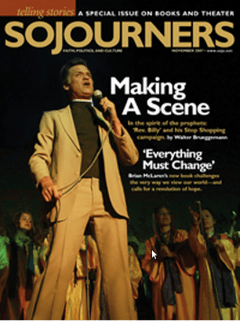
Reverend Billy, also known as Bill Talen, has gotten the strange idea that the Big Corporations, notably Disney, Starbucks, Nike, and Wal-Mart—and their shameless commitment to profit at the expense of human infrastructure—constitute a destructive force in our society. He has, moreover, reached the critical judgment that such a negative ideological force in our society must be resisted, and can best be resisted from a self-aware theological perspective that operates with parody and irony. The purpose of such parody and irony is to expose what seems like an economic operation as an ideological force of totalizing scope in our society. This force seeks to situate U.S. consumers in an uncritical way in the “life world” of consumer capitalism.
Rev. Billy began to take his preaching into the Disney Store, and later into Starbucks, often joined by supporters who would help him stage “shopping interventions,” during which he might, for example, perform an “exorcism” of the cash register. In the process, the Church of Stop Shopping was born, a performance activism nonprofit staffed almost entirely by volunteers, including many professional musicians, singers, and actors who turn up as they’re able at actions and rallies promoting free speech, local communities, and anti-consumerism; tour with Rev. Billy as the Stop Shopping Choir; and help lead periodic “revival” productions.