A new chicken…

We welcomed a new creature to our menagerie at the weekend- a Bantam chicken, courtesy of Freecycle. Chickens (like humans) are not good when isolated and alone- they need company, so the wonderful Freecycle in this instance acted as a kind of dating agency (in a platonic kind of way you understand.)

She came to us named Sugar, but we renamed her Bandit, as she proved to be rather tougher than our last surviving chicken. The first thing that chickens do when they meet each other (Also like we humans) is to jostle for position- to measure their worth in the pecking order of life.

Thankfully, after a few flying feathers and odd pecked eye, things have settled down to some kind of communality. Whether you could call it friendship I am not sure. I do not speak chicken.

Here she is, mid peck…

Worship music remix 1- introduction…

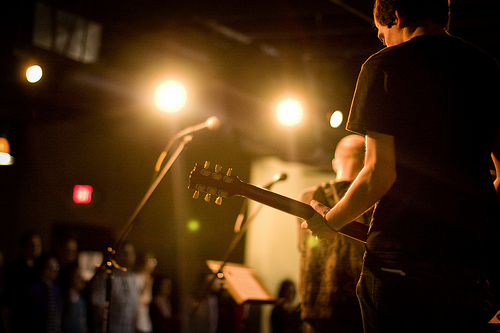
This is the first of a series of post on worship music. My current working titles for he others include ‘Authenticity/Creativity’, ‘Transcendence’ , ‘Songs of community’ and ‘What is so special about singing anyway?’- hopefully these will emerge over the next few weeks. But in the meantime, here is a bit about my own journey, in which I have to acknowledge some rather negative aspects to my experience…
I have written before about my own previous encounters with worship music- the practice of which has been extremely important to me.

I started out singing in a church choir. I had a high pure voice as a boy, and sang solos in church. I learned to play piano, and church organ- earning some pocket money playing at weddings and funerals.

Later we discovered simple choruses- and during the late 70’s and early 80’s I started playing guitar. We played simple songs such as ‘We have come into this house’ and ‘Freely’, and were indebted to the songs of the ‘Fisherfolk’, whose music became the soundtrack to the Charismatic revival that swept through the Church of England. I still feel a strange nostalgia for the simplicity and ‘wholesomeness’ I remember from this time- and the music was a huge part of this.

I then spent 15 years as part of a large independent church in the north of England- in which my major contribution was musical. I eventually became the leader of the music team. We made a journey through all the waves of new church music that emerged- at first it was all sourced via new songbooks- which would come out every now and then- but later the machine that poured out songs  (mostly from America) used many different portals- books, CD’s and increasingly, the internet. Vineyard soft rock worship was something we constantly imitated- although the shiny happy Hillsongs worship always left me a bit cold.

Following a move to Scotland, I continued to lead worship- now in a small Baptist church. Through connections there, I also became slightly itinerant- leading worship in the USA, Europe and for some different events in Scotland.

Then I stopped.

I found it increasingly difficult to sustain any kind of passion for this kind of worship. It had become so formulaic and anchored within a narrow world view- based on  set of core assumptions that were all-dominant even if rarely spoken. I was increasingly finding myself at odds with these assumptions, which were grounded in a particular American Evangelicalism.

Then there was the place of this kind of worship at the centre of all of our services. At first, worship music was all about FREEDOM- it was the means by which we escaped ritualistic liturgy and ‘made room for the Spirit.’ Except the longer we did this, the more liturgical and rigid we became. The formula went something like this-

Open service with a time of ‘praise’- 

Upbeat high energy praise songs. However, there were (and presumably still are) far fewer exuberant praise songs than quieter ones, so we tended to do the same 10-15 or so over and over, after which typically the kids will leave for Sunday School, and we hear notices.

Time of ‘worship’

We then have more singing- quieter songs now which worship leaders try to theme slightly, with a nod towards the coming sermon. In my experience, we often talked about worship being about a much broader thing than just music, but in practice other artistic forms of collective worship had little part in our services. The odd bit of drama, or music/power points. Possibly a bit of dance. The job of the worship leader here is to generate some intensity and expectancy as we prepared to hear the preaching of Gods word- mainly by singing songs.

The sermon

Teaching within this tradition is of paramount importance. We talk of being ‘fed’ by this teaching, and skillful preachers were the top of the tree in terms of status. The very best preaching has this goal of creating a climax– you could call it a spiritual/emotional crisis- during which the congregation is expected to ‘make a response’. This might mean coming forward for prayer for healing and deliverance. The public nature of these crises is valued as some kind of statement before man and God, but I have long wondered whether it might also serve the purpose of measurable ‘success’ of the peaching.

And while all this happens, the music has a vital role again- ecstatic, emotional love songs to Jesus. Matching/creating/heightening the emotion of the event. A benign manipulation of our emotions in the name of Jesus.

The sending out

The last part of the service was about commissioning the congregation to go out into the world, changed by their encounter with God in the service. Songs tend to be more martial, triumphalist and perhaps more hymn-like.

All of this can be energising and vibrant- it can also be very ego-centric for those of us on the stage.

That is not to say that all this has no value- but I think we greatly exaggerated it. People were challenged and even changed in these services, but most were not- they were just caught up in the weekly merry go round. I once heard these services described as like a weekly wedding with the same couple getting married each time. And me, the wedding singer.

About 5 years ago I decided that I could do it this no more. The ‘crisis point’ of services seemed to me increasingly to be manufactured and divorced from the reality of the lives of the people present. At worst it became a religious show- a pep-me-up for the dwindling faithful. The particular context I was part of did not make this easier as there was also a surface dishonesty about levels of conflict and political in fighting.

There were other reasons why I walked away- firstly, theological ones. I found myself adventuring into new ideas, questioning and rediscovering aspects of my faith- and the Evangelical assumptions of many of the songs I had previously used became very difficult to sing. They tended to be strange quasi-erotic love songs to Jesus, or triumphalist war songs for the army of God. They use the Bible as source material- but only parts of the Bible that come pre-packaged by Evangelical assumptions.

And they tend to be American, arising from the cult of the super worship leader- a strange cool guy (mostly male) who has an expensive guitar. His music only finds wider release if he is marketable, and hopefully photogenic. Then the music goes into a highly profitable (but not necessarily prophetable) machine, which spews out visuals, CD’s and sheet music for the whole band. All worship leaders have their favourite super worship leader. We aspire to be like them, and to make music that is a second rate version of their music.

Secondly, I was discovering other forms of worship that I could connect to in a different way- both older forms of worship (from a contemplative tradition) and also new forms of ‘alternative worship’, which had more in common with performance art that with praise and worship as I had used to understand it.

I am a few years down the line now though- and have been involved in many a prayer room, curated worship space or wilderness meditation event. These experiences are very precious to me, in my on going attempts to reach towards God, and to offer my worship.

But I still love to sing. Gatherings with friends still often involve getting out some of the range of instruments our family have accumulated. And within my community (Aoradh) we still sing when we gather from time to time. What I have however, are a set of open questions that I am still working through-

  • Where are the songs of lament, of thanksgiving, of hope, of brokenness, of joy, of doubt, that fit this new context?
  • What songs are counter cultural- challenging the idolatry of the consumer driven unsustainable way of life our churches are embedded within?
  • This new context- what songs might collectively release us towards a different kind of mission? Encourage us to seek after justice, truth, beauty- and when we find it, to sustain it?
  • If these songs are the cultural carriers of our theology- then what of our faith do we want to celebrate? How do we move towards songs that are more open, less reductionistic, more comfortable with mystery and less concerned with the promulgation of fake certainty?
  • Where are the songs of community- not of individuality- all of that personalised spirituality from the God of success?
  • Are there different kinds of songs needed for small community contexts?
  • Why do we need to sing the songs of the machine- how can we encourage local expressions emerging out of community?
  • What of the old is still usable? From the 1560s or the 1960s?
  • I long for poetry- deep and honest lyrics. I am sick of the same old sacred rhymes- grace/face, love/above, sing/bring. We can do so much better.
  • I long for music that carries emotion, not just a steady tune. Where are the solo instruments, and the complex rhythms and harmonies? I am so tired of soft rock.
  • Is all this just because I am looking for something new, something trendy? Am I overreacting?
So, the journey continues- think I will go and get my guitar…

Dark reflection…

Part of some poetry written for Aoradh’s Pucks Glen meditation walk- another Cowalfest collaboration. If you are local- come along to the Glen next Saturday @ 2.00pm. You can book here.

The sun can only be seen in the light

Of the sun

And everything else is just

Reflection

~

Sometimes our roads lead through dark places

Places of uncertainty

Bridges between here-

And somewhere else

~

But darkness is often penetrated

From above

~

Like this falling silver water

Standing at the edge…

Today I took a step closer to the edge.

Like most changes we face, this one is not of my choosing. I was told today that I would be receiving a redundancy notice- I will be invited to apply for a different job at my level (which I do not want) otherwise I will have a choice between a demotion or redundancy.

The circumstances of this are really rather strange- for reasons which I will not discuss here, but this means that for the first time in my career, I am facing redundancy. In one sense, I am fortunate, as I have a choice.

But perhaps (more scarily) I am facing an opportunity to take a leap into the unknown.

After 21 years of uninterrupted social work practice, then a chance is here to re-invent life and living.

I am not sure yet whether I will leap. There are lots of sums to do and business plans to work on. There is a skew in me towards safety. But a safe life is not the measure of value I want to look back on in 20 years time, should I last as long…


Human rights, cats and really bad politics…

Vodpod videos no longer available.

Mathew Paris said it all when he described the Conservative grass roots opinion of the European Convention on Human rights as akin to that of ‘political correctness’ ‘health and safety legislation’ and all other sorts of interfering European pettiness.

Paris suggested that this has nothing to do with the finer points of the law- nothing to do with how complex legal matters have been worked out following the incorporation of the convention into our law statutes back in 1998. Rather it relates to something baser and more instinctive.

Theresa May, the minister for ‘justice’ (I kid you not) so shocked her own Senior minister- the Home Secretary Kenneth Clark- that he later publicly ridiculed some of her Daily Mail style ‘factual’ statements. Interestingly enough, it seems as though the Prime Minister sided not with Clark, but with May.

The article that May had a problem with was this one-

Article 8: Right to privacy

(1) Everyone has the right for his private and family life, his home and his correspondence.

(2) There shall be no interference by a public authority with the exercise of this right except such as is in accordance with the law and is necessary in a democratic society in the interests of national security, public safety or the economic well-being of the country, for the prevention of disorder or crime, for the protection of health or morals, or for the protection of the rights and freedoms of others.

The strange thing is, article 8 reads like a slice of just about any Conservative Party Manifesto. It could be a clarion call for the protection of the men and women of middle England in their suburban castles.

However- the issue appears to be that this article is not just to be applied to US- but actually THEY want these rights too. The grubby grasping immigrants.

Lord forgive us if this is the essence of who we have become.

Losing small wars, but not learning lessons…

Britain has been engaged in some small war or other for much of the last couple of decades. Small that is as they are not here- the public are not particularly involved, and most of the time are not even very interested.

The last couple- Iraq and Afghanistan- will probably come to define our age- along with the ‘credit crisis’, and the death of Princess Di.

When these wars are spoken about at all in the media, a strange kind of mythological language is used. We start from a position of ‘our brave boys’ (no argument there- mostly we send boys, and they are incredibly brave) who are part of the most professional, humane and most highly respected army in the whole world.

Criticism of the war is possible- in terms of the political decisions that have been made- but criticism of the actual way the war is being waged by our Generals is not countenanced.

If you are interested in an alternative perspective, then I would recommend listening to Start the Week on the i-player, here.

Frank Ledwidge was devastating in his analysis. He described how we lost the war in Iraq- including the humiliation in Basra, where our forces were rescued by an exasperated US army. We then went on the lose the war in Afghanistan, where we sent our troops to a place where they were only ever going to be seen as an invading unwelcome army- given our history in the region.

The scary thing about this is how little we are prepared to hear these critical voices. We have been brought up to view our own military misadventures as essentially good versus bad- the plucky resourceful Brit against the Hun/Jap/Red. We always triumph in the end- true character always does.

This ignores all the evidence to the contrary- the mounting body bags, the torture of prisoners, the resounding “NO!” echoing from the population of all these countries that we are supposedly liberating.

Them there is the stench of post imperialist self-interest, and the feeling of being manipulated by murky spinners of media messages- all of that gung ho ‘smart’ bombing and ‘shock and awe’-ing.

The discussion mentioned above identified some key myths that we really should watch out for (along with a few of my own suggestions)-

  • “Failure is not an option”- we will win. We. Will. Win. Or at least give it the appearance of victory.
  • “This year is the pivotal year”- as each one seems to be.
  • More money will win ‘hearts and minds’.
  • You can’t trust the locals.
  • The hero myth- glorious death. Dulce et decorum est.
  • War will solve our problems.
  • You can fight a war on terrorists by terrorising their communities in return.
There is a different path of course- to see these things from the perspective of the individual. This is a luxury that governments, particular superpowers, appear not to have. The voices that emerge from war that are the most powerful in retrospect are ALWAYS the stories of individuals faced with the awfulness of war.
.
Our TV’s are full of the soldiers stories- amputees and medal winners, returners to family. We have so few stories of ordinary Afghans.
.
Let us create space for honest debate, and for the sharing of stories of small ordinary people in extra ordinary situations.

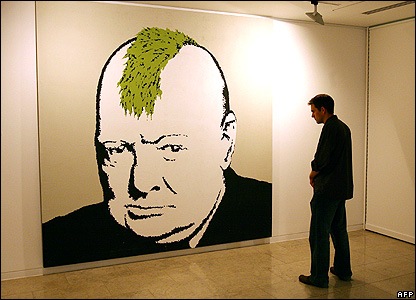
Churchill’s faithful black dog, and why we might be grateful…

I wonder if anyone heard this last Sunday morning-

(The programme blurb-)

“For a couple of days in May 1940, the fate of the world turned on the fall of a leaf” says John Gray. He outlines the strange conjunction of events – and the work of chance – that led to Churchill becoming Prime Minister.

He muses on how Churchill was found by one of his advisers around one o’clock on the morning of May 9th “brooding alone in one of his clubs”. He was given a crucial bit of advice which may have secured him the job. What would have happened Gray wonders if he hadn’t been found and that advice – to say nothing! – not been passed on?

He also ponders whether it was it Churchill’s recurring melancholy which made for his greatness? “It’s hard to resist the thought that the dark view of the world that came on Churchill in his moods of desolation enabled him to see what others could not”.

“Churchill had not one life but several” says Gray. Without them all, “history would have been very different, and the world darker than anything we can easily imagine”.

Interesting for several reasons- the obvious historical one- the other leading candidate for Prime Ministership (who most MPs wanted) probably would have sued for peace rather than fought on against Hitler. As a pacifist, I would have supported him in this- but the end result of Churchill’s influence on British politics at this time was war- and history has rather sided with him on this one…

The other reason however is related to how we understand depression.

Churchill was stalked by what he called his ‘black dog’ all his life. He was prone to black moods and fits of despair- it separated him from those around him, and made him different.

Depression is a terrible thing- it destroys lives. But Depression is not only a terrible thing- and those who journey with the black dog often achieve a level of insight and depth of understanding that others do not.

Depression in this sense may actually be a means of equipping us for life.

Some time ago I wrote a post on why I found all the obsession with positivity rather difficult. All those shiny happy invocations to will ourselves to ever greater heights. Here it is- entitled ‘In which I find myself reacting against positive thinking’. This is really not because I believe that to be miserable is good, and that we are all doomed (although perhaps we might be when I come to think about it.) Rather I believe that we start from where we are- and I am sick of people telling us to be someone else.

Human life is made up of light and shade- and as well as pure white there are many shades of grey. My experience is that most art emerges from the shadows- most creativity is achieved through adversity- and perhaps great statesmen also need a hinterland…

Let the grand correction commence…

Today we heard from the Labour leader.

I find so little to celebrate in what he said, or the way he said it (so said the Guardian– “Miliband’s pedestrian, drooping delivery did no justice to the ambition of his argument.”)

In saying this, I feel sad. Sad that once again I am writing out of negativity not from a position of hope. Sad too that the party I have roughly aligned myself with all my life appears so bereft of ideas.

A swipe at the Tories, the bankers and Southern Cross care homes- then a strange promise that people who work hard or volunteer will get preferential allocation of social housing. (Sounds a bit like ‘the deserving poor’ to me.) But at least ‘I am not Tony Blair (awkward pause…..)

I have been asking myself what is missing- and I think it is this- a visible value base that comes from a passion that is not merely manufactured, or self consciously media friendly.

I have also been thinking a lot about just how bankrupt our political/economic system seems to have become. When did commerce become capitalism, and when did capitalism become turbo-capitalism? How did the survival of our affluent way of life come to require the addiction of a whole nation to the accumulation of ever more stuff that we do not need?

And perhaps the most important question; what might be an alternative way of ordering our collective economy?

Ed Milliband’s father, the late great Ralph Miliband, was a Marxist Sociologist whose writing was an essential part of my student days. For a while, my hope was for an egalitarian socialism to take gentle hold in our country- mixed in the very British way of changing slowly whilst still holding on to idiosyncratic anachronisms- because it is better to accommodate and compromise rather than to revolt and overthrow…

But it seems that at least for now, ‘Free Market’ Capitalism has cleared the playing field of all opposition. The Berlin wall has been reduced to the dust of folk memory.

And in the middle of all this economic mess, Capitalism (despite being the cause of so much difficulty) continues to present itself as the solution.

I am no longer a political ideologue. All of that was killed by Blair and middle age. But still, where are the critical voices? Where are those who bring hope for change- for better ways of living that are not geared towards entrenching the global inequalities that condemn the poor south to be one large sweatshop for our supermarkets and high streets?

Do we need more riots? More kids in hoodies running away with box-fresh trainers and security tagged x-boxes?

As someone who tries to follow Jesus, I am ever more conscious of the way he had of standing as a faithful, hopeful, critic of the way we live. This is not the same thing as condemning and rejecting- rather it might mean that we should seek to participate, whilst at the same time hoping for better.

Hoping for voices to be raised that offer an alternative- that start not from a position of protecting the status quo, but instead long for justice for the global poor, and a sustainable, honest and healthy way of life for the rest of us. Looking for love, Grace and beauty, then seeking to nurture it.

Little of which did I hear today in Milibands speech. But perhaps there is time yet…

Time for a song I think…

Cornflakes are noisy apparently…

We called in to see this exhibition, part of a collaboration in the Burgh Hall, Dunoon. It is there for the rest of the week- go along if you get the chance…

Soozie, a local artist (and nice person, based on our wee chat!) is making art that emerges from a dramatic change of life- a cochlear implant.

I love meeting people who are on journeys. They see things with new eyes- or in Soozies case, hear them with new ears. It made me think again about how much of the time we all spend in an artificial bubble- insulated by constant electronic static from the lovely things all around us. To speak to someone experiencing these things anew is a privilege.

Soozie has a blog, charting her experiences- here.

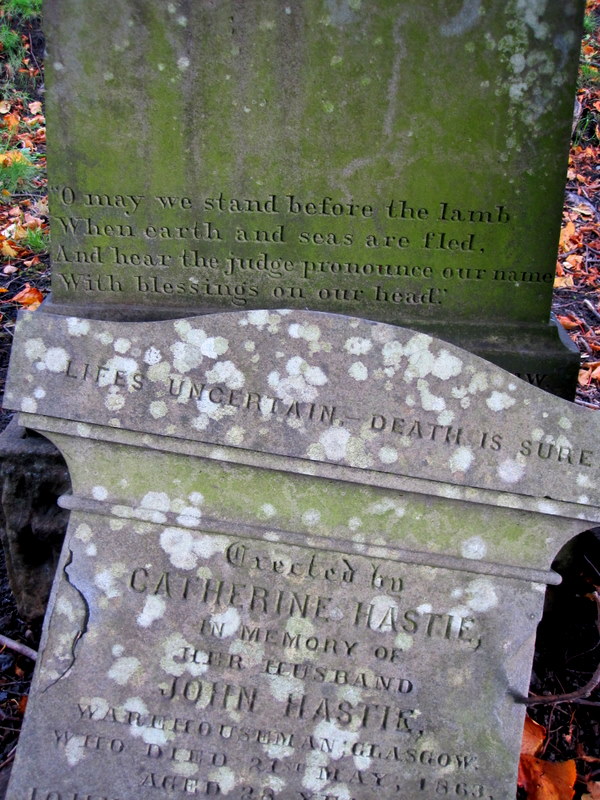
The shadow of John Knox…

We tried to visit Glasgow Cathedral again today. The last time we were turned away as the Cathedral was ‘about to close’. Today we were turned away again as there was a service ‘about to start’ (the service was due to start in an hour.) It is not really fair to generalise from this limited experience, but we certainly did not feel welcome.

Perhaps we look like heretics?

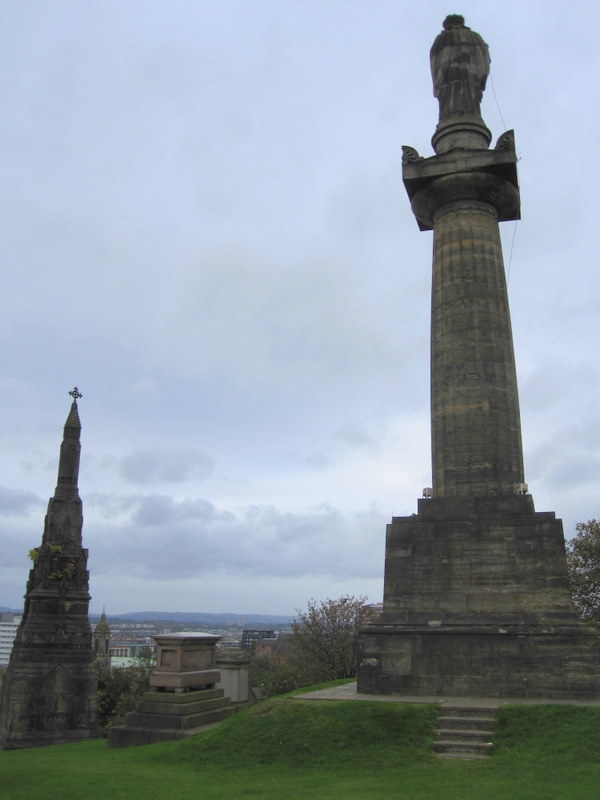
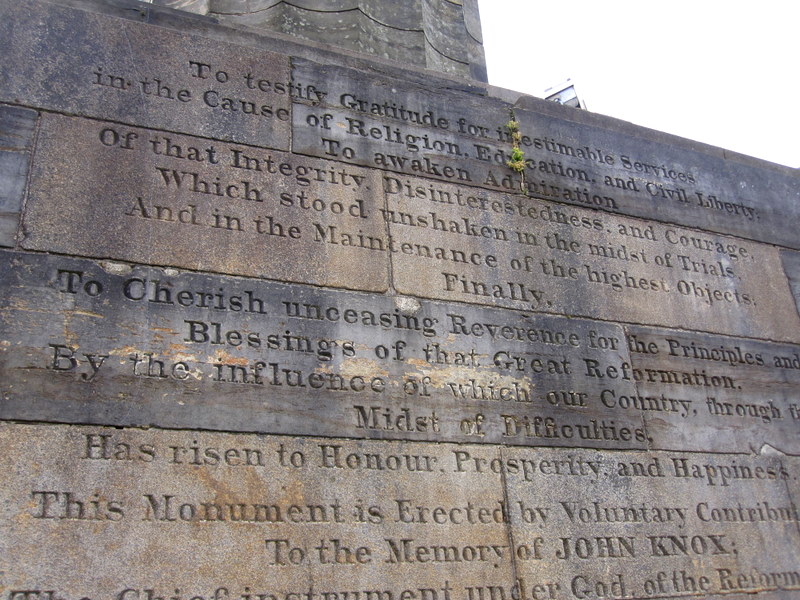
Above the Cathedral, on the top of the hill that is Glasgow Necropolis, stands the John Knox monument- a reproachful finger wagging against the sky.

The Cathedral only just survived John Knox’s reformation. Stripped of all it’s ancient finery- its statues and pictures, along with all objects associated with ‘Popery’, but still the mob tried to burn it down- held back only by the Guilds men.

So was unleashed a time of repression in the name of freedom and violence in the name of peace. Driven by fervency and ‘truth’- religion used as a political meat tenderiser.

Did anything good come out of reformation? Was it necessary? Was it inspired of God- commanded by his angels and energised by his Spirit? My current answers to these questions are- Yes. Not sure. Don’t think so.

We used to talk of reformation being constant- it was not a one off event following which we had achieved Christian nirvana, but was rather a process of constant engagement with the refiners fire. This always seemed to be an aspirational thing for the most part however- that moralistic therapeutic Deism thing again.

My ambivalence about the Reformation is more in relation to my hope for a new kind of gentle reformation- a change again in emphasis, away from right belief and correct religious practise, towards the…. other. A kind of faith that inspires us to be agents of love, joy, peace, patience, kindness, goodness. And none of these things should be subordinate to pious correctness.

John will turn in his grave.

Or perhaps he will look at the course of his own reformation, and agree with me.