Eschatology and the Book of Revelation…

I have been dipping my clumsy toe back into some murky theological water…

I have written before of my encounters with End Times theology- those folk who believe that the world is about to come to an end.

Otherwise known as eschatology.

For some of you this will conjure up a rather ridiculous picture of some bloke with a sandwich board…

But religious ideas have the power to shape the world, for good and for ill.

The dominance of a particular interpretation of the apocalyptic writing contained in the Bible on American politics is difficult to understand from this side of the Atlantic. It is part of a package of belief that has become part of a middle American world view.

One of the individuals who first put apocalypticism on the bestseller lists in the United States was a charismatic preacher named Hal Lindsey. His book, The Late Great Planet Earth, was published in 1970 and has sold over 35 million copies to date. Ronald Reagan was so influenced by Lindsey’s book, that he wanted his military leaders to fully understand its significance. With Reagan’s blessing, Lindsey was invited to brief the Pentagon on the “divine implications” of their hostilities with the Soviet Union.

Since then, Tim la Haye’s ‘Left behind’ series of novels from 1998 have also had enormous influence, popularising and sensationalising the basic ideas. A 2002 Time/CNN poll found that 59 percent of Americans believe that the prophecies found in the Book of Revelation are going to come true. Nearly one-quarter think the Bible predicted the 9/11 attacks.

This from here

Tune in to any of America’s 2,000 Christian radio stations or 250 Christian TV stations and you’re likely to get a heady dose of dispensationalism, an End-Time doctrine invented in the 19th century by the Irish-Anglo theologian John Nelson Darby. Dispensationalists espouse a “literal” interpretation of the Bible that offers a detailed chronology of the impending end of the world. (Many mainstream theologians dispute that literality, arguing that Darby misinterprets and distorts biblical passages.) Believers link that chronology to current events — four hurricanes hitting Florida, gay marriages in San Francisco, the 9/11 attacks — as proof that the world is spinning out of control and that we are what dispensationalist writer Hal Lindsey calls “the terminal generation.” The social and environmental crises of our times, dispensationalists say, are portents of the Rapture, when born-again Christians, living and dead, will be taken up into heaven.

The most powerful nation on earth has at it’s core an idea that the world is coming to an end soon. Does that worry you?

It is a view that makes looking after our environment pointless. It will all be gone soon.

It is a view that tends to go hand in hand with Christian Zionism– and so to justify military and economic support to Israel, and to encourage crusading interventions in the middle east, with a view to somehow hasten the second coming. Check out articles like this one on Rapture watch.

It may seem mad to you- but for many in the USA, this way of understanding our future is accepted as an unassailable tenet of their faith.

I grew up in an Evangelical Christian world where people had their own version of this belief, more or less. But at the risk of stating the obvious, this is simply not the only way to understand what the Bible says.

If you are interested, some of the main arguments are rehearsed quite well in this video-

Vodpod videos no longer available.

Watching them grow…

One of the principle sources of deep joy in this life of ours comes from watching our children develop and grow.

Kids get a bad press. All those raised eyebrows and exasperated sighs. The broken ornaments and filthy clothes. The noise on a Sunday afternoon when all should be quiet. The lurking spectre of the teenage years with all those erupting emotions. The cost of shoes and designer clothing.

But they give so much more than they they take.

I speak as a father of a 10 year old and a 14 year old.

Kids, they are great…

1840…

We are in the middle of various renovations of the old house. It is a constant process, but there is a particular burst of activity at present.

  • New ceilings (one collapsed a couple of weeks ago, so we are being extra careful!)
  • Redecorating Emily’s room. This was the first room we decorated when we moved here- so I reckon this is some kind of milestone- the first part of the house we have decorated twice.

  • New kitchen flooring. We had discovered that flotex, even though it is very expensive, is impossible to keep clean.
  • Clearing out all sorts of accumulations of toys, books and clutter to make space for new things to happen. Including (gulp) the cellar, which is chock full of things- wood, bits of metal, almost empty paint tins, broken furniture- that might have come in useful. But now we need the space to install a kiln.

And in stripping back the surface coverings of this old house, you always come face to face with it’s mostly mysterious past. The flowery pencil marks of workmen on the bare horsehair plaster, old brass fittings from doors long gone, bell circuits to summon servants, all hidden under bad renovations done to the building in the 1960s and 70s when the house was a converted into a guest house.

It is impossible not to wonder at the lives lived by previous generations in our old houses.

This house was built in 1840, in a small town on the up. A regular ferry service was established across the Clyde around 1820, and by the 1840’s you could travel direct from Glasgow to Dunoon courtesy of the new fangled steamers. It became fashionable for prosperous Glasgow merchants to have a house ‘doon the watter’ for weekends and holy days. Merchants whose prosperity rested on the commerce of an expanding empire- whose booty poured into Glasgow from plantations of sugar, cotton and tea. A prosperity that rested on the back of slavery and oppression.

Our house was obviously not built by merchants in the top rank. It is one of two identical buildings next to one another and the story goes that they were built for two brothers. They had cornices, but not of the very ornate kind, and the proportions of the rooms were generous rather than expansive. They were sober in their success.

1840. How much has changed, and how much still is the same.

It was the year when the world’s first self adhesive postage stamp was issued- the penny black.

It was the year of the first steam crossing of the Atlantic, by the wooden paddle wheel steamer RMS Britannia.

Napoleon Bonaparte died and his body was brought back to France.

Missionary Scot David Livingstone left Britain for Africa.

Queen Victoria married Prince Albert.

And some great British workmen were knocking in the last nail of a brand new house in Dunoon, Argyll.

Curtains were chosen, and carts lined up to take heavy furniture from the shore up the hill.

A family gathered, excited and thrilled by the smell of new paint.

And here we are, 170 years later.

Screwing together flatpack furniture.

Such progress.

Tea, sugar and slavery…

If you were to think of things that define us as a nation, most of us would include our addiction to tea.

Then there is our huge sugar consumption- in tea of course, but also lacing almost all of our other processed foods.

This morning I listened to the wonderful radio programme ‘A History of the World in 100 Objects‘ on Radio 4. It is nearing it’s end, but today’s programme described an early Victorian Wedgwood tea set.

And it brought to be again the need to understand history from the perspective of the small people- not the law makers and war mongers. Because the history of ‘Great’ Britain has often been one of militaristic expansionism, and economic oppression.

Slavery brought us sugar, via the terrible triangle of trade that saw African people stolen from their homelands and shipped like expendable cattle to work in the West Indies.

And tea- this was a much later economic obsession. Stolen from the Chinese, with much double dealing and opium peddling along the way, and increasingly adopted as the drink of high society in Victorian Britain.

But because it was expensive, there was a need to find ways to control the production, distribution and sales of tea on a massive scale. For this, we needed new plantations in a suitable climate.

And of course, we also needed a huge cheap workforce that we could control and dominate.

And so we manipulated, shanghaied and cajoled the poorest of another one of our conquests to move to a country far from their birth and work our new plantations in Ceylon.

To make this seem OK, we had to believe that we were doing them a favour. We had to be able to see these people as less than us, weaker, less human.

So we called them a name that befitted their status- a pejorative name. Coolies.

In the British Empire, coolies were indentured labourers who lived under conditions often resembling slavery. The system, inaugurated in 1834 in Mauritius, involved the use of licensed agents after slavery had been abolished in the British Empire. Thus, indenture followed closely on the heels of slavery in order to replace the slaves. The labourers were however only slightly better off than the slaves had been. They were supposed to receive either minimal wages or some small form of payout (such as a small parcel of land, or the money for their return passage) upon completion of their indentures. Unlike slaves, these imported servants could not be bought or sold. (From here.)

These mass movements of population leave their mark on human politics to this day, as does much of our colonial system. The Tamils who were imported into Ceylon (now Sri Lanka) were fighting a bloody civil war until only last year.

All of which makes my tea taste a bit sour.

And it does not get much better for the tea producing nations today. They are slaves to the free market, with commodity prices rising and falling, and plantations mostly tied to multinational corporations.

All the more reason then to drink tea (and coffee) as well as using sugar that has the fair trade mark– yes I know all about the tokenism thing- but my tea just goes down with more satisfaction.

And given my inherited history, it seems the very least that I should do.

Relational tithing- a new take on small scale community action…

Michaela and I watched this the other day- a small American group that have decided to do something simple and rather profound with 10% of their income.

I have always had a bit of a strange relationship with tithing- by which I mean the Evangelical Christian use of the word- giving your ten per cent to the great Agent in the sky (via your local church of course.) Laying down a ‘seed offering’ so that you might get so much more in return.

Giving money to the church to enable redistribution and support for people who are working with the poor- I can get that, but tithing has of course a whole different lot of baggage that goes with it- usually associated with those who need this to be a Biblical instruction so that the machinery of their institution might be oiled- salaries paid, roofs mended.

Churches do need to be funded, but if all our resources go into buildings and hierarchical salary structures then what might be left to use for things outside the establishment?

There are all sorts of potential problems of doing the things that this group have done- but I think it is really interesting…


Vodpod videos no longer available.


The spirituality of log stacking…

`

So here is my little ten part sermon based on the stacking of logs.

You can make your own analagous links.

  1. Stacking logs can not be rushed
  2. There are no machines that can stack them for you- bend your back and get stuck in
  3. Beginning carefully is very important- you will be building on these foundations
  4. Neatness is not important, but a well stocked log pile will probably be orderly
  5. Fresh air needs to circulate in, over and through the pile or the logs won’t dry, and will go stale and mouldy
  6. The rigidity and strength of a log pile comes from the closeness- the proximity- of its individual logs
  7. The big ego-bulging logs are the hardest to stack- they tend to topple and teeter and can easily bring the whole thing crashing down
  8. The smaller logs tend to be the glue that hold together the whole structure
  9. The higher you build the pile, the more unstable it will become
  10. The pile is not an end in itself- no matter how decorous. It exists to store and dry fuel that can then burn bright in service of the other

On being thankful for harvest…

So, Autumn is fully with us.

The winds are still quite warm, but we have had a procession of storms over the last few days, interspersed with the odd burst of golden sunshine.

And the garden has given it’s last harvest. A few beans and some beetroot. Michaela planted some winter crops of spuds, onions and garlic- but we won’t see anything from these until next spring.

The hens continue to give us three eggs a day, but they are smaller- as the nights draw in, they are less active. Hens do not have good eyesight, and so they take themselves off to bed at dusk. Safely tucked up into their roost.

Autumn is sad season. Everything is becoming less. Everything is old and worn. And the survivors steel themselves for the harshness to come.

Even we humans, who are largely disconnected from the natural world that feeds us, are affected. We are different animals as the temperatures fall and the light disappears.

All the more reason, I reckon, to be thankful for the harvest.

To mark the time of gathering in and storing up.

A time to remember the grace still present in the resting soil, waiting and storing up energy for the year to come.

It is perhaps useful to recall the Celtic way of thinking about time- as a circle, rather than linear. The circle of the year begins on the 31st of October after the festival of Samhain or ‘Summers end’. The first period of the new year is Samonios, or ‘seed fall’, with the promise that out of darkness will come renewal, and a turning again of the circle.

Turn away.

Fresh expressions, medieval stylee…

Saw this and it made me chuckle. I think I have tried all of these options for revitalising church- before more or less settling on the last.

But lest I kid myself that I am cutting edge, lets remember that they were probably doing the same sorts of things 500 years ago.

When this video was made.
Vodpod videos no longer available.

Marketa Irglova and Glen Hansard singing in the snow…

Graham posted a link about the soundtrack album from the film ‘Once’- which made me go searching, and quickly hitting Amazon to order. Listen to it, you will not be disappointed.

Glen Hansard is a face that might be familiar- front man of The Frames, and no stranger to the silver screen, having been in The Commitments all those years ago.

Marketa Irglova has a jewel of a voice, and will go far…

A shed full of hope…

I have been busy!

Regular readers of this blog may remember some garden deconstruction in the summer…

It has been quite a job to clear the wreckage, along with all sorts of junk left behind by previous occupants of our house.

One benefit to clearing the space is that it revealed some graffiti art on our back wall done by Marcel, a Swiss guy that lived in our annex for a while. It spells out the word…

Hope.

Which is kind of appropriate, as building new things always requires hope.

I need a shed.

All men need sheds- perhaps women too, but the place of contemplation and creativity for men of a certain age is often made out of timber.

I have another purpose to all this though- we are in the process of trying to reshape some of what we do to earn a living, and one of these involves the establishment of a craft co-operative with some friends. And so the cellar needs to be cleared out to allow the setting up of a couple of kilns. Tools go into what is presently the garden store, and garden equipment needs a new home.

So here it is so far, after three days hard labour-

And I need a workshop, where I intend to make stuff.

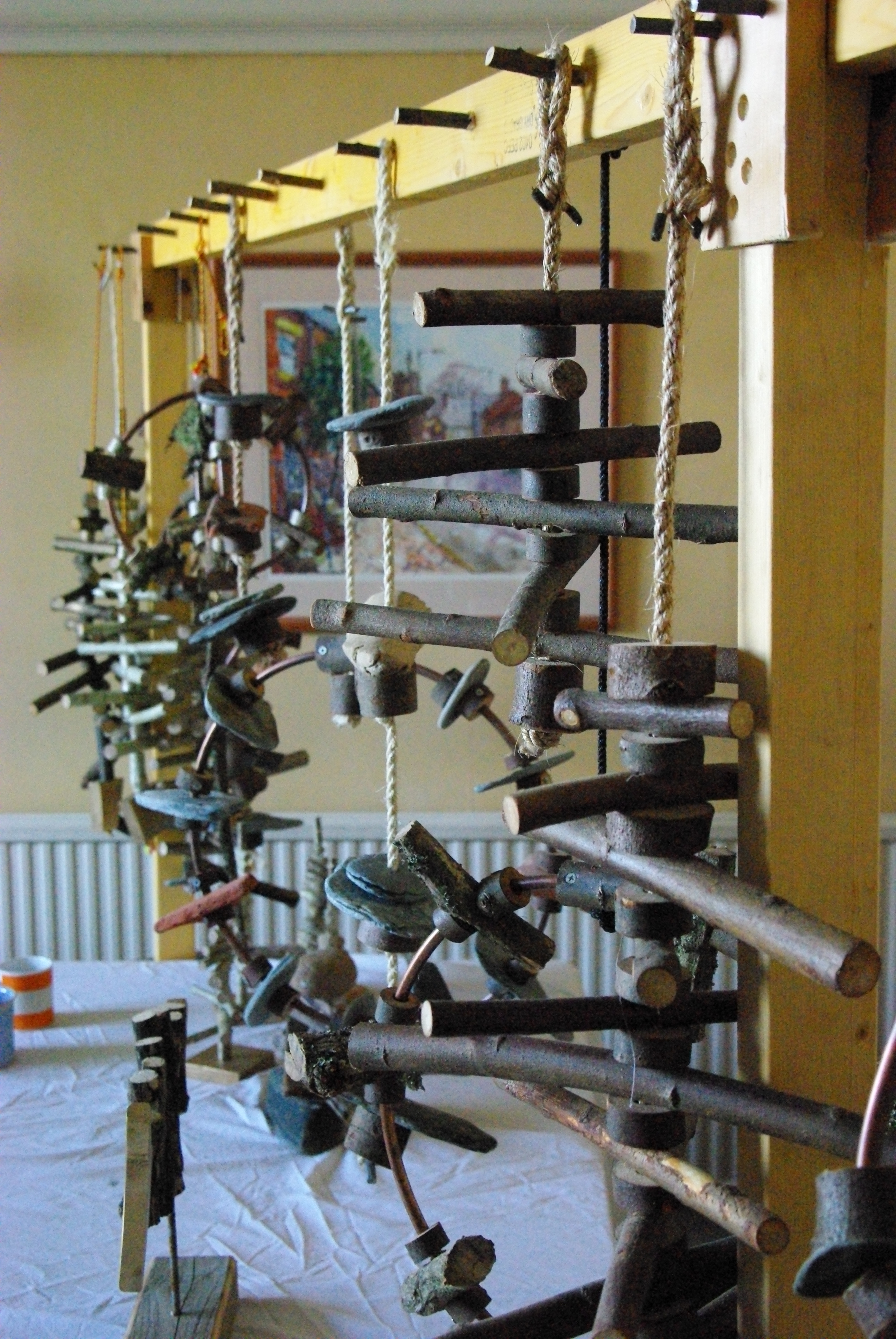
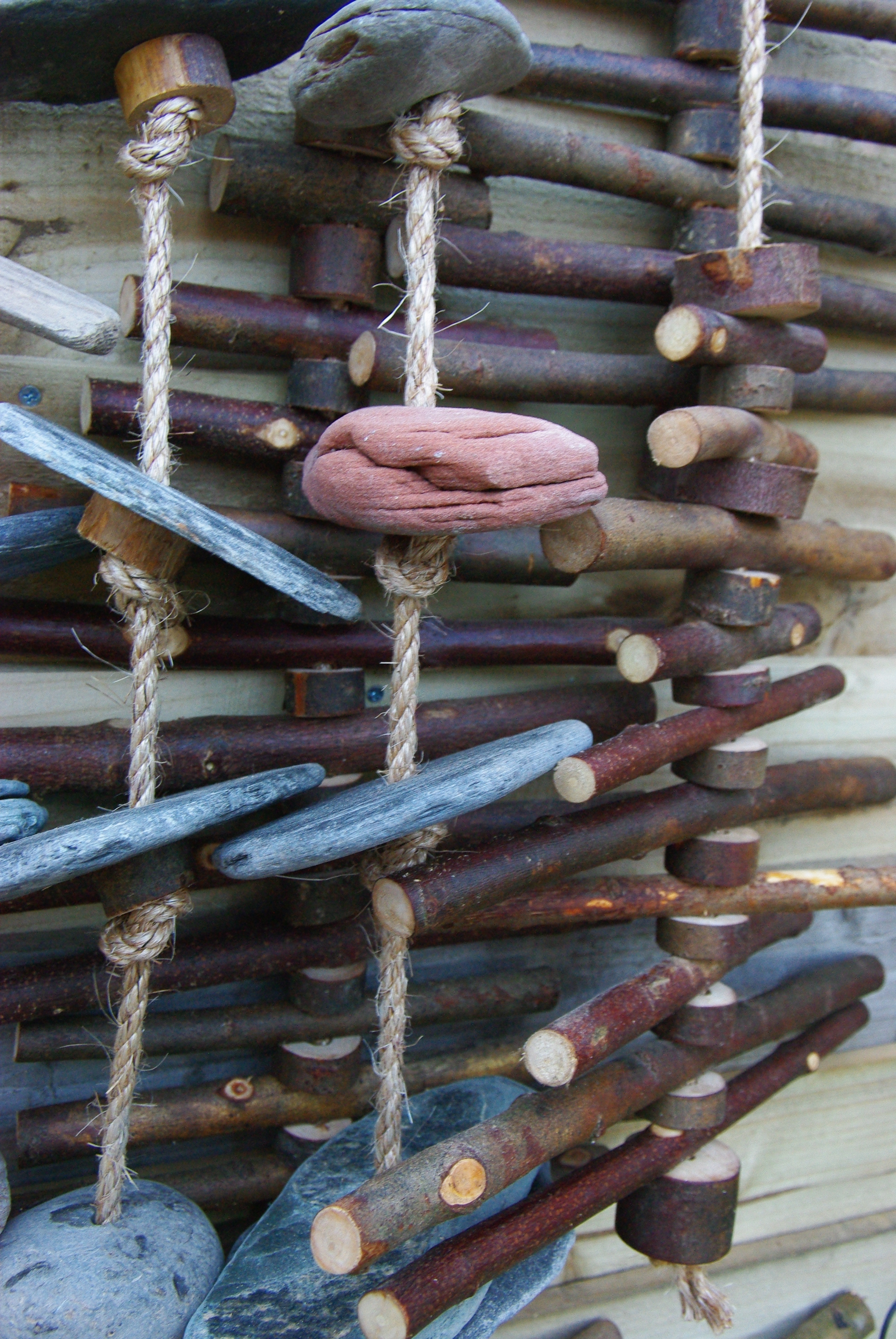
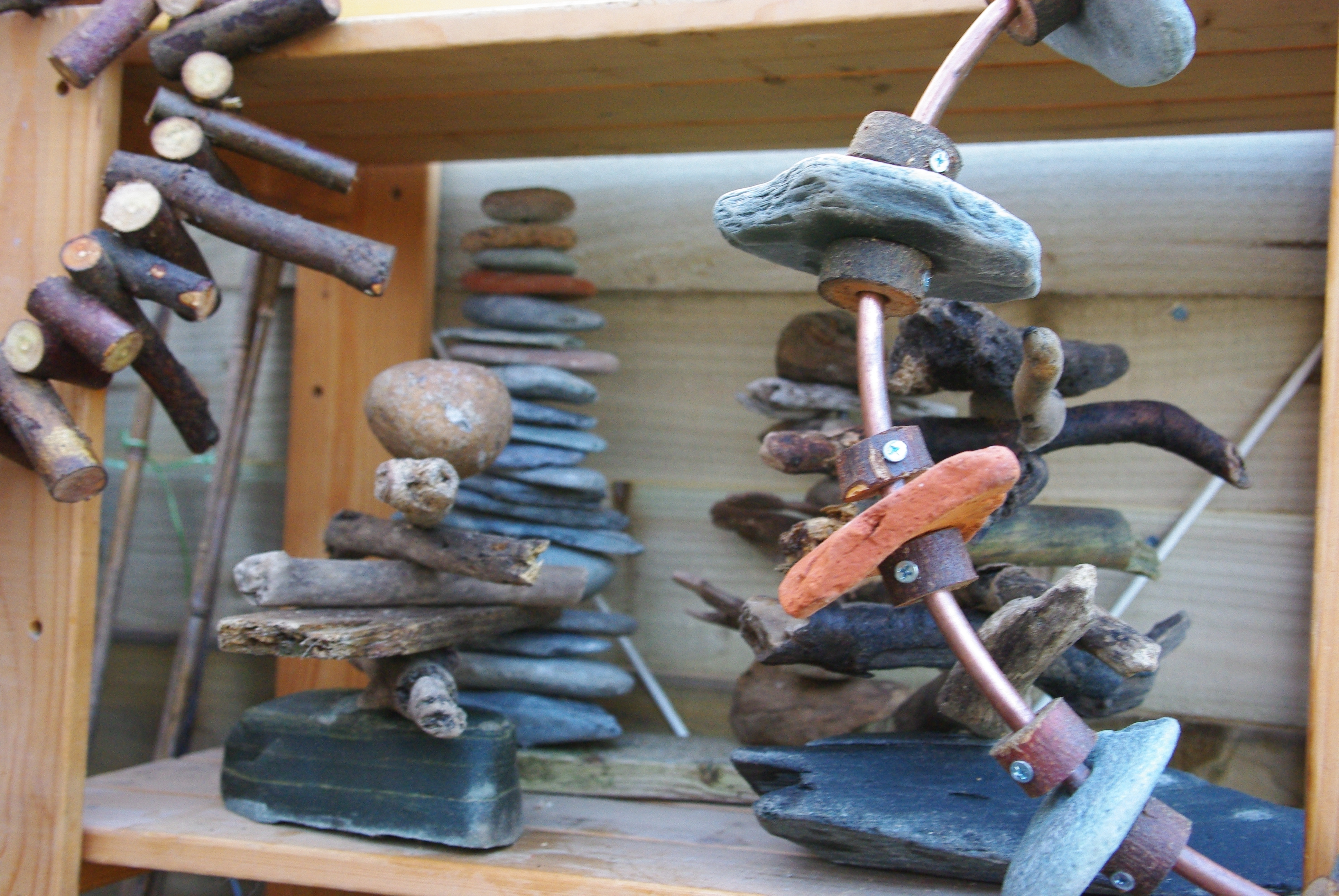
Simple stuff from driftwood and pebbles and rope.

In the hope that a new kind of life is possible.