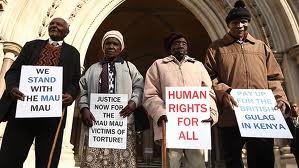
A flashback to our colonial legacy…

mau mau

We Brits still think of ourselves less as militaristic colonisers, more as civilisers- as if the mission of our Victorian forebear to the rest of the world was to instill stiff upper lips, courts of justice and the gentility of cricket.

Stories this week have revealed some of the bloody ragged edge of Empire however, as the British Government have finally admitted some of the brutality done by ‘our boys’ in our name upon the people of Kenya in the 1950s.

Most of these stories take some believing. Rape, including rape with bottles. Torture. Slaughter of men women and children. All done by British soldiers- not in the context of global struggle, but in a long line of brutality aimed at people regarded as ‘less than’, as savages.

Dig a little further back into the history of British intervention in Kenya and it all makes sense. This from Wikipedia;

Britain’s presence in Kenya was marked by dispossession and violence. In 1894, British MP Charles Dilke had observed in the House of Commons: “The only person who has up to the present time benefited from our enterprise in the heart of Africa has been Mr. Hiram Maxim“,[23]though such a state of affairs was in accordance with insistence of Arthur Hardinge, the first commissioner of British East Africa,[24] that “[t]hese people must learn submission by bullets—it is the only school . . . In Africa to have peace you must first teach obedience and the only person who teaches the lesson properly is the sword.”[25] During the period in which Kenya’s interior was being forcibly opened up for British settlement, Francis Hall, an officer in the Imperial British East Africa Company and after whom Fort Hall was named, asserted: “There is only one way to improve the Wakikuyu [and] that is wipe them out; I should be only too delighted to do so, but we have to depend on them for food supplies”,[26] and colonial officers such as Richard Meinertzhagenwrote of how, on occasion, they massacred Kikuyu by the hundred.[27]

For the next 60 years or so, the Kenyan people were slaughtered, oppressed, lost land, lifestock, economic power, and found themselves less than serfs, working on the farms and plantations of the British. After the second world war, attempts were made to set up a government, but there was never a chance that this would be fair and just;

In May 1951, the British Colonial SecretaryJames Griffiths, visited Kenya, where the Kenyan African Union presented him with a list of demands ranging from the removal of alleged discriminatory legislation to the inclusion of 12 elected black representatives on the Legislative Council that governed the colony’s affairs.[Griffith proposed a Legislative Council in which the 30,000 white settlers received 14 representatives, the 100,000 Asians (mostly from South Asia got six, the 24,000 Arabs one, and the 5,000,000 Africans five representatives to be nominated by the government.

In this struggle- whose side would you be on? Where is justice? Not with we Brits that is for sure. No surprise then that when violence erupted it was necessary to dehumanise;

The official British explanation of the revolt did not include the insights of agrarian and agricultural experts, of economists and historians, or even of Europeans who had spent a long period living amongst the Kikuyu such as Louis Leakey. Not for the first time,[81] the British instead relied on the purported insights of the ethnopsychiatrist; with Mau Mau, it would fall to Dr. John Colin Carothers to perform the desired analysis. This ethnopsychiatric explanation would infect everything, from British psychological warfare, which painted Mau Mau as “an irrational force of evil, dominated by bestial impulses and influenced by world communism”, to the later official study of the uprising, the Corfield Report.[82]

The psychological war became of critical importance to military and civilian leaders, who waged it in the time-honoured colonial fashion of divide and rule, always trying to “emphasise that there was in effect a civil war, and that the struggle was not black versus white”, attempting to isolate Mau Mau from the Kikuyu, and the Kikuyu from the rest of the colony’s population and the world outside. In driving a wedge between Mau Mau and the Kikuyu generally, these propaganda efforts essentially played no role, though they could apparently claim an important contribution to the isolation of Mau Mau from the non-Kikuyu sections of the population.[83]

…The savagery of the British response was inflated by two factors. First, the settler regime in Kenya was, even before the insurgency, probably the most openly racist one in the British empire, with the settlers’ violent prejudice attended by an uncompromising determination to retain their grip on power[112] and half-submerged fears that, as a tiny minority, they could be overwhelmed by the indigenous population.[113] A common view among the settler community was that “[a] good sound system of compulsory labour would do more to raise the nigger in five years than all the millions that have been sunk in missionary efforts for the last fifty”,[114] and its representatives were so keen on aggressive action that George Erskine referred to them as “the White Mau Mau”.[113]Second, the brutality of Mau Mau attacks on civilians made it easy for the movement’s opponents—even for African and loyalist security forces—to adopt a totally dehumanised view of Mau Mau adherents.[112

This savagery is now a fact of historical record rather than debate- check out the rest of the Wikipedia article.
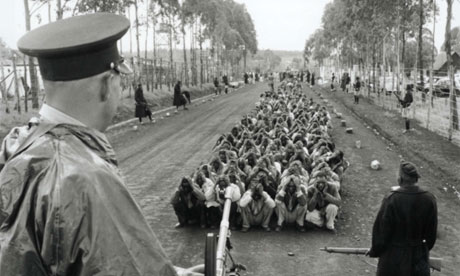
mau-mau-captives-007

Why is this relevant now?

Unless we learn from history- and confront what made us what we are – we simply repeat it.

There is no doubt in my mind that Christian missionary activity in Kenya was part of an oppressive colonial regime. It had little to do with the Kingdom if Heaven and everything to do with empire. May God forgive us.

Britain has set itself in allegiance with the USA, the current dominant colonial power in the world- although these days colonialism is more easily understood as globalised capital. We believe ourselves to have moral authority, even after the mess of Iraq and Afghanistan- so that we should police the troubled parts of the world.

Kenya tells us much about the way that other parts of the world see us- and I reckon that this is the tip of the colonial ice berg. Once you start looking through the eyes of the oppressed, empire looks very different.


A mouth full of marbles…

Rainbow, kyles of bute

The blog has been rather slow recently- there is a rhythm to blogging that seems to work that way- sometimes it feels like you have nothing to say.

One response to this is to write a blog post about the fact that you have nothing to say. But I would never do that of course.

The fact is, I blog primarily to reflect on who what and where I am. Sometime who I am I do not like.

I am small and shallow,

I am big like a beached whale.

My mouth is  stuffed with marbles

No wonder you look at me and sneer

I have nothing worth saying

For I am nothing

But there- enough. I write this not to wallow in my own mud – but more to honour the policy I made for myself in writing this blog, which was to be as honest as I can be. Even if this is not very.

Yesterday was dark, despite the sunshine. Today the shadows under the trees are laced with purple from the late spring bluebells. I am mercurial- sometimes I think I am better than I was, but then again perhaps not.

Life is full of ups and downs. Sometimes we fly, at other times it is all we can do to just walk.

A weekend of Cricket…

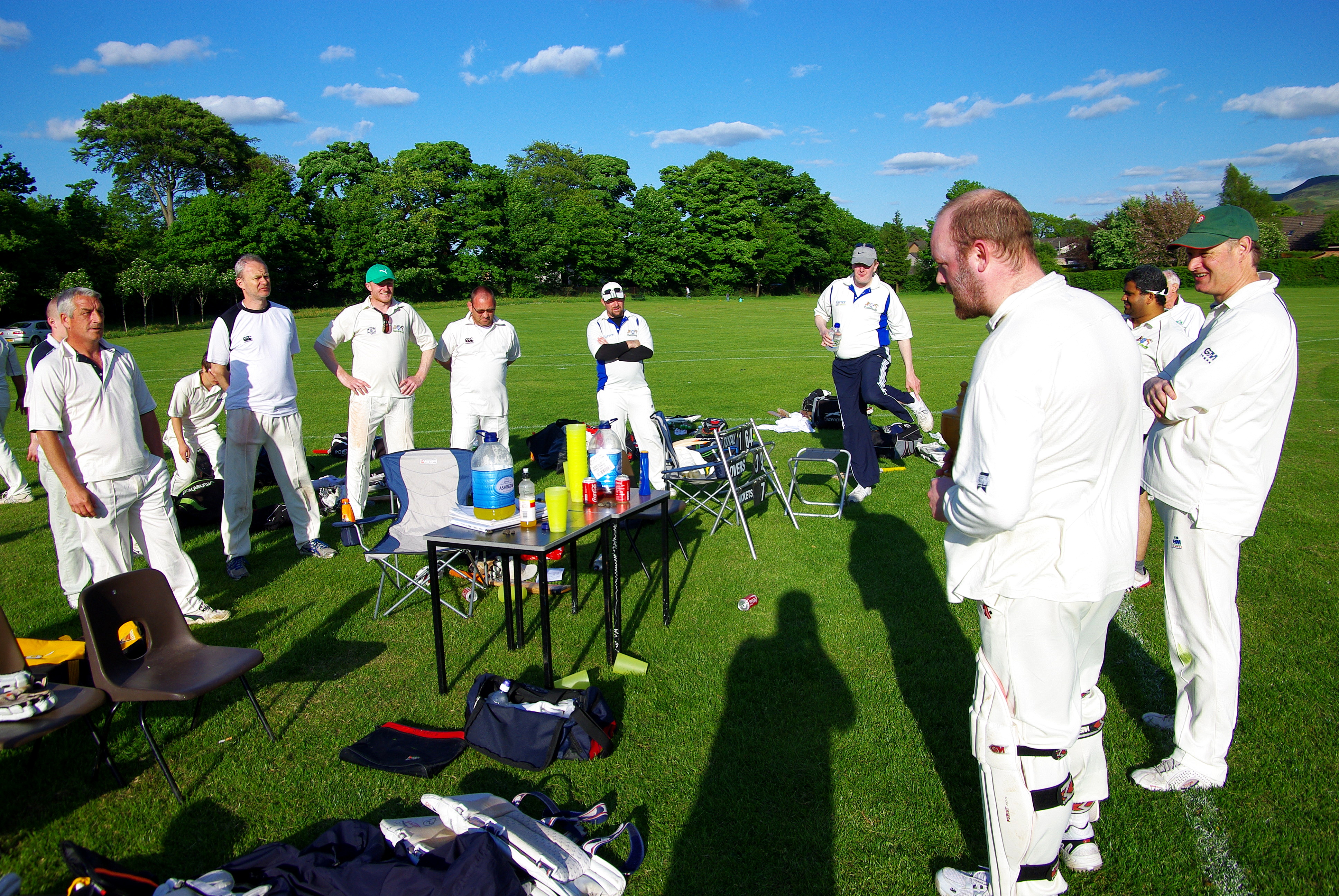
Skippers Robin and Mark exchange the Ashes

Apologies- I know that many of you have no interest in cricket, but this is my blog after all, so here we go again! 

I am rather stiff and sore after playing two games of cricket this weekend- a great rarity in our climate. Yesterdays game in particular was played in glorious sunshine and we are all a little sunburnt.

One of the great pleasures of my middle age is to play cricket in the same team as my son William, who (aged 12) is already better than me as a bowler– we both bowl wrist spin but his has far more fizz and venom, and he can turn the ball both ways with no appreciable change of action. I have the edge in the batting, but not for much longer I am sure- this is mostly about power, not technique.

Only a father who loves cricket will know how much pleasure this gives- I am sure this is true in any sport, but cricket has a kind of sepia timelessness that makes the embrace of the new generation all the more beautiful. Promising kids are cherished by everyone on all sides and old men playing into their twilight years seem to lose twenty years as they smile at a youthful shot well played through the covers – even against their own bowling.

This weekend contained two very different kind of games (both of which we lost!) The first one, played in Greenock on Saturday, was a 2nd XI league match against Prestwick. They rattled up a formidable total after a series of nearly-outs gave them a head start. William and I bowled late- he got a good wicket, but I at least kept things tidy and slowed down their scoring. I batted down at number 8, and when I came in victory was already a forlorn hope. However, I whacked a few and finished with 37 not out, a score well bettered  by young Harry Briggs (aged 14) who made a lovely 57 (there is a match report and scorecard here.) There was an intensity to this cricket- there were few jokes, lots of shouts and loud groans, and damage was done in the dressing room when wickets fell cheaply.

The other game was rather different. We traveled to Edinburgh to play a Royal Botanical Gardens CC, a long time fixture,with Innellan Cricket Club, played for our own cup. Botanics often contain some tasty players as they gather strong fit blokes from Australia as well as home grown talent. However, the emphasis on the game is far more relaxed – the aim is to play friendly cricket in the best kind of way. Winning is important, but not the most important thing- this is that thing called ‘the spirit of the game’; playing well, giving everyone a chance, being honest and fair, having a laugh with friend and foe alike. In fact, the cruelest humour is always reserved for members of our own teams.

Will bowled beautifully again and got a wicket with a perfect curling arc of a ball that defeated a decent batsman in flight and turn. He had every batsman groping and hopping about- much to the delight of their colleagues. I managed a wicket too- a nice one that pinned the batsman plumb in front for an LBW (which I appealed for rather too forcibly, against the gentle friendly tone of the game.) RBG made a healthy 169 at the close, aided by a blistering knock from their tame Aussie.

In a really nice touch our captain let Will and I open the batting- and we spent a few overs teasing each other for each bad shot and enjoying the good ones, until William got a bit too ambitious and hit a shot over the bowlers head to be caught in the deep.  All the clean hitting freedom I had found the day before seemed to have deserted me, but I scratched and edged my way to 25, the point at which we had agreed to retire so everyone had a chance to bat.  I also took one for the team right in the box which brought tears to my eyes from the pain of it and to my team mates eyes for its comedic effect.

Our wickets fell regularly so I came back at the end to accompany our skipper. By then I had a migraine, with all the usual vision problems   (perhaps related to the blow in the testes) so it was a miracle that I hit anything at all, managing only a few runs before timing a drive straight at a fielder and setting off on a suicidal run as I could not see where it had gone. This left the skipper high and dry, but in a typical piece of good sportsmanship the RGB captain invited him to bat on with a runner, as we had only 8 players and this seemed to him to be fair.

Then began one of those pieces of sport that always live in your mind- Robin, our captain, started to open his shoulders, hitting sixes and fours to every side of the ground. Because I was still padded up I acted as runner and almost contrived another run out, having to dive in to make my ground. It was one of the those elbow-skinning, should-know-better, middle-aged dives which has limited forward motion and is more like a rotten tree falling in a wet forest. I was in by about an inch.

We fell just short after 40 overs- 6 runs short in fact – after RGB realised their peril and upped their bowling game in the last over. The game was lost, and no worse for that.

Men in a field, a bat, a ball and lots of laughter. You may laugh at my foolishness, you might justifiably scoff at such a waste of our precious time on earth. What captives were liberated? How many souls saved? How was the cause of humanity served?

All I can say is that you were not there.

IMGP4690

Church, in photographs…

church service


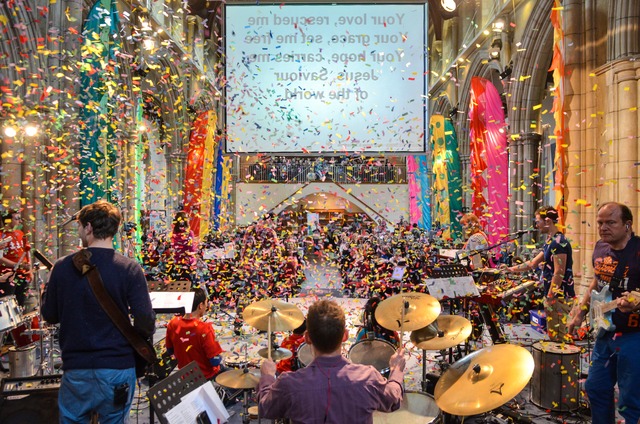
Check out this lovely collection of photographs sent in to the Guardian Witness Assignment entitled ‘Your Church Congregation’. It rather dispels the stories of the death of Church as the pictures of full of life and humanity- real people meeting and trying to share good life in the name of Jesus. I found looking at the pictures quite emotional, despite my journey away from established religion.

There is life in the old girl yet…

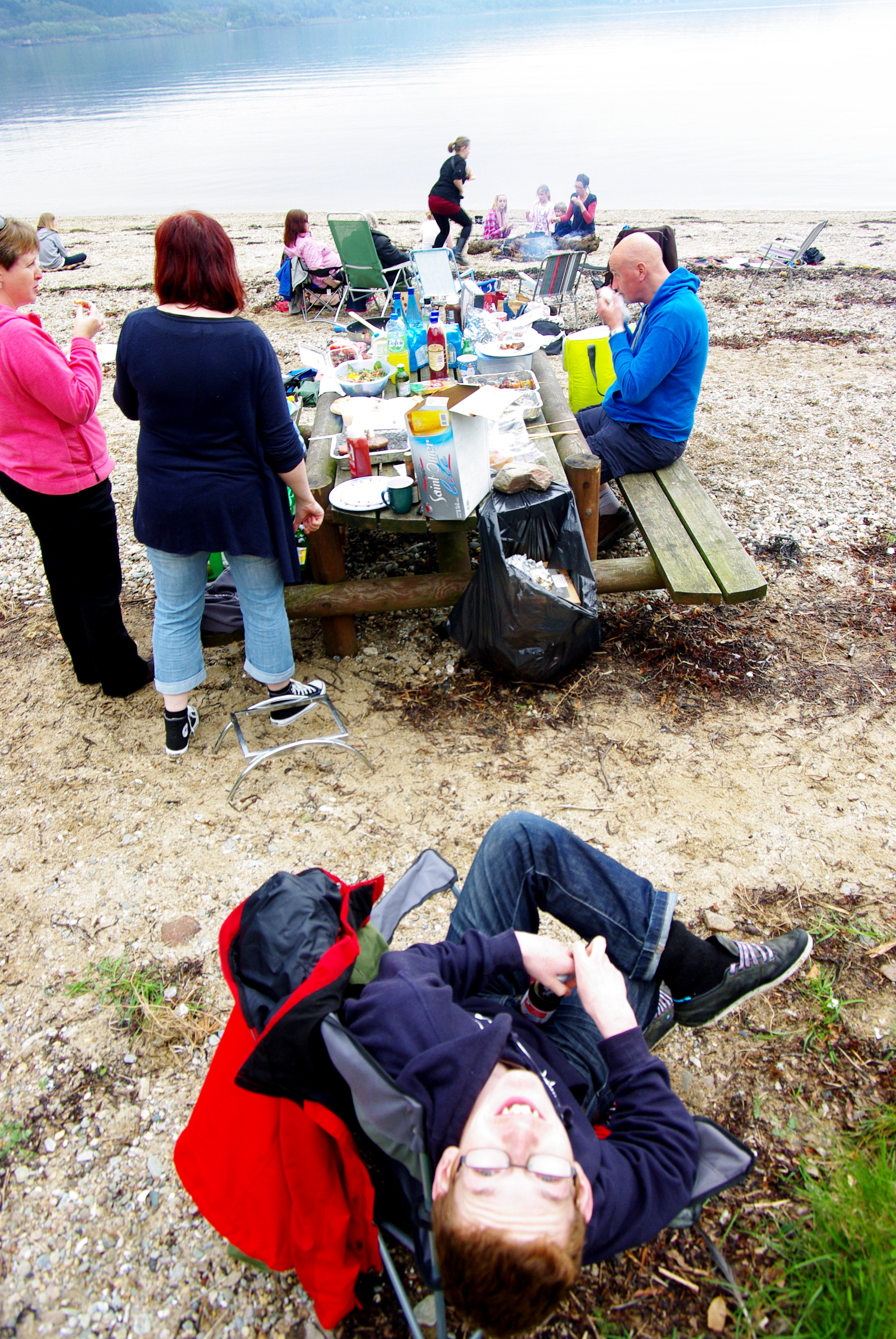
Here is one of my own congregation;

Andrew upside down

Recession=austerity=extremist politics=the rise of fascism…

di canioIs

Is he or isn’t he?

The Sunderland football team manager, Italian former international Paolo Di Canio, caused a storm recently because of his views on Fascism, and his description of Benito Mussolini as a ‘principled man’. He later retrenched, describing many of his friends as black and all appears forgiven at the club- where results are more important than politics.

Di Canio’s views emerged out of a particular socio-ecomomic context. This from here;

Paolo Di Canio’s Roman upbringing may not excuse any fascistic beliefs he once held but it does help to contextualise them. Born in 1968, Di Canio grew up in a country that was violent and divided, as it had been since Mussolini’s rise to power. The 1945 liberation had failed to stimulate the national unity that fascism had claimed it would build and a vicious settling of scores left around 15,000 Italians dead in the three months that followed. There were no trials, no coming to terms with the past and, consequently, no definitive end to the ideological conflict in Italian society.

After students revolted in 1968, northern factory workers joined the fray in the“hot autumn” of 1969, car industry operatives pitched battles with the forces of order on the streets of Turin. Tacitly supported by the police, secret services and more openly by conservative society, rightwing violence erupted in response. The 1969 Piazza Fontana bombing in Milan left 16 dead and more than 80 wounded. Hastily blamed on anarchists, it was eventually traced to a neo-fascist group based in the Veneto region.

All of which is further evidence of these things;

  • Violence leads to violence
  • Divided splintered societies in which there is a huge wealth imbalance become polarised and breed violence
  • It takes generations to change the political mindset of a particular population
  • Economic turmoil leads to extremism

If this is true, it should be no surprise that we see a rise in hate politics across Europe as austerity bites. In the UK we have seen success for the dreadful British National Party, and the prominence of the English Defence League. Both target immigrants as the source of our nations ills- exploiting the baser and most ignoble part of our British isolationist psyche.

In France, Marine Le Pen and her National front seem to be more popular than ever, despite brushes with the law.

In Greece Golden Dawn is on the rise.

Man in camo trousers stands to attention in front of sea of Greek flag-wavers


The mechanisms by which Neo Fascism is finding popularity again are of course complex. In times when people feel desperate and under threat the appeal of someone to blame and an easy fix are always going to be attractive.

There are darker deeper forces at work too – after all, how is it that we do not see the wood for the trees? The cause of our current economic woes has nothing whatsoever to do with inflation or Muslims, and everything to do with the greed of the richest in our economies- who in the UK appear to be doing better than ever. What stops us seeing this so clearly?

I suspect that this is a combination of distraction, aspiration, envy, celebrity worship, and clever manipulation by the ruling elite to maintain the status quo, either by accident or design.

Violent politics flourish in the mess made by capitalism. It has to be resisted…


Leadership, networking and the trajectory of pioneering groups…

network


I am part of a small ‘missional’ group. We had ‘emerging church‘ conversations, flirted with ‘new monasticism‘. We found the old ‘paradigms’ restrictive and so wanted to do a new thing, using new ‘alternative worship‘ styles.

There you go; I have established my credentials- the badges and trendy buzz words that have allowed me to find a groove to travel in, no matter how shallow and indistinct.

The reality is that this language has often felt contrived and pompous, and the journey of our group has been one of ordinary people trying to get along, whilst searching for a way to live out faith that has some integrity and authenticity. Groups like ours are not unusual, even if they are ephemeral, fragile.

Many small groups like ours set out with pioneering passion- they have this idea of the purity of community releasing a power in them to achieve something special. Often they are right- but very soon it will get messy. The enforced intimacy of small community will crack things open quickly- there is no place to hide at times.

Then there is the inevitable reduction in passion that comes over time; things that were exciting always feel stale with repetition. How do you refresh, revitalise and renew. How do you avoid creating a new narrow liturgy that ensnares every bit as much as the ones we gratefully left behind?

This is the trajectory of most small groups- excited start, success, stagnation, crisis, reinvention (or destruction.)

If we are to be sustainable, if we are to make the longer journeys together, then we will probably need some help in the form of some external connections- we will need to speak to people who understand, who have made some of the same mistakes and dreamed the same dreams. Sometimes we may need others to listen to our pain or laugh with our small absurdity.

Groups like ours are inoculated against organised booted-and-suited religion for the most part. However I remember some interesting research from my old group work days within social work.  I nforget the references (I will try to add them later) but it goes something like this;

The success of a group depends to a large extent on the external context it is embedded within. An example of this might be an encounter group within a hospital or a prison. If the group lacks the support of the establishment this might be a plus at first- people feel embattled and react against their context – but it is simply less likely to be successful in the longer term. However, a little external validation seems to go a long way. So if the staff in the wider hospital speak positively of the group, see it as valuable and helpful, the group absorbs it all, and thrives.

Of course, the links to groups like ours is rather tenuous, but it is no surprise to me that many of the pioneers of missional groups that I know arrived at their adventure after many years of established churching. Despite their maturity, experience and a degree of reaction-formation against the context they escaped from, many of them still look back. Some return.

And this is no bad thing.

In Englandshire, there are good supportive links now for ephemeral groups- there is a wider recognition of the value of micro church through movements like CMS and Fresh Expressions. This is much less the case north of the Border in Scotland.

Last night (and this morning) I had a long discussion with David from Garioch Church, around this kind of stuff. We talked about the possibility of a new kind of network- an old theme for me. 5 years ago we tried to start such a network (see here and here for example) but things did not work out for various reasons.

So here is a question to people north of the border who find themselves on the ragged edge of organised church- where do you find your connections, and is it time to try this networking thing again?

The blessings of place…

IMGP4686

I write this sat in the Garden on a delightfully warm evening.

Michaela is in the living room running a craft course with a group of people.

Will has gone for a walk along the sea front with a couple of pals- heading for the shop and an associated sugar rush. Emily is on her way back home from Glasgow after submitting her higher photography portfolio.

Staying in our annex is Sam, along with Becky and his three lovely kids. We spent an hour sitting in the sun with them watching them play with Emily’s old dolls house.

I am waiting for another friend, David, who is staying here overnight on his way back up north. We will no doubt share a dram and lots of good conversation.

Most of which is made possible by the place that we live.

I often feel guilt about our house. It is fairly big (even if definitely not posh) with fantastic views over the sea. In these days of house-idol-worship it might be considered to be in the upper pantheon. The fact is that we bought it reluctantly when it was in a terrible mess and spent 10 years patching it all back together on a shoe string, but despite this it is still grand enough to often make me wonder about our use of the earths resources.

But without the house, many good things might not happen- in our lives, and hopefully in the lives of many others.

This is no excuse- places have the power to sustain, to enrich, to revive. I pray that this may always be true of our house.

How to deal with extremists…

ARABIA_SAUDITA_-_terrorismo_islamico

Invite them in for a cup of tea of course.

There are scary things happening at the moment- in the wake of the brutal murder of a young man on the streets of Woolwich  in broad daylight, something is being unleashed.

In many ways it feels like the time is right for scapegoats. They are always a useful release or distraction at times of economic trouble. The 1926 great depression led to the great purges in Europe of the Jews. In more recent times Thatcher had a series of social groups to blame- the miners, New Age Travelers, benefits scroungers,

Currently there is a real danger that the next scapegoats will be Muslim.

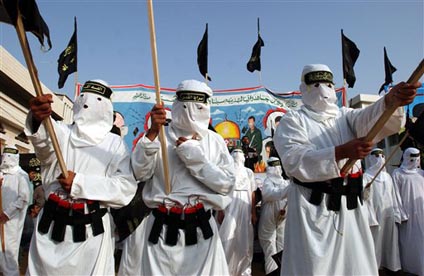
Politicians start to talk about dealing with radical preachers. Fear is stoked. ‘The other’ is cartoonised and selectively described. The nuances, the complexity of it all is stripped away- there are the good guys (us) and them; the evil, half human terrorists who want to kill us all whilst shouting Allahu Akbar.

How do you deal with extremism? Surely the first thing we have to do is to set aside the dehumanising stereotype and talk. Meet real people and hear stories. Listen to each others world view and seek understanding.

I read a great example of exactly that today; The English Defence League  organised one of their protests outside a Mosque in York. The EDL is a scary far right organisation, with roots in the old British National Party and football hooliganism.  These are not people who like to talk- they would rather throw insults and broken bottles. The people in the Mosque had every reason to feel afraid. However, according to the Guardian, this is what happened;

York mosque dealt with a potentially volatile situation after reports that it was going to be the focus of a demonstration organised by a far-right street protest movement – by inviting those taking part in the protest in for tea and biscuits.

Around half a dozen people arrived for the protest, promoted online by supporters of the EDL. A St George’s flag was nailed to the wooden fence in front of the mosque.

However, after members of the group accepted an invitation into the mosque, tensions were rapidly defused over tea and plates of custard creams, followed by an impromptu game of football.

A young member of York mosque displays his message.

A young member of York mosque displays his message. Photograph: Anne Czernik

Leanne Staven, who had come for the protest, said that she had not come to the mosque to cause trouble but because “We need a voice”. “I think white British who have any concerns feel we can’t speak freely,” she said.

“Change has been coming for a long time and in light of what happened to that soldier in Woolwich there have to be restrictions on people learning extremist behaviour and it has to stop.”

Mohammed el-Gomati, a lecturer at the University of York, said: “There is the possibility of having dialogue. Even the EDL who were having a shouting match started talking and we found out that we share and are prepared to agree that violent extremism is wrong.

“We have to start there. Who knows, perhaps the EDL will invite us to an event and the Muslim community will be generous in accepting that invitation?”

Ismail Miah, president of York mosque, added: “Under the banner of Islamthere are very different politics: democratic politics, the far right, left, central, all over. You can’t target a whole community for what one or two people have done.

“What they’ve done in London is for their own reasons but there’s no reasoning behind it from an Islamic point of view.”

DSM-5; step into the straight-jacket…

DSM-5


It is out today.

Back in February, I wrote a long piece reflecting on a number of issues thrown up by the new American Psychiatric Association edition of the Dignostic and Statistical Manual of Psychiatric Disorders. I confessed to considerable skepticism and concerns into the way this hugely dominant document had been drafted. Here is some of what I said

 It matters on an individual level because all of us will be affected by mental disorder. One in four of us will be diagnosed according to one of the classifications above, so even if this is not you it will be someone you love or someone you work with. Lots of us feel a strange relief when distress is given a name – it suggests understanding, companionship, a removal of uncertainty and the possibility of treatment. However, for many these can easily become self perpetuating and destructive as they have the effect removing responsibility, ownership and eventually hope of recovery, which some never find again.

It matters too on a sociological level. Our societies are increasingly regulated by psychiatry. We medicalise, medicate and plan ‘evidence based interventions’ into all sorts of human variation. This may simply amount to the application of science and knowledge to the alleviation of mental illness, but the question is whether this is ‘healthy’? Are we seeking to make a world in which the mess and gristle of life is edited out, tidied away, chemically suppressed? And is it working?

Psychiatric classification almost always demands treatment, so step forward the drug companies, with another product to push by fair means or foul. All those countless drug rep funded lunches, gadgets, even holidays, in the name of publicity for the next wonder drug. Even if the drugs do half of what they promise there is no doubt that our population is increasingly medicated.

At the time I wrote a list of what I hoped might form the new direction within mental health care- which I am convinced will be looked back on by future generations with shame and anger;

Away from ‘illness’ towards ‘distress’

Away from ‘symptoms’ towards understanding that we develop different  means of coping with this distress.

Away from restrictive labels towards listening to individual experience.

Away from medicalised interventions, towards encouragement and support of individual recovery.

Away from simplistic distinctions between ‘psychosis’ and ‘neurosis’ towards a greater interest and understanding of the effect of trauma.

Away from segregation and ‘otherness’ towards seeing mental distress as an essential part of the human experience and as such, part of all of our experiences.

Away from ‘maintenance’ towards hope and acceptance.

I was not expecting quite so much public and professional resistance to DSM5- even to the point of questioning anew the core concepts of ‘mental illness’. This from here;

Critics claim that the American Psychiatric Association’s increasingly voluminous manual will see millions of people unnecessarily categorised as having psychiatric disorders. For example, shyness in children, temper tantrums and depression following the death of a loved one could become medical problems, treatable with drugs. So could internet addiction.

Inevitably such claims have given ammunition to psychiatry’s critics, who believe that many of the conditions are simply inventions dreamed up for the benefit of pharmaceutical giants.

A disturbing picture emerges of mutual vested interests, of a psychiatric industry in cahoots with big pharma. As the writer, Jon Ronson, only half-joked in a recent TED talk: “Is it possible that the psychiatric profession has a strong desire to label things that are essential human behaviour as a disorder?”

Psychiatry’s supporters retort that such suggestions are clumsy, misguided and unhelpful, and complain that the much-hyped publication of the manual has become an excuse to reheat tired arguments to attack their profession.

But even psychiatry’s defenders acknowledge that the manual has its problems. Allen Frances, a professor of psychiatry and the chair of the DSM-4 committee, used his blog to attack the production of the new manual as “secretive, closed and sloppy”, and claimed that it “includes new diagnoses and reductions in thresholds for old ones that expand the already stretched boundaries of psychiatry and threaten to turn diagnostic inflation into hyperinflation”.

Others in the mental health field have gone even further in their criticism. Thomas R Insel, director of the National Institute of Mental Health, the American government’s leading agency on mental illness research and prevention, recently attacked the manual’s “validity”.

And now, in a significant new attack, the very nature of disorders identified by psychiatry has been thrown into question. In an unprecedented move for a professional body, the Division of Clinical Psychology (DCP), which represents more than 10,000 practitioners and is part of the distinguished British Psychological Society, will tomorrow publish a statement calling for the abandonment of psychiatric diagnosis and the development of alternatives which do not use the language of “illness” or “disorder”.

The statement claims: “Psychiatric diagnosis is often presented as an objective statement of fact, but is, in essence, a clinical judgment based on observation and interpretation of behaviour and self-report, and thus subject to variation and bias.”

All this comes starkly to light when we hear the voices of experience;

“Strange though it may sound, you do not need a diagnosis to treat people with mental health problems,” said Dr Lucy Johnstone, a consultant clinical psychologist who helped to draw up the DCP’s statement.

“We are not denying that these people are very distressed and in need of help. However, there is no evidence that these experiences are best understood as illnesses with biological causes. On the contrary, there is now overwhelming evidence that people break down as a result of a complex mix of social and psychological circumstances – bereavement and loss, poverty and discrimination, trauma and abuse.”

Eleanor Longden, who hears voices and was told she was a schizophrenic who would be better off having cancer as “it would be easier to cure”, explains that her breakthrough came after a meeting with a psychiatrist who asked her to tell him a bit about herself. In a paper for the academic journal, Psychosis, Longden recalled: “I just looked at him and said ‘I’m Eleanor, and I’m a schizophrenic’.”

Longden writes: “And in his quiet, Irish voice he said something very powerful, ‘I don’t want to know what other people have told you about yourself, I want to know about you.’

“It was the first time that I had been given the chance to see myself as a person with a life story, not as a genetically determined schizophrenic with aberrant brain chemicals and biological flaws and deficiencies that were beyond my power to heal.”

Longden, who is pursuing a career in academia and is now a campaigner against diagnosis, views this conversation as a crucial first step in the healing process that took her off medication. “I am proud to be a voice-hearer,” she writes. “It is an incredibly special and unique experience.”

In the 1960’s the liberation battles were about race, the 1970’s gender, the 1980’s sexuality. The 1990’s we began to think we had sorted it all out and in the 2000’s we discovered that perhaps we had not.

This decade, let us take on the oppressive machine that makes madness out of the variety of human distress.

A few more reflections on our wilderness retreat…

Looking down on our camp site

Regular readers of this blog will know that one of the things I really love to do is to immerse myself in wild places and for many years (along with some old friends) I have been taking time each year to make what we call ‘wilderness retreats’.  These usually involve camping on small uninhabited islands and following a deliberate rhythm of silence and community- with a lot of laughter in between.

Increasingly we have enjoyed being hosts and have been joined by friends, friends of friends and contacts from the assortment of church contacts and networks we are connected to.

This year, Crawford (a friend who has been coming for a few years now ans our go-to source for all things avian) described how it was usually only quite a while after we had left the island that its full impact was felt- almost as if we take a little of it away with us.

This year I felt very privileged to take some people who had never camped before and certainly never managed to get out to a wild west island. I always worry about the shock to the system that camping wild can be to those who have never done it before- particularly when (as happened this year) the weather is bad. It requires a methodical stoicism and can result in real lows as well as highs.

Half way through for example, I was convinced that my mate Graham was in some kind of stupour induced by wet waterproofs and fear of the poo-trowel. I would have taken odds on him chalking all of this camping in the wild stuff to experience and deciding that, if he were to survive, it was an experience he would never repeat.

Graham- "What have I done?"

Which just goes to show how wrong  I can be.

Graham is a blogger too, and his blog has had a series of reflections on the retreat- the last of which is here.  I loved this;

What I loved about retreat on that island was trying to discover a male spirituality that did not rely on dominance and aggression but had a measure of strength and vulnerability. It was ok to pray, share deeply, lose the mask of invulnerability and at the same time banter, fart, make toilet jokes, swear and build fires. Realising you are male, a Jesus follower and you don’t have to pretend/assume false piety is a very powerful thing.

I don’t claim to have discovered ‘a model’: there isn’t one, but the route of honesty is good for the journey…

It occured to me again that one of the most important spiritual disciplines is the attitude of vulnerability. We normally armour ourselves against this in a thousand ways, but in wilderness, on a tiny island, in silence, this armour falls away. For those like Graham who experience this for the first time, it falls with a loud clang.

There have been a couple of other lovely things that have been inspired by the retreat which I wanted to mention here- firstly Andrew wrote a lovely poem on his blog- which is here. A quick excerpt- but please go and read the whole thing;

Steel grey skies darken,
Hidden rock spires, deep depths, whirling, roaring tides and waves.
Wind and waves grow,
Deck lurching side to side,
Uncertainty,
Hope,
A rocky shore, but his plan, not ours.
Safe upon a new shore, an unknown glen, not known for generations passed.
Rocks, prayers,
The rough-hewn blackness sinking into waves,
Rocks, prayers,
Held, carried, prayed over
Are you there?
Finally, Andy- who has been a friend of mine for about 25 years, and a companion on many of these trips, wrote a song. More than that, he recorded the song, and made a video using clips and photos taken on quite a few of our trips- I recognised Scarba (x2) Jura, Coll, Eilleach an Naiomh, The McCormaigs and man more. It is quite lovely, and so here it is;