15 minutes of grace…

I listened to this today, and it made me cry.

There was a story told by a woman who returned to the mental hospital secure ward where she had been incarcerated years before. The building was being demolished and she was there to take photographs. But walking into the building she could hear the noises of people shouting and screaming, and she could remember feeling so dreadful whilst she was there that she broke both arms by smashing them into the wall in the hope that they would have to take her somewhere else. She cried as she remembered the dead butterflies she saw on the floor of the empty ward, and could only bring herself to take photographs with all the heavy locked doors wide open.

But there were also lots of other stories of people who found their own healing- their own recovery.

It is 15 minutes long, but full of beauty. Go on, have a listen.

Climb every mountain…

No, I am not going all Rogers and Hammerstein on you- rather I wanted to mention a remarkable story of endurance and human endeavour.

I have a long time interest in climbing mountains- personally this has amounted to gasping up many a peak in the UK, but it also means a book shelf or two full of books about climbs in the Himalayas.

If I analyse what this interest is about, I have to acknowledge that climbing mountains is a pointless, self absorbed, selfish activity. It liberates no captives, heals none of the afflicted, brings no comfort to those in grief. Rather it can become the obsessional activity of the rather socially dysfunctional.

But any of us who have been on a high ridge as the dawn rose, or stood in the snow as hammerhead clouds gathered in the distance, or tested ourselves beyond any comfort zone on ascent through wild rock- for us there remains something noble and pure about mountains that can not be dismissed. The photograph above was taken on the Cuillin Ridge, Skye, on a day when cloud lapped my feet on one side of a knife edge, and clear air dropped two thousand feet on the other. The day lives on in my memory.

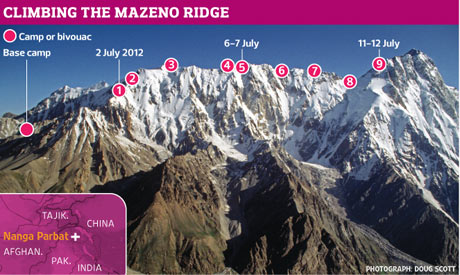
But back to the story. Two British men have just completed a climb up Mazeno Ridge, on Nanga Parbat in the Himalayas. This climb has been widely regarded as the ‘last great problem of the Himalayas’, and countless previous expeditions have failed. Involving both technical climbing and massive endurance, the Mazeno route requires ascents on seven subsidiary summits above 6,000m before tackling the final summit of over 8000m.  Remember that at these altitudes, gaining even an extra 300m in height takes superhuman strength. It is not called ‘the death zone’ for nothing.

The men who managed this incredible feat are Rick Allen and and Sandy Allan. Rick is 59 years old and Sandy is 57.

This from the Guardian;

Sandy Allan and his climbing partner Rick Allen were at their last camp below the summit of Nanga Parbat, the world’s ninth highest mountain, when they gathered together the food they had left.

After 14 days on the vast unclimbed Mazeno Ridge – the longest in the Himalayas – it amounted to a packet of McVitie’s Digestives biscuits.

A lighter they had taken with them had stopped working, its flint worn through. The only spare, they realised, was in the pocket of another member of the team who, exhausted and demoralised, had already decided to descend.

The consequence was that they could not light their stove to boil snow for water, essential on the world’s highest mountains where the consequence of dehydration is the risk of frostbite and pulmonary and cerebral oedema. They hoped, however, that they could reach the summit and descend the imposing Diamir Face in a day and a half; they were counting on fixed ropes left by other expeditions. In reality, it took them three full days to get down from the summit without any food or water, a lengthy struggle through deep snow at the limits of survival.

When asked if he intended to climb more high dangerous routes like this, Sandy said this; “I’m 57. I’m a father. The rat’s been fed.”

A rat it may be, but a what an animal.

The moral case against welfare provision…

Those of us this side of the Atlantic find the American polarisation around the provision of state welfare/health care extremely puzzling. Here, for the last 60 years there has been a general hegemony that it is the job of any government to look after the most vulnerable people in our society, even allowing for the fact that there are differences between the left and right of the political spectrum as to how we might do this.

People like me would go further- and say that the best measure of a society is the degree to which it looks after the poor and broken, and how the structures of society mitigate towards providing as much equality of opportunity as possible.

From here this seems like the only moral position that could be compatible with a modern state- particularly one with its roots into the teachings of Jesus.

So how then does a society that is avowedly Christian, and is the wealthiest, most powerful state in the world manage to more or less take a different view? What moral choices justify this position to the moral majority- the middle American mostly Republican, conservative Christian majority?

If this interests you, then I very much recommend listening to this radio 4 programme.

The eminent American political philosopher Michael Sandel is Radio 4’s “Public Philosopher.” Now, as America prepares for its Presidential elections, he is going on the road in America with a unique mission to challenge ordinary voters and lay bare the deeper moral questions bound up in the noisy Romney and Obama campaigns.

In this week’s programme, Professor Sandel is at Harvard, his home university in the intellectual heartland of New England. Much of the debate between Mitt Romney and Barack Obama has been about welfare policy, social security and healthcare. Underlying this, Professor Sandel believes, is a moral and philosophical disagreement about the nature of the American dream itself.

Earlier this year, Obama was attacked for his remarks about the role of government. “Somebody helped to create this unbelievable American system that we have that allowed you to thrive,” the President said. “If you’ve got a business, you didn’t build that. Somebody else made that happen.” Republicans saw this as an attack on business and accused Obama of stifling the idea of individual success at the core of the American dream. The right’s policies are more focussed on individual choice — lowering taxes and opposing, for example, the type of universal health care policy which Obama has enacted.

Against this backdrop, our public audience will be asked: “Who Built It? Is the American vision of individual responsibility for one’s own success a myth?” Michael Sandel weaves through these issues with the help of philosophers past and present.

The programme allows real debate between thinking Americans about the nature of government and sets it within a philosophical and world wide context. However, I was most interested to try to understand the American/Conservative perspective- because like it or not, the power lies here- not just in America, but through the various world wide institutions and globalised interests, the morality inherent in the position affects us all.

Follow me on this a little- I would suggest that no human endeavour exists in a moral vacuum- rather it grows and is driven by a set of underlying assumptions, leading to half understood rules and codes, and eventually to a kind of automated set of behaviours. The same set of principles that result in a moral stance firmly against state welfare and health provision also result in free market capitalism, evangelical Christianity and economic growth systems depending in endless innovation, and conspicuous consumption. (You will note that so far I am trying hard to remain neutral in this piece!)

The Michael Sandel  radio programme allowed members of the audience to state clearly the reasons behind their support of both sides of the welfare debate. Those AGAINST clearly stated some of these things;

Freedom

This was the powerful idea behind many parts of the argument. The idea that government tax is a form of coercion, that being made to give money is a fundamental invasion into the rights of the individual.   Freedom is seen as the pre eminent idea of what is truly American.

(I can no longer stay neutral!)

There seem to me to be some real problems with this idea. Freedom is not abstract- it is constructed. It arises in a particular social context and is meditated by many powerful self interests. There is also the fact that one person may extract their freedom (for example to enjoy a particular lifestyle) at the expense of others. Might they not also wish to be free from what they regard as oppression?

Americans seem to have not problem in paying taxes to government to build up massive military forces. To protect their ‘freedom’.

Individualism

Allied to the idea of freedom is a powerful sense of individualism- the idea that the individual is always more important than the collective. That is not to say that small town neighbourliness is not important, but that society ought to be based on the hard work, the opportunities made and taken and the achievements of- the individual. This principle extends right to the point of individual rights to protect what is ‘mine’ by the use of the gun.

I have come to see the dominance of individual, personal rights as part of the reason for much human distress in Western culture. Researchers will point to the fact that the more dependent connections we have on those around us, the more we are anchored to our context, then the happier and more fulfilled we will tend to be. It is how humans are made. When Margaret Thatcher said ‘There is no such thing as society’ she was never more wrong.

We have a choice between anchoring our society around a sense of common good, or against a common enemy. The Americans (and by association the British) have tended towards the later of late- and this is something that I think we should deeply regret.

Encouraging and rewarding fecklessness.

This is the powerful idea that benefit breeds dependency and laziness  The end result is that people who work hard end up supporting those who will not work, and a huge growing underclass is created of state sponsored inactivity.

This is of course one of the issues that any State benefit system has to contend with. How to prevent people getting ‘stuck’ in the system. How to constantly find ways to encourage and develop people, not stigmatise and exclude people from full participation in society. Our system in Britain pegs benefits below the level of the minimum wage, and has evolved a huge machine into which people are churned in the hope that they will emerge into renewed enterprise. It is far from perfect.

Some people can not work in any society. They are sick, or broken, or addicted. They may also be very unlovely, and brutalised by their experience. There is no evidence whatsoever to suggest that we in the UK (as a result of having a developed welfare state) have more of these people than in the USA.

Charity is a better means through which to provide welfare.

This idea suggests that where people are in genuine need, then individuals can still offer help via donating to charities, voluntary agencies and self help groups, who will operate more efficiently and are better able to meet the needs of the poor and sick than the state can ever be. This is of particular interest to faith groups and churches, as this might then become their natural field of operation.

Back in the Victorian times, a man called Samuel Smiles wrote a book called Self Help, which was an excoriating account of the inefficiently of the charitable activity of the time. Charities have the capacity to be every bit as efficient or inefficient as government action. They are also likely to be piecemeal, and lacking in any kind of overall vision or common principles.

It will be no surprise to you to know that I do not think the moral case against welfare provision hangs together- particularly from a Christian perspective. It owes more to enculturalised ne0liberalism than it ever does to the words of Jesus.

But there is a moral argument nevertheless- polarised and dualistic as it has become…

Miliband takes on mental illness…

So, Ed Miliband is to tackle the Stigma of mental illness in his next speech, according to the Guardian. Good for him, although he seems to be choosing some rather soft celebrity hate figures to take a swipe at in order to give his speech some punch- Jeremy Clarkson and Janet Street Porter;

With the cost of mental illness to the NHS believed to be around £10bn, Miliband will announce he has set up a taskforce – led by Stephen O’Brien, the chairman of Barts Health NHS Trust and vice-president of Business in the Community – to draw up a strategic plan for mental health in society, in the hope that the next Labour government can begin work immediately on implementing reform.

He will also say that attitudes in society need to change, criticising “lazy caricatures” of people with mental health problems and highlighting recent comments by Clarkson and Street-Porter.

He will say: “There are still people who abuse the privilege of their celebrity to insult, demean and belittle others, such as when Janet Street-Porter says that depression is ‘the latest must-have accessory’ promoted by the ‘misery movement’.

“Jeremy Clarkson at least acknowledges the tragedy of people who end their own life but then goes on to dismisses them as ‘Johnny Suicides’ whose bodies should be left on train tracks rather than delay journeys.

“Just as we joined the fight against racism, against sexism and against homophobia, so we should join the fight against this form of intolerance. It is not acceptable, it costs Britain dear, and it has to change.”

Whilst I welcome the initiative- I feel slightly skeptical about the outcome, even before it begins. I hope I am wrong, but the problem faced by any such review (particularly one led by someone embedded in the NHS) is that its conclusions are inevitably shaped by the set of lens through which we look at the ‘problem’.

It reminds me a little of theology- we inherit a set of beliefs about who or what God is based on our culture, denomination and hermeneutic. These things are useful, valuable, even essential for a while- they are vehicles through which the Spirit travels. But there can come a point when they obscure, restrict, oppress and close down our understandings. For example, if our theology is based on a flat earth created in 6 days a few thousand years ago, then something has to give when we are confronted with the expanding universe.

The mental illness machine is not working.

I say this not in disrespect of the many wonderful people working within the system, but there comes a time when we have to see the machine for what it is- something that more often than not sucks people in, strips them of who they used to be, and replaces this with a new set of roles- patient, schizophrenic, lunatic, depressive, manipulative, unemployable, benefit scrounger.

Then there is the role played by the pharmaceutical companies, competing to push the next wonder drug, and employing a thousand drug reps to flood doctors, nurses and even social workers with half truths about their new product using everything from free toys (pens, flasks, binoculars) to free meals and holidays. The wonder drugs each turn out to be versions of what has gone before- no Lilly the Pink, just more chemical suspended animation to hold people in half lives.

A few months ago I wrote a piece reflecting on the monster that is the new  American Psychiatric Association  Dignostic and Statistical Manual of Psychiatric Disorders, otherwise known as DSM 5. In this, I wrote of my own hopes for change in the system along these lines;

Away from ‘illness’ towards an understanding that all forms of mental illness are caused by mental ‘distress’

Away from ‘symptoms’ towards understanding that we develop different  means of coping with this distress.

Away from restrictive labels towards listening to individual experience.

Away from medicalised interventions, towards encouragement and support of individual recovery.

Away from simplistic distinctions between ‘psychosis’ and ‘neurosis’ towards a greater interest and understanding of the effect of trauma.

Away from segregation and ‘otherness’ towards seeing mental distress as an essential part of the human experience and as such, part of all of our experiences.

Away from ‘maintenance’ (which is a form of medicalised slavery) towards hope.

If Ed can gather some real radicalism from his up coming review, I really hope it will contain some of these ideas.

Bully…

There was an interesting discussion on Radio 4’s ‘Thinking Allowed’ yesterday about workplace bullying.

I am now a few months out of my last workplace, and have spent a lot of time thinking about the nature of the working environment and the power given/taken to a certain kind of manager. It was a corrosive and damaging place to be and although I am a big boy and ought to be able to stand on my own two feet, at times it brought be to my knees. Social work is hard enough when you consider the nature of the tasks and the limitations of resources without adding in bullying as well.

When you are in the middle of it all, it is hard not to focus on particular individuals as the cause of all this. The dark shadow cast by certain people over everything is hard to escape- the thundering threatening e-mail, the meeting in which people are casually destroyed, the deliberate provocation and lack of co-operation. The relish that seemed to be exhibited at any kind of conflict.

There was a time when a new manager arrived who had a reputation to make. His career path was firmly upwards and woe betide anyone who got in the way. He had a new broom and wielded it like a scythe (to mix a deliberate metaphor.) Part of this meant categorising everything from the old regime as ‘bad’- and to be got rid of. Unfortunately, I was the only surviving middle manager from a previous ‘re organisation’ (which in the public sector is another word for a cull) so I was for it. There was no attempt to discuss with me some kind of plan of action, or lay out goals and action plans. No attempt was made to understand my strengths, or to make use of my considerable ‘organisational memories’.

What began was a campaign of alienation. I was called in for Performance Development Reviews and accused of all sorts of things that made no sense to me. I started collecting e-mails that seemed so unreasonable and even abusive that I thought I may need to use them as evidence later. It felt as if all the hard work I had put in to building an integrated mental health service had no value, and was being systematically sneered at, and then dismantled.

I stopped sleeping. I developed terrible cluster headaches. It became incredibly hard to maintain motivation, and all around me I saw people retreating into trenches and keeping their heads down. I contemplated just handing in my resignation and in a desperate moment, confided in a much older wiser manager who was doing some locum work with the council. He told me “Chris, don’t be so bloody stupid. What you need to do is to go and see (…..) and tell him that you have thought long and hard about the situation, and realise you have a lot to learn, and that you want to hear any advice he has to give about how to improve performance, and to provide the sort of management required. If you do this, you then have six months to get out intact, and protect your mortgage and your family.” 

I more or less did this, and things settled down. Years later, I was told almost casually by the manager who had put me under such pressure that I had made considerable improvements- and that he had initially thought that I was not able to do this, so had tried to get rid of me.

Perhaps I had improved- but I do not think so. I think my development, if there was any, was more about managing my interface with the higher management. I did this by expecting no support, by trying to focus on the important stuff and to protect my staff from some of the huge pressure coming down. I think I also became more valuable, as a lot of the hand picked new management team did not adapt well, and many left soon after joining the council, sometimes leaving chaos in their wake.

Back to ‘Thinking Allowed’ however. They were interested in the sociological aspect of bullying, not the psychological one; so rather than focussing on individual processes, the focus was more on the sorts of environments that breed this kind of behaviour. What sort of organisations might make it more or less likely? What organisations are high risk? Sociologists Ralph Fevre and Amanda Robinson claimed that organisations which are well versed in modern management practices may create a culture in which bullying, harassment and stress thrive.

Unsurprisingly Fevre and Robinson found that organisations that were overly focussed on abstract performance and production targets to the exclusion of the particular human needs of staff will certainly be high risk of bullying behaviours developing.

They looked at different kinds of bullying- ranging from psychological through to actual physical violence, and found that even people who have been subjected to violence tended to focus on one thing as the most damaging- the fact that their workplace placed no value in the work they were doing, or their contribution to the organisation. This certainly resonated with me- the social work department I worked for seemed to operate in an environment where the soft detail of caring social work had no currency whatsoever. Rather everything was reduced to narrow performance stats, which placed pressure on people to constantly cover their backs.

When I think about my time under this kind of stress, I find myself feeling a little ill- but I have to acknowledge that this is not just about particular individuals- it is a systemic thing. It grows in the margins of an organisation being squeezed to death by inspections, scandals, enquiries, financial crises, staffing shortages. There will always be people who are able to exploit these situations for their own personal gain, but the real problem is the nature of the environment.

What then might change round such an environment? Some of it I think has to be about a change in management style- a rediscovery of a value base, and the value of individuals. The place I worked had all the right language, but somehow totally missed the mark on this stuff. For the sake of those who work there, I hope that things have changed. There is evidence that new managers are trying to achieve this, so good luck to them.

As for me, I feel like I am still in recovery. I am expecting to need to go back into the social work/health care world, at least as a part time worker, in the new year. This still makes me feel a little queasy, but I hope that this will continue to abate. Some scars will remain…

Dale Farm a year on- a case study in social exclusion…


12 months ago, the above site was big news in Britain. Dale Farm, neat Basildon had been the site of decades of legal battles over the use of land owned by Travelling people from  a Romany background. It formed a tight well organised community of families from an ethnic group of people whose traditional way of life has been increasingly squeezed within UK society.

The local Basildon council spent £7.2 million evicting families from the empty half of the site above. They say they did it to uphold planning laws, and in response to wider community concerns about criminality, noise and unhygienic conditions.

Today a Parliamentary report has been made public investigating the effects of the traumatic eviction. This from the Guardian;

Scores of Travellers removed from the Dale Farm site near Basildon in Essex 12 months ago have suffered mental or physical illness after being forced to live in “squalor” following the controversial eviction, according to a report by MPs.

It said: “The delegation found that many of the residents are highly vulnerable and have serious conditions such as Parkinson’s disease, dementia, osteoporosis, Crohn’s disease, bowel cancer, Down’s syndrome etc.

“Members of the Red Cross again stated their continued concerns regarding the physical and mental health of the Travellers, lack of sanitation and the possible health threats posed by the evicted site.”

Issues like this divide opinion. For some, the Travellers had it coming to them. Their lifestyle is unsustainable, morally bankrupt and an insult to hard working people. The conditions that they find themselves are due to choices they have made. Such opinions would usually be accompanied by stories of some encounter with a travelling group squatting in filth on a roadside verge, or doing some poor tarmac work on the driveway of a pensioner.

There is another story here however- a cautionary tale of what happens to marginalised groups in the face of prejudice, stigma and scape goating.  This kind of poverty is brutal, and we should not be surprised that it also brutalises.

Neither should we be surprised that such marginalisation and social exclusions results in poor mental and physical health.

Dale Farm is a stain on who we are and I hope may yet be the point when things turn for the better for travelling folk in the country. Perhaps the point at which we start to seek to understand the other rather than condemn them for not being like us.

I posted this previously, as a reminder of the rich traditions of the Romany people in these islands;


Consumermas….

It is coming- the ringing of the tills and the twinkling of the plastic stars. The singing of the Santa Claus songs and the pressure to eat and drink till we burst.

At some point over the last 100 years- somewhere between Dickens and and ‘A Muppet’s Christmas Tale’ (fine film though it may be)- we were occupied by forces of the Empire. It happened whilst we were looking the other way- distracted by another shiny gadget.

Don’t get me wrong- I have nothing against secular festivals- in fact I think there should be more of them. Anything that brings us closer together and celebrates our humanity is good as far as I am concerned, and you could argue that our Christmas took the slot in the year previously occupied by pagan feasting.

I do however feel a slight tinge of irritation at the fact that Christ gets hardly a mention in the representation of Christmas in popular culture. The icons that survive are ones that seem to me to fit in with the Disneyfication of it all- the tree, snow, twinkling lights, Santa Claus and of course, the giving of gifts. Lots of gifts. There is some mention from time to time of the ‘true meaning of Christmas’ uttered in films by some bloke in a red suit and a stick on beard. As far as I am able to understand this usually involves believing in Santa, being nice to your family and consuming lots of Christmas product.

And there is the rub- the consuming of product.

The incredible pressure exerted by the massive Capitalist machine to suck us all into a vortex of buying, eating, drinking. The system depends on it. Without strong Christmas sales then the whole edifice (already rather rickety) will come tumbling down. So do your bit- credit cards out boys and girls, lets take one to preserve our way of life.

How we Christians continue to live with the contradiction of celebrating the birth of a man whose whole life was a warning against storing up pointless possessions on earth is always a matter of amazement and guilt for me. Jesus- the man of poverty who told his followers that they did not need two shirts for their backs.

More importantly, a man who spoke more about one issue that almost any other- our individual relationship to money. The camel and the eye of the needle, the widows mite, the alabaster jar, the sermon on the mount, rendering unto Caesar etc.

Then there is the matter of exploiting the poor- doing unto the least of these. All those factories in far off places paying peanuts. All those brand names stitched on by people whose whole yearly salary amounts to less than one shoe worn by a pampered western foot. The trade circle controlled by those who have at the expense of those who have not.

All celebrated at the feast of Consumermas.

The older I get, the less willing I am to attend this particular feast. Call me rude, but I have another one to go to- a simpler one. Less shiny, costing far less money, connected with something far more important.

You are invited too.

I mention this friends, as once again, we will be thinking about the shopping. We will be wondering what we can afford, who we feel an obligation of love, friendship or duty towards. It will feel like a power over us beyond our control.

But it is not.

Stop consuming. Share life, share love, share time. Make stuff, gather with friends and do the ‘secret santa’ thing. Give stuff away that you no longer need. Buy gifts only from charity shops ( a great idea Samir!)

Start your own Advent Conspiracy.

Find silence in the clamour of another crap Christmas number one endlessly replayed. Celebrate mystery and light in the middle of darkness.

You have to start somewhere- Consumermas is coming, and will not let you go easily, or without emptying your wallet.

Living simply in a complex world…

Just in case you did not see this on TSK the other day, I thought to repost it here. It is long- but I have faith in you all to go beyond the 10 second blog cut off point and enjoy it!

Very apposite for us at the moment- we spent all day emptying cupboards and making piles- one to sell, one to recycle via charity shops and one to take to the tip. The latter was the largest by far which seemed all wrong.

So here is Susan Pitchford,  a senior lecturer in the Department of Sociology at the University of Washington, and a member of the Third Order, Society of Saint Francis. This is a religious community for people who wish to follow the Franciscan way “in the world,” that is, within the families and occupations where they find themselves.

Evangelical becomes gay for a year…

Amazing story in the Guardian today about an American ultra conservative evangelical Christian who found himself questioning his Church teachings on homosexuality, and decided to walk in the shoes of a gay man for a year.

In order to do this, he had to tell his family, his Church, his friends that he was gay, take on a pretend ‘boyfriend’ and live and work in gay bars.

It seems that not only his own theological understanding of homosexuality radically changed, but so was that of his mother.

Finally Kurek’s journey ended when he revealed his secret life and “came out” again, but this time as a straight Christian. However, he says that one of the most surprising elements of his journey was that it renewed his religious faith rather than undermined it. “Being gay for a year saved my faith,” he said.

Kurek also said that he felt his experience not only should show conservative Christians that gay people need equal rights and can be devout too, but that it can also reveal another side of evangelicals to the gay community.

“The vast majority of conservative Christians are not hateful bigots at all. It is just a vocal minority that gets noticed and attracts all the attention,” he said.

Our first Guest Room nears completion…

Here is a peek at what I have been working hard on over the past weeks- our first guest room for the new holiday/retreat/craft business is nearing completion;Image

Image

It will all be ready to go in the next few weeks- available for cosy escapes, quiet retreats and the like.

We are waiting for curtains and a couple of bits and pieces, but check out the view;

Image