More than plastic…

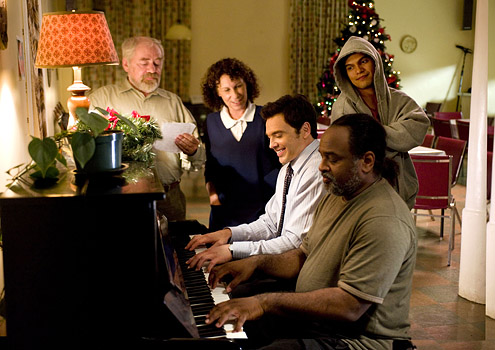
ChristmasChoir5

So I was watching one of those films. You know the

kind: cheaply made-for-TV at Christmas time. Full of cute kids whose

families are being squashed by the weight of some

manufactured crisis. Then despite my (long nurtured) defensive

cynical screen, I am punctured by goodness;

skewered by grace that grew where even the trees

are plastic. I can offer no excuses except to say that

like fake glitter on the surface of snow the hidden

heart of this angel-beast is shaped

towards love.

We laugh at the Mayan apocalypse junkies, but…

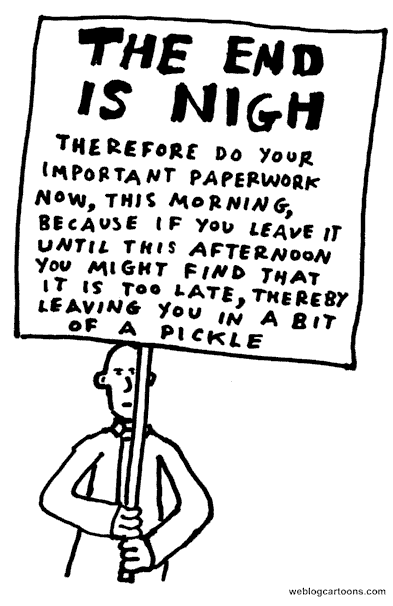
end-of-the-world


…we Christians have plenty of our own End Of The World doomsday predictors. Check out this list.

On the day when at very least the prediction made by the Mayan calendar that the world will end has been proved to be a slight miscalculation, it might be useful to reflect again on that word eschatology (not to be confused with Scatology) defined by Wikipedia as follows;

 The Study of theologyphysicsphilosophy, and futurology concerned with what are believed to be the final events of history, the ultimate destiny of humanity — commonly referred to as the “end of the world” or “end time

Note that this is serious business to many theologians in particular. It is big bookshelf time. Big argument time. Big business time. Why? Particularly when the subjects of study have little to do with the environmental/political/economic/social crises at the end of our noses, and everything to do with esoteric texts written thousands of years ago.

It is perhaps ironic that many commentators on the book of Revelation (the source of a million Christian predictions of apocalypse) have a very different understanding of the text, pointing out that it was one of many pieces of ‘apocalyptic literature’ of its time- a style of writing that used mysterious and ritualised language to shine light on the culture of their day. People reading the text under Roman occupation would have had a totally different entry into the language and imagery used. They would know who the Beast was, and the meaning of ‘Babylon’.

In this way, the coming apocalypse was a warning to people to take a long hard look at who they are, what they are becoming, and to refocus on a life that is in service of the Kingdom of God.

It was not a description (thanks again to Sharon who coined the phrase) of how God is going to use his great big hoover to suck his chosen few from a doomed and despicable world up into his heavenly fall out shelter.

The apocalypse that the followers of Jesus should concern themselves with is a daily occurrence. It happens always in the shadow of Empire as forces conspire to promote greed and power mongering.

Of course I could be wrong, it is not yet Mayan high noon. I kind of thought that if I am wrong no one would be around to laugh at me though…


Reflections on the census- the end of Christendom…

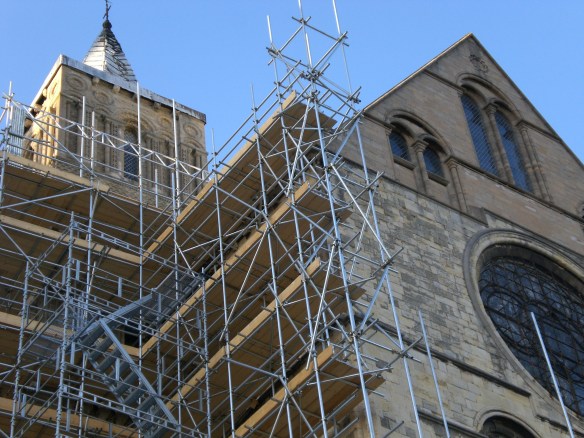
a church under reconstruction?

So, there have been a number of articles and opinion pieces reflecting on the recent 2011 census data, and what it tells us about the nature of religious belief in the UK. Here are some of the head liners in case you missed them;

• The number identifying themselves as Christians is down 13 percentage points. In 2001, 72% (37.3 million) called themselves Christians. In 2011 that had dropped to 59% (33.2 million).

• Interestingly, Christianity is not down everywhere. Newham, Haringey, Brent, Boston and Lambeth have all shown increases in the Christian population.

• The number identifying themselves as having no religion has increased by 10 percentage points from 15% (7.7 million) in 2001 to 25% (14.1 million) last year.

In response, Humanist Nick Cohen, writing in The Guardian, said this;

The number of people who say they have no religion jumped from 15% in the 2001 census to 25% in 2011. If the remaining 75% were believers, this leap in free-thinking would be significant but not sensational. But those who say they are religious are not faithful to their creeds, or not in any sense that the believers of the past would have recognised. Church attendance is in constant decline. Every year that passes sees congregations become smaller and greyer…

…When millions of people tell the census takers they are “Christians”, therefore, they are muttering the title of a childhood story they only half remember. What is more, their spiritual “leaders” know it. Long before the census figures were in, you could hear the screams that always accompany ideologies and institutions history is leaving behind…

…while everything is changing in British society, nothing is changing in the British establishment. England still has a “national” church – even though in 2010 its average weekly attendance was down to 1,116,100 (or 1.8% of the nation’s population). Twenty-six Church of England bishops are automatically granted seats in the House of Lords to support or oppose any legislation they please. On top of the decaying heap sits Elizabeth II: a grumpy priestess-queen, who in theory at least is the state religion’s “supreme governor”. In the education system, almost one-third of state schools are run by religious authorities (and Michael Gove will ensure that number will rise).

This humanist perspective is not without merit. Much of the institutions of religion in the country are indeed relics of a time when religious power was inseparable from the power of the State. Church and Government were connected by bonds at every level. The Church marked out comings, our joinings and our endings. The shape of the religious calendar became the shape of our working life. The very law of the land was approached through (an often flawed) Biblical interpretation.

But this link between ordinary people and institutional Church has been in decline for years. Perhaps the last vestige of this kind of Christendom in the life of the UK was that people who otherwise had no connection to Church, and no active faith journey, would still describe themselves as ‘Christian’. People did this almost by some kind of inherited instinct. The be Christian was to be decent, British, middle class, well mannered, one of ‘us’.

However,  the rigidity exhibited by some parts of the religious hierarchy is increasingly at odds with the culture that it is part of. There are the totemic issues- homosexuality, gender equality. There is the lack of a critical or analytical voice in a time of consumerist economic meltdown. There is the swing towards ultra conservatism in the Catholic Church, and all the sexual abuse scandals that diminish all organisations of faith.

The time for hand wringing and desperate attempts to preserve what Church used to be is long gone, although there are still people who have a passion for preserving the traditions of our institutions. And perhaps we should be grateful to them as they are a repository for our organisational memories. Without them, we lose our connection to tradition, and all the rich variety of previous experience. But it is not enough for faith to be in a museum cage. It is not enough for faith to be an abstract historical curiosity.

I have been chewing on what this might mean for those of us who still try to follow in the way of Jesus. Here goes;

Lies and Statistics.

It is perfectly possible to understand these figures as a reduction in nominal Christianity. A reduction in people identifying with a label that has no relevance to life. In this sense, perhaps there has been no real change in the last ten years- apart from the words we chose to describe ourselves with.

The word ‘Christian’.

It is however significant that people no longer what to wear this as a badge. It is a devalued word, a word that appears to have gathered to it lots of connotations that people have less use for. Ideas of stuffy right-wing judgementalism. A word that has no relevance in the here and now. It is a word that even I use to describe myself with some discomfort. But a decision to walk in the way of Jesus is not an easy choice- he was very clear about that. It is a decision to make an ever new daily adventure, and this is so much more than wearing a comfortable middle class badge.

Incarnation.

The Church is not the place where God resides in these islands- rather he lives in us. The Hebrew Temple was replaced by the human heart. He took on flesh and dwelt amongst us. In and over and through. Along with us and despite us. In the cracks of everything we are. This is not a numbers game- who cares how big your corporation has become?  This is now to be tested in new ways, in a new context.

Mission.

At some point, probably around the time of the Roman Emperor Constantine, the Church became an instrument of the state. The mission of the Church was the mission of the State. God was co-opted by the people in power. We then spent Millenia trying to disentangle the mess of this- movements would rise, then they would fall, or become assimilated. But perhaps we are now in new territory- the mission of God can be set free again in the minds of we his followers. It is not to the strong that the Kingdom belongs, but to the week, the poor, the broken.

Finally however, I find myself taking a more sociological perspective. If nominal religion anchored in the State is in decline this may be no bad thing for faith- but I still wonder if it may be a bad thing for the State.

The Church contains us, or used to. Old Emile Durkheim captured this well- he suggested that people need to be part of something bigger- to be integrated and linked and that when this begins to break down the end result is anomie (a lack of social norms) leading to a time when the anchors and moorings that hold us together are gone.  He believed that anomie is common when the surrounding society has undergone significant changes in its economic fortunes, whether for good or for worse and, more generally, when there is a significant discrepancy between the ideological theories and values commonly professed and what was actually achievable in everyday life- which to my mind describes British society in 2012 pretty well. (There is a great article discussing some of these ideas here.)

Durkheim thought that religion was one of the key social mechanisms that created these bonding social norms. However, he also thought that these old bastions of society where in decline- that the institutions of faith were dying. However at the same time he also thought that they were being replaced by new forms of sacred passions.

The question is- where are these to be found in our society? It is easy for cynics like me to rail against consumerism, ephemeral celebrity entertainment and post modern fluidity of connection and belief, but the story is more complicated.

There is a groundswell of goodness in British society. Some of is might well have roots in Christian traditions and ideas, but we see a turning towards simple living, small community life, and a rising up against the power of the big banks through the Occupy Movement.

We the followers of Jesus always have to find our own mission, our own Peregrinatio.  Here is my prayer for the journey;

Lord stain me with salt

Brine me with the badge of the deep sea sailor

I have spent too long

On concrete ground.

If hope raises up these tattered sails

Will you send for me

A fair and steady wind?

Spirituality always requires boundaries…

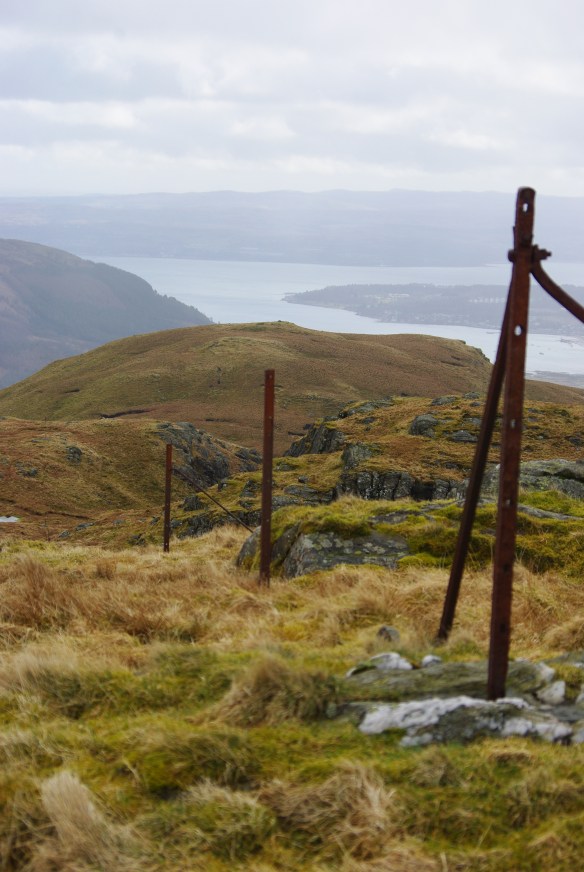
old fence, Holy Loch in the background

I read this today (courtesy of Minimergent)

Askesis

Spirituality requires context. Always. Boundaries, borders, limits. ‘The Word became flesh and dwelt among us.’ No one becomes exalted by ascending in a gloriously colored hot-air balloon. Mature spirituality requires askesis, a training program custom-designed for each individual-in-community, and then continuously monitored and adapted as development takes place and conditions vary. It can never be mechanically imposed from without; it must be organically grown in locale. Askesis must be context sensitive.

Eugene Peterson

Under the Unpredictable Plant

I have been asking myself whether I agree with this- whether it is only possible to make a spiritual journey within defined boundaries. Because I suppose that defined boundaries in this case could also be described as ‘religion’.

My thought so far is that Peterson is probably right- it is just that I prefer my boundary fences to be like the one above- present in symbolic form mostly, used as a guide when the mist comes down but for the most part a set of posts that I can meander in and out of whilst looking towards the big picture beyond.

Lamenting…

sad-woman

I was thinking about the world Lament the other day.

‘Laments’ are one of the oldest forms of poetry, for example the Mesopotamian city laments such as the Lament for Ur.  These bear a striking similarity with many of the psalms in our oldest hymn book (pinched from the ancient Hebrews) otherwise known as the book of Psalms. Here are few;

You have taken my companions and loved ones from me;  the darkness is my closest friend.

Psalm 87/88: 18

And even now that I am old and grey, do not forsake me, O God…

Psalm 70/71: 18

The LORD is close to the brokenhearted; he rescues those who are crushed in spirit.

Psalm 33/34: 18

My days are vanishing like smoke … my heart is withered like the grass. I forget to eat my bread…

Psalm 101/102: 3-4


Out of the depths I cry to you, O LORD; O Lord, hear my voice. Let your ears be attentive to my cry for mercy…

My soul waits for the Lord. More than watchmen wait for the morning.

Psalm 129/130: 1, 6

Around one third of the Book of Psalms is written in the form of poetic lament- a cry to God for help in times of distress- help for individuals, but particularly help for the Nation. And, it is recorded, sometimes he listened. At other times he turned his face and watched his chosen people be destroyed by internal wrongdoing and external invasion.

What can we learn from these Laments? How is it that we tend to ignore them in our readings of the Bible- in our claims on a God who gives good things to we his new Chosen People?

I think we can take the idea that it is OK to cry to God in desperation, in anger, in brokenness- that these are part of all of our human journeys.

I also think that we can not believe that God is any kind of talisman for us to wear against the winds of misfortune. It is not whether hard times come, but how we learn to live with love as we move through them.

Finally I think that our approach to the Bible as a set of heavenly testable propositions is severely challenged by the poetry of lament. If the Bible gives all the answers that we need (as long as we apply the correct theological set of goggles) then how come it is written by people who seemed so bereft of answers themselves?

Many (but not all) the poems of Lament in the book of Psalms take a deliberate turn at their end. In spite of all the evidence to the contrary; in spite of the pain, the defeat, the failure of plans and the death of dreams; in spite of all of this- I will worship. I will put myself in the place of trust.

In Emmanuel. God with us. God in us. God through us and God beyond us calling us on.

Asylum…

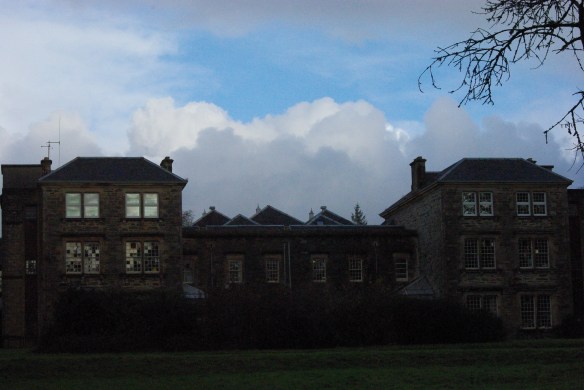
Argyll and Bute hospital 3


Something I wrote for a Greenbelt event a couple of years ago- which came back to me recently when discussing brokenness. Originally it was written to make comparisons between organised church and psychiatric care.

There was a concern in the land

In every town the roads were lined with beggars

There were homeless orphans and widows cast out onto the streets

Lunatics were stoned by children

And melancholics drowned their sorrows with gin

The pain of it all was in the middle of us

The Jesus in the least of these

Was weeping


So the good people gathered

“What is needed” they said “Is asylum.”

A safe home where broken people can live out their lives in care-

Protected from all of the mess of life,

Fed and warm and watered.

So money was gathered

Stones were shaped and raised

Staff were retained and clothed in starched clothing

-The heavy doors were opened wide in welcome


And so they came- the halt, the sick, the lame

The motherless and the pregnant child

All those broken by worry and grief

The shakers and the mutterers

All the awkward squad

The outsiders now came inside

They were home at last
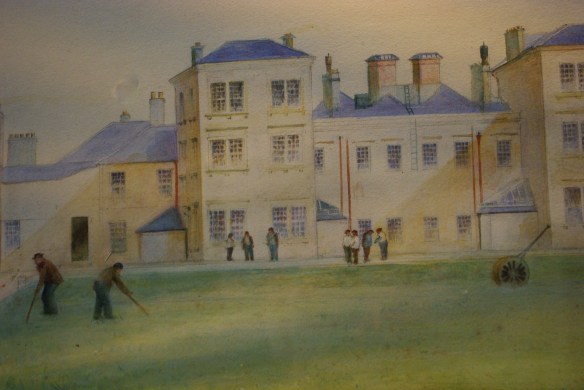
old painting, Argyll and Bute hospital grounds


It went well for a while

All was orderly and planned

Starved frames filled out

Songs were sung again in the entertainment hall

Gardens were laid and tended

Sheets danced in the evening sunlight

And a bell rang out to warn of the dowsing of night candles


But time passed, and shadows fell

Budgets were tight, and the paint peeled on windows

The good folk who had once been so generous had other calls on their coin

A few still visited on feast days but for the most part

Out of sight became out of mind.
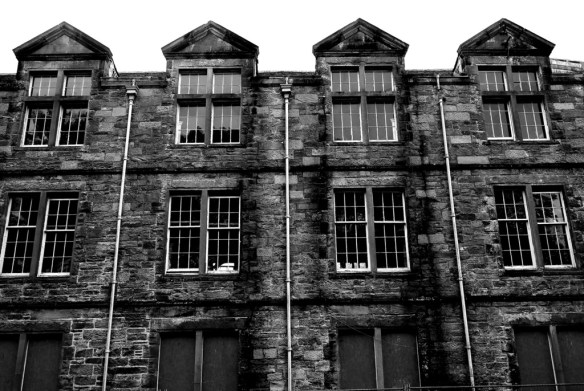
uniformed building


And there was trouble

The awkward squad was still awkward

The asylum split into ‘us’ and ‘them’


‘We’ had roles- uniforms and clipboards, rotas and registers

Big bunches of keys danced at our belts

We had dreams- of advancement, romance and families

We had homes away from this home


‘They’ stood the other side of our desks

Dirty and lacking in motivation

Ungrateful and manipulative

Un co-operative with our assessments

Lacking insight into the nature of their dysfunction.

They had ceased to be like us

Rather, they lived out regulated half-lives

They ceased to be flesh

And became instead a collection of paper

In manila folders
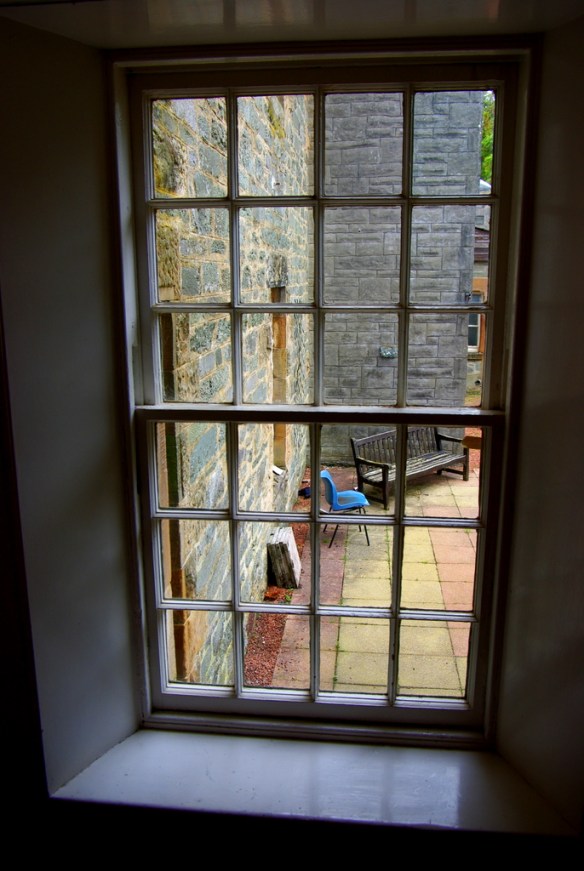
listening

Despite all the material provision- something was missing

Despite all the person centred plans, the person was not at the centre

Despite the close press of humanity, there was no family

Despite all the risk assessments, there was no adventure

Despite all the planned activity, there is no purpose

Despite the safety of the high walls, I am still destroyed


So it was that care became captivity

Individuals became invisible

And home became hollow

And toxic

While Jesus in the least of these

Was weeping
locked door

Kierkegaard on poetry…

brazen bull

Soren Kierkegaard had this way of throwing stories into the middle of his philosophising. Here is one of them;

What is a poet?

An unhappy man who in his heart harbours a deep anguish, but whose lips are so fashioned that the moans and cries which pass over them are transformed into ravishing music.

His fate is like that of the unfortunate victims whom the tyrant Phalaris imprisoned in a brazen bull, and slowly tortured over a steady fire; their cries could not reach the tyrant’s ears so as to strike terror into his heart; when they reached his ears they sounded like sweet music.

And men crowd around the poet and say to him, “Sing for us soon again”—which is as much as to say, “May new sufferings torment your soul, but may your lips be fashioned as before; for the cries would only distress us, but the music, the music, is delightful.

Kierkegaard is describing something that most familiar- art arising from introspection, sensitivity, dysfunction, hurt. Art that does not heal, but rather is a plaster over an open wound.

Poetry like this has no choice but to be written. You might as well tell a cut to stop bleeding.

Hmmm.

Creative breaks…

IMGP3342

Work is progressing on our second B and B room (although this is a photo of the first!)  Just carpets and curtains to sort out now, and then we can get everything put together.

We are hoping to offer some weekends of themed ‘creative breaks’ over the next few months. These will be a chance to escape to lovely Dunoon and make something beautiful. It is amazing what we can achieve when given space to do so. This bowl was made by Issy in our pottery a couple of weeks ago, on her second ever attempt at moulding clay;

IMGP3544


The idea is that we will be setting out a list of creative weekends people can book in for, but also guests in the B and B, or our holiday cottage, will be able to get creative too- making some pots, or a range of other activities.

More info to come!