The new rise of Communism?

I am interested in ideas. I think they can change everything and that perhaps above all, we live in a time when ideas are desperately needed otherwise how will anything change?

The Bible is the best selling book of all time- we all know that. But how about the second best selling book? It might surprise you to know that it is this one;
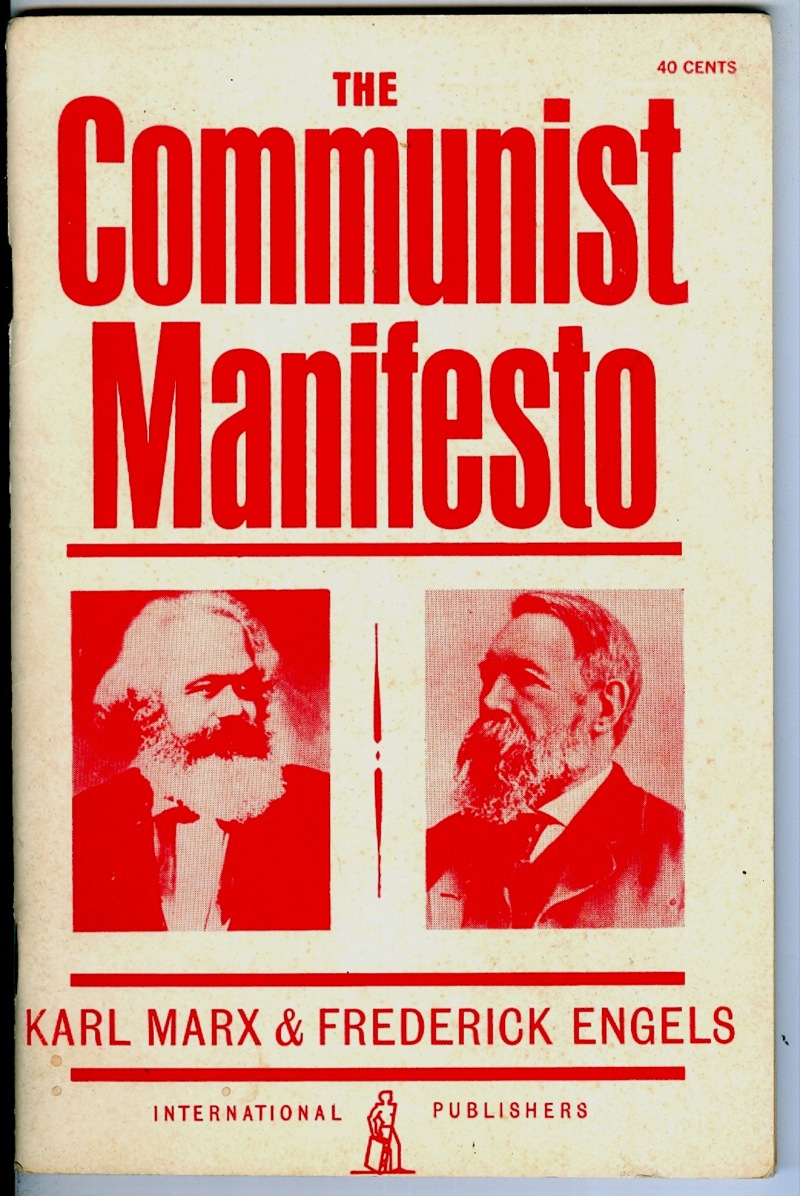
There is an irony in measuring the success of political or theological ideas by the sales of their sacred texts, but nevertheless the permeation of these ideas into the consciousness of modernity has been in no small part due to the  information revolution of a former age- the printing press.

Communism.

Socialism.

I am aware that to many (particularly those who read this blog on the other side of the Atlantic) these words are something close to being taboo. They are regarded as dangerous, evil words. They are also perhaps regarded as defeated words- finally overcome by the rise of the forces of light and truth (revealed in the holy form of democratic capitalism.)

This is less the case in the UK, where socialism is a political term divorced from it’s original meaning as painted by Marx and Engels. This from here;

 Socialism is defined as a mode of production where the criterion for economic production is use-value, and is based on direct production for use coordinated through conscious economic planning, where the law of value no longer directs economic activity, and thus monetary relations in the form of exchange-valueprofitinterest and wage labour no longer operate. Income would be distributed according to individual contribution. The social relations of socialism are characterized by the working-class effectively controlling the means of production and the means of their livelihood either through cooperative enterprises or public ownership and self management, so that the social surplus would accrue to the working class or society as a whole.

Marx saw socialism as the inevitable consequence of greed, oppression and unfair distribution of the power and assets within post agricultural societies. He thought that the tensions created were so great that change was inevitable.

Except that it did not quite work out like that did it?

However the story of Communism is not over. There is a fascinating article in the Guardian entitled ‘The return of Communism’;

Today, 164 years after Marx and Engels wrote about grave-diggers, the truth is almost the exact opposite. The proletariat, far from burying capitalism, are keeping it on life support. Overworked, underpaid workers ostensibly liberated by the largest socialist revolution in history (China’s) are driven to the brink of suicide to keep those in the west playing with their iPads. Chinese money bankrolls an otherwise bankrupt America.

The irony is scarcely wasted on leading Marxist thinkers. “The domination of capitalism globally depends today on the existence of a Chinese Communist party that gives de-localised capitalist enterprises cheap labour to lower prices and deprive workers of the rights of self-organisation,” says Jacques Rancière, the French marxist thinker and Professor of Philosophy at the University of Paris VIII. “Happily, it is possible to hope for a world less absurd and more just than today’s.”

That hope, perhaps, explains another improbable truth of our economically catastrophic times – the revival in interest in Marx and Marxist thought. Sales of Das Kapital, Marx’s masterpiece of political economy, have soared ever since 2008as have those of The Communist Manifesto and the Grundrisse (or, to give it its English title, Outlines of the Critique of Political Economy). Their sales rose as British workers bailed out the banks to keep the degraded system going and the snouts of the rich firmly in their troughs while the rest of us struggle in debt, job insecurity or worse.

We stand on the brink of something new.

What shapes this new thing will be an amalgam of political and economic vested interests, expediency and (just perhaps) the power of the idea. Ideas of course can be dangerous and Communism, with its appeal to the highest moral human purpose, might well be the most dangerous of all. But much of what is in there might be regarded as a natural progression of the teachings of Jesus. C S Lewis called Communism ‘a Christian heresy’ after all.

But what form might these ideas have to carry us forward?

One of the ‘full stops’ to any debate about Communism that I have heard is this one- it can never work, because of basic human nature. We will only work for our own advantage. Without the possibility of the accumulation of individual wealth, even at the cost of others, human society will naturally degenerate and wither into unproductivity.

This is such a depressing idea- that despite the odd individual expression of selfless altruism, humanity is essentially greedy, self serving and only motivated by gaining ascendency over the other. Jesus had a few words to say about this I think.

What other forms of human productivity and exchange might form the currency between us? The Zeitgeist movement have had considerable discussions already about the possibilities of societies without money. However, some of the Communist analysis of the economic processes that have fuelled our current crisis has centred around the ‘Law of Value’;

In his formidable new tome Less Than Nothing: Hegel and the Shadow of Dialectical Materialism, Slavoj Žižek tries to apply Marxist thought on economic crises to what we’re enduring right now. Žižek considers the fundamental class antagonism to be between “use value” and “exchange value”.

What’s the difference between the two? Each commodity has a use value, he explains, measured by its usefulness in satisfying needs and wants. The exchange value of a commodity, by contrast, is traditionally measured by the amount of labour that goes into making it. Under current capitalism, Žižek argues, exchange value becomes autonomous. “It is transformed into a spectre of self-propelling capital which uses the productive capacities and needs of actual people only as its temporary disposable embodiment. Marx derived his notion of economic crisis from this very gap: a crisis occurs when reality catches up with the illusory self-generating mirage of money begetting more money – this speculative madness cannot go on indefinitely, it has to explode in even more serious crises. The ultimate root of the crisis for Marx is the gap between use and exchange value: the logic of exchange-value follows its own path, its own made dance, irrespective of the real needs of real people.”

Is it really possible to value products by the labour that goes into making them?

And can we really disentangle the financial system that appears to have taken on a life of it’s own, a bit like Frankenstein?

Whatever the horrors that ideas like Communism may have unleashed in the past, I still hope that ideas will emerge that  will be a path that people can travel again.
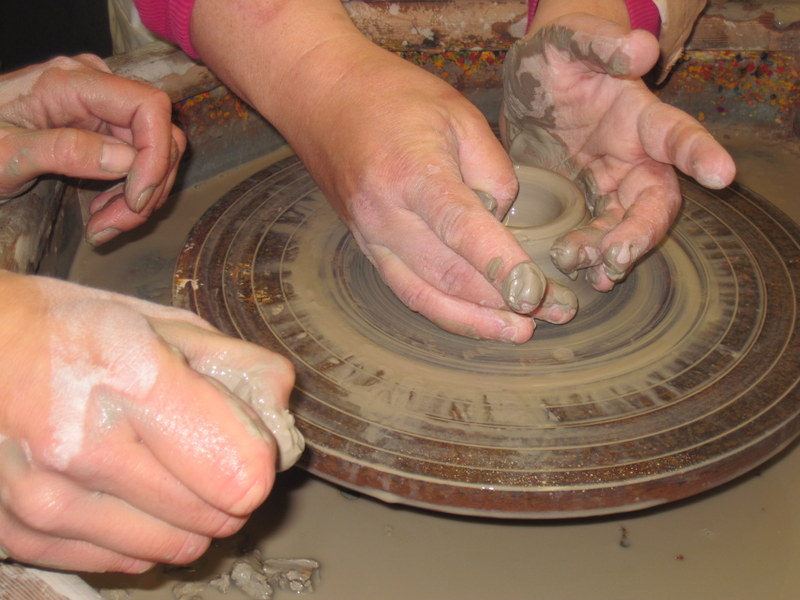
Pottery workshops, Sgath an Tighe…

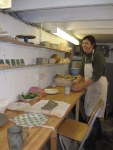
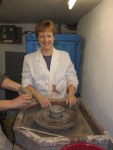
Last night Michaela and Pauline led the first workshop in the pottery in the cellar of our house.

It is really exciting to see this space coming alive- and to see beautiful objects being shaped out of what are essentially lumps of mud. Last night people spent some time at the potters wheel, and also made a slip decorated cake plate. Results were very impressive for first time potters!

Over the next few months we intend to spend time developing part of the old house into Bed and Breakfast, but already we have self catering accommodation available in our cosy annex.

If you are considering a break in Scotland, perhaps it might be worth combining this with some potting? We can tailor a residential potting experience!

If you contact us via our website, mention this blog and you will be eligible for a discount!

For locals, there are details of Michaela and Pauline’s craft courses here.

A few more photos from last night;

Reflecting on the life of small ‘missional’ groups…

The Christian group that I am part of, Aoradh, is now about 7 years old.

We are due to speak at Greenbelt Festival this year about our experience in a session entitled ‘Don’t do it like us; making community in uncool places’. Despite the faux-humble tone of our title, it still feels very bombastic to be speaking about Aoradh in such declarative fashion.

Planning what we will say does start to focus the mind on what we hold precious however, and also brings to light those rather tender areas of our small group where there are wounds and vulnerabilities. We have had a little reminder of this recently- issues that flare and fester for a while, which can be very painful. They can also be the end of small groups based essentially on friendship and shared passion; there have been several points over the years at which Aoradh could have ended.

Despite the pain of this, I have come to see these tensions as above all- normal, inevitable.

The deep friendships that we value so highly within our community will always mean a suspension of defences, and perhaps a tendency to reveal some of our less attractive personality traits which pop out under pressure.

Then there are all the group processes that you have to work out; leadership, facilitation, communication, agreeing principles, organising your business, looking after those who are on the edge. I confess to avoiding some of the theory of how all of this works- there is of course a whole industry looking at group dynamics. The idiosyncrat in me wants to flee from the regimented check list nature of this kind of thing.

But we can always learn from the experience of others- that is why we are doing the Greenbelt talk/discussion session after all.

A few years ago I read a couple of M Scott Peck’s books, including the surprisingly wonderful ‘A different Drum; community making and peace’.  Surprisingly because I read it reluctantly- I had pegged it as new-age-psychobabble-pop psychology-nonsense. What Peck does though is to give a passionate analysis of the group as the highest form of what we humans are. He describes community building like this;

  • Pseudocommunity: In the first stage, well-intentioned people try to demonstrate their ability to be friendly and sociable, but they do not really delve beneath the surface of each other’s ideas or emotions. They use obvious generalities and mutually-established stereotypes in speech. Instead of conflict resolution, pseudocommunity involves conflict avoidance, which maintains the appearance or facade of true community. It also serves only to maintain positive emotions, instead of creating safe space for honesty and love through bad emotions as well. While they still remain in this phase, members will never really obtain evolution or change, as individuals or as a bunch.
  • Chaos: The first step towards real positivity is, paradoxically, a period of negativity. Once the mutually-sustained facade is shed, negative emotions flood through: Members start to vent their mutual frustrations, annoyances, and differences. It is a chaotic stage but Peck describes it as a “beautiful chaos” because it is a sign of healthy growth. I would add that many groups do not survive this stage, and at least, many people will leave.
  • Emptiness: In order to transcend the stage of “Chaos”, people are forced to communicate. Things that get in the way of communication are forced aside, or at least forced out into the open-  need for power and control, self-superiority, and other similar motives which are only mechanisms of self-validation and/or ego-protection, must yield to empathy, openness to vulnerability, attention, and trust. Hence this stage does not mean people should be “empty” of thoughts, desires, ideas or opinions. Rather, it refers to emptiness of all mental and emotional distortions which reduce one’s ability to really share, listen to, and build on those thoughts, ideas, etc. It is often the hardest step in the four-level process, as it necessitates the release of patterns which people develop over time in a subconscious attempt to maintain self-worth and positive emotion. For Peck, it should be viewed not merely as a “death” but as a rebirth — of one’s true self at the individual level, and at the social level of the genuine and true Community.
  • True community: Having worked through emptiness, the people in the community enter a place of complete empathy with one another. There is a great level of tacit understanding. People are able to relate to each other’s feelings. Discussions, even when heated, never get sour, and motives are not questioned. A deeper and more sustainable level of happiness obtains between the members, which does not have to be forced. Even and perhaps especially when conflicts arise, it is understood that they are part of positive change.

Any of you who are frustrated in organised church (as I have been) will recognise immediately the fact that most churches are pseudocommunities. All that politeness and veneer of respectability. Any conflict is immediately suppressed by the paid leaders, and it is possible to be entirely anonymous and disengaged in these places. To be fair there are many that like it this way, but to me it was a kind of death.

Has Aoradh achieved Pecks kind of true community? Sometimes I would say yes, other times emphatically no. Because I am not sure that the formation of community is actually a LINEAR process like this. Circumstances change, different people join the group then leave. Rather community is something that ebbs and flows, sometimes becoming constrictive and even boring, at other times full of creative energy and passion.

Peck also wrote of list of what he saw as characteristics of true community. These I like more, as they are less mechanistic and more inspirational;

  • Inclusivity, commitment and consensus: Members accept and embrace each other, celebrating their individuality and transcending their differences. They commit themselves to the effort and the people involved. They make decisions and reconcile their differences through consensus.
  • Realism: Members bring together multiple perspectives to better understand the whole context of the situation. Decisions are more well-rounded and humble, rather than one-sided and arrogant.
  • Contemplation: Members examine themselves. They are individually and collectively self-aware of the world outside themselves, the world inside themselves, and the relationship between the two.
  • A safe place: Members allow others to share their vulnerability, heal themselves, and express who they truly are.
  • A laboratory for personal disarmament: Members experientially discover the rules for peacemaking and embrace its virtues. They feel and express compassion and respect for each other as fellow human beings.
  • A group that can fight gracefully: Members resolve conflicts with wisdom and grace. They listen and understand, respect each others’ gifts, accept each others’ limitations, celebrate their differences, bind each others’ wounds, and commit to a struggle together rather than against each other.
  • A group of all leaders: Members harness the “flow of leadership” to make decisions and set a course of action. It is the spirit of community itself that leads and not any single individual.
  • A spirit: The true spirit of community is the spirit of peace, love, wisdom and power. Members may view the source of this spirit as an outgrowth of the collective self or as the manifestation of a Higher Will.

Is this Aoradh? My heart says YES.

My experience says it is the best of what we are, but it is not all that we are.

However, this too is normal. If we are moving towards the light through many dappled shades of darkness, then why would we not expect the same from ourselves in the collective? What Peck remind me of however, is that our groups have the capacity not to be just the sum of the parts within them– they are far more than just a gathering of individuals in one place. Rather they are the place of becoming.

They are not places where conflict is tolerated and excused as somehow ‘developmental’, rather places where conflict is understood and wounds are healed. It is a major distinction.

The writer of the Psalm 133 understood this.

How good and pleasant it is
when God’s people live together in unity!

It is like precious oil poured on the head,
running down on the beard,
running down on Aaron’s beard,
down on the collar of his robe.
It is as if the dew of Hermon
were falling on Mount Zion.
For there the Lord bestows his blessing,
even life forevermore.

A Very British Tale…

My mate Mark has written a book

Mark and I were student housemates together back in the 1980’s but he lives in the Rhondda valley in Wales, a long way from Scotland, so we have not been able to see much of each other over recent times. It has been great to meet up at Greenbelt festival recently though.

Back to his book. If you like fantasy fiction, and are a bit of a royalist then this might be the one for you (Audrey!) Here is Mark’s blurb-

Come on a journey that will take you to the very heart of a secret adventure. An adventure so secret it should not be made public. ‘A Very British Tale’ brings together ancient folklore, a thousand year old Royal Family and mystical magic; and sets it all firmly in the 21st Century.
This story tells of how Kate, the Duchess of Cambridge, hides a dark family curse that turns her into a strange flying creature. In order to break the curse Prince William and Prince Harry must face an adventure that will take them to the four corners of the United Kingdom. This heroic tale involves princes and knights and trolls and dragons – even the Loch Ness Monster makes an appearance. Secret Agents, King Arthur and a Welsh Rock Star all play their part in helping the young princes in their quest to break the age old curse.

Mad!

Fun though…

Is God violent?

It is a question I was discussing with a friend last week. She, like me, comes from a background in which the stories of the Bible were regarded as unquestioned absolute fact. The problem is that as you start to take a look at some of these stories, you start to hope that they are not.

But if they are not, then the absolutes that faith has been built from start to come unravelled- if you pull at these bricks the whole wall will fall in.

I wrote a series here called ‘Bible Nasties’ in which I tried to explore some of the issues that arose from my own theological meanderings. You can catch the first one here, and the others via the links in the comments.

However, Brian McLaren does it much better in this article here. Here are a couple of quotes;

Let’s define violence simply: force with the intent of inflicting injury, damage, or death. I think believers in God have four primary responses to the question of God’s violence defined in this way:

1. God is violent, and since we human beings are made in God’s image, we’re free to use violence as one valid form of political communication (to borrow a famous phrase from Carl von Clausewitz), and in fact we are commanded to use it in some cases.

2. God is violent, but in a holy way that sinful humans are incapable of. That’s why violence is generally prohibited for humans except in certain limited cases. In those cases, only those designated as God’s chosen/elect/ordained, acting under God’s explicit direction, are justified in using violence.

3. God is not violent, so human violence is always a violation of our creation in God’s image — both for the perpetrator and the victim. If it is ever employed, it is always tragic and regrettable, never justified.

4. God is not violent, so violence in any form is absolutely forbidden, no exceptions.

McLaren goes on to describe his own struggles with this issue- how the violent version of God contrasts with the other version in the pages of the Bible- the loving, forgiving, self sacrificing one, who eventually casts himself as the victim of violence, not the originator of it. Which version is the truest one, because increasingly it becomes impossible to hold them both together.

McLaren points us to Jesus, and along the way, we again bump into how we understand attonement;

In my own grappling with this subject, a single question has brought things into focus for me: Where do you primarily find God on Good Friday?

If God is primarily identified with the Romans, torturing and killing Jesus, then, yes, the case is closed: God must be seen as violent on Good Friday. The cross is an instrument of God’s violence.

But if God is located first and foremost with the crucified one, identifying with humanity and bearing and forgiving people’s sin, then a very different picture of God and the cross emerges.

Both locations present a scandal. The former, it seems to me, subverts the entire biblical narrative. God is not then identified with the slaves seeking freedom, but with Pharoah keeping them in their place. God is not with the woman caught in adultery, but with those who want to stone her. God is not with Paul, accepting Gentiles as sisters and brothers, but with the Judaizers, upholding the Law. And God is not hanging on the cross, but stooping over it, pounding in the nail. That’s scandalous in one way.

The latter understanding subverts violence and all those who depend on it for their security, affluence, and happiness. God is with the slaves, not with the slave-drivers. God is found in the one being tortured, not the ones torturing. God is found among the displaced refugees, not those stealing their lands. And God is found in the one being spat upon, not in the one spitting. A very different scandal indeed — and a very different cross, with a very different, but no less profound, meaning.


The trees of the field shall clap their hands…

Part of some poetry I am working on for Greenbelt festival

The air is harrowed by the song of birds

Each note a spore

Lighting upon the curl of some fertile ear

And the trees of the field clap their hands


The earth exhales

No longer held in the clamp of winter

Breath misting the day into rainbows of light

And the trees of the field clap their hands


Last year’s leaves fell not in vain

Digested as they are by a subterranean stomach

Burping out it’s appreciation

And the trees of the field clap their hands

Raw…


I am sometimes so sick of the me

I wish I would just go away

I wish that the skin that I’m in would fall off

And the bones would go somewhere and stay


I should stay far from the you

It really is better that way

The sight of me stripped of my skin and my bones

Is a gruesome revolting display


Time, almost always on our side…

Or at least it was today.

We have had a busy weekend- yesterday we took William to play in the finals of a Gaelic school football competition in Fort William. This involved a 2-3 hour drive through Argyll and into the big mountains. It was a wet day yesterday, and the clouds boiling around the high rock walls of Glen Coe were stunning. Will’s side did OK, but football is not his sport really.

Today we spent the morning in the garden, the afternoon playing cricket and the evening walking the beach. Mmmmm.

But back to the time thing- Michaela and I were talking about all the busyness that we are in the middle of- creating a new income, keeping all the family things going and planning new things with Aoradh. Practically speaking, there is far too much to do.

We hear it everywhere- busy busy busy. This is partly because in our society everything does go so fast- we are conditioned to run hard on the hamster wheel. However I think it is also because we are caught in the trap of believing that the only valuable time involves stress. This is revealed in the fact that it is almost a thing of shame to admit we are NOT busy. All this frenetic activity in the service of- what?

There is no life without stress. But there is much stress without purpose.

I have this theory about time- less about physics, more to do with the human condition. I am convinced that time can be stretched into the shape of what you really love. There are of course limits to the elasticity – eventually the break may come – but on the whole we always have time to chose to do those things that we love.

And there is no shame in learning how to be a human be-ing.

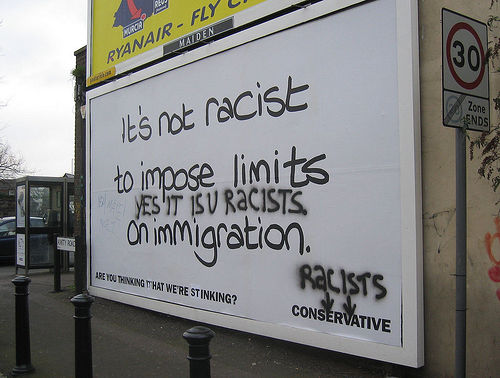
When does concern about immigration become racism?

Today, the Limp Lettuce Leaf that heads up the opposition in our parliament spoke out.

Not against injustice, overconsumption, unsustainable lifestyles- he spoke about immigration.

In an interview with the Guardian, he concedes that immigration is being discussed in “every kitchen” and that the Labour party has been too quick to dismisses the concerns of ordinary people as “prejudice”.

He says the government should strengthen the law so that employment agencies cannot – even informally – favour foreign workers.

He was at pains to suggest that the former labour government had got it wrong on immigration- that it had ‘let too many people in’. This from the son of an immigrant- his mother, Marion Kozak (a human rights campaigner and early CND member) survived the Holocaust thanks to being protected by Roman Catholic Poles. His father, Ralph Miliband, was a Belgian-born Marxist academic, who fled with his parents to England during World War II.

With this in mind, perhaps we might take a moment to reflect on the fact that in the middle of just about every renewal and innovation in our society has always been the incomer- the outsider seeking to make good. At the middle of industry, and at the centre of our professional groups.

Also of course, doing all the jobs we do not want to do, and in times of economic success, refuse to do.

To be fair to the Leaf, if and when he does speak out on issues of justice no one listens, but when he speaks out like this he is at the top of every news bulletin.

But our kitchen has hosted no debates over immigrant labour of late- has yours?

If it did however, I might find myself suggesting that the reason why so many Eastern European people, or so many Asian people, come to this country is very simple- economics. Our lifestyle is based in the need to sustain huge inequality, some of which was enforced at the point of an imperialist bayonet. The shadow this casts is over a dozen generations or more.

In the Eastern European case however, the opening up of the borders in the European Union did indeed cause a large movement of migrant workers far beyond what was expected. Working people in some cases were simply priced out of the market as workers from the East were cheaper, and willing to work long hours.

In the past this would not have been possible, because of something called Trade Unions. But we more or less neutralised them in the name of free market economics.

So- when does concern about immigration become racism? Remember the famous spat between Gordon Brown and the redoubtable Gillian Duffy? Was she a bigot as he famously was heard calling her?

The answer of course, is probably not- but at the same time, maybe we have to acknowledge there is something about our society that is instinctively hostile to the outsider, or the other. When this becomes part of our politics, it gets ugly very quickly and the victims are usually those with the least power.

Particularly during an economic downturn- when we have the need for a scapegoat.

If the Leaf should visit our Kitchen, we can discuss it in more detail.