A time to gather stones, and then to scatter them…

I received a lovely thing today. One of our guests over the weekend left behind a gift for both Michaela and I.

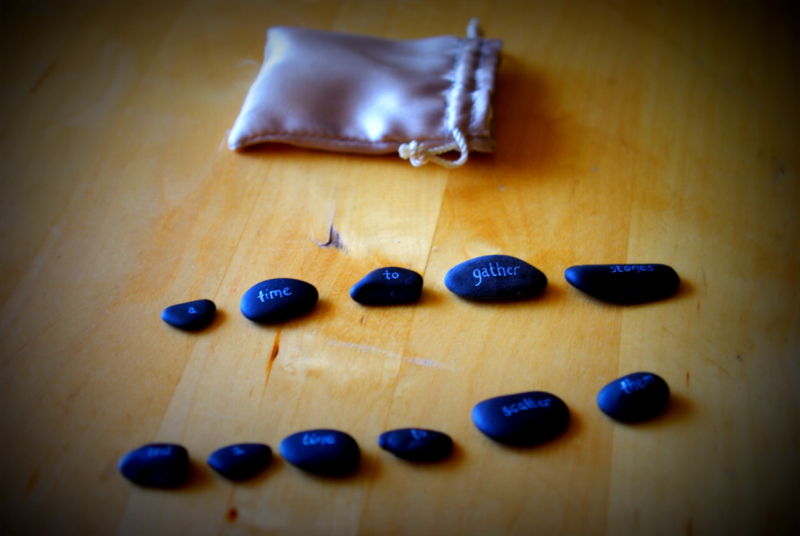
Mine was a little bag full of tiny black stones, each one with a word in tiny writing.

When you put the sentence together, it read

…a time to gather stones and a time to scatter them…
The words of course, are from Ecclesiastes chapter 3. This is a special chapter for me, as I spent a very creative time writing a series of poems based around it, which became part of ‘Listing’.

At present, I am wondering whether I am gathering stones, or scattering them.

In some ways, I am building- all the plans we have for different ways of making a living. In other ways, it feels as if I am taking hold of a handful of stones and throwing them in the air, waiting to see where they all land.

It made me return to those old poems I had written. It is a strange thing to do, as they arise very much in the moment, and so to consider them anew is difficult. The one that impacted me was this one;

A time to gather

There is a time for all things under heaven…

There’s a murmur and mutter of holy unrest
They’re coming
So look to the north, the east and the west
They’re coming

Fools now wise in the way of the One
Captives unchained, once more on the run
Broken people splinted and cast
Winners now all prepared to be last

Sick folk nursed and discharged
Narrow people with lives now enlarged
Bitterness sweetened and ready to serve
Unworthy who get more than they deserve

Useless people ready to be used
The inexcusable being excused
The unstable stop up-and-downing
Depressives learn to start clowning

Sensitive souls softened to others
Orphans find fathers and mothers
The outsiders will sit by the fire
The lazybones now never tire

The tuneless will learn how to sing
The lame will dance Highland fling
The childless will learn how to mother
The selfish will favour the other

The talentless learn brand new skills
Megalomaniacs surrender their wills
Soldiers lay down the gun
The miserable start to have fun

~

Angry folk fit a long fuse
Drinkers will give up the booze
Sinners like me will no longer be
And the faithless will spiritually see

The becoming of God are flowing together
For now is the time
To gather

When I wrote this, it was a poem of yearning. A few years down the line, despite the battering taken from the ups and downs of community it is still there.

One of the challenges for sensitive damaged souls like me is the tendency towards isolation. I believe that community should be our goal and our aim, in spite of our experience of community.

I was grateful for the gift, and for the little slice of community- thanks Raine!
What money can’t buy…

There was a great debate on the radio this morning, involving the author of this book, Michael Sandel;

It is well worth a listen, on this link. In fact I would say more, if you have an interest in stepping aside from the Capitalist rut we find ourselves in it is essential reading! Here is the blurb;

On Start the Week Andrew Marr discusses the relationship between markets and morals with the political philosopher Michael Sandel. In his latest book, What Money Can’t Buy, Sandel questions the dominance of the financial markets in our daily lives, in which everything has a price. But the economist Diane Coyle stands up for her much maligned profession, and points to the many benefits of a market economy. The Russian economist Grigory Yavlinksy argues against viewing the world of money as separate from culture and society: he believes the financial crisis was merely a symptom of a wider moral collapse, and that it is time to examine the way we live.

In many ways this is the debate I have been hoping for. The papers are full of doom about the terrible state of the economy, and our politicians seem to have only one solution- austerity. Cut public spending, cut taxes, create wealth for a few, because greed once again is our only salvation. Those who suffer under this regime will be those who always suffer- the poor, the weak, the sick, the broken.

As well as a lack of alternative political/economic thinking, what is also entirely lacking is a spiritual/moral dimension to the debate. Here is Sandel again;

The (dis)armed man…

Michaela and I went to see The Armed Man last night- a mass for peace written by Karl Jenkins, performed by the Cowal Choral Society, along with the Glasgow Concert Orchestra, with powerful moving images of war and suffering projected throughout. It made me think deeply about violence- something that spreads like bird flu- received then given, and just as you think it is over, it breaks out again.

It was a deeply moving end to a lovely weekend.

We had some guests in our annex, and ended up playing instruments and singing into the small hours on Saturday, as they were a musical bunch- Yvonne, and her lovely friends Alison and Raine.

My fingers get very sore after playing guitar these days as they have softened with lack of use- it reminded me that I should play more often, or lose something that is precious to me.

Which will unfortunately have to wait- I was playing cricket yesterday and was hit by a ball on the tip of finger, which despite my batting gloves is now swollen to slightly resemble that of ET. It was a great game though- we lost again, but both Will and I made contributions to a decent effort (15no and 20 respectively with a wicket apiece.) Our star batsman of the day had to retire when his hamstring twanged as he smashed 50 odd then tried a quick single.

All weekends should be like this. Here is a bit of Yvonne’s music to point us to the week ahead;

There is a light…

I just watched this advert, and it caused my glasses to mist a little…

I know- it is carefully calculated clever manipulation to make me buy insurance. The ‘Hiscox values’ made clear to build a ‘customer base’.

But I misted because of the glimpses of humanity, or the glimpses of grace. The possibility that we were indeed made in his image.

So even if I am being sold a carefully researched and focus grouped ideal, good for you Hiscox.

Although to be honest, I am not about to buy any insurance. Michaela told me that we tried to insure our annex with Hiscox, and they would only do so if we took in no one on benefits.

Goodness is not without economic compromise in the world of risk and loss and big business it seems.


All manner of things shall be well…

I have been working on a song today. I used to write songs a lot, but stopped (unsurprisingly) when I no longer sang as much.

It forced me to return to rhyme, which I am usually glad to put aside when I write poetry.

I was thinking about those words of Julian of Norwich– All shall be well, and all manner of things shall be well. The theology behind these simple words is highly complex. Despite living in a time of the the Black Death, which religious people saw as the just punishment of a wrathful God because of the sin of the people, she chose to believe in love and hope. Interestingly, in our times when the theological debate around Atonement is causing such conflict, Julian had some very non standard views about sin and the punishment of God. This from the Wikipedia entry;

Julian believed that sin was necessary in life because it brings one to self-knowledge, which leads to acceptance of the role of God in one’s life. Julian taught that humans sin because they are ignorant or naive, not because they are evil, which was the reason commonly given by the church for sin during the Middle Ages.Julian believed that in order to learn, we must fail. Also, in order to fail, we must sin. The pain caused by sin is an earthly reminder of the pain of the passion of Christ. Therefore, as people suffer as Christ did, they will become closer to Him by their experiences.

Similarly, Julian saw no wrath in God. She believed wrath existed only in humans but that God forgives us for this. She writes, “For I saw no wrath except on man’s side, and He forgives that in us, for wrath is nothing else but a perversity and an opposition to peace and to love”. Julian believed that it was inaccurate to speak of God’s granting forgiveness for sins because forgiving would mean that committing the sin was wrong. Julian preached that sin should be seen as a part of the learning process of life, not malice that needed forgiveness. Julian writes that God sees us as perfect and waits for the day when humans’ souls mature so that evil and sin will no longer hinder one’s life.

Here are the words so far, still listening for their tune;

In the morning when I rise
In the evening when I die
You are there

In the cloister or the gutter
In the music and the song
In the heart that breaks wide open
In the right and in the wrong
In the tear that no one noticed
In the flow of every stream
In the leaf slowly unfurling
In things seen and yet unseen

In the mist of mellow fruitfulness
Or a stinking torture state
In the stab of empty promises
And twisting with our fate
In the road as yet untraveled
In the barrel of a gun
In the plan that comes unravelled
Or the journey just begun

In the cracks of what we concrete
In the atom and the bomb
In the hope of each spring morning
In a moment too soon gone
In the Bible and the bar room
In famine and the feast
In the spaces we make for him
And where we expect him least

I am learning trust in you
For all manner of things
Shall be well
All manner of things
Shall be well


The psychology of wilderness…

The promised land always lies on the other side of a wilderness

Havelock Ellis

Many of us who love wild places constantly will describe the transformational effect of being immersed in wilderness. We may consider many subjective benefits- the lowering of our stress levels, a deeper appreciation of our place within the ecology of life, our sense of the ageless beauty of natural things.

Measuring these benefits objectively is more difficult. There are of course clear physiological advantages to exercising in the outdoors, but what (if any) psychological benefits can we point towards?

Peter Kahn and his colleagues at University of Washington have been working on this for a while- in one simple experiment  they installed plasma TV “windows” in workers’ otherwise windowless offices for a period of 16 weeks, and then took various measures of psychological function. They found that those with the “views” of parkland and mountain ranges had a greater sense of well-being, were clearer thinking, and a greater sense of connection to the natural world.

Next they compared office workers with plasma TV’s in their offices with people with real windows overlooking trees and grassland, and exposed them to mild stress- the sort that raises the heart beat- and waited to see how long it would take for them to calm down. What they found was that those with the real window calmed down quicker. The TV seemed to have no more benefit than a blank wall. If you are into reading academic papers, it is here.

What might be going on here? University of Michigan psychologist Marc Berman suggested that nature might actually shift our brain from one processing mode to another. In cities, we are constantly stimulated- so we use a more focussed analytical attention style. In this way we are able to deal with rush-hour traffic and sirens and all those other urban noises. Berman suggested that this is also the kind of attention we need to study for exams, make financial decisions, do business deals and so on.

It is also the kind of attention that we use up. It burns out, or burns us out. Berman’s theory is that being in wild places shifts the mind to a more relaxed and passive mode, allowing the more analytical powers to restore themselves. Berman too did some experiments to test his theory;

He gave a group of volunteers a very difficult mental reasoning test that measures the kind of focused attention needed for school and work. They were then given additional task to further deplete their normal ability to concentrate, to mirror a typical high pressure day at work. Then all the volunteers took a three-mile walk- half the volunteers took a leisurely stroll through a secluded park, while the others walked down a busy city street, after which the psychologists again measured their focus and concentration.

You can see what is coming- as reported in the journal Psychological Sciencethose who had been on the nature walk had significantly better focus and attention than those who had been required to negotiate the city streets. Being in nature does indeed appear to replenish our reserves of concentration and analytical attention capacity.

It also suggests that being in nature allows us to switch to a different kind of attentiveness- less focussed, more holistic and open.

There is also some interesting research about how this kind of attentiveness might affect irritability, even aggression. This from here;

The hypothesis laid out by Frances Kuo and William Sullivan of the University of Illinois was a marvel of logic and sequence: If fatigued attention is related to irritability, and irritability leads to aggression, then perhaps people deprived of nature’s restorative qualities would be overly aggressive (Kuo & Sullivan, 2001).

Kuo and Sullivan tested their premise on 145 female residents of a public housing complex in urban Chicago. The complex provided natural control and study groups: Some residents lived in buildings that overlooked “pockets of green,” while others had a view of only bleak concrete. The researchers reported significantly lower levels of aggression and violence in residents with apartments near nature than in those who looked onto barren lands. When handling disputes with their partners, women in the nature group used fewer “psychologically aggressive conflict tactics” and fewer “mildly violent conflict tactics” than those whose randomly assigned housing unit was denied exposure to nature.

So, the next time you need to undertake some kind of task think of this- if you need space, then find some.

It might do you more good than you think.

Geek worship!

I saw this via Ian Adams on FB this morning;

It is a film of a worship service in Exeter Cathedral, making use of the X-box game ‘flower’ throughout as an image of creation.

The curmudgeon in me wants to scoff at such techno-geek worship- in many ways the use of an X-box seems to me the ultimate in what some already might regard as excessively gimmick-driven alternative worship.

However, it was really lovely wasn’t it? And perhaps it is totally logical to start to use new media within our worship as it becomes increasingly part of who we are and how we interact.

Perhaps Call of Duty as an way of symbolising spiritual warfare might be a step too far though…

Leaving…

I’ll not miss your snarling e mail

Or your apparent hysteria over things instantly forgotten

The ever worming mobile phone can canker itself

Into your flesh now-

For I am leaving

~

Neither will I miss those meetings around a table

Shadowed by glooming suits where

Words land like shot partridges

The elephant can trumpet in your ear now-

For I am leaving

~

I’ll not miss those twin pincers

Of guilt and responsibility

That claw me just before dawn

My pulsing vein has a fitted valve-

Now that I am leaving

Grab yourself some great art!

My mate Si Smith is clearing out some of his lino cut prints and so you may be able to grab yourself a bargain at his Etsy store.

Apparently to get a 50% discount (although why would you want to?) enter the code BARGAINDEAL1 at Si’s Etsy store- here.

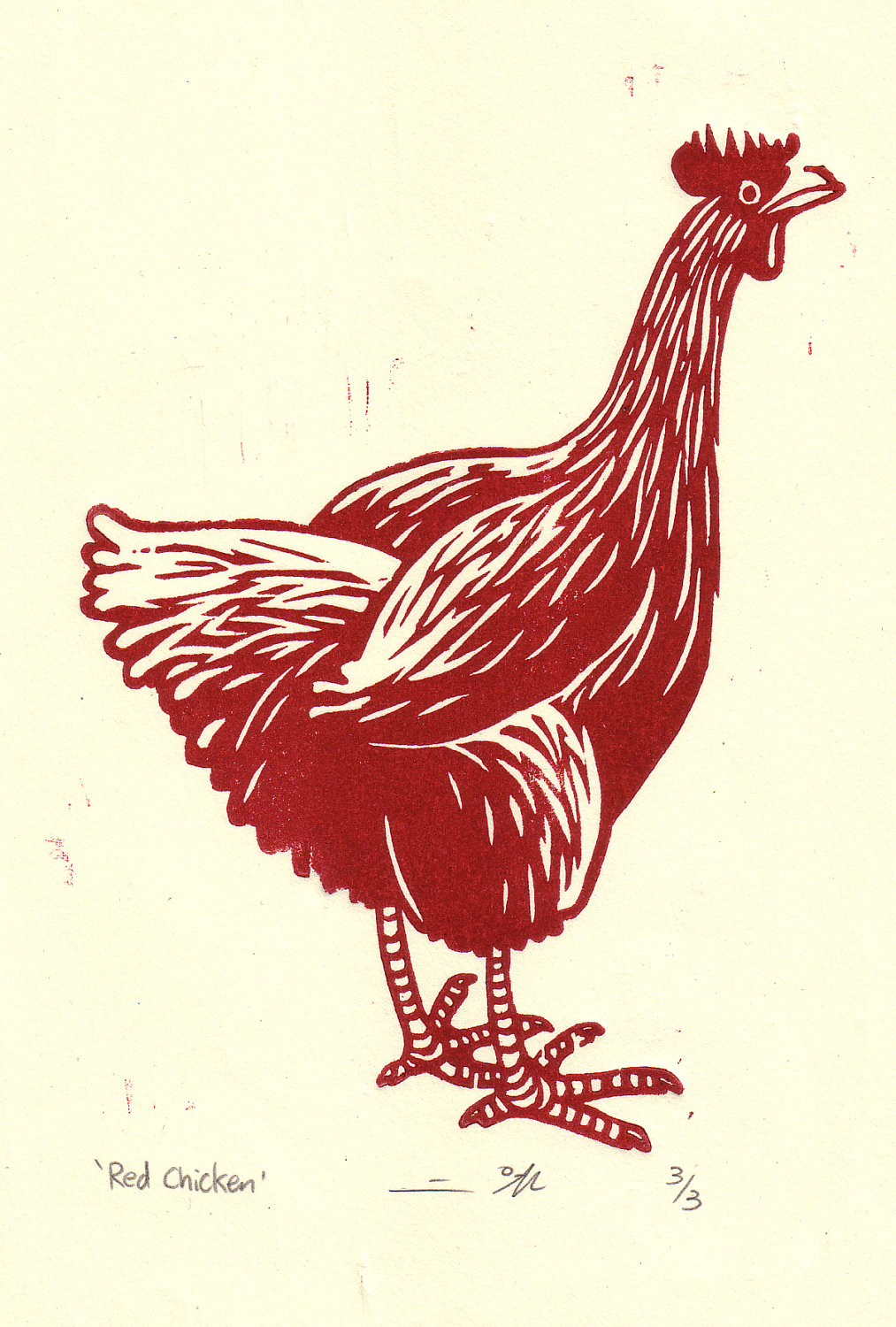
I love his work- we have a number of his prints at various parts of our house, including this one- of one of our chickens!

Passing places…

Michaela and I went to see this play last night. To be honest I had to be dragged out, half way through cutting the grass. I am increasingly a home bird these days- we have been so busy, so the idea of not using spare time to be gently busy at home always seems a waste.

However, I am glad I went- it has been a while since we have seen any live theatre. I always find that it takes time to adapt to the watching of stage acting- you have to get yourself into the characters and see the set for what it is- a cue to the imagination. This play took the idea of a road trip round lots of familiar places in Scotland, so lots of imagination was required. It raised a few chuckles too.